This is topic Nikon will stop making most film cameras in forum Film-Yak at Film-Tech Forum ARCHIVE.
To visit this topic, use this URL:
https://ft-forum.com/ft/cgi-bin/ubb/ultimatebb.cgi?ubb=get_topic;f=8;t=004441
Posted by Mark Gulbrandsen (Member # 72) on 01-15-2006, 05:01 PM:
Its sad to read about this... Consumer film cameras are quickly comming to an end.......
Link To Article
Thursday, January 12, 2006; Posted: 7:16 p.m. EST (00:16 GMT)
(AP) -- Nikon Corp., which helped popularize the 35mm camera five decades ago, will stop making most of its film cameras to concentrate on digital models.
The Japanese company said it wanted to focus on "business categories that continue to demonstrate the strongest growth" as film cameras sales keep shrinking.
Nikon will discontinue seven film-camera models, leaving in production only the current top-line model, the F6, and a low-end manual-focus model, the FM10.
It will also stop making most of its manual-focus lenses.
Most of the company's autofocus lenses work with manual-focus bodies, however. Also, German optical company Carl Zeiss AG is widely reported to be planning a line of manual-focus lenses for Nikon bodies.
Nikon did not give firm dates for the discontinuation of its products, but said Wednesday that sales will cease as supplies are depleted.
Major competitor Canon Inc. still makes five models of single-lens reflex film cameras. At the lower end of the market, Eastman Kodak Co. announced in 2004 that it would stop selling film cameras in the United States and Europe.
Nikon ranks fifth in digital-camera shipments in the United States, behind Kodak, Canon, Sony Corp. and Fuji Photo Film Co.
Nikon was a major force in establishing the dominance of the 35mm single-lens reflex camera, the workhorse of professionals and sophisticated amateurs until the arrival of digital cameras.
Its breakthrough model was the F, released in 1959. It set a standard for ruggedness and reliability and became a must-have for photojournalists.
Unusually, Nikon has maintained the same lens mount over the years, meaning most lenses from 1959 will fit today's digital models and vice versa, albeit with functional restrictions.
Posted by Steve Guttag (Member # 268) on 01-15-2006, 05:30 PM:
I still have my Nikon F2a (25th Anniversary). Wouldn't think of parting with it, nor its lenses. (28, 50 and 135)
Steve
Posted by Phil Hill (Member # 371) on 01-15-2006, 05:55 PM:
Steve, to me, that is the ***Perfect*** combo of basic 35mm film camera lenses!
I have the same!
Posted by Mark Gulbrandsen (Member # 72) on 01-15-2006, 08:58 PM:
What... you two don't have the full set?????? ![[Razz]](tongue.gif) Some days I'm not sure if I bought the VV camnera or the F-2 to be able to use use the Nikors.... OK, I bought the F-2 body after I moved out here actually.... I was a Canon fan till I started using the Nikors! 18mm to 300mm......
Some days I'm not sure if I bought the VV camnera or the F-2 to be able to use use the Nikors.... OK, I bought the F-2 body after I moved out here actually.... I was a Canon fan till I started using the Nikors! 18mm to 300mm......
Mark
Posted by Mike Blakesley (Member # 26) on 01-15-2006, 09:24 PM:
I still have a Yashica FR-1. Takes great shots but I haven't used it in a long time. So I guess this isn't a surprising development.
Posted by Steve Guttag (Member # 268) on 01-17-2006, 04:33 AM:
I still have my Canon AE-1 too...not a bad camera at all...not up to the Nikon camera and the Nikkor lenses are definately superior.
My Canon was the orginal mount with the non-locking ring...one just turned the ring to tighten it.
Posted by Mark Gulbrandsen (Member # 72) on 01-17-2006, 08:22 AM:
quote: Steve Guttag
My Canon was the orginal mount with the non-locking ring...one just turned the ring to tighten it.
All Canon camera end mounts are the same... the difference is in the mounting part of the lens. I prefer the older style lock ring like you have. If you ever use the AE-1 seriously again have the shutter curtain timming checked first. The springs get lazy and change a bit if it sits around... can cause exposure to be off.
Mark
Posted by Daryl C. W. O'Shea (Member # 1303) on 01-17-2006, 01:46 PM:
quote: Steve
I still have my Canon AE-1 too ... My Canon was the orginal mount with the non-locking ring
Me too. Still use it.
Posted by Tony Bandiera Jr (Member # 2365) on 01-17-2006, 05:55 PM:
Olympus OM-1. Still takes damn great pics!!
I use it for action shots at the mx tracks, it beats the digitals when it comes to catching fast action.
Posted by William Hooper (Member # 71) on 01-18-2006, 04:41 AM:
Nikon cutting out cameras, Kodak cutting out still film; time to go back to glass plates!
Posted by Brad Miller (Member # 2) on 01-18-2006, 06:54 AM:
Get with the program boys and get a Nikon D-100 like I have. It's quite an amazing camera and it's digital too! That of course means far superior photographs than is possible with conventional analog film which as we all know gets scratched and dirty.
Seriously though, the images off of it are quite often BETTER than 35mm film.
Posted by John Pytlak (Member # 331) on 01-18-2006, 08:19 AM:
quote:
Nikon cutting out cameras, Kodak cutting out still film; time to go back to glass plates!
While still film product volumes are declining, they certainly are substantial, with well over $2 BILLION in revenue in 2005. Film was still used for about 15 BILLION still photos taken in 2005. Motion picture film products had one of their best years ever in 2005.
Posted by Phil Blake (Member # 2012) on 01-19-2006, 08:20 AM:
I agree with brad , todays digital still cameras are taking better pictures than analogue cameras. and yes no negatives to get dusty and scratched, but the big issue I see is how do we keep the pictures safe so they last . It is proved that film/photo processing pictures will last a very long time indeed , but with digital pictures now printed out instead of being developed , will they last 100 years ? , if we store them on cd's they will have a limited life , and I doubt a hard drive would still function when 100 years old . How do we keep them safe ?
Posted by Dick Vaughan (Member # 540) on 01-19-2006, 08:58 AM:
Konica Minolta are latest to dump film. they are even selling off their digital camera division to Sony as reported here
Konica Minolta quits photo market
Konica Minolta is focusing its business elsewhere
Japanese photographic equipment maker Konica Minolta has announced plans to withdraw from the camera business.
Konica Minolta said the market had become too competitive, and added it would sell its digital camera business to Japanese electronics giant Sony.
Konica Minolta is planning to cut 3,700 jobs, or 11% of its workforce, by 2007 as part of a restructuring drive.
Earlier in January, fellow Japanese cameramaker Nikon said it would stop making most of its film camera line.
Instead, Nikon intends to focus most of its effort on digital cameras.
Digital era
Konica Minolta, which was formed from the merger of the two companies in 2003, warned in November that it was on course to post a full-year net loss of 47bn yen ($408m; £232.5m).
Its decision to ditch the camera business altogether includes the cessation of its colour film and photo paper business, in which it has trailed Eastman Kodak of the US and Japan's Fuji Photo Film.
Instead, it plans to focus on products such as colour office photocopiers and medical imaging equipment.
"In today's era of digital cameras...it became difficult to timely provide competitive products even with our top optical, mechanical and electronics technologies," Konica Minolta said.
"For colour film and colour paper, while considering our customer needs, we will step-by-step reduce product line-up and cease our film production and colour paper by the end of fiscal year ending 31 March, 2007."
The global photographic market has been undergoing a major upheaval recently, with many key players withdrawing from traditional areas of the industry.
As well as Nikon's decision, Eastman Kodak has said for some time that digital is to be its priority in the future.
Posted by Jesse Skeen (Member # 586) on 01-19-2006, 12:56 PM:
CDs are supposed to last at least 50-100 years, and they can be copied in the meantime before they deteriorate. (Course none have been around that long to tell for sure....)
Posted by Paul Mayer (Member # 355) on 01-19-2006, 01:16 PM:
"Supposed" is the key word there. I just read a new study that indicates many of the cheap CD-R blanks being sold everywhere these days are lasting only two to five years due to dye fading issues. So backing up such discs is already a concern.
I had all of my old Las Vegas showroom audio tapes mastered onto CD-R a few years ago. So far, they all still play but I am going to copy these "old" discs (seven years) to new ones soon. The original cassettes still play just fine even after 29 years, though one of them is beginning to show some dropouts due to oxide shedding.
Posted by Phil Blake (Member # 2012) on 01-19-2006, 10:24 PM:
Supposed is definately the key word ! My super 8 "Chaplin films have retained better quality than some VHS movies I bought some 20 years ago. Only yesterday I made a music CD , it played only once and would not play again , after inspecting I found the all the recorded data on the disc had gone!
I guess all new tech stuff is superiour in some ways but , not as reliable or lasting , just look at todays cars, power tools, white goods, underwear, none of it built to last, so data storage is also on that list
Posted by Leo Enticknap (Member # 534) on 01-20-2006, 04:18 AM:
Slattery et al., 'Stability Comparison of Recordable Optical Discs: A Study of Error Rates in Harsh Conditions'
Posted by Stephen Brown (Member # 292) on 01-20-2006, 04:23 AM:
quote: Brad Miller
Get with the program boys and get a Nikon D-100 like I have. It's quite an amazing camera and it's digital too! That of course means far superior photographs than is possible with conventional analog film which as we all know gets scratched and dirty.
Seriously though, the images off of it are quite often BETTER than 35mm film.
You should try the D200 then.....very nice camera.
Posted by Claude S. Ayakawa (Member # 1401) on 01-21-2006, 11:51 PM:
I started using Nikon cameras in the late fifties with the last of their range finder cameras, the SP. When Nikon introduced their first SLR, the F model, I was one of the first to get one and used it until the next model, the F2 was introduced and kept up with every model up to the F4 and finally settled using the F100. When I started to use digital cameras for my professional work, I went with the Fuji S1 which had a cheap Nikon body with excellent Fuji electroinics. The camera served me very well until I replaced it a year ago with the Nikon D70. The Nikon like the Fuji is a 6 megapixel. camera but it has more features than the S1 and I am getting excellent results with it. I am planning to get the new D200 in about three months and use the D70 as a backup.
I had a hard time getting accustomed shooting in digital in the beginning and preferred film but after I got accustomed to the new format, I wish digital photography was available very early in my photography career. The money I have saved not having to buy film and the cost of processing and printing turned out to be a very substantial amount. I have also saved a lot of money producing finished prints for my clients after I had retouched the images with Photoshop. I love digital! ![[Big Grin]](biggrin.gif)
-Claude
Posted by Sean R. Custer (Member # 3531) on 01-22-2006, 01:32 AM:
Nikon shot itself in the foot with the Nikon F in the first place. I have 3 bodies from 1966-73, only one with a meter (very accurate for slides) and only one has needed mechanical shutter service in its lifetime. Using lenses from the late 70's and 80's with multi-coating, extremely consistent exposures and color rendering are easily acheivable. Therse are extrodinarily reliable and sturdy machines. The lens designs for the fixed focal lengths, even the modern autofocus lenses, date from the 1950's rangefinder 'S' line. You could happily use the 1959 105mm f/2.5 on a D100 set on manual and get a fine and fast photo. Their original line of mechanical cameras are in danger of outlasting their medium.
The shame is, you could scan a 35mm frame and get a digital image, but then spend all day in photoshop trying to duplicate if not simulate the inherent qualities right there in the film itself. It's sad to see this brand abandoning it's reputation for such a transient technology. A digital image cannot posses the subtle nuances between camera makes and lens designs which are readily apparent in an image made with an old Leica, Hasselblad, Nikon, etc. No matter how many pixels and color gamuts they pump in to it.
But they make a picture, and they sell. And they do both very fast.
My solution to the digital dillema: buy a 35mm scanner and an old 4x5" camera, and brush up on some chemistry.
-SRC
Posted by Leo Enticknap (Member # 534) on 01-22-2006, 05:42 AM:
Which is effectively what I've done - I use a Nikon F75 SLR, which I got at an amazing discount when a chain of high street electronics stores decided to discontinue film cameras last summer. This is firstly, I guess, because I'm a bit of a geek: I enjoy the technical challenge of judging the aperture, exposure length, depth of field etc. etc., and choosing different films with different characteristics for different subjects. The second reason is long-term preservation.
The digital camera wielding public haven't yet cottoned on to long-term data storage issues to the point of their being discussed in the non-specialist media: probably because digital cameras haven't been in mass circulation long enough for people to lose their wedding or christening photos when an HDD crashes or a CD-R decomposes. Wilhelm & Brower made the point in The Permanence and Care of Color Photographs that dye fading first came to public attention not because of Martin Scorsese or any other luminaries of the motion picture industry, but when thousands of families started taking their wedding photos back to the photographer's studio 10-15 years later and asking why they were going pink. I can see something similar happening in this case: in around 2010-15 the first wave of consumers will try to read 15 year-old CDs with photos on them and discover that oil-based ink has knackered them, or that the cyanine dye has faded, or some other reason why they can't read them, and that's when you'll start seeing feature articles about data longevity in the Sunday papers.
With a film negative or reversal elements stored in strips in acid free paper sleeves in a reasonably cool and dry environment, I know that I've got about the best preservation option that is currently available. The scanner means that I only have to develop the film - something which can be done using a changing bag in the kitchen, with no need for a darkroom - and can then produce all sorts of digital versions, from small JPEGs for emailing to 10mb uncompressed TIFs for printing.
Posted by Mark Gulbrandsen (Member # 72) on 01-22-2006, 08:57 AM:
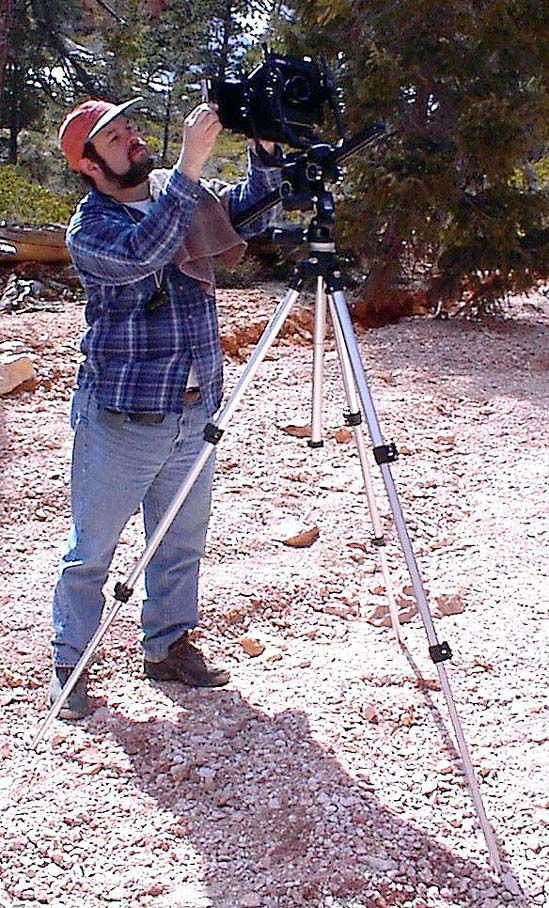
I still use my 4X5 quite a bit but there are many things around the areas I travel to justify its use. My scanner will do 4X5 and does an ok job but the best way to have them scanned is still on the drum scanner down at the Lab where I have them processed. The drawback is that a fully scanned 4X5 chrome is going to yield 100 mb plus of data and they charge by the mb for the scan!!
Posted by Sean R. Custer (Member # 3531) on 01-22-2006, 03:07 PM:
Mark,
If you enjoy that set-up, you should look into using Printing-Out-Paper for contact printing. Its tonality and resolution really blow away silver gelatain enlargements or contact prints. But, yeah, if you want to go really large either drag around an 8x10" camera or drum scan.
P.O.P is sensitive only to ultraviolet and develops in distilled water. For permanance, you use a two-bath toner. The developing stage can be done under fairly bright tungsten light, and it's all portable and non-toxic.
If interested the breakdown on the history, instructions, chemistry and so on of P.O.P can be found here:
Roger Vail's alternative process pages
cheers,
-Sean
Posted by Mark Gulbrandsen (Member # 72) on 01-22-2006, 03:14 PM:
Thanks for that link Sean! Very interesting process. I've been out of B&W for many years now, mainly color out here due to the scenic stuff thats available and the sometimes incredible sunsets. I did in fact shoot some 4X5 B&W that day at Bryce Canyon. Always wanted to go the 8X10 route but I am leaning more towards a 6X17 format camera. Its alot more practical to take on a hike.....and the vistas available are incredible out here. Ya need two people on a hike just to do 4X5.
Mark
Posted by Stephen Furley (Member # 1277) on 01-22-2006, 03:17 PM:
There's been a lot of renewed interest in the 'alternative processes' in recent years, including new developments to remove the need for some of the more toxic substances. I can think of two shops in London which sell materials.
If you really want to go large format, try this for size:
web page
Posted by Pete Naples (Member # 761) on 01-22-2006, 03:36 PM:
How well timed!
I recently moved house, new place came with a cracking outbuilding, which with the help of some timber and a length of kitchen worktopm, is shaping up into a nice darkroom. It's been 10 or more years since I played with B&W, however I am so glad I re discovered it!
Mark, glad to see I'm not the only 5x4 incher here! (That sounded dodgy!)
On the subject of Nikon, I've had Nikon 35mm over the years, models F, F2 and FE. For manual focus I've settled back on a rather elderly but trusty Pentax SV and K1000 of all things, it just refuses to die. 120 I'm dusting off a YashicaMat 124G, and a Bronica. 5x4 is a battered old Sinar. A university pal of mine, now pro photographer, was using Nikon for years, has defected to Canon, apparently Nikon UK were slow and expensive for service on the digital SLR's, and there was the small matter of the viewfinder not showing full frame ( I thought we got away from that eons ago). Canon are supporting his kit, and some. He's not the only pro in the UK to make the jump, so I'm thinkign that Nikon have taken their eye off the ball somewhat.
Powered by Infopop Corporation
UBB.classicTM
6.3.1.2