This is topic Brad Miller Going Digital Cinema in forum Film-Yak at Film-Tech Forum ARCHIVE.
To visit this topic, use this URL:
https://ft-forum.com/ft/cgi-bin/ubb/ultimatebb.cgi?ubb=get_topic;f=8;t=004463
Posted by Phil Hill (Member # 371) on 01-29-2006, 07:27 PM:
AP Newswire. January 29, 2006.
Brad Miller Going Digital Cinema
By Ms. Virginia Hamm
AP TV Newswriter
Rockwall, TX (AP) -- Highly (and questionably) respected Brad Miller of Film-Tech Inc, LLP, LIP, DDS, DOH, is disposing of his 35mm motion-picture film-based inventory of mechanical projection systems, spare parts, support equipment, film audio readers, etc. for commercial movie theatre venues.
This has been verified to this reporter by White Horse souses as well as many of the film industry leaders including Jack Valenti of the MPAA. A listing of some of the equipment Mr. Miller is pawning off is available on his website (www.film-tech.com) in the "For Sale" forum.
Consistent with an image of a $3.00 whore, he is posting all equipment as "best offer" or "make me an offer I can't refuse."
-30-
Posted by Bobby Henderson (Member # 840) on 01-29-2006, 07:31 PM:
What is a "White Horse souce?"
![[Confused]](confused.gif)
Posted by Phil Hill (Member # 371) on 01-29-2006, 07:34 PM:
A drunk at the White Horse Inn... ![[Razz]](tongue.gif)
![[beer]](graemlins/beer.gif)
(It's a play on the words "White House sources")
Posted by Joe Redifer (Member # 3) on 01-29-2006, 08:32 PM:
Digital is perfect and Brad has finally seen the light. Everyone hates film.
Posted by Joshua Waaland (Member # 287) on 01-29-2006, 08:33 PM:
Has he fallen and hit his head? Why would he sell all that nice stuff he has? I just wish I could afford to buy it all. ![[Eek!]](eek.gif)
Posted by Brad Miller (Member # 2) on 01-29-2006, 08:39 PM:
Simple. It's taking up way too much room and I need the space.
Posted by Jennifer Pan (Member # 2035) on 01-29-2006, 08:54 PM:
Brad, have you replaced the theater seats with love seats yet?
Posted by Brad Miller (Member # 2) on 01-29-2006, 08:56 PM:
Is that what I have to do in order to get you to come back for another movie? Ok then, just for you!
click here
Posted by Phil Hill (Member # 371) on 01-29-2006, 09:04 PM:
Oh PUHLEEEZE! "Love Seats"... HA! Brad told me last week he was going to rip out all those theatre seats and replace them with motorized sofas that turn into full-sized beds at the push of a button.
Posted by Jennifer Pan (Member # 2035) on 01-29-2006, 09:06 PM:
Phil, when that happens... I'll be over in a flash! ![[Big Grin]](biggrin.gif)
Posted by Phil Hill (Member # 371) on 01-29-2006, 09:12 PM:
Cool (THE) Jen! Me too! He said he was looking to install "Magic Fingers" massage vibrators too... hhot!
Posted by Jennifer Pan (Member # 2035) on 01-29-2006, 09:15 PM:
Is it against the rules to post a picture of what that is?
Posted by Eric Hooper (Member # 1730) on 01-29-2006, 09:46 PM:
quote: Phil Hill
A drunk at the White Horse Inn...
Now I wonder who else on here got that one?
Posted by Brad Miller (Member # 2) on 01-29-2006, 10:30 PM:
The "magic fingers" are attached to someone you may not want touching you Phil! hehehehe
Posted by Joe Redifer (Member # 3) on 01-29-2006, 11:06 PM:
Brad you need to get rid of that crusty DLP projector and get something that can go higher than 800x600 and has a true 16:9 chip. Oh and has more versatile inputs! Gotta have S-video because it is great.
Posted by Mark Gulbrandsen (Member # 72) on 01-29-2006, 11:18 PM:
Really, Who on earth would want that old film junk when we already have DLP going strong across America....
Mark
Posted by Joe Redifer (Member # 3) on 01-29-2006, 11:31 PM:
Well if you notice he's selling the smelly seats, too. That can only mean ONE thing: He's turning the room into a garage to store his upcoming mid-life crisis sports cars.
I can't wait until my midlife crisis. The cars I buy will kick so much ass. Maybe I'll start now!
Posted by Brad Miller (Member # 2) on 01-30-2006, 12:48 AM:
I find it humorous how many people think I am dismantling my screening room. Nothing except possibly the seats is for sale out of there. This is all extra equipment that is taking up room.
Posted by Joe Redifer (Member # 3) on 01-30-2006, 01:19 AM:
Damn. No wonder the CA21's weren't for sale.
Posted by Joshua Waaland (Member # 287) on 01-30-2006, 06:44 AM:
So many of the things you have listed are just like what you have in your screening room. I thought you must have went off the deep end or something. ![[Wink]](wink.gif)
Posted by Bruce Hansen (Member # 281) on 01-30-2006, 11:18 AM:
Hay Jennifer, what does the rest of the T-shirt say? I'm hoping: Don't tell Santa...but I've been a naughty girl.
Posted by Jennifer Pan (Member # 2035) on 01-30-2006, 04:38 PM:
"Don't tell Santa I'm up to something."
Anyway, back to the glorious screening room... I'm wondering how many love seat(motorized beds) can fit in there.
Posted by Mark J. Marshall (Member # 1409) on 01-30-2006, 05:17 PM:
I would love to have a complete CDS system.... but what the hell would I do with it? ![[Shrug]](graemlins/shrug.gif)
Posted by Bobby Henderson (Member # 840) on 01-30-2006, 05:41 PM:
The CDS film reader kind of looks like a big toaster. You would have to use 70mm slices of bread. Maybe crackers would work.
Posted by Phil Hill (Member # 371) on 01-30-2006, 06:02 PM:
Jen, Brad told me he was also going to remove the row risers and put in a slanted floor with one big waterbed. Ummm, heated of course with slosh dividers so as not to disturb adjacent "viewers".
Posted by Daryl C. W. O'Shea (Member # 1303) on 01-30-2006, 06:50 PM:
Slanted floor with a water bed, eh? Is it going to be one strong bladder or is the screening room being moved into a big centrifuge?
I always wanted to have a gel filled water bed.
Posted by John Pytlak (Member # 331) on 01-30-2006, 09:10 PM:
Consider donating (tax deduction) one of the Cinema Digital Sound (CDS) systems to the International Museum of Photography at the George Eastman House. It will be in good company:
http://www.eastmanhouse.org/inc/collections/technology.php
quote:
The Technology Collection
Bellows Camera The technology collection is one of the world's largest collections of photographic and cinematographic equipment. It contains nineteenth- and twentieth-century objects of photographic technology, including cameras, processing equipment, motion picture devices, and a broad range of early historical accessories. Many of the objects are unique, representing distinguished historical ownership and significant scientific achievement.
This collection is the most comprehensive held by any institution in North America and equaled in overall quality by only three other major holdings worldwide. From devices that pre-date the formal invention of photography in 1839 to the most modern state-of-the-art instruments used by both amateurs and professionals, the collection offers visitors an unparalleled opportunity to examine and learn about photographic technology.
The core collections are both European and American in origin; the greatest strengths are early French and American cameras.
Highlights
* An Edison Kinetoscope and a Cinématographe camera, made by the Lumière brothers in France, are the earliest commercially produced motion picture systems.
* An eighteenth-century camera obscura is the oldest item in the collection.
* One of two Giroux daguerreotype cameras in North America. Produced in 1839 for and signed by Daguerre, it is the world's first commercially manufactured camera.
* The Bemis daguerreotype camera outfit, built in 1840, is a key artifact in the early history of the process. The fitted wooden trunk containing all the equipment needed to make a full-plate daguerreotype was sold by François Gouraud, Daugerre's first sales agent in the United States, to a Boston dentist and jeweller, Samuel A. Bemis, on April 15, 1840, just six months after the process was announced. Bemis learned the process from François Gouraud. This outfit, complete with the original bill of sale, provides a unique link between France and America. It is one of the first camera outfits sold commercially in the United States.
* A lunar orbiter camera developed for the National Aeronautics and Space Administration
* Speed Graphic camera used by Joe Rosenthal for the 1945 photograph of the flag raising on Iwo Jima
* Cameras and equipment used by such people Ansel Adams, Eadweard Muybridge, Arnold Newman, Alfred Stieglitz, and Edward Weston
* The largest collection of French daguerreotype cameras; the most varied collection of daguerreotype cameras
* One of the largest collections of American cameras in the world
Materials
Noble Camera The technology collection is made up of more than 16,000 separate items including
* 4,100 cameras (still and motion picture)
* 700 projectors (still and motion picture)
* 400 viewers (hand-held mono and stereo)
* 900 lenses
* 1700 equipment (accessories)
* 700 dark room (enlargers, timers, trays)
* 1500 supplies (film and paper packaging)
* 1700 exposure measuring instruments
* More than 4,000 items in the Eastman Kodak Company Patent collection
Access
Access to the collection is by appointment Tuesday through Friday, 10 a.m. to 5 p.m.
Contact
Technology Curator, Todd Gustavson Ext. 369
Posted by Brad Miller (Member # 2) on 01-30-2006, 09:54 PM:
Good deal John. If no one bites on this thing in the next 2 weeks, it shall be donated to the GE house. ![[Cool]](cool.gif)
Posted by Nick Scott (Member # 2850) on 01-31-2006, 04:09 AM:
Hi all
just a querey what is a CDS sound system ive never heard of them in australia before?
thanks..
Posted by John Pytlak (Member # 331) on 01-31-2006, 05:47 AM:
CDS was Cinema Digital Sound, the first theatre digital sound system that actually put the bits on the film (not double system). Kodak and Optical Radiation Corporation (ORC) developed it, and ORC made the hardware. Unfortunately, hardware reliability issues caused its demise, as it put the digital bits in the analog soundtrack area, so there was no analog backup if the hardware failed.
Although commercially unsuccessful, it paved the way for today's digital sound systems, and showed the viability of digital sound in theatres.
http://mkpe.com/articles/digital_cinema/misc/multichannel.php
quote:
In 1990, the Optical Radiation Corporation in collaboration with the Eastman Kodak Company introduced the world’s first digital audio format for film. Called Cinema Digital Sound, or CDS, it was first introduced to the public with the 70mm release of Dick Tracy. Unfortunately, it only enjoyed a handful of releases before ORC pulled the format from the marketplace. CDS was a highly engineered technology, incorporating an error detection and correction scheme in the printed bit map to ensure robustness of the digital signal. The bit map itself was impressive. Thanks to the support of Eastman Kodak and specially developed film stock, the format boasted a very tiny pixel size, giving the format lots of digital bandwidth on the film. Audio was recorded without data compression, but instead of the commonly used 16-bit linear PCM scale, it used a custom 12-bit logarithmic scale that produced excellent sound with a 90 dB dynamic range. Despite its clever engineering, CDS suffered from a major shortcoming, that being that the actual recorded digital sound track for 35mm films was placed where the stereo optical track normally resides. In other words, there wasn’t a stereo optical track that could be used as a backup. CDS also suffered from playback equipment problems, which, combined with the absence of a backup track, turned the major filmmakers away from the format. Optical Radiation’s CDS format should be remembered as the pioneer for today’s digital film sound formats. They were the first to introduce digital audio to the theatre, and the first to implement a discrete version of today’s popular 5.1 technique in a major exhibition format. The impact of the 5.1 format has been tremendous. From an artistic point-of-view, discrete digital sound has been a real boon, as it frees the mixers from the limitations and hassle of mixing audio for the matrix. Full range and discrete surround channels have given the mixers the ability to use these channels much more freely. If one were to listen to the mixes of today and those of 10 years ago, the degree of artistic freedom that the digital formats offer will be obvious.
More formats were soon to follow.
Posted by Stephen Furley (Member # 1277) on 01-31-2006, 07:15 AM:
It was also the only system to put a digital soundtrack on 70mm film; both Dolby Digital and SDDS are 35mm only.
I never actually heard it, but I have seen one of the readers, at Bletchley Park.
Posted by William T. Parr (Member # 677) on 01-31-2006, 08:21 AM:
Brad,
Let me know if you ever run across a CP200 Aux unit. The Paramount in Austin is in need of one and they would be a Tax Right off to as thier a Non Profit group.
Posted by Brad Miller (Member # 2) on 01-31-2006, 02:48 PM:
Sure do William. Email me.
Posted by Chris Hipp (Member # 1788) on 07-01-2006, 09:29 PM:
The new all digital film tech screening room.
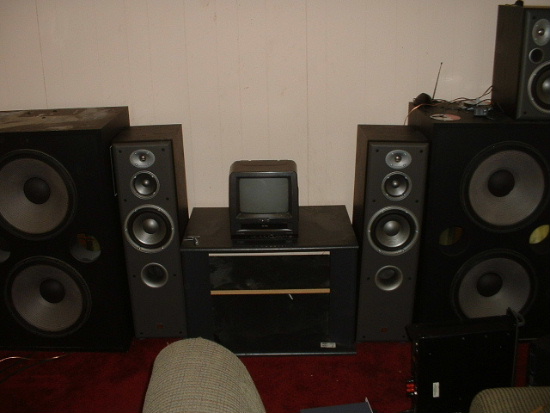
Posted by Brad Miller (Member # 2) on 07-01-2006, 09:49 PM:
Chris, you weren't supposed to post that picture until the curtains were finished. After all, the curtains are what makes for a REAL theater!
Posted by Mike Heenan (Member # 392) on 07-01-2006, 10:06 PM:
Isn't that Andy Summers first screening room before he upgraded to a 20" monitor?
Posted by Phil Hill (Member # 371) on 07-01-2006, 10:46 PM:
I miss Andy...he was a true inspiration to us all!
Posted by Leo Enticknap (Member # 534) on 07-02-2006, 05:39 AM:
GEH would be a great place for the CDS unit, if they'll actually make sure that visitors will be able to see it, rather than just locking it in a vault.
A couple of years ago I made a research visit to the National Museum of Photography, Film & TV in Bradford (about the nearest equivalent we've got) wanting to look at their Prestwich 5 camera in connection with an article I was writing. It came out of their equipment store in a non-public area. When I was done, the curator kindly offered to show me the store. It was an absolute treasure trove, and it's a real pity that most of the stuff in there is not on public display.
The stuff they've got includes a Paul Theatrograph, a Baird Televisor (plus several other Nipkow disc scanners and receivers, including a couple of Nazi ones), a three-strip Technicolor camera, an original Mitchell Todd-AO camera, a Vistavision camera, a Gaumont-Kalee Vistavision projector, the Dolby sound camera which produced the optical track negs for the 35mm release prints of Star Wars and loads more besides. But none of it is on permanent or even temporary, rotating display, as far as I can tell.
I know that museums have limited space and that, faced with a choice of acquiring an item and storing it out of public view or risk letting it end up in a skip, acquiring and storing is preferable. But I do with the NMPFT would try and display more of its film and TV technology collection, even if that means rotating exhibits in a limited gallery space.
Posted by Stephen Furley (Member # 1277) on 07-02-2006, 06:51 AM:
quote: Leo Enticknap
GEH would be a great place for the CDS unit, if they'll actually make sure that visitors will be able to see it, rather than just locking it in a vault.
What would be even better would be if some film, both 35mm and 70mm were preserved, and occasional screenings made, so people could actually hear the system, and see it working.
Posted by John Pytlak (Member # 331) on 07-05-2006, 10:48 AM:
quote: Stephen Furley
What would be even better would be if some film, both 35mm and 70mm were preserved, and occasional screenings made, so people could actually hear the system, and see it working.
I know that the folks at the International Museum of Photography at GEH are hoping to upgrade their Dryden Theatre, which may include 70mm capability. Their collection does include 70mm prints.
quote: Leo Enticknap
I know that museums have limited space and that, faced with a choice of acquiring an item and storing it out of public view or risk letting it end up in a skip, acquiring and storing is preferable. But I do with the NMPFT would try and display more of its film and TV technology collection, even if that means rotating exhibits in a limited gallery space.
GEH Technology curator Todd Gustavson does try to rotate significant items for public display. The entire equipment collection can be toured by appointment:
http://www.eastman.org/technology.html
quote:
The GEH Brownie Collection CHECKLIST THUMBNAILS INDEX
Cameras from the Exhibit: The Brownie at 100 (May 13, 2000 - February 10, 2001) INTRODUCTION CHECKLIST THUMBNAILS INDEX
Cameras from the Mees Gallery Exhibit: Enhancing the Illusion CHECKLIST THUMBNAILS INDEX
Precinema Project - Technology CHECKLIST THUMBNAILS INDEX
Selected Magic Lanterns INTRODUCTION CHECKLIST THUMBNAILS INDEX
Timeline of Cameras - Technology CHECKLIST THUMBNAILS INDEX
Photographic Apparatus From the Cromer Collection CHECKLIST THUMBNAILS INDEX
Cameras from the exhibition: "Language of Light" CHECKLIST THUMBNAILS INDEX
Selected Cameras CHECKLIST THUMBNAILS INDEX
Selected Nikon Cameras CHECKLIST THUMBNAILS INDEX
Selected Ciné Cameras CHECKLIST THUMBNAILS INDEX
Lumière Cinématographe CHECKLIST THUMBNAILS INDEX
http://www.eastmanhouse.org/inc/collections/technology.php
quote:
Materials
The technology collection is made up of more than 16,000 separate items including
4,100 cameras (still and motion picture)
700 projectors (still and motion picture)
400 viewers (hand-held mono and stereo)
900 lenses
1700 equipment (accessories)
700 dark room (enlargers, timers, trays)
1500 supplies (film and paper packaging)
1700 exposure measuring instruments
More than 4,000 items in the Eastman Kodak Company Patent collection
Access
Access to the collection is by appointment Tuesday through Friday, 10 a.m. to 5 p.m.
Powered by Infopop Corporation
UBB.classicTM
6.3.1.2