This is topic How many Roxy Theaters? in forum Film-Yak at Film-Tech Forum ARCHIVE.
To visit this topic, use this URL:
https://ft-forum.com/ft/cgi-bin/ubb/ultimatebb.cgi?ubb=get_topic;f=8;t=004509
Posted by Steven J Hart (Member # 2340) on 02-18-2006, 02:21 PM:
How many of you work at or are familiar with a Roxy Theater? My Roxy is in Langdon, ND. I know about Mike Blakesly in Forsyth, MT but there must be a lot more.
Steve
Posted by Bobby Henderson (Member # 840) on 02-18-2006, 04:04 PM:
I recall New York City having perhaps the most famous Roxy theater. Of course the actual theater hasn't been in existence in decades.
Posted by Monte L Fullmer (Member # 2797) on 02-18-2006, 04:06 PM:
Roxy is about the most common name for a theatre. Just like the Main, the Avalon, the Lyric, the Bijou, et.al.
In this area,(S. Idaho) we had the Roxy in St. Anthony, the Roxy up in Salmon..there was one in Idaho Falls (my home town) many moons ago..
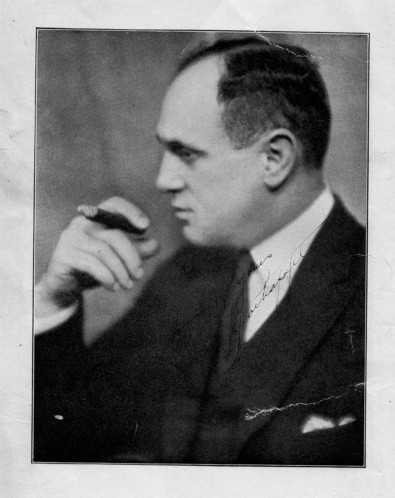
The name "ROXY" started with the ROXY theatre in NYC back in the early 20's and here's a story of the man who's name would be emblazed on many theatres around the world. His name was Samuel L. Rothafel, known as "Roxy" Rothafel in the silent era.
A showman of the 1920s silent screen era, Samuel Lionel "Roxy" Rothafel was the impresario for many of the great movie palaces such as the Capitol, the Strand, and the self-named Roxy Theater in New York City. He has been credited with many movie presentation innovations including syncing orchestral music to movies (in the silent screen era) and having multiple projectors to effect seamless reel changes.
A picture of Samuel L. "Roxy" Rothafel
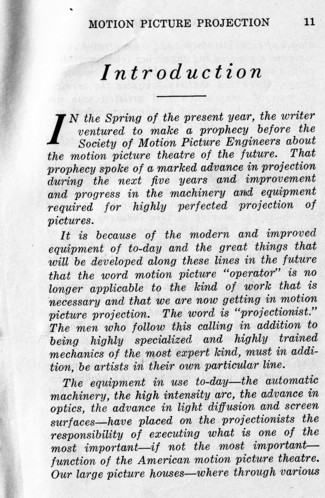
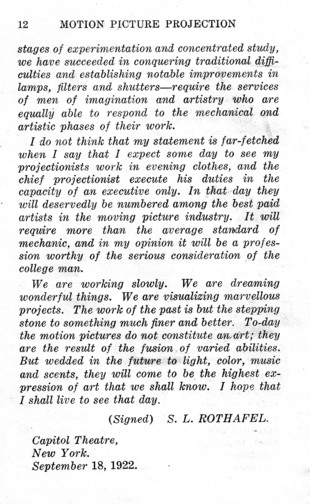
...and an interesting "prophecy" of the future of motion pictures that he wrote:
..another story of S.L. Rothafel from this
page
quote:
Roxy
By Allene Talmey (1927)
It has never been expertly analyzed, whether Roxy actually believes in the tonic qualities of the milk toast he hands out so lavishly, whether those cloudy gray eyes of his rolling lazily under lids thick and semi-closed will ever reveal that he considers it all just further helpings of what be calls, variously, applesauce, bunk or boloney.
He is a tired man with a skin grayed and lined, a squat, paunchy man, heavy, with a pursed mouth from which the words emerge childishly, with a naive inflection. High up in the massive block that is the Roxy Theater, there is a large beautifully-paneled room with a desk, great and shiny, behind which sits Roxy, pitying himself because he cannot find an assistant to do those things that have made Roxy Roxy. He is a sob sister, sentimentalizing himself and all the rest of this world's inhabitants. In his theater he has on constant display the vibrant heart of Roxy, open as the strings of a mandolin. The sweetest songs are played on it with a gentle touch of melancholy.
At forty odd, be sees himself a man run down in the service of a cannibalistic public. "Look what this theater has done to me," he points out plaintively, touching his graying hairs. He serves the motion picture public, that insatiable vampire, sucking the lifeblood of Samuel Lionel Rothafel. This public character possesses, however, a fathomless and sincere love for his enemy, a love warm and abstract. For that shapeless enemy whom be addresses over the radio as "Hello Everybody!" he will pitch himself off emotional cliffs, laughing or weeping automatically. When Roxy thanks a friend, God and Love and the Sermon on the Mount are all inextricably mixed. It overflows into his correspondence. His business thank-you notes to women start with "My dear Little Girl" and end "Yours truly, S.L. Rothafel".
But friends and enemies alike agree that in this man, whose external characteristics are a sob in the throat, a passion for frankfurters and sauerkraut, navy blue clothes, dark ties and nicknames on five minutes' acquaintanceship, there are such inner qualities as an amazing generosity, persistence, a feeling for beauty, and tremendous organization abilities.
In his official capacity of slush arranger, Roxy works constantly, intensely, giving himself playtime only in those all-night Sunday evening poker sessions at his Riverside Drive home, and in those sudden escapes to baseball games or the race track. So hard does he work at his task that he spends several nights a week in his private apartments attached to the theater office. There his place is managed by a butler whose uniform is distinguished by gilt buttons embossed handsomely with a red R, and by a white capped chef. Friday night he always stays at the theater, as that is the focal point of the week. After the regular performance, everybody gathers to work until early morning.
It is a violent scene then in that great bowl of an auditorium, with the little ballet dancers standing around, kimono on shoulder, the electricians, the orchestra players, the costumers all watching, listening to a stubby man down in front blazing with orders and enthusiasm, getting plaintive.
"Can't you do that little thing for me?" he pleads. "Must you, Sol, play the piccolo right there?"
Saturday at one o'clock the first show is on. 'Way up in the last row of the uppermost balcony Roxy sits, like a Supreme Court Justice, or a stuffed pigeon, his staff circled beside him. Under his chair coils an elaborate affair, known as "The Public Address System", through which Roxy yells his frustrations. After the performance a convention is held on the stage for the purpose of a general bawling-out. He is not pathetic then. At last Roxy retires to rest for an hour, winding up with a short workout on the roof, where the residents of the Hotel Manger can manage a vision of Roxy in sweatshirt and running pants doing his one-two-three exercises. At four o'clock be is once more ready to view the show, this time, however, from a loge. Nothing goes wrong. Otherwise the sobs of Roxy would be too unbearable. A faithful loving heart broken on the rack of organization indifference! It has never happened.
Every young reporter interviews Roxy at some time, for with his pail of tears he has edged himself into the meager band of really distinguished public entertainers. He is the leader of presentations, the originator of the atmospheric prologue which is merely a prologue setting the emotional pace of the movie following it. In the olden days the films were bolstered with Japanese Tumblers and The Refined Swiss Bell Ringers, but since Roxy waterwinged to the crest of the wave Mischa Levitska has played at this theater, Frank Harling has arranged a score, and Fritz Kreisler has been asked to play for Roxy's audiences, fattening movies whose dullness has a shellacked veneer of smartness.
It is years since Roxy's first interview, dated in the times when the pianists trebled through "Hearts and Flowers" for every sequence which the Sousa marches did not fit. All the interviews have markings as definite as ink spots. For whenever he gives public utterance, his speech centers about his plans, always a topic of general interest. In that first interview in Forest City, Pa., not far from Scranton, Pa., he announced that he was offering an extra special feature, solos, to demonstrate the remarkable talent of his musical staff every evening, in addition to the regular performance, for five cents. As be rose in theater presentation he confided his successful theories of institutionalized movie houses, his methods of staff uniforms, his vision of the ballet, his lighting systems, his projection devices, his whole battery of mechanical marvels which are now lodged in his theater.
Sometimes, at interviews these days, he will show a collection of letters from famous persons to him, or letters from unknown persons telling him that they have named the baby Roxy; or he will tell how be arranged the presentation of the Eucharist Congress film by request from a Cardinal, or how be loves to go incognito around town, playing Caliph. Known to millions, with his name famous and loved, Roxy, as a man without intimates, derives a tremendous fillip from extravagantly tipping barbers and waiters who have no knowledge that they have served Samuel Rothafel, the Haroun Al Raschid of Fiftieth Street.
When be begins an account of his career, be starts quietly, calmly. He states that his father was of German peasant stock, that he was disagreeably poor, that he was a bartender, then a Marine and then a baseball player. Somewhat less calmly be explains that in his first movie house the undertaker removed the 250 chairs whenever the town had a good funeral. The recital moves on to theaters in Minneapolis, and so to New York, where he took up the managership of the Strand, the Rialto, the Rivoli, and the Capitol in succession, of his accomplishments in presentation, of his radio work, and of his public. Gradually through this truthful aria grows a marveling at himself until the words take on magnificence, the adjectives are epic. In his description he rides in a skyscraper elevator to the tower of his career, the Roxy Theater. When he looks down he thrills at the street floor start.
Every day when the Roxy Theater, now called simply "The Cathedral of the Motion Picture", was in building-process, Roxy was driven there in his town car. Under lathings, through all the roar of hammers, over planks and plaster moldings, he crawled to steep himself in his pleasure. He scrambled to the rim of the auditorium, to the great stage where he could admire the orchestra's spaciousness. When he first took the reticent Arthur Hopkins there, Hopkins gazed for a while silently, taking in the vastness of the musicians' pit.
"Be careful, Roxy," advised Hopkins. "Shuberts will want to build a theater there."
From the stage Rothafel escorted him to the top floor, through the hospital ward to the executive offices, the red and bronze lobby, the secretary's room, the library, the kitchenette, and the simply magnificent shower room. They came to another room, but Roxy, master of a building which would hold 10,000 persons, could not remember its purpose.
"That is for your assistant," supplied the builder's helper.
"I am going, now, to have two assistants," said Roxy, with dignity, as became a man whose office, the blue prints showed, would have stained glass windows.
Built on the foundation of the personality of Samuel Rothafel, the Roxy Theater is, of course a sponge of sentiment. At the slightest touch everything dissolves into outpourings of humanitarianism. Not even the ushers escape, for in each issue of the program this proclamation is inserted:
"We, the attaches of the Roxy Theater, earnestly request our patrons to kindly refrain from offering gratuities for any service rendered.
"We regard the Roxy Theater as a university and place ourselves in the position of students seeking better understanding and appreciation of the theater arts.
"Patrons of the theater are our guests and we place ourselves in the position of hosts.
"Being associated with Mr. Rothafel is a distinct privilege and pleasure that we feel is sufficient remuneration."
That gush directly emanates from the beautifully proportioned room where sits the man whose flare for plaintiveness brought into that theater, in its first two days, 51,513 paying patrons. There is Roxy, suffering profitable sentiment to flow through him as though his veins were as hollow as macaroni.
Allene Talmey, "Doug and Mary and Others," New York: Macy-Masius, 1927, pages 173-181.
© 1997, David Pierce, on editing and revisions (if any)
-Monte
[ 02-18-2006, 05:10 PM: Message edited by: Monte L Fullmer ]
Posted by Mike Blakesley (Member # 26) on 02-18-2006, 05:05 PM:
There are four in Montana that I know of, in Forsyth, Hamilton, Choteau, and Shelby. All are single screen independents except for Shelby which was taken over by Polson Theatres, a 22-screen Montana circuit, and twinned a couple of years ago. (I think it might have been re-named, but not sure.) All are mainstream theatres.
There was a two-screen Roxy in Missoula (originally a single) but it burned down around 10 years ago and was not rebuilt.
Posted by Brad Miller (Member # 2) on 02-18-2006, 05:32 PM:
You guys are going about this all wrong.
www.cinematour.com
In the "search" box right at the top of the screen type Roxy and hit enter. Sit back and watch what happens! ![[Cool]](cool.gif)
Posted by Mike Heenan (Member # 392) on 02-18-2006, 07:23 PM:
"Best paid artist in the motion picture industry..." Lol. ![[Roll Eyes]](rolleyes.gif)
Posted by Steven J Hart (Member # 2340) on 02-18-2006, 10:58 PM:
Monte, thanks for the history lesson, thats interesting stuff.
Brad, thanks! thats a great lesson in "search smarter, not harder" ![[Smile]](smile.gif)
Posted by Tim Reed (Member # 137) on 02-18-2006, 11:36 PM:
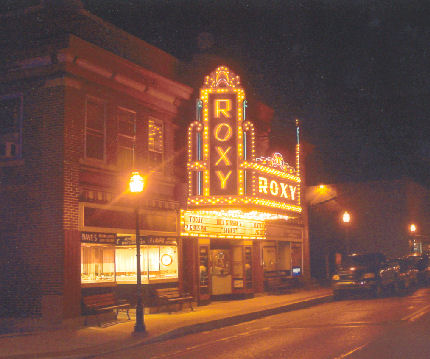
Let's not forget the grand and glorious Roxy Theatre in Northampton, PA. It's owned and operated by fellow Film-Techer Richard Wolfe.
I'm not only a fan of this theatre, I live there, too. ![[Wink]](wink.gif)
Posted by Mike Blakesley (Member # 26) on 02-20-2006, 12:51 PM:
Yeah, I am jealous of that one. The marquee is beautiful as is the interior.
Posted by John Eickhof (Member # 323) on 02-20-2006, 02:26 PM:
Mike..actually the Roxy in Missoula was originally a single, 700+ seats! Then twinned in the 1980s, then burned! It was rebuilt and re-opened as the Roxy 3 cinemas back in 1999 it was open for only a few short months untill Bob Sias and Bob Ranstrom both passed away! It was then in limbo with the bank, and finally the Wildlife Film Festival group bought it and eventually sold off the 35mm equipt and installed video projection and it is in use today as their offices and headquarters with the new ROXY marquee still adorning the building!
Monte..The Roxy in Salmon was twinned a few years back and renamed the River Cinemas! Howard Pickerill gave me the letters from the original vertical sign to take home and light up someday for my Daughter Roxy!!
Posted by Mike Blakesley (Member # 26) on 02-20-2006, 05:00 PM:
OOPS, I didn't realize it was rebuilt. Oh well -- it's not there now, so I'm still "fairly" accurate!
Posted by John McConnel (Member # 2000) on 02-20-2006, 08:40 PM:
As a 19-year-old, I passed through New York City and saw a huge, deep hole in the ground. I noticed there were 25 or more urinals along one wall, and thought that was unusual. It turned out to be the basement of the Roxy.
I was already a theatre lover at that age, and was so sorry I wasn't there before it was demolished. I probably would have lost my rocks if I'd gotten inside it.
Posted by Monte L Fullmer (Member # 2797) on 02-20-2006, 11:26 PM:
Thx John for that info.
Course, you know that good ol' DeMordant and Drennin had the Roxy in as well as the others in the eastern part of the state - including the landmark in Blackfoot, the Nuart, which is on the historical register. D&D had the Roxy in Salmon, the Roxy in St. Anthony, the Romance and the Holiday in Rexburg, the Rio, Centre and the Motor Vue in Idaho Falls, and finally the Nuart in Blackfoot-their home base.
D&D was almost the originator of the 'cheap operation' - barely well-paid employees and horribly run down theatres.
...I seemed to remember the Roxy up in Missoula - that big palace that was as big as the FOX up there. Mann Theatres had the FOX in Missoula and the FOX in Butte in their early days.
-Monte
Posted by Bob Koch (Member # 1062) on 02-21-2006, 12:36 PM:
As per Brad`s instructions you could run a search on "State" Theatres. Years ago I had ten of them on my run.
Posted by Bill Gabel (Member # 1105) on 02-21-2006, 05:38 PM:
According to Film Daily 1/1/45 there was 287 Roxy Theatres in the US.
- Alabama-(6)
Alaska-(0)
Arizona-(3)
Arkansas-(4)
California-(14)
Colorado-(3)
Connecticut-(0)
Delaware-(1)
D.C.-(0)
Florida-(11)
Georgia-(10)
Idaho-(10)
Illinois-(16)
Indiana-(12)
Iowa-(4)
Kansas-(3)
Kentucky-(2)
Louisiana-(3)
Maine-(0)
Maryland-(1)
Massachusetts-(0)
Michigan-(7)
Minnesota-(18)
Mississippi-(2)
Misssouri-(14)
Montana-(5)
Nebrasaka-(4)
Nevada-(0)
New Hampshire-(1)
New Jersey-(2)
New Mexico-(0)
New York-(5)
North Carolina-(1)
North Dakota-(28)
Ohio-(8)
Oklahoma-(5)
Oregon-(6)
Pennsylvania-(19)
Rhode Island-(0)
South Carolina-(1)
South Dakota-(3)
Tennessee-(11)
Texas-(10)
Utah-(3)
Vermont-(1)
Virginia-(4)
Washington-(20)
West Virginia-(5)
Wisconsin-(1)
Wyoming-(0)
Some theatres were just known by the chain:
- Paramount
Fox
Warner
Orpheum
Other popular theatre names of the day were:
- Ritz (There are more Ritz Theatres during this time)
State
Strand
Palace
Princess
Rialto
Lyric
Rio
Royal
Cozy
Rex
Posted by Mike Blakesley (Member # 26) on 02-21-2006, 06:39 PM:
Any one of those names sure has a lot more class and style than some of the names of today, like "Wynnsong."
Posted by Steven J Hart (Member # 2340) on 02-21-2006, 07:10 PM:
Wow, according to Bill Gabel's post, in 1945 there were 28 Roxy Theaters in North Dakota!! Thats got to be the only time that ND has had the most of anything in this country (except for wide open prarie) My Roxy theater was built in 1936 by a Minneapolis based corporation by the name of "Wellworth Enterprises" I wonder if they were behind more of the huge number of Roxy named theaters in this state.
This is how Langdon's Roxy currently looks from the street:
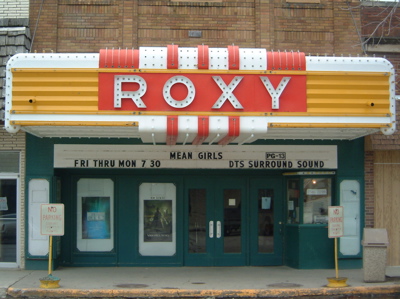
Anyone got some more Roxy Marquee pictures?
Posted by Josh Jones (Member # 447) on 02-23-2006, 12:30 PM:
Steven,
Wasnt your theatre originally converted from a fire house? I seem to have toured the place several years back ( I have pictures somewhere) And it seems that the guy running the place at the time told me this. I also have vague recolections of him driving some Honda civic hatchback with NOS
Josh
Posted by Jarryd Beard (Member # 2543) on 02-23-2006, 08:05 PM:
There's one about a 20-30 minute drive from my house. It's located in Lock Haven, PA. Once a single, it's now a triplex. See their web page.
Posted by Steven J Hart (Member # 2340) on 02-23-2006, 09:05 PM:
quote: Josh Jones
Wasnt your theatre originally converted from a fire house? I seem to have toured the place several years back ( I have pictures somewhere) And it seems that the guy running the place at the time told me this. I also have vague recolections of him driving some Honda civic hatchback with NOS
Josh, sounds like you were talking to Andy. I remember him telling me that he gave a couple guys from Fargo a tour. If he told you it was formerly a firehouse, he was mistaken. The lot where Langdon's Roxy sits was occupied formerly by another theater named the Electric Theater. It was raised in 1935 to make way for the construction of the Roxy which was completed in 1936.
I nearly met you on a Saturday night just before Christmas this year when my wife and I were at the Fargo Theater for "Capote" We were up in the booth with Dave and Zach just before the show started. Dave said something about "Josh being up front running the Organ remote" or some such. I said "Josh Jones like from Film Tech" he said "yep" then the show started and you were gone when it got over. Hope to run into you some time.
Steve
Posted by Tim Reed (Member # 137) on 02-23-2006, 10:26 PM:
Here's home for me (literally). My pad is right across the hall from the booth. I can hear reel-end alarms in my kitchen. It's wonderful!
Powered by Infopop Corporation
UBB.classicTM
6.3.1.2