This is topic Plane Crash at Bluegrass Field Lexington Ky in forum Film-Yak at Film-Tech Forum ARCHIVE.
To visit this topic, use this URL:
https://ft-forum.com/ft/cgi-bin/ubb/ultimatebb.cgi?ubb=get_topic;f=8;t=004789
Posted by Darryl Spicer (Member # 711) on 08-27-2006, 02:59 PM:
CNN
(CNN) -- Forty-nine of the 50 people aboard Delta Flight 5191 were killed when the aircraft crashed Sunday morning shortly after takeoff from Blue Grass Airport in Lexington, Kentucky, according to Fayette County Coroner Gary Ginn.
Ginn said he believes most people died from fire-related causes "rather than smoke inhalation."
Flight 5191 -- operated by Delta Air Lines' commuter carrier, Comair -- was en route to Atlanta's Hartsfield-Jackson International Airport, where it was scheduled to land at 7:18 a.m. ET.
First responders extricated the crew's first officer -- the crash's lone survivor -- according to Blue Grass Airport's Chief of Public Safety Scott Lanter.
They "observed movement at the front of the aircraft, and then extricated the first officer from the nose of the airplane," Lanter said.
Comair President Don Bornhorst identified the first officer as James Polehinke.
Polehinke was in critical condition at University of Kentucky Chandler Medical Center in Lexington, airline and hospital officials said.
There were 47 passengers and three crew members aboard the flight. One of the passengers was off duty, sitting in the plane's jump seat, Blue Grass Airport Director Michael Gobb said.
Flight 5191 was cleared for take-off at 6:05 a.m. ET, which was the last communication between the pilot and air-traffic controllers at the airport, Federal Aviation Administration officials said.
The plane crashed about a half-mile from the end of the runway, said Bornhorst, Comair's president.
Two sources told CNN that radar identifying the plane's location shortly before it crashed indicates that it took off from the wrong runway -- one that was 3,500 feet shorter than the other.
The Bombardier Canadian Regional Jet (CRJ)-200 was cleared to take off from runway 22, which is more than 7,000 feet long, the sources said.
Instead, it took off from runway 26, which is 3,500 feet long, the sources said.
That length is "pretty short for that type of aircraft," former National Transportation Safety Board Vice Chairman Bob Francis told CNN.
Lanter confirmed that the crash site was at the end of runway 26 but would not speculate from which runway the flight took off.
"Part of the investigation will establish what runway they were using," Lanter said. "Based on the information we received for the incident, we don't know what runway they were using."
Asked about the possibility that the wrong runway was used, Bornhorst told reporters, "I think that is a rumor and speculation that would be not good for any of us to go down right now."
NTSB investigators could take up to a year before formally ruling on the cause of the crash.
Gobb said the flight data recorder and cockpit voice recorder "have been retrieved and turned over."
County Coroner Ginn said much of the aircraft remained intact, despite a heavy fire that "traveled with the plane." The airport's fire department "got there very fast ... and because of that, we're able to keep a lot of the plane intact," he said.
"We are going to say a mass prayer before we begin the work of removing the bodies," County Coroner Ginn told The Associated Press, referring to the chaplains who serve the airport.
The coroner's office has set up a temporary morgue in Frankfort -- about 30 miles west of Lexington -- "in order to expedite the autopsies," Ginn said.
He said he is asking family members for dental records to help make identifications.
Comair purchased the CRJ-200 from Bombardier in January 2001 and said its maintenance was up-to-date.
That type of plane has a good track record, according to the NTSB Web site.
Bornhorst said the flight crew had been "on a legal rest period far beyond what is required," but the specifics of the crew's schedule will be part of the NTSB investigation.
The pilot, Capt. Jeffrey Clay, began work with Comair in 1999 and was promoted two years ago to captain, Bornhorst said.
Polehinke has worked for Comair since 2002, and Kelly Heyer, the male flight attendant, had been employed with the carrier since 2004, he said.
The plane went down before sunrise, and scared residents who initially thought it was bad weather.
"I really thought it was a big clap of thunder, so (I) didn't think much about it until I heard all the sirens," one man said.
Another man described what he saw from his back door.
"Over the hillside, I saw a flash of light and then an explosion, and then just a big plume of smoke come up," he said.
In Atlanta, most of the passengers aboard the crashed plane had planned to connect to other flights and did not have family waiting for them there, the Rev. Harold Boyce, a volunteer chaplain at Hartsfield-Jackson airport, told the AP.
One woman was there expecting her sister on the flight. The two had planned to fly together to catch an Alaskan cruise, he said.
"Naturally, she was very sad," Boyce said. "She was handling it. She was in tears."
NTSB investigators are heading to the crash site to begin an investigation.
CNN's Mike Ahlers and Miles O'Brien contributed to this report.
Posted by Louis Bornwasser (Member # 3063) on 08-27-2006, 04:06 PM:
Always sad when this kind of thing happens. Watched local coverage all day today...(My daughter flies this exact same plane but for a different airline.)
The "mixup" at that airport between runway 22 and 26 is well known by all pilots...I noted it again within the last month. The turn from the single taxiway to the "wrong" runway happens first, then a few hundred feet later is another slight turn then a 90 degree turn to the longer runway. Professional pilots normally would be "on guard" for troublesome situations. Because of the years of experience in that cockpit, I am surprised that this happened. Lexington is a "mini hub" for Comair I am sure that both pilots had been there many times before. Louis
Posted by Frank Angel (Member # 248) on 08-27-2006, 05:23 PM:
Horrible story. You would think they would paint huge signage on the runway itself: SHORT RUNWAY SHORT RUNWAY like they do FULL STOP on at street corners....any kind of reminder that tells the guy he's going to fall off the end of the damn thing if he keeps going. I've noticed the little signs they have at the airport runways....small little things close to the ground. I always thought how easy it would be to misread those little things.
A friend of mine just moved to Lexington three months ago. He called today very upset. I know his feeling. We had that jet smash into a residential neighborhood here in Queens in 2001, only a few miles from us; a few of my co-workers live there, one only three blocks away from the crash site. Terrible.
Posted by Tim Reed (Member # 137) on 08-27-2006, 05:50 PM:
Back when I was in the Lexington Flying Club, out of this airport in the 80s, that runway used to be X-ed out and was designated as "taxiway hotel".
I think this is the first big crash at Bluegrass Field in a long time, maybe forever. The last mishap I recall there was a small business jet that crashed just short of runway 4/22, about 10 years ago.
Posted by Aaron Garman (Member # 1653) on 08-27-2006, 07:40 PM:
With this story, the terror plot in Britain, some rumblings with Aer Lingus in Ireland, and the 5th anniversary of 9/11, I'm freaking because my girl was off in Europe this week on vacation with the family. In addition, on September 11, she leaves for Ireland for 9 months to study abroad. I know everything will be ok, but goodness I hate hearing news like this.
AJG
Posted by Jeff Stricker (Member # 224) on 08-28-2006, 06:28 AM:
Your compass should agree with the runway number the tower assigns you to. i.e. runway 22> compass reading should be 220 degrees, runway 29> compass reading should be 290, etc.
Posted by Louis Bornwasser (Member # 3063) on 08-28-2006, 08:54 AM:
Also, if you programmed your FMS at the gate, then this kind of mistake would be obvious. (You would show that you were not on the takeoff runway.)
It is yet to be determined if the "overnight" (Saturday) was any factor. Sunday 6am comes very fast after Saturday night. Louis
Posted by Mark J. Marshall (Member # 1409) on 08-28-2006, 08:57 AM:
Doesn't the tower have a radar? Can't they see that the plane is on the wrong runway, or do they normally just assume that the pilots know where they are if visibility is reasonable?
I don't mean that in any kind of a condescending way, I'm just curious. I don't know anything about this airport - it might not even have a "tower" for all I know.
I agree that there should be warning signs especially since the confusion is well known there.
Posted by Louis Bornwasser (Member # 3063) on 08-28-2006, 09:08 AM:
Although it has not been mentioned this time, I would have thought that the tower was closed until later in the morning.
Certainly during the day, the tower advises pilots to "continue onward to runway 22." Louis
Posted by Ron Yost (Member # 1850) on 08-28-2006, 01:18 PM:
So, there was maybe no occupied tower (I guess this is 'normal' for a podunk airport, but sure seems stupid when there are commercial flights), runway lights that weren't in working order, charts that weren't updated by the airport, officers half-asleep and impaired .. not that they receive proper training in the first place. These regional and 'feeder' operations are mostly low-bid farm clubs for commercial aviation. Least pay, least training, least hours, least experienced pilots and engineers, period. Think about that next time you hop on one.
Yes, I know aviation folks will remind us these terrible accidents are rare. And, thank God they are .. so far. Small comfort for the families who's loved ones were burned alive thanks to so-called professionals failing at their jobs, and a very lax operation all around, it seems.
Ron Yost .. damn near got killed in a Comair flight myself years ago. Waaaaaay to 'casual' an operation for my taste.
Posted by Leo Enticknap (Member # 534) on 08-28-2006, 02:22 PM:
quote: Ron Yost
Yes, I know aviation folks will remind us these terrible accidents are rare. And, thank God they are .. so far. Small comfort for the families who's loved ones were burned alive thanks to so-called professionals failing at their jobs, and a very lax operation all around, it seems.
My recently-moved-in neighbour is a pilot with the airline I regularly fly from an English regional airport (Durham/Tees Valley) to London and back on. She agrees that it's looking like either the pilots, the air traffic controllers or both made a tragic mistake in this case (because there's no other explanation for the aircraft having attempted to take off from the wrong runway), but made the point that all are professionals, none wanted this to happen and that therefore the priority should be to go back over what happened, identify the weak points in the system, fix them and learn the lessons.
I flew on a Delta CRJ from Bangor, Maine to Boston last month: the whole experience was normal, routine and completely unremarkable. I guess the whole thing about air travel is that it's like that on 999,999 out of 1,000,000 flights; but the one on which it isn't has a horrible habit of being a tragedy rather than a minor accident. My condolances to the deceased, their relatives and friends.
Posted by Louis Bornwasser (Member # 3063) on 08-28-2006, 03:57 PM:
Local news confirmed that the tower was open (but maybe not watching..or was too dark) Radio calls indicate that the correct runway was thought to be the one they were on. There is no lighting on the short runway...daytime only.
That should have been a dead giveaway since the 7000 ft runway was very well lit. Lexington tower at one time closed at 10 or 11 pm. These were multi-years-with-Comair professionals who routinely operated out of that airport who just made a tragic mistake. Louis
Posted by Ron Yost (Member # 1850) on 08-29-2006, 08:41 PM:
An update:
NTSB: Tower didn't notice deadly mistake By JEFFREY McMURRAY
AP, Aug. 29, 2006
The lone air traffic controller on duty the morning Comair Flight 5191 crashed cleared the jet for takeoff, then turned his back to do some "administrative duties" as the aircraft veered down the wrong runway, a federal investigator said Tuesday.
Separately, the Federal Aviation Administration acknowledged violating its own policies when it assigned only one controller to the Lexington tower.
The commuter jet struggled to get airborne and crashed in a field before daybreak Sunday, killing 49 of the 50 people aboard, after taking off from a 3,500-foot runway instead of an adjoining one that was twice as long. Experts said the plane needed at least 5,000 feet for takeoff. The sole survivor, first officer James Polehinke, was in critical condition Tuesday.
The air traffic controller had an unobstructed view of the runways and had cleared the aircraft for takeoff from the longer runway, said National Transportation Safety Board member Debbie Hersman.
Then, "he turned his back to perform administrative duties," Hersman said. "At that point, he was doing a traffic count."
The controller, whose name was not released, had been working at the Lexington airport for 17 years and was fully qualified, Hersman said.
Polehinke was flying the plane when it crashed, but it was the flight's captain, Jeffrey Clay, who taxied the aircraft onto the wrong runway, Hersman said. Clay then turned over the controls to Polehinke for takeoff, the investigator said.
Polehinke was pulled from the burning plane after the crash but has not been able to tell investigators why the pilots tried to take off from the wrong runway.
Both crew members were familiar with the Lexington airport, according to Hersman. She said Clay had been there six times in the past two years, and Polehinke had been there 10 times in the past two years — but neither had been to the airport since a taxiway repaving project just a week earlier that had altered the taxiway route.
Earlier Tuesday, the FAA admitted it violated a policy, outlined in a November 2005 directive, requiring that control tower observations and radar approach operations be handled by separate controllers.
FAA spokeswoman Laura Brown said the controller at the Lexington airport had to do his own job — keeping track of airplanes on the ground and in the air up to a few miles away — as well as radar duties.
Before Hersman's briefing on Tuesday, the NTSB said Polehinke was flying the plane; it made no mention of Clay being the one who taxied the plane into position.
Polehinke's mother, Honey Jackson, said her son is not to blame for the crash, and she asked people to be patient until all the facts were revealed.
"He could die at any moment," said Jackson, a lounge singer who lives in Miami.
Jackson's boyfriend and business manager, Antonio Cruz, said the 44-year-old Polehinke was on life support, with punctured lungs and a broken pelvis. He was scheduled to have the first of many operations Tuesday, Cruz said.
"Nobody can say for sure yet if he'll be able to recover," Cruz said.
Federal officials are looking into whether runway lights or a repaving project a week before the crash confused the crew into turning onto the wrong runway.
On Monday night, investigators used the same model of aircraft that crashed, a CRJ-100, to try to recreate the last few minutes of Flight 5191 as it taxied away from Blue Grass Airport's terminal.
Polehinke had a clean record as a pilot, with no accidents or mistakes, authorities said.
Polehinke spent five years — from 1997 to 2002 — flying short-range, twin-engine planes for Florida-based Gulfstream International Airlines. He flew at small airports all over Florida and the Bahamas, starting as a first officer and getting promoted to captain in 2000.
Tom Herfort, director of operations for Gulfstream, was a pilot for the company at the same time as Polehinke. He recalled no problems with his colleague.
"You know who's got the good reputation and who doesn't. I didn't hear anything bad about the guy," Herfort said. "As far as I know, he was a good captain for us."
Jackson said newspaper reports about her son were lies, but Cruz confirmed newspaper reports that Polehinke's wife, Ida, shot him in the abdomen with a handgun in 1999. Polehinke said the shooting was an accident, but his wife told police she shot Polehinke because she feared for her life after her husband threatened to kill her, The Miami Herald reported.
Polehinke declined to press charges, and Cruz said the couple had resolved their problems.
"They have overcome it, and they are working it out," he said. "It is a good relationship. They were supposed to travel to Italy or something, just the two of them."
-60
Associated Press writers Leslie Miller in Washington; Bruce Schreiner in Louisville; and Melissa Nelson in Pensacola, Fla., contributed to this report.
.. Ron Yost
Posted by Frank Angel (Member # 248) on 08-30-2006, 12:05 PM:
quote: Ron Yost
FAA spokeswoman Laura Brown said the controller at the Lexington airport had to do his own job — keeping track of airplanes on the ground and in the air up to a few miles away — as well as radar duties.
I guess we're not the only industry where management is cutting corners in booth personnel.
Posted by Paul Mayer (Member # 355) on 08-30-2006, 12:38 PM:
Combined positions in towers during late-night operations were quite common until this new FAA policy came out. The Lexington tower probably has barely enough night traffic counts to keep it staffed as a 24-hour tower. Here at LAS (a much bigger and busier operation than Lexington) during mid shifts all positions in the cab were combined - local, ground, flight data, and clearance delivery all on one frequency. No big deal when you only have a few flights an hour operating. Tower staffing is not a factor in this case.
The Lexington controller was at the end of his shift and doing the passdown paperwork, counting and bundling the paper flight strips used for logging the flights handled during the shift. All of the radio communications show that both the pilots and the controller thought the aircraft was on the correct runway and there were no audible indications of confusion that would cause anyone to look up and double-check themselves. So in the end a very simple mistake led to a very sad conclusion.
This one is already a topic in our Human Factors class here in the CCSN Aviation Program, just as I'm sure it is at all flight training programs around the world. We all await the NTSB's final finding of probable cause, which should be published about a year from now. In the mean time we're all reminded that it's the simple things that can kill you in this business. There but for the grace of God go any of us that fly or work traffic for a living.
Posted by Leo Enticknap (Member # 534) on 08-30-2006, 12:38 PM:
quote: From the CNN article posted by Ron
Jackson said newspaper reports about her son were lies, but Cruz confirmed newspaper reports that Polehinke's wife, Ida, shot him in the abdomen with a handgun in 1999. Polehinke said the shooting was an accident, but his wife told police she shot Polehinke because she feared for her life after her husband threatened to kill her, The Miami Herald reported.
Polehinke declined to press charges, and Cruz said the couple had resolved their problems.
"They have overcome it, and they are working it out," he said. "It is a good relationship. They were supposed to travel to Italy or something, just the two of them."
What on Earth does this have to do with the plane crash? Unless the writer is trying to imply that marital difficulties may have distracted him from his duties on the morning of the crash - if so, the evidence is pretty thin, given that the incident described happened seven years ago - I fail to see how this information is relevant to the story. The poor man is going to have a hard enough time recovering from his injuries and then dealing with the inquiries and investigations, without his domestic difficulties being plastered all over the media.
Posted by Ron Yost (Member # 1850) on 08-30-2006, 12:43 PM:
Yea, very sad, isn't it, Frank. ![[Mad]](mad.gif) "Penny pinching" in VITAL areas .. those responsible for such things should be shot! Well, not really, but someone needs to be held accountable. The current ruling crowd in D.C. talk about responsibility and accountibility, but don't like to apply it to themselves, or their cronies. Things will (hopefully) change (a little) soon.
"Penny pinching" in VITAL areas .. those responsible for such things should be shot! Well, not really, but someone needs to be held accountable. The current ruling crowd in D.C. talk about responsibility and accountibility, but don't like to apply it to themselves, or their cronies. Things will (hopefully) change (a little) soon. ![[Big Grin]](biggrin.gif)
The suits this 'accident' will generate would probably have paid for two or three more FAA controllers. How terribly, terribly sad.
Ron Yost
Posted by Paul Mayer (Member # 355) on 08-30-2006, 01:16 PM:
Deleted double post.
Posted by Darryl Spicer (Member # 711) on 08-30-2006, 06:19 PM:
There has been some talk of building a new 5000 foot runway parralel to the current 7000 foot runway. This airport can become very busy at certain times of the year. Especially around the time that Keenland horse track is open.
Posted by Ron Yost (Member # 1850) on 08-30-2006, 08:20 PM:
Yea, Leo .. I thought the same thing. I almost deleted that part of the article, but figured I should post it in its entirety.
Since I found that on Yahoo, I -think- it was raw, right-off-the-wire. Hopefully editors around the world did their job before publishing it.
And, Paul .. thank you for the information. I heard today that new controllers will be starting at lower pay. Just what's needed. Not.
Ron Yost
Posted by Frank Angel (Member # 248) on 08-31-2006, 01:46 AM:
The thing that makes this so tragic is that it is such a simple, mundane mistake. There should have been fail-safe upon redundant fail-safe starting from the ergonomics of the runways -- signage in highly reflective paint or whatever, warning of a short runway, then all kinds of stuff in the tower to warn the air traffic guys that a plane that needs T . . H . . I . . S length runway is about to take off on a runway that is only THIS long.
Aren't the guys in the tower supposed to be actually looking when they say, "Flight so and so, you are cleared for take off."? Or do they just start the projector and not even look out the window at the screen, to make an crude but familiar analogy. Shouldn't which direction a plane is headed be quadruple checked that it's on the right freakin runway? especially at an airport where everyone knows that they have a runway that is too short for some types of planes? You would think.
But I guess we think this is all super high tech stuff, when really, it seems it be just a guy making as simple a mistake as taking a wrong turn. You want some more elaborate reason such thing can take place....something bigger that befits the enormity of the tragedy....not somebody didn't look out the window.
I was at the Denver airport awhile back. Lots of planes were backed up waiting to take off this one runway. Thing is, another runway crossed it at a right angle. As we kept taxing up to what I guess was some sort of starting point with planes at least four planes in front of us and planes in back of us, we on point we wound up sitting in what would be the "cross street" of the other runway.
We were all bored and kind of pissed because we had been in this taxing line for more than 45 minutes, so I am sort of daydreaming looking out the window at this other long runway. Then off in the far distance, I notice a jet in the sky. It was far enough away and so high up that I couldn't tell if it was even going to land so I didn't think much about it, but soon enough came the revelation: "Woe, look at that....it's going to land on the runway that is crossing ours, smack dab in the middle of WHERE WE ARE PARKED!! Hey, does this plane have any side impact airbags? Yah, funny now, but it wasn't then, trust me.
Now it never actually touched down, and it pulled up and went right over our heads, but WAY to close for comfort, let me tell you. There is no doubt in my mind that this was one of those near-misses the airlines are always saying hardly ever happens; yeah, right.
Talk your super Hooo-leeeey Shit! moments.
Posted by Leo Enticknap (Member # 534) on 08-31-2006, 02:39 AM:
I am increasingly thinking that the way the media reports aviation issues really isn't helpful. For example, this story:
quote: The Northern Echo, 23 August 2006
A PILOT narrowly avoided disaster last night when a jet's engine failed seconds before take-off. Passengers described how the pilot slammed on brakes to abort the flight as sparks sprayed from the damaged engine. Kevin Wilson, the chairman of the Master Photographers Association who was on the flight from Durham Tees Valley Airport, said: "It was a miraculous escape. We are very, very lucky the plane had not lifted off. "If it had, the pilot told us, the aircraft would not have been able to sustain itself." The drama began as a BMI flight to London, with about 50 people on board, was about to take off at 6.30pm. Mr Wilson said: "The aircraft was accelerating and was building up to maximum revs for take-off when I heard a loud explosion."I saw a shower of sparks flying over the wing from the engine, as the pilot jammed on his brakes. "I couldn't see smoke, but could smell it. "The aircraft was then surrounded by fire engines, which doused the engine with foam. Mr Wilson said: "There was oil all over the runway. The passengers were evacuated by steps brought to the aircraft and led to the perimeter."He added: "The pilot came up to us and explained that, although it was an emergency, he had not used the chutes as he had everything under control and didn't want to risk anyone breaking their limbs. "A spokesman for the airport said alternative flight arrangements would be made for the passengers.The runway was reopened once the oil was cleared, and no other flights were disrupted, he said.
I was on that flight last Tuesday and, frankly, what this Kevin Wilson chap said is simply bullshit. He might be a master photographer, but he also seems to be a master of making a drama out of a crisis. What happened was this: the plane, very lightly loaded (an A319 or 320, with only about 30-40 passengers) started its take-off roll, seemingly normally. Probably around 10-15 seconds in, I heard a sort of dull 'thud' - clearly an indication that something unusual was happening, but not much louder than the bump you'd hear when going over a nasty pothole in the runway . At that point we did brake very hard and came to a stop, less than half way down the runway (for those that know Teesside Airport, we started from the railway end of the runway and were roughly adjacent the hangars when the plane came to a stop). The fire engines and foam bit was right, but at this point Wilson's description starts to enter the realms of fiction.
The pilot came on the Tannoy and told us to remain seated with belts fastened. He explained that the takeoff had been aborted because an engine had failed, that the correct emergency procedures had been followed and that no-one was in any danger. He didn't elaborate further, and certainly didn't mention anything about the plane 'failing to sustain itself'. In fact, as my pilot friend told me, a twin-engined airliner is designed to be able to take off safely even if one engine stops at the moment the wheels lift off the tarmac. Mobile steps were wheeled up to the plane in situ, we all got off and were taken by bus back to the terminal. A couple of hours later, another flight made an unscheduled stop, picked us up and we flew to Heathrow without incident (though presumably not Mr. Wilson, who I guess was busy telling the Northern Echo's reporter how he'd just starred in a 1970s disaster movie).
I can only speculate that some underpaid and overworked local journalist didn't have the time or inclination to double-check what this guy said, but it only makes for unnecessary hysteria. Personally, I didn't think the incident was even newsworthy. I guess I probably take one or two flights a year in which there's some sort of unusual happening. The last was in May this year, when the pilot had to abort two attempts to land at Newquay becuause of thick fog and divert to Exeter. I wonder how the local rag covered that: '130 tourists moments from diaster as holiday jet neaerly crashes into sea!' ? Then there was the flight from Minneapolis to Amsterdam which diverted to Gander because they discovered that a suitcase had gone on board without its owner. The bottom line is that air travel is now so routine and widespread that minor incidents are bound to happen, and it's testament to how seriously the industry takes them that it's incredibly rare for them to turn into major incidents.
One final thought - someone on the radio made the point yesterday that the number of people who died in Sunday's crash is roughly the number who are killed in accidents on Britain's roads in a 36-hour period. That's not to diminish the tragedy for those involved, just to point out that fatal air accidents invariably hit the international media and stay there; while in contrast, a fatal road accident usually doesn't even make the local paper.
Posted by Louis Bornwasser (Member # 3063) on 08-31-2006, 09:14 AM:
Training and procedures "kick in" to minimize risk for all concerned even when tired. When procedures ARE NOT followed is when trouble starts. I assume that the controler thought the professional pilots would know all about the troublesome airport. This day he assumed incorrectly. Inside the cockpit, the heading indicator would have shown a 40 degree error in any aircraft; the more automated (assuming it is being utilized) the cockpit is, the more the error would have been obvious. Louis
Posted by John Pytlak (Member # 331) on 08-31-2006, 09:56 AM:
quote: Louis Bornwasser
Inside the cockpit, the heading indicator would have shown a 40 degree error in any aircraft
At airports that have several runways with the same or very similar headings (e.g., LAX with 25L, 25R, 24L, 24R), what other "checks" other than heading indicator are in place? Should signs that indicate the runway number also show the length?
Posted by Paul Mayer (Member # 355) on 09-01-2006, 01:53 AM:
The lengths of the runways are published on the airport diagram and each instrument approach chart that applies to a given runway. These charts or their electronic equivalents are required to be aboard any aircraft engaged in scheduled airline operations. So yes, the runway length data is readily available. But what if you're not on the runway you think you're on? You'll be reading the data you expect, not the data that actually applies.
In yesterday's NTSB briefing it was noted that this flight crew got off to a bad start that morning. They began by going to and setting up the wrong aircraft for the flight. When they found out they were on the wrong airplane, things got very rushed as they packed up their stuff and moved over to the correct aircraft and went through all of the set up again. Apparently there was a real rush to get the flight out on time. This is a classic situation where the little things like checking heading against the runway number before pushing the power up can get unconsciously skipped.
Here's the airport diagram for KLEX as shown at www.airnav.com :
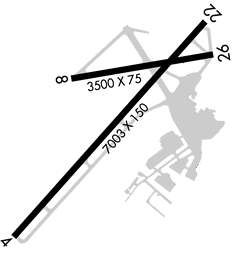
Note the taxiway from the ramp to the end of runway 22. One has to cross the end of runway 26 prior to reaching runway 22. It was dark, and this flight crew was in a big hurry. In their haste it looks like they turned left at the first runway they came to instead of proceeding further ahead to the next one. They didn't notice the runway number, either on the runway threshold itself or on the taxiway signs. They were in a hurry. They didn't notice the aircraft heading as they turned onto the runway. They were in a hurry. They expected to see runway 22 and that's what they thought they were on. They were in a hurry. The controller, busy with end-of-shift paperwork, didn't notice the mistake either. So, a series of very simple mistakes and oversights compounded to yield a very tragic result. A classic accident scenario.
The controller might have caught this, but as mentioned above this situation would be most unexpected with a professional flight crew, especially on a routine daily or weekly flight. In the end the controller's primary job is to separate aircraft from each other - anything beyond that is just foam on the beer. It is the flight crew's job to navigate the aircraft, both on the ground and in the air. The controller did nothing wrong in this case. And that there was only one controller on duty at the time may be a contributing factor, but not a causal factor.
As I wrote above, when tragedies like this happen we in aviation are all reminded that it's the simple things that can kill you in this business. My condolences go out to the victims and the survivors.
Posted by Darryl Spicer (Member # 711) on 09-01-2006, 03:30 AM:
If you notice there are two taxi ways leading to runway 22. The airport added safety buffers at both ends of the runway 22 therefore moving the approach to the runway forward to where the beginning of the approach is where the smaller taxi way is used to get to runway 22. The longer taxi way is no longer in use because of the new safety buffer addition.
Posted by Leo Enticknap (Member # 534) on 09-01-2006, 04:20 AM:
Another piece of information to emerge is that the captain had been in and out of that airport something like five times in the last two years, and therefore (according to the 'expert' on the radio), should have been very familiar with it.
Sorry if this analogy isn't really valid, but I can think of several places I drive to with that sort of frequency (i.e. two or three times a year), and that's not often enough for me to remember where I'm going: I have to refresh my memory with a map, and am a lot more likely to take a wrong turn somewhere if it's dark and/or I'm in a hurry. Let's say for argument's sake that these pilots had used this airport only once or twice previously this year, and in the intervening time had flown in and out of tens, if not hundreds of other airports. In that scenario, I can easily believe that unfamiliarity with the runway/taxiway layout was a contributory factor.
Posted by Tim Reed (Member # 137) on 09-01-2006, 08:46 AM:
They're also saying today that the ATC only had 2 hrs. sleep, even though he logged a mandatory 8hr. break. Not surprised here, this is an everyday transportation industry occurence; we do the same thing in trucking.
Posted by Louis Bornwasser (Member # 3063) on 09-01-2006, 12:00 PM:
The good thing about trucking, Tim, is that you are either at-the-motel or in the truck when you stop. Planes require a long walk and a ride on each end of the 8 hr break...that and a meal usually so there is much less than 8 hrs available to sleep. A minimal "turn" might yield 6 or less hours of sleep; less if your ride is late. Thank God my daughter's airline has generous "off" times. Louis
Posted by Phil Hill (Member # 371) on 09-01-2006, 10:54 PM:
The truly sad thing is, while 49 innocent souls rot, the stupid jerks that designed the taxi ways/airport will NOT be held accountable for their shitty, dumbass designs. THEY SHOULD rot in hell! I HOPE the airport and those responsible for the design and modification approvals get sued to hell!
Bottom Line: NO excuses for shitty airport design!
(Ooops! Over-edited by poster)
[ 09-02-2006, 09:16 AM: Message edited by: Phil Hill ]
Posted by Tim Reed (Member # 137) on 09-02-2006, 03:09 AM:
Phil, you are right, of course. It was an incredibly stupid thing to have not taken up that redundant taxiway when they constructed the extension.
Like motoring crashes, though, I've always believed that the majority of collisions can be avoided. Most of them happen when two people who are not paying attention to themselves or their surroundings... meet. I'm sure all of us can recall several instances where we've avoided a wreck simply by being vigilant and compensating for the mistakes of others. I know I have. I think this could also apply here... no one was paying close enough attention, and the mistake(s) of the designer slipped through the last set of fingers. quote: Louis Bornwasser
The good thing about trucking, Tim, is that you are either at-the-motel or in the truck when you stop.
I do like being able to sleep whenever I need to, but the big problem (particularly late at night) is you can't always find a place to stop. Too many trucks and not enough parking spaces. You have no choice but to keep driving. Fortunately for me, I normally run at night, so by the time I shut down at 6 or 7am all the truck stops have cleared out. ![[Wink]](wink.gif) If I get sleepy any earlier than that, though, it's very difficult to find a place to stop.
If I get sleepy any earlier than that, though, it's very difficult to find a place to stop.
Posted by Leo Enticknap (Member # 534) on 09-02-2006, 03:33 AM:
quote: Tim Reed
Like motoring crashes, though, I've always believed that the majority of collisions can be avoided. Most of them happen when two people who are not paying attention to themselves or their surroundings... meet.
Agreed completely. My no. 1 bugbear is people not leaving a safe enough distance between them and the vehicle in front. For at least half, I'd say, of my drive to and from work (48 miles each way, about half of which is on a 50-60mph single carriageway and the other half on a 70mph dual carriageway), there's usually someone close enough behind me that if I had to brake suddenly for any reason, (s)he'd be guaranteed to rear end me - no question whatsoever. The reason is either that they're just not paying attention, or that they're frustrated and want to overtake. The only way to deal with it is to slow down even more and open up an even bigger gap in front of me, to try and reduce the chances of ever having to brake sharply ... but of course that just makes the moron behind more frustrated and likely to do something really stupid, like try to overtake me from 55mph in a 1.1 Nissan Micra on a 200-yard approach to a blind bend. That's why I'll usually always sit behind a big lorry for the single carriageway stretch rather than try to overtake it - because (i) it can't brake that sharply compared to a car's braking action, and (ii) the driver is a professional, and therefore likely to be keeping a safe distance to the vehicle in front of him. And even if I did go past him, doing so would get me to work or home massive 2-3 minutes earlier (the difference between 50 and 60mph over a 10-15 mile stretch)! Not worth the risk or the hassle.
Oh, and people who drive up and down the motorway with one hand on the steering wheel and the other clasping a mobile 'phone to their ear really should be led up a hill and introduced to the wicker man. This was made illegal here in 2003, but that hasn't reduced the problem.
quote: Phil Hill
I HOPE the airport and those responsible for the design and modification approvals get sued to hell!
That's already started. So far it's just the airline on the receiving end of the writ, but I imagine the airport soon will be as well, certainly over the understaffed control tower and possibly for causing the confusion over the runway remodelling/layout as well.
quote: Yahoo news site
Family Sues over Deadly Comair Crash
By JEFFREY MCMURRAY, Associated Press Writer
Fri Sep 1, 4:59 PM ET
LEXINGTON, Ky. - The family of a woman killed when Comair Flight 5191 took off on the wrong runway and crashed in flames sued the airline Friday, blaming it for the nation's deadliest airplane disaster in five years.
The lawsuit accuses Comair of negligence and says passenger Rebecca L. Adams suffered "conscious pain and suffering" when the plane went down Sunday morning and quickly burned with 49 people still inside. The only survivor was the co-pilot, who remained hospitalized Friday but was upgraded from critical to serious condition.
The regional jet had left the gate before dawn with 50 people aboard. The pilots mistakenly turned onto the wrong runway, one too short for the twin-engine plane, and tried to take off. The plane crashed in a field just beyond Lexington's Blue Grass Airport.
The crash "could not have happened if those having control of the instrumentality had not been negligent," attorney Bobby Wombles of Lexington said in the lawsuit. Adams' son, Joshua Isaac Adams, said the family was pursuing legal action "so that we can one day have the answers we need."
The action needed to be taken immediately to make the family a full part of the investigation, giving it power to subpoena witnesses who also are being questioned by federal investigators, said another of the family's lawyers, Robert Clifford of Chicago. Other families also have contacted his firm, he said at a Lexington news conference.
Nick Miller, a Comair spokesman, said he couldn't comment on pending litigation. "Comair extends its heartfelt sympathy to everyone affected by the accident and our focus remains addressing the needs of family and loved ones in cooperating with the investigative process," Miller said.
Earlier this week, a Texas law firm ran a full-page ad in the Lexington Herald-Leader promising to get maximum damages for the families of victims who hired it. Comair, a subsidiary of Delta Air Lines Inc., operates 850 flights to 108 cities daily. Both airlines filed for bankruptcy protection last year.
The Lexington airport board met in a private session Friday morning to discuss "proposed litigation" against it as well. Michael Gobb, the airport director, said at least one family of the victims had told the airport it intends sue.
Federal officials have been looking into how the plane ended up on the 3,500-foot-long runway, the shortest of two runways at the Lexington airport and meant only for small planes. The taxiway to the 7,000-foot-long main runway had been altered by repaving one week before the crash.
In addition, only one air traffic controller was in the tower. The controller had had only two hours of sleep before starting work and had turned his back to do administrative work as the plane headed down the runway, according to the
Nearly a week after the crash, the first funerals began for the victims. Clark and Bobbie Sue Benton had boarded Flight 5191 for a trip to the Caribbean and vacation. They were buried Friday near Stanford in south-central Kentucky.
"We're asking difficult questions," the Rev. Wayne Galloway said at their funeral, attended by more than 300 people at Calvary Hill Baptist Church. "Why? Why do bad things happen to good people." Another memorial service was planned Friday in Lexington for Larry Turner, who oversaw the University of Kentucky's extension service.
Associated Press writers Samira Jafari in Pikeville; Roger Alford in Stanford; and Brett Barrouquere in Louisville contributed to this report.
Posted by Louis Bornwasser (Member # 3063) on 09-02-2006, 09:15 AM:
The legal concept is likely to be "Pilot-in command" though (as Phil says) there are certainly more factors like stupid airport design. The "problem" in LEX is well known and long-standing. A good friend was drummed off of that airport board because of his concern with this and other safety problems. The Mayor controls who is on the board. Louis
Posted by Joel N. Weber II (Member # 3530) on 09-02-2006, 01:39 PM:
In looking through avweb.com's coverage of this accident, I found it very interesting that the pilot's union focused on blaming the tower staffing. It certainly seems that the two pilots, not the people in the tower, are legally responsible for finding the right runway (perhaps unless the pilots had asked for progressive taxi instructions), and the compass ought to have been a clue that could have prevented this if the pilots had looked. Then again, avweb suggested that checking the compass is not necessarily a well standarized procedure, so perhaps poor signage actually is more than just a contributing factor.
Whether the airline was pressuring the pilots to be on time in spite of the distraction with the wrong plane is an interesting question, though, and I'm surpised the union wasn't asking about that.
Posted by Will Kutler (Member # 770) on 09-02-2006, 02:15 PM:
Honeywell has a cockpit system specifically for avoiding such disaters from occuring. At about $13,000 per aircraft, it is not "widely" used.
Kutler
Posted by Mark Gulbrandsen (Member # 72) on 07-23-2007, 08:52 AM:
And here is the NTSB's findings......
Article here.
Pilots in deadly crash didn't get warnings paper:
4 "Notices to Airmen" were missing from flight dispatch paperwork
One notice said normal taxiway to main runway was closed, says report
Comair Flight 5191 used wrong runway and crashed in August, killing 49
Notice wasn't included on recorded airport message system used by pilots
LEXINGTON, Kentucky (AP) -- The pilots in a jet crash last summer that killed 49 people left the terminal without receiving four important airport advisories, including one that said the normal taxiway to the main runway was closed, a newspaper reported Sunday.
The four updates -- called Notices to Airmen -- were missing from the flight dispatch paperwork the pilots received from Comair, the Lexington Herald-Leader reported, citing information the Air Line Pilots Association submitted to the National Transportation Safety Board.
Comair relies on prerecorded messages to get local advisories from the Blue Grass Airport, but the taxiway closing wasn't recorded that day.
Randy Harris, president of the local National Air Traffic Controllers Association, said he didn't know why the notice was omitted.
Comair Flight 5191 crashed on August 27, 2006, shortly after mistakenly taking off from the general aviation runway, killing all people aboard but one. The plane taxied to the wrong runway in the pre-dawn darkness.
Flight data recordings indicated the pilots thought they were taking off from the main runway and may have been confused by the alternate route.
The NTSB will release its findings and state a probable cause in the crash during a meeting Thursday in Washington.
The pilots -- Jeffrey Clay and first officer James Polehinke -- also did not receive information about the airport's general aviation runway being limited to daytime use and about the distance-remaining lights on the airport's main runway being out of service, the Herald-Leader reported.
Pilots contend the notice system is outdated and isn't always readily available. Anywhere from 300 to 1,000 notices are issued each day across the nation and can contain everything from departure procedures to airport construction. E-mail to a friend
Posted by Louis Bornwasser (Member # 3063) on 07-23-2007, 11:29 AM:
The difficulty here is that these are only contributing factors. When a commercial pilot who routinely flies into an airport that has a known problem area: (unlit alternate runway, misleading signage, close alignment of simiar runways) does not check and cross check you will get errors. It is untimately the pilot-in-commands fault. Controller error, paperwork error, lack of timely notice, etc. are only contributing factors.
A simple cross check of the takeoff heading versus the runway heading would have yielded a cautionary hold if the check list had been followed.
In other words, these are NOT itinerant pilots; they are Comair pilots. Lexington is a mini hub for them and they should have been aware of this problem on-their-own due to experience. The rest of us in Kentucky knew (from personal experience)that confusion of runways is normal. Louis
Powered by Infopop Corporation
UBB.classicTM
6.3.1.2