This is topic D-SLR Lens and Accessory Choices in forum Film-Yak at Film-Tech Forum ARCHIVE.
To visit this topic, use this URL:
https://ft-forum.com/ft/cgi-bin/ubb/ultimatebb.cgi?ubb=get_topic;f=8;t=004893
Posted by Bobby Henderson (Member # 840) on 12-08-2006, 10:59 PM:
I nearly placed this post into another older thread involving affordable digital cameras, but felt this is just a completely different topic.
I ordered a Canon EOS Digital Rebel XTi to wade into the whole D-SLR thing finally. Should have the camera sometime early next week. Got the "kit" package with the cheap EF-S 18-55mm f/3.5-5.6 lens and a 1GB CF card from NewEgg for $789. That's about the same price many other retailers are asking for the camera body alone.
There are better and more expensive options but I consider this a starter D-SLR. The intent is to put more money toward lenses and accessories, which can be used on a better camera body purchased in a couple years. I figure I'm going to spend another $1000-$2000 right after getting the camera. The trick is just deciding on what to buy to start off the collection and go from there.
My question for any D-SLR users, particularly those with Canon camera gear, what all did you buy first?
From one perspective, I take most of my photos outdoors and need a really good zoom lens. So I'm thinking about spending $1600 for the Canon EF 70-200mm f/2.8L IS USM telephoto zoom lens (and a couple 77mm filters) and getting by with that for a while. It's a fantastic lens and fast enough to even be used for some indoor situations, like a basketball game.
I've also considered the less expensive EF 70-300mm f/4-5.6 IS USM lens for around $600. It's a useful zoom lens, but the lower price comes with several trade offs, some of them pretty serious. It isn't weather sealed and risks sucking dust particles into the lens body while zooming.
For a different approach, I may buy a Canon Speedlight, probably the 430EX model, and then get a good general purpose lens, such as the EF 24-70mm f/2.8L USM standard zoom. I also intend to buy the Canon EF 50mm f/1.4 USM lens at some point. It's a great standard range lens and costs $300. The new L-series 50mm prime costs six times the price but is hardly any better.
I don't want to buy any EF-S series lenses since they are not compatible with full frame sensor D-SLR camera bodies.
Posted by Brad Miller (Member # 2) on 12-09-2006, 03:41 AM:
The Canon EF 70-200mm f/2.8L is definitely a solid lens to purchase. Make sure to pick up a lens in the 20/30-80mm range at f/2.8 as well. Between those two lenses, you will have most things covered nicely.
Posted by Bobby Henderson (Member # 840) on 12-10-2006, 12:27 AM:
I just about have my mind made up about the EF 70-200mm f/2.8L IS USM lens as the first purchase for my D-SLR gear. I've read nothing but great things about it. And considering the XTi body has no image stabilization in the camera body alone that makes it a little more crucial to have the IS feature in the lens. Canon's own excuse is their lens IS functions are better built into a lens than into a camera body.
On top of that, the Digital Rebel XTi has some limitations a 2.8L series lens or faster can overcome. The 10.1 megapixel sensor demands some faster lenses for the more tight pixel spacing in the sensor. The somewhat older 8 megapixel sensor bodies had wider pixel spacing and less sensitivity requirements. That equaled in a sense of not demanding so much from the lens attached to the body. Now, I know as much as anyone that a good prime lens is going to be better in most cases than a zoom. But this 70-200mm lens is really tough to beat. I'm going to get some dedicated primes in the long run, but I have to start from somewhere and this very popular lens seems to be a good place to begin for covering a very large and useful focal length.
Even as I am starting to get into this D-SLR thing, I can already see how the camera manufacturers have every user bent over a barrel. We all know very well what we need for a complete camera kit. Those guys know as well. And they're more than willing to make us pay for it. Cha-ching!
The payoff though is checking out the astounding image quality one can gain from purchasing and using truly professional quality gear. With that, and the goal of preserving artistic intention in mind, they're going to make a few thousand dollars off me in the next couple of years. I'm just hoping I can make that money back by way of very pleased customers from industrial jobs noticing how great the job turned out.
Posted by Mark Gulbrandsen (Member # 72) on 12-10-2006, 07:49 PM:
I rented the latest Canon EOS 30 D to try out on a friends wedding. I would NEVER purchase this camera. Aside from being VERY battery hungry the autofocus mode was almnost a joke and the camera weighs a ton with the needed large accessory battery pack that mounts to the bottom of the camera. I disabled the AF for the entire wedding shoot. The body is only 8 mp and you are stuck with the foolish Canon version of the RAW file... a big dis-advantage and another expensive plug in for those with older versions of photoshop.
I am planning on buying the Nikon D-80 digital camera. Its got alot more features and a 10 MP sensor. It si also lighter in weight. The Nikor optics in my experience are also far superior to the Canons. The larger LCD screen on the back is almost actually uselful.
Mark
Posted by Martin Brooks (Member # 1269) on 12-10-2006, 08:47 PM:
I'm a Nikon guy, not a Canon guy, but before I bought the digital, I bought a mid-range SLR in 2002 (an N80) and I bought it with a 70-300 3.5-5.6 and a 28-105 3.5-4.5.
For shooting outdoors (I went to Hawaii shortly after the N80 purchase), those lenses were fine, but when I started shooting rock shows and other indoor events, they were too slow. I can't remember if I upgraded before or after I went digital, but I went with Nikon's 70-200 2.8 and the 18-70mm 2.8, both AF-S, the longer lens with VR (Vibration Reduction.) Those are expensive lenses, and the 70-200mm is heavy and large, but they're both spectacular. It looks like you made a similar choice in the Canon line. Canon has four 70-200mm lenses: a 2.8 and a 4.0 with and without Image Stabilization. Street price on the 70-200mm 2.8 with IS is about $1700, a bit more than the Nikon.
For the digital body, I first had a Nikon D70, but I later upgraded to the D200.
There are all kinds of Nikon vs. Canon debates, but the general conventional wisdom is that Canon's got lower noise in their sensors at high ISOs and more lens choices, but Nikon's got far better ergonomics and generally better glass, although they seem to be slower at getting out new lenses. Pro sports shooters tend to go Canon (notice all the white lenses at sporting events) and pro journalists tend to go Nikon.
Posted by Mark Gulbrandsen (Member # 72) on 12-10-2006, 09:23 PM:
quote: Martin Brooks
Pro sports shooters tend to go Canon (notice all the white lenses at sporting events) and pro journalists tend to go Nikon.
Martin,
All the white Canon lenses are lightweight Floride glass lenses... ues they are prefered becaise they are lighter and hence allow sports photographers to work faster. Canon pioneered the use of floride glass in high speed telephoto lenses way back in the 70's when I was working there. The 300mm f2.8 was the first long lens they produced. While I can't remember the exact weight I want to say about 6 lbs or there abouts. The 2X extender came with it as standard. Having used almost all of the Canon glass back when I worked there and later alot of Nikor glass the Nikor glass always performed better. Mechanics of the lenses were also far ahead of Canon who used plastic helicoids in many of the more expensive lenses.
Mark
Posted by Bobby Henderson (Member # 840) on 12-10-2006, 11:35 PM:
quote:
I rented the latest Canon EOS 30 D to try out on a friends wedding. I would NEVER purchase this camera. Aside from being VERY battery hungry the autofocus mode was almost a joke and the camera weighs a ton with the needed large accessory battery pack that mounts to the bottom of the camera.
I've read that circular polarizer filters can improve auto focus performance by cutting down reflectional glare that can fool the sensor. Were you using anything like that at the time?
Canon and Nikon both make excellent cameras. I'm more familiar with working with some of the older film camera bodies, but I've mainly used Canon. I used a pretty old Canon F-1 in art school.
The higher end Canon bodies, such as the EOS 5D and EOS 1 series have better auto focus designs than the EOS 30D. The 5D model adds a number of supplemental focus points around the central 9 point design. All of the EOS cameras enable more auto focus options when using lenses f/2.8 and faster. I'm not going to worry too much about the limits of the XTi body for now. I figure I'll sell it in a couple years while moving up to a model with a full frame sensor.
Canon's high end telephoto zoom lenses and super telephoto primes are pretty heavy even despite the use of fluorite glass. The EF 70-200mm f/2.8L IS USM lens weighs 3.24 pounds -three times the weight of the Digital Rebel XTi camera body I'm getting.
I did briefly consider Canon's EF 100-400mm f/4.5-5.6 L IS USM lens. It costs a bit less than the 70-200mm model and has more zoom reach. But I figured I'd be better off getting a really good f/2.8 zoom lens first and then add a lens kind of like that later -after I've already bought another L-series lens or two in the more general purpose range. The EF 24-70mm f/2.8 L USM lens might be the second expensive lens I purchase. I'm not sure if I'll buy Canon's very fast f/1.4 50mm prime lens before then.
Canon's 300mm to 600mm super telephoto prime lenses cost a fortune. They're out of my league unless someone is paying me a decent amount of money to take photos that require use of such lenses.
Canon says they use white on the bodies of their heavy, high end telephoto lenses because they don't absorb heat from the daytime sun so much. Nevertheless, I guess I would prefer an all black, less conspicuous looking lens. It's not going to draw so many stares from people in a crowd, possibly ruining the natural feel of a camera shot. That kind of lens could even attract attention of would be criminals while you're shooting outdoors in some places. However, I'm probably going to get my conceal carry permit soon and perhaps have my SigSauer P226R .357 handy for such an occasion.
Posted by Mark Gulbrandsen (Member # 72) on 12-11-2006, 07:26 PM:
quote: Bobby Henderson
I've read that circular polarizer filters can improve auto focus performance by cutting down reflectional glare that can fool the sensor. Were you using anything like that at the time?
Nope, but I have tried everything without any filters. The lens I was using was the 17-85 zoom. At this price level I can truely say I was disappointed in the AF part of the camera.
BTW: Here are the specs of the 300mm f2.8 floride telephoto... I wasn't too far off on the weight thingy...
Focal Length & Maximum Aperture
300mm 1:2.8
Lens Construction
17 elements in 13 groups
Diagonal Angle of View
8º 15\'
Focus Adjustment
Inner focusing system with USM
Closest Focusing Distance
2.5m / 8.2 ft.
Lens Hood
ET-120
Filter Size
52mm Drop-in
Max. Diameter x Length, Weight
5.0" x 9.9", 5.6 lbs. / 128.0 x 252.0mm, 2,550g
Posted by Bobby Henderson (Member # 840) on 12-11-2006, 08:15 PM:
That 300m f/2.8L lens is one of the ones definitely out of my league -at least as far as price is concerned. I'm better off getting the L-series 70-200mm IS USM and 24-70mm f/2.8L USM lenses together for about the same amount of money.
quote: Mark Gulbrandsen
Nope, but I have tried everything without any filters. The lens I was using was the 17-85 zoom. At this price level I can truely say I was disappointed in the AF part of the camera.
That must be a lens Canon doesn't even make anymore. I can't find it listed in any of their EF lens models. There's a 17-40mm f/4.0L zoom and a more affordable 24-85mm f/3.5-4.5 zoom, but the 24-70mm f/2.8L is the real king of that group. In the long run I would consider Canon's 16-35mm f/2.8L zoom for ultra-wide work.
Given all the reviews I've read like crazy over the last few weeks it seems with Canon lenses you either have to go L-series for any zoom and if you're not going to spend in that pain level you have to go with a few select primes. I am going to get that 50mm f/1.4 lens. As fast and sharp as it is, for $300 it seems like a steal.
Posted by Mark Gulbrandsen (Member # 72) on 12-11-2006, 08:46 PM:
Sorry Bobby,
It was the 24 to 70 USM zoom. Went back and looked at the Metadata on a shot. If I'm correct that lens is around 2 grand by itself although it is no more accurate than the cameras focus sensors anyway.
Mark
Posted by Bobby Henderson (Member # 840) on 12-11-2006, 11:03 PM:
Amazon.com is offering the EF 24-70mm f/2.8L USM lens for $1089 (after a $50 rebate).
One thing that has me wondering about that lens is the broad shift from wide angle to telephoto. I've read some complaints about slight softness and light falloff around the edges on that lens around 28mm. Some photographers are actually choosing the slower EF 24-105mm f/4L lens as what they consider the best general purpose Canon zoom lens (provided you get a later model without the flare problems). Still, f/4 is pretty slow if you have to do any shooting indoors.
This issue is another reason why I'm leaning more toward Canon's less expensive primes in that focal length. Canon's EF 50mm 1.4 USM and EF 85mm f/1.8 lenses may not have the prestige of a Red L-series ring on them but they're sharper than those zoom lenses and quite a bit faster. I could buy those two lenses and a 430EX model Speedlight for less money than the L-series 24-70 zoom.
I haven't seen any serious complaints at all about the EF 70-200 f/2.8L IS USM lens. Too bad it costs $1650 (after rebate).
Posted by Scott Norwood (Member # 30) on 12-12-2006, 05:57 AM:
Don't forget to buy a good tripod. This is probably one of the most important purchases that you can make and a good one will last a lifetime (or most of it). Expect to spend about $200 or so; the cheapo $30 tripods are useless. B&H Photo in NYC has good prices and a good selection. A cable release ($10) is also an important purchase. A good incident light meter (I like the Sekonic Studio Deluxe, which is an older analog meter) is also worth having.
Posted by Ian Woloschin (Member # 3709) on 12-12-2006, 08:25 AM:
I just bought a new XTi this week as well. Unfortunately, I don't have the money right now to go buy a nice lens, so I'm stuck with the kit lens until the summer when I'll actually be working again.
I'm probably going to be using it for a wide range of outdoor to indoor stuff, but I won't have several grand to spend on lenses ![[Frown]](frown.gif) .
.
Posted by Bobby Henderson (Member # 840) on 12-12-2006, 10:54 AM:
quote: Scott Norwood
Don't forget to buy a good tripod. This is probably one of the most important purchases that you can make and a good one will last a lifetime (or most of it). Expect to spend about $200 or so
Tripods are important. I bought a Hakuba tripod a couple years ago for nearly $300 to use with my little video camera. It has a fluid head and carbon graphite extension legs. The main support legs have black padding around them. Another feature I like is how the legs have twist locks on them rather than the flip style locks that snag on things. It's not as nice as a high end Sachtler or Bogen tripod, but it works well.
I also plan to get one of the Canon cable releases for this camera. There's a couple infrared wireless models, but I've read some complaints about them being a little flaky.
I'll probably cave and get the Speedlight 430EX and a decent bounce diffuser pretty quick. I may even order that before I get the big telephoto lens.
A good light meter is highly valuable for portrait work. I'll probably get one a bit later when I can get a good medium range "portrait" style lens. For the time being a lot of the stuff I plan to shoot will be outdoors.
quote: Ian Woloschin
Unfortunately, I don't have the money right now to go buy a nice lens, so I'm stuck with the kit lens until the summer when I'll actually be working again.
If your short term budget allows you might consider that EF 50mm f/1.4 USM lens. It's around $300 (cheap for a good lens). It's a good bit sharper than the EF-S 18-55mm kit lens and doesn't have the issues of chromatic abberation found in the kit lens. That shows up if you take pictures of high contrast items like dark tree branches against a bright sky. The kit lens is still a decent value. It's certainly better than nothing.
Posted by Ian Woloschin (Member # 3709) on 12-12-2006, 11:59 AM:
I was considering getting that 50mm lens. The only thing I'd be concerned about is with a 50mm lens (especially on a smaller sensor), would I be able to use it for much indoor (aka, dark) stuff without being kind of far away from where I'm shooting?
I bought this camera to get more into photography, so I'm still learning what's the stuff to be buying. I figured the kit lens is a good start and that I'll figure out from there what else I need. I don't think I'll be buying a new lens for a few months though, as I'll be in London for two months, spending all of my money and not making any.
Posted by Bobby Henderson (Member # 840) on 12-12-2006, 01:48 PM:
quote: Ian Woloschin
I was considering getting that 50mm lens. The only thing I'd be concerned about is with a 50mm lens (especially on a smaller sensor), would I be able to use it for much indoor (aka, dark) stuff without being kind of far away from where I'm shooting?
You'll only need to get farther back when taking full body portraits. I don't know the minimum focus distance (or how close you can get to a subject and maintain focus). The 50mm lens has a really big maximum aperture of f/1.4. It's your best affordable bet for shooting with available light indoors. The small size makes it great for travel. Reviewers say you can almost fit it into a shirt pocket.
To get any lens faster than that, you have to spend $1800 on the new L-series 50mm or 85mm lenses, both of which go up to f/1.2.
Don't make the mistake of buying the cheaper $70 f/1.8 50mm lens. It isn't nearly as good. The $300 50mm lens has an eight blade aperture which, along with the larger f/1.4 size, creates much smoother, better quality "bokeh" (out of focus objects in the background). The f/1.8 50mm lens has a five blade aperture that isn't designed as well. You'll get a bunch of pentagon shapes in the background instead of circular discs.
Posted by Ian Woloschin (Member # 3709) on 12-12-2006, 10:53 PM:
Interesting bit about the lens, didn't know that. Looks like I'll have to start looking at lenses now if I plan on buying one in a few months, heh.
Maybe when I come back from London I'll have some extra money left over and I'll splurge. I'm kind of doubting it though.
Posted by Per Hauberg (Member # 529) on 01-30-2007, 10:49 AM:
Mark, -You must have had a very bad day, trying the 30D. It's the without doubt best camera, You can get to the price.
I do not want to go into a religions war Nikon vs. Canon, but with experience from Canon T70, T90, EOS 600 and 650, I have never been more happy with any slr than this one, -taking 18.000+ shots since last april !
It was a chok, getting the 1,6 crop witch cost me a couple of new lenses to cover everything, but at the same time, You can't hide now, even when running very fast....
I use my 30D with the following glas, having no complaints on any of them:
EF-S 10-22 3,5 - EF 24-70 2,8L (great !!) - Ef 70-200 2,8 L IS (Even greater -- and heavier...) - EF 180 2,8 L Macro (Yummi !) - EF 300 2,8 L IS (as bringing Your DP70 with You, but worth the effort) plus 1,4 and 2x Extenders. I've got, what I need, and do not wish to try other brands. -All of these are honestly recommended ! ![[thumbsup]](graemlins/thumbsup.gif)
Per
Posted by Mark Gulbrandsen (Member # 72) on 01-30-2007, 12:05 PM:
Per,
This is not really a matter of who's sensor is best or camera religion... its more a matter of the glass. I used to work for Canon repairing cameras and lenses and their stuff is well made. Not till I had my VistaVision camera with full compliment of Nikkor glass did I find out how much better the Nikkor glass is. I bought an old Nikon F-2 body to use the array of lenses I had on hand and they put to shame the pics shot with my F-1n and Canon glass. Thats pretty simple and nothing special... just that Nikkor glass is way ahead of Canon's. I can still use all my Nikkor glass manually on a new Nikon digital camera body. I don't really like all that auto stuff anyway and I still shoot more 4X5 and 6X9 than I do 35mm anyway.
Mark
Posted by Bobby Henderson (Member # 840) on 01-30-2007, 01:33 PM:
I don't think the Canon versus Nikon thing is quite that simple.
As far as lenses go, judgment really must be centered exclusively on the specific kind of lens being considered, not a broad-sweeping judgment of brand name. Both Canon and Nikon have some outstanding lenses, and they have others that aren't so great either. Every lens has its trade-offs as well.
I can't judge Nikkor lenses, but when it comes to Canon's stuff the buyer needs to read a lot of reviews and other feedback from forums (like those at Digital Photography Review) before buying.
After long consideration, I chose to buy these Canon L-series lenses:
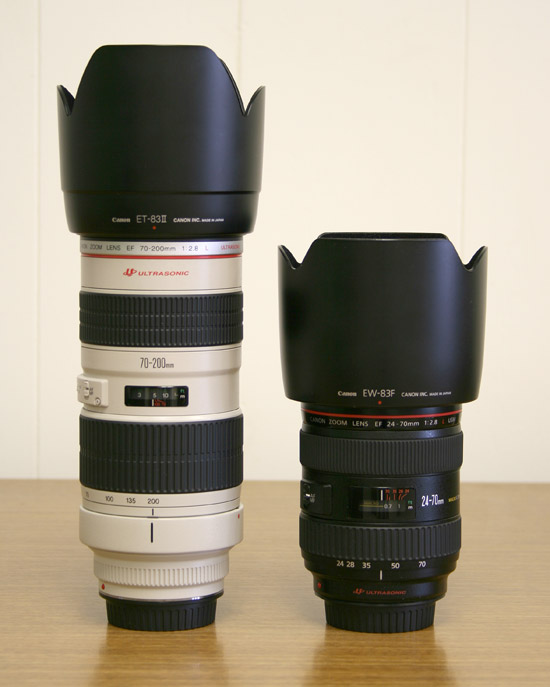
The big white and black model is the EF 70-200mm f/2.8L without IS. Since I do much of my photo work from a tripod I didn't feel the extra $500 was worth it. And a number of reviews suggest the "non-IS" version is actually sharper. I'm really pleased with the image quality of the lens. Judging from feedback of others, Canon seems very consistent with making great copies of this lens. The same isn't so true for the more expensive "IS" version.
The smaller lens is the EF 24-70mm f/2.8L. It's also very good. Overall it doesn't have quite as razor sharp of image quality as the longer lens, but it's still sharp and the vivid color quality just makes my "kit" lens seem like a cheap piece of crap. I'm using the hell out of it though, in part as an attempt to expose any weaknesses that might be in the lens. If I feel like it needs to be re-calibrated I'll send it in while it's still covered under warranty. Some people have encountered bad copies of the 24-70L.
Probably the one area where Canon does deserve some very heated criticism is their rebates. They hired some company called "Young America" to handle their rebate program. This company has a very widely known policy of screwing with customers. The attorney generals from two different states have filed law suits against Young America over this crap. I have $190 due back in "doubled rebates" for the two lenses I purchased. Most people say you often have to go back and forth with that company and even make calls directly to Canon's customer service in order to get your check. I am prepared to do just that. Canon would be doing themselves a favor by firing Young America and either getting rid of the rebates entirely or making them "instant" at the time of the sale.
Posted by Mark Gulbrandsen (Member # 72) on 01-30-2007, 04:37 PM:
quote: Bobby Henderson
I don't think the Canon versus Nikon thing is quite that simple.
Actually it is. Having been a big Canon fan it too took me along time to believe that the Nikkor was better. There is something about the Nikkor glass that just goves more snap and better contrast to pictures taken with them. They also have better srpth and sharpness too... the Canon glass no matter which lens I used always appeared somewhat soft. Take the 17mm Nikkor wide angle and 55 micro Nikkor lenses and compare them to the equivelent Canon lenses. You will be shocked!! I;m not a zoom fan at all... sorry. I just don't like spending alot of $$ for a lens that has different trasnfer characteristics, optical center, and colorimetry at each setting.
Mark
Posted by Per Hauberg (Member # 529) on 01-30-2007, 06:25 PM:
OK, then: I have not been with You for quite some time - and definitely not since I went digital. The upload process is new to me, but if i manage, I would like to show You a couple of photos, I took last november, attending the farewell-tour of good, old german party-king, James Last. "The Last Tour", some smart-ass called it on the poster, but the old chap himself wispered, when I got close enough to have my portrait "We'll be back in a couple of years, -if I can...!" So much for farewell... -Four days after the end of "The Last Tour", I bought tickets for two James Last concerts in Royal Albert Hall, London for september 2007. Pics from concert in CampusHalle, Flensburg, Germany.
So many journalists went berserk and wrote page after page about Rolling Stones going on tour, being sixty. James Last is 77 years old now, but within ten minutes the roof was about to go off the building. We got 3 full hours of everything from soft pop, over solid rock, U2 and a brass version of "Over the Rainbow", leaving no eye dry... Well: Even if he's had his part of ![[beer]](graemlins/beer.gif) and scotch, Mr Last has not been climbing Coconut Palms
and scotch, Mr Last has not been climbing Coconut Palms
These pictures are all taken with the Canon EF 70-200 2,8L IS - from behind raw no. 45 or standing direct in front of the stage. 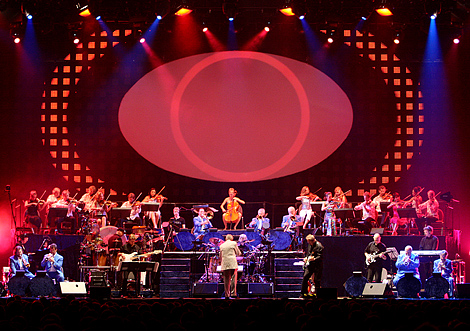


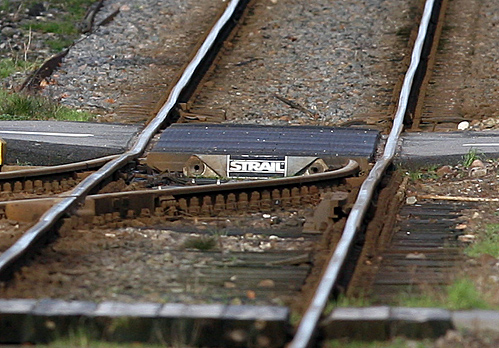
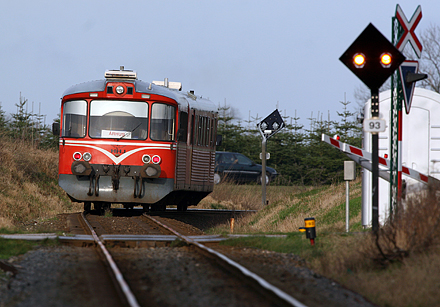
Last - that is - after Last - an example from the EF 300 2,8L IS with 2x Extender. -The explanation, why passengers sometímes believe, trains on smaller danish railroads have octave, not round wheels.... The small (116 seat) German Duewag Railcar is about 250 meter (750 feet) away.
Posted by Mark Gulbrandsen (Member # 72) on 01-31-2007, 09:05 AM:
Per, While they do look nice I can't really tell anything of the pics except that you have great composition! Unless I look at them on my monitor with Lightroom posting them here is pretty much meaningless. I also doslike Canon's idea of the RAW file... requiring you to purchase yet another plug in for Photoshop.
Case in point.....
Was this photo taken with my Nikon Coolpix 2200, The Canon EOS 30D that I tried out or my old Konica Digital camera?
Mark
Posted by Cameron Glendinning (Member # 3516) on 01-31-2007, 07:13 PM:
Nice photos Par and Mark.
As for the Nikon vs Canon debate, I would like to throw my 5 cents.
Its great to know that you have bought some of the finest glass on the planet, one might be slightly better than the other, but lets keep the perspective that there are other manufactures out there that are not even close. The camera is just a tool, its the human interaction and the subject that makes a great photo, not the camera.
To me its the lighting that gets me excited, Bobby what sort of flashes/ lights/ reflectors will you be using?
Posted by Steve Guttag (Member # 268) on 01-31-2007, 10:54 PM:
I dunno how valid debates are on 1970s lenses for 35mm film cameras with fixed focal lengths and either manual or shutter-priority and then compare them to current lenses for digital cameras that are often zooms.
I can tell you, my first serious camera was a Canon AE-1 before they became quite popular. I did quite well with it and even won a photo contest (which netted my dad a new suit worth several hundred dollars in 1970s money (it was a fathers day photo contest)...I liked that camera a lot.
However, I noticed pictures taken on Nikons (or Licas) seemed to have that "snap" as Mark calls it that my photos didn't...so....I worked all summer to buy a Nikon F2a (25th anniversary model), Nikkors 50mm f/1.4, 28mm f/2.8 and 135mm f/2.8. That is the camera and lenses I've used ever since for most all of my photos. The camera and lenses really do look better than the Canon equivalents (or Vivitar, which I had some for the Canon...the 70-200 zoom with Macro feature was just too much bang for the buck to pass up). About the only time I used the Canon after I had the Nikon was when I wanted to have two types of film handy and loaded (different speeds, tungsetn vs daylight, B/W vs Color...etc).
I even had my cameras tested...oddly enough I found that the Nikon with a mechanical shutter was more accurate than the Canon with an electronic timer. Furthermore, the Nikon was more even in light uniformity across the aperture...the Canon hot-spotted (this was a test on the camera, no lens). I don't remember the machine that did the testing but it was done by Strauss Photo and the same machine measured both cameras.
So given all that...yes I agree with Mark that in the 1970s and 1980s, Nikon beats Canon in every respect in terms of camera and glass. I still would not apply that to 2007 using different camera bodies, different mediums, different lens series.
As I am now approaching the concept of buying a digital SLR (my boy is now over 1 and my desire to record these little events are going beyond the digital point-n-shoots...I would instinctively lean towards Nikon....after all I have Nikon lenses that should work on new Nikon Digital cameras and I like the lenses...Nikon has always pleased me in the past. That doesn't mean I'm not open to the concept of Canon (also have some of those lenses) or others.
Then again, I might just say screw it load up the Ol' F2a with film and record his events the old fashioned way...the pictures will look better and last longer...I can always scan them in for sharing...oooo....the thought of cranking up my darkroom again, and for color no less (Bessler 23CII w/color head, EL Nikkors and up to 16" x 20" paper, gives me goosebumps!
Steve
Posted by Bobby Henderson (Member # 840) on 02-01-2007, 12:22 AM:
quote: Steve Guttag
I dunno how valid debates are on 1970s lenses for 35mm film cameras with fixed focal lengths and either manual or shutter-priority and then compare them to current lenses for digital cameras that are often zooms.
That was one thought which occurred to me as well when Mark was making his comparisons between Canon and Nikon gear. The newer EF lenses and bodies are different. I kind of wish they weren't because my father has some really good Canon F-1 gear and some really good lenses that go with it. He bought the F-1 body from a photo-journalist friend of his named Bill Foley he met in Beirut (I used the same camera body in art school). There's a really nice 100mm prime lens in that collection. Sadly, I'm pretty sure those old lenses won't fit my Digital Rebel XTi body.
One of the reasons I bought into the Canon line of equipment is for the wider range of equipment, larger user base, and better overall range of camera bodies. The Nikon D2X is not quite the same in comparison to Canon's EOS 5D or EOS 1D series. I'm starting out with a Digital Rebel body, but I plan to move up to one of those "full frame" sensor bodies pretty soon.
I briefly considered the Nikon D200, but after looking closer at it and what I would be getting for the money I chose differently. That camera's sensor is just too noisy for my liking, a lot more noisy than Canon's sensors at the same ISO settings. And certainly too noisy for the much higher price. I was disappointed by that because the Nikon D200 has a built-in intervalometer that makes it possible to shoot time lapse sequences. It's a very cool feature that should be in a lot more cameras.
On Nikon, I really have nothing against their line of equipment. Back in the "analog" days when I was still in art school, I was lusting after a Nikon F4s -especially since my side job during senior year was working at Olden Camera in Herald Square and being in very close proximity to those nice camera bodies.
There is one thing I find very curious. If Nikon's gear is so much better than anything Canon makes, why aren't all the professionals who use D-SLR gear going with Nikon alone? I see a high prevalence of Canon bodies and lenses at high profile news and sporting events. That wouldn't make any sense if Canon's gear is really as inferior as what is being stated in this thread.
[ 02-01-2007, 08:45 AM: Message edited by: Bobby Henderson ]
Posted by Mark Gulbrandsen (Member # 72) on 02-01-2007, 09:03 AM:
quote: Bobby Henderson
If Nikon's gear is so much better than anything Canon makes, why aren't all the professionals who use D-SLR gear going with Nikon alone? I see a high prevalence of Canon bodies and lenses at high profile news and sporting events. That wouldn't make any sense if Canon's gear is really as inferior as what is being stated in this thread.
In past years and today I see most sports photographers seem to prefer Canon and most other photographers seem to shoot Nikon. The thing there is Canon's lightweight Floride telephoto lenses thata re prefered by sports guys. Overall Canon has a good reputation but Nikon still seems to hold the lead on reliability and glass quality to this day.
Steve... Your AE-1 shutter was probably either out of adjustment(curtain timming) or speed the actual adjustment. Also some shutters cen become erratic and you have a different exposure time with every shot. The latter can also caused by a dirty release magnet on the bottom of the camera(under the bottom cover).
In the end no one here thought about the fact that none of the digital sensors in use today are capable of actually displaying who's lens is better... there is just not yet the quality from any sensor that is available with a film record. So Steve.... I vote you take your kids pics with the F2a!! They will be a better record for some time to come.
Mark
Posted by Cameron Glendinning (Member # 3516) on 02-01-2007, 04:10 PM:
Mark, which camera did you take that shot with?
Posted by Mark Gulbrandsen (Member # 72) on 02-01-2007, 04:19 PM:
With the Nikon Coolpix 2200. A 2 megapixel point and shoot. I think it proves my point that its impossible to tell pictures, lenses or cameras apart here. It still really needs to be done via film.
Mark
Posted by Mark Gulbrandsen (Member # 72) on 07-16-2007, 11:37 AM:
Well, After owning the Canon EOS Rebel xti now since March I thought I'd post some general feelings about the camera.
The Rebel xti is a decent digital SLR camera but has not lived up to my expectations. Frankly I wish I had gotten the Nikon D-80. Sure the Canon is quieter in the higher ASA speeds but the Canon lenses simply still leave alot for want. I own three different lenses for this camera and neither of the others really perform all that much better than the inexpensive lens the camera comes with. Sure the other lenses have stabilization and that feature does indeed work but apparently at the sacrifice of some resolution and some color fringing I am seeing out in the corners. I am not seeing this fringing on the cheap lens. This leads me to believe that Canon lenses have not really gotten much better than the old FD series was. This is the main reason I wish I had gone Nikon.
Onto the battery....
My battery has not lived up to its expectations. I am not getting the average advertised number of shots per charge. At best I am getting around 90 shots per charge... a mixture of shooting with and without flash. This is from two different batteries. I'm glad I bought two! I refuse to add weight to it by getting the dual battery holder for it. I do like the low weight of this camera and its one reason I went for it.
Autofocus:
Works just ok.... I have found that using just one auto-focus point works best for me. Using all of them or in other pre-set combinations does not guarantee an infocus shot especially under lower light conditions. Whan I was a tech at Canon we used to make fun of the first Canon Auto-Focus camera by calling it the "Out Of Focus-1" That still seems to be partly true of the EOS. Also, the Auto-Focus is basically worthless in dark places!! The manual focus rings are so sloppy and loose as to be a joke...even on the expensive lenses.
Image quality:
Is excellent if you leave the stabilization on the lenses turned off. I also now only shoot RAW files.
Viewfinder: Needs a few more basic markings on it or the ability to change out the ground glass for others.
Display: This is the single best feature of this camera. It is excellent and the imformation display is also great.
Menu and User Adjustments: Excellent and easy on the fly.
I just wish Canon would get it together in the lens and optics end of things. Their lenses are good but have never been near the quality of Nikon's. They'd have a really great system if the optics were at least on a par with Nikon! Now I guess I have to go out and buy the Nikon I originally intended to get!
Mark
Posted by Mark Gulbrandsen (Member # 72) on 09-03-2007, 11:35 AM:
Being fortunate enough to have a local camera store that also rents all the EOS lenses so I can try before I buy I have finally found one decent lens for this camera that actually is superb... Its the 17 to 40 mm F4 L series lens. I have tried many of the wide angle zoom lenses for this camera including the much touted 16 to 35mm f-2.8 L series and the F2.8 lens was not near as sharp at the sides and corners as the 17 to 40mm was overall. So I ended up with this lens in my set. The sharpness, color, and contrast this lens is capable of is incredible.
Highly reccomended in spite of its slower F-4 speed!!
Mark
Powered by Infopop Corporation
UBB.classicTM
6.3.1.2