This is topic Digital Projectors at ShoWest convention in forum Film-Yak at Film-Tech Forum ARCHIVE.
To visit this topic, use this URL:
https://ft-forum.com/ft/cgi-bin/ubb/ultimatebb.cgi?ubb=get_topic;f=8;t=004999
Posted by Richard Fowler (Member # 893) on 03-15-2007, 09:10 AM:
Barco, Christie, Sony displayed new digital products. Barco has 3 different sizes of Digital 2K projectors which are physically smaller in size and weight due to using Texas Instrument's smaller DLP chip set. Power suppies are now part of the projectors and many parts are interchangable between the 3 units. The smallest unit is suitable for a 33 foot screen and the largest at 30000 lumen, suitable for monster screens. They have a sales contract for 700 of this new series to be installed in China ![[Cool]](cool.gif)
Christie displayed a new smaller footprint model with an optional 19 inch rack width box for player installation.
Sony 4K machines are monsters size wise.....they announced a deal to oufit all 233 screens for Muvico over the next 18 months.
Prices are dropping; but talking to suppliers the short term is sales in the USA and China being the leaders with the rest of the playing "wait and see".
Posted by Mark Gulbrandsen (Member # 72) on 03-15-2007, 04:46 PM:
Of course no one amounting to anything in this industry will ever take Sony seriously after the SDDS debacle... Its going to take something like the Regal Consortium to make Sony fly and they've already said no to it.
The best thing happenning to the 2K projectors is the new T.I. Chip set that uses a black matrix coating between the pixels to give an apparent lower black level... of course the black level really isn't lower but it does improve contrast range of the image slightly just like the old black matrix coating of color CRTs of yester year. The Christie projector is identical inside to the first model except for the new T.I. Chipset and possibly xenon power supply changes.... This low production stuff is not going to change all that fast.
Mark
Still here in Vegas....
Posted by Lyle Romer (Member # 1266) on 03-15-2007, 11:11 PM:
Can you explain the new black matrix coating between pixels. What does it do? How does it work? How does it make the black level appear better but not really be better? How does it make the contrast ratio better?
Also, have they applied this new process to the old 1.2 inch DLPs or just the new .98 inch model?
Posted by Richard Fowler (Member # 893) on 03-16-2007, 11:56 AM:
The concept is like flocking or painting internal parts on optical equipment to improve contrast and lessen flare. The new chip size falls in line with the majority of commercial (0.99 or less ) video/digital projectors so as to allow smaller packages and lens expensive lenses.
Posted by Mark Gulbrandsen (Member # 72) on 03-17-2007, 10:02 AM:
FWIW, here is the link to the announcement of the new chipset.
New T.I. Chipset
Posted by Kenneth Wuepper (Member # 1174) on 03-17-2007, 11:15 AM:
Mark,
Thanks for that link. That is a remarkably simplified explanation of how the DLP projector works.
I can't help thinking back to the original CBS color system where they rotated a large celuloid color wheel in front of the B&W TV screen to get color. (I think it rotated at 3,600 RPM)
I can see how this system really can work since the area of color in the light path is much smaller and, no doubt, Dichroic filters are used.
KEN
Posted by Richard Fowler (Member # 893) on 03-17-2007, 05:52 PM:
NED annouced their new projector using the same chipset....the horse race is on ![[Wink]](wink.gif)
Posted by Mark J. Marshall (Member # 1409) on 03-17-2007, 10:58 PM:
So if I own a projector with the old style chip, am I able to upgrade to the newer chip?
Posted by Kevin Raisler (Member # 1761) on 03-17-2007, 11:03 PM:
Is NEC still working with fiber optics for data transfers between the server and the projector?
Posted by Darryl Spicer (Member # 711) on 03-18-2007, 01:31 AM:
I know of two locations that have been having convergence issues and apparently there are others out there having the same problems. Now that's one thing you don't have to worry about with film. I just hope the one we have installed does not give us those problems. I have seen a DLP unit running with convergence problems and it looks terrible.
Posted by Stephen Furley (Member # 1277) on 03-18-2007, 06:14 AM:
quote: Kevin Raisler
Is NEC still working with fiber optics for data transfers between the server and the projector?
Our recently installed NECNC800 has four iputs, all copper,no fibre; 2x SDI on co-ax with BNCs for server and 2x single link DVI-D for connection to other things.
Posted by Mark Gulbrandsen (Member # 72) on 03-18-2007, 09:43 AM:
quote: Richard Fowler
NED annouced their new projector using the same chipset....the horse race is on
Exactly! But I also think its VERY wise to stand back and see how the betting goes for another year or so...
quote: Mark J. Marshall
So if I own a projector with the old style chip, am I able to upgrade to the newer chip?
Don't know for sure... but a light engine costs around 30 grand to replace....
quote: Kevin Raisler
Is NEC still working with fiber optics for data transfers between the server and the projector?
Well have you priced copper lately? Its gone up X3 in the last year or so. In a small install copper is feesable but in a large plex having all the servers networked fibre is now the less expensive route.
quote: Kenneth Wuepper
I can see how this system really can work since the area of color in the light path is much smaller and, no doubt, Dichroic filters are used.
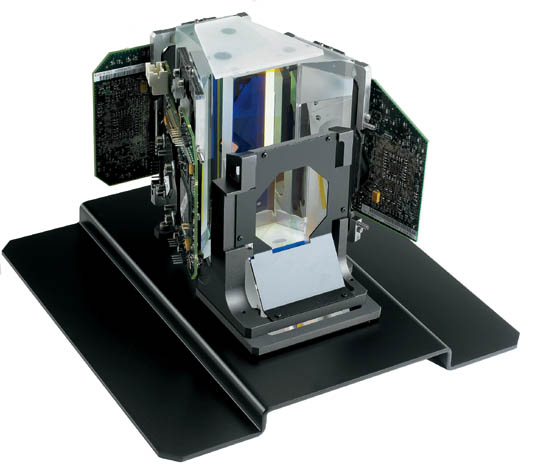
Yes, Dichroic filters are used and it will be interesting to see what the fade rate is on them. The following is a picture of the Christie light engine I stole off their web site..... pricy little beast!
Mark
Posted by Tristan Lane (Member # 1169) on 03-18-2007, 08:16 PM:
Mark,
Let's hope the dichroic coatings hold up over time.
I was speaking to a Dolby rep about their 3D technology, and where the main cost was. He stated that the dichroic filter used is manufactured using a multiple coating process that is very time consuming and expensive. I can't remember the number of coatings he specified, but it was a very large number. He also said that the filter coatings have held up to testing very well. I believe it was placed directly before the integrator rod in the light path, so the light is very concentrated at that point. I'm assuming this is where the majority of the equipment cost is.
I would think that the prism in the light engine was coated using a similar process, hopefully they don't fade or flake before the entire engine is obsoleted by new technology.
Time will tell.......
Posted by Darryl Spicer (Member # 711) on 03-18-2007, 08:24 PM:
by the time the light gets to the light engine all of the ultraviolet light has been eliminated. So basically you have cool light hitting the light engine and I would suspect that fading would not occur since the damaging light would not be there. What you have to watch for is the light at the reflector around the bulb. The bulb position has to be in a certain range when setting up each new bulb so that the reflector is not damaged from misalignment.
Posted by Tristan Lane (Member # 1169) on 03-19-2007, 02:02 AM:
quote: Kevin Raisler
Is NEC still working with fiber optics for data transfers between the server and the projector?
I doubt they every did use fiber for transferring data between the server and the projector in the d-cinema field.
Christie/Barco/NEC all use the SMPTE 292m standard for the video signal. The document specifies coaxial copper and BNC connections. I believe this is best suited for HD-SDI in the cinema.
Perhaps other lines of NEC projectors used fiber, but not any DCI compliant ones.
Posted by Mark Gulbrandsen (Member # 72) on 03-19-2007, 08:09 AM:
quote: Darryl Spicer
So basically you have cool light hitting the light engine and I would suspect that fading would not occur since the damaging light would not be there.
Cool light.... ![[Roll Eyes]](rolleyes.gif) Yea, thats why there is a closed loop cooling system with a water pump moving glycol though each 2K DC projector's light engine. Actually the fading of dhicroics even occurs in photographic printing machines over time. Now those machines DO USE a cool light source!!
Yea, thats why there is a closed loop cooling system with a water pump moving glycol though each 2K DC projector's light engine. Actually the fading of dhicroics even occurs in photographic printing machines over time. Now those machines DO USE a cool light source!!
Mark
Posted by Darryl Spicer (Member # 711) on 03-19-2007, 09:02 AM:
Just quoting what the Christie people told me. I was wondering the same thing. If it's cool light why all the hoses going to the light engine. But all of the ultraviolet light is removed before the light hits the light engine so the damaging light is suposed to be gone hence the brighter picture. That's what Christie claims anyway.
Posted by Tristan Lane (Member # 1169) on 03-19-2007, 09:56 PM:
Mark - ![[Smile]](smile.gif)
I think that the reason the chips are cooled they way they are is because they are a mechanical device, and to hopefully reduce further stress on the prism. I doubt that dichroics are as sensitive as DMD's, but fading may still happen over time, even with the reduced UV. It would be prudent to mention that you can run pure white light @ 20 FL through the lens all day long without cracking an element due to the reduced IR and UV. (not that this wouldn't affect the coatings over time)
I still believe (and hope) that the dichroics will outlast the chip and asociated technology. Look at some of the quality cold reflectors that still look great after 10-15 years of abuse. Proper cooling goes a long way.
Posted by Mark Gulbrandsen (Member # 72) on 03-19-2007, 10:06 PM:
Tristian,
It would be interesting to k now exactly how hot the light engine gets. A light engine failed here in SLC in a big hurry when the cooling system failed to pump. Sure the silicon on the imagers is MORE sensitive to heat but I've seen dichroic fade occur even in photo lab machines that are far more expensive to buy and that use relatively low light levels. Many of the filters in the DC Projectors are multi coated to create a specific light bandpass... not sure how the life of them will fare but it will be interesting to measure over years and see color space drifts much.
Mark
Posted by Peter Castle (Member # 1997) on 03-20-2007, 06:09 AM:
Did anyone see the Dolby 3D demo at Showest?
I presume this was of the German 'sort of' anaglyph system.
Posted by Tristan Lane (Member # 1169) on 03-20-2007, 01:03 PM:
I don't think that the dolby system could be considered anaglyph, or "sort of". I didn't get to see the presentation, but only heard minimal complaints about the design of the glasses.
It uses a rotating dichroic filter at the integrator rod to modify the light for each eye. From what I gather, the optics used in the glasses are much more expensive compared to cheap one-time-use polarized glasses, and therefore will be sanitized and re-used after each show.
Color correction is performed in the dolby show player, and I was told there weren't any issues with the color on screen. I hoped to have a chance to see the presentation, but didn't make it.
I think one benefit of this system is that rather than polarizing the projected image after the lens (like IMAX and RealD) you are "polarizing"[sic] the light source entering the light engine. I'm unsure if there is any benefit to this method, but it makes sense.
Mark, I'll check on that for you. There's temp sensors on two of the DMD's as well as the prism. I'm sure it also depends on the size of lamp the projector is running.
Posted by Bobby Henderson (Member # 840) on 03-20-2007, 01:17 PM:
quote: Tristan Lane
It uses a rotating dichroic filter at the integrator rod to modify the light for each eye. From what I gather, the optics used in the glasses are much more expensive compared to cheap one-time-use polarized glasses, and therefore will be sanitized and re-used after each show.
If this is true, that could be a bad knock against Dolby's 3D system.
If the glasses are expensive, then they'll be a costly item to maintain and replace. Count on customers breaking lots of them.
This is one reason why I rarely, if ever, see any IMAX 3D theaters using the laser controlled LCD 3D glasses and PSE headsets anymore. It's far cheaper to use cheap, plastic ones with basic polarized lenses.
The other problem is the sanitation issue. The health departments in many states would probably mandate movie theaters have something along the lines of a heavy duty dish washing system similar to those used in restaurants to clean and sanitize the 3D glasses. Some theaters wouldn't have any space to install such equipment. That factor is the principal reason why RealD shows just give away the glasses to the customers.
Posted by David Stambaugh (Member # 1102) on 03-20-2007, 01:51 PM:
quote: Bobby Henderson
RealD shows just give away the glasses
Cinemark here charges $1.50 premium, ostensibly to cover the cost of the glasses. However I've been told they don't give you a credit if you bring your own recycled glasses (haven't tried that myself yet). Will find out if the new Regal does the same thing on pricing for 3D shows when "Meet The Robinsons" opens (playing in 3D at both Cinemark and Regal).
Posted by Ron Curran (Member # 3631) on 03-20-2007, 06:34 PM:
Bobby, we have a State-approved commercial dishwasher (not cheap) because we serve coffee and tea in china cups ans saucers. I can't see how it would handle 150+ pairs of glasses. Also, they wash at extremely high temperature so plastic glasses wouldn't stand up to too many treatments.
Posted by Bobby Henderson (Member # 840) on 03-20-2007, 06:41 PM:
I assume the more advanced glasses Dolby sells would have to be dishwasher safe.
I, too, kind of wondered if the price premium I've seen on RealD shows has been to cover the cost of those glasses. It could be that. Or it could be those royalty fees RealD charges. Or a bit of both.
Posted by Dustin Mitchell (Member # 372) on 03-20-2007, 08:22 PM:
For the Meet the Robinsons feature at least the customers are allowed to keep the glasses.
In NATO's former magazine, 'In Focus' there was an article about the various 3D systems last years. One thing it mentioned was special washers for the glasses if they were to be kept by the cinema.
Posted by Paul Konen (Member # 41) on 03-20-2007, 08:29 PM:
The DMD's get pretty hot. The TPC will show you the temps of each one.
Posted by Tristan Lane (Member # 1169) on 03-22-2007, 01:10 AM:
Not that hot,
I checked on this today on houses running 2K to 4.5K lamps.
The DMD temperatures ranged from 80 to 90 degrees F.
The Prism was 85 - 90 degrees F. This is near the tail end of the shows. Believe it or not, the hottest part was not even in the light path, it was a module used to monitor temperature and interlocks, and to control fan speed.
It seems the cooling system is pretty effective. There's also LAD cooling that runs filtered air across the face of the DMD of each chip.
Powered by Infopop Corporation
UBB.classicTM
6.3.1.2