This is topic Hard Drives Reach 1 Terrabyte Storage in forum Film-Yak at Film-Tech Forum ARCHIVE.
To visit this topic, use this URL:
https://ft-forum.com/ft/cgi-bin/ubb/ultimatebb.cgi?ubb=get_topic;f=8;t=005029
Posted by Mark Gulbrandsen (Member # 72) on 04-09-2007, 08:36 PM:
I would have to say this is a pretty landmark thing in computer data storage.... its taken just 24 years to get there... the first 3.5" hard drive was marketed in 1983...
Article Link
Just when you got used to hard drives with hundreds of gigabytes (hundreds of billions of bytes) they do it: make one with a terabyte (a trillion bytes).
Yes, you can now get a terabyte hard drive on a desktop PC. Breaking the ice with a Hitachi drive was Dell, with “Area 51” game-oriented machines from its Alienware subsidiary. The 1T option initially costs $500.
In case you’re wondering, as printed text a terabyte would occupy 100 million reams of paper, consuming some 50,000 trees. It is enough to hold 16 days (not hours) of DVD-quality video, or a million pictures, or almost two years worth of continuous music.
You might not have any songs that last for two years, but that’s irrelevant, indicated Henry Baltazar, storage analyst for The 451 Group, a technology analyst firm in San Francisco. “There will be a demand for it, since a lot of people have digital media, like movies, pictures and music,” Baltazar told LiveScience.
“Larger devices will become more commonplace, and we will see the same kind of transition from gigabyte to terabyte drives as we previously saw from megabyte to gigabyte drives—in fact, the move from 500 gigabytes to a terabyte has taken longer than expected.”
The leap from 500G to 1T required a breakthrough in “areal density” (how tight the bytes are packed on the surface of the disk), according to Doug Pickford, a marketing executive at Hitachi Global Storage Technologies. The trick, he explained, was to move to Perpendicular Magnetic Recording (PMR), where each bit is a perpendicular rather than a linear magnetized spot on the disk—as if the bits were standing up rather than lying down.
Currently, areal density is growing at about 35 to 40 percent per year, and the techniques used to create the 1T drive are expandable to make a 5T drive, Pickford said. More work will be needed to surpass the 5T hurdle, but he foresaw no physical limitations until drives reach a capacity of at least 50T.
At that point, they’ll hold about a century of music.
Incidentally, for planning purposes, the next level is the petabyte (a quadrillion bytes); and then the exabyte (one quintillion bytes); and then the zettabyte (one sextillion bytes); and then the yottabyte (one septillion bytes.)
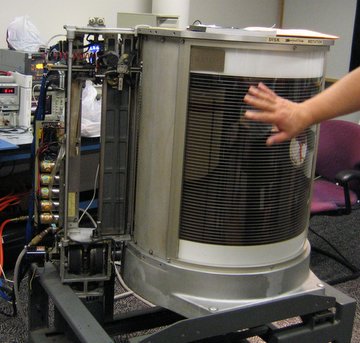
The very first hard drive was the IBM RAMAC that came out in 1956. It had fifty-24 inch disks that held a total of about 5mb of data. It was only available for lease back then for the small fee of $35,000 a year... The photo is of a RAMAC hard drive array thats being restored for display.
Posted by Mike Heenan (Member # 392) on 04-09-2007, 08:41 PM:
Anybody figure out how much porn will fit on there?
Posted by Tim Reed (Member # 137) on 04-09-2007, 11:28 PM:
quote: Mark Gulbrandsen
It had fifty-24 inch disks that held a total of about 5mb of data.
Yeah, but that's when 5mb was worth 5mb...
Posted by Monte L Fullmer (Member # 2797) on 04-09-2007, 11:41 PM:
quote: Mike Heenan
Anybody figure out how much porn will fit on there?
(buy one and let us know .. ![[Big Grin]](biggrin.gif) )
)
Then, you'll be seeing flash drives that are going to follow this storage trend very quickly.
..as with Tim, I do remember when IBM 8088 computers had a 10mB, 5.5 Winchester HD loaded with DOS 3.30...and if you were the lucky one, also loaded with Windows 1.03 being displayed on an amber monochrome, 11inch screen.
Who ever thought of a computer being converted to a multimedia monster when they were originally constructed as strict business machines ....
-Monte
Posted by Bobby Henderson (Member # 840) on 04-09-2007, 11:56 PM:
I remember back in the early 1990s when having more than 1GB of hard disc space was a really big deal. 2GB drives cost a bunch in 1993. A little over a decade has passed and we now have hundreds of times that capacity.
A few years from now and our current data storage maximums will seem kinda puny.
Posted by Joe Redifer (Member # 3) on 04-10-2007, 12:45 AM:
We've had TWO 1-terabyte external hard drives at work for awhile now. One of them is obviously two 500GB drives in the same enclosure, but the other seems to be the size of a normal drive or so. They are a lot smaller than they seem, and the space goes away quick. We'll be getting at least one new TB drive per year.
Posted by John Walsh (Member # 168) on 04-10-2007, 11:31 AM:
Ahhh .... I remember when .... My first hard drive was an 25Mb MFM type that cost $300. 1983, I think....
Posted by Mike Blakesley (Member # 26) on 04-10-2007, 06:06 PM:
I paid $449 for my first hard drive -- 40 megabytes. I installed it in a Radio Shack computer that had a whopping 640k of memory. Somewhere around 1987, give or take a year.
I have an old Radio Shack catalog from the early 80s around here somewhere that advertises an outboard hard drive for something like $3500...and says it will hold "thousands of pages" of text.
Posted by Jason Burroughs (Member # 68) on 04-10-2007, 08:05 PM:
We have a RAMAC on display at my office. Needless to say the thing is HUGE and heavy.
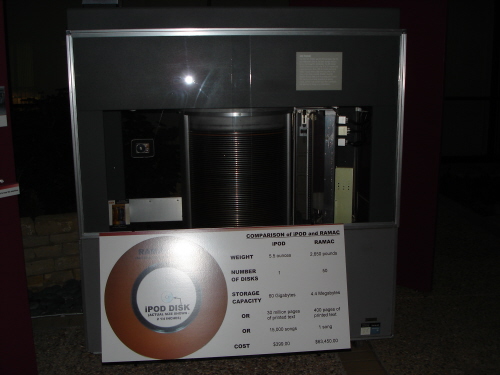
We also have an ENIAC on display as well. =
[ 04-14-2007, 09:05 PM: Message edited by: Jason Burroughs ]
Posted by Bobby Henderson (Member # 840) on 04-10-2007, 10:34 PM:
Many don't realize it, but much of the original ENIAC computer is stored at Fort Sill, not far from where I live. Only some of the control panels and a few other components are on display at places like the Smithsonian.
A number of different politicians, military people and businessmen are trying to raise money and momentum for a new museum for the US Army to be built on designated land at Fort Sill. ENIAC I is one of the highest priority items they want to put on display. The computer system was used for many different military and science purposes, from doing lots of ballistics calculations to work on America's first H-bomb.
Posted by John Walsh (Member # 168) on 04-11-2007, 08:05 AM:
I read a magazine article years ago that described how a small company was still using a UNIVAC computer for their accounting. I'm sorry I can't remember the name of the magazine. The name of the article was (I think) "Last of the First." It described things like water cooling leaks; there was a picture of a fan blowing dry a rack full of tubes. The mag tape transport had a feature where, if it found a bad section (that gave read errors) it would punch a hole at that location. An opto sensor would see the hole and know not to read/write there ever again.
Posted by Joel N. Weber II (Member # 3530) on 04-11-2007, 07:42 PM:
Water cooling might happen again at some point in the future as a way to cool big data centers; allegedly it would be significantly more efficient than the air cooling that is generally used today.
Posted by Jason Burroughs (Member # 68) on 04-13-2007, 10:04 AM:
quote: Joel N. Weber II
Water cooling might happen again at some point in the future as a way to cool big data centers
This is already happening. The vast majority of CRACs and in-row coolers are chilled water or glycol mix cooled.
There are water cooled cabinets on the market with the water look comming to the cabinet itself.
With server densities constantly increasing, having the cooling at the cabinet is the only way to effectivly contain the heat produced by 20+ Kilowatts. Projected densities are exceeding 40 and may go up to 60 Kw in a cabinet.
There are aircooled cabinets that are pushing 22-24 Kw but that's about as far as air can go.
Manufacturers are considering water to a chill plate in the server itself.
Mainframes have had water loops run to them in the past.
Posted by Joel N. Weber II (Member # 3530) on 04-13-2007, 07:26 PM:
It's not obvious to me that these ever increasing power densities are especially desireable. Especially after I came across something explaining that, above a certain power density, you have to put the air conditioning on battery power because if you don't, the computers will overheat in the 20 seconds the air conditioner isn't running while the generator starts up after the power goes out.
Posted by Jim Bedford (Member # 4) on 04-14-2007, 10:20 AM:
Looking toward the future, what comes after "terrabyte" and when do you think we can expect it?
Posted by Scott Norwood (Member # 30) on 04-14-2007, 10:38 AM:
Exabyte. (Not to be confused with "Exabyte tapes," which were/are a crappy backup format that used/uses 8mm videotapes.)
These larger capacities are great, but I just wish that backup technology would catch up. LTO3 is great, but it costs several thousand dollars and holds "only" about 400GB per tape. Not very practical for the home user. And before anyone mentions backing up to removable hard disks, I'll just say that I don't trust that a disk will be readable in a decade after sitting on a shelf for years. They just aren't that reliable.
Posted by Mark Gulbrandsen (Member # 72) on 04-14-2007, 02:18 PM:
Jim, From the article in the first post....
"the next level is the petabyte (a quadrillion bytes); and then the exabyte (one quintillion bytes); and then the zettabyte (one sextillion bytes); and then the yottabyte (one septillion bytes.)"
quote: Scott Norwood
but I just wish that backup technology would catch up.
Well, A simple RAID array is not very expensive and provides pretty darn good backup.
Mark
Posted by Scott Norwood (Member # 30) on 04-14-2007, 04:35 PM:
RAID != backup
It doesn't provide versioning, doesn't provide offsite storage, and won't help one bit if someone does something stupid (e.g. accidental file deletion, accidental reformat, etc.).
Posted by Mark Gulbrandsen (Member # 72) on 04-14-2007, 05:46 PM:
Scott,
You're right there... I was thinking more of HD backup in case one fails.. this has been my main problem with IDE HD's. My Seagate SCSI's are still chugging right along though with about 2.5 continous operating years on them. I only shut the puter down if I'm away for an extended time. I did however recently replace my aging power supply with a much larger more environmentally friendly one...
Mark
Posted by Joe Redifer (Member # 3) on 04-14-2007, 06:11 PM:
I hear SATA drives are less reliable than IDE or ATA or whatever the standard connection is. True?
Posted by Bobby Henderson (Member # 840) on 04-14-2007, 06:24 PM:
The biggest problem with SATA is its arguably poor connector design. Some people have had problems with it. As to the hard discs themselves, that's really hard to tell.
SATA RAID is not as reliable as a SCSI-based solution. It can make a regular desktop computer run faster. But it also makes it doubly important that you back up your data to another physical hard disc.
As cheap as massive external hard discs have become, I see little reason for anyone to avoid using them for data backup. They have about as low a price per gigabyte as any other storage medium and don't take up as much space as a growing stack of CDs and DVDs.
Posted by Mark Gulbrandsen (Member # 72) on 04-14-2007, 07:01 PM:
quote: Bobby Henderson
I see little reason for anyone to avoid using them for data backup. They have about as low a price per gigabyte as any other storage medium and don't take up as much space as a growing stack of CDs and DVDs.
I certainly agree with that and its someting that I do occasionally with my 2 spare HD's! Making a HD image or exact copy on another HD is a cinch and very inexpensive... the software to do so is also inexpensive, it doesn't even take that long. It makes more sense to me than making a tape BU copy, tape drives are slow and dam... don't get that tape near any mag field.
Mark
Posted by David Stambaugh (Member # 1102) on 04-14-2007, 07:07 PM:
quote: Bobby Henderson
SATA RAID is not as reliable as a SCSI-based solution.
RAID-0 should never be used when reliability is the top priority. RAID-0 is for performance and capacity. Whether it's SATA or IDE/PATA, RAID-0 is more risky.
Western Digital Raptor SATA drives are basically SCSI drives with an SATA interface. Very fast and very reliable.
SATA connector reliability is fine if you use the cables with locking tabs on the connectors. With or without the locking tabs, you just need to be careful how the cables are routed inside the case. It's not like the SATA cables just spontaneously disconnect.
Posted by Bruce Hansen (Member # 281) on 04-15-2007, 06:27 PM:
quote:
Hard Drives Reach 1 Terrabyte Storage
My one remaining brain cell is feeling very lonely right now.
--> ![[uhoh]](graemlins/uhoh.gif)
By the way, there have been water cooling units for CPUs in PCs for some time now.
Posted by Joel N. Weber II (Member # 3530) on 04-15-2007, 09:28 PM:
I would assume that Scott and Mark were probably talking about RAID 1, in which a complete copy of the data is stored on each drive, such that as long as at least one drive is still working, you have your data, and not RAID 0, in which the data is distributed across all of the drives in such a way that any drive failing will generally result in none of the data being easily recoverable.
There are also some other configurations available, such as RAID 5, where you use several drives, writing off the capacity of one to store parity information so that any one drive in the array can fail without data loss. RAID 10 layers RAID 0 and RAID 1 together, which can be useful if you have four drives and want the usable capacity of two drives while having the whole RAID array look like a single large drive.
Posted by Wayne Keyser (Member # 2420) on 04-15-2007, 09:59 PM:
So, let me see if I get this ... now, a single hard-drive crash can wipe out the equivalent of the entire Library of Congress?
Cool!
Posted by Mark Gulbrandsen (Member # 72) on 04-16-2007, 04:01 AM:
Joel,
RAID -1 is exactly what I was talking about. Loose a drive--- replace it--- re-configure the new drive and keep on going without any data lose.
Mark
Posted by Jason Burroughs (Member # 68) on 04-16-2007, 12:52 PM:
Bottom line: RAID is not a method of backup. With the exception of RAID 0, the different forms of RAID are simply a layer of redundancy to avoid a failure of a system while in production.
RAID 0 actually poses the most risk to data integrity, as if you lose 1 drive, everything in the array is lost.
SATA arrays have very limited usefulness, due to the failure rate of the drives. Primary uses are for data caching, i.e. backing up to the array and queing the job to tape.
Powered by Infopop Corporation
UBB.classicTM
6.3.1.2