![[Frown]](frown.gif)
![[Smile]](smile.gif)
quote: Emma TomiakLawrence of Arabia is pretty tempting to make the drive down to Austin. Does anyone know if this is a 70mm DTS print or one from the previous 70mm Dolby SR mag generation?
Anyone from around north Texas up for a road trip?
.
quote: Mark GulbrandsenUnfortunately I have not seen it yet, but I wish there were more people like him reminding the audience (not technicians) how good 65/70 is.
That whole Bill Bennett thing is certainly nothing but a bunch of hype
quote: Louis BornwasserAbsolutely, those scenes showed perfectly what 65/70 can do, amazing
"Far & Away" was pretty bad.....until the land rush scenes....Bruce Surtees, Jr. Every bit as good as Lawrence.
![[thumbsup]](graemlins/thumbsup.gif) I prefer 1000 times a 65/70 on a curved large screen on a conventional cinema than any IMAX blow up from 35mm.
I prefer 1000 times a 65/70 on a curved large screen on a conventional cinema than any IMAX blow up from 35mm.
quote: Paul LinfestyI think I also read that. Wasn't that mentioned in American Cinematographer Rag???
I could be wrong, but I thought I had read soemhere that those land rush scenes were shot with new VistaVision cameras.
quote: Mark GulbrandsenWhat gives this latest test some relevance is that it takes into account current post-production and exhibition practices (i.e. digital intermediates and digital projection) but also illustrates just how good 65/70mm origination and projection can be. The whole point is to remind people of just where the quality bar actually is.
That whole Bill Bennett thing is certainly nothing but a bunch of hype. This has been done in past years and with 65mm as well as other formats in 35mm and at differing speeds.
quote: Mark GulbrandsenI don't recall Bill Bennett boasting about reinventing the wheel or finding a cure for cancer. Bennett simply is the guy who shot the demo, and I'm the one who happened to interview him and made the piece available to you. Don't read into the situation any more than necessary.
People try to take credit for reviving or creating a new format and what ever it is they try it already exists.
quote:
4K Projection of 65mm and 35mm Footage
by Staff
Kees Van Oostrum, ASC, and Bill Bennett, ASC will be hosting an interesting event at UCLA next week: a 4K projection demo of 65mm and 35mm footage.
This demonstration is designed to explore the possibilities for improving image quality to maximize the movie-going experience. It is based on practical experiences of Oostrum, who directed and shot We Fight To Be Free, which recently opened at the Mt. Vernon Visitors Center in Virginia, and Bennett, who directed and shot a test conceived by ARRI. Scenes were shot in 65mm 5-perf, anamorphic 35mm, and Super 35mm spherical, and then combined through digital intermediate postproduction.
The 65mm negative was scanned at 8K resolution and down-sampled to blend with the 35mm scanned at 6K in a 4K DI workflow.
The demonstration will include state-of-the-art 4K digital projection of a direct comparison of the same scenes shot in all three formats. We will also show a first generation 35mm contact print made from an internegative created with an Arrilaser recorder of the same source material. You will also see something shown only once before: a "zero generation" print recorded directly onto 35mm release print stock in the Arrilaser.
The final demonstration is not to be missed: a 70mm contact print made from the original 65mm camera negative will be projected. This is an opportunity to see "how good it can get" and discuss the possibilities for a new golden age of cinema.
WHEN: Thursday, June 21 at 7:00 p.m.
WHERE: James Bridges Theatre, UCLA,
Park in Structure 3 (Enter off Hilgard Ave, at the Wyton Dr. entrance)
quote:
'Napoléon,' the man and mostly the myth
Abel Gance's restored 1927 epic shows the French commander and emperor as the greatest of heroes. The film is screening at the Los Angeles County Museum of Art.
By Kevin Thomas
Special to The Times
July 11, 2007
To mark Bastille Day, the Los Angeles County Museum of Art will screen Abel Gance's legendary 1927 epic "Napoléon," which has rarely been shown publicly since its 1981 restoration by film historian Kevin Brownlow, complete with tinted sequences, and presented by Francis Ford Coppola with a score composed by Coppola's late father, Carmine, that is as glorious as the silent classic is itself. (Brownlow also completed a five-hour version in 2004.)
On Friday and Saturday at 7:30 p.m., LACMA will be screening the splendid print struck by Universal in 70 millimeter in the early 1980s, for which Carmine Coppola's orchestral score was recorded in stereo and transferred to the print.
This two-part, amazingly fast-moving and swiftly engaging 235-minute reconstruction premiered in 1980 at Radio City Music Hall with much fanfare, and soon after that at the Shrine Auditorium in L.A. Gance, who had traveled to the 1979 Telluride Film Festival for a work-in-progress presentation, complete with its famous triptych concluding sequence, was able to hear the ovations accorded "Napoléon" in New York over the phone from his apartment in Paris, where he died in November, 1981, at 92.
"Napoléon" is history as an action-filled pageant, filled with as many cliffhanging flourishes as a serial, relieved from time to time with scenes of intimacy and humor. Gance was as natural and energetic a storyteller in the silent screen medium as Cecil B. DeMille — and could stage an orgy with similar zest. His visual flair remains awesome and richly varied. He staged complex battle scenes with ease yet could create images as richly textured as those of Josef von Sternberg.
Yet more than anything else, Gance is engaged in mythmaking in regard to his treatment of Napoleon — as much as Leni Riefenstahl would be several years later with Adolf Hitler in her eternally controversial "Triumph of the Will." Indeed, "Napoléon" would seem the very embodiment of John Ford's famous command, "Print the legend," yet Ford's heroes were often far more complex than Gance's unflappable Bonaparte.
The film covers Napoleon's youth through his siege of Italy in 1796, and Gance was never able to complete Bonaparte's story, as he had intended. In any event, Napoleon, with his dream of a unified Europe, is depicted as the greatest of heroes, a man of stupendous vision and courage and seeming faultlessness.
"In this film," wrote Gance, "I neither judged nor prejudged what was to happen to Napoleon after Italy.... I might have become one of his detractors. My Bonaparte was in that long line of republican idealists of which Christ was the first example."
Gance's Bonaparte is played with appropriate stoicism by jut-jawed, hawk-nosed, diminutive Albert Dieudonné, blessed with an all-important piercing gaze.
It is fortunate that Gance spends 25 minutes depicting the youthful Napoleon's character-forming, destiny-determining experiences at a French military academy, where he endured much abuse as a fiercely proud native of Corsica, dismissed by a professor as "a half-savage island." (There's a dormitory scene that surely inspired Jean Vigo's "Zero for Conduct.") The adult Napoleon is unvaryingly sober, insubordinate and unstoppable in his rise in the military through the tumult of the French Revolution and its savage aftermath — which he found deplorable in its excesses — to become in his own mind, France itself. Talk about the ultimate revenge.
It would seem that his sole distraction — and one that would ensure his career-making command of the invasion of Italy — was Joséphine de Beauharnais (a lush, Junoesque Gina Manès), a divorced viscountess with two children and a reputation for being able "to seduce even the most virtuous." Once the two met, Josephine, realizing her lover, who happened to be Napoleon's commander-in-chief, was tiring of her, agreed to marry Bonaparte if he in turn were given command of the Italian campaign — a deal apparently unknown to Napoleon.
The emperor-to-be's awkward, impassioned courtship of the sophisticated, somewhat older Josephine allows for the film's most charming and amusing sequence. It leads to a stunningly revealing moment, when, envisioning Josephine's smiling face on a globe, Napoleon kisses it; clearly, conquering Josephine and the world were one and the same to Napoleon.
The roughly 20-minute triptych sequences, for which the screen image greatly expands, covers the invasion of Italy over the Alps in a format that symbolizes Napoleon's dream of a unified Europe.
Toward the end of the three sepia-tinged sequences, the left image turns a tinted blue, the right image, a tinted red, embodying visually just what Napoleon intends for Europe. It's an undeniably dramatic, highly portentous effect, but one requiring Gance's three-projector Polyvision process that ultimately doomed "Napoléon" to its long undeserved obscurity, with Gance, in between other films, driven to reworking — yet perversely ever-diminishing — his cherished epic in various forms as late as 1970.
quote: Thomas Hauerslev
Hi everyone, 2007 program now posted here: http://www.in70mm.com/festival. 70mm extravaganza on the curved Schauburg Cinerama screen. This is the best opportunity to see 70mm and 6-track magnetic stereo as it was meant to be seen.
Best from Thomas
www.in70mm.com
5 October
"Taras Bulba" (122 min). 12:00 – 14:02. Original English version 70mm blow up print with 6-channel magnetic sound.
"Imperial Venus" (140 min). 14:30 – 16:50. Vintage German in Super Technirama 70 with 6-track magnetic stereo.
"Pathfinder" (86 min). 17:15 – 18:41. Vintage Norwegian 70mm blow up print with 6-channel magnetic sound and English subtitles.
“Khartoum” (134 min). 19:30 – 21:44 + intermission (22:00). Vintage German rectified Ultra Panavision 70 print with 6-track magnetic stereo
6 October
"The King and I" (133 min) 10:00 – 12:13 + intermission (12:28). Vintage English Grandeur 70 print with 6-track magnetic stereo
“Ben Hur” (212 min) 12:45 – 16:17 + intermission (16:32). Vintage German Camera 65 print with 6-track magnetic stereo
"Uncle Toms Cabin" (125 min) 17:00 – 19:05. Vintage German MCS-70 Superpanorama print with 6-track magnetic stereo
"Ice Station Zebra" (148 min) 20:00 – 22:28 + intermission (22:43). Vintage German Super Panavision 70 print with 6-track magnetic stereo
"Pink Floyd The Wall" (95 min) 23:00 – 00:35. Original English version 70mm blow up print with 6-channel magnetic sound.
7 October
10:00 – 10:30 "The Wonderful World of Film Formats" hand made lecture by Thomas Hauerslev
10:30 – 11:00 Demonstration: Digital State of the Art – incl. „As Good as it Gets“ in digital and 70mm
11:30 - 12:00 Restoration of “Play Time” Lecture by Monsieur Jean-Rene FAILLOT
“Play Time" (126 min). 12:30 – 14:36.
“El Cid” (182 min) 15:30 – 18:32 + intermission (18:45). Vintage German in Super Technirama 70 with 6-track magnetic stereo.
"The Wild Bunch" (134 min) 19:30 – 21:44. Vintage German original 70mm blow up print with 6-channel magnetic sound.
quote: Paul LinfestySome dates would be nice...
It (The Wild Bunch)also plays in 70mm at the Aero Theate in Santa Monica, CA at 7:30pm, part of a 5 film 70mm series that includes Pink Floyd-the Wall (a "slightly" faded print, according to their notes) as well as LOA, 2001, and Baraka. Other 70mm showing in L.A. is South Pacific at the LACMA Bing Theatre (Sound of Music was listed as a 70mm showing here, but the 70mm notation has dropped off the prgram list in recent weeks).
quote: Brad MillerWell that may seam that way,but it's kind of "Steam Railways" for the Cinema world, old, but with class.
I will probably be flamed for this, but fact of the matter is that with advances in filmstocks over the years, in many cases the 70mm print will not give a better presentation
![[thumbsdown]](graemlins/thumbsdown.gif)
quote: Mark GulbrandsenTwo? I count three. (Or are you not considering "Tron"?)
I just checked the link to the listings.... how pathetic! Only two of them were 100% lensed in 65mm.
quote: Mark GulbrandsenAccording to American Cinematographer's coverage of the film published around the time of its release, the entire movie was shot in Super-35.
Wasn't the Top Gun aerial stuff done in either Techniscope or Super 35 because the anamorphic lenses were too heavy to fly at those G forces?
quote:Also 70mm prints are more likely to be triacetate, and therefore need adjustment due to thicker stock, and possibly brittle with age.
- gate tension is touchy due to mag tracks and varies from print to print
quote:This seems to be a very common problem; I've seen a lot of 70mm prints which have scratches which obviously line up with where the edges of 35mm film would be.
- need to remove certain 35mm parts from projector (e.g. 35mm pad roller from JJ upper sprocket) to avoid potential for film damage
quote: John Walsh"Aliens" (1986) didn't play at the Criterion. (The Manhattan first-run 70mm bookings were 84th Street Six, Gotham, Orpheum Twin & Warner Twin.)
If I remember, a 70mm print of Aliens was destroyed on opening night at the Criterion theatre in New York. The owners had just twined the place in time for opening, and probably rushed the job.
![[Big Grin]](biggrin.gif)
quote: Blaine YoungNot true - I saw the film in 70mm in Germany in October 2006 and it looked fine. (Must have been the print Brad screened
I've been wondering about the screening of Titanic. I thought I read somewhere that all of the 70mm prints for that had been played to death and there only a handful to begin with.
).quote: Sean WeitzelUpsetting though they are, these problems are not intractable. What is required for showing 70mm is some form of venue accreditation where the Distributor can be sure that a sufficient level of competence and equipment specification exists. Venues that don't meet the criteria don't get the prints. This is similar to ideas I raised in this thread:
sadly, the last screening I attended, at least one of the prints was covered in scratches and vertically jumped throughout. It was hard to determine whether the machine was threaded incorrectly, or the perforations were damaged, but it sure didn't look good at all. I asked the manager about it once i noticed the problem and all he said was "it's the print". Sigh. I later learned that both prints were all but destroyed by the time the engagement ended.
quote: Ron FunderburgActually there are growing numbers of new 70mm prints in circulation - log onto www.in70mm.com for updates, and indeed for information on all aspects of this format.
The problem with 70MM is there just is not enough demand to make it economical to use for final out put.
quote: Steve GuttagIf Library of Congress protocol permits Steve, it'd be great to see some photos here on Film-Tech when it's all done!
I'm also happy to say that we are installing 70mm projectors into the new Library of Congress facility in Culpeper, VA in addition to Nitrate rated 35/16 projectors.
quote: ArcLight website
AFI 100: 2001: A SPACE ODYSSEY
SPECIAL DOME PRESENTATION IN 70MM WITH SIX TRACK DISCRETE MAGNETIC SOUND
A landmark, science fiction classic--and one of the best films about exploration of the unknown -- '2001: A SPACE ODYSSEY' was released at the height of the space race between the USSR and the US in 1968- the same time as NASA's exploratory Apollo Project with manned Earth-orbiting missions.
'2001' brought in four Academy Award nominations, took home the Oscar for Best Special Effects and ranked HAL 9000 as the 13th villain on AFI's 100 Years…100 Heroes and Villains list and the 15th film on AFI's 100 Years… 100 Movies-10th Anniversary.
quote: Brian GuckianIt was also screened at the last year's Widescreen Film Festival in Bradford and the DTS sounded fantastic as well the print.
Not true - I saw the film in 70mm in Germany in October 2006 and it looked fine. (Must have been the print Brad screened
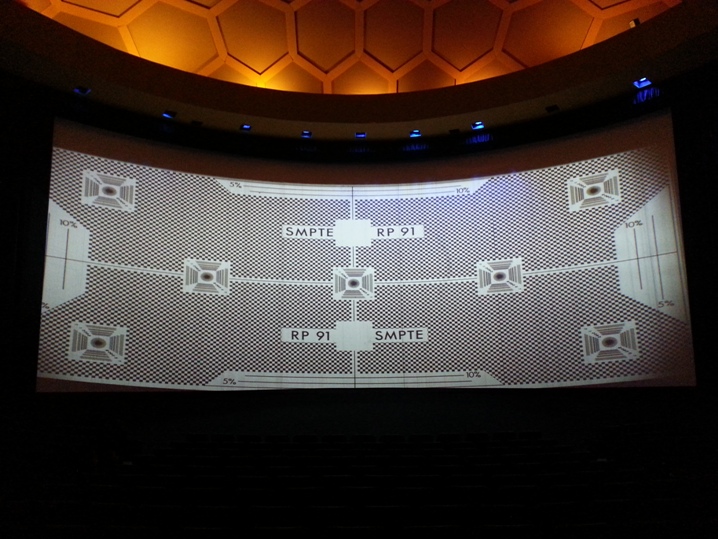
quote: Brian GuckianWhat is the magic number (degree) that defines a deeply curved screen? 100 degree curve? 120? 140?
I wasn't aware that 2001 had premiered on a true Cinerama screen, so for me that opens up a whole new area of enquiry regarding use of the deep curve.
quote: Brian Guckian2001 was presented at the Casino Cinerama in London on the deeply curved screen with a special 70mm print and lens for Cinerama. A pair of Philips (Kinoton) DP 70's were installed to replace the 3 strip Cinerama. The film however had its first premiere run in normal 70mm at the Empire Theatre, Leicester Square.
I wasn't aware that 2001 had premiered on a true Cinerama screen, so for me that opens up a whole new area of enquiry regarding use of the deep curve.
quote: Bernard TonksI don't think that's correct, Bernard. The first London season of "2001" appears to have been at the CASINO. If it played the EMPIRE, that would've been a re-issue. (The nine-day premiere date discrepancy aside, the following two sources indicate "2001" premiered at the CASINO.)
The film ["2001: A Space Odyssey"] however had its first premiere run in normal 70mm at the Empire Theatre, Leicester Square.
quote: John Sharp's 70mm in London list
2001: A SPACE ODYSSEY -- May 10, 1968 -- Casino-Cinerama
quote: Mike's '2001' list
01 May 1968 ... London, England, UK: Casino Cinerama (47 weeks)
![[Confused]](confused.gif)
![[Roll Eyes]](rolleyes.gif)
quote: Mark LensenmayerWhat have they got there? I've never seen a triple gauge projector, at least not for 16/35/70mm, there used to be one for 8/9.5/16mm. Have they got four machines, or the strange double-sided Kinoton things? I've only ever seen these with 35mm on one side, and 16mm on the back, but I can't see any reason why they couldn't build them with a DP-75 on the main side.
For the record, the Wexner Center runs reel to reel on 2 Kinoton projectors that are equipped for 16/35/70 projection. They rarely show a film for more than one or two screenings.
![[Cool]](cool.gif)
quote: Tim ReedAnd why does the same chain we do work for seem to get a different architect on each job??? Oh well... When I first moved to Utah I worked on a theater.. 8 plex... and it was the architects first... He had the floors graded absolutely flat... he said he didn't know they should be sloped... aparently not only did he never design a theater but he also had never even been in one... It was too late to do much because the concrete was already poured down in the front of some of the theaters. We conveined an emergency meeting with the two guys that were building the place, the contractor and architect. We finally settled on them sloping the remaining 2/3's of grade up towards the hallway to the allowable ADA specs. This necessitated the contractor raising the roofline of the lobby/booth area another 8 feet. So out of the lobbby you walked uphill to the hallway going down the theater entrances and then down into the theaters... That was the strangest one I ever worked on but we saved the project and the auditoriums more or less resembled what a normal slope would be, the concrete guys did an excellent job too. Recently the theater property and adjoining grocery store was bought and both will be razed to make room for a new hospital.
Most architects have little to no experience designing theatres. You really have to work closely with them to make sure they don't paint you into too many corners.
quote: Paul MayerIt was installed for the first-run engagement of HOWARD'S END. AFAIK, the only other full engagement they ran in 70mm was HAMLET. (However, they did run 70 prints of Ben-Hur and 2001 during a series of one-day showings of MGM classics, I believe).
Wasn't aware that the Royal even had 70mm capability
quote: Steve GuttagNope, there's barely enough room for the machines as it is.
They can't run 70mm on 2 machines? Most of my clients that have 70mm capability are being told that it is a requirement nowadays.
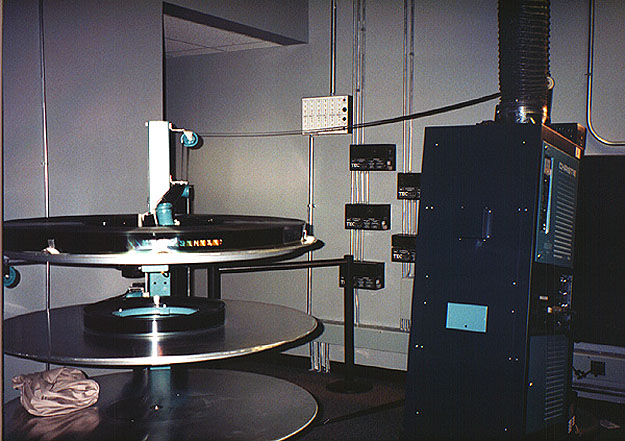
quote: Steve GuttagEvidently the bean counters here in So Cal rarely felt that way.
...those theatres that warranted 70mm also warranted NEVER losing a show.....
It has been 1895 days since the last post.
quote:Most of the good projectionists with real 70mm experience are retired. It only takes one playdate with one guy handling the print to inflict that damage. This is of no surprise and unfortunately there are too many theaters popping up that got an old 3570 projector and suddenly think they are experts at handling 70mm prints. This reminds me all too much of that one day Alamo training seminar thing on 35mm last year, as if someone attending that will suddenly be worthy of handling archive prints. One day is a joke, and actually insulting to real projectionists.
The Vertigo, Baraka, West Side Story and Lawrence prints that we seem to get every couple of months or so are now really starting to show their age and mileage, sadly.
quote: Daniel SchulzI'm going to risk being flamed here by opining that judged as movies (script, acting, direction, art direction, music etc.), they're all pretentious, plodding, vastly overhyped on their initial release, met a mainly lukewarm critical reception and would probably be quickly and permanently forgotten if it weren't for the 70mm aspect. All of them have some beautiful cinematography, art direction and costumes in places, which is why the large format does them justice. But now that they're in the second run/rep circuit, anybody booking those movies is going to have to accept that the 70mm geeks will show up to see them, but virtually no-one else. Lord Jim is also a tough sell - it never really achieved the "corny but essential classic" status of Lawrence (despite a lot of the same talent being involved), and even its star (Peter O'Toole) admitted that the movie didn't really work. It's not exactly feel-good family matinee fodder, either! South Pacific, The Bible, Magnificent Men, Cleopatra, My Fair Lady and Dr. Dolittle would at least be a draw for the wider public, and apart from occasional outings at places like the Bradford festival, have barely been shown since the launch of their restorations.
And hopefully The Master, Inherent Vice and Interstellar can be added to the rotation.
![[Eek!]](eek.gif)
quote: Leo EnticknapThat is correct. Quentin's movie will unfortunately almost single-handedly be murdering the future of film and specifically the 70mm format with this release because it's TOO big...such that it will FORCE people even worse than the concession-projectionists of years past to run them. Never in the history of 70mm will so many prints be shredded at the theaters so fast as this one.
Which means that an existing employee of these places, possibly someone with no film handling experience whatsoever (if the venue went digital several years ago and its last proper projectionists have left), is going to be running a 5/70 platter installation, presumably after a one-day crash course.
quote: Louis BornwasserThose Land Rush Scenes were filmed about 2 miles from where I
"Far & Away" was pretty bad.....until the land rush scenes....Bruce Surtees, Jr. Every bit as good as Lawrence.

quote: Mitchell DvoskinI'm guessing the currently circulating 70mm print is the UP70 version struck for the 40th anniversary. I caught this at the Cinerama Dome in 2003.
No, I am not sure that the currently circulating 70mm print is a blow up
quote: Mitchell Dvoskin was the last to postSorry for any confusion. I'm sure the print will be the version currently circulating. I used the phrasing I received in a personal email.
will screen a 70mm restored road show print of It's a Mad, Mad, Mad, Mad World
quote:
Facts about the new "Mad World" 70mm print
Written by: John Kirk, Director of Technical Operations" for the MGM Worldwide Services Department
The project was started during last summer (2003), probably around June. The final print was finished around the end of September or beginning of October 2003. We have various locations in the L.A. area, as well as in other places, where we store our elements. (It would be unwise to keep everything in one place, in case of natural or manmade disasters). Our original negatives are kept in a state-of- the-art facility called Pro-Tek in Burbank.
The DTS track was made at Chace Productions in Burbank from the existing 35mm 6-track stereo magnetic from the original release. Chace cleaned up the track and pumped up the surrounds a bit to give the track a more appropriate sound for modern ears. We used several different sound sources for the sound; I honestly don't remember which of our local facilities housed the 6-track magnetic before it was moved to Chace.
The lab work was done at Technicolor, because that is the only lab in Hollywood that still does 70mm work. Fortunately, the original negative was basically in good shape, so there was not a lot of repair work necessary. Most of the lab work involved close inspection of the materials, cleaning, re-timing, and a few repairs. The most notable problem was some color fading in the opening credit sequence, but since this project was not a true "restoration" per se, there was no work done on that. Otherwise, the color throughout the rest of the film was quite good.
One thing you should know about the 70mm print you'll be getting. The projector should be left on during the timed 15-minute intermission. There is nothing on the picture, obviously, but the DTS track has the police calls that were in the original release. The calls are repeated a few times during the intermission so that people from the audience can leave to go out to the restrooms before or after they hear the calls.
quote: Jeffry L. JohnsonThats quite a lot of unshown Footage since the Orginal Theatrical Release in 63 was 205 minutes
Total running time including overture, intermission, entr'acte, and exit music was 176 1/2 minutes.