This is topic Minneapolis Bridge Collapse in forum Film-Yak at Film-Tech Forum ARCHIVE.
To visit this topic, use this URL:
https://ft-forum.com/ft/cgi-bin/ubb/ultimatebb.cgi?ubb=get_topic;f=8;t=005190
Posted by Steve Scott (Member # 630) on 08-01-2007, 09:16 PM:
Just to let you all know, I am well, though under certain circumstances, I might've been close enough to this bridge to have been at the scene. In a surreal way, this was my day off. I will be at work, eight blocks upstream tomorrow morning & will take some photos of the scene.
Link
Posted by David Stambaugh (Member # 1102) on 08-01-2007, 09:30 PM:
Someone in the Minnesota Dept. of Transportation has some 'splainin' to do.
A few years ago the Oregon Dept. of Transportation figured out that the 50-year-old I-5 bridges spanning the McKenzie and Willamette Rivers here were both structurally unsound. Coincidentally, the bridges were designed and built in the 1950s with a 50-year lifespan in mind. The structural problems were so urgent that they had to detour heavy trucks to other routes. ODOT eventually built new temporary bridges that bypass the old ones. The temp bridges are designed to last only 10 years.
The old bridges still stand, and the one crossing the Willamette River seems to have visible sagging in some of the spans. I suspect it was closed in the nick of time.
Posted by Allison Parsons (Member # 2728) on 08-01-2007, 10:04 PM:
I am NOT trying to make light of this situation, but some people reported feeling vibration on the bridge, while construction workers were hammering away. What was the episode of Myth Busters that they tried to 'take down' a bridge with vibrations?
How long was that bridge anyway?
Posted by Phil Hill (Member # 371) on 08-02-2007, 01:07 AM:
quote: David Stambaugh
Someone in the Minnesota Dept. of Transportation has some 'splainin' to do.
I agree Dave. Makes one wonder just how far the structural engineers and inspectors have their heads up their collective ass.
I feel so sorry for the innocent people that, once again, trusted the "authorities" and "experts" and lost.
Posted by Bobby Henderson (Member # 840) on 08-02-2007, 01:24 AM:
I'm pretty nervous about this incident. My cousin, a really good fellow named Thomas McCurry, lives in the Minneapolis-St. Paul metroplex and drives through the I-35W corridor on a regular basis. I haven't heard from him since this happened. My aunt Patricia (his mother) hasn't heard anything either. I just pray he's alright.
My hopes and prayers are for all the families caught up in this disaster.
Some of this incident reminds me of that horrific incident that happened on I-40 in Oklahoma over the Arkansas River near Webber's Falls years ago. 14 people (and 4 horses) were killed when a barge hit the I-40 bridge going over the river. The barge hit the bridge support and caused large spans to fall away sending numerous vehicles flying into an abyss.
I think this is a pretty good sign for this nation to finally pull it stupidly dumb-assed head out of its collective ass and finally start paying attention to maintaining infrastructure. Doing that job right is not some socialist concern. It is a moral obligation. "Good enough" and selling out to the communist Chinese will not qualify. Americans absolutely Goddamn deserve roads and bridges that aren't going to kill them.
![[fu]](graemlins/fu.gif)
Posted by Leo Enticknap (Member # 534) on 08-02-2007, 01:54 AM:
I hope Bobby's cousin and all the other Minneapolis Film-Techers are OK.
I guess two things we can be thankful for are that the school bus managed to stop in time and that only one lane on the bridge was open, because of roadworks. I remember driving across it (or it could have been the one next to it - not sure) in heavy traffic when I visited Minneapolis in 2004: there would have been a lot more than 50 vehicles involved if all the lanes had been open.
Posted by Hillary Charles (Member # 769) on 08-02-2007, 06:06 AM:
quote: Bobby Henderson
I think this is a pretty good sign for this nation to finally pull it stupidly dumb-assed head out of its collective ass and finally start paying attention to maintaining infrastructure. Doing that job right is not some socialist concern. It is a moral obligation. "Good enough" and selling out to the communist Chinese will not qualify. Americans absolutely Goddamn deserve roads and bridges that aren't going to kill them.
Amen, Bobby!
I'm afraid way too many of our nation's roadway structures are ticking time bombs of this sort. It's shameful!
Bobby, I hope you hear from your cousing soon.
Posted by Stephen Furley (Member # 1277) on 08-02-2007, 06:22 AM:
quote: David Stambaugh
Coincidentally, the bridges were designed and built in the 1950s with a 50-year lifespan in mind.
That sounds like a very short lifespan for something like a major bridge.
Posted by John Walsh (Member # 168) on 08-02-2007, 06:41 AM:
In 1983 or so, the I95 bridge over the Mianus River here in Connecticut collapsed. A local resident had called the CT DOT several times prior about how the "sound" of cars going over the bridge was changing. They told her she was crazy. Also, the two bridge inspectors would 'inspect' the bridge using binoculars, sometimes from two miles away.
Posted by David Stambaugh (Member # 1102) on 08-02-2007, 09:37 AM:
quote: Stephen Furley
That sounds like a very short lifespan for something like a major bridge.
Interstate 5 is the primary north-south artery for the west coast. It takes a horrible pounding from large trucks carrying very heavy loads. Fifty years could be the norm for this type of structure, I dunno.
Last night initial reports were that the Minnesota bridge had passed its 2005 inspection. Now the reports say it was actually judged structurally deficient, scoring 4s and 5s on a 9 point scale.
As a result of news inquiries, ODOT now says the bridges here were not structurally unsound and that their closure and replacement with very expensive temporary bridges was purely precautionary. Uh huh.
Posted by Mark Hajducki (Member # 1732) on 08-02-2007, 11:04 AM:
quote: Stephen Furley
That sounds like a very short lifespan for something like a major bridge.
The main Road Bridge over the Forth Estuary is estimated to be closed by 2020 giving it a lifetime of less than 65 years.
The 1890 opened Rail Bridge will last a lot longer.
[ 08-03-2007, 08:42 PM: Message edited by: Mark Hajducki ]
Posted by Bobby Henderson (Member # 840) on 08-02-2007, 11:07 AM:
My cousin Tommy is alright (thank God). My aunt talked to him last night fairly late. He was at a restaurant in downtown Minneapolis when the bridge collapse happened. Tommy said he crossed that bridge taking I-35W on the way to work every day.
Our nation has lots and lots of bridges that are structurally deficient. A year ago a woman from Kansas was killed on I-35 in northern Oklahoma when a chunk of concrete fell from a crumbling overpass and smashed through her windshield.
A former co-worker of mine now works for a Texas-based construction company that specializes in bridge rehabilitation in Oklahoma and the Lone Star state. He didn't give bridges much thought previously, but this job has given him a whole new perspective. He has seen some bridges that look like they're barely held together by rust and paint. Yet thousands of people drive over them...oblivious to the danger under that road deck.
50 years may seem like a short life span for a bridge. However, any bridge requires regular maintenance or it won't last anywhere near that long. And you have the issues of geology. The earth supporting that bridge is in an ever changing state.
Posted by Mike Blakesley (Member # 26) on 08-02-2007, 12:00 PM:
Around 15 or 20 years ago when I was in Florida, my friend and I decided to drive the highway over the Keys. At one point, we were funneled into one lane because a huge bridge on the other side was "under construction." Weeks later I found out in a newspaper article that, in fact, the bridge had fallen down and was in the process of being rebuilt. The article said that somewhere around 50% of the bridges in the US are in serious need of some kind of work, but the usual "budget cuts" prevented it.
The bridge here over the Yellowstone River hasn't had so much as a coat of paint in my lifetime that I know of, and that bridge was built in 1952.
Posted by Steve Scott (Member # 630) on 08-02-2007, 01:14 PM:
Well, I'm at work for the afternoon, watching the busiest Thursday traffic on humble Main Street I've witnessed yet.
The closest I got to the scene, this morning was on the University Ave. Bridge (the last overpass before the former bridge, where you'll probably see all the national newspeople reporting from). I got some epic photos of the buckled span, as well as group shots from the press conference with the Gov., congresspeople & the head of the NTSB. I should be able to crop down some photos of the overpass that collapsed onto the freight train, as well. All, to come when I arrive home this evening.
Traffic had backups around the detour, but the detour route (MN-280) has apparently been free-flowing. Many more buses in service, the light rail probably won't be affected, as it mainly services south metro connections. A lot of roaming amateur photographers around.
Posted by Bruce McGee (Member # 131) on 08-02-2007, 01:31 PM:
Was the bridge that collapsed built in the same style as the bridge on the other side?
There is a bridge here in Asheville that was built to replace a 95 year old 2-lane bridge. I was told by the son of the builder of the replacement bridge that the replacement would possibly last 30 years, maybe. Its all in being the LOW BIDDER!!! Its now 25 years old. It vibrates when I am walking on its sidewalk when cars go by.
The 95 year old bridge survived several major floods of the river, and had to be brought down with dynamite!
There is a local bridge on I-40 here that was built using substandard steel. Of course, the builder is long out of business. I tend to think that the state knew that the bridge was not right, and was in a big hurry to get I-40 open through here in the early 1970's.
I learned about this horrible incident while watching the BBC News last night. Their reporting was very thorough.
Posted by Gordon McLeod (Member # 33) on 08-02-2007, 02:25 PM:
By its nature most concrete structures just like concrete itself have a finite life span compared to natural materials like stone
An engineer once told me most concrete will have a reduction in strength in about 10 years
Posted by Frank Angel (Member # 248) on 08-02-2007, 02:28 PM:
Hey, you want to know how to build a bridge? Come to Brooklyn and we'll show you. 50yrs life span? That's a joke. Roeblings' Brooklyn Bridge was finished in the early 1880s, was build before bridge models could be tested in wind tunnels for aerodynamic integrety AND it was built for horse and buggy travel, not for cars. And.....IT IS STILL STANDING, long after many others built after it are gone. Interesting fact: the Manhattan side tower isn't planted in bedrock but only on sand. Now THAT's how you build a bridge!
Posted by Stephen Furley (Member # 1277) on 08-02-2007, 03:32 PM:
quote: Gordon McLeod
An engineer once told me most concrete will have a reduction in strength in about 10 years
I would expect to see some reduction in that time, but how much? If it's 0.01% then it's no great problem; no structure is going to last forever. If it's 5%, then something is seriously wrong.
Glenfinnan Viaduct, in Scotland was built in concrete in 1901, and still seems to be in pretty good condition. web page Admittedly, the construction is quite different to most modern concrete structures.
quote:
Hey, you want to know how to build a bridge? Come to Brooklyn and we'll show you. 50yrs life span? That's a joke. Roeblings' Brooklyn Bridge was finished in the early 1880s, was build before bridge models could be tested in wind tunnels for aerodynamic integrety AND it was built for horse and buggy travel, not for cars. And.....IT IS STILL STANDING, long after many others built after it are gone. Interesting fact: the Manhattan side tower isn't planted in bedrock but only on sand. Now THAT's how you build a bridge!
I suspect that New York has more large bridges per square mile than just about anywhere else on Earth, most of them much more than fifty years old. Even the Verrazano-Narrows is now 43 years old. Most of them don't seem to be falling down, though some, such as the Manhattan Bridge, and the recently re-opened railway bridge between New Jersey and Staten Island have undergone some very heavy maintenance/refurbishment recently, and there is talk of replacing the Goethals bridge. If modern bridges are only expected to last fifty years then something seems to be wrong; whether in design, materials, construction or maintenance, I don't know.
I can think of very few bridges which have actually collapsed; there was the famous one that failed due to resonant oscillations when subjected to crosswinds, I can't remember the name.
I can think of a few in this country, oddly enough all of which were rail bridges. The Tay Bridge in 1879, I'm not sure if that was a design or materials failure. web page
Lewisham, 1957, where an overbridge was brought down after being hit by the wreckage of a train. Interestingly, the Wikipedia entry ror the accident states that the temporary bridge erected is still in use fifty years later. I haven't been that way for some time, but I remember seeing it still there a few years ago. web page .
Lastly, the Severn Rail Bridge, which partially collapsed after being hit by a barge in 1960. web page
Posted by David Stambaugh (Member # 1102) on 08-02-2007, 03:56 PM:
quote: Stephen Furley
there was the famous one that failed due to resonant oscillations when subjected to crosswinds, I can't remember the name
You're thinking of the Tacoma Narrows Bridge. There's decent quality video of it oscillating and finally collpsing there (that link be wikipedia) and probably many other places.
Posted by Leo Enticknap (Member # 534) on 08-02-2007, 04:45 PM:
Perhaps the record for the shortest lasting bridge goes to the first Tacoma Narrows Bridge, which disintegrated a mere four months and six days after it was opened. The owner of a local camera shop filmed it in 16mm Kodachrome, and you can see the footage on this Wikipedia page (or buy the DVD from his son for $65 if you want to see it in colour, though this seems very expensive for an 8-minute film if you ask me) - very scary stuff.
Glad to hear that Bobby's cousin and Steve are OK.
Stephen: if memory serves me correctly, the Tay Bridge was a design issue. Wasn't the famous architect who designed it stripped of his knighthood or something like that?
Edit: great minds think alike!
Posted by Bobby Henderson (Member # 840) on 08-02-2007, 05:31 PM:
With regard to complaints about short life spans of bridges, there are some important points to consider, such as wear and tear beyond the original design capacity.
The I-35W bridge in Minneapolis was 40 years old. It was carrying 100,000 vehicles per day on average -which is likely a much higher traffic count than what it supported when opening in 1967. Many of those vehicles are heavy tractor-trailer rigs. One pass from a truck exerts wear and tear of the structure equal to as many as 2000 cars.
A concrete building structure can potentially withstand the elements for many decades. However the stresses to bridge and road structures posed by super-highway traffic are pretty severe, especially on urban roadways carrying hundreds of thousands of vehicles every day. Comparing a super-highway bridge to an old structure that only carried pedestrians and horse-drawn carriages is an apples to oranges thing.
Then you have to consider that most bridges built in recent decades are engineered to use as little in the way of building materials as possible -to save money.
A bridge like the Brooklyn Bridge was definitely "over-built" compared to today's standards of engineering. Some mention should also be made about how the Brooklyn Bridge (and many of the other large bridges in NYC) have had lots of rehab work done on them over the decades.
The Verrazano Narrows bridge is one of the youngest bridges in NYC. But when I moved to Staten Island in 1986 the bridge was getting all sorts of maintenance work and a new paint job. My family took the opportunity to walk across the top deck of the Verrazano bridge during a celebration of its 25th birthday in November of 1989. Somewhere I have a bunch of color slides I took while making the walk.
Posted by Mike Heenan (Member # 392) on 08-02-2007, 06:39 PM:
quote: Frank
Hey, you want to know how to build a bridge? Come to Brooklyn and we'll show you. 50yrs life span? That's a joke. Roeblings' Brooklyn Bridge was finished in the early 1880s, was build before bridge models could be tested in wind tunnels for aerodynamic integrety AND it was built for horse and buggy travel, not for cars. And.....IT IS STILL STANDING, long after many others built after it are gone. Interesting fact: the Manhattan side tower isn't planted in bedrock but only on sand. Now THAT's how you build a bridge!
Hmmm, not so fast....
http://wcbstv.com/topstories/local_story_214173505.html
(CBS) MINNEAPOLIS The three governors across the tri-state have called for a review of all bridges following the devastating Minnesota bridge collapse, but there is one bridge in particular causing worries: the Tappan Zee, which spans the Hudson River.
It's long been known the Tappan Zee bridge has problems. A recent report from the Federal Highway Administration points out significant deterioration to the concrete and the structural steel of the bridge. The New York State Thruway Authority says it's working to address the problem.
There's reason to be concerned about the bridges in the region, which take on a heavy load from the overload of traffic especially within New York and New Jersey.
Of 2,027 bridges in New York City, the 124-year-old Brooklyn Bridge is only one of two to fail its most recent inspection. It's got problems, but the city insists those problems do not put the public at risk.
"The poor condition means there's components of the bridge. They are the approaches, and of the approach it's the bridge deck and some joints," said Lori Ardito of the New York City Department of Transportation. "Again, it is safe, but it just means that those components need to be rehabilitated."
That said, it's the older bridges that cause DOT officials the most anxiety. New Jersey's Pulaski Skyway, for example, was built in 1930 to funnel the Holland Tunnel traffic inland and would be replaced if the state could afford the billion dollar price tag.
Gov. Jon Corzine says they're keeping a close watch on it. "If there are unsafe bridges, they'll be shut down," he says.
Most bridges are physically inspected every two years unless a structural problem is identified. Many believe that's not enough protection and some experts say we should employ more electronics to sense extra wear or stress, such as technology available that enables remote monitoring of bridges.
Still, the biggest bridges in the area are often under continual maintenance. Crews were out Thursday, for example, on the Throgs Neck Bridge connecting Queens and the Bronx. In a phone conference Thursday afternoon, city DOT officials said the bridges connecting the boroughs are in the best shape in a decade.
"I want to reassure all New Yorkers that all of our bridges have been inspected in according to state and federal standards," Ardito said.
Posted by Mark Gulbrandsen (Member # 72) on 08-02-2007, 08:13 PM:
Humm, I heard last night during the Prez's DOT secretary speaking that there were 80,000 bridges nationwide deemed unsafe and need replacing... Anyone else hear her say that?
Mark
Posted by Mike Heenan (Member # 392) on 08-02-2007, 09:35 PM:
Didn't hear it but there's an article at the top of Drudge that says more than 70,000
Posted by Steve Scott (Member # 630) on 08-02-2007, 11:03 PM:
For the sake of the busy day, here's my album containing a few photos of the day's tour around the scene. Nothing more spectacular as I was on my day off, thankfully & not among the would-be first responders if fate had treated me differently yesterday!
Again, a sunset shot of the abandoned superhighway; a view of late evening traffic levels that rival typical rush hours around here; the buckling approach to the non-bridge; the press conference with most representatives attending, this morning; and the freight car that was leaking last night, now subtly pinned underneath the former interstate overpass.
Posted by Leo Enticknap (Member # 534) on 08-03-2007, 02:40 AM:
That freight train wagon looks like it was built to withstand a direct hit from a missile! Admittedly it's in the background and perspective may be playing tricks, but it seems as if the entire bridge deck is resting on its roof - the wagon doesn't look in any way deformed or crushed at all.
Posted by Mark Hajducki (Member # 1732) on 08-03-2007, 07:36 AM:
quote: Bobby Henderson
The I-35W bridge in Minneapolis was 40 years old. It was carrying 100,000 vehicles per day on average -which is likely a much higher traffic count than what it supported when opening in 1967. Many of those vehicles are heavy tractor-trailer rigs. One pass from a truck exerts wear and tear of the structure equal to as many as 2000 cars.
The ever increasing weight of trucks, combined with the greater numbers is adding a lot of stress to many bridges (and roads in general).
This is one reason why the M6 Toll road near Birmingham UK, charged HGV (heavy goods vehicles) £10 compared with £2 for cars when it opened, however these were reduced since most drivers were using the old (free) section of the road.
quote: Leo Enticknap
if memory serves me correctly, the Tay Bridge was a design issue. Wasn't the famous architect who designed it stripped of his knighthood or something like that?
I think it was a combination of a flimsy design (which is why the Forth bridge was built so much stronger) and the use of substandard materials. Some of the old structure has been used to support the current bridge.
The rail crossings of the Tay also have cultural importance inspiring three clasic poems
Posted by Mike Blakesley (Member # 26) on 08-03-2007, 10:43 AM:
quote: Mark Gulbrandsen
I heard last night during the Prez's DOT secretary speaking that there were 80,000 bridges nationwide deemed unsafe and need replacing...
Did she say "need replacing" or "structurally deficient?"
On the news yesterday, they explained that "structurally deficient" could mean anything from "about to fall down" to "needs to be repainted." About half of the bridges in the country are supposedly in need of SOME kind of work, but they're not all about to cave in.
It's amazing how many bridges there are. The state of Montana has over 5,000 bridges.
Posted by Louis Bornwasser (Member # 3063) on 08-04-2007, 06:38 AM:
Note that they were busy repaving a structurally bad bridge. This is a bit like rearranging the deck chairs on the Titanic. Louis
Posted by Leo Enticknap (Member # 534) on 08-04-2007, 05:16 PM:
If I'm reading the news reports correctly, the key issue appears to be finding a reliable definition of 'structurally bad' by which to examine other bridges in the aftermath of this incident.
We had what I guess might turn out to be a similar sequence of events: the preliminary investigation into the Hatfield rail crash in October 2000 suggested that the likely cause was 'gauge corner cracking', i.e. structural failure of the rail itself under the stress of a heavy, high-speed train passing over it. For about a year afterwards, temporary speed limits and diversions were put in place while virtually every inch of rail in Great Britain was checked for signs of the problem. Thousands of miles of rails were simply replaced on spec: the cost was enormous, the disruption huge, and to this day no-one really knows whether it was really necessary or if the problem was in reality confined to a small proportion of the total rails in use on the system. The only thing we know for sure is that a lot of engineering companies made a lot of money from the British taxpayer.
Presumably the issue as to whether the cause of the Minneapolis bridge collapse could potentially affect other bridges will be very high on the investigators' agenda. But I can't help suspecting that there'll be civil engineering contractors across the US and beyond looking to cash in on the fear that your local bridge might just have a problem...
Posted by Ben Wales (Member # 92) on 08-04-2007, 05:46 PM:
One of the Oldest Contrete structures (may in the World) is not far from where I live and is call Sway Tower and still stands at 200ft!.
"Sway is perhaps best known for Sway Tower. At 66 metres (200 feet), it is the tallest folly in the world. It is a Grade II listed building. It is also known as "Peterson's Folly"
Built by Judge Andrew Thomas Turton Peterson on his private estate from 1879-1885, its design was influenced by the follies Peterson had seen during his time in India. It is constructed entirely out of Portland cement, supported by iron joists. At the time it was built, it was the tallest concrete structure in the world.
It was originally designed as a mausoleum, with a perpetual light at the top. However this was not allowed, as it was thought the light would confuse shipping.
The tower is visible from much of the New Forest, and most of the western Solent."
Posted by Phil Hill (Member # 371) on 08-04-2007, 07:02 PM:
quote: Louis Bornwasser
Note that they were busy repaving a structurally bad bridge.
Good point, Louis! ![[thumbsup]](graemlins/thumbsup.gif)
Posted by Dustin Mitchell (Member # 372) on 08-04-2007, 07:28 PM:
From what I understand the repairs that were being done were to the surface of the deck, or more specifically, the pavement. As far as I know-and I could be mistaken-no structural repairs were being done at the time of the collapse.
Posted by Jim Bedford (Member # 4) on 08-05-2007, 08:45 AM:
Although true that structural work was not being done, I think the point people are trying to make with comments about the jackhammering and resurfacing is the "straw that broke the camel's back" effect. If if was substandard or weakened in the first place, then the activity and additional weight might have made the structural issues reach their tipping point.
Monday, more than 100,000,000 Americans are going to cross a bridge that has the same rating as this one did before its collapse. Sort of like playing the wrong lottery, eh?
Posted by Chad Souder (Member # 343) on 08-05-2007, 11:15 AM:
quote: Jim Bedford
If if was substandard or weakened in the first place, then the activity and additional weight might have made the structural issues reach their tipping point.
Actually, in my understanding, the ongoing construction kept a lot of weight off the bridge at the time of the collapse as there were only 2 lanes open for traffic as opposed to the "normal" 4 lanes. The construction could be a blessing in disguise as the number of cars was fewer and possibly at a stand-still because of it, although I am well aware that during that time of day there is regularly stopped traffic throughout the Twin Cities.
Posted by Jeremy Jorgenson (Member # 2989) on 08-09-2007, 06:00 AM:
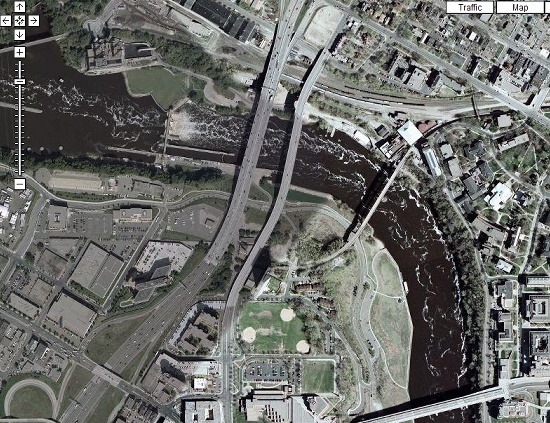
When this happened, I checked google's satellite image of the bridge pre-collapse ... the water looks to be rough there.
------
...speaking of cement, the new Trump Tower in Chicago (supposedly being completed in 2008 & will be Chicago's 2nd tallest building until about 2010) is using concrete (rather than steel) in order to fit the footprint it had available & still have the height.
Posted by Leo Enticknap (Member # 534) on 08-09-2007, 09:31 AM:
Was that weir a little way upstream built to relieve the water pressure on the bridge supports?
Posted by Chad Souder (Member # 343) on 08-09-2007, 03:15 PM:
Jeremy -
Do you know when that picture was taken?
Posted by Bill Enos (Member # 440) on 08-09-2007, 06:29 PM:
No supports for this bridge were in the water, supported from both banks.
Posted by Jeremy Jorgenson (Member # 2989) on 08-09-2007, 08:33 PM:
quote: Chad Souder
Jeremy -
Do you know when that picture was taken?
No idea.
Posted by Joe Redifer (Member # 3) on 08-09-2007, 09:29 PM:
Which bridge in the picture is it?
Posted by Sam Graham (Member # 2889) on 08-09-2007, 09:58 PM:
It's the wide one on the left.
Powered by Infopop Corporation
UBB.classicTM
6.3.1.2