This is topic Changeover guys/gals - test your skills in forum Film-Yak at Film-Tech Forum ARCHIVE.
To visit this topic, use this URL:
https://ft-forum.com/ft/cgi-bin/ubb/ultimatebb.cgi?ubb=get_topic;f=8;t=005235
Posted by Frank Angel (Member # 248) on 09-28-2007, 07:31 PM:
So you think you can make those "perfect" changeovers? Don't mind the cartoon format, this little program will give you your eye/finger reaction time in hundredths of a second.
Cue --> Reaction : Time in hundreths of a second
Any of you math wizzes want to figure out how fast you have to be in order to get within a single frame accuracy....two....three...etc?
Posted by Brad Miller (Member # 2) on 09-28-2007, 07:36 PM:
Gosh Frank, I don't need that program to tell me that I am frame accurate with all of my changeovers, whether it is when I am running films on a platter or in my screening room under the CA21 command. ![[Razz]](tongue.gif)
Posted by Monte L Fullmer (Member # 2797) on 09-28-2007, 07:42 PM:
I used to cheat a bit: I would lace up the leader in the machine down a bit to when would hear the leader splice enter the trap is when I did the picture changeover..then, on the 2nd cue, is when I would do the sound changeover. Total delay was about one half of a second.
Posted by John Hawkinson (Member # 1135) on 09-28-2007, 09:05 PM:
Frank: HUH?
Length of reaction time has nothing to do with frame-accuracy of changeovers, unless your reaction time exceeds the better part of a second. What's important is consistency of reaction time. You simply thread such that your changeovers will be accurate for your own reaction time. End of story.
--jhawk
Posted by John Wilson (Member # 269) on 09-28-2007, 09:31 PM:
Hi Monty
Why?
Posted by Frank Angel (Member # 248) on 09-28-2007, 10:54 PM:
John, you are right, and of course that means that if you REALLY want to get it accurate as humanly possible, you first have to determine the exact time each of the projectors ramped up to full speed, which might not even be the same for each machine, and then each projectionist who worked the booth would need to determine his own "personal" response time and adjust down from there to compensate for that.
And believe me, those of us old enough to know what it was like when all houses were changeover know at least a few of those really old guys whose reaction time sure did exceed the better part of a second. And you knew who they were by watching them thread up on [3] "just to be on the safe side," as one of them once explained it to me. And even THEN you couldn't be sure they would hit it. Hells, they could fall asleep between the MOTOR/SYNC cue and the C/O cue! OK, I exagerate, but you KNEW they were threading on some ridiculously low number when you heard the garbled sound because the sound drum did not get up to speed and saw that tell-tale picture continuity jump so badly that it was painfully obvious you just missed something. ![[Eek!]](eek.gif)
You think these times of the minimum wage splice-monkeys are scary....don't let anyone kid you, the change-over days had some scary scenarios as well. At least the platter prevents some clown from changing over to the last 5 min. of the last reel so he can get home early on a Friday night.
Posted by Monte L Fullmer (Member # 2797) on 09-28-2007, 11:01 PM:
quote: Frank Angel
At least the platter prevents some clown from changing over to the last 5 min. of the last reel so he can get home early on a Friday night
I've known changeover kids to skip an entire reel just to beat it out of the theatre early on any night when they can get away with it.
On that "delayed" changeover trick that I sometimes used, it was for the reason to "blend" the changeover, and on certain reels, I would "blend" opposite - sound first, then picture. But, on new prints with uncut head leaders, then I would do the conventional changeover.
(That's pretty sad when they have to lace down to the number "3" in the framebox. I always maintained between "8" and "7" on the academy leader and be in the "5" section on the clocksweep leader)
Posted by John Hawkinson (Member # 1135) on 09-28-2007, 11:06 PM:
Oh, sure, Frank. Been there, done that, got the t-shirt. Measured the actual projector speed, the ramp-up time, made a spreadsheet for common changeover lengths, did up a nice threading diagram, and posted it on the side of the lamphouse. It is indeed slightly different for two adjacent machines...
Like this:
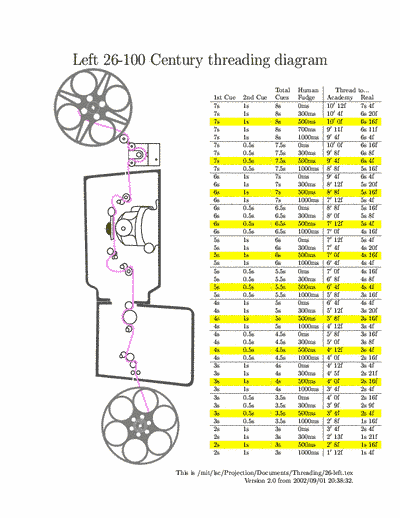
Each operator can choose the proper reaction time ("fudge factor"). Yellow line goes through 500ms, which seems to be typical.
The "self-clocking" method (I'd attribute it to Steve K.) is a handy way to check yourself and soforth, but then you run into an uncut print and screw yourself.
Threading to 8 on an academy leader? Perhaps our Centuries are just a tad fast (insert Mark G. jackrabbit comment), but perhaps you guys are shortchanging the last second of the outgoing reel? Motor start on motor cue. Pause ONE FULL SECOND after the changeover cue, and then hit the changeover button. That last second is there to be shown.
--jhawk
Posted by Joe Redifer (Member # 3) on 09-29-2007, 12:17 AM:
I don't like that flash game. I kept waiting until the sheep got on a perfect vertical line above the tranquilizer dart, but it penalized me 2/10ths of a second for that. I guess I'm too used to video games.
Posted by Brad Miller (Member # 2) on 09-29-2007, 01:55 AM:
quote: John Hawkinson
Perhaps our Centuries are just a tad fast (insert Mark G. jackrabbit comment), but perhaps you guys are shortchanging the last second of the outgoing reel? Motor start on motor cue. Pause ONE FULL SECOND after the changeover cue, and then hit the changeover button. That last second is there to be shown.
Nope, nowadays most brand new prints only have 18 frames after the changeover cue, and since most films run at 24 frames per second, you have to wait 3/4 of a second to do the changeover! That was messing with me this year at Telluride as I did some practice changeovers because I am so used to 24 frames after the last cue.
Posted by Stephen Furley (Member # 1277) on 09-29-2007, 03:45 AM:
quote: Brad Miller
Nope, nowadays most brand new prints only have 18 frames after the changeover cue, and since most films run at 24 frames per second, you have to wait 3/4 of a second to do the changeover! That was messing with me this year at Telluride as I did some practice changeovers because I am so used to 24 frames after the last cue.
I remember something about this change being posted here a couple of years ago. However, I often see to opposite happening; the c/o cue is early on the print, by anything up to 5 or 6 extra frames, so there could be up to about 30 frames from first frame of cue to LFOA. It just varies from print to print, and sometimes from reel to reel. That's before people start chopping odd frames out of the print. I can only think that they're dooing this to allow for the loss of some frames at the reel ends during the life of the print; it's happening too often to be an eror. Then, of course' there are the prints, mainly from French labs, which have no cues at all, unless someone as scribed some huge, ugly handmade ones ![[Frown]](frown.gif)
What was the official reason for the change to 18 frames; was it that people were tending to change too early, and missing too many frames at the end of the reel?
Posted by Tim Reed (Member # 137) on 09-29-2007, 06:50 AM:
BTW, I used to wait one second before hitting the switch, too (or, listen for the incoming splice, depending on the action).
FWIW, it was 18 frames in the "old days". I used to run a repertory booth for many years, and some of the classics I got new prints of were cued this way.
Posted by Mike Blakesley (Member # 26) on 09-29-2007, 09:25 AM:
There was no way I could wait a full second back in my changeover days. A lot of the prints we got had been through so many platter theatres, each of which would cut off one or more frames to get rid of the splice tape, that often the changeover cue was MISSING, let alone having frames left after it.
Posted by Rick Raskin (Member # 1561) on 09-29-2007, 12:00 PM:
IMHO you guys are being far to analytical about this. Reel breaks were normally placed where a change can occur and not affect the story if a half second or so was cut. Think Dorothy opening the door at the end of Wizard of Oz, R-1. Think the leopard licking his chops at the end of 2001, R-1. Thread on 8 or 9 (Academy) or 6.25 (SMPTE) and let 'er rip. You'll catch a perfect fade-out, fade-in every time.
Posted by John Hawkinson (Member # 1135) on 09-29-2007, 03:23 PM:
Well, Rick, somebody's got to be too analytical.
Yes, it's true, often there are 18 frames. During inspection, of course, we count the distance between and after cue dots, and right it down on the cue sheet, and then of course our projectionists adjust their timing based on that. Sorry for leaving out yet another detail ![[Smile]](smile.gif)
--jhawk
Posted by Mark Ogden (Member # 43) on 09-29-2007, 03:42 PM:
quote: Rick Raskin
Think Dorothy opening the door at the end of Wizard of Oz, R-1.
At the risk of being too anal . . . ytical, the from behind P.O.V. shot of Dorothy opening the door is at the head of reel 2. It's the cut point between the sepia-tinted B/W footage and the full color stock.
Posted by Frank Angel (Member # 248) on 09-29-2007, 05:33 PM:
John, that chart.....WAY freakin awesome, my friend! Details.... they're what make the world go round.
Posted by Monte L Fullmer (Member # 2797) on 09-29-2007, 06:13 PM:
quote: Rick Raskin
You'll catch a perfect fade-out, fade-in every time.
..another fadeout changeover to get exact was the change from reels 1 to 2 on the first STAR WARS (1977) movie.
And with XL's and SH-1000's that I had, I would place "10" in the framebox of reel 2 to make the changeover just right due to the slow ramp up speed of the SH-1000 (4-star) heads.
(Think what those guys would have to do with the 70mm prints to get that changeover just right in their "JJ's" and "AA-2's")
Posted by John Hawkinson (Member # 1135) on 09-29-2007, 09:15 PM:
Umm, Monte, slow ramp-up speed means you thread with LESS countdown, not more.
--jhawk
Posted by Bill Enos (Member # 440) on 09-29-2007, 10:46 PM:
Around here the old guys said that they were expected to make the changeover WHILE the change cue was on the screen and trainees had to demonstrate the ability to do so before they were allowed to work by themselves.
Posted by Brad Miller (Member # 2) on 09-29-2007, 11:02 PM:
Those old guys are just dating themselves...all the way back to pre-tape splicers. I've seen more than a few prints go through my hands where some idiot chopped off 12 ID frames and the leaders were cement spliced back on.
Posted by John Hawkinson (Member # 1135) on 09-29-2007, 11:27 PM:
It was wrong then, it's wrong now. Always measure. Maaaaaybe if you're a screening room with a one-shot show and you're in a hurry, you can get away without it, but it's not Film Done Right.
(Measuring the time between cue dots is sufficiently more work that I could see skipping that if you're in a hurry. It doesn't take much time with a sync block, assuming that you use the guess-and-check method and the timing is near to correct...)
--jhawk
Posted by Monte L Fullmer (Member # 2797) on 09-30-2007, 03:40 AM:
Yea John, you're right on that one - thx for getting me on the right track ..
Posted by Mark Gulbrandsen (Member # 72) on 09-30-2007, 10:29 AM:
Can't we have some important thread like "Best way to Pick Your Nose" or something more relevant?
Posted by Robert Throop (Member # 61) on 09-30-2007, 11:26 AM:
quote: John Hawkinson
Measuring the time between cue dots is sufficiently more work that I could see skipping that if you're in a hurry. It doesn't take much time with a sync block, assuming that you use the guess-and-check method and the timing is near to correct...)
Most guys I knew would line up the changeover cue with the edge of the reel and then count the turns either of the reel or the rewind crank depending on the setup. It was fast and accurate.
Bob
Posted by Mark Gulbrandsen (Member # 72) on 09-30-2007, 12:10 PM:
The best operators I knew would memorize the last line of dialog in each reel so they didn't clip off any of the dialog at all. On reels that didn't have ending dialog they'd go by the cues which they had previously checked for accuracy.
Mark
Posted by John Hawkinson (Member # 1135) on 09-30-2007, 12:17 PM:
Huh, that's an interesting method, Bob.
In the last millennium, before we had sync blocks and frame counters, we'd count "by hand." We have a paper blotter on the rewind bench with 24 frames (plus some extras) marked off, so you'd just pull out a second of film, move the right edge of the film to the left edge of the mark and measure off the next second, repeat 7 times.
It wasn't terrible, but it's a lot faster with a sync block (travel 10-foot-8-frames and check. Or 10-foot-12-frames in the New World Order).
As for crank-counts: I'm not quite so sure about accuracy... it seems like it depends a lot on the outer diameter of the reel. For instance, 7 seconds is 2.9 revolutions at 14 inches, but 3.1 revolutions at 13 inches, and 3.3 at 12 inches.
Or, to put it differently, if you decide you want to measure with 4-frame accuracy (seems like a lower bound on the accuracy you want), you need to be able to resolve 0.068 (14") or 0.080 (12") revolutions, and that seems a tough act to follow. That's somewhere between 1/15th and 1/12th of a revolution. I guess we should all be able to do twelfths (clock face)...
On the other hand, at various times I've toyed with the idea of mounting a revolution counter on the rewind bench. I'd always decided that it was mostly pointless as a footage indicator given the diameter variations, and the utility otherwise was insufficient.
But then it occurs to me that if you measure the number of revolutions on both sides, perhaps there is something clever that is doable. But it probably leaves the realm of purely mechanical devices. Probably need to measure their rates, too... Perhaps after I make Steve's cue markers.
--jhawk
Posted by Steve Guttag (Member # 268) on 09-30-2007, 02:20 PM:
John,
Using standard house reels with 5" hubs...unless you have a incredible amount of tail scrap leader...the "kitchen physics" rule is 8-truns between motor and changeover cues. It is accurate enough to check cues, not accurate enough to scribe cues.
So when I'm working a screening room and checking for cues...I'll locate the c/o cue...go back 8-turns and verify the motor cue. It takes virtually no time, presuming your are checking in the print anyway (which I always do...even for just one show).
Steve
Posted by John Hawkinson (Member # 1135) on 09-30-2007, 02:25 PM:
Sigh...you know, I didn't think of counting revolutions of the small diameter, just the big (variable) diameter. Fooled by the obvious again!
(Of course, handchecking from tail-out to head-out on a motorized rewind bench, there's no hand-crank to gauge it by, ah...)
--jhawk
p.s.: Yes, Scott, with a foot pedal.
Powered by Infopop Corporation
UBB.classicTM
6.3.1.2