This is topic California On Fire - 2007 in forum Film-Yak at Film-Tech Forum ARCHIVE.
To visit this topic, use this URL:
https://ft-forum.com/ft/cgi-bin/ubb/ultimatebb.cgi?ubb=get_topic;f=8;t=005253
Posted by Mark J. Marshall (Member # 1409) on 10-23-2007, 10:13 AM:
Good grief, you guys have some serious problems out there! I hope everyone stays safe.
Posted by Chad M Calpito (Member # 3736) on 10-23-2007, 10:24 AM:
Yeah, it's not good out here. The air quality currently, is unacceptable. I just hope things will get better soon. It's a day by day situation right now.
Posted by Mark Lensenmayer (Member # 134) on 10-23-2007, 10:31 AM:
Fires in the west (my aunt in San Diego was told to evacuate yesterday), drought in the southeast, and we just got a surprise 2" of rain dumped on us this morning in central Ohio. (I wish I could bottle it up and send it where it is really needed!)
What I found very scary was an article in the NY Times Magazine section this weekend on the water problems in the west. They point out how Lake Mead is FAR below normal and how this will affect the entire southwestern US.
Please take care in Southern CA...looks like this could be a LONG winter season for all of us.
Posted by Chris Slycord (Member # 4239) on 10-23-2007, 10:55 AM:
We need to seriously change how we deal with forest fires.
There's been a direct correlation between us completely squelching every fire every time with an increase in the number of fires and their severity.
We used to not go out and try to absolutely demolish all the fires and we had less of them and each wasn't nearly as bad. And if people think fires are always bad and not a normal thing, why do some trees evolve where they only reproduce... by having their cones explode from a fire's heat thereby launching seeds around?
Hope things get better for you guys.
Posted by Jon Miller (Member # 163) on 10-23-2007, 11:34 AM:
IMHO, any change in how wildfires are dealt with is not going to be of much use in the conditions causing the current San Diego fires to to spread like crazy: serious drought and strong Santa Ana winds. The authorities can summon every fire battalionwithin fifty miles to help fight the inferno and it'll still be like holding back a tidal wave with a five-gallon bucket.
Rant aside, things are safe where I am. Just some smoky air, that's all.
Here's a few links to check on the status of these fires:
CAL FIRE
News 8 - KFMB-TV
SignOnSanDiego (San Diego Union-Tribune)
San Diego County Wildfires 2007 blog (SD Union-Tribune)
Posted by Mike Heenan (Member # 392) on 10-23-2007, 07:11 PM:
Where in San Diego is the fire? I ask because we were there on Friday in the old town and then we went down to Misson Beach and left for home on the 8 East. I dont know if that's out of the area of the fire but I'm glad we left on Friday and not Saturday so we didn't get caught up in the traffic.
Posted by Jon Miller (Member # 163) on 10-23-2007, 07:34 PM:
Multiple locations around San Diego County, Mike (Google Maps link). The biggest fire is the Witch Creek fire, extending from Santa Ysabel in the east to Rancho Santa Fe to the west. The Harris fire, the next largest, extends from Portrero near the Mexican border northwest. The North County town of Fallbrook is being threatened by the Rice Canyon fire.
Most of San Diego city proper including Mission Beach and surrounding communities are safe but the air around here is understandably smoky. The greatest impact is in the North County, 10-15 miles north of I-8, and near the border. Incidentally, I-8 is closed from Alpine to Descanso due to the proximity to the Witch Creek blaze.
All told, this firestorm has overshadowed the Cedar fire of 2003. FWIW, classes have been cancelled in virtually every school and college, public and private alike, for the remainder of the week. What a mess. ![[Frown]](frown.gif)
Posted by Chris Slycord (Member # 4239) on 10-23-2007, 09:05 PM:
quote: Jon Miller
IMHO, any change in how wildfires are dealt with is not going to be of much use in the conditions causing the current San Diego fires to to spread like crazy
I was more referring to changing the overall way we deal with fires. Any change to what I was suggesting would take years to see the "fruits" of it.
Posted by Mark Gulbrandsen (Member # 72) on 10-23-2007, 09:15 PM:
I'd sure like to know where those Evergreen Air 747 fire tankers are parked right about now!
Mark
Posted by Jon Miller (Member # 163) on 10-23-2007, 09:38 PM:
I haven't heard anything about Evergreen's 747s being used here but I have seen news footage of a DC-10 tanker in red and white trim making an incredibly long dump of retardant in one of the burn areas. Very impressive!
Posted by David Stambaugh (Member # 1102) on 10-23-2007, 09:58 PM:
It might be difficult for the rest of the country to appreciate just how, uh, "insidious" those Santa Ana winds are in SoCal. The conditions are hot and dry with screaming winds blowing in the opposite direction from normal and they occur at the worst possible time of year as far as fanning the flames. Everyone who lives in hilly areas of SoCal knows the risk, and this year a whole lot of people have been hit with their worst nightmare.
Am I imagining things or does Ahnuld, for whom English is a second language, express himself much more articulately and coherently in a disaster situation like this than, oh, say, um, well, never mind. ![[Wink]](wink.gif)
Posted by Mike Blakesley (Member # 26) on 10-24-2007, 01:36 AM:
I have a feeling these fires are going to be stopped when nature wants them to stop. This is an "urban version" of what happened in Yellowstone Nat'l Park in 1988. Fires got out of hand, and the only thing that saved the day was September snowstorms.
Good luck, Californians...plenty of well wishes coming your way from Montana.
Posted by Mark J. Marshall (Member # 1409) on 10-24-2007, 09:40 AM:
Well, there's no denying that when you don't clear away dead trees or underbrush for decades because you're afraid you might displace some wildlife you're left with much more fuel for fires. I wonder how many spotted owls have lost their homes or burned to death because of some misguided policies.
Posted by Mike Blakesley (Member # 26) on 10-24-2007, 10:08 AM:
I don't want to start an off-topic argument here, but that's why I said the California situation is an "urban" version of what happened in Yellowstone. Since the national park is kept as a natural area there is no reason to clear underbrush and such. Fires are a part of life for a forest and are necessary for it to sustain. In fact if you drive through Yellowstone today, the areas that burned in '88 look quite nice and healthy. The "misguided policy" was in effect decades ago when people squelched all fires.
The only difference is the fuel. In California the fuel (at least in the cities) is man-made. But my point was that nature will control the fire, no matter where the fuel comes from.
Posted by Mark J. Marshall (Member # 1409) on 10-24-2007, 11:12 AM:
And my point is that we have a responsibility to control the fuel. Since you mentioned Yellowstone, you probably know that even they have adopted a prescribed burn policy to prevent fuel building up to the point where fires would burn uncontrollably.
Posted by Mike Blakesley (Member # 26) on 10-24-2007, 01:38 PM:
Prescribed burns are only done near developed areas to protect buildings and people.
Gov. Schwarzenegger mentioned that what's happening in California is a result of dry conditions combined with high winds. "Controlling the fuel" wouldn't have made any difference. That's the same thing that happened in Y'stone. Firefighters are saying in many cases, they just have to wait it out until the winds die down and protect what they can.
Posted by Mark J. Marshall (Member # 1409) on 10-24-2007, 06:32 PM:
quote: Mike Blakesley
"Controlling the fuel" wouldn't have made any difference.
Right. Because more fuel doesn't mean bigger fires, and less fuel doesn't mean smaller fires.
Posted by Mike Blakesley (Member # 26) on 10-24-2007, 09:56 PM:
Well, I might have worded that poorly. Of course you can control the fuel, but fires happen for lots of reasons. At least some of these fires were apparently arson-caused. But whatever starts it, when the "perfect storm" conditions for a wildfire exist (as they have in California), there's really not much you can do to stop it unless the weather cooperates.
Posted by Mark J. Marshall (Member # 1409) on 10-26-2007, 09:37 AM:
Well, we can all agree to disagree on how we got where we are, but the fact is we're here, so I say we just agree to send our thoughts and prayers to everyone out there.
Posted by Samuel Hynds (Member # 2610) on 10-26-2007, 11:05 AM:
Well most of the fires are now at least 50% contained.
The bigger problem is the air - or what's in the air.
Now with no wind - all the ash is settling down; like snow.
The other thing now is when/if it rains - the hillsides will be coming down.
Thanks for your support - Sam.
Posted by Louis Bornwasser (Member # 3063) on 10-27-2007, 03:00 PM:
My understanding is that FAA grounded most all the heavy fire fighting planes last year for structural reasons. That is why so many (lightweight) helicopters. Louis
Posted by Mark Gulbrandsen (Member # 72) on 10-27-2007, 07:09 PM:
quote: Louis Bornwasser
My understanding is that FAA grounded most all the heavy fire fighting planes last year for structural reasons. That is why so many (lightweight) helicopters. Louis
Actually that happened right after the wings folded up on that Hawkins And Powers C-130 out in California. Hawkins And Powers Aviation in Greybull, Wyoming had the majority of the air tankers flying back then and all of them became grounded at least from fighting fires. H&P also does aircraft for movies and they have both the planes there from both "Flight Of The Phoenix" films.
I personally think the FAA is ludicrous on this because of just one incident all they had to do was a structural analysis of each airframe to find the bad ones and either scrap if beyond reasonable repair or repair them... Hawkins even has their own shop and does C-130 refurbishment for Uncle Sam, so there's no real basis to ground all their planes. With fires being as big and bad as they are these days it would seem beneficial for Uncle Sam to get these planes flying again.
The last KC-97 off Boeing's production line now sits idle in Greybull. A number of these and many other firefighting aircraft now sit idle on their airfield.
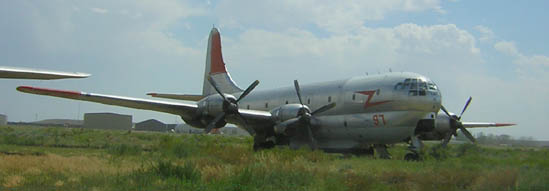
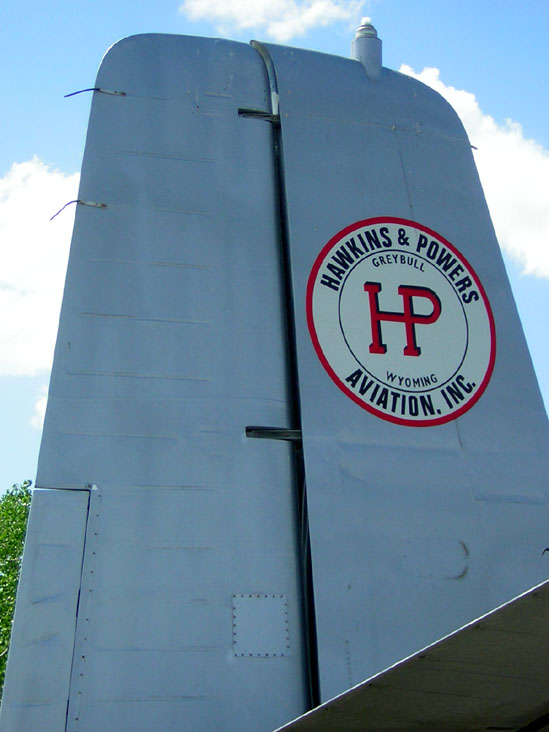
Several miles of "grounded" planes sit at the H&P airstrip.

Posted by Mark Hajducki (Member # 1732) on 11-09-2007, 09:20 AM:
quote:
Let California burn, say experts
New Scientist 01 November 2007
Arnold Schwarzenegger injects Hollywood glamour wherever he goes. When California's governor inspected the 2000 square kilometres charred in last week's wildfires, he looked every bit the movie hero. The script worked out well, too. Arnie won praise for mobilising rescue workers quickly and even the wind turned in his favour, dying down in time for firefighters to limit the damage.
Yet there is an alternative plot line that Schwarzenegger would not be pleased with. It's the story being told by wildfire experts. In this version, state and federal policies are partly to blame for the fires, and the moral of the tale is that policies must change if the million people ordered to evacuate last week are to be spared a repeat performance. There is accumulating evidence that rather than suppressing fire, we should allow it to return to the role it used to play in Californian ecosystems.
The latest evidence comes from a study of the era before European settlers arrived; a time when wildfires were sparked by lightning or started by Native Americans, who used them to for a variety of purposes including flushing out wildlife when hunting. Ethnographic studies and data from tree rings suggest that 18,000 square kilometres burned every year in California (Forest Ecology and Management, DOI: 10.1016/j.foreco.2007.06.005). That's almost as much as the area that burned across the whole of the US between 1994 and 2004.
In other words, says Nicholas Clinton at the University of California, Berkeley, last week's wildfires - labelled "extreme events" and judged the worst national disaster since hurricane Katrina - would have been unremarkable prior to 1800.
So what happened? Wilderness has been converted to agriculture, reducing the area that might burn, but the remainder would still experience large fires if forest managers allowed it. Instead, the authorities tend to suppress blazes.
It is an understandable response: California is one of the more densely populated states in the US, and residents inevitably want nearby fires stamped out as quickly as possible. Nevertheless, this small-picture attitude may be making the big picture worse. Richard Minnich, at the University of California, Riverside, has compared wildfires in California with those across the Mexican border, where land is managed less intensively. A similar amount of land burns on both sides, but the US fires are less frequent and larger because smaller fires - which use some of the available fuel - occur less often. That means that US fires are more likely to get out of control in high winds, as happened last week.
One solution would be to allow small fires to burn out naturally, at least in areas away from homes, says Clinton. Such policies have the backing of many wildfire experts, but remain controversial, not least with members of the voting public who live near forests, so progress in this direction has been minimal. Minnich's research, for example, is now almost 25 years old (Science, vol 219, p 1287). Last week's events show that the script has not changed a great deal in a quarter of a century - just be prepared for the sequels.
Link
Posted by Joe Redifer (Member # 3) on 11-09-2007, 05:34 PM:
I really like how they didn't even get to the point until the second to the last paragraph. That made it extra-fun to read! Fantastic journalism!
Powered by Infopop Corporation
UBB.classicTM
6.3.1.2