This is topic Incandescent light bulbs rule. in forum Film-Yak at Film-Tech Forum ARCHIVE.


To visit this topic, use this URL:
https://ft-forum.com/ft/cgi-bin/ubb/ultimatebb.cgi?ubb=get_topic;f=8;t=005281

Posted by Joe Redifer (Member # 3) on 11-26-2007, 07:40 PM:
 
OK first of all I highly dislike the term "Green". I am annoyed when people and businesses say "were going green" or some such retarded nonsense. Anyway, I recently bought some of those light bulbs that are shaped like a swirly fluorescent turd so I could do my part in saving the planet and making it "green". Now my room seems extremely green-orange-yellow-ish. If I had wanted yellow light emitting from my fixture, I would have purchased a yellow light bulb. But nope, this is the natural color for these things. With incandescent light bulbs my eyeballs can at least white-balance themselves so everything appears to be the correct color. Not so here.

I say "Who cares about the planet?" What has it ever done for me? This planet can kiss my ass, I'm using real light bulbs instead of this pansie-ass neo-hippie "green" shit. I'm not gonna display any AIDS or breast cancer ribbons, either!
 
Posted by Richard Fowler (Member # 893) on 11-26-2007, 08:10 PM:
 
All my outdoor and indoor lighting is a mix of LED or flourescent except for 3 - 4 antique halogens [Big Grin] Color temperature can be rangled by checking what you are buying. We are saving an average of $40.00 / month on electric since the change out. Next is the 50 year old water heater [Roll Eyes]
Phillips is the largest vendor of LED lighting and our old friendly conglomorate G.E. is pushing their classic "cheap to buy" incandescent bulbs...should be cheap, they probably paid off the light bulb machinery 50 - 70 years ago [Razz]
 
Posted by Wayne Keyser (Member # 2420) on 11-26-2007, 08:48 PM:
 
Am I just an aging hippie, or does anyone else think this whole "green" idea (while noble in intent) has been almost instantly co-opted, and is little more than a smokescreen for more profiteering?

Suddenly - REALLY suddenly - "green" is the new way to market your company image. Suddenly "global warming" has been given equal ranking in the lineup on the docu-cable-channels (formerly "all sharks, mummies, Nazis and UFOs all the time). And suddenly you're a jerk if you use incandescent bulbs or throw out a can of paint instead of waiting in line to dispose of it at a hazardous waste facility (that it takes 5 gallons of gas to get to).

The energy my house uses in a year, the average pizzeria uses in an hour.

That said, I'm using the new fluoro bulbs now that they're affordable - sick of replacing incandescents every time I turn around.
 
Posted by Ron Curran (Member # 3631) on 11-26-2007, 10:57 PM:
 
These bulbs have their place. We use one over the projection box stairs – a 11 Watt replacing a 60 Watt incan that used to blow regularly. They are great for utility areas and passageways.

Unfortunately they can’t be dimmed so they are useless in auditoriums and living rooms. They can’t be used in security lights.
 
Posted by Frank Angel (Member # 248) on 11-26-2007, 11:43 PM:
 
Ron, I understand that they have made some progress with that. There are some that actually can be dimmed, but they are more expensive. And you have to be careful if you've got dirty AC -- they are not very tolerant of crapy AC. The AC in one of our buildings has so much junk on the line that the X10 units become quite unreliable.

When we put the non-dim compact florescent units in any of those fixtures you mention that would normally be ideal for a light that is difficult to reach, we found these things zapping out faster than incandescents normally last -- some going out with a nice loud zap sound, some arcing sparks and a puff of smoke. They certainly aren't as benign as incandescents and not very "green" if they wind up burning the building down.
 
Posted by Mike Blakesley (Member # 26) on 11-27-2007, 12:23 AM:
 
Since I run a historic building, my rule of thumb is: If people can see the bulb, then I use an incandescent. If people can't see it (like in the booth) then the flouro bulb goes in.

We're using a bunch of LED Christmas lights this year at the house...they actually seem to have better (deeper) colors than the C7 bulbs we used before.

I read today in 'The Week' that even if the US were to stop burning fossil fuels completely right now, the greenhouse gases created from increasing coal burning in developing countries would still cause significant global warming anyway, so if all those predictions come true we're screwed no matter what we do.
 
Posted by Jeremy Weigel (Member # 4208) on 11-27-2007, 12:26 AM:
 
We began replacing our R30 60w incan floods in the lobby and hallways (total of 110 bulbs) with GE 15w R30 compact fluorescents during summer of '06 and just about have all of them replaced. I'm trying a few of the dimmable types on some wall sconces in the auditoriums to see if they hold up. So far we've only had 3-4 of the non-dimmables die early, but I had those replaced by GE in short order. So far none of the dimmables have died. We also noticed that our lobby stayed much cooler this past summer when we actually had temps in the low 90's and up.

The only down side that I have noticed is that they take some time come up to full lumens when first turned on, if the ambient air temp is say below 80. This is an annoyance in the booth where we keep it around 67. The projector work lights start out really dim for the first 30-60 seconds until the gas heats up.
 
Posted by Brad Miller (Member # 2) on 11-27-2007, 12:54 AM:
 
I switched pretty much everything over to flourescents. Everything in my house and everywhere else that isn't on some sort of dimmer, that is. It just took some getting used to flipping the light switch, stopping thinking to myself "you dip you didn't actually flip the light switch" and then it would turn on as I was leaning back to hit the light switch. Other than that, I've no problem with the color temperature. They are cheaper to run, they last longer and most importantly they don't heat up the place! Why just about every movie theater booth would have a couple of track lighting aiming at the projector with a 500 WATT FLOODLIGHT in them I've no idea, but it must be some booth law I am not aware of. (They all have the 100W equivalent flourescents in them now. [thumbsup] )
 
Posted by Monte L Fullmer (Member # 2797) on 11-27-2007, 02:15 AM:
 
quote: Brad Miller
Why just about every movie theater booth would have a couple of track lighting aiming at the projector with a 500 WATT FLOODLIGHT
..probably so the 'button pushers' can see the framebox to frame and to clean the machine since their sups climb all over the operators for cleaniness checks.
 
Posted by Joe Redifer (Member # 3) on 11-27-2007, 02:32 AM:
 
Nowhere on the packaging of these turd bulbs is anything about color temperature. One side is English, and the other side is in moon language. Maybe the light isn't white since white isn't politically correct?
 
Posted by Stephen Furley (Member # 1277) on 11-27-2007, 04:37 AM:
 
quote: Joe Redifer
Nowhere on the packaging of these turd bulbs is anything about color temperature.
It does on almost all on the ones I buy here, either directly, e.g. 2700K, like the one I've got in my hand at the moment, or as a three figure number, e.g. 830 or 840. In this case the first digit indicates the Colour Rendering Index, 8 = between 80 and 90, which it will be for just about all lamps of this type, and the last two digits multiplied by 100 are the correlated colour temerature.

Screw-in or bayonet ones with an integrated ballast are almost always between 2700K and 3000K because they're designed to look like the incandescent lamps which they're intended to replace. The pin base type for use with a separate ballast can be obtained in a much wider range; 827, 830, 835, 840 and 865 (daylight) at least, and I've never seen one of these where it wasn't marked on the box. For some reason in the U.S. 4100K seems to be used rather than 400K; I don't know if this is a real difference, or just caused by a difference in the way it is measured.

I've got a Chinese-made American one, if you see what I mean, It's branded 'Feit', in my bedside lamp, and I've just looked at that; I don't have the box for it, but the lamp itself is marked.
 
Posted by Rick Raskin (Member # 1561) on 11-27-2007, 05:37 AM:
 
I have a ceiling fan with a light fixture rated at a maximum of 60W. Not really enough light output with an incandescent bulb but a compact flouro rated at eq: 75W solved the problem. I think the power draw is now around 20 watts.
 
Posted by Mark Gulbrandsen (Member # 72) on 11-27-2007, 08:25 AM:
 
Joe,

You can thank Al Gore for the "Green" terminology! Isn't he your buddy????

At home we use a combination of Florescent/incandescent/halogen/Aladdin Lamp to light the house. The latter also gives off so much BTU that it assists in heating the home in the winter. The Aladdin's are the equivelent of a 75 watt lamp running at full tilt and the color spectrum is close to an incandescent type of light because of the incandessence of the radioactive mantle. Great way to fool the neighbors when the power goes out(oh yea, we have power) [Cool] .
 
Posted by Joe Redifer (Member # 3) on 11-27-2007, 10:01 AM:
 
Halogen kicks ass. It is great knowing that at any moment they will spontaneously combust and ignite everything into a fiery inferno. That makes every day the thrill ride of the summer. I have never met Al Gore, but his wife is, like, soooo totally lame.

quote: Stephen Furley
It does on almost all on the ones I buy here
Your bulbs are in PAL and are therefore totally different and incompatible with out sockets. The closest thing to color temperature the packaging says is "A EQUIV".
 
Posted by Bobby Henderson (Member # 840) on 11-27-2007, 10:21 AM:
 
Just about any consumer-level fluorescent lamp is going to give off a nasty yellow cast.

Industrial level "high output daylight" fluorescent lamps emit white light much closer to the 6500K color temperature. The downside is they have to be hooked up to heavy duty ballasts and the wiring should be in metal conduit to UL specifications. This is also not a very "green" approach. You'll see with your electric bill!
[evil]
 
Posted by Steve Guttag (Member # 268) on 11-27-2007, 12:21 PM:
 
I dunno...I find Florescence to give off a greenish cast more than anything. Even in photography there various light magenta filters to correct for this. FL-D and FL-W come to mind for Daylight and White versions of lamps.

Steve
 
Posted by Bill Enos (Member # 440) on 11-27-2007, 01:20 PM:
 
I've found that the so called dimmable ones only dim about 1/3 way then blink off.

Factor in the electronic ballast, the drop of mercury, the added manufacturing processes, the extra weight to be shipped I'll bet they are dirtier that incandescents.
 
Posted by Louis Bornwasser (Member # 3063) on 11-27-2007, 03:00 PM:
 
Green style fluorescents are really great in my magnetic work lights (on a mike-style flexible arm). They are bright, cool, and most of all don't fail when dropped. They don't burn you when working "close." Louis
 
Posted by Mark Gulbrandsen (Member # 72) on 11-27-2007, 09:54 PM:
 
quote: Bill Enos
I've found that the so called dimmable ones only dim about 1/3 way then blink off.

There are indeed dimming systems made by both Colortran(now owned and completely screwed up by Leviton) and Strand Lighting that can dim down to the 12% realm before the lamp goes out. It requires both special ballasts and special dimmer modules to achieve though. One of the last lighting related jobs I did at GTS was to commission a new system with Colortran Dimmers in an Art Museum at a university. I never thought the flourescent end of it wold work but it did indeed. It was actually pretty impressive as they didn't change color temperature very much through out the dimmable range.

Mark
 
Posted by Leo Enticknap (Member # 534) on 11-28-2007, 02:31 PM:
 
quote: Bill Enos
Factor in the electronic ballast, the drop of mercury, the added manufacturing processes, the extra weight to be shipped I'll bet they are dirtier that incandescents.
Agreed completely - the chemical goo produced by manufacturing the PCBs and plastic must create as much if not more toxic emissions than the increased power consumption of a glass/metal/filament bulb during an average lifetime.

I do use mini-incandescents for all the lights in my flat except the ones I need to read under: not out of any worship of the Swampy brigade, but simply because they cost about the same to buy (the supermarket chains here are now selling them as loss leaders to burnish their green credentials) and less to run. But attempting to read under them gives me a headache, so I do have a 40w halogen spot on my work desk.
 
Posted by Jeff Stricker (Member # 224) on 11-28-2007, 02:58 PM:
 
Edison invented the incandescent lamp in 1879. In 1929, Henry Ford threw a lavish dinner party at Greenfield village to celebrate the 50th anniversary of the invention. Edison, among other notables was in attendance. That was in 1929, it's time to move on with beter more energy efficient lighting. [Wink]
 
Posted by Joe Redifer (Member # 3) on 11-28-2007, 04:57 PM:
 
I agree. Someone please invent better lighting. The light coming from these turd coil lamps is pathetic.

I'll throw this out there as well: Hybrid cars are also pathetic. They get less MPG than my REAL car and cost much more. Therefore hybrid = retarded.
 
Posted by Leo Enticknap (Member # 534) on 11-28-2007, 05:07 PM:
 
And again, how much Co2 and other toxic waste is produced, and energy consumed, manufacturing (and, at the end of their life, disposing of or recycling) the electric motors and batteries, relative to the energy and emissions saved by the hybrid during its service life?

There's no denying that peak oil will become a reality (the only dispute is when), and that we're going to have to find ways of powering our homes and transport that don't need fossil fuels. But when the CEO of Google said that he was investing in a research programme to try and produce renewable energy at a lower cost than generating it by burning coal or oil and with a lower energy input to output ratio, and that until he'd found one renewable energy was basically just a side issue, it was refreshing to hear someone talk sense at last.
 
Posted by Jack Ondracek (Member # 1466) on 11-29-2007, 11:07 PM:
 
Why is it that the passage of time qualifies as a reason that something must be changed?

Fluorescents are fine for some applications, especially if lamp life is a main factor. For a sense of warmth in an environment though, I'd put in an incandescent any time. Personally, I've never picked a product off the shelf and evaluated it based on how long ago it was invented.

Guess we'd better be tossing our phones, too... all of 'em! That nasty AC and DC has also got to go... look how long that stuff's been around! We must immediately cut the cables on any elevator that's been in service over 20 years. I rode a 1940 Otis the other day... yeech! [Razz]
 
Posted by Randy Stankey (Member # 64) on 11-29-2007, 11:39 PM:
 
Don't forget! Fluorescents don't work well in cold temperatures and they can take a second or two to come on, even in warm temperatures.

For lighting outdoors in cold climates and in places where safety is critical, fluorescents are actually contraindicated.
 
Posted by Joe Redifer (Member # 3) on 11-30-2007, 01:26 AM:
 
I have a couple of fluorescent bulbs that turn on immediately when the switch is flipped, no delay.
 
Posted by Frank Angel (Member # 248) on 11-30-2007, 03:33 AM:
 
I don't know about the color issue. They seem to have overcome that greenish, cold white thing.

Our offices burned down awhile back and when they rebuild, all the lighting was florescent tubes (none of the compact curly "turds" as Joe so colorfully calls them). As soon as I heard it was going to be flourescents, I got all set to huff and puff about how terrible the color would be and how everyone would look sickly. Well, I was very pleasantly surprised that they installed these improved tubes that have nearly the same color as incandescents and much more efficient; they are skinny tubes, about half the diameter of the older tubes that have been around since we were kids. Everything in the office is very warm looking. It's all indirect lighting too -- everything facing the ceiling so you never see any of the tubes. Everyone is really pleased with the whole look.

I, on the other hand, feel cheated that I can't bitch and moan and pound my desk about how I refuse to work under ugly, epileptic fit inducing flourscent light.
 
Posted by Richard Fowler (Member # 893) on 11-30-2007, 07:47 AM:
 
There are many options for color temperature + suppression of "green" spikes on new flourescents. High frequency ballasts replacing the "buzzy" 60hz magnetic type make working under them more tolerable. Those skinny color corrected tubes are replacing bulky tungsten softlight fixtures on film and video shoots more often in the past few years.
 
Posted by Mark J. Marshall (Member # 1409) on 11-30-2007, 08:54 AM:
 
quote: Joe Redifer
Incandescent light bulbs rule
quote: Joe Redifer
Hybrid cars are also pathetic.
You'd like Glenn Beck, Joe.

quote: Joe Redifer
Your bulbs are in PAL
HAHAhaa! [Big Grin] [thumbsup]
 
Posted by Mike Blakesley (Member # 26) on 11-30-2007, 10:03 AM:
 
We have a 4' flourescent fixture in the concession stand which I always hated because of the "hospital"-like feeling it produced in the lobby. Then I replaced the bulbs in there with these special "kitchen and bathroom" type lights that are supposed to create more natural lighting. It really made a difference! The popcorn even looked better.

One of our concession girls (a 17 year old) walked in that night and immediately said, "The lighting looks way better in here...what did you do?" So if a teenage girl spotted a difference, I knew it had to be a real improvement.
 
Posted by Bill Enos (Member # 440) on 11-30-2007, 10:14 AM:
 
We used "Gro Lux" aquarium fluorescents in the concession case for a while, then switched to cool whites with a gel wrapped around. The gels last thru about 3 lamp changes before they are faded to clear.
 
Posted by Jeremy Weigel (Member # 4208) on 11-30-2007, 01:15 PM:
 
I use "Warm White" lamps in the lobby, hallways, restrooms, and offices. "Cool Whites" are used in the auditorium clean up lighting. "Daylight" lamps are used in all the signage lighting. I'm not sure why, but the "daylight" bulbs provide better color rendering of the posters and auditorium mylars even though the light coming off appears to be on the blue end of the spectrum.
 
Posted by Chad Souder (Member # 343) on 11-30-2007, 01:42 PM:
 
I just noticed our local Wal-Mart has lighting in their freezers hooked up to motion sensors that go dark when nobody is in the aisle.
 
Posted by Jeremy Weigel (Member # 4208) on 11-30-2007, 02:56 PM:
 
quote: Chad Souder
I just noticed our local Wal-Mart has lighting in their freezers hooked up to motion sensors that go dark when nobody is in the aisle.
They've done that to the ones around here along with their neiborhood markets. Its kind of annoying when you're trying to look for something ahead a few cases down and you can't see everything in the case cause its not lit yet.
 
Posted by Jack Ondracek (Member # 1466) on 11-30-2007, 05:09 PM:
 
quote:
I have a couple of fluorescent bulbs that turn on immediately when the switch is flipped,
Yah... most of mine do, to, Joe!
 
Posted by Brad Allen (Member # 470) on 11-30-2007, 08:18 PM:
 
The skinny florescent tube bulbs are the new T8 bulbs, with matching T8 electronic ballast's. Considerable less energy used, they come on instantly, and work down to 20 degrees and have a nice color rendition to them. The old magnetic ballast's are being phased out

I buy GE's spiral turd bulbs for home and the lobby at the theatre, and the color is soft white, almost identical to a soft white incandescent. Only ones I've had "color" problems with has been some cheap no namer's I picked up accidently in a rush.
 
Posted by Bobby Henderson (Member # 840) on 12-01-2007, 01:32 AM:
 
The only thing I don't like about the new "slimline" fluorescent lamps is most have a "warmer" (more yellow) color -around 4200K. That's on par with a 4500K "Cool White" lamp. When you have to use those things in a skinny sign cabinet the color of graphics on the back-lighted face can be thrown out of balance. Sometimes LEDs or even 6500 Snow White neon can be a better solution in tight spaces. You'll get a better quality result, but the solution will cost more.
 
Posted by Dustin Mitchell (Member # 372) on 12-01-2007, 02:12 AM:
 
For those questioning the environmental impact of CFL's, there is more than enough information easily avaiable via a web search showing the potential impact of converting to CFL's on energy use. Here's just one snippet:
http://www.energystar.gov/index.cfm?c=cfls.pr_cfls
quote:
If every American home replaced just one light bulb with an ENERGY STAR qualified bulb, we would save enough energy to light more than 3 million homes for a year, more than $600 million in annual energy costs, and prevent greenhouse gases equivalent to the emissions of more than 800,000 cars.
I'd say that's significant.
 
Posted by Randy Stankey (Member # 64) on 12-01-2007, 08:57 AM:
 
At the cost of how much phosphorus, mercury, arsenic and other toxic ingredients used to make them?

At the cost of how much MORE energy, resources and manufaturing capacity needed to produce them which COULD have been used to produce something else?
 
Posted by Leo Enticknap (Member # 534) on 12-01-2007, 09:41 AM:
 
Agreed. We can only make any meaningful comparison as to how 'green' a new technology is compared with an existing one if we know the following:

How much more or less energy is used and/or toxic by-products created manufacturing the new one relative to the old one?

How much more or less energy is used and/or toxic by-products created during a typical service life of the new one relative to the old?

Just saying that a hybrid car uses 30% less petrol is meaningless if the extra energy needed to make one is equivalent to the petrol needed to drive a conventional equivalent 50k miles. Sure, the 'curly turd' bulbs only burn 10 watts or so once you've got it in your home, but if it takes several kilowatts more to manufacture it than a 60w incandescent, is there a net saving of energy?
 
Posted by Dustin Mitchell (Member # 372) on 12-01-2007, 09:56 AM:
 
Well the mercrury question is easy. Most electricity in the US comes from coal fired power plants. Coal power plants create mercury as a byproduct (which is why 44 or the 50 US states have advisories against eating more than a certain number of fish caught in lakes and streams since the mercury in the environment settles in their tissues). The amount of coal it takes to power an incandescent bulb compared to a CFL creates far more mercury than is contained in the CFL. The average CFL contains less mercury than a watch battery.
Link.

As fas as how green CFL's on a manufacturing comparison with incandescents that not an easy google search. However, since the manufacturing of CFL's is not being subsidised (at least in the US) the question of a straight up 'resource efficency' comparison is fairly simple-whichever costs less to manufacture/use is the more efficent solution. I think its pretty clear CFL's win in both categories.
 
Posted by Bobby Henderson (Member # 840) on 12-01-2007, 12:12 PM:
 
quote: Leo Enticknap
Just saying that a hybrid car uses 30% less petrol is meaningless if the extra energy needed to make one is equivalent to the petrol needed to drive a conventional equivalent 50k miles.
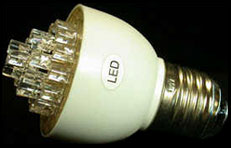
This is why I think E85 Ethanol is a really stupid idea. It takes nearly 1 gallon of fossil fuel to create 1 gallon of E85 Ethanol. If there's no gain, why bother? Ethanol isn't going to be worth a damn until it can get much greater efficiencies more on par with other alcohol-based fuels. In Brazil, 1 gallon of fossil fuel will create 8 gallons of sugar cane-based alcohol fuel. Claims are being made that switch grass, corn stalks and other "cellulose fibers" will eventually yield 8 or more gallons of Ethanol per every 1 gallon of fossil fuel used. I don't know. I think it's going to be years before we see any real development on that. For the time being, this big push on Ethanol is just amounting to a huge subsidy for corn farmers.

Back to the light bulbs thing, they all use up a good amount of power at some point. LEDs are supposed to be very efficient in terms of energy use. At least that's what most people seem to think. When we sell a business a good sized full color RGB LED variable message center display they're kind of thrown when they end up having to run multiple 20 amp circuits to power the thing.
 
Posted by Joe Redifer (Member # 3) on 12-01-2007, 12:24 PM:
 
I don't recall any incandescent bulb I've ever used emitting any gas, so how would changing my bulb to the new hippie bulbs save greenhouse gas or whatever?
 
Posted by Bruce McGee (Member # 131) on 12-01-2007, 03:38 PM:
 
I was talking to a girl one night at a party, and she mentioned that she had a 'green house.' I thought, AHHA! Something to talk about! And I mentioned that I grew up in a country house and that my dad had a greenhouse... The plant kind.

I got a withering look from the girl. "I mean an energy efficient house." Yeah right, I thought. Her house is as old as mine is, (1924) and has only had its windows replaced, as I know the previous owner, who did nothing that he didnt have to do...

There is only one incandescent lamp left in our 7-plex besides the dimmable lights in the auditoriums. That light is directly over the ushers stand at the ramp going up to the theatres. We use the Sylvania/Phillips lamps. They seem to last longer.

I, too, hate the turd lamps. I have a few in my house. I'm still not terribly impressed with them.
 
Posted by Louis Bornwasser (Member # 3063) on 12-01-2007, 08:55 PM:
 
I think they are great when used in a proper place; driveway, basement, night light, garage. Perhaps not in rooms that have a "decorate" requirement. Seem to be OK as indirect light, though. Louis
 
Posted by Randy Stankey (Member # 64) on 12-01-2007, 10:09 PM:
 
They're also good in places where it's a pain in the ass to change the light bulb.

At work, we've got several lights where we have to get the Genie lift of a 40 foot ladder to change them. One day, one of the maintenance men came along and asked, "Why don't you use compact fluorescents? They'll last 10 times longer and you won't have to change them as often!"

We all looked at each other and said, "Why didn't WE think of that?" [Wink]
 
Posted by Jeffry L. Johnson (Member # 453) on 12-02-2007, 02:33 PM:
 
Full Spectrum Solutions
Full Spectrum lighting research articles
Ott-Lite
 
Posted by Evans A Criswell (Member # 381) on 12-03-2007, 03:54 PM:
 
I've bought GE "soft white" compact fluorescents that are 26W and supposedly put out the light of a 100W incandscent. The color is nearly indistinguishable from an incandescent, although I've been to friends' houses and they'd have other brands that had terrible harsh colors.

As for tube fluorescents, I'm seeing more and more T8's. F32T8's have taken over in 4-foot fixtures. The color rendition is superior to the old cool-whites and the bulbs don't lose their brightness over time to the degree that the old F40T12s did. You get almost as much light as the 40W T12 with the 32W T8, and it's a more pleasing light. The T8s come on instantly (many are actually run on instant start ballasts) and will work in low temperatures, and are run at higher frequencies and are totally silent! The ballasts are more efficient so there is less power overhead in running the bulbs.

I'm also seeing more and more T8s being used in 8-foot fixtures. The 86 watt 96-inch T8 is probably going to replace the old standby 110W T12 8-footer for high-output fixtures eventually. As before, excellent color rendition and more lumens-per-watt.

By the way, "slimline" does not necessarily mean T8, but refers to the "cold cathode" variety of instant-start fluorescent, which have a single pin on the end, the most common of which is the 96-inch 75 watt T12.
 
Posted by Frank Angel (Member # 248) on 12-03-2007, 05:48 PM:
 
I needed to install an indication light up in the 5th floor rewind room so that when the camera system was that is located up there is turned ON or OFF from the stage via an X10 telco responder (stage manager calls up the X10 unit and gives it the appropriate command) to power the camera and associated electronics equipement. This system sends a video signal of what was going on on the stage to the monitors in the lobbies.

I needed the stage manager to be able to look up at the booth and verify if the system had actually turned ON or OFF -- the X10 in our building is only about 90% reliable due to dirty AC we have to live with.

I figured I need indication that is only a very small pin-point of light so as not to spill all over the place, but bright enough to be seen 150ft way, and very directional. AND, it is in a place that is very difficult to get to -- it is on the outside of the booth wall and the camera and port glass need to be removed in order to change whatever pilot light I might decide to use. I figured using LEDs which I thought would have a lifespan that would outlast me, in place of incanies, seemed to be a brilliant idea....on paper. Green LEDs....how cool is that.

I chose this:
 - Direct Replacement High Intensity LEDs - Green

Long life? In actuality, the first one went dead in about a year (in real-time use -- probably only about 300 hours). I figured it was just a fluke. Second one went dead not even 100 hours.

I did my usual ranting to my collegue, our lighting director, who, come to find out, had been using exactly the same LED unit but in red. He needed a "spotting light" for ballet dancers (they need a pinpoint to look at when they spin or something or other happens to them....they spin off the stage or something, not sure what exactly) and he had the same experience -- you just look at the damn things and they blow out. Evedently they are very intolerant of any aberations on the electrical line. Turn them upside down and they self-distruct from their own ballast heat.

In this case, the ole incandescant pilot bulb beat the high-tech LED "bulb" hands down.
 
Posted by Bobby Henderson (Member # 840) on 12-03-2007, 08:10 PM:
 
quote: Evans A Criswell
I'm also seeing more and more T8s being used in 8-foot fixtures. The 86 watt 96-inch T8 is probably going to replace the old standby 110W T12 8-footer for high-output fixtures eventually. As before, excellent color rendition and more lumens-per-watt.
In general office use, I can see T8s and other "slimline" lamps getting more and more use.

Although the color rendition of these 4000K-4500K standard T8 lamps may be "excellent," the light they put out is still a little too yellow and dingy looking for my purposes (lighting up electrical sign cabinets with back-lighted faces).

Some 6500K "daylight" rated T8 lamps do exist. But they're usually very expensive and run at higher wattage levels. A standard F96T12D/HO lamp runs on 110W and costs several bucks. The 6500K T8 may run at 192W and cost several times the price per lamp.

If bulb manufacturers can deliver high output slimline lamps that emit 6500K color and do so within 110W I'll be excited (especially if the price is comparable to a standard T12D/HO. Building mounted "box" style sign cabinets with back-lit Lexan or Acrylic faces can look very clunky when their cabinet depths exceed 12" or more. Go too narrow and you'll see lamp hotspots through the sign face. It's possible to run a bunch of slimline lamps in a really narrow sign cabinet or light box and have a very even spread of light. But that color temperature really needs to get closer to the 6500K level to make most back-lighted graphics look really good.

quote: Frank Angel
Long life? In actuality, the first one went dead in about a year (in real-time use -- probably only about 300 hours). I figured it was just a fluke. Second one went dead not even 100 hours.
LEDs aren't perfect, but LED-based light fixtures have definitely improved a great deal over the years.

One thing I have to ask about that LED light is, "who made the LEDs?"

General Electric is widely regarded to make the highest quality, most dependable LEDs. Phillips also makes good quality LEDs. Many LED-based fixtures do not use higher quality American or European LEDs. Many use cheaper, less reliable components made in China. This is a really critical issue when it comes to products that use a lot of LEDs, such as electronic variable message center signs.

A good quality, high intensity LED should have a lifespan of at least 100,000 hours of use at full power. The problem is other components in that lighting fixture or complex display system are not going to last nearly that long without failure. Anyone who drives past a LED-based billboard has probably seen the thing with a flaky driver board at some time or another.
 
Posted by Josh Jones (Member # 447) on 12-08-2007, 03:00 AM:
 
Avoid twister bulbs out doors up here. In the cold (20 or less) they die in mere weeks, and often wont strike at all. Back to bulbs for post lights anyway...

I am however, quite fond of my flourescent wand light. It follows me all over the country in my race gear and has proven to be reliable, cool, and easy on the genset. It also doesn't seem to mind being dropped off the back of a bike now and then either.

JJ
 
Posted by System Notices (Member # 2357) on 04-30-2009, 07:38 PM:
 

It has been 509 days since the last post.


Posted by Bill Enos (Member # 440) on 04-30-2009, 07:38 PM:
 
Anybody noted exceptionally short life on compact fluorescents when installed base up? I put half a dozen low wattage (10 watts) equivalents base up in ceiling sockets in our emergency stairwells from the balcony, they replaced 11 watt 130 volt bulbs. I expected and got a lot more light, I also expected at least the same life, and got a lot less. The incandescents last about 13 months, these CFLs are failing in 5 months. In another location where there is a ceiling socket I used a 75 watt equiv. base up and got even shorter life... 3.5 months, the 75w incand. lasts 8 to 10 months. Line voltage is 118, within the spec for these bulbs. In base horizontal or down the CFLs last as long as advertised.
 
Posted by Richard May (Member # 2627) on 04-30-2009, 07:58 PM:
 
I have them in my basement ceiling. 15 in total. They have been in now for a full year. I did have one fail after a few months but the rest have been fine. BTW, anyone know where I can buy dimmable ones. There are a rare few around here. I'm looking for ones for my ceiling fan lights.


Powered by Infopop Corporation
UBB.classicTM 6.3.1.2