This is topic Kodak on the Street in forum Film-Yak at Film-Tech Forum ARCHIVE.
To visit this topic, use this URL:
https://ft-forum.com/ft/cgi-bin/ubb/ultimatebb.cgi?ubb=get_topic;f=8;t=005371
Posted by John Hawkinson (Member # 1135) on 02-07-2008, 11:32 PM:
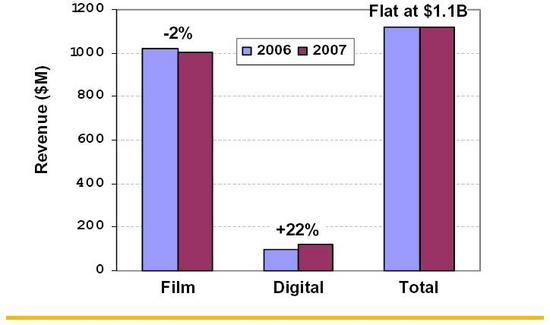
Kodak's 8K filed yesterday notes that the Entertainment Imaging group had flat revenues, but that within that film revenues declined by 2% (to about $1B) and were offset by gains in digital revenue keeping EI revenue constant at $1.1B.
I think this the first year where EI film revenue declined (i.e motion picture film revenue, not consumer still cameras). From 2006 to 2007 (i.e. last year's report), EI showed gains:
quote: http://edgar.sec.gov/Archives/edgar/data/31235/000115752307004585/a5394743ex992.txt
Net worldwide sales for Entertainment Imaging, which includes origination, intermediate, and print films for the entertainment industry increased 8%, primarily reflecting significant volume increases in print films and favorable exchange, partially offset by unfavorable price/mix.
The writing on the wall.
Does anyone know what the $100M of digital revenue within Entertainment Imaging is? We're not talking about consumer products here...
--jhawk
Posted by Adam Martin (Member # 641) on 02-08-2008, 12:24 AM:
Kodak Digital Preshow
Posted by Claude S. Ayakawa (Member # 1401) on 02-08-2008, 12:52 AM:
When talking about consumer products, primarily the professional photographic market, Kodak must be really hurting in the UK because they were not represented with a booth at the trade show when I was in London last month at a British professional photographers convention. In years past when I had attended at least two conventions a year on the mainland, Kodak used to be one of the most prominent exhibitor but not anymore. Some of the biggest players now are companies like Epson and others with computer printing hard wear and soft wear products.
-Claude
Posted by Leo Enticknap (Member # 534) on 02-08-2008, 06:14 AM:
A major high street photographic retailer, Jessops, no longer has any film whatsoever on display in the shop, now. You ask for it and they get it out from a cabinet behind the cash desk. Anything other than ISO400 C41 negative stock is a special order. If you want b/w, E6 or Kodachrome 64, it takes them 1-2 weeks to get it. I buy most of my film online now, simply because it's gone from the high street.
Posted by John Hawkinson (Member # 1135) on 02-08-2008, 08:23 AM:
I feel like I should re-stress that "Entertainment Imaging" refers to the motion picture film business, and not the consumer film business.
I guess Adam is probably right, but somehow I don't see the digital preshow business managing to pull in the same kinds of revenues as the MP film business. I do wonder what's up with IMAX.
Perhaps it's helpful to quote a few of Kodak's slides:
Entertainment Imaging: A Year of Solid Results for Kodak
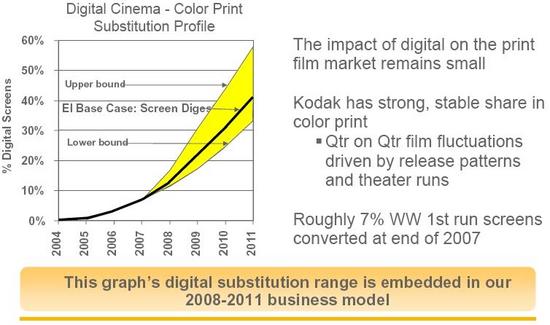
D-Cinema Adoption Still in Early Stages
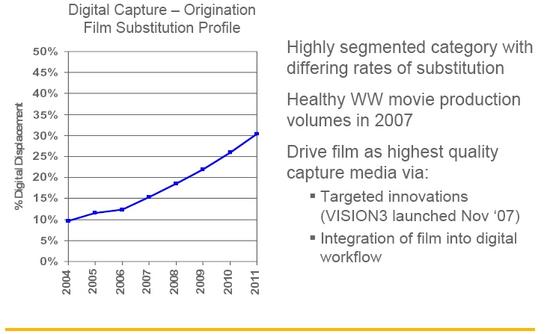
Origination Film Transitioning at Measured Pace
--jhawk
Posted by Brian Guckian (Member # 1678) on 02-08-2008, 07:21 PM:
A 2% drop is hardly "the writing on the wall"!
Also, the second graph - "D-Cinema Still in Early Stages" is notable by the fact that the EI base case - based on Screen Digest predictions - significantly overestimates digital video uptake; 11% approx. for end 2007 is shown on the graph, but in actuality take-up was at 5.5%, or half this amount, at end 2007, also according to Screen Digest.
It is also significant that Kodak continues to stress the fact that film remains the highest quality capture medium, and continues to drive its development with the VISION 3 range of stocks.
Kodak will also be presented - today I believe - with an Academy Award of Merit (Oscar® Statuette) "for the development of photographic emulsion technologies incorporated into the Kodak Vision 2 family of color negative films".
The citation notes that:
"These technologies are breakthroughs in film speed, grain and sharpness that have made a significant impact on the motion picture industry. The Vision 2 family allows wider use of high-speed color negative film, lower light levels on set and faster set-ups. Most importantly, Vision 2 improves the overall picture quality in theatrical presentation".
![[beer]](graemlins/beer.gif)
Posted by Tim Reed (Member # 137) on 02-10-2008, 12:25 PM:
Still hard to hear discussions about Kodak without having John Pytlak jump in. ![[Frown]](frown.gif)
Posted by Stephen Furley (Member # 1277) on 02-10-2008, 12:39 PM:
Polaroid have announced that they are to end production of their instant films.
Kodak have now dropped High Speed infra-red. Many other specialised films have been withdrawn in recent years.
Agfa film is no more.
Ilford almost went under, but they were sold, and still make a wide range of black and white films, including, in sheet form only, an ortho one. Other than that they offer three conventional films, three Delta ones one chromogenic and SFX, a sort of semi-infra-red, which was dropped, but then re-introduced. However, they dropped motion picture stocks some time ago. They can still supply some of their products in sheet form in most sizes from 2.5x3.5 up to 20x24.
Fuji still offer a wide range of films, including Polaroid-compatible peel-apart instant films.
Adox became Efke years ago, but now seems to be Adox again. They offer the traditional films, but also some new products.
The Orwo name seems to be back, but I'm not sure what they are making now. Their black and white film used to be good, their colour didn't; the same went for Ilford when they made colour film long ago.
There are several other manufacturers from central and Eastern Europe making traditional films.
All seems to be a bit if a mixed message.
Posted by Tim Reed (Member # 137) on 02-10-2008, 02:16 PM:
Agfa is still active in the professional arena. The last custom trailers I made were on Agfa stock.
Agfa Motion Picture Film
Posted by Leo Enticknap (Member # 534) on 02-11-2008, 09:38 AM:
quote:
A 2% drop is hardly "the writing on the wall"!
I don't think we can draw any conclusions from that, really, because (i) we don't know what the figure for release print stock is specifically (could be slightly higher or lower, though probably not much), and (ii) we don't know what a normal fluctuation in sales from year to year is without the start of a transition to digital being a factor. It could be that on a slow year for the film industry, drops in stock sales of 2% are entirely normal anyway as distributors order fewer prints; but on the other hand this could be significant. For many commodities, sales drops of that order ARE significant: a 2% fall, for example, in petrol/gasoline sales in any developed country would usually indicate that an almighty recession has hit.
quote: Brian Guckian
It is also significant that Kodak continues to stress the fact that film remains the highest quality capture medium, and continues to drive its development with the VISION 3 range of stocks.
Agreed; and, together with the comment on the slide John posted, that origination film sales remain solid because of the successful integration of film into digital post-production models (i.e. shoot on film, then scan it and work digitally from there on), sends the message that Kodak considers the main - and possibly, if you want to be really bearish, the only - future of film to be for origination, not exhibition.
At last year's AMIA conference, hosted by Kodak in Rochester, Kodak put on a panel, 'The Future Availability of Motion Picture Film'. It really sent out mixed messages. The four senior Kodak execs on the panel stressed that a huge range of film products was still in the catalogue, with no immediate plans to discontinue them. But from questions from the floor, it soon emerged that almost everything except the camera negative and IP stocks routinely used in feature film production is now a special order item, with lead times typically running into months; and that this is now having a real impact on preservation work. In my last months at the NRFTA I had a taste of this, trying to have preservation dupes made of a 1960s industrial promo film. We were told that there was a nine-month waiting list for deliveries of YCM panchromatic separation stock (unless we ordered something like a million feet, in which case they'd do a production run now). OrWo, incidentally, is very much alive and well. Some European archives are now using its b/w products a lot more, mainly because of much quicker delivery times.
Powered by Infopop Corporation
UBB.classicTM
6.3.1.2