This is topic iTune Sound Quality? in forum Film-Yak at Film-Tech Forum ARCHIVE.
To visit this topic, use this URL:
https://ft-forum.com/ft/cgi-bin/ubb/ultimatebb.cgi?ubb=get_topic;f=8;t=005375
Posted by Claude S. Ayakawa (Member # 1401) on 02-10-2008, 11:06 AM:
I have been recording all of my music to my iPod from Cds all these years but I just recently started to download some music from the Apple iTune store online and have been very pleased with the sound quality. When I was checking out a title I was interested in buying yesterday, I decided to read customer's reviews of the album first before I bought it and one customer said he was considering buying the CD instead of downloading because he wanted to get the best sound quality from that album. He decided to download after all and was pleased.
Can anyone tell me if there is a difference in sound quality from downloaded music from Cds and iTunes? I have noticed a great price difference between the two. A CD normally costing about $18.00 can be downloaded for about $10.00 or less and that is one of the reasons I have used iTunes recently. If there is a great difference in the sound between the two?
-Claude
Posted by Bruce Hansen (Member # 281) on 02-10-2008, 11:49 AM:
Most itunes stuff is compressed. The more compression that is used, the poorer the sound quality. Compression is the process of throwing away information that you hope will not be badly missed. The more info you throw away, the more you miss it. Personaly, I do not like to go lower than a 256K data rate. CDs do not use compression.
A BIG problem I have had with the music industry in recent years, is that each company wants their stuff to sound the loudest on KTLA, and have been cranking up the record levels for years. This causes clipping distortion, and I find that I cannot even stand to listen to anything that has been recorded in recent years. I have not bought a new CD or downloaded anything in years, and will not, until the greedy music companies get their heads out of their behinds and learn how to record properly again.
Posted by Mark Gulbrandsen (Member # 72) on 02-10-2008, 11:51 AM:
It should sound at least as good as Looney Tunes!
Posted by Mark Strube (Member # 4190) on 02-10-2008, 05:07 PM:
Personally, I don't care for the audio quality in iTunes. They use 128kbps AAC compression. While better than 128 MP3, it's not great by any means... I hear most of the lost detail in the higher frequencies. I've found I prefer Amazon's new MP3 download store... same price as iTunes and in many cases cheaper, they use 256kbps MP3 without any DRM (copy protection).
Posted by Joe Redifer (Member # 3) on 02-10-2008, 06:11 PM:
Why not 320kbps?
Posted by Mike Olpin (Member # 1115) on 02-10-2008, 11:33 PM:
Most iTunes tracks are 128 AAC. Some tracks are 256 AAC. Those tracks have a plus symbol next to the buy song button. 256 AAC is very good, however very critical listeners will be able to hear a difference. iTunes Plus tracks are also free of DRM and can be played on any device that supports AAC wheras iTunes standard tracks can only be played on iTunes or Apple devices such as iPods.
AAC is vastly supirior to MP3 compression, nearly twice as good according to some, though I'm really not sure who or what is used to quantify this.
If you are ripping your own CDs, iTunes has a compression seting called Apple Lossless, which is able to reproduce CD quality sound at only half the file size.
Posted by Mark Strube (Member # 4190) on 02-11-2008, 12:52 AM:
The claim of AAC being twice as good is ridiculous. If this was true, a 64kbps AAC file would be comparable to a 128kbps MP3 file, and they're not even close. I prefer AAC to MP3 since it is better, but far from twice as good.
Unfortunately the iTunes plus service is twice the price with hardly any labels signed on. AllTunes is really the way to go, since you choose your own format and bitrate, encoded from a PCM source... however it's "gray" in its legality. So, I generally recommend the Amazon service as a happy medium for people worried about using AllTunes (aka. allofmp3), but want better quality and/or no DRM.
Posted by Max Biela (Member # 1919) on 02-11-2008, 01:27 AM:
Both (the 128 and 256) songs are the same price (99 Euro cent) - at least in Germany. It depends on the label which quality you will get.
Posted by Mike Olpin (Member # 1115) on 02-11-2008, 11:00 AM:
When iTunes plus was introduced, tracks were $1.29 vs $.99. Now all tracks are $.99 cents. The labels will come around soon.
Songs are encoded by the label, not Apple.
Posted by Jack Ondracek (Member # 1466) on 02-11-2008, 11:33 AM:
quote:
A BIG problem I have had with the music industry in recent years, is that each company wants their stuff to sound the loudest on KTLA, and have been cranking up the record levels for years. This causes clipping distortion,
Load one of those songs into a waveform editor, like Audition, and you can really see the processing... and it usually is very extreme.
Posted by James Westbrook (Member # 3690) on 02-11-2008, 01:17 PM:
When Rhino released downloads of various artists, called the Rhino Hi-5's, they suggested purchasing these off the Rhino web site as they use WMA, which in their opinion sounds better than the format Apple uses in Itunes. (but for convience, the same titles will be available at the Itunes store.)
Posted by Claude S. Ayakawa (Member # 1401) on 02-11-2008, 11:50 PM:
I am currently using a Shure SE 210 headset with a 16 gb iPod Touch and I love the sound quality from both the music I had downloaded from Cds as well as selections from iTunes. Many of you had given me the impression that the way the music is compressed by iTunes, I would be losing quiet a bit of sound quality especially the higher range from iTune downloads but from what I have been hearing, I cannot tell the difference between music I had downloaded from my CD library and from iTunes. I appreciate good sound when I hear it and that it the reason I had invested in a pair of good headsets such as the Shure. As most of you know, I love classical music and to fully enjoy it, you need to hear the full range of sound and I am getting it. When buying CDs as well as music from iTines, I am very partial to recordings from European labels such as Harmonia Mundi, Delos, Hyperion, DGG, and from the American label Telarc. I also like the sound quality of the London Symphony LSO recordings
-Claude
Posted by Greg Anderson (Member # 235) on 02-12-2008, 07:54 PM:
Using Audition, I looked at the "Spectral" display on a brief piece of audio featuring a full orchestra. You can see how MP3 compression takes away some of the detail throughout the spectrum and nearly all of the audio above about 16,000 Hz.
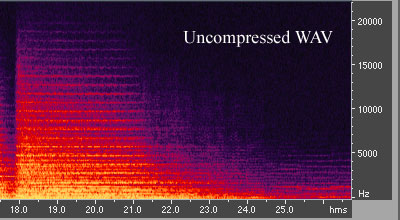
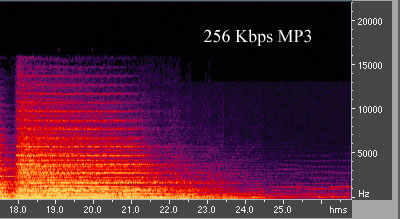
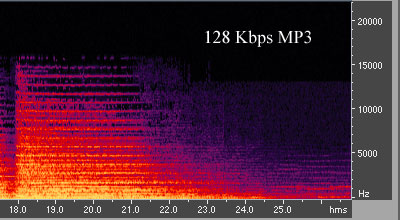
By looking at this display, I might know what to listen for and, therefore, I might be able to hear what's "wrong" with MP3 compression. But I'm not sure if I can really hear it or if I'm just imagining the problem. I'm wondering if I could really tell a difference in a blind comparison. Nevertheless, I think I prefer to have an "uncompressed" CD or, at the very least, the improved quality of iTunes Plus or Amazon's MP3 downloads.
Posted by Bobby Henderson (Member # 840) on 02-12-2008, 08:27 PM:
Wasn't Apple supposed to start offering lossless compressed music via iTunes?
quote: Bruce Hansen
A BIG problem I have had with the music industry in recent years, is that each company wants their stuff to sound the loudest on KTLA, and have been cranking up the record levels for years.
Agreed.
Take any "old" CD (stuff released in the 1970s or 1980s) and load it into a digital audio editing program. Chances are you'll see a normal looking wave form with little, if any, clipping of peaks.
Load up a pop or rock CD released in recent years. Not only is there clipping, there's so much decapitation of peaks on the disc that it's often difficult to make out the wave form unless you're zoomed way in tight on it. Total shit engineering of the audio track.
![[bs]](graemlins/bs.gif)
This is probably one of the main reasons why many who love iTunes can't tell the difference between a severely compressed 128kb/s AAC file and a retail CD. Both have shitty, over-driven audio quality. Lots of tonal detail gets lost when you deliberately clip the hell out of an audio track.
The only area where wave form clipping needs to happen at all is in the "lead" channel of a good guitar tube amp. I don't think it needs to be happening in many other places than that.
Posted by Greg Anderson (Member # 235) on 02-13-2008, 12:01 AM:
A few weeks ago I downloaded a "free sample" from Amazon's MP3 collection. This is a jazzed-up Christmas song performed by Brian Setzer and presented at 320 Kbps. The top part shows you the spectral view of the right channel (for just a few seconds) and the bottom part shows the wave form of the same bit of audio.
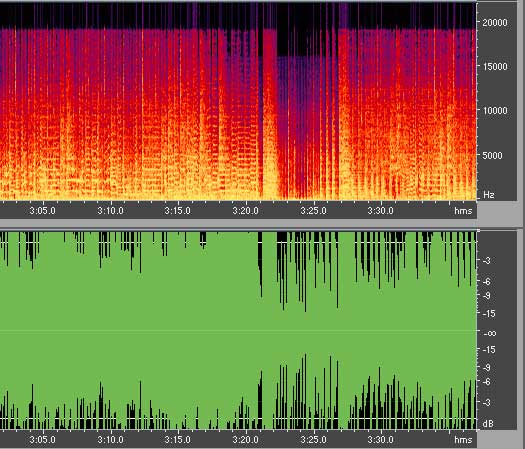
I remember when I first learned that CDs would have an amazing dynamic range. Little did I know that some 25 years later, engineers wouldn't want to use it.
Posted by Joe Redifer (Member # 3) on 02-13-2008, 12:35 AM:
I am wondering if this has a lot to do with the lacking volume controls on portable music players. I find that when listening to well recorded music, the volume won't be able to be turned up enough and it is much too quiet even at maximum volume. However if you take just about anything recorded from the mid-90's on, maximum volume on those same players will blow your ears out. Or it could be the other way around, the players limit the volume due to a decrease in overall dynamic range in the music industry?
I remember when volume knobs could be used at the listeners discretion, not the studio's. By the way, is the music industry in charge of mixing movie trailers and television commercials?
Powered by Infopop Corporation
UBB.classicTM
6.3.1.2