This is topic US Experts Find Oldest Voice Recording, from 1860 in forum Film-Yak at Film-Tech Forum ARCHIVE.
To visit this topic, use this URL:
https://ft-forum.com/ft/cgi-bin/ubb/ultimatebb.cgi?ubb=get_topic;f=8;t=005422
Posted by Tim Reed (Member # 137) on 03-28-2008, 08:11 PM:
This is a fantastic story! Given our interests here, I thought this news was too big to place in the Random Stories thread...
Link to Full Story
U.S. experts find oldest voice recording, from 1860
Thu Mar 27, 2008 6:09pm EDT
By Will Dunham
WASHINGTON (Reuters) - U.S. audio historians have discovered and played back a French inventor's historic 1860 recording of a folk song -- the oldest-known audio recording -- made 17 years before Thomas Edison invented the phonograph.
"It's magic," audio historian David Giovannoni said on Thursday. "It's like a ghost singing to you."
Lasting 10 seconds, the recording is of a person singing "Au clair de la lune, Pierrot repondit" ("By the light of the moon, Pierrot replied") -- part of a French song, according to First Sounds, a group of audio historians, recording engineers, sound archivists and others dedicated to preserving humankind's earliest sound recordings.
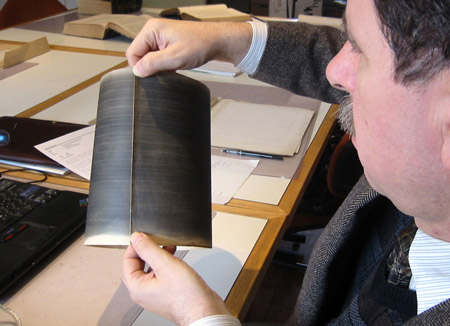
It was made on April 9, 1860, by Parisian inventor Edouard-Leon Scott de Martinville on a device called the phonautograph that scratched sound waves onto a sheet of paper blackened by the smoke of an oil lamp, Giovannoni said.
Giovannoni said he learned on March 1 of its existence in an archive in Paris and traveled to the French capital a week later. Experts working with the First Sounds group then transformed the paper tracings into sound.
"It's important on so many levels," Giovannoni said in a telephone interview. "It doesn't take anything away from Thomas Edison, in my opinion. Thomas Edison is generally credited as the first person to have recorded sound."
"But actually the truth is he was the first person to have recorded (sound) and played it back. There were several people working along the lines of Scott, including Alexander Graham Bell, in experimenting -- trying to write the visual representation of sound before Edison invented the idea of playing it back," Giovannoni said.
Giovannoni said that phonautograph recordings were never intended to be played.
"What Scott was trying to do was to write down some sort of image of the sound so that he could study it visually. That was his only intent," Giovannoni said.
Link to mp3 of the recording.
Posted by James Westbrook (Member # 3690) on 03-28-2008, 10:48 PM:
I hope this "finding" isn't a hoax.
Posted by Allison Parsons (Member # 2728) on 03-28-2008, 10:57 PM:
I heard about this (and heard it) on talk radio the other day. Kind of spooky!
Posted by Mark Gulbrandsen (Member # 72) on 03-28-2008, 11:01 PM:
After listening to it I'm convinced that they definately should have had Dolby SR back in the 1800's!
Mark
Posted by Ron Funderburg (Member # 4561) on 03-28-2008, 11:07 PM:
Why do you hope it is a hoax? The Luminaries in Italy invented light bulbs before Edison did but it doesn't seem to hurt his reputation on that!
Marconi used 19 inventions in the radio of Tesla and the design patented by Tesla in Radio and still Marconi is credit with the invention.
Someone else is supposed to have invented the telephone before Bell can't remember his name right now, sorry.
Edison wasn't even working on sound recording at the time he was working on a repeater to transmit telegraphic signals during the night when no operator was there to receive it. It would record the dots and dashes they would play it back in the morning and translate it was the theory and then that light bulb he invented went off in his head and thought "wow you could say Marry had a little lamb and play it back" so he did.
What some else did 17 or 18 years before doesn't take away from what Edison did. Besides that he was the first to turn a profit off of it!
Posted by Joe Redifer (Member # 3) on 03-28-2008, 11:14 PM:
How do they know how old this is, did they carbon date it?
I wonder if the poor bastard realized his recording would be destroyed by 128kbps MP3 technology in the future. Is there a SACD or DVD-A version?
Posted by Tim Reed (Member # 137) on 03-28-2008, 11:39 PM:
![[rofl]](graemlins/rofl.gif) I was waiting for Joe to chime in on this! Hilarious.
I was waiting for Joe to chime in on this! Hilarious. ![[Big Grin]](biggrin.gif)
Either the article or their website, First Sounds.org, said the phonautograms were dated when the patent was filed, and with the Paris archive.
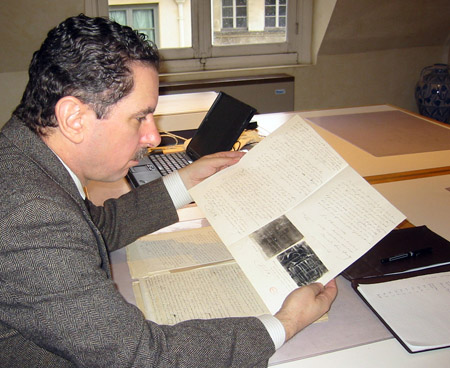
BELOW: David Giovannoni inspects Scott's first two experimental sound recordings, made in 1853 or 1854, in the archives of the Académie des Sciences of the Institut de France, where they were deposited in 1857.
Photo by Isabelle Trocheris
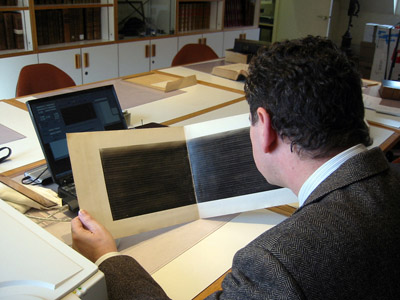
BELOW: David Giovannoni examines one of Scott's 1860 phonautograms in the archives of the Académie des Sciences of the Institut de France, where it was deposited in 1861.
Photos by Isabelle Trocheris
Continuing, from a Times report:
"Mr Giovannoni had found earlier recordings at a Paris patent office, dating back as early as 1857 but he told the newspaper that his "eureka moment" came when he found the immaculately preserved 1860 recording on a sheet of rag paper measuring nine inches by 29 inches.
"It was pristine," Mr Giovannoni said. "The sound waves were remarkably clear and clean."
Mr Giovannoni sent scans of the recording to the Berkeley Lab where they were painstakingly converted into sound by scientists using technology designed to salvage historic recordings.
That technology allows the voice of a young French woman, recorded in Paris in the months before Abraham Lincoln's inauguration as President of the United States, to be heard again."
Posted by Chris Slycord (Member # 4239) on 03-29-2008, 12:42 AM:
Ron,
He didn't say he hopes it's a hoax; he said he hopes it ISN'T one.
No one is claiming that Edison invented the first light bulb. Obviously light bulbs existed even back to 1800. On the other hand, he was the first to produce a bulb that lasted for many hours and was the first to go for commercial distribution.
Heck, he invented the first commercially available fluoroscope and his design is pretty much identical to the ones used everyday in medical offices across the world.
Like Henry Ford isn't important for inventing the car (since he obviously didn't) but is important for bringing it to the masses.
Posted by Louis Bornwasser (Member # 3063) on 03-29-2008, 05:01 AM:
I was present at an exhibition/seminar presented by Max Bell (London) where many 35mm film soundtracks and dates were presented. While many were recorded, only the Western Electric was successfully and commercially played back. "Many" could be 10-15 going back to before 1900. Louis
Posted by Hillary Charles (Member # 769) on 03-29-2008, 07:49 AM:
That's amazing!
The thought that there would have been the ability to record Lincoln's voice, even without Hi-Fi, is stunning.
Posted by Sean McKinnon (Member # 612) on 03-29-2008, 10:29 AM:
quote: Chris Slycord
Like Henry Ford isn't important for inventing the car (since he obviously didn't) but is important for bringing it to the masses.
You're right about that. Ford I beleive invenited the assembly line system of manufacturing that was a huge boost to the industrialization of the united states and the world, and is still in use today (even though most humans have been replaced by robots) It would be hard to imagine a world without the assembly line. You think cars are expensive now? Imagine how must they would cost if they were built by one person one at a time!
Posted by Leo Enticknap (Member # 534) on 03-29-2008, 02:11 PM:
The coverage of this story on British radio gave rise to one of the funniest things I've heard in a long time - MP3.
Posted by Ron Funderburg (Member # 4561) on 03-29-2008, 02:42 PM:
Chris my bad but the rest of my post still stands! There are a lot of people that never get credit that do a lot of work for every step forward that is taken!
[ 03-29-2008, 08:31 PM: Message edited by: Ron Funderburg ]
Posted by Chris Slycord (Member # 4239) on 03-29-2008, 08:10 PM:
I'm not disagreeing with you on that. I'm just saying that a person can be important even if they were expanding on the effort of someone else.
Posted by Ron Funderburg (Member # 4561) on 03-29-2008, 08:29 PM:
Chris I agree with you entirely.
Sean, I think maybe you will find several others between 1800 and 1900 used to some degree an assembly line technique Winchester for one used a progressive assembly line for the fitting of the rifles. I would guess it was no where near the degree that the assembly line efficiency of Henry Ford was.
The amazing thing is there a lot of Edison cylinder phonographs that still work. I have an 1892 rifle made in 1892 that works and works well. I have friend that has a first generation Colt 44-40 made way back in 1884 and it shoots wonderfully. I had a pocket watch made in 1885 that kept great time. Sold that to a friend. Some of the old technology was built for not a lifetime but several lifetimes!
Posted by John Walsh (Member # 168) on 03-30-2008, 09:49 AM:
I read an article awhile ago that suggested technology might be moving slower than it was 40-50 years ago. Back then, inventors and scientists wanted to freely publish their findings, not for money, but for the 'honor.' This sharing allowed people to build on the work of others. Today, though, companies try to keep things secret to prevent competition.
Posted by Jim Cassedy (Member # 4115) on 03-30-2008, 10:29 AM:
Amazing story!
What I found particulary fascinating was this line:
"The existence of a tuning-fork calibration trace allows us to compensate for the irregular recording speed of the hand-cranked cylinder. "
WoW! Almost like a primitave sync or time-code track!
I recall reading a story several years ago where someone had managed to restore the voice of Alexander Graham Bell originally recorded by his "Photophone" system onto a strip of photo sensitized paper. The recording sounded like the one in the story above, only worse.
(And remember: if it wasn't for A.G Bell, we'd all be carrying around cellular telegraphs!)
Posted by Tim Reed (Member # 137) on 03-30-2008, 12:21 PM:
Jim, the tuning fork thing blew me away, too. He inadvertently created a pilot tone.
Posted by Jim Cassedy (Member # 4115) on 03-30-2008, 01:25 PM:
quote: Tim Reed
He inadvertently created a pilot tone.
Ah yes..."pilot-tone" that's the word I was searching for!
It's a more accurate description of the tuning fork concept than I wrote in my post.
Haven't heard that phrase since my film school days many years ago.
FYI> Here's an actual photo (WoW!) of a phonoautograph, from the Institute Of Electrical Engineering archives.
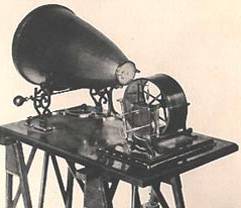
As you can see, it's pretty simple. Just a needle attached to a diagphram at the end of a horn. The needle scratches a "waveform" of the sound captured by the horn onto a piece of paper covered with lampblack. (soot)
No tubes, no wires, no chips! (and no motor- it was hand cranked)
Posted by Mark J. Marshall (Member # 1409) on 03-31-2008, 09:13 AM:
That's truly amazing.
Thanks for posting that story, Tim.
![[thumbsup]](graemlins/thumbsup.gif)
Powered by Infopop Corporation
UBB.classicTM
6.3.1.2