This is topic RED CAMERAS "as good as film?" in forum Film-Yak at Film-Tech Forum ARCHIVE.
To visit this topic, use this URL:
https://ft-forum.com/ft/cgi-bin/ubb/ultimatebb.cgi?ubb=get_topic;f=8;t=005590
Posted by Cameron Glendinning (Member # 3516) on 09-28-2008, 06:14 PM:
Over the last few weeks I have seen some camera tests shot at Fox Studios. I even went and watched some of the "Bank Job" which is a feature film shot with this new 4k digital technology. All the footage had been transfered to 35mm film for projection.
Needless to say the on screen results looked impressive and quite film like to me. Anyone else impressed with this new technology?
Posted by Greg Anderson (Member # 235) on 09-28-2008, 07:19 PM:
At NAB in April I saw footage from Soderbergh's movies The Argentine and Guerrilla. Both were shot with the Red camera. One of them (I forget which) was shot using anamorphic lenses... which must have given a final, corrected aspect radio of, what, 32:9? Anyway, they were going to crop it off to 2.35:1 in the end. But the point was that he was trying to mimick the look of older war movies shot with anamorphic lenses. And it worked very well.
What I saw was projected digitally. It looked great.
I don't know how long this thread can remain on topic but I'll just say that the phrase "as good as film" is probably going to get us into trouble. I don't know that digital needs to look "like film" although, to my eyes, it does. For me, the bottom line is that digital is different but it still looks great. And Red is already developing their 5K camera.
Posted by Joe Redifer (Member # 3) on 09-28-2008, 07:43 PM:
They probably aren't quite as good as film just based on exposure tolerances alone, but DAMN Red has a really nice camera for only 3 grand. Freakin' unbelievable.
Posted by Greg Anderson (Member # 235) on 09-28-2008, 09:23 PM:
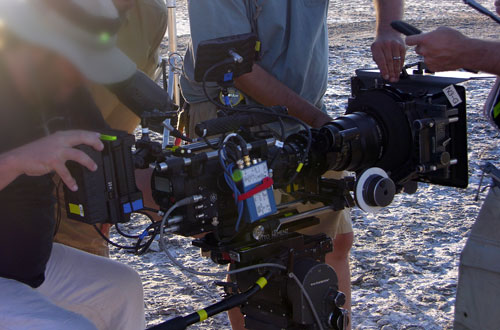
You can deck these things out to look an awful lot like film cameras and you can spend an awful lot more than the base price. National Lampoon did a feature here last month with a three-camera package.
Posted by Mark Gulbrandsen (Member # 72) on 09-28-2008, 10:30 PM:
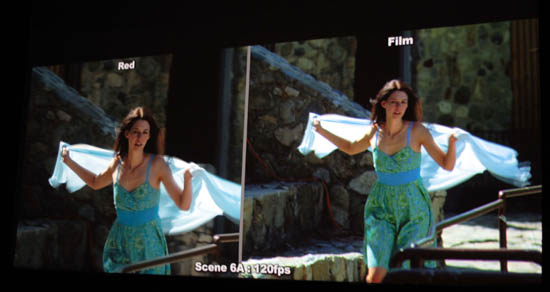
I saw that test a week ago and projected via the new Christie M projector at the correct color temp and light level. IMHO the Red Camera actually did look better than film in many aspects... especially at bringing out details in the dark areas and there was no "Kodak Blue" in the dark areas at all. Hair had much more detail to it as well. Now I don't always believe tests like this unless they are done by some neutral entity, or in other words I can't say the filmed parts were done to the best of film's ability. For what its worth a couple of off screen pics...

Mark
Posted by Tim Reed (Member # 137) on 09-28-2008, 10:33 PM:
quote: Joe Redifer
Red has a really nice camera for only 3 grand. Freakin' unbelievable.
I've been watching this since Red One was still a rumor. It's designed specifically for Digital Cinema.
"Scarlet" is due out next year, base price $3,000. ![[thumbsup]](graemlins/thumbsup.gif) (The Red One body is something like $12,000.)
(The Red One body is something like $12,000.)
Posted by Mike Olpin (Member # 1115) on 09-28-2008, 10:39 PM:
The thing to keep in mind is that it is not all about resolution. It's about dynamic range. Film has a great deal of headroom in terms of color, whereas electronic (digital) imaging does not. This makes a difference with color correction. The raw footage shot on film can look pretty bad, and yet still be color corrected to look great. In digital, the color correction possibilities are much more limited.
The key for the RED camera is the price point. It's set at a level where independent film makers can at the very least rent the equipment at an affordable rate.
Posted by Joe Redifer (Member # 3) on 09-29-2008, 12:16 AM:
quote: Greg Anderson
You can deck these things out to look an awful lot like film cameras
No kidding... colored tape makes ANY camera look professional!
quote: Mark Gulbrandsen
IMHO the Red Camera actually did look better than film in many aspects.
Who was running this demo? Was it.... RED? Also digital pictures of projected screens don't show much.
quote: Tim Reed
"Scarlet" is due out next year, base price $3,000.
Ahhhh, so it is the Scarlet. I was looking at that camera and thinking "No, it can't be this one. It must be one called "Zit Bleed Red".
quote: Mike Olpin
The thing to keep in mind is that it is not all about resolution. It's about dynamic range. Film has a great deal of headroom in terms of color, whereas electronic (digital) imaging does not.
Agreed, which is the basis of my very first comment in this thread. I really, really, really hate images that are blown out where all of the highlights are clipped or the blacks crushed.
Posted by Brad Miller (Member # 2) on 09-29-2008, 12:58 AM:
quote: Joe Redifer
I really, really, really hate images that are blown out where all of the highlights are clipped or the blacks crushed.
You and me both! I've noticed an increasing trend in portrait photography to clip the highs and yet these photographers still label themselves as "professionals". ![[Roll Eyes]](rolleyes.gif)
Posted by Mark Ogden (Member # 43) on 09-29-2008, 08:17 AM:
The camera that was going to be the Scarlet isn't going into production after all, mostly because of the appearance of the Nikon D90 and the Canon 5D Mk 2. Although Red Digital isn't saying much, the rumor is that the whole Scarlet concept has been dropped in favor of something more a response to those cameras, one with interchangeable lenses, which the original Scarlet didn't have. They are also bringing out a 5K camera, the Epic, whose sensor can be retrofitted into the Red One.
Posted by Tim Reed (Member # 137) on 09-29-2008, 09:57 AM:
The new design is still making its debut at NAB 2009, and still going to be called Scarlet.
Posted by Michael Barry (Member # 237) on 09-29-2008, 10:07 AM:
...but, will it still meet that promised $3000 price point?
Posted by Bobby Henderson (Member # 840) on 09-29-2008, 10:11 AM:
The Canon 5D Mark II has some exciting possibilities, but I have a feeling the camera will be pretty limited as far as video use is concerned. Reportedly the camera has HDMI and USB connections. Hopefully that might enable some direct-to-disc recording rather than having to rely totally on a flash card within the camera.
Good quality D-SLR camera lenses are relatively expensive, but not as expensive as lens packages for motion picture film cameras or broadcast quality video cameras (at least not in the most commonly used lens lengths). Obviously the line separating D-SLR still cameras and video cameras is going to get further blurred or completely eliminated. A relatively affordable camera that can work fully as a D-SLR and semi-professional quality video camera and use Canon or Nikon D-SLR lenses would be a pretty attractive product.
Posted by Tim Reed (Member # 137) on 09-29-2008, 12:59 PM:
quote: Michael Barry
will it still meet that promised $3000 price point?
Since that was one of its main selling points, I would think they'd keep it in that range. quote: Bobby Henderson
The Canon 5D Mark II has some exciting possibilities, but I have a feeling the camera will be pretty limited as far as video use
I don't think a DSLR had anything to do with the re-purposing of Scarlet; no one's going to be shooting DC or HDTV content with a Canon still camera (some animation, possibly).
Posted by Bobby Henderson (Member # 840) on 09-29-2008, 02:37 PM:
Of course not. Professional video projects will still demand fully dedicated video cameras to get the work done.
But it does represent an obvious shift in the direction of product development. Ultimately what happens with the Canon EOS 5D Mark II and other D-SLRs incorporating video capabilities is that in the long run consumers will have one device to do both video and still photography and get great results doing each. Right now no such product exists -at least not anything credible. Currently you have video cameras that do a terrible job taking still photos and various still cameras that do a crappy job handling video.
D-SLR lens systems have a great product range. Lenses on most consumer priced video cameras are not very good at all. The Red camera and several other D-cinema video cameras are able to use 35mm film camera lens systems. With D-SLR cameras growing in popularity, it only seems logical to develop a device that can use those kinds of interchangeable D-SLR lenses to do both video and still photography very well.
Posted by Scott Norwood (Member # 30) on 09-29-2008, 03:50 PM:
Still photography and cinemtography use different types of lenses, so I'm not sure how much they could possibly be interchanged. For example, no one really cares about "breathing" with a still camera lens, but it would ruin a rack-focus shot in a motion picture. Motion-picture camera lenses also have gearing for follow-focus units and other features that are not useful or desirable for still photography. Still camera lenses generally have a mechanism to close down the iris when the photograph is snapped and remain wide open at all other times for focusing and composition; this is not the case with motion-picture lenses.
Even the video camera world has different types of lenses for different applications--"cine" lenses have a longer focus "throw" (distance the lens barrel must rotate from the closest setting to infinity) and are designed to be able to be focused precisely, while "ENG" lenses have a shorter focus throw and are designed to be easier and faster to focus, but are less precise.
In any case, there have been methods for fitting Nikon (most commonly) 35mm still camera lenses onto 35mm and 16mm motion-picture cameras for years. There are uses for this, but the concept is not popular for everyday filming.
Even if the RED camera is just as good as 35mm film (which I doubt), I still fail to see the point, except perhaps for films which make extensive use of digital effects. A film transfer is necessary for archiving and distribution, which will eat up a good chunk of any savings from not having to purchase and process film at the production stage. In any case, film isn't what makes movies expensive; a "low budget" feature might cost $5 million and have a film budget of maybe $100k.
Posted by Mark Gulbrandsen (Member # 72) on 09-30-2008, 01:20 PM:
Actually Scott,
The original VistaVision cameras starting with the studio built "Lazy 8" and all the VV Mitchell's used Leica camera lenses of the era. Today many Nikor lenses are in use on all 35mm formats including VistaVision. Imax uses many adapted Pentax 6X7 lenses and Some Mamiya 6X7 lenses on it's cameras. They generally but not always have custom made barrels and focus heliciods to take the abuse of daily production rigors.
Mark
Posted by Scott Norwood (Member # 30) on 09-30-2008, 06:39 PM:
I did not mean to suggest that still-camera lenses are never used for motion-picture work...just that their use is uncommon. For a typical narrative feature, most DPs would go with Zeiss or Cooke primes or zooms rather than using a Nikon-mount adapter. I've never seen still camera lenses on a rental price sheet; they would be there if a demand existed.
Posted by Mark Gulbrandsen (Member # 72) on 09-30-2008, 07:22 PM:
Scott,
Many rental houses that rent 2nd unit/high speed/timelapse packages have them although they are more than likely not marketed as "Still Camera Lenses". You might be shocked to discover just how many Nikors are in use...
Mark
Posted by Charles Greenlee (Member # 3856) on 10-02-2008, 06:11 PM:
quote: Mark Gulbrandsen
there was no "Kodak Blue" in the dark areas at all.
Um, enlighten me. Please define "Kodak Blue"?
Posted by Mark Gulbrandsen (Member # 72) on 10-05-2008, 11:25 AM:
Kodak film products, particuluarly Ektachrome and Eastman Color have been long known for the "Blue" tinge to not only the overall image on occasion but especially in darker areas of images... but not necessarily the deep black areas... It's always been frustrating to me and thousands of other photographers/cinematographers who use their products. They did make one Ektachrome product in 120 size and up that was not as bad at this... call it a warmer image... but they have never managed to equal the results that Fuji has done with their color reversal "Velvia" ASA 50 product. Kodak always had superior grain structure although Velvia sure gives even ASA 25 Kodachrome a run for it's money. Ironically Kodak is marketing a line of CCD sensors called Blue Plus! As well as a line of digital cameras called Blue. Go figure...
Kodachrome never suffered from the "Kodak Blues" issue. It was always very neutral capable.
Mark
Posted by Louis Belloisy (Member # 3836) on 10-06-2008, 06:58 PM:
Rumor has it that kodak will stop production of Kodachrome 25
louis
Posted by John Koutsoumis (Member # 1855) on 10-15-2008, 11:15 PM:
quote: Cameron Glendinning
I even went and watched some of the "Bank Job" which is a feature film shot with this new 4k digital technology
Can someone clarify? I thought it was shot using Arriflex digital cameras that only do HD...
It looks great but if that's 4K then I am a little dissapointed. Also very flat looking too. No depth.
Posted by Randy Stankey (Member # 64) on 10-19-2008, 11:32 AM:
It really bugs me when people say some kind of video is "as good as" some kind of film.
The truth is that video is video and film is film. There will be a significant bit of overlap between the two but never will one be "as good as" the other. Each has its own strengths and weaknesses.
It's the same as asking, "Are diesel locomotives 'as good as' steam powered locomotives?"
When you get down to it, diesels are more convenient, are easier to maintain and repair and are often more fuel efficient than steamers but, for sheer power, you can't beat steam.
I was at the county fair, a while back, when they had a steam engine show and a tractor pull on the same day. Somebody got the bright idea to hook one of the steam tractors up to the pulling sled as if it was some kind of joke.
They had dozens of souped-up, turbocharged "monster" tractors which often had a hard time making the "full pull" distance of 150 feet.
When they hooked the steam tractor up, the announcer started cracking jokes like "Let's see what this OLD tractor can do!" Everybody was smiling and laughing the whole time... Right up to the time when they realized that the steam tractor had covered the 150 feet and was still going!
By the time the referee ran out and stopped him, the guy had pulled that sled half way around the quarter mile track!
The crowd was going nuts!
The driver waved to the crowd as he unhitched the sled and "chugged" his tractor off the track. He left it there for the other tractors to pull back to the starting line.
So, just as I compare diesels to steam engines, in the long run, video will end up being easier, faster and cheaper to produce but I don't think it will ever be "as good as film."
Each has its own strengths and weaknesses. It will be up to the user to decide what he wants to accomplish and choose the right equipment to do the job as he requires.
Thus, I think it is a fallacy to say, "Video is as good as film."
Posted by Mark Ogden (Member # 43) on 11-13-2008, 06:27 PM:
Here is the new Red line-up, but be sure to read the fine print.
Since they are clearly making a play for still shooters here I wonder when, if ever, we will see Photoshop, Lightroom or Aperture support RedCode.
Posted by Jennifer Pan (Member # 2035) on 11-14-2008, 01:48 AM:
I got chills from looking at those.... ![[Big Grin]](biggrin.gif) so beautiful...
so beautiful...
Posted by Joe Redifer (Member # 3) on 11-14-2008, 02:11 AM:
So the mount... just a couple of steel bars and some plastic... is $55,000?????? But the working component is under $3K?
Posted by Jennifer Pan (Member # 2035) on 11-14-2008, 08:28 AM:
Red 617 mount includes the Epic 617... which is a working component(Brain), that looks like the body of a DSLR camera in regular view. 28,000x9334 pixels compared to Scarlet at 3072x1620 pixels.
Posted by Mark Ogden (Member # 43) on 11-14-2008, 09:42 AM:
The Red 617 is actually a 261 mega-pixel digital back for the Linhof 617 panoramic camera.
Posted by Jon P. Inghram (Member # 4125) on 11-14-2008, 12:30 PM:
That "Epic 617" is also pure BS as NOBODY makes sensors that size. And 25 fps off a CCD that big? I hope it's just a strange joke. Also, I'm not sure if I'm reading that right or not, but are they really implying a 28000x9334 sensor that's 7.3 inches long will only cost $55,000?
[ 11-14-2008, 02:19 PM: Message edited by: Jon P. Inghram ]
Posted by Bobby Henderson (Member # 840) on 11-14-2008, 03:01 PM:
quote: Mark Ogden
Since they are clearly making a play for still shooters here I wonder when, if ever, we will see Photoshop, Lightroom or Aperture support RedCode.
This is from Adobe's page on Premiere Pro CS4:
quote: Adobe Systems
Adobe and RED Digital Cinema Camera Company are collaborating to bring a truly native, color-rich, 4K tapeless workflow to desktop tools, enabling filmmakers to harness the full potential of high-resolution raw digital cinematography. The first step of this long-term collaboration is the importer beta plug-in that brings native support for RED R3D files to Adobe® Premiere® Pro CS4, After Effects® CS4 Professional, and Encore® CS4, allowing 4K resolution native R3D files to be dropped straight onto the timeline without transcoding or rewrapping.
Posted by Cameron Glendinning (Member # 3516) on 11-14-2008, 08:56 PM:
quote: Randy Stankey
The truth is that video is video and film is film
The TRUTH is that red is neither video nor film, its data off a cmos sensor uses the exact same lenses and identical imaging size of super 35mm film.
It has more of a relationship with the technology of digital still cameras than any television production equipment of the past.
quote: Jon P. Inghram
And 25 fps off a CCD that big?
Its a CMOS
quote: Mark Ogden
Linhof 617 panoramic camera.
I have a beautiful photograph taken with this camera (film) given to me as a wedding gift, the qualiy is draw droppingly good. I have seen enlargements made up to 10' x 30' at an exibition here in Sydney.
quote: John Koutsoumis
I thought it was shot using Arriflex digital cameras that only do HD...
I might have misunderstood the cinematographer I was asking who has tested several D cameras. We were discussing red and I simply asked if there was a good example in release. I have found out since that the Australian part of the shoot was with arri D20. I would guess that the rest would have been shot with it as well but dont know for sure. The arri D21 now features a 3k sensor and will except 35mm film anamorphic lenses.
Aatons new Penelope 35mm camera is interesting as it will be able to shoot 2 perf or 3 perf 35mm, In the near future it will have a Digital Magazine option so that you can shoot film or digital with the same body.
aaton
Posted by Joe Redifer (Member # 3) on 11-14-2008, 09:53 PM:
quote: Cameron Glendinning
The TRUTH is that red is neither video nor film
The truth is that if it is an electronic moving image, it is video. Film is chemical. Red is video.
Posted by Cameron Glendinning (Member # 3516) on 11-14-2008, 10:21 PM:
I was under the impression that the red camera did not output an electronic image, only data, that was to be processed by a computer into the final image at a later date. This is unlike video cameras (or should I say previous generations of video cameras ![[Smile]](smile.gif) )that are processing and outputing a finished standardised product.
)that are processing and outputing a finished standardised product.
Personally If I was to shoot a low budget motion picture at the moment I would use super 16mm, Its light weight and can use a small crew, a decent budget I would shoot 2 or 3 perf 35mm. I am not sure what my answer would be next year as this technology is simply getting better.
With the output of most finished hollywood product being on 35mm film from digital post production, doesn't that technically make all the films are now video no matter what?
Posted by Joe Redifer (Member # 3) on 11-14-2008, 10:28 PM:
quote: Cameron Glendinning
I was under the impression that the red camera did not output an electronic image, only data, that was to be processed by a computer into the final image at a later date.
Kind of like every MiniDV camcorder! Only the MiniDV camcorders happen to have onboard A/D converters so you can see the video and hook it up directly to the TV.
Posted by Cameron Glendinning (Member # 3516) on 11-14-2008, 11:50 PM:
Are you comparing red raw with mini dv? ![[Confused]](confused.gif) If it was similar I am sure there would not be the huge post production sting that red seems to have at the moment.
If it was similar I am sure there would not be the huge post production sting that red seems to have at the moment.
I really don't care if its called video or digital, to many it seems different enough to be noted as such.
After listening to some seminars about working with it in post, I would have to say it seems a far more complicated path than traditional tape based formats including HDCAM SR beta etc (at this stage).
The Red does have issues but they seem to be moving forward and working through them. The results on screen after a chemical process seem very film like to me. Having shot motion picture film, worked on 35mm productions, I am surprised how close or similar the results are now getting.
Posted by Joe Redifer (Member # 3) on 11-14-2008, 11:54 PM:
Compression format is irrelevant in the discussion of Red being video or not. It's not video only if you define video as being an accepted standard like PAL or NTSC.
Posted by Bobby Henderson (Member # 840) on 11-15-2008, 12:02 AM:
Geez. Only film is film. "Digital" is still electronic. And any electronic imagery is still video. It isn't film.
And the CMOS versus CCD thing, well that a whole other complicated debate.
The thing going on with Red as well as what's happening lately with D-SLR still cameras shows a long term path of convergence where we may see large, very high pixel count sensors performing double duty on capturing still images and video.
I have no desire to buy a Red camera body. But Canon's new version of the EOS 5D is very intriguing in that it shoots 21.1 megapixel still images and records true 1080p video in MPEG-4 AVC format (not to mention ISO sensitivity up to 25,600 ISO). I had considered the eventual purchase of a "full frame sensor" body like the EOS 5D when I bought my first pair of Canon L-series lenses. Still, I may not buy the EOS 5D Mark II, but it looks like a definite sign of what is to come in future D-SLR technology.
Powered by Infopop Corporation
UBB.classicTM
6.3.1.2