This is topic Exhibition in 2018 in forum Film-Yak at Film-Tech Forum ARCHIVE.


To visit this topic, use this URL:
https://ft-forum.com/ft/cgi-bin/ubb/ultimatebb.cgi?ubb=get_topic;f=8;t=005607

Posted by Mike Blakesley (Member # 26) on 10-20-2008, 02:35 PM:
 
The new Boxoffice has an article with 10 predictions as to what Exhibition will be like in ten years. I won't put up the actual predictions from the magazine but let's make some guesses of our own. What kind of changes do you foresee?

If you have the magazine, feel free to comment on specific predictions in the article but I think it would be wrong to put up the 10 actual predictions from the magazine at this point.

It'll be fun to check back in here in 10 years to see how right/wrong we were.
 
Posted by Bill Enos (Member # 440) on 10-20-2008, 03:09 PM:
 
If theatrical exhibition exists, all sub runs and mid runs will be gone, your show times will be controlled by studios/distributors who will be getting 10% to 20% of concessions and anything else sold in the building, govt. at some level will be dictating what can and cannot be shown, and unflattering things about government and its officials will be censored.
 
Posted by Rick Raskin (Member # 1561) on 10-20-2008, 03:10 PM:
 
Some of us don't get "Boxoffice" and would like to know what they are predicting before we comment or add. Given that, I think posting their predictions would be acceptable.
 
Posted by Scott Norwood (Member # 30) on 10-20-2008, 03:23 PM:
 
I can't speak for the rest of the world, but for the US, I'll offer these:

- screen count will be 1/3 to 1/2 of what it is today (2008)
- the theatres that survive will not be mainstream multiplexes (mostly), but will be the ones which offer something unique--programming, dining, atmosphere (drive-in, etc.), history, etc. will be valued
- the above notwithstanding, mainstream multiplexes will survive in cities and major population centers
- number of film releases will be about the same as it is now, but screen counts will be far lower
- 35mm film (and, in repertory and special venues, 16mm and 70mm) will still be with us, but will by no means be universal, and some releases may be digital-only
- 3D will be a specialty format (sort of how Imax is today) and not used for every release or available on every screen
- Imax as a company will be gone, though large-format will continue in some form (film or digital)
- ticket and concession prices will rise with (or maybe slightly faster than) inflation
- quality of feature films will remain about the same as it is today
- out-of-home entertainment options will continue to proliferate, with the result that movies are seen as a "special event" and not just "something to do"
 
Posted by Scott Jentsch (Member # 1681) on 10-20-2008, 04:25 PM:
 
When making predictions about the future, it's sometimes useful to look an equal distance in the past.

What has changed in the last 10 years?

One can probably safely assume that the rate of change will increase in a non-linear fashion, where the next 10 years will see more change than the past 10.

That said, I agree with many of Scott's predictions. I think the total number of screens will be lower, as will the total number of theater owners (consolidations of theaters and chains). I think that at least one of the major chains will be absorbed by another, possibly one lower in the ranks but not leveraged to the hilt in a bad economy.
 
Posted by Joe Redifer (Member # 3) on 10-20-2008, 06:04 PM:
 
-There will be many more screens but fewer owners.

-There will be fewer if any independents. Mike Blakesley will be homeless. He will eat discarded newspapers to survive. It will be a tough living since not many newspapers will exist in 10 years.

-There will be at least 9 hours of ads and 4 hours of trailers before every movie.

-The majority of releases will be digital only.

-DTS will exist only in the home market... barely.

-Many of us will have died.

-Filmguard and media pads will be made-to-order only.

-3D will still be just a gimmick for buffoons.

-Going to the movies will be "something to do" until the home version of the movie comes out.

-There will be flying cars and cyborg implants.

-Jaws 19 will be one of the biggest flops in the last 3 years.

-Working at a movie theater will still be considered the minimum wage "starter job" that it is today, thus professionalism will not be expected nor delivered... just like it isn't today.

-Theater seats will be blamed for the epidemic outbreak of anal warts.

-It will not be uncommon for the movie theater experience to cost the average family $100 or more, thus strengthening the home video market.

-Nothing politically incorrect will be allowed to be shown or spoken due to the deep nationwide fear of offending someone. Reparations will be paid to anyone who has ever been offended for any reason.
 
Posted by Phil Hill (Member # 371) on 10-20-2008, 06:12 PM:
 
I could care less about what commercial film/TV exhibition would be like in 2018. By then, I'll be rotting in my grave and whatever happens won't phase me.

Hopefully by then, they will bury dead people under new freeways and roadways...Ummm, *without* the the "mile dedications"... [Smile]
 
Posted by Geoff Jones (Member # 3668) on 10-20-2008, 06:58 PM:
 
Scenario A
Movie-going has fractured into two distinct categories: Standard and Premier

Standard screens are 20 or 30 feet wide and feature digital projection. Their business is split evenly between feature films and television. People come together and watch the latest episode of The Office or Survivor in these screens. The price of admission actually drops, thanks to automation and lack of print costs.

“Premier screens are 60’ wide or larger. They feature new releases and classics in 70mm. The costs are greater ($25 a ticket), but discerning movie-goers are happy to pay it. Tuxedoed ushers monitor auditoriums regularly for problems and presentations are flawless.

Most metropolitan areas feature 8-12 premiere screens and small towns usually have 1 or 2.

Scenario B
Movie-going is almost a thing of the past. Theatres are over-run by chatty dullards who don’t care that the image is a blurry mess. Discerning movie-goers have given up, realizing that they can have a better experience with friend and family at home. 120” Constant Height Projection is common-place in the home.

[Smile]
Jonesy
 
Posted by Mark J. Marshall (Member # 1409) on 10-20-2008, 07:22 PM:
 
The world is ending in 2012 anyway according to the Mayans, so it won't matter much.
 
Posted by Bobby Henderson (Member # 840) on 10-20-2008, 07:58 PM:
 
What will movie exhibition be like in 10 years?

Honestly? Probably not much different than it is today.

If I need to go out on a limb, I'll offer these predictions.

In 2018, far fewer commercial movie theater screens will exist if exhibitors keep doing business the same old way. Exhibitors like Bill Warren who gamble big sums of money on high end "destination theaters" may be among the few left standing. High priced luxury theaters may flourish in larger cities. The movie/grille/bar concept will become more popular and may be one of the few ways cities with populations of 100,000 or smaller even keep a theater at all.

A lot of fairly decent or even impressive theaters are going to close because the theater company (or whoever owns the property) wants to cash in on the real estate values. Once a few mergers happen, the "bigger" company will sell off lots of assets (theater sites) to pay down debt and lower operating costs. Some theaters may be bought out of their lease.

VHS, DVD and Dolby Digital 5.1 were not enough to inflict damage to the commercial movie theater industry. However various kinds of home-HD technology will cause enough of a market shift to make traditional movie theaters in cities and towns with fewer than 100,000 people unprofitable to operate.

IMAX Digital will be a historical foot note. IMAX will be out of business too if no one is making 65mm and 70mm film stock by then.

If Kodak and Fuji are still making 35mm film stock, most Hollywood movies will still be shot on film rather than video. The movies just won't be shown on film.

35mm projection will exist only in revival type theaters within cities large enough to have any sort of arts district. It will be as rare as 70mm projection is now.

OTOH, 70mm could see a slight or even significant resurgence -thanks in part to home video and Blu-ray. By 2018, a decent number of movies may be filmed in 65mm due to the increasing demands each successive home video format. Roger Ebert said this about the new Blu-ray release of Baraka: "The restored 2008 Blu-ray DVD is the finest video disc I have ever viewed or ever imagined."

Digital projectors will be moving to something other than DLP. 4K-based projection will be common. I'm sure we'll see 6K or even 8K systems being introduced by then. By 2018, enough 4K digital intermediates will have been made to seed the successor of Blu-ray. Home viewers will have their super-phiggidy 1 billion to 1 contrast ratio, paper thin, wall sized 3840 X 2160 resolution screen for watching movies and TV, playing games, running their computer and making video phone sex calls to their girlfriends. People will be such cocooned couch potatoes by then they'll be fed by IV or stomach tubes and wear catheters and colostomy bags!
 
Posted by Robert Crabtree (Member # 4795) on 10-21-2008, 01:40 AM:
 
Based off of Chris Anderson's "The Long Tail: Why the future of business is selling less of more", I imagine a proliferation of alternative content that at the moment, is largely a novelty, like opera, concerts, and sporting events.

I think digital will become the norm, with film hanging on in small/niche markets. Theatres will see a greater need to break free of the limitations of the "short shelf", and with the above mentioned content shift, and digital capabilities, that can happen.

I'm sure the trend towards a few Large companies will continue, but with a dark horse coming out of nowhere to become The Biggest. Call them REG 2.0.

As for screen counts...I think there'll be a slight dip, with a focus on 12-14 plexes.

With population growth staying constant, and many large cities already bursting at the seams, an exodus to the 'burbs and other less populated areas will bring new growth opportunities in previously underserved areas and perhaps a return to the neighborhood theatre, further driving down screen count averages in a "Post-Mega" era.

I think there will be a growing market for theatres as a part of an entertainment site, but not the only focus- Restaurant/Theatre/Fun Center/Bowling Alley/etc.
 
Posted by Allison Parsons (Member # 2728) on 10-21-2008, 01:50 AM:
 
I do predict that posters will be no more, and some tiny projector thing will project the images on the walls of the lobby.

But my crystal ball is fuzzy when it comes to the meat and potatoes aspect of the biz. I would have laughed at you 1996 if you told me in 10 years, my job would be replaced by a giant blue box projector which was ran by a super computer...
 
Posted by Jesse Skeen (Member # 586) on 10-21-2008, 07:46 AM:
 
quote: Geoff Jones
Theatres are over-run by chatty dullards who don’t care that the image is a blurry mess. Discerning movie-goers have given up, realizing that they can have a better experience with friend and family at home.
Well on our way there already.

I predict: screens and auditoriums will keep getting smaller, prices will keep going up, quality will keep going down (problems with digital projection will replace problems with film, and people still won't notice) and somehow theaters will still manage to stay in business. Every big movie will have "the highest-grossing opening week of all time" since the prices will go up as each one comes out. Customers will start arriving later after the show starts than they do now, and will leave earlier, right when it looks like the plot is wrapping itself up. End credits will be a few minutes longer and have some cool stuff hidden in them, but nobody will see it.
 
Posted by James Westbrook (Member # 3690) on 10-21-2008, 12:07 PM:
 
In 2018, people like myself will no longer be in the exhibition business but will instead be gathering shopping carts in the parking lot of Wal*Mart and handing said carts to customers who walk into the store. I'll likely be bothering the staff in Electronics by pointing out the "classics" like Saw 5 and informing them I ran those movies back when theatres ran film.
 
Posted by Rick Raskin (Member # 1561) on 10-21-2008, 02:05 PM:
 
2018: "What's film?"
 
Posted by Frank Angel (Member # 248) on 10-21-2008, 05:39 PM:
 
In 2012 spontanious expansion of the earth's magma causes the polar magnatism to invert. + become - and - becomes + All electronics, computer chips, ICs, LEDs, LCDs, DLPs as well as everything digital either just stops functioning or simply blows up. We are tossed back a century or so before the dawn of the industial revolution.

People will ask, "what is digital?"
 
Posted by Mike Blakesley (Member # 26) on 10-21-2008, 06:54 PM:
 
That'll just spawn a huge industry of geeks who will go around in white coats reversing polarity on every pair of wires in the world, at $100 a pair.
 
Posted by Steve Guttag (Member # 268) on 10-21-2008, 07:05 PM:
 
Either that or Lucas electric actually starts to work!
 
Posted by Scott Norwood (Member # 30) on 10-21-2008, 07:06 PM:
 
So, what happens to on-screen advertising in 2018?

I'd guess that it either goes away completely (as too few people will be going to movies to make it worthwhile) or it becomes totally omnipresent, to the point of interrupting the feature.
 
Posted by Bobby Henderson (Member # 840) on 10-21-2008, 07:22 PM:
 
I think we'll see a good deal of on-screen advertising migrate out of the auditorium and into the lobby where it might actually be more effective. Once I take my seat in the theater, I'm not going to go back to the lobby even if the ad for buying soda and popcorn is way freaking cool.

Large LCD-TVs and plasma screens have fallen a great deal in price and are good advertising tools, especially when you can have numerous displays positioned around the lobby. A really big movie theater could install a LED-based jumbo-tron in the lobby to hammer customers with ads and movie trailers.

In some respects I see the potential for "sports bar & grille" restaurants to transform into entertainment venues that even dip into the business of showing some feature films. The traditional movie theater is not set up for showing live sports events as alternative content. Companies like Buffalo Wild Wings have large projection screens for showing football games or a pay per view UFC fighting event -but their projection quality is not great. They have lots of smaller LCD and plasma screen televisions and a handful of big projection screens. Put a cinema-quality projector in there, adjust the seating layout and install a better quality audio system and it will unlock a lot of potential. You could be showing a movie or some pay per view event and then be showing ads on some of the smaller screens. Not quite the movie going environment I would prefer. But I probably wouldn't care quite so much over being too busy stuffing my face with food and sucking down beers.

I think the high end luxury theater model (i.e. Warren Theaters or Arclight in L.A.) and the cinema grille concept are going to be long term winners. A sports bar-cinema could be a worthy spin-off of that theme.
 
Posted by Mike Blakesley (Member # 26) on 10-22-2008, 01:05 PM:
 
I guess I can see the appeal of the cinema grill concept to people but it doesn't appeal to me. When I watch a movie I don't want to have to eat supper -- to me that's something to do before or after the movie. I guess for me the bottom line is, eating is not my favorite pastime like it is for many people.

Anyway - Now that we've had a couple of days to discuss, here are the 10 predictions from Boxoffice. (These are just the headlines - there is additional explanatory text in the mag.)

The article is by Nick Dager, who edits digitalcinemareport.com.

1. Most major Hollywood movies will be released in 3-D

2. 3-D home theatre will increase demand for bigger screens at the cineplex

3. Screens will get a lot bigger

4. Theatres will increasingly become destinations (with restaurants and such)

5. There will be more theatres and more screens (some of which will show very little first-run content)

6. Alternative content will be the major revenue source for most exhibitors

7. Hollywood will try to play a key role in alternative content

8. There will be fewer Hollywood major studios

9. Some theatres will still be showing 35mm prints

10. Day and date release will be the norm. Exhibitors will want it. (He predicts theatres will sell DVDs in the lobby and will be the exclusive place to buy them during the "window." He also says this is the prediction he's least confident in.)
 
Posted by Bobby Henderson (Member # 840) on 10-22-2008, 03:24 PM:
 
I find some of those predictions surprising -especially because some don't make much sense. That's just my opinion of course.

1. Even if 3D does get significantly more popular, I don't agree most major productions will use it. CG animated movies are going to adopt 3D across the board. Certain genre pictures, like horror movies, can be effective in 3D. I don't see serious drama or light comedy embracing it.

2. Full color 3D in home theater won't cause demand for bigger screens. It will increase demand for better quality movie theaters.

Predictions 3, 4 and 5 contradict each other and don't seem economically feasible. A true "destination theater," complete with restaurants and other attractions, costs a fortune to build and demands heavy customer traffic for survival. Currently there are too many first run theater screens. I don't think the market can support a lot more. Theater companies will have to consolidate resources into fewer theater sites boasting a higher quality movie-going experience.

I don't agree with prediction #6. Overall I'm not impressed with how theaters have handled alternative content so far. Much of it has limited customer appeal. Things like live sporting events are going to attract more people to restaurants and sports bars that serve drinks and allow for rowdy, cheering crowds.

Not sure about prediction #7. Movie studios could use their marketing muscle to promote certain kinds of alternative content -like a DLP showing of a sold out, major Broadway stage play. But they're not going to have a stake in a lot of other kinds of content like live concerts, pay per view fights, etc.

I agree with prediction #8.

Regarding #9, I think film will be gone from first run theaters by 2018. The only way I see it hanging around is via IMAX or 70mm -if the film is made anymore at that time.

If prediction #10 happens, it would only work if DVDs and BDs are sold exclusively in the theater lobby and for a high, premium price. If day and date happened with the movies being available at any retail store or for rent at video stores it would be a fatal poison pill for the movie theater industry.
 
Posted by Rick Raskin (Member # 1561) on 10-22-2008, 03:31 PM:
 
quote: Frank Angel
In 2012 spontanious expansion of the earth's magma ...
December 21, 2012 to be exact. According to the Mayan calendar, the end of the world.
 
Posted by Caleb Johnstone-Cowan (Member # 3710) on 10-22-2008, 07:43 PM:
 
My predictions:

The Box Office will cease to exist. Customers will have to get tickets at the concession stand. You may find some very large cinemas or carved-up cinemas (do you have those in North America?) keep a till or two for busy times but nowhere else.

Alcohol will become more important to the cinema experience. Most cinemas will be fully licensed in the screens and/or have a bar.

Digital projection will be less forgiving to films that open poorly as the ability to ditch them for another print of a better performing or older film will be easier. Can also see the number of titles shown at a cinema in a given week going up as it will be easy to programme, store and play films from a central server. The diversity will mainly be during the early and late shows though.

The major action picture of each year will get filmed/videoed in the IMAX format/brand. A lot of this will depend on if Transformers 2 and the 2010 big summer film do well on their screens.
 
Posted by Scott Norwood (Member # 30) on 10-22-2008, 08:51 PM:
 
I have not received this issue yet and can't comment on the article (and I will spare everyone my opinion of Nick Dager's previous articles (hint: low) and Boxoffice in general (hint: also low)), but here are my comments, should anyone care:

quote: Mike Blakesley

1. Most major Hollywood movies will be released in 3-D

Unlikely. We have had the ability to produce 3D films for 60+ years and yet only a handful have been made in the format. Why would this change now? Most films just wouldn't benefit from 3D. Add to that the fact that many people have lousy 3D vision and that many more find the glasses annoying. Large-format films and CGI/Pixar-type films seem to benefit most from 3D.

quote: Mike Blakesley

2. 3-D home theatre will increase demand for bigger screens at the cineplex

HD was available in 1998 (as a viable commercial product) and is just now becoming affordable to the average consumer. A viable, consumer-friendly 3D-at-home product does not currently exist and likely won't for several years. I don't see how this would become anything more than a high-end niche product by 2018.

quote: Mike Blakesley

3. Screens will get a lot bigger

Doesn't this logically follow #2 above, if he's correct? Personally, I can see that the average screen size will increase when the dumpy mini-mall theatres are killed off, but I can't imagine that average screen size in new construction will change. If anything, new screens will be slightly smaller, as theatres with lower seating capacity are built.

quote: Mike Blakesley

4. Theatres will increasingly become destinations (with restaurants and such)

I can believe this. Customers will demand something more than seats and a screen.

quote: Mike Blakesley

5. There will be more theatres and more screens (some of which will show very little first-run content)

I disagree completely. Ticket sales are either flat or slightly rising, but entertainment options continue to proliferate and there is no sign that the quality of major releases will improve substantially in the next decade. Many smaller communities will lose their theatres as people choose other forms of entertainment; this may not be a bad thing if the theatres that fail are 1970s shoebox-style multiplexes.

Further, I would think that the proportion of screens showing first-run features will increase, as video and cable continue to kill what is left of the discount/dollar-house market.

quote: Mike Blakesley

6. Alternative content will be the major revenue source for most exhibitors

I don't have numbers, but my understanding is that alternative content has (to date) pretty much been a loser, due to the cost of advertising one-night-only events, as well as the general lack of interest on the part of the general public. I don't see this changing in a mainstream way, although I don't doubt that someone, somewhere will find success with it in a niche market.

quote: Mike Blakesley

7. Hollywood will try to play a key role in alternative content

I don't have an opinion on this. I guess it depends upon whether "Hollywood" (whoever that is) thinks that there is money to be made in alternative content.

quote: Mike Blakesley

8. There will be fewer Hollywood major studios

No opinion.

quote: Mike Blakesley

9. Some theatres will still be showing 35mm prints

No question in my mind. I'm quite sure that 35mm film will exist substantially forever in the art-house and repertory markets, at least.

quote: Mike Blakesley

10. Day and date release will be the norm. Exhibitors will want it.

No opinion.
 
Posted by Frank Angel (Member # 248) on 10-23-2008, 11:30 AM:
 
quote: Rick Raskin
December 21, 2012 to be exact. According to the Mayan calendar, the end of the world.
According to my Financial Advisor, the day I move into the poor house.
 
Posted by Sam Graham (Member # 2889) on 10-23-2008, 12:45 PM:
 
Due to the shortened attention span of youth at the time, movies will rarely be longer than 40 minutes in length.

Movie tickets ($50) will have to produce a profit after popcorn and soda are declared illegal for being unhealthy. Dinner and a movie at a movie grill will cost upwards of $150 per person.

Emeril will patent Smell-O-Vision and unintentionally revolutionize the industry, bringing a whole new level of sickness to horror movies.

Smell-O-Vision will be the only new technical advance in theatres, who will still be catching up on the digital cinema conversion.

Miley Cyrus will become one of the most successful comedic actresses in the history of cinema.

The Princess 2 will be split into three screens and be rechristened the “Princessarama”.

The number one blockbuster of the year will be “Waffle House: The Movie”…which, oddly enough, will be a gay musical.
 
Posted by System Notices (Member # 2357) on 12-03-2013, 07:17 PM:
 

It has been 1867 days since the last post.


Posted by Manny Knowles (Member # 1171) on 12-03-2013, 07:17 PM:
 
We're half-way there.
5 years + approx 1.5 months
 
Posted by Justin Hamaker (Member # 2165) on 12-03-2013, 08:22 PM:
 
Looking at the points from the article.

1. Most major Hollywood movies will be released in 3-D
I think most of us now see this is not going to happen. While 3D can still be a great format for the right movie (Gravity, Life of Pi, Avatar), we are seeing a leveling off of the number of 3D releases. Plus customers are starting to reject 3D in many instances.

2. 3-D home theatre will increase demand for bigger screens at the cineplex
After some initial interest, it seems that 3D television has been relegated to the ranks of a novelty. If I was buying a new TV today, 3D would not even make the list of features I'm interested in. And I certainly don't see 3D as driving the design of auditoriums.

3. Screens will get a lot bigger
Large screen formats seem to be growing in popularity, but I don't think we're seeing any particular push to increase screen size. If anything, I think new theatres would be more focused on the quantity of auditoriums, and only a couple of those would have large screens with the latest sound formats.

4. Theatres will increasingly become destinations (with restaurants and such)
In large markets, I think it's logical to have a movie theatre anchor a shopping center or entertainment destination. But only in markets with enough population to make this viable. In any town, real estate near a movie theatre will be desirable for restaurants. But that's simply a matter picking a prime location.

5. There will be more theatres and more screens (some of which will show very little first-run content)
There has been little growth in the number of screens since the article was published (less than 1000 additional according to NATO data). Other than replacing outdated theatres with new locations, and building in locations with growing population, I don't see where there is a major demand for new theatre construction.

6. Alternative content will be the major revenue source for most exhibitors
We have yet to see alternative content become a major revenue source for theatres, and it's difficult to see that changing. If the industry can work out licensing agreements with the major professional sports leagues, we might see growth for major events. But I don't see those as a major regular revenue source.

7. Hollywood will try to play a key role in alternative content
no comment on this one.

8. There will be fewer Hollywood major studios
I think it was obvious that Lionsgate was starting to become a major studio in 2008. If you include LG, that makes 7 major studios in 2013. At this point there has been nothing to indicate this will change any time soon. Although some minor studios have had successful releases, we keep seeing those bought up and folded into one of the majors, or merging to create stronger specialty studios.

9. Some theatres will still be showing 35mm prints
Given that we are on the verge of seeing the studios stop making 35mm prints for new releases, this is obviously a bad prediction. By 2018, 35mm film will be completely gone from first run distribution. It will only be shown in specialty repository theatres, and even that seems like it will be extremely rare.

10. Day and date release will be the norm. Exhibitors will want it. (He predicts theatres will sell DVDs in the lobby and will be the exclusive place to buy them during the "window." He also says this is the prediction he's least confident in.)

Until one of the studios is willing to take a gamble on doing a day and date release for a major title, it's unlikely this is going to happen. So far we have not seen any day and date DVD releases (to the best of my knowledge), and day and date VOD has been limited to small marginal films. Furthermore, the DVD window seems to have more or less stabilized at about 3 months for most releases.
 
Posted by Louis Bornwasser (Member # 3063) on 12-03-2013, 09:22 PM:
 
By 2018, cinemas will be second run behind downloads.

Studios will sell direct; no need for Netflix. Louis
 
Posted by Mike Blakesley (Member # 26) on 12-03-2013, 10:12 PM:
 
I'm kind of surprised the 2nd half of the above post hasn't come true already. The studios all have websites; they could easily set up pay-to-stream portals. I'll bet that'll happen.

As for the first half above, I don't believe that at all. If you think about it, and just thinking of moviegoing habits of people (not of theater operations themselves), the industry really hasn't changed all that much in the last five years, and doesn't really show many signs of changing substantially anytime soon.

On the other hand, the pace of technology is pretty rapid, so it's anybody's guess what things will be like in another 5 years.
 
Posted by Terry Lynn-Stevens (Member # 7349) on 12-03-2013, 10:24 PM:
 
quote: Justin Hamaker
Until one of the studios is willing to take a gamble on doing a day and date release for a major title, it's unlikely this is going to happen. So far we have not seen any day and date DVD releases (to the best of my knowledge), and day and date VOD has been limited to small marginal films. Furthermore, the DVD window seems to have more or less stabilized at about 3 months for most releases.
Well, Cineplex has already sort of started something that could lead to day and date release. When you see select movies at Cineplex you can purchase the digital copy immediately, you just don't the movie until it is released on video, but the sale is already there. They call it Superticket and the next movie is for The Hobbit, I don't think Superticket will last long.

quote: Justin Hamaker
Large screen formats seem to be growing in popularity, but I don't think we're seeing any particular push to increase screen size. If anything, I think new theatres would be more focused on the quantity of auditoriums, and only a couple of those would have large screens with the latest sound formats.

I think there has been a push to increase screen size, most of the theatres in my area have gone from a wide common height screen to no masking wall to ceiling IMAX style screens. These screens really suck.

quote: Justin Hamaker
I think it's logical to have a movie theatre anchor a shopping center or entertainment destination
By 2012, luxury or premium experiences will be more common place. Cineplex served 71 million customers in 2018 and 30% paid anywhere from $15-$20 for AVX, IMAX or VIP screenings. This segment barely existed in 2008 and it was only really IMAX that had this premium segment in my territory.

The next few years, Cineplex will get that percentage closer to 50%

Luxury, food delivered to your seats, nicer seats and most important, reserved seating will increase demand for these types of theatres. And you will get all this with no masking lol.
 
Posted by Jock Blakley (Member # 6552) on 12-03-2013, 10:26 PM:
 
I didn't realise this was an old article until I read that by 2018 "some releases might be digital-only" [Razz]
 
Posted by Jesse Skeen (Member # 586) on 12-17-2013, 03:14 AM:
 
Howzabout this: At least one theater chain using one movie (worked out in advance with the distributor) will try showing a commercial break in the middle.
 
Posted by Terry Lynn-Stevens (Member # 7349) on 12-17-2013, 08:47 AM:
 
I can't see a commercial in the middle of a movie ever happening.

The biggest trend I see happening going forward will be the continued emergence of premium priced theatres, a VIP concept with reserved seating and an 18+ only admission policy is certainly on the horizon and VIP will dominate all other formats.

Reserve seating will become more and more popular and eventually we will get to a point where there will be all reserve seating theatres (I think this already happen a some places)

I think IMAX is at the point where it really can't add too many more screens but I can see some theatres with dual IMAX screens working. IMAX is part of the future that is for sure.

I really hope someone gets 4K advertising going. I really don't see the chains making the difference between 2k and 4k known and that is going to really suck for movie fans.

Dolby Atmos is going to fizzle out in the next five years, it might stick around but it is something I am not too concerned about. Going to the movies to see a movie in Dolby or Dolby Atmos is something the newer younger generation really don't care about. The other problem is that generic DCP sound is pretty good these days anyways.

35mm is pretty much done. We might get the occasional 35mm hyped up release. I think we will see some 35mm presentations of Interstellar etc in a similar way to the 70mm release of the The Master.

15/70 will sadly be done and never used again. Hunger Games Catching proved that aside from The Dark Knight and Dark Knight Rises, nobody cares about the sequences that were shot in 15/70. There was practically no hype whatsoever about the 15/70 sequences.

RealD will continue to be around but I see Dolby giving up on Dolby 3D in the same way SDDS gave up.

If one of the studios can buy THX, we might see a comeback which would be good. Maybe Disney can buy them? If THX does comeback it likely won't be the same, it will be more to certify premium large screen theatres. No masking will be a standard [Frown]
 
Posted by Bobby Henderson (Member # 840) on 12-17-2013, 04:20 PM:
 
Terry, you personally may not care about things like Dolby Atmos or 15-perf 70mm filmed content. Don't speak for everyone else.

Plenty of viewers care about film projection. Unfortunately far too many theaters have left it behind. There will be at least one more significant 15-perf 70mm release, Interstellar. After that, who knows? The same goes for movies shot on film. If too many productions go digital then Kodak won't be able to keep making 35mm negative stock (or even stay in business for that matter).

I think the proverbial genie is out of the bottle regarding next-generation audio formats. You can't pin a fancy label on "generic" LPCM 5.1/7.1, but Auro 3D and Atmos are brand names that have the potential to build traction. Both formats are getting support from movie studios, but Atmos is gaining a good lead in title numbers.

Regarding 4K, home theater may finally be the thing that causes 4K to gel in the minds of at least some consumers. Over the next 5 years 4K HDTV sets will become standard at the high end and creep down into more affordable TV model levels, just like 120Hz and 3D have done.

I don't count on IMAX to make any noise about 4K, even after they start installing their laser-based digital projectors. They want customers to go on with the illusion that all IMAX theaters are the same. The same can be said for IMAX' "large format" rivals.

Regarding a studio buying THX, that isn't going to work. The movie studio ties between DTS and SDDS worked like a double-edged sword in the early days of the digital sound format war. A movie studio really has little if anything to gain in buying THX. And very few movie theaters want to support THX, much less actually comply with the quality standards THX set forth 30 years ago.

quote: Louis Bornwasser
Studios will sell direct; no need for Netflix.
The movie studios can try selling movie streaming direct to customers, but I don't think the idea would work. Having several different movie streaming apps, one for each major studio and possibly other apps for minor/indie studios sounds very impractical. One or two movie streaming apps is a lot easier to manage than several.

If anything, I think we'll eventually see serious consolidation in the movie streaming market. Some companies are going to buy out competitors to simplify the market if they can.

quote: Mike Blakesley
On the other hand, the pace of technology is pretty rapid, so it's anybody's guess what things will be like in another 5 years.
A lot of current, 2K d-cinema equipment will be hitting the end of its life span over the next 5 years. We'll see a lot more 4K projectors. I doubt if projector resolution levels will go any higher within 5 years even though companies like Red are making cameras that can shoot at 5K and 6K resolutions. Maybe we'll see a new breed of security measures that will introduce new headaches.

quote: Jesse Skeen
At least one theater chain using one movie (worked out in advance with the distributor) will try showing a commercial break in the middle.
My feelings on such a stunt: they can show a commercial in the middle of the movie if the admission price is free and the concession items cost the same as they do at a convenience store. If I want TV commercials breaking up the movie, I'll just watch something at home on TNT, AMC, FX, etc. and eat my own store-bought food.

It's bad enough most theaters now have a pre-pre-show loaded with TV commercials while the house lights are still up. I prefer movie theaters that have curtains closed and playing nothing more than house music until the pre-show starts. That doesn't generate as much advertising money for the investors, but it does make for a better movie-going experience.

As it stands, movie distributors are very hesitant to break up a really long movie with an intermission even though the bladders of many audience members might appreciate it.
 
Posted by Mike Blakesley (Member # 26) on 12-17-2013, 04:33 PM:
 
Agreed with the last sentence especially. If NATO wants to do something productive, they should work on getting a mandatory intermission built into any movie over, say, 130 minutes. Make it optional so the theaters who don't want to stop the film don't have to. It would be a simple matter of splitting the DCP into two parts, and creating a simple "Intermission" tag. Can't be any more difficult than making 127 different versions of movies the way they're doing now.
 
Posted by Terry Lynn-Stevens (Member # 7349) on 12-17-2013, 07:50 PM:
 
I forgot to add a few:

1. High Frame Rate will become more popular, Avatar 2, 3, and 4 will put High Frame Rate (HFR) in the public eye for the movie going public. James Cameron will be the one who gets it right and more directors will follow.

2. Rep cinema might be a thing of the past.

3. Regal will enter the Canadian market to challenge the 75% market share that Cineplex currently owns.

4. D-Box will be officially out of business.
 
Posted by Mike Blakesley (Member # 26) on 12-17-2013, 11:13 PM:
 
quote: Terry Lynn-Stevens
Avatar 2, 3, and 4 will put High Frame Rate (HFR) in the public eye
I think there will be far more "hope" that Avatar 2, 3 and 4 will re-energize 3-D (the way Gravity did) than there will be for HFR.

My prediction: Coke Freestyle machines will be ubiquitous in some chain cinemas, but will all still produce shitty drinks.
 
Posted by James Westbrook (Member # 3690) on 12-18-2013, 09:24 AM:
 
I was pessimistic back in 2008...working at Wal*Mart? [puke]
 
Posted by Bobby Henderson (Member # 840) on 12-18-2013, 10:04 AM:
 
Without enough of a decent story there won't be much of anything after Avatar 2. If James Cameron is going to shoot all three sequels at once Avatar 3 and Avatar 4 could be playing to a lot of empty auditoriums. James Cameron is really putting himself out on a limb, raising seemingly impossible expectations by comparing this trilogy of sequels with The Godfather movies. Honestly, I'm not sure what could be done to follow up the first Avatar movie. The story on that one was thin & derivative enough, but it did very well on novelty and spectacle. I thought pretty much everything that could be mined out of that subject was used up in Avatar. James Cameron really has his work cut out for him in having to flesh out three more of those movies.

Overall, the topic of HFR 3D will probably be an afterthought. The primary question on most people's minds is "will these Avatar sequels be any good or just plain suck?"

HFR 3D will desperately need the help of other types of movie content in order to survive, much less proliferate to a larger number of theaters. Concert movies would be a natural fit for HFR 3D. It would work good for sports too, if only HFR 3D could be delivered live.

I don't know enough about the financials of the D-BOX company to make an intelligent prediction on whether the technology will stick around. A decent number of event/spectacle movies are supporting D-BOX. More theaters seem to be installing it. My guess is the company will stay around as long as they're not drowning in debt.

Repertory cinema isn't a very big market to begin with; it seems to do alright in really large cities. Such theaters also tend to show a mix of art house/indie fare. Some of these theaters are situated in art museums or arts districts. As long as such a theater has been able to convert to d-cinema I see no reason preventing it from surviving many years into the future.

I think we could see quite a few closures in mainstream multiplex cinemas. As prices rise and customer expectations rise the "plain" multiplex theater is going to come under increasing threat. I've seen some small town theaters in my region adapt by offering low ticket and refreshment prices.
 
Posted by Dick Vaughan (Member # 540) on 12-18-2013, 10:17 AM:
 
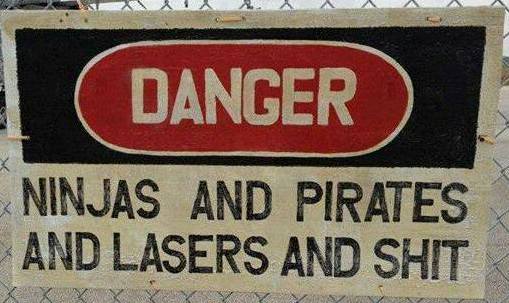
With the introduction of new technologies and theatres being operated by unscrupulous companies it will be necessary to have warning notices posted on all projection room doors such as the one shown below.
 -
 
Posted by Mike Blakesley (Member # 26) on 12-18-2013, 02:08 PM:
 
quote: Bobby Henderson
I've seen some small town theaters in my region adapt by offering low ticket and refreshment prices.
That seems like a bad strategy to me. A better idea would be to start a very visible remodel or upgrade, raise the prices (if necessary) to pay for it, and be very vocal about what's happening and why the prices are what they are.

Customers love it when they see their money being re-invested in a local business. My own theatre is proof of that. If we had tried to raise attendance by dropping the prices, we'd have made less money and probably been out of business by now.
 
Posted by Bobby Henderson (Member # 840) on 12-18-2013, 02:59 PM:
 
I guess some of it depends on the community, as well as what the theater was charging for admission prior to the conversion. The Liberty Theatre in Carnegie, OK converted its screen to digital and even put in a couple RealD systems. They charge $4 standard admission plus $2 for 3D. That's pretty cheap. Maybe they're able to get away with those prices with good attendance levels.
 
Posted by Justin Hamaker (Member # 2165) on 12-18-2013, 05:48 PM:
 
Bobby, the thing to remember about RealD is there is not upfront cost, you just pay them $0.50 per ticket. Other systems, like MasterImage, require that you purchase the equipment. Which is more cost effective depends on your market and how many 3D tickets you're going to sell.
 
Posted by Chris Slycord (Member # 4239) on 12-18-2013, 06:55 PM:
 
And how long you're likely going to continue selling them.
 
Posted by Terry Lynn-Stevens (Member # 7349) on 12-18-2013, 10:15 PM:
 
So it looks like masking will become a thing of the past. I was disgusted to see that Cineplex installed a new wall to wall screen in one of their non AVX theatres today. The original screen apparently needed replacing and they just supersized it and left it without any moveable masking.

It really is sad how the modern cimema experience is changing.
 
Posted by Brad Miller (Member # 2) on 12-19-2013, 12:03 AM:
 
quote: Terry Lynn-Stevens
It really is sad how the modern cimema experience is changing.
What I think you meant to say was it is really sad how the modern cinema experience is turning to shit.

quote: Justin Hamaker
Bobby, the thing to remember about RealD is there is not upfront cost, you just pay them $0.50 per ticket. Other systems, like MasterImage, require that you purchase the equipment. Which is more cost effective depends on your market and how many 3D tickets you're going to sell.
And that's why art houses should use RealD and regular theaters should use MasterImage.

quote: Mike Blakesley
If NATO wants to do something productive, they should work on getting a mandatory intermission built into any movie over, say, 130 minutes. Make it optional so the theaters who don't want to stop the film don't have to. It would be a simple matter of splitting the DCP into two parts, and creating a simple "Intermission" tag. Can't be any more difficult than making 127 different versions of movies the way they're doing now.
It doesn't even need a fancy fade out and fade in. Just 2 separate feature clips and one un-encrypted "intermission" clip (tagged however, I really don't care). For theaters that don't want the intermission, just butt feature part 1 right next to feature part 2. Bonus points for working it at a quick fade out/in though. Still, it's super easy to automate an intermission, complete with intermission tag in a 3 hour single DCP. Been there, done that.

quote: Scott Norwood
So, what happens to on-screen advertising in 2018?

I'd guess that it either goes away completely (as too few people will be going to movies to make it worthwhile) or it becomes totally omnipresent, to the point of interrupting the feature.

I've yet to see the theater chain's "bug" in the bottom right corner of the image, or a ticker-tape across the bottom informing of popcorn combo specials...but give it time. Some ass-hat WILL do it.

quote: Mike Blakesley
Coke Freestyle machines will be ubiquitous in some chain cinemas, but will all still produce shitty drinks.
That's cheating. Obviously some big chain theater will jump on that retarded bandwagon of Freestyle thinking they are "giving more options to the customers", but mainly switching over because they don't care about quality and are doing it for marketing reasons (to try and seem better than their competition). Plus we already know Freestyle machines pour out shitty drinks.
 
Posted by Paul Gordon (Member # 3320) on 12-19-2013, 05:59 AM:
 
2018 - It will be the same as it ever was. Really what has really changed in the last 30 years? not much. Yes we have DCP's instead of film big deal.
 
Posted by Bobby Henderson (Member # 840) on 12-19-2013, 10:11 AM:
 
quote: Justin Hamaker
Bobby, the thing to remember about RealD is there is not upfront cost, you just pay them $0.50 per ticket. Other systems, like MasterImage, require that you purchase the equipment.
I guess the thing that amazes me is this 3-screen theater in Carnegie, OK (population 1,721) was able to convert its screens to digital projection in the first place and then have a $4 admission price for 2D shows. Contrast that with the Vaska, the oldest theater still in operation in Lawton (population around 100,000). I'm pessimistic about that theater's future.

quote: Brad Miller
I've yet to see the theater chain's "bug" in the bottom right corner of the image, or a ticker-tape across the bottom informing of popcorn combo specials...but give it time. Some ass-hat WILL do it.
It's horrifying that anyone would even mention such a thing. We're taking the chance some executive at one of the parent media companies that own major movie studios or an executive at one of the movie theater chains will think that's a great idea and run with it. Too many TV channels are already polluted with that ticker & bug crap. I could see studios baking company logos into the bottom of the movie frame for theatrical releases and maybe using some different ones for the home video versions. I'll be reading a lot more books if that shit happens.
 
Posted by Adam Martin (Member # 641) on 12-19-2013, 10:34 AM:
 
quote: Bobby Henderson
It's horrifying that anyone would even mention such a thing.
We've already had trailers with social media hash tags in the corner all the way through, and every pre-release screening seems to have demands of a social media clip on-screen before the show to make sure folks have their phones on and tweeting the whole time. [Mad]
 
Posted by Mike Blakesley (Member # 26) on 12-19-2013, 12:12 PM:
 
quote: Bobby Henderson
I could see studios baking company logos into the bottom of the movie frame for theatrical releases and maybe using some different ones for the home video versions.
I don't think we really need to worry about this. The network "bug" has a purpose -- it's to remind you what network that show is on, so when you want to watch the next episode you'll hopefully remember what channel it was on. There's no reason to market a movie by the name of its studio, except in the case of Disney, maybe...and even then people search out the title they want in the theater they prefer, they don't care what studio is involved.
 
Posted by Monte L Fullmer (Member # 2797) on 12-19-2013, 12:30 PM:
 
quote: Brad Miller
What I think you meant to say was it is really sad how the modern cinema experience is turning to shit.

And boothless operations can be added with no mercy for the one who has to take care of the units.
 
Posted by Jesse Skeen (Member # 586) on 12-23-2013, 03:50 PM:
 
quote: Mike Blakesley
The network "bug" has a purpose -- it's to remind you what network that show is on, so when you want to watch the next episode you'll hopefully remember what channel it was on.
Well, for me it's always reminded me what networks NOT to watch anymore. I seriously hope the people who started that and currently advocate it have something REALLY bad happen to them. I STILL haven't seen any concrete evidence of anything that's been GAINED by anyone by using those, but if ratings haven't dramatically dropped since they first appeared that just shows how stupid a lot of people are.
 
Posted by Mike Blakesley (Member # 26) on 12-23-2013, 06:45 PM:
 
Well if I like a TV show (which I don't, most of them) I wouldn't stop watching it just because of the stupid little graphic in the corner. A little bothersome? Yes, especially when the graphic is covering something important, such as the legs of a Price Is Right model. But not enough to make me stop watching something I like.
 
Posted by Marcel Birgelen (Member # 6801) on 12-23-2013, 07:38 PM:
 
This weekend I went to watch an advance screening of The Secret Life of Walter Mitty at a local multiplex, or let's call it movie exhibition factory, because with a total of roughly 8100 seats it feels more like that... I've been avoiding that place like the plague, but I've wanted to see that movie for quite some time.

During the commercials, they were now actively promoting the use of your mobile phone, with some stupid movie quiz app, that will interactively ask you questions during the pre-show (commercials, commercials and yet even more commercials) and movie... And if you answer those questions correctly, after leaving your name, address, date of birth and probably your social security number, you're entitled to rebates on tickets and their supermarket-style and supermarket-sized concession stand...

Around here we already witnessed a Dutch movie called App, that offered a "second screen experience" via a downloadable app on your smartphone or tablet.

So, besides the somewhat general prediction of the "average cinema experience is going to shit", I want to add some more specifics to how this mess will probably unfold: I expect this "second screen experience" to become more of a trend. Alongside with probably the first* "real interactive movie experience", where yet another piece of digital equipment offers the moviegoer an "interactive experience" like: the most votes decide how the next scene is going to unfold...

* I vaguely remember that this has been done several times before on a limited scale. Actually, I still remember an attraction at Epcot called Horizons, where you could choose the ending of the ride, back in the late 80s.
 
Posted by Mike Blakesley (Member # 26) on 12-23-2013, 09:38 PM:
 
Epcot recently did a remodel of the Spaceship Earth ride (the one in the big ball) wherein you have your picture taken at the beginning, and you answer a few questions about yourself. This data is then used to generate the "ending" of the ride for you (which is presented in a small screen on your ride vehicle). It's uber-cheesy. The fun part is to make a weird face when it takes your picture, then watch your weird self on the cheesy video.

I don't really see the whole "second screen" concept catching much fire except maybe in teen-oriented novelty movies.

The idea of multiple endings has never really worked before (remember "Clue?") and would just jack up the production budget. Can you imagine the heads that would roll if Ending #4, which cost $15 million to shoot, never got chosen by moviegoers because the word got around that it was "stupid?" And then what would happen with the video....you'd have to pick your ending before the show started? How is that fun?
 
Posted by Terry Lynn-Stevens (Member # 7349) on 01-24-2014, 02:13 PM:
 
Cineplex Odeon is now leaving off the masking whenever they do upgrades or renovations to an existing theatre.

It is sad and unfortunate but for 2018 I think all new builds will come without masking.
 
Posted by Jesse Skeen (Member # 586) on 01-24-2014, 08:33 PM:
 
Just came back from my first time seeing a scope movie projected digitally on a screen with proper side-masking, and am not at all pleased. I haven't played with digital equipment up-close so I don't know much about how they work, but it appears there's really no point shooting movies in scope anymore as they're still 'letterboxed' on the digital projector, rather than unsqueezed as they are with film. Here it looked like the picture was at the top of the 1.85 frame, which was zoomed to fill the screen with the stray light underneath projected onto the area under the screen. Admittedly the presentation otherwise didn't look as bad as the inexcusably awful film presentation this theater used to have, but this is still too stupid for me to support in good conscience. If this the norm for digital projection, I'll just watch movies at home from now on.

This theater (UA Arden/Market Square, Sacramento) usually had a tradition of projecting the tail end of the film, and it appears that tradition now continues as a Windows taskbar appeared after the movie ended and the lens was zooming-out to show the next round of pre-show crap in 1.85.
 
Posted by Justin Hamaker (Member # 2165) on 01-24-2014, 09:39 PM:
 
Jesse, it sounds like this theatre did a horrible job of setting up their screen files.

The scope resolution is 2048 x 858, on a chip that is 2048 x 1080. Unlike with film, the picture is not morphed, so no anamorphic lens is needed for projection.

When done properly, there should be no letterboxing. The masking should be set to the scope position, the picture should be set so it best fills the masking top to bottom and side to side. Then crop files should be set up to crop what falls outside the masking (essentially a digital aperture plate). The crop file even has a curve setting to eliminate any picture overlapping the masking in the middle of each side.

With a digital presentation, there is zero excuse for not having nice crisp lines that are dead on the masking.
 
Posted by Bobby Henderson (Member # 840) on 01-24-2014, 09:51 PM:
 
Mistreatment of 'scope is one of my biggest complaints with d-cinema. The spherical single lens approach in d-cinema makes 'scope a smaller, lower resolution format than 1.66:1, 1.77:1 and 1.85:1. It doesn't matter whether the theater has a common width or common height screen, the image quality of 'scope will be lower. Common height screens make 'scope image bigger (as it should be), but that lower resolution is magnified.

Was a dual lens system ever considered for d-cinema projectors (one spherical lens for flat formats and one anamorphic decompression lens for 'scope)? Doing some quick math, a 1.25x decompression lens (similar to Ultra Panavision) applied to an entire 2048 X 1080 imager (or a 4096 X 2160 imager) would deliver something very close to the 2.39:1 ratio (2.37:1 to be exact).

IMHO a 'scope DCP ought to fill the entire image sensor area, just like it filled an entire 35mm film frame. The letterboxing method is crap.
 
Posted by Terry Lynn-Stevens (Member # 7349) on 01-24-2014, 10:24 PM:
 
quote: Bobby Henderson
Was a dual lens system ever considered for d-cinema projectors (one spherical lens for flat formats and one anamorphic decompression lens for 'scope)?
Yes, it is possible to do a dual lens setup.

quote: Bobby Henderson
IMHO a 'scope DCP ought to fill the entire image sensor area, just like it filled an entire 35mm film frame. The letterboxing method is crap.
If you have an anamorphic set up, I believe (not exactly sure) the projector will change the image to use more of the sensor. This will use light a little more efficiently for larger screens. The big difference is that the image is not ever distributed in anamorphic and is changed in the projector.

Perhaps someone can provide a little more info and clarity .
 
Posted by Brad Miller (Member # 2) on 01-24-2014, 10:56 PM:
 
quote: Jesse Skeen
Just came back from my first time seeing a scope movie projected digitally on a screen with proper side-masking, and am not at all pleased.
quote: Jesse Skeen
This theater (UA Arden/Market Square, Sacramento)
Jesse, you shouldn't base digital cinema on a Sony presentation, which is what you saw. Go see something in DLP. The difference is SIGNIFICANTLY better.

quote: Terry Lynn-Stevens
If you have an anamorphic set up, I believe (not exactly sure) the projector will change the image to use more of the sensor. This will use light a little more efficiently for larger screens. The big difference is that the image is not ever distributed in anamorphic and is changed in the projector.
That is accurate. The scope source file is scaled vertically to use all available pixels on the DMD, then the anamorphic lens stretches the image just like with 35mm and you end up with your 2.4 ratio which typically looks better than "zooming out" to scope. (I say typically because that may not always be the case, but in the several anamorphic installs I've personally done, the anamorphic definitely looked better.)
 
Posted by Jesse Skeen (Member # 586) on 01-24-2014, 11:28 PM:
 
So why didn't they make anamorphic the standard for showing 2.35, or just make the frame natively 2.35 and put side bars on 1.85 or less material? To use a politically incorrect term, this is just plain retarded.

And I've seen pictures of digital booths where cardboard or masking tape was put in place to hide the light from the unused parts of the frame; this theater was 95% incompetent in all the film presentations I saw there in the 21 years it's been open, so likely if there's a proper way to set their projectors for this they don't know how. Zooming the image is, again, just plain retarded anyways. [Razz]

Oh, and just a random question- the movie I saw (Jack Ryan) had some English subtitles during scenes where characters were speaking Russian- are these typically on the actual picture, or overlaid as separate subtitles? Reason I ask is because many recent Blu-Rays and DVDs of movies that include subtitles in this way include them as a subtitle track on the disc rather than using a source where they're actually on the picture, which personally annoys me as it looks very un-film-like, but if that's the way "D-Cinema" is doing it I guess I can live with it.
 
Posted by Marcel Birgelen (Member # 6801) on 01-25-2014, 01:43 AM:
 
The reason that anamorphic isn't the standard is pretty simple: It's more expensive to add two lenses to your setup. Also, the resolution is still lower than flat and non-square pixels in the DCP are still a no-go.

The reason why there are no native scope DMDs is also pretty simple: DCI compliant hardware uses just off-the-shelf DMD equipment, using 16:9 / 1.78:1 as reference aspect ratio. TI (who services every DCI-certified projector supplier except Sony) would probably also be reluctant to setup a separate production line for DCI equipment only. The same goes for digital camera equipment, this is often based around "industry standard" CMOS or CCD sensors with the same aspect ratio.

The Digital version of IMAX also considers 1.78:1 the new BIG format...
 
Posted by Brad Miller (Member # 2) on 01-25-2014, 02:05 AM:
 
quote: Marcel Birgelen
DCI compliant hardware uses just off-the-shelf DMD equipment, using 16:9 / 1.78:1 as reference aspect ratio.
The DMDs for Cinema DLP projectors are 1.9 aspect ratio, not 1.78

quote: Jesse Skeen
So why didn't they make anamorphic the standard for showing 2.35, or just make the frame natively 2.35 and put side bars on 1.85 or less material?
Because that would actually be smart.

quote: Jesse Skeen
To use a politically incorrect term, this is just plain retarded.
Exactly right.
 
Posted by Marcel Birgelen (Member # 6801) on 01-25-2014, 02:39 AM:
 
quote: Brad Miller
The DMDs for Cinema DLP projectors are 1.9 aspect ratio, not 1.78
That's right, it is either 2048x1080 or 4096x2160, but those same DMDs are being used for a whole bunch non DCI equipment too and in some cases, otherwise DCI compliant projectors are also being used as e.g. large venue projector.

On another note, do you actually like the result of scaling/stretching the image across the DMD for scope? Especially for 2K setups?
 
Posted by Bobby Henderson (Member # 840) on 01-25-2014, 02:48 AM:
 
quote: Terry Lynn-Stevens
If you have an anamorphic set up, I believe (not exactly sure) the projector will change the image to use more of the sensor. This will use light a little more efficiently for larger screens. The big difference is that the image is not ever distributed in anamorphic and is changed in the projector.
And that is still a major failure.

A similar analogy would be playing a non-anamorphic 2.39:1 DVD to fill the same amount of TV screen as one authored as 16x9 anamorphic enhanced. The non-anamorphic 'scope image has to be zoomed along two axis (height and width). The anamorphic version is only stretched horizontally. By having more native vertical pixels the anamorphic version will always look better. D-cinema is going with the lower quality route.

quote: Marcel Birgelen
The reason that anamorphic isn't the standard is pretty simple: It's more expensive to add two lenses to your setup.
I really have to question that.

Here in Lawton, when our local Carmike 8 went "digital" several years ago, I looked closely at the Konica-Minolta lenses mounted on Christie digital projectors. Those things are gigantic in size compared to the Schneider Super-Cinelux lenses on the Simplex 35 projectors that were put into mothballs. I don't know what a single Konica-Minolta d-cinema projector lens costs, but judging by the size of all that glass I'm willing to bet it costs a lot more than a pair of Schneider 35mm lenses.

As for non-square pixels being a no-go, non-square has been around for a long time. It was standard for NTSC SD. Consumer DVD supported non-square pixels and an anamorphic widescreen model. If the DCI standards committee had to rigidly stick with square pixels only it must have come from someone with a preference for flat movies as opposed to 'scope.
 
Posted by Marcel Birgelen (Member # 6801) on 01-25-2014, 03:14 AM:
 
quote: Bobby Henderson
I really have to question that.
Well, in case of the current DCI solutions, it will add another few thousand dollars to the costs. The Christie MALM for example goes for about EUR 3500 around here and I'm not sure if that already includes the anamorphic lens. It will probably also complicate stuff like RealD XL and MasterImage 3D.

quote: Bobby Henderson
As for non-square pixels being a no-go, non-square has been around for a long time. It was standard for NTSC SD. Consumer DVD supported non-square pixels and an anamorphic widescreen model. If the DCI standards committee had to rigidly stick with square pixels only it must have come from someone with a preference for flat movies as opposed to 'scope.
Technically it should not be a problem at all. Even stuff like VLC and mplayer can deal with non-square pixels just fine, it has been used in DVDs for ages, etc. Maybe they were afraid of the compatibility and implementation issues with non-square pixels at the time, or somebody just hated scope, I don't know.

I don't think we will see "scope sized" DMDs real soon, besides the limited market, it will probably also require a redesign of the light engine and the light path itself. Maybe it will also be harder to make such a setup light efficient, because the DMD will be even more of a rectangular form.
 
Posted by Jesse Skeen (Member # 586) on 01-25-2014, 03:38 AM:
 
Hmm, seems like the whole point of scope has gone out the window with this. So much for progress!

quote: Bobby Henderson
A similar analogy would be playing a non-anamorphic 2.39:1 DVD to fill the same amount of TV screen as one authored as 16x9 anamorphic enhanced. The non-anamorphic 'scope image has to be zoomed along two axis (height and width). The anamorphic version is only stretched horizontally. By having more native vertical pixels the anamorphic version will always look better. D-cinema is going with the lower quality route.
I usually just leave those as-is at home too and pretend I have a 4x3 TV, since they look like ass zoomed in (even more so if it's a laserdisc), and if it's a movie I care about I'll just re-buy it on Blu-Ray if it's available. The zoomed theater picture didn't look TOO bad, but it's just insulting that they went with something like that- I'd expect that on consumer equipment, but not something designed for theaters. I certainly see why these new "XD" screens and such are installed without masking though, since the picture is just letterboxed anyways, but it's still pretty stupid.
 
Posted by Terry Lynn-Stevens (Member # 7349) on 01-25-2014, 11:00 AM:
 
quote: Bobby Henderson
And that is still a major failure.
The only way to achieve 100% efficiency from your lamp and your sensor is to be presenting with an anamorphic lense.

quote: Bobby Henderson
The spherical single lens approach in d-cinema makes 'scope a smaller, lower resolution format than 1.66:1, 1.77:1 and 1.85:1. It doesn't matter whether the theater has a common width or common height screen, the image quality of 'scope will be lower.
This is not exactly true, light and sensor efficiency with a single lense approach is dependent on whether you are common width or common height.

Lamp and sensor efficiency is the most important factor, presenting with an anamorphic lense for scope and a separate prime lense for flat is best way to get full light/sensor efficiency.
 
Posted by Bobby Henderson (Member # 840) on 01-25-2014, 11:29 AM:
 
quote: Jesse Skeen
I usually just leave those as-is at home too and pretend I have a 4x3 TV, since they look like ass zoomed in (even more so if it's a laserdisc), and if it's a movie I care about I'll just re-buy it on Blu-Ray if it's available.
I haven't watched my DVDs of True Lies and The Abyss in several years due to their non-anamorphic nature. They're OK on a 4:3 SD TV, but look downright terrible zoomed up to HD. Unfortunately there are no Blu-ray versions of either movie. There's no telling when James Cameron will get around to supervising the production of those BDs or just get out of the way and let Fox Home Video get it done already.
 
Posted by Lyle Romer (Member # 1266) on 01-25-2014, 02:12 PM:
 
I assume the image dimensions were driven by making each "1k" for 'scope be equal to a digital k (1024). Therefore, 2k scope was 2048 pixels wide by 858 tall. If you had just made that the size of the imager and knocked off unused pixels in flat, the flat image would have been 858x1588 and the physical area of the flat image would have been tiny and probably not big enough to light a decent size common width screen.

That approach would have probably made the light engines cheaper. Once they had to grow the flat height, it made sense to go 1080 high to be standardized with HDTV.

Following from that if you made spherical scope at that height you'd have 1080x2582 (2,788,560 pixels) in 2k. This would be a 26% larger image chip (which I imagine would cost a not insignificantly higher amount to manufacture).

I think they stayed away from anamporphic lenses required was for cost reasons.

For me, the whole problem with the DCI standard is that they wanted to rush it so they made 2k acceptable. DCI should have been 4k minimum.
 
Posted by Jesse Skeen (Member # 586) on 01-25-2014, 04:37 PM:
 
I have True Lies in HD on D-VHS [Smile] (And I don't even LIKE the movie!)
 
Posted by Marcel Birgelen (Member # 6801) on 01-25-2014, 08:11 PM:
 
quote: Lyle Romer
I assume the image dimensions were driven by making each "1k" for 'scope be equal to a digital k (1024). Therefore, 2k scope was 2048 pixels wide by 858 tall. If you had just made that the size of the imager and knocked off unused pixels in flat, the flat image would have been 858x1588 and the physical area of the flat image would have been tiny and probably not big enough to light a decent size common width screen.
I guess the decision making at TI was quite simple: Full HD is very close to flat, aspect ratio wise. So, instead of totally redesigning a chip they already had, they just extended Full HD so flat could fit. Those same DMDs could also be used for professional projectors that would otherwise only show 16:9 content. The reason that it ended up being 2048, is because it needs to be dividable by 8, otherwise designing hard- and software for it would become rather awkward.

quote: Lyle Romer
For me, the whole problem with the DCI standard is that they wanted to rush it so they made 2k acceptable. DCI should have been 4k minimum.
I totally agree with this. The probem is that probably 80 to 90% of all current installs are 2K machines. Most of them are just a few years old, so 4K is never going to get a widespread market adoption in the forseable future. I've told this before, but it really hurts knowing that your next big TV will probably a 4K model (I'm pretty sure those things will be as cheap as Full HD screens are now within 2 years), but the cinema around the corner is operating at a fraction of that resolution...
 
Posted by Lyle Romer (Member # 1266) on 01-25-2014, 10:38 PM:
 
quote: Marcel Birgelen
The probem is that probably 80 to 90% of all current installs are 2K machines. Most of them are just a few years old, so 4K is never going to get a widespread market adoption in the forseable future.
In the US, this isn't necessarily the case because AMC and Regal both went with Sony and are therefore close to 100% 4k capable.
 
Posted by Bobby Henderson (Member # 840) on 01-26-2014, 12:21 AM:
 
Here's the bigger overriding issue: the "digital" gear has absolutely nowhere near the lifespan of the analog film gear.

With computer-based equipment you're doing pretty well if you can get 10 years of life out of a digital device. You're practically working miracles if you can get 15 to 20 years out of said digital device.

Many of the 2K digital projectors currently in service were already installed 5 or more years ago. That leaves only so many years left before they become unreliable and must be replaced.
 
Posted by Brad Miller (Member # 2) on 01-26-2014, 01:03 AM:
 
quote: Lyle Romer
In the US, this isn't necessarily the case because AMC and Regal both went with Sony and are therefore close to 100% 4k capable.
That doesn't matter when they use RealD with that Sony. 4k is out the window. In fact it looks downright awful because nobody moves that RealD out of the way. (Not that Sony ever looks as good as DLP anyway...even 2k DLP. There is far more than just resolution to a quality image.)
 
Posted by Jarod Reddig (Member # 6363) on 01-28-2014, 01:52 AM:
 
One of the biggest areas in need of improvment with commercial cinema projection is there high black levels and poor contrast. Its one my biggest complaints and a big reason Digital Cinema can appear flat and lifeless at times and personally a huge factor in a rich image. Home theater projectors can excell in this area. The JVCs and Sony liquid crystal on silicon projectors can put out a 20fL calibrated image on a 10ft screen and measure 0.001fl or lower black level. And JVC does it without a dynamic iris. Im curious as to why the DCI projectors dont strive for this? Is it difficult getting black levels that down with the high wattage lamps used or is it the optics or cost to implement or what? Im curious.
 
Posted by Marcel Birgelen (Member # 6801) on 01-28-2014, 05:03 AM:
 
For now there are only 3-DLP or 3-SXRD (Sony's version of LCoS) products that are DCI certified. There is no single 3-LCD implementation, probably because it's rather hard to produce transmissive LCD panels that keep performing well under the required light levels.
Of all the digital projection gear, the JVC LCoS implementation, called D-ILA, has the deepest levels of black and probably the best overall contrast without cheating (like auto-iris) that I've seen. But there is currently no DCI certified projector that uses this technology.

quote: Lyle Romer
In the US, this isn't necessarily the case because AMC and Regal both went with Sony and are therefore close to 100% 4k capable.
I've done a little bit of Googling and found that Sony claims about 35% to 40% market share in the U.S. That's higher than I expected, but I didn't know that Regal also had an exclusivity agreement with Sony. Still, I'm wondering how many of those "other" installs are 4K machines.

quote: Brad Miller
That doesn't matter when they use RealD with that Sony. 4k is out the window. In fact it looks downright awful because nobody moves that RealD out of the way.
It's also a bit of a failure of RealD itself, since they don't offer an out-of-the-box solution for their Z-Screen and XL(S) units and you need to go shopping at a third party. Also, moving the XL(S) unit back in place requires more calibration than just moving the Z-Screen in place, so it's probably very tempting to just leave it in place, due to lack of sophisticated projectionists.
 
Posted by Terry Lynn-Stevens (Member # 7349) on 02-13-2014, 02:54 PM:
 
As more and more premium large screens open, I think we are going to see more and more 1:85 films released. Perhaps we will see dual aspect ratio releases, by 2018 we are going to see more and more screens without masking so I can see this happening.

Cineplex VIP now 6 screens out of the 22 screens at a location in Toronto without masking. I think it will a studio and chain push to have more movies in flat and this might piss off a few directors.
 
Posted by Mike Blakesley (Member # 26) on 02-13-2014, 05:33 PM:
 
quote: Terry Lynn-Stevens
Perhaps we will see dual aspect ratio releases
Oh please, no. Any director that agrees to do this ought to be drummed out of the industry. There is a reason a good filmmaker chooses the size frame he chooses.
 
Posted by James Westbrook (Member # 3690) on 02-13-2014, 08:27 PM:
 
I agree with Mike. Some movies do NOT need to be shot in "scope", especially dramas where the scenes mostly take place indoors. Spielberg chose to shoot ET and The Color Purple flat. Pick a format that works best for that project and stick to it.
 
Posted by Bobby Henderson (Member # 840) on 02-14-2014, 12:04 PM:
 
Lots of movies have been filmed for multiple aspect ratios since the 1980s. This is essentially what the Super35 format allowed. Home video safe widescreen. I have generally hated the compositions of most Super35 movies since they merely tried to frame in a happy medium between aspect ratios for standard definition TV, HDTV and 'scope. The compositions would be merely okay, very conventional but not really using any of those aspect ratios properly. Directors like James Cameron, David Fincher and very few others shot movies in Super35 while deliberately composing for the 2.39:1 frame.

Anamorphic lenses force the director and DP to use the 2.39:1 frame. But even with that locked in aspect ratio plenty of movies would still try to play things safe. Lots of 80's and 90's movies shot in scope tried to confine the most important stuff in the frame into a 4:3 area safe for panning and scanning to old TV sets. It's kind of an 80's look to have an actor placed on the far left or far right end of the frame in a low depth of field shot where the other 80% of the screen is a big anamorphic blur.
[Roll Eyes]

The situation isn't quite as bad in the differences between 'scope and HDTV, but the difference is still pretty substantial. Some of the same "playing it safe" compositional problems with Super35 are still there today with video-based movie production. Most movie productions are effectively shooting a movie in near flat format and merely cropping into the image. We're still ending up with 'scope aspect ratio movies that don't really look like they're deliberately composed for 2.39:1.

quote: Terry Lynn-Stevens
As more and more premium large screens open, I think we are going to see more and more 1:85 films released. Perhaps we will see dual aspect ratio releases, by 2018 we are going to see more and more screens without masking so I can see this happening.
I don't think we'll see dual aspect ratio releases at all. With 'scope essentially sucking as a d-cinema format we'll eventually see a big shift to where 'scope just isn't used anymore -except for rap music videos and some TV commercials.

In the years leading up to the big shift to d-cinema, Super35 was dominating many releases. There was a LOT of movies released with 'scope 35mm film prints that really didn't need to be in 'scope at all. The only thing that was happening was filmmakers and producers wanting to fill 100% of commercial movie theater screens. That's all. It didn't have a damned thing to do with the aesthetics of the 'scope aspect ratio. Just fill the entire movie screen. At that time most movie screens were common height. That made 'scope the biggest format image. The practice was so prevalent that Super35 in the theater almost seemed like a reverse form of panning and scanning.

With d-cinema, 'scope is the smallest image. Obviously this situation is fucking backwards, but that's how it is. The 'scope format is smaller on the DCP, it's smaller on the imaging chips and it's smaller on all these common width screens. Now 'scope just sucks. Honestly, throwing in those black bars across the top and bottom of a video camera's 1.77:1 image is pretentious bullshit.

There are some video cameras, like certain Red models, that treat 'scope quite a bit better. Some people are using anamorphic lenses with the Arri Alexa; that's the only way to make that 2.8K image expand to something closer to 4K. Unfortunately, that better treatment ain't making it to the theater screen.

Since one of the ultimate image goals for producers and other big decision makers is to fill the entire screen, I see the 'scope format as an endangered species. With so many new theaters installing common width screens it's only a matter of time before movies shift to fill those screens.

A lot of people were shocked The Avengers was released in flat format. But with so many common width screens, that move actually makes sense. Skyfall was shown in 'scope in most movie theaters, but had more of a HDTV aspect ratio in IMAX branded theaters. Eventually we're going to see a lot more of that and a lot less of 'scope.
 
Posted by Mike Blakesley (Member # 26) on 02-14-2014, 02:08 PM:
 
While you might be right about scope eventually going away, it seems like the opposite is happening right now. I looked at the list of movies from IME starting in late December, and of the ones we've either already played or might possibly play....of 19 movies, only 4 of them were flat.

Of the entire list of movies I looked at (which goes to mid-April), there are 36 scope and 13 flat. There are about a dozen movies on the list where the format isn't shown yet.

This is quite different from the way it was back when I first got into the biz....scope movies were about 1 in 4, maybe.
 
Posted by Bobby Henderson (Member # 840) on 02-14-2014, 03:22 PM:
 
I remember back in the 1980's 'scope movies seemed to be pretty rare. Most movies were 1.85:1 or 1.66:1.

One theory I have on why there are so many 'scope movies these days: money. A movie in 1.85:1 ratio requires more pixels to be rendered and more data to be encoded and stored. A movie in flat format will require a little more time than 'scope format for various things to be rendered in post production.

The flat format is often dismissed by many movie fans as being "plain" and not as interesting as 'scope format. Unfortunately there is a greater number of people out there who think it's more important for the image to fill the entire screen. This issue has not vanished regardless of most new movies being released on Blu-ray and DVD without any multiple inventories of widescreen and "full screen" versions. People still want those screens filled 100%. With so many premium priced big screen theaters getting built, with the vast majority being of the common width screen variety, I think customers will start getting vocal about having that entire screen filled. It's already happened in the case of some movies, like Skyfall.
 
Posted by Terry Lynn-Stevens (Member # 7349) on 02-20-2014, 05:45 PM:
 
quote: James Westbrook
Some movies do NOT need to be shot in "scope", especially dramas where the scenes mostly take place indoors.
Honestly, I would rather just watch every movie in flat.

I saw the future of cinema exhibition two days ago. The Silver City IMAX location that I was at opened up all ten screens to the flat aspect ratio and simply projected scope within the flat framing and did not bother closing up the masking. This was for all ten screen which were all common width. I asked for my money back when I realized the masking was not going to close.

Cineplex also does for all new retrofits or upgrades with no moveable masking, even worse is their VIP cinemas which are border less (stuck out of the wall) type screens.

It is terrible what has become of picture quality. I say just release everything in flat so I do not have to worry about it.
 
Posted by Edward Havens (Member # 4715) on 02-20-2014, 05:56 PM:
 
I seem to remember most Fox movies from when I started working at theatres in the summer of 1986 on being scope. Not all, but most. I could be wrong. However, I do remember Aliens and The Fly both being 1.85:1, and being disappointed both times our theatre couldn't open up the masking all the way. The screen in House 1 at the UA Riverfront Twin in Santa Cruz was huge (70mm-capable projector, but none ever played there).
 
Posted by Terry Lynn-Stevens (Member # 7349) on 03-01-2014, 04:25 PM:
 
quote: Allison Parsons
I do predict that posters will be no more, and some tiny projector thing will project the images on the walls of the lobby.
This is sort of true, Cineplex is using digital poster cases for their UltraAVX theatre entrances. Eventually there will be more digital poster cases.


Powered by Infopop Corporation
UBB.classicTM 6.3.1.2