This is topic Way Cool Radio Station: KPRK in forum Film-Yak at Film-Tech Forum ARCHIVE.
To visit this topic, use this URL:
https://ft-forum.com/ft/cgi-bin/ubb/ultimatebb.cgi?ubb=get_topic;f=8;t=005868
Posted by Mark Gulbrandsen (Member # 72) on 07-30-2009, 12:35 PM:
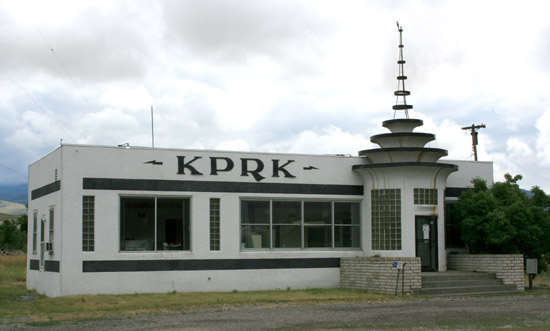
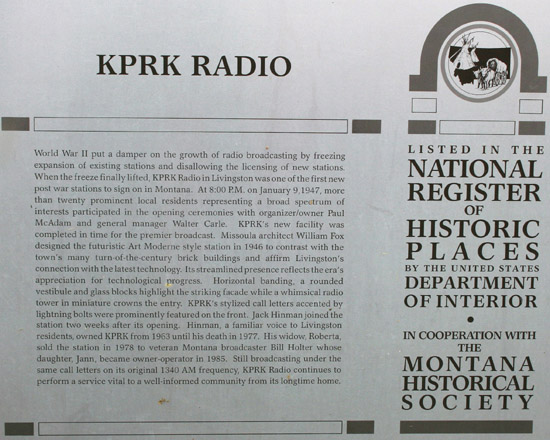
Here are a few photos of KPRK Radio Station in Livingston. MT. The station is still on the air from Bozeman and this building is no longer used but I thought the architecture for a radio station building to be very unique... and it is also listed in the National Regester Of Historic Places.
Posted by James Westbrook (Member # 3690) on 07-30-2009, 06:26 PM:
Is the transmitter located out there at the building site?
1340 is a "local" frequency designated by the FCC for 1000 watt day and 250 watts night, or now it may be just 1000 watts day and night. We have a station in Lubbock on that same frequency.
That is a cool building.
Posted by Mark Gulbrandsen (Member # 72) on 07-30-2009, 06:35 PM:
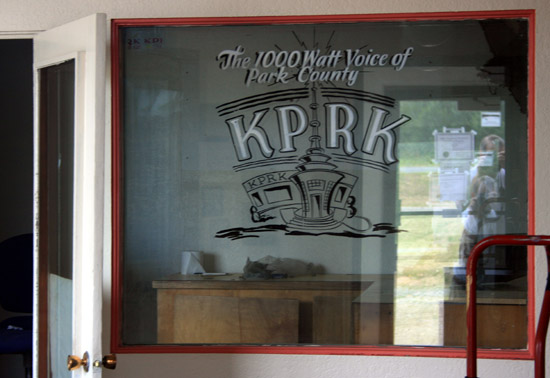
Yep! The 500 foot stick is still out back and the transmitter is a room or two over from that announcers room in the second photo. I assume all that could be seen through the front windows when driving by...
Mark

Posted by Robert E. Allen (Member # 1351) on 07-30-2009, 06:47 PM:
When I was in broadcasting most of my time was spent at small market stations because I loved small market local stations. Now many have been bought by conglomerates and have lost that "local" sound. I suspect that's what happened to this station.
Posted by James Westbrook (Member # 3690) on 07-30-2009, 09:41 PM:
I am afraid you are probably right, Robert.
I just did a Google search and found the station is currently owned by Gapwest Broadcasting. A sister company, Gap Broadcasting out of Dallas, acquired a bunch of the Clear Channel stations in Lubbock (including 1340 KKAM), Amarillo, Abilene, Midland-Odessa, Texarkana, Victoria, Lawton Ok, Wichita Falls and several others.
The Lubbock stations do not sound much different than they did during their Clear Channel days except there seem to be fewer announcers.
According to their website, KPRK seems to be talk radio formatted, carrying the syndicated Rush Limbaugh and Glenn Beck among others.
KPRK's website looks quite similar to the Gap stations websites, which all appear to have been designed by the same people using the same program.
There are some local radio out there still, but almost all use computer based automation and or satellite based networks for programming.
Posted by Jack Ondracek (Member # 1466) on 07-31-2009, 12:18 AM:
Looks like a couple of FM bays on that tower, too.
Before satellites, small town radio WAS fun. Not much of that left anymore, especially on AM.
Great pictures, Mark.
Posted by Mike Blakesley (Member # 26) on 07-31-2009, 01:25 AM:
Our local station is still "hometown" part of the time -- they have a live call-in show "The Country Store" from 8:30-9:45 Monday thru Saturday, and live DJs from 7AM until 10:30, and from 12:00 noon until 2:00, I think. (It's a country format, which I hate, so I hardly ever listen.) The rest of the time it's satellite programmed.
101.3 FM, KIKC. They don't have a website (well they DO, but it's only used once a year for their annual radio auction.)
Posted by Louis Bornwasser (Member # 3063) on 07-31-2009, 06:36 AM:
I'm on the same page as Jack.
Small town was GREAT! My personal fun was early FM (1964-1975) which was "small town in the big city." No one cared . . . . until we became number one in Louisville. Then they changed it to be more like AM, thus eliminating the reason we were successful. Genius! ![[Roll Eyes]](rolleyes.gif) (I see these people all the time now in this industry.) Louis
(I see these people all the time now in this industry.) Louis
Posted by Rick Raskin (Member # 1561) on 07-31-2009, 07:33 AM:
As a teen, I used to hang out at the shack for WEAM (1390) in Arlington, VA and drink beer in the gravel parking lot. The studio was in a bank building about 5 miles away so the only person at the station was the engineer. The transmitter was a Gates 5KW with Shaefer automation running 9 tape decks. The engineer also had a mixer board and two turntables. After hours programming originated at the transmitter shack. The engineers would sometimes change the colored knobs around on the studio mixer to screw with the DJs.
Posted by Scott Norwood (Member # 30) on 07-31-2009, 07:53 AM:
Wow! What a great building!
It's interesting to see how many people here have been involved with radio and/or television as well as film (Mark, Jack, Tim, Josh, and the late Paul Thompson come to mind, and there are probably many others, plus those involved with amateur radio).
What kind of range do you get with 1000 watts? Is the relationship between watts and coverage area linear (i.e. doubling of power doubles the radius of the coverage area), or is it more complicated? And what about stations with a directional pattern?
Posted by Paul Mayer (Member # 355) on 07-31-2009, 12:48 PM:
I used to hang in the booth at KORK-AM 920 on Sunday evenings back in the mid-70's. The DJ was Bob Amblad, formerly of Chicago's WBBM - I was a teacher's aide for him during the week at Woodbury Junior High, where we taught a then-mandatory 8th-grade TV and radio media course.
KORK's format then was MOR (Middle Of the Road), sort of a precursor to today's Adult Contemporary. The station doesn't exist anymore, 920 is now KBAD, and the building was replaced by the east leg of I-515.
For Scott, at MF freqs power is main game for reception distance. A typical 1000 watt signal will go 45 miles or so.
The antenna is usually spotted where a good RF ground is available. Height doesn't mean much at these freqs.
At VHF freqs antenna height becomes important. That's why you see FM and TV antennas on mountain tops or very tall buildings, or very tall towers.
Yes, that KPRK building is very cool! ![[thumbsup]](graemlins/thumbsup.gif)
Posted by Jack Ondracek (Member # 1466) on 07-31-2009, 01:25 PM:
quote: Scott Norwood
What kind of range do you get with 1000 watts? Is the relationship between watts and coverage area linear (i.e. doubling of power doubles the radius of the coverage area), or is it more complicated? And what about stations with a directional pattern?
You don't get nearly the range you did when the dial was less congested. Close spacing and skywave interference have effectively cut many stations' local coverage in half. In our area (Seattle), a 1,000 watt station could get out to 25 miles or so during the day, but that same power at night may only be good for 10... sometimes less. Most low power stations in our area have become useless, due to urban sprawl and skywave interference. However, this doesn't apply to everyone. Some stations still enjoy huge night coverage, but it's usually more a matter of what's also on the dial on and around your frequency than anything special you've done. Clear channel protection is pretty much gone, because our government has decided there's enough media out there that everyone can pick up a good(?) cross section of signals and programming.
AM stations that broadcast in our current form of "stereo" are causing serious interference to other stations on adjacent channels. In the cases I know of personally, fringe reception for the adjacent stations is pretty much gone. However, it's all legal, because fringe reception is not protected by the FCC.
Frequency makes a difference. Stations at the lower end of the AM dial go farther for a given power than stations at the upper end.
Tower placement makes a difference. Towers in swampy cow pastures do better than those in gravel pits. Terrain can have a huge effect on coverage. We have a 10kW station in the area that can't get out 20 miles around mountainous terrain, while getting better than 50 in a flatter direction.
Terrain & conductivity aside, a single tower radiates equally in all directions. Directionalizing is the art of taking power from one direction and adding it to what you're shooting in another... something like squeezing a balloon full of water. Any tower installation you see with more than one tower is creating a directional pattern, though not necessarily all the time. Many stations are non-directional during the day. Others have different patterns for day and night. Most of the time, they're directionalizing in order to protect another station. However, a station can pull power from an unpopulated direction and point it where the people are. It's kind of a trade-off. They don't have to spend the money for larger transmitters and higher power bills, but the initial cost of directional arrays and ongoing maintenance of the system is higher.
Re: power/coverage. It takes 4 times the power to double your coverage, so a 5,000 watt station is roughly better than twice as "powerful" as a 1,000 watter, all else considered.
Finally, there's a certain amount of voodoo involved in all this. You can design a wonderful system on paper, but the end result will frequently be something else... better or worse.
Posted by Jeff Stricker (Member # 224) on 07-31-2009, 02:58 PM:
Thanks for sharing the photos, Mark. I once worked at a 250W U-
ND, where you could see the tower from a rise in the road about 20 miles away, but couldn't hear the station at night for the clutter! But, those were the days, no program mgr....just play what you wanted as long as you stayed within the "type" music for that time of day. Oh, and we had an hour of polkas 7 at night, after which rock and roll until sign off at 10:30.
Posted by Scott Norwood (Member # 30) on 07-31-2009, 03:53 PM:
Thanks, Jack.
Another related question that I've wondered about for a while is why the three major 50kw AM stations in the Boston area have such different signal propagation characteristics. WBZ (1030) has an excellent signal that can be heard (at least) as far south as Virginia at night. By contrast, WRKO (680) has a mediocre signal that doesn't go fifty miles on most days (actually, the signal is usually better in the day than at night). WEEI (850) is somewhere in between. Meanwhile, WTAM (1100) in Cleveland is one of the strongest stations on the AM dial here at night.
I'm sure that some of this has to do with directional signals and protection for other stations' signals, but it still seems odd that WBZ has a signal that is so far superior to the other stations in this market.
Posted by Phil Hill (Member # 371) on 07-31-2009, 04:27 PM:
quote: Scott Norwood
It's interesting to see how many people here have been involved with radio and/or television as well as film...
While I really enjoyed broadcasting for many years, my 1st LOVE was film since I was 13.
(Selected "broadcast" clips from my bio...)
My 1st "official" radio job was a transmitter guy at WJBK AM when I was 19. A 50kW AM 6-tower directional radio station in Detroit. My buddies and me used to see who could stand the most RF by walking our fingers up the antenna tower base-loading coil to see how much "heat" we could stand! GOD!!!! We stupit at 19...huh?!!!! But we had fun!
I then went on to be that "Sunday-Night-DJ" at WPON AM in Pontiac Michigan and played "vinyl records" and yakked live for 4 hours a week giving the weather, the news, commercials, and my feelings...8pm 'til midnight!
The 1kw xmtr was remotely located from the studio and the xmtr guy and I would have races to see who could kill the transmitter 1st at the end of the day after the national anthem was played. I "won", since one time, I cut the power at the beginning of the NA. Ummmm, that was the last show I did for them! What a bunch of "Sticks-In-The-Mud" jerks! They just could NOT take humor!
While in college, I worked at a 141kW ERP FM stereo broadcast station as a DJ and transmitter guy. I used to like to turn off and on the 19kHz stereo pilot in between the records I was playing. The effect was to blink everyone's "STEREO" light/indicator on and off in the area we covered. God forgive me, oh, and the FCC but, I used to blink them on and off in Morse code sending "sex" messages! You would not believe the phone calls I got from listeners. God! It WAS soooo funny!
Ahhhh, to be young and "learning" the ways of the world. I was such a pistol!!!!
---------------------
And yes, that KPRK building is super cool! It would make a great diner!
Posted by Robert E. Allen (Member # 1351) on 07-31-2009, 05:13 PM:
The last radio station I worked for was KGBR in Gold Beach, Oregon (they have a website). It had a 250w fm transmitter located on a mountain near the city which made its effective radiated power 3000w. My first radio station was KKIM in Albuquerque a 10,000am religious broadcaster. During the day it boomed all over New Mexico and southern Colorado (it may still be doing that). At night we had to cut to 12w (that's right, 12w) to protect a Mexican station.
Posted by Sam Graham (Member # 2889) on 07-31-2009, 07:18 PM:
I worked in radio for 15 years and had a fascination with the AM band during my childhood.
Listening to distant stations at night was my connection to the real world...my escape from the hell that was Ketchikan, Alaska. I always pictured the radio stations as being housed in cool buildings like the one Mark photographed, probably because of American Graffiti or something.
1190 KEX Portland, who at the time still played music and had the coolest ever news sounder at the top of the hour (it was sort of an electronic synthesizer thing that I've never heard anything like before or since), was my primary night time entertainment. Their signal almost always came in after 9 at night. The AM stations in British Columbia were always reliable. Occasionally I might pick up an odd signal out of California or even the Midwest. Basically, anything west of the Mississippi with 5,000 watts or more had a chance of being heard. I loved finding new stations at night, and always wanted to be that guy on the air. And I got to be that guy for awhile.
Sadly, it was the last days of traditional local radio. Local news, local commercials (LOTS of different ones, not the three or four sponsors you hear in between the pharmaceutical and credit scare ads you hear today), and lots of local flavor with real professional sounding disk jockeys.
Now it's just syndicated talking heads intertwined with mindless news announcers who don't even try to sound unique.
I will say that I did work in a building in the sticks with an "on-display" studio like the one in Mark's picture (not NEARLY this cool, but...) I hated that. Stranded motorists would bang on the window and scare the daylights out of you in the middle of the night.
We once had a board op whose car was stolen by somebody who found the car warming up in our parking lot while walking to town. I actually passed the guy on my way out there and assumed it was the board op, as he'd leave early when he knew I was on the way occasionally.
(me): "What are you doing here? I passed your car on the way into town."
(him): "No you didn't. I'm just warming it up."
(me): "I'm serious!"
(he goes and looks): "Okay...My car is gone!"
The car was recovered the next day in a local supermarket parking lot. No damage, nothing missing, keys inside.
One night, we had a new girl working her first shift during a huge storm. She heard this loud crash while announcing warnings on the air. She stopped, took a breath, and continued frightened out of her wits. Upon going to commercial, the guy on the FM side walked in and said "One of the towers just fell on your car. Geez, I'm glad it didn't hit mine" and walked out.
(It turned out to be our small aluminum utility tower, not one of our three big sticks, and it hardly did any damage to her car at all.)
Powered by Infopop Corporation
UBB.classicTM
6.3.1.2