This is topic multi-image slide show production in forum Film-Yak at Film-Tech Forum ARCHIVE.
To visit this topic, use this URL:
https://ft-forum.com/ft/cgi-bin/ubb/ultimatebb.cgi?ubb=get_topic;f=8;t=006289
Posted by Scott Norwood (Member # 30) on 10-30-2010, 09:49 AM:
I know that we have a bunch of people here who are now or have previous been involved with audio-visual production and presentation (more than just 35mm cinema films), so I'm hoping that someone here knows about multi-image slide shows.
I am a big fan of these shows (multiple slide projectors, synchronized to taped music and narration), but haven't seen any really good ones since the early 1990s.
For several years, I have been doing small family slide shows with a Kodak dissolve unit (a re-branded Arion) that can control three 35mm Ektagraphic projectors. I am using a 1/4" 2-track tape machine for the sound (mono sound on one track, slide sync data on the other). Programming needs to be done in real time, and my current setup can only advance the third projector, not control the lamp or reset the tray.
What is the next step up in terms of dissolve units that can control more than three projectors? Is there a more modern (digital?) multi-track recording device that weighs less than a reel-to-reel machine and, ideally, can carry more than two tracks? I'd like to at least have stereo music plus a sync track. I am happy with the 1/4" machine for sound editing purposes, but would switch to a digital system if it had a decent editing interface (or easy way to transfer sound from tape).
Is it worth buying a film recorder (which one?) to make slides from computer files, or should I just continue to have these done commercially (for about $2/slide) for titles and digital photographs?
Has anyone had experience with medium-format slides? What is the preferred format (2 1/4" square? something else?)? Can the projectors be controlled by a standard dissolve unit, but are they limited to simple forward/reverse without lamp control?
(Yes, I realize that we have had quality video projection for a decade now, and that I am basically re-inventing 1975 here, but I have thousands of old and new photographs in slide form, and even 1080p video projection does not compare to even the worst 35mm slides. Plus, slide projection equipment is now essentially dirt-cheap and readily available.)
[ 10-30-2010, 01:21 PM: Message edited by: Scott Norwood ]
Posted by Richard Hamilton (Member # 321) on 10-30-2010, 12:42 PM:
Scott,
You can try Spitz .
I've done quite a few dome/planetarium installs with them, and they all had slide projectors all around the ring of the dome as well as video projectors and our 8/70 MegaSystems projector. Everything is controlled by their own automation, but I'm sure they could help you out. If you call(610-459-5200), ask for Darrin Bruce and just tell him I suggested you call.
Rick
Posted by Paul Mayer (Member # 355) on 10-30-2010, 12:47 PM:
Wow, bringing back some memories there Scott.
My experience was mostly with AVL Dove dissolve units driven by a 386 PC running Geminii II show control software. Sound and cues were usually from a Teac 3340 1/4" 4-track reel-to-reel tape deck to give stereo playback plus cues and a spare channel. Sometimes playback was from an Otari 1/2" 4-track reel-to-reel machine.
The Doves controlled up to three slide machines each, with full forward, backward, and lamp control. I don't remember being able to reset to top-of-show through the show controller, though I know there are controllers that do this. I used to have to manually back all the projectors on the kinds of one-off industrial shows I did back in the day. Biggest common setup I programmed and ran myself was 27 projectors in three groups of nine running seamless (mostly ^_^ ) panoramic images on a 10x30' rear projection Dalite FastFold truss screen.
I remember some 2-1/4" glass slides, but that was fairly rare, so I don't remember much about those projectors being controlled by dissolve units. I do remember the couple of times we used 2-1/4", the machines were completely manual for loading the slides, and used mechanical iris fading to do dissolves or cuts transitions between the pair of projectors. I did one 2-1/4" show myself using borrowed equipment like that. I shot that show in 645 format using a Mamiya.
I imagine all of that kind of gear must be available at junk prices these days, assuming the stuff hasn't been landfilled or recycled by now.
Posted by Kenneth Wuepper (Member # 1174) on 10-30-2010, 02:17 PM:
Hello Scott,
The nearest working multi-projector show is at Bronner's Christmas wonderland. They are located in Frankenmuth, Michigan.
www.bronners.com/
The last show I saw there had 4 Kodak Carousel slide projectors and a Kodak 16mm sound projector.
The show was run several times each day and was a free documentary history of the family owned company.
You might contact them at 989-652-2669. If you ask for Dietrich (pronounced Dee Trick) Bronner, he can direct you to the proper person on their staff.
I hope this is helpful
KEN
Posted by Tony Bandiera Jr (Member # 2365) on 10-30-2010, 05:00 PM:
quote: Scott Norwood
Is there a more modern (digital?) multi-track recording device that weighs less than a reel-to-reel machine and, ideally, can carry more than two tracks? I'd like to at least have stereo music plus a sync track. I am happy with the 1/4" machine for sound editing purposes, but would switch to a digital system if it had a decent editing interface (or easy way to transfer sound from tape).
Scott, check out ebay for the Alesis ADAT recorder. Up to eight tracks recorded digitally on a high-grade version of a VHS tape.
Even more versatility can be had when you mate the ADAT with its BRC (Big Remote Control).
They can be had for a few hundred apiece or less.
I have a set that I might be willing to sell, with manuals, PM me.
Posted by Steve Guttag (Member # 268) on 10-30-2010, 07:03 PM:
Come on...if you are going to go retro then get a cassette deck to finish off the look. Get a Tascam 133
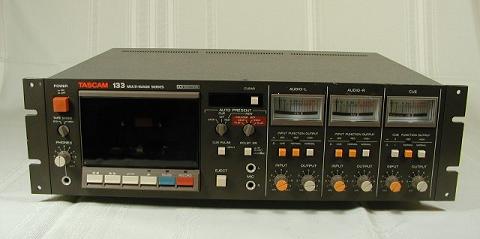
The last time I did a multi-slide show, I too used a Tascam 3440 (came after the 3340). In fact, I still own that 3440!
Steve
Posted by Manny Knowles (Member # 1171) on 10-31-2010, 08:54 PM:
Scott, I don't have an answer for you, but this brings back a fond memory...
I can *still* remember the pre-show from the holding area for CAPTAIN E/O in the Magic Eye Theatre at EPCOT Center. CAPTAIN E/O was "presented by Kodak" and the pre-show was a catchy little promo based around a song called "Makin' Memories."
"Makin' memories. Makin' memories.
Takin' pictures is makin' memories.
Catchin' little pieces of time.
Makin' 'em yours and makin' 'em mine."
The music was ragtime. The vocals were tight 4-part "barbershop" harmony. The song traces the history of photography from the turn of the century to the present.
My memory is a little hazy but I did make an effort to count the projectors. There were around 20 Carousel projectors, about 5-6 across and stacked about 3 high. I wish I had taken a picture of that. The screen was super-super wide. I'd guess the aspect ratio was about 7:1. At one point there was even apparent motion, about 10-12 fps. Just an amazing show!
Does anyone else remember this?
BTW the song was written by the Sherman brothers, who wrote the music for MARY POPPINS. I still use the EXCELLENT recording of that song as test/evaluation material.
We waited in a long line to see CAPTAIN E/O -- the movie was 17 minutes long, so the line only moved once every 17 minutes. When we were deciding whether it was worth it to see the movie a 2nd time, the idea of seeing "Makin' Memories" again was the deciding factor!
I thought it was kinda nifty coz it came off looking like a simple little show but I'm sure it was one heck of an engineering task. They made it look easy.
Posted by Brad Miller (Member # 2) on 11-01-2010, 02:46 AM:
There was a traveling multi image show that came to my high school way back in the day. They had 5 screens (aspect ratio about 1.33 each) setup in a wide panorama. I want to say each screen had 5 projectors on it, and the middle screen also had a 16mm projector that was randomly started and stopped during the show.
There were 2 guys running it and they never sat down. They spent the entire time switching trays of slides and they could definitely cycle through a tray pretty fast too. I enjoyed their show more than the show.
Posted by Scott Norwood (Member # 30) on 11-11-2010, 01:06 PM:
A few random findings and musings:
As discussed elsewhere here, Kodak quit manufacturing slide projectors in 2004. A French company called Simda appears to be the only source for brand-new slide projectors suitable for these types of shows. You don't want to see the price. I ended up getting four NOS Kodak Ektagraphics (I already had two older ones) pretty cheaply. Anyone working with slides should probably get a spare projector or two now while they are cheap; repairs are expensive (upwards of $100 per unit).
The basic Kodak slide projection lenses aren't very good; Schneider makes (made?) a line of slide projection lenses, but these seem to be rare and hard to find. I've also heard good things about the Navitar lenses.
This video has some good tips for cleaning and lubricating the Kodak Ektagraphic mechanism. Cinemas which use these for advertising might want to take note (or not, if you don't like screen advertising). The Kodak mechanism depends on plastic gears, which probably isn't such a good thing. On the other hand, my oldest projector dates from 1982 and still works perfectly. The video doesn't discuss cleaning dust out of the fan blower, but that is probably something worth doing as well. Replacing the belts does not look like much fun, and I have not attempted that yet.
There is some interesting information on the "Mate-Trac" synchronization signal that the newer Arion dissolve units (and their Kodak-labelled variants) use.
The Chief ASU and MSU projector stackers are useful for easy alignment of multiple slide projectors. No longer available new, but available used and not very expensive.
Some slide production information is worth reading. Many of the processes are similar to optical printing for motion-picture work.
I decided against getting a slide duplicator, but the Bowens Illumitran and Durst something-or-other are the ones to get. Apparently, the Bowens unit has a flash tube that illuminates the slide, while the Durst unit uses a modified color enlarger head. The Bowens flash is supposedly high(-ish) voltage, and probably shouldn't be connected directly to the PC socket of an electronic camera (it was made for mechanical shutters).
These people produce planetarium shows and have some interesting techniques for producing the slides. Further research on my part indicates that a pin-registered camera is highly desirable, and that pin-registered slide mounts aren't especially useful without a pin-registered camera back. Pin-registered Nikon F2s and F3s show up regularly on Ebay, but at extremely high prices.
Dwayne's Photo (which happens to be the last Kodachrome laboratory and which will be ending Kodachrome processing services on 12/31 of this year) will duplicate slides for $.50 each. This is the best price that I have seen. I sent them a bunch and was generally happy with the results. Turnaround is about two weeks. Dupe slides from Ektachrome look noticeably better than those from Kodachrome, with respect to sharpness, grain, and color balance, at least for my order.
White-on-black title slides can be made with motion-picture sound recording film (I used to do these with Kodalith, which was sold as "Ektagraphic HC Slide Film," but which is no longer made). I took the easy route and sent a PDF to Express Slides, which uses a film recorder to output the file to slides. Their prices are reasonable and their turnaround time was only a few days. There are many others who offer similar services, so it's probably not worthwhile to get a copy stand and lighting setup just to shoot titles.
As for sound, solid-state digital recorders seem to be the way to go for portable multitrack work. I'm lusting after the Tascam DR680, but will probably just go with DAT or CD for this show, since I already have the equipment and don't have $900 for the Tascam unit. As much as I like the idea of having a 1/2" or 1" analog 8-track tape machine someday, I do not like the idea of moving it. For tape formats, ADAT and DA88 seem to be reasonable options, too.
It's probably too late for this show, but I'm still curious about the larger, computer-programmable control systems. The AVL stuff seems to be about the best, but it's darn near impossible to find the software, and it supposedly only runs in DOS, anyway.
Posted by Dick Vaughan (Member # 540) on 11-15-2010, 07:04 AM:
For our shows here in Bradford back when we opened in '83 we used the Kodak SAV 2050 projectors controlled by Electrosonic ES4003 units, one unit controlling dissolve etc for 3 projectors. Sound and control tracks were on 1/4" reel to reel running on Tascam 34. Most projectors we ran on one show was 24.
Programmed , by somone else, on an Apple II (E I think).
Weak link was the Electrosonic auto lamp changers which were bolted on the back and tended to jam halfway.
If you can lay your hands on some SAV2050 s they will run forever with a little TLC , just keep the cooling fans well cleaned and lubed.
As for lenses Navitars and Iscos
Later we moved on to Hasselblad 6 x6 cm PCP80 projectors with Dataton Control . We ran 15 of those. Cost would have been astronomical but luckily the UK Pro Centre provided all the kit. The lenses by them selves cost well over £1000 each ( probably $2000 in the day) and that was back in the early 90's.
Posted by Adam Fraser (Member # 1074) on 11-17-2010, 12:26 AM:
I used to make programs on a newer Arion System (circa 2003) that could control up to 16? projectors with built in dissolve controls, digital audio in WAV or MP3 format and a ton of other features. You set everything up in a computer program that they supplied you.
It looks like Arion is now out of business but these models go on Ebay once in a while. I think I sold ours for $400 used, I think we paid about $1k new for it. Looks like http://www.kxcamera.com/dis-units.html has a few in stock, I think they are who bought mine from me off Ebay actually.
The program was fairly easy to use and stored all the slide controls and audio on a CF card that you put into the unit when you were done programming it. It was called the Arion Show Wizard.
Posted by Tony L. Hernandez (Member # 3524) on 11-18-2010, 11:42 PM:
I have many vivid memories of these systems and have repaired and/or provided technical support for several.
At one time, The National Park Service had one (or more) of these systems at about 90% of their 393 units in the visitor centers to provide an orientation program (ranging from 5-20 minutes in length). Usually, the slide program acted as a supplement to the main orientation movie (mostly on 16mm, with a few 35mm and laserdisc systems here and there) but a few of the smaller parks with more limited budgets relied solely on the automated slide program for their visitor orientation. Most employed 35mm slides and Kodak Ektographic projectors but there were 10-15 that had 70mm Hasselblad systems. All of the slide shows were professionally produced by the Harper's Ferry Center-the NPS's in house exhibit and AV design center.
Almost all of these systems were still fully maintained and in use until as recently as 2 years ago, when they started disappearing at an alarming rate in favor of DVD, Blu-Ray, Flashdrive and other digital-based projection systems. In the final years, the systems went from a tape-based audio/cue system to a DVD providing the audio and cues. The slide systems did require some maintenance and you had to replace the slides about every 2 years but for running almost constantly for 9 hours per day, every day of the year except Thanksgiving, Christmas and New Years Day, I'd say they had a darn good track record.
I personally know of one that is still in use. That is the one at Agate Fossil Beds National Monument, 30 miles North of Mitchell, Nebraska. The film (formerly on laserdisc, now on DVD) is the mainstay now however they still (somewhat) maintain the slide show and run it for visitors and large groups once in a blue moon since the slide show focuses more on the Native American history while the movie focuses on the geological history. I know there are more still in use. If anyone wants an exact number or wants to know where these are, let me know and I will find out. I believe there is even 1-2 of the Hasselblad systems still in use.
I never really appreciated these amazing little systems or realized just how "cool" they were until they started disappearing :-(.
I still have all of the technical specs and misc. paperwork pertaining to them and several photos of the actual systems. If anyone has any questions or wants/needs this information, let me know.
PS
If you really wanted to see a cool system, you should see the 16mm Film Trees installed in most NPS units...now those are amazing!
Posted by Frank Angel (Member # 248) on 11-22-2010, 10:56 AM:
When I was in Bryan/College Station, Texas A&M had a slide show with a TWELVE slide projector setup -- screen was three x three -- wound up looking like Cinerama. Why 12 projectors you ask? Because it was 3D. That's right. Polarized 3D. It was a brilliant show about Texas much like The New York Experience and Chicago Experience multimedia shows that were popular at that time, if memory serves me (of late, not so much). I can't imagine how labor-intensive the alignement of this rig must have been. Sound was in stereo, and I do remember there was a really hefty sound system. The show itself was very well done with great stereo photography and the use of multiple screens in some shots and then tiling the pictures to get a full panorama with all screens creating one really big image. I would imagine that three across x three down 35mm slides would create an image close to Cinerama, yes? Anyway, to this day, that was the most impressive slide show presentation I've ever seen.
Posted by Scott Norwood (Member # 30) on 11-23-2010, 12:08 PM:
One more find that I forgot to mention earlier: Surplus Shed has the best "Extra Bright Lamp Module" for Ektagraphic projectors for $15 with an EXR bulb included. It's item #M2407 "Unused Slide Projection Assembly." They are selling the whole assembly for only slightly more than the typical price of the bulbs.
These work in most Ektagraphic III-series slide projectors (older ones have the door attached to the projector). The "Extra Bright" version that is for sale is what came with the late models; it has a better mirror and eliminates the heat-absorbing glass that the older (black) ones had. Supposedly, it is 30% brighter. I can say that the color temperature is better (whiter and less green) than with the old version.
Dick--interesting notes. I have not seen the SAV model that you mention. I think that it may be a European thing. In the US, pretty much everyone has the Ektagraphic models. Other than the plastic gears (which may or may not be flimsy), they seem to be mechanically good. They do use two rubber belts; I don't know how long they last.
The Ektapro shows up from time to time, but it uses a different interface (RS232 vs. contact closures) to the automation system and it is microprocessor controlled (read: might have some interesting applications, but is also more likely to break). I don't know how well these are built mechanically. From what I can find online, the SAV also has a unique interface and also a different lens mount.
I did get one of the good Schneider lenses (Vario-Prolux MC 70-120mm f/2.8) on Ebay, and am looking for a second one at a reasonable price.
I'm also experimenting with scanning slides on a consumer-grade scanner (Epson V500) and outputting the scans to film at 4K or 8K resolution. It's expensive compared to optically duplicated slides, but it might be worthwhile if the original needs color correction, dust removal, or has other flaws. I should have some samples in a few days from which to judge the quality.
Posted by Scott Norwood (Member # 30) on 11-27-2010, 09:26 AM:
In case anyone is still reading this thread, slides scanned on the Epson and output at 8k look way better than optically duplicated slides. They also look way better than the scans look on a computer monitor, for some reason (the process or the film itself seems to do something to smooth out imperfections in the scans). They do have a tiny bit of "digital" or "processed" look to them, but the color and contrast beats optical duplicates hands down.
This approach is way more expensive, but is worthwhile for those who can afford it. And it doesn't require sending original archive material to a lab.
Does anyone have an opinion on Gepe vs. Wess slide mounts? I have been using Gepe anti-Newton glass mounts because they are the easiest to obtain. On the other hand, the planetarium people seem to like the Wess mounts.
Posted by Jonathan Smith (Member # 5609) on 11-27-2010, 11:14 AM:
I think 8K (45 megapixels) is too MUCH resolution for a film recorder, unless you are outputting onto a fine-grained dupe film like EDUPE (Kodak's slide duplicating film).
A regular 100 speed slide film, you'd be fine with 4- or 6K.
That being said, I agree that slides can far surpass any digital projection alternative. Just like the movie business though, it seems that no one, not even the theatre owners, gives a ![[fu]](graemlins/fu.gif) about anything concerning image quality.
about anything concerning image quality.
Posted by Steve Guttag (Member # 268) on 11-27-2010, 06:42 PM:
Actually, 8K is about right for a typical slide frame (35mm SLR sourced). Going with less will degrade from the original and I firmly believe it is better to have the digital be in excess of the film you are going to output to ensure the digital part does not negatively impact the film output.
-Steve
Posted by Manny Knowles (Member # 1171) on 06-09-2011, 03:09 PM:
While performing a library search here (for something else) I stumbled onto a book called "Images, Images, Images: The Book of Programmed Multi-Image Production" that was published by Kodak.
LibraryThing has an image of the front cover on this page.
ISBN: 0879853271 (paperback)
Posted by Gordon McLeod (Member # 33) on 06-09-2011, 03:13 PM:
For years eastman kodak had a traveling multi slide show that covered a 3:1 or wider screen with if memory serves 12 xenon extagraphics with mechanical disolve units and 3 marc 300 pagent 16mm projectors it was an impressive show
Posted by Fred Georges (Member # 505) on 06-10-2011, 11:38 AM:
Ahhh..Yes...Xenon Extagraphs with Mechanical fade modules. I've still got about a dozen in My warehouse. Those were Great $$$ days when I did Multi-image. My "work" was featured in the opening scene of "Chain Reaction". If you ever catch it on TV as the professor is giving His lecture you'll see My Slide show & dissolves. If you look quickly during a POV shot you'll see me sitting to the left of My machines during a slide dissolve. Them were fun times. ![[thumbsup]](graemlins/thumbsup.gif)
Powered by Infopop Corporation
UBB.classicTM
6.3.1.2