This is topic Need info on snow chains/cables in forum Film-Yak at Film-Tech Forum ARCHIVE.
To visit this topic, use this URL:
https://ft-forum.com/ft/cgi-bin/ubb/ultimatebb.cgi?ubb=get_topic;f=8;t=006344
Posted by Bruce Hansen (Member # 281) on 01-17-2011, 08:49 PM:
Now that we are getting more snow and ice more often here in Atlanta, I have been thinking about buying snow chains or snow cables for my car, a Ford explorer. Since I would only be using them for a couple of days at a time, I would want something that is easy to get on and off. The stuff tends to melt somewhat fast, so we end up with dry roads with ice in places that are in the shade. The cables sound interesting, but I know nothing about them. We just got the same sort of thing that the nothern states get early in the winter, with trucks jack-knifed, and cars left all over the road. So what do you think, all you notherners?
Posted by Sean McKinnon (Member # 612) on 01-17-2011, 09:33 PM:
I dunno... Ive lived in Boston and up-state New York all of my life and I have never used snow tires/chains/or cables. Until this year I never drove a four wheel drve vehicle (though, I will admit it is nice) My advice is to make sure your all year round tires are good, and take it slow. Try to build your speed very gradually. Most people get stuck or spin out when they stomp on the gas pedal and try to build up speed too fast.
Posted by Mike Blakesley (Member # 26) on 01-17-2011, 11:10 PM:
If you have four-wheel-drive you probably don't need chains. Make sure your tires are in good shape, always be aware of your stopping distance and don't make "sudden moves" while driving on ice.
I've driven a Ford Ranger for years and have never used chains. We're currently having the worst winter in at least 10 years here...If not for the 4 wheel drive I'd probably have gone nuts by now.
Posted by Joe Redifer (Member # 3) on 01-17-2011, 11:14 PM:
I agree with Sean of the McKinnon clan. Start out slow. It often helps to start in second gear to reduce torque.
Posted by Dave Macaulay (Member # 813) on 01-18-2011, 08:23 AM:
This is pretty normal for folks in warm states to use chains when there's a sprinkle of snow.
Snow tires are great but if you deal with a day or two of snow every few years, not worthwhile.
I've used chains on a Jeep but only when venturing on uncleared country roads or offroad. They work great in really nasty deep snow but there comes a time when the vehicle body is just sitting on packed snow and you get to do a lot of shoveling. I'm not sure about chains on an inch of snow over pavement.
Regardless, asking at an auto parts place would be best. The chains I had were fairly easy to get on and off: I laid them out in front of the tires, drove on, and wrapped them around and did up some clips. These were somewhat loose and made a heck of a noise on pavement.
Posted by Jarret Chessell (Member # 5077) on 01-18-2011, 08:36 AM:
Usually people slide off the road because they're driving too fast!
I do a lot of highway driving, so a good set of snow tires is a must (piece of mind too!)
I recommend getting your new snow tires put on separate rims. You can usually get new rims and tires off-season pretty cheap, or you can get rims from the wreckers. If you get them installed on another set of rims properly you can change them yourself fairly easily.
Posted by Scott Norwood (Member # 30) on 01-18-2011, 09:39 AM:
I also recommend snow tires and have never used chains. As mentioned above, snow tires are probably not worthwhile for once or twice per year, however. Chains are not allowed on all roads (they tear up the surface). Check into this before using them.
The key to driving in snow is to go slowly and use gears rather than brakes to slow the car. Front-wheel drive helps. With a rear-wheel drive car, it can help to carry something heavy-ish in the trunk to provide extra traction.
Most (but not all) drivers will benefit from anti-lock brakes. The braking technique is entirely different: with conventional brakes, you push down on the brake slowly until the wheels lock and the car starts to skid; then, you ease up until the car rolls again, and repeat this pumping process until the car stops. With anti-lock brakes, you push the pedal to the floor and hold it there and let the car do its magic (the brake pedal will vibrate). An excellent driver can usually do better than an anti-lock braking system, but ABS will be better than the average driver.
If you get stuck, "rock" the car back and forth, and remember that reverse is the lowest gear (and will thus give better traction than any of the forward speeds).
Always carry a shovel, ice scraper, and extra washer fluid in your car.
Posted by Louis Bornwasser (Member # 3063) on 01-18-2011, 10:48 AM:
Attention Notherners: The main problems we are dealing with are:
1. The people don't have the life experience you have in dealing with snow/ice.
2. The states don't have any snow moving equipment or the knowledge of how to use it.
You haven't lived until you have seen Atlanta in a snow or ice emergency. 18 wheel trucks are moving (with me) at 55 to 60 mph, the expressways are "closed" by order of the governor, and the police are in the ditch. louis
Posted by Randy Stankey (Member # 64) on 01-18-2011, 10:53 AM:
I agree. There is a certain amount of overhead involved in using tire chains. If the conditions are severe or if there will be snow on the ground for a long time, they are fine to use. If snow is light or if it will melt in a short time, they are more trouble than they are worth.
I used to drive a Dodge Neon. Never bought snow tires for it. Just used all-season radials. Never had any trouble driving it anywhere that I would usually drive. There were a couple of times when I drove it through snow as deep as the headlights. (Only for a few hundred yards.) As long as I keept momentum, the car would go through almost anything.
I think Scott is on the right track with his driving advice but I'll add that, however you drive, you should always try to maintain consistent speed and direction.
You could theoretically drive 100 mph. on solid ice. As long as you KEEP going 100 mph. and keep going straight ahead, you can drive like that all day. The problem arises when you try to change speed or direction. If you try to stop or turn too fast, you'll end up in a slide. If you can't stop that slide before you come to any obstacle, you'll "have some trouble."
The trick is to know how fast to drive for given conditions so that you can maintain constant speed and stay under the threshold of controllability.
When explaining winter/ice driving to people who have never done it before, I use the analogy of driving a boat. When you drive a boat, you don't directly control your direction and speed. You control the direction and strength of thrust. You have to judge your thrust to steer the boat where you want it to go.
Essentially, the less traction you have, the more lag time you have between the time you change thrust and the time the car reacts.
Yeah, it's almost like driving a boat. ![[Big Grin]](biggrin.gif)
When driving in the winter, no matter where you are, slow and steady wins the race. If you only can drive 5-10 mph. and stay in control then so be it.
My father used to say, "You could be out walking in this stuff!"
If you don't use your head, you might end up that way! ![[Wink]](wink.gif)
Posted by Louis Bornwasser (Member # 3063) on 01-18-2011, 01:04 PM:
Randy; the reason I mention "life experience" is that if you don't know this from previous experience, then the only adequate solution is suction cups.
To our friends in the South: even chains and snow tires are not as good as dry pavement.
(I drove from McDonough Ga to Florida one Saturday morning on blue ice with the truckers as I mentioned above. About every 6 miles was the sure sign of a large crash from the night before along with the "doghouse" (hood and fenders) of Billy Bob's pickup. Must have seen 15 or 20 of them in 150 miles. louis
Posted by Bruce Hansen (Member # 281) on 01-18-2011, 07:49 PM:
Thank you all for the advice. I have done well driving on the stuff, but one of the problems is that north Georgia is rather hilly, and we have a lot of idoits that will just about stop before trying to make it up an ice covered hill. This screws everyone behind him who does know how to drive. The truckers here don't have a clue. They are the biggest problem, jack-knifed across the expressway so no one can get passed.
I freelance, and being able to show up on a job, when some of the crew could not "make it", is a nice feather in my cap. I see the chains/cables as good insurance.
Posted by Randy Stankey (Member # 64) on 01-18-2011, 09:04 PM:
You could certainly try them. If they don't work as advertised or if you decide you don't like them it won't hurt anything.
However, don't forget that you must limit your speed when you have them on. They aren't meant for highway speed.
It doesn't take long to get used to driving in snow. Does it?
All summer long, people have been driving fast and stepping on the brakes whenever they want. The first time it snows, the roads are full of idiots slipping and sliding all over the place. After about two weeks, everybody gets their snow chops back and things proceed normally for the rest of the winter.
Every winter, we go through the same ritual.
Posted by Sean McKinnon (Member # 612) on 01-18-2011, 10:03 PM:
I used to drive a camaro with regular touring tires all year long. (I know... I know... If you want to drive a sports car in the north you should also have a winter vehicle) The only thing I did was take a 50lb bag of popcorn seed and put it in the trunk to get some extra weight on the back tires.
Adding to what scott said if you are trying top brake and turn at the same time that can cause trouble on snow and ice. Hitting the brakes will make the car want to go straight. If you cannot slow down enough before you start to turn and have to use the brakes you have to pay attention to when you feel the car start to not respond to the steering wheel then LET UP on the brake a little. This will allow the car to respond to the steering wheel again. Sometimes it can be a dance of hitting the brake and then letting it go while trying to steer around an icy/snowy corner.
Like Louis said experience is everything and your communities ability to clear and salt/sand the roads makes a big difference.
Posted by Mike Blakesley (Member # 26) on 01-18-2011, 11:41 PM:
Lots of good advice in this thread.
quote: Randy Stankey
The first time it snows, the roads are full of idiots slipping and sliding all over the place. After about two weeks, everybody gets their snow chops back and things proceed normally for the rest of the winter.
That's a nationwide phenomenon, apparently...the same thing happens here.
One time for added weight, I put an old radiator from the theatre in the back of my pickup truck. The thing probably weighed at least 250 pounds. I didn't have much trouble with traction that year! (Course my gas mileage sucked, but life is full of tradeoffs.)
Posted by Robert E. Allen (Member # 1351) on 01-19-2011, 04:17 PM:
If you have a WalMart in your area with a TLE (Tire and Lube Express) go there and the TLE staff can give you all the info you want on chains and cables. If you buy a set from them and don't use them through the winter they will buy them back from you. As a former TLE associate I can tell you we sold very few cable sets. Talk to the TLE manager.
Posted by Manny Knowles (Member # 1171) on 01-20-2011, 02:15 AM:
I asked about tire chains when I moved to Indiana and was told they are not legal here - not in Bloomington, anyway.
At first, I thought I'd just take the bus whenever it snowed. The bus is free. But then it snowed while I was already at work and I had two problems: I didn't want to leave the car at work indefinitely; and it was also quite late and I'd freeze at the bus stop.
So I took a deep breath and gave it a shot.
Luckily I only live 3 miles away from where I work. I just drove really slowly and, as others have mentioned, I did whatever I could to avoid braking.
I leave lots of clearance between my car and whatever's ahead of me, so I can slow naturally instead of hitting the brake.
So far, no highway driving for me in the snow yet.
Posted by Monte L Fullmer (Member # 2797) on 01-20-2011, 03:08 AM:
...and keep the air in the tires up to correct pressure - don't let them go soft, or soften them to think that soft tires bite more in the snow. That's an old wive's tale, for you need them tight to roll in the snow better and actally help them to dig into the snow for traction - not float on the snow if you soften them up.
I haven't had snow tires since I converted to FWD with my scrappy little "lunchbox" Honda Civic in the mid 70's.
-Monte
Posted by Louis Bornwasser (Member # 3063) on 01-20-2011, 09:35 AM:
The good news is that Indiana does a credible job at keeping the roads open.
Kentucky, OTOH waits for the Spring Thaw. Louis
Posted by Manny Knowles (Member # 1171) on 01-20-2011, 09:51 AM:
But, Louis - at least KY has a California Pizza Kitchen - there isn't one in the entire state of Indiana! ![[Frown]](frown.gif)
...and, btw, it's snowing today! ![[Smile]](smile.gif)
Posted by Randy Stankey (Member # 64) on 01-20-2011, 11:10 AM:
quote: Louis Bornwasser
The good news is that Indiana does a credible job at keeping the roads open.
Kentucky, OTOH waits for the Spring Thaw. Louis
"God put the snow there. God will take it away when he's good and ready."
When I lived in North Carolina, that's the answer I got when I asked why they don't have at least one truck they can use as a snowplow if they needed it.
Posted by Scott Norwood (Member # 30) on 01-20-2011, 11:56 AM:
Manny -- highway driving in snow is easier than what you experienced on narrower roads.
The most well-travelled roads get plowed first and get the most ongoing attention from sand/salt trucks and plows. They are also less likely to ice over as the snow melts. And there is more open space and fewer obstacles if one's car starts to skid. I'd always prefer an interstate highway to a local route in the event of bad weather.
Posted by Bruce Hansen (Member # 281) on 01-20-2011, 07:52 PM:
Georgia has very little equipment to handle snow and ice, so the side streets are last to be delt with, if at all. On my way home, I make a right turn onto my street, and there is a well shaded, and ice covered hill right there. Not much room to get enough speed up to make it up the hill. The hill also curves to the left. This is north Georgia. This being said, I did make it up the hill without a problem, so maybe I'm worying about nothing; but as the old saying goes: I'd rather be safe than sorry.
As I posted on my Facebook page right after the ice storm: Mother Nature please get it right: ice belongs in drinks, not on the road.
Posted by Mike Blakesley (Member # 26) on 01-21-2011, 11:30 AM:
Mother Nature just likes to remind you once in a while who's really in control.
Posted by Randy Stankey (Member # 64) on 01-21-2011, 12:31 PM:
So, isn't anybody going to put in their two cents worth regarding studded tires?
Posted by Monte L Fullmer (Member # 2797) on 01-21-2011, 01:34 PM:
Big ya, they don't work on ice very well and only last around 4000 miles. On other road conditions, they have decent advantages like on snow packed roads where the base is slick.
Why it's best to mount studded tires on separate rims and do your own tire changeout when the time comes so you don't have to wait hours at the tire shop to bust your tires' mounting beads up mounting and remounting two/four tires on one set of rims.
Posted by Manny Knowles (Member # 1171) on 01-21-2011, 09:11 PM:
quote: Scott Norwood
Manny -- highway driving in snow is easier than what you experienced on narrower roads.
What a relief!
Posted by Aaron Mehocic (Member # 15) on 01-22-2011, 08:34 PM:
quote: Randy Stankey
So, isn't anybody going to put in their two cents worth regarding studded tires?
The last time I ran either chains or studs was on a 1984 Mercury Cougar that almost exclusively moved on the many narrow (and hilly) back roads of Western Pennsylvania.
With front wheel drive, studs and/or chains is pretty much worthless. Here in Pennsylvania the state law used to say they could go on after November 30, but had to be off by April 1. I cant say if that is still the current regulations or not. Monty is absolutely right in his observation about studs.
Twenty years ago a college professor told me palm trees will be growing in Massachusetts by 2073 so this is all just a mute point anyway.
Posted by Chris Slycord (Member # 4239) on 01-22-2011, 09:31 PM:
If your professor said exactly that, he should give up his job.
Hint: moot != mute. ![[Razz]](tongue.gif)
And on a more serious note, I was shocked to scrape my windshield this morning. FFS, I'm in Houston. And since I don't have a scraper anymore, I did a makeshift one out of my cvs card...
Posted by Steve Guttag (Member # 268) on 01-22-2011, 11:25 PM:
I dunno, his professor could have been deaf...in which case mute = moot since it would not hear it anyway
Posted by Mike Blakesley (Member # 26) on 01-23-2011, 12:46 AM:
quote: Chris Slycord
I did a makeshift one out of my cvs card...
A CD jewel box works well too, if you're one of those neanderthals that still drives around with actual CDs in jewel boxes on board.
Posted by Randy Stankey (Member # 64) on 01-23-2011, 01:11 AM:
Try a heavy, plastic funnel about 6 inches in diameter.
Just press the wide mouth flat against the windshield and run it around in circles using the spout as a handle.
Posted by Chris Slycord (Member # 4239) on 01-23-2011, 01:21 AM:
Didn't exactly have time to create better scrapers. I needed to stop at the store to get something for lunch and go to my school clinic shift.
Posted by Steve Guttag (Member # 268) on 01-23-2011, 02:21 AM:
Just use a hammer...if the windshield breaks, completely knock it out and it will never ice up again! Problem solved!
-Steve
Posted by Randy Stankey (Member # 64) on 01-23-2011, 08:26 AM:
Here in Pennsyltucky, the ice scraper is part of the car.
The scraper stays underneath the passenger seat or in the trunk 365 days per year. When you buy a car, one of the first accessories you buy for it is the ice scraper. It doesn't matter if you bought the car of the Fourth of July. You just buy a scraper. Even if you park your car in a garage, you still just buy a scraper.
In fact, some car dealers in these parts will even throw a cheap, plastic ice scraper (emblazoned with the company logo, of course) into the glove compartment, for free, when you buy the car.
Posted by Mike Blakesley (Member # 26) on 01-23-2011, 12:51 PM:
Seems like every year, I buy a new ice scraper because I can't find the one I had last year. Then when I trade in the car and clean it out carefully, I invariably find at least three or four extra ice scrapers under the seats, in the trunk, buried in the glovebox, whatever.
Posted by Manny Knowles (Member # 1171) on 01-23-2011, 11:02 PM:
I love my combination ice scraper/squeegee/snow brush.
(If I remember, I'll post a pic of it in the "what did you buy recently" thread.)
Posted by Louis Bornwasser (Member # 3063) on 01-24-2011, 10:02 AM:
If I ever retire to the South, I will buy a Snowcat. Ironically if I move to Minnesota, I will not need one. Louis
Posted by Bruce Hansen (Member # 281) on 02-02-2011, 06:55 PM:
OK, I can't help pokeing fun at the notherners that laff at we southerners when we get ice, and have problems. What's happening up there in the north? Why are you having so many problems driving on ice and snow? Why are your cars all over the road, why are you spending the night in your cars? Why are your schools closed? It's just ice and snow. What's the problem? Now I don't want to hear about how us southerners can't drive, ever again. <That felt good>
Posted by Mike Blakesley (Member # 26) on 02-02-2011, 08:52 PM:
No problem here in Montana. Our schools and roads have been open all winter. There've been a few ball games canceled, is all....and that's mostly due to fear of school buses' diesel fuel "gelling" than anything else.
I kind of enjoy driving around on the ice. As long as it's not windy, winter weather doesn't bother me too much. I don't like the cold, but it doesn't keep me at home...and we've never canceled a show due to weather. Seems like no matter how crappy it is outside, there will always be a small handful of diehards who will come to the movies.
Posted by Martin McCaffery (Member # 37) on 02-02-2011, 09:04 PM:
quote: Mike Blakesley
Seems like no matter how crappy it is outside, there will always be a small handful of diehards who will come to the movies.
Back in the days of neighborhood theatres the movie theatres made money when everything else was closed by snow but people could walk to the local theatre. Can't walk to the mall.
Here in the south Hurricanes cause more cancellations than anything. If they don't knock out the power, they flood the streets or both.
I did open up during hurricane Hugo, but closed when no one showed. I've never pre-emptively cancelled a show.
Posted by Mike Blakesley (Member # 26) on 02-02-2011, 09:51 PM:
The only time we ever canceled a show (outside of a film-delivery or equipment issue) was when Mount St. Helens erupted. The governor of Montana ordered all non-essential businesses in the state to close due to the ash. Other than coating everything with a layer of fine ash, no harm was done here, but I suppose he was just covering his butt in case a lot more of it blew this way. It was really weird that night seeing all the bars closed....I don't think that's happened since.
Posted by Randy Stankey (Member # 64) on 02-02-2011, 11:44 PM:
The last theater that I remember closing was on 9-11 and that's because it was in Norfolk, VA. All highways near the base were closed to non-essential traffic.
Posted by Paul Mayer (Member # 355) on 02-03-2011, 12:51 PM:
Driving in snow seems fun - just got to do a little of that again up in Seattle a couple of weeks ago. Used to carry chains back when I regularly drove up to Mt. Charleston here, in a VW Type I Bug no less.
In my flying days, I've landed and taken off in snow a couple of times. No issues. But a friend who routinely operated on snowy/icy runways in Idaho told me, "You haven't lived until one prop goes into reverse before the other while landing on an inch or two of ice." Apparently his aircraft (a Swearingen Metro III) did 360's straight down the runway in Coeur d'Alene one day.
Posted by Scott Norwood (Member # 30) on 02-03-2011, 12:57 PM:
Paul--how _do_ aircraft stop in snow/ice after landing? Do the wheel brakes do anything (are they anti-lock?), or is it all based on reverse thrust?
Posted by Claude S. Ayakawa (Member # 1401) on 02-03-2011, 01:26 PM:
Thank God, we do not have the problem here in Hawaii that you have on the mainland with snow. We had some very nasty weather about two weeks ago with torrential rain and thunder but it has been gorgeous recently. Yesterday was so perfect, there were no clouds in the sky - just blue sky. Temperature outside at noon was about 80 degrees.
-Claude
Posted by Paul Mayer (Member # 355) on 02-03-2011, 02:16 PM:
From my limited experience in snow, aircraft stop fairly well - the snow creates a lot of rolling drag so stopping distance isn't affected that much. I tried to land as slow as possible and didn't touch the brakes until it came time to turn off the runway. Also, I didn't try for reverse - the props in beta range (power levers at idle) produce lots of drag. But I was also never in a short runway situation, so I never felt the need to use reverse.
But if there's ice under the snow, things can be quite fun, as my friend found out. No one was hurt, there was no damage, and it was all over so quickly that nobody got all that shook up. Again, I think the general idea is to use the brakes sparingly at first, to verify that there is braking action available and that directional control can be maintained. And if planning on going beyond beta range and into reverse, do so only after verifying that both props are actually in reverse before applying any power.
Most aircraft do not have anti-skid since they land at slow enough speeds that hydroplaning is usually not an issue. I'm pretty sure that all transport category jets and at least some turboprops do have anti-skid. Not so sure that anti-skid is all that useful when landing on ice anyway. Anti-skid works by sensing that the wheels have stopped turning while the aircraft is still moving, and releases the brakes to get the wheels to spin again. But if you land in a hydroplaning or icy condition, the wheels may not spin up. In the mean time the anti-skid is holding the brakes off. Another "interesting" situation. Here it is probably best to execute a "firm" landing - drive the wheels solidly into the runway to minimize the chance for hydroplaning to start.
Interestingly, having reverse thrust available is not a factor when calculating landing distance. During FAA certification for an aircraft type, the landing performance chart figures are based on use of brakes only (and proper pilot flying and braking technique of course).
Posted by Bruce Hansen (Member # 281) on 02-03-2011, 07:59 PM:
Claude,
Be carefull, you are about to have half the people on this forum as house guests. After I leave this site, I am going to find out how much a ticket to Hawaii is.
Posted by Adam Martin (Member # 641) on 02-03-2011, 10:47 PM:
quote: Scott Norwood
how _do_ aircraft stop in snow/ice after landing?
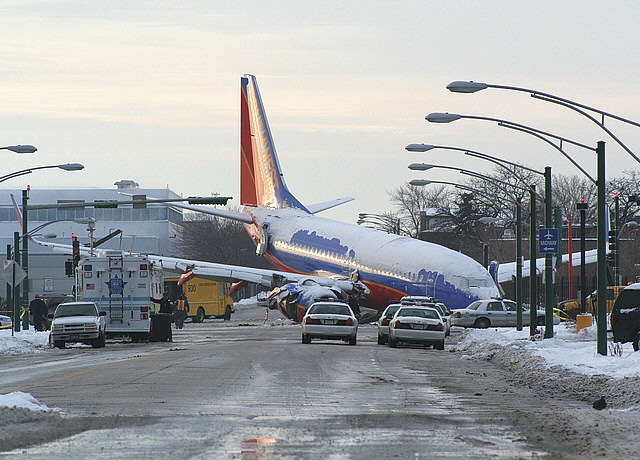
At MDW, they sometimes don't!
Powered by Infopop Corporation
UBB.classicTM
6.3.1.2