This is topic home electrical service question in forum Film-Yak at Film-Tech Forum ARCHIVE.
To visit this topic, use this URL:
https://ft-forum.com/ft/cgi-bin/ubb/ultimatebb.cgi?ubb=get_topic;f=8;t=006596
Posted by Scott Norwood (Member # 30) on 01-13-2012, 11:40 PM:
Here is a graph of voltage over time in my apartment:
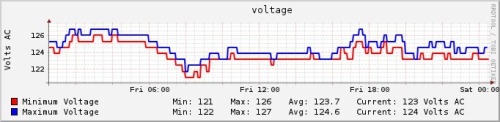
As you can see, voltage is fairly constant during the day (approximately 9am to 4pm) and then rises significantly in the early-morning hours. This is fairly consistent from day to day, with the typical range being from about 120 to 127 volts. This is measured at a normal outlet by a UPS (it takes the high and low values over five-minute intervals).
Q1: what is the reason for the variation over time?
Q2: is this variation within the standard tolerance for home electrical service?
Q3: if the answer to Q2 is "no," then what should I do about it?
I have not noticed anything that would lead me to believe that I have had any problems with my electrical service, but I am sure that there are people here who know far more about any potential issues than I do.
Note that nothing else of any significance (other than a lamp or two) is connected to this circuit.
Posted by Monte L Fullmer (Member # 2797) on 01-14-2012, 03:17 PM:
Keyword here is "apartment" - apartments on one meter?
But, if not, I bet it's due to the complex is feeding from one main transformer with incoming voltage is being split for all the apartments with some renters are using more current than others and the results are what you see on the graphs.
Posted by Frank Angel (Member # 248) on 01-14-2012, 04:46 PM:
Basically its the load variation. We experience the same patterns in our theatre that you are seeing, Scott; fairly steady during the day with a significant rise starting around 6pm as large users -- businesses mostly -- begin to shut down. Con Edison explained that regulating and balancing the load on the grid to compensate for the variation isn't easy, evidently. This is what they told us when we found equipment dying premature deaths.
When I put in Furman rack mount power units with a digital read-out in the booths, there was no doubt that the voltage would rise at night. I have seen them sending us a stead 130v for an hour or more before it leveled back down to 127-8, which is not what you'd like to be juicing up your equipment with.
And as much as there are transformers and a rectifier in front of the Peerless lamphouses, the arc burn still reacts to these changes. Starting with the Evening show, you have to start readjusting the carbons and watching them more closely because that voltage increase was enought to get eratic drift, and the dreaded mushroom bubble on the tip of the negative carbon. And that was after they burned rock steady during the first two shows.
And let me tell you, 130v is no picnic for equipment designed to run on 110v-120v. We decided to stop keeping the studio equipment on round the clock and began shuting it down at night when we realized that equipment was meeting some very premature deaths. Also, we'd come into the studio in the morning and two or three of the lights in the hallway would be burned out. We even switched to Long Life Service bulbs and they didn't fare much better.
Con Ed's answer to our complaint was that it was within their parameters of what is considered "normal range" of fluctuation.
On the really expensive stuff, we put Triplite voltage conditioners, but you really can't do that for the big high wattage equipment.
Posted by Jason Burroughs (Member # 68) on 01-14-2012, 06:04 PM:
It makes sense that the voltage would increase in the early morning, as the electrical providers bring more generation online in anticipation of large consumers starting up, leading the load.
As those loads increase, the voltage drops.
From Wikipedia:
In the United States[3] and Canada,[4] national standards specify that the nominal voltage at the source should be 120 V and allow a range of 114 to 126 V (−5% to +5%). Historically 110, 115 and 117 volts have been used at different times and places in North America. Main power is sometimes spoken of as 110; however, 120 is the nominal voltage. http://en.wikipedia.org/wiki/Mains_electricity
Municipal water suppliers do the same thing with water pressures.
Posted by Tony Bandiera Jr (Member # 2365) on 01-14-2012, 06:11 PM:
Scott:
Utility standards required by law allow a +10% to -10% long-term variation from the Nominal supply voltage. So for 120v, the high can be 132v and the low can be 108v. Short-term deviation can be 15%.
EDIT: Jason's post went up as mine was being typed..wiki's source is wrong, 10% + or - is the allowable deviation.
As for Frank's problems he mentioned, there should be no failures with well-designed equipment. Sad to say even some major brand names have crappy power supplies that can't handle the normal variations (are you listening, Dolby?) Light bulbs are another story, their quality has been shit for the last several years. The filaments are made of thinner wire, with less tungsten content, and fewer filament supports.
I have several books on, and have studied, power transmission and distribution for many years. Frank, Con Ed wasn't lying to you. In matter of fact, taken in the literal sense, since AC power generation MUST Exactly match demand, in the literal sense the power grid as it exists today is theoretically impossible. The only reason the grid works and survives is that normal load diversity is such a small percentage of the overall imbalance that although it stresses the transformers and generators, the imbalance is not enough to collapse the grid.
But, as the great East Coast (and other) blackouts have shown, unbalance things enough and a major collapse happens. ![[Eek!]](eek.gif)
Posted by Tony Bandiera Jr (Member # 2365) on 01-15-2012, 01:17 PM:
I stand corrected on my edit to that last post....wiki was right in general, the tolerance is +5 -5%, as a measured SERVICE voltage. BUT, for the actual UTILIZATION voltage, the tolerance is -13%, +6% (which is close to the 20% spread I was thinking of.) `However, NEMA (National Electrical Manufacturers Association) DOES specify a recommended tolerance of +10% -10% from equipment NAMEPLATE voltage as an operating tolerance. So therefore, equipment that is nameplated at 120 volts should be able to handle voltages from 108-132 without issues.
Here is a link to a paper from Pacific Gas and Electric which includes a voltage table (see page 2) for easy reference. It is a pdf so I couldn't capture the table to post here. LINKY
It also has some other tolerance curves and lots of other useful info.
Posted by Louis Bornwasser (Member # 3063) on 01-15-2012, 03:17 PM:
I once serviced a theatre that had chronic faiures with an older Simplex tube amp system. Line voltage in this community has always been 133 volts. System had 105-110-115 volt tape; we were using 120. I bought a buck-boost transformer and provided 112 volt to the 120 tap. System stable.
Later found that the marquee lights failed at the rate of 120 per week. Changed to 140v bulbs.
Most modern equipment will run quite well on lower voltages; usually there are no ill effects. Louis
Posted by Tony Bandiera Jr (Member # 2365) on 01-16-2012, 01:37 PM:
quote: Louis Bornwasser
Most modern equipment will run quite well on lower voltages; usually there are no ill effects. Louis
And to add to that, most equipment with "universal" power supplies (ones that say for example 110-240 volts on the nameplate), like a lot of cell phone chargers, etc. will operate on a very wide range, sometimes as low as 85 volts and up to 250 safely. Basically ANY voltage in the stated range will work just fine.
Posted by Stephen Furley (Member # 1277) on 01-16-2012, 02:16 PM:
Louis, Where on Earth do you find 140 V bulbs? I know that most of the small decorative ones over there tend to be rated at 130 V, presumably to extend the life of them. I've got some C9 Christmas lights which are 130V for example.
Scott, find out for certain what the tolerances are on your supply, if you're not sure ask the electricity company. If you're regularly seeing Voltages outside this range then report it to the electricity company; it's their problem to sort it out. Do you own or rent the apartment? If you rent then your landlord would probably have to contact them to report it. This assumes that you are fed directly from a transformer owned by the electricity company. If you're not fed directly, for example if the company supply the building at 277/480 V three phase and the owner of the building own a transformer to step this down to provide your supply then you'd have to report it to them. If the incoming supply to that transformer was out of range, then they in turn would have to take it up with the electricity company.
If the Voltage which you're getting is within spec, but you have equipment which can't cope with it then it's your problem, and you would have to install stabilisation equipment to handle it.
I recently had a problem at work. Until recently the Voltage was always low. After our high Voltage feed was moved to a different supply it was always high. Overnight I was seeing Voltages as high as 269.2 V on one phase, and only slightly less on the others; 253 V is the upper limit here now. I collected data from a UPS over several nights, highlighted figures out of range in red, and sent them to the consulting engineers for our refurbishment project. They sent them to UK Power Networks who sent an engineer in late one night to take the tap changer on the transformer down a notch. It's still slightly high, but well within spec.
It's rather different over there with the small pole mounted transformers which you use; I don't think these have tapchangers. Transformers in large substations. over here typically 66 or 33 down to 11 or 6.6 kV, usually have automatic on-load tap changers which adjust to keep the Voltage reasonably constant throughout the day.
All that you can do if it is above the limit is to take it up with whoever owns the transformer which is feeding you; they may in turn have to take it up with somebody else.
Posted by Louis Bornwasser (Member # 3063) on 01-16-2012, 03:02 PM:
Regrettably, the Utility companies here are mostly concerned with proving that "it's not our problem."
Years ago, I could not reliably get Strong (regular) Lumexes to strike. Line voltage after 7pm was 190 volts (should have been 208v) using 2 points of a three phase feed. Daytime voltage was over 220v. When the landlord (a large shopping center) got involved, the problem was settled.
Say what you will, bit THAT problem did not exist on motor-generator sets! Louis
Posted by Scott Norwood (Member # 30) on 01-17-2012, 05:41 AM:
To answer some questions: I have a separate meter for my apartment. I do not know how the service is fed to my unit, but it seems to be isolated from my neightbors (e.g. my lights do not dim when my neighbor uses his vacuum cleaner, etc.).
From the comments here, it sounds as if this situation is normal and expected and within the expected tolerance. I suppose that my light bulbs won't last as long as they should (due to the higher than normal voltage; I normally use 120v bulbs), but that is not a huge concern to me.
Posted by Stephen Furley (Member # 1277) on 01-17-2012, 06:32 AM:
Scott,
A few Volts difference will make a major difference to the life of incandescent lamps, but most other things will work over quite a wide range without problems. Many electronic devices now have power supplies that will work from 100 to 250 V for worldwide use.
How many apartments are there that would be fed from that supply? I might be able to explain why your lights don't dim when other people switch things on.
I'll send you a private message about something else tonight when I get home.
Posted by Jeff Stricker (Member # 224) on 01-17-2012, 07:06 AM:
To correct for power factor (inductive loads like motors, etc being switched on), the power company will switch power factor correction capacitors across the line. These capacitors can be seen up high on poles here and there in the distribution system, and there is usually some type of "controller" mounted low on the pole. This controller senses the line voltage, and if it gets below a certain value, the power factor correction capacitors are switched across the lines. This, in turn, raises the line voltage which, I'm sure, is one of the effects that Scott is noticing.
Posted by Dave Macaulay (Member # 813) on 01-17-2012, 11:29 AM:
There used to be 140V incandescent lamps available, labeled as "farm bulb". This was because rural distribution often has long ungridded line legs serving several farms and the voltage delivered is unstable. I haven't seen these lamps lately, but I haven't been in a farm store lately either.
140V bulbs are fine for long life but weak on light. A 100W 140V lamp is a 70W lamp at 120V.
Posted by Louis Bornwasser (Member # 3063) on 01-17-2012, 02:57 PM:
140v bulbs=works good, lasts a long time.
As mentioned before, 60 Hz countries usualy use many small line transformers; 50 Hz countries use a single very large line transformer. I would expect loads to "talk with" each other more on the single transformer. Louis
Posted by Stephen Furley (Member # 1277) on 01-17-2012, 06:12 PM:
If they're on different small transformers, but if they're on the same small transformer then I think it would be worse than being on the same large one. I think switching on a fairly heavy domestic load would be likely to affect the secondary Voltage more on a 20 kVA transformer than on a 2 MVA one. In general, people do not all switch on heavy loads at the same time. We don't usually see our lights dim here if a neighbour switches on a washing machine etc.
Powered by Infopop Corporation
UBB.classicTM
6.3.1.2