This is topic 2 cores microphone cable in forum Film-Yak at Film-Tech Forum ARCHIVE.
To visit this topic, use this URL:
https://ft-forum.com/ft/cgi-bin/ubb/ultimatebb.cgi?ubb=get_topic;f=8;t=006641
Posted by Marco Giustini (Member # 4544) on 03-22-2012, 01:51 PM:
I am looking for a 2 cores microphone cable that needs to be strong enough to be used on a daily basis, but small and flexible enough to be practical to use.
Could anybody of you possibly advise for a brand and type?
Cheers,
Marco
Posted by Louis Bornwasser (Member # 3063) on 03-22-2012, 03:57 PM:
Is this 1 pair of wires under one shield or 2 pairs of wires under 2 seperate shields, all under one jacket.
I use Belden 8412 for microphone cables; 2 conductor shielded, woven shield. (old school) Louis
Posted by David Buckley (Member # 2600) on 03-22-2012, 07:16 PM:
Given Marco is in the UK I'd advise him to go to his nearest Maplin store and get Van Damme tour grade microphone cable.
Most folks buy ready made up cables with the XLR connectors already on, so when it gets damaged you can use the spare you have in the cupboard.
Posted by Randy Stankey (Member # 64) on 03-22-2012, 09:09 PM:
Get the made-up cables if you can. They are a lot less hassle and, once you account for your labor, they aren't any more expensive than making your own.
The benefit of making up your own cables is that you can customize them to the exact length you need. If you need an extra long cable to reach across the room or if you only need a shorty to connect a CD player to a mixing console, you have the exact thing you need.
Regardless of whether you buy them premade or whether you make them yourselves, get Neutrick XLR connectors. They are the best. They are easier to solder and assemble. They last longer without breaking or coming apart. We used to use Switchcraft connectors but changed to Neutrick for just this reason.
The last thing you need is to be in the middle of a gig when your emcee stands in front of the audience and says, "Good evening...@#!*&...ladies and gentle*@#$men..." because the connectors frayed the cable and it starts go all staticky and cut in and out on you.
According to Murphy's Law, that's when cables are most likely to crap out. ![[Wink]](wink.gif)
I've never had a properly installed Neutrick connector crap out in the middle of a gig.
Posted by Michael Voiland (Member # 5386) on 03-22-2012, 10:30 PM:
Ever use the switchcraft AAA connectors. The all metal ones a really tough.
Posted by Randy Stankey (Member # 64) on 03-22-2012, 10:42 PM:
Since discovering Neutrick, I haven't even looked at anything else.
I just looked up the Switchcraft AAA and they look nice. If I can't get the Neutricks I'll certainly give them a look.
Aside from the fact that you can run them over with a truck, the thing I like about Neutrcick is that they're easy to solder up.
Posted by Scott Norwood (Member # 30) on 03-23-2012, 10:54 AM:
For microphones, my preferred setup is Canare L-4E6S star-quad, with Neutrik XX-series connectors. I buy the parts from Markertek and make the cables myself, though I would buy pre-made cables if I were putting a value on my time. The cable is flexible and quiet and can be had in many different colors (which can help identifying whose cable is whose after an event where cables from different sources are mixed together). The connectors come in all-black and black/silver.
I have never had issues with Switchcraft connectors, but I prefer Neutrik XLRs because they can be disassembled without tools; on the other hand, I prefer Switchcraft for 1/4" connectors. Do stay away from generic connectors, though; stick to Neutrik or Switchcraft.
Posted by Marco Giustini (Member # 4544) on 03-23-2012, 03:42 PM:
Hi all,
Thanks for so many answers!
I am indeed in the UK David, not so far from Oxford!
Louis, 2 pairs under one jacket, I guess that a separate shield would avoid crosstalk, wouldn't it?
I do need a custom cable, I will probably need micro-XLR on one end. And the cable will be possibly 15-ish meters long. I am not a big fan of Maplin, they seem to sell overpriced stuff to me.
Scott's suggestion looks excellent, and there is a 'reduced size' version as well, with two pairs inside. But if I'm not mistaken the pairs are not independently shielded.
The size is crucial for my application. I need something small and robust at the same time. The cable won't be moved when being used. And it won't be abused.
Thanks everybody!
Posted by Marco Giustini (Member # 4544) on 03-25-2012, 05:57 AM:
Hi there,
My researches led to two possibilities:
1. Snake cable. This would be ideal, but I have already have a 4-cores snake cable, I am looking for something smaller - otherwise I could use the one I have. Unfortunately a 2-core snake cable is just a little bit smaller than the one I own.
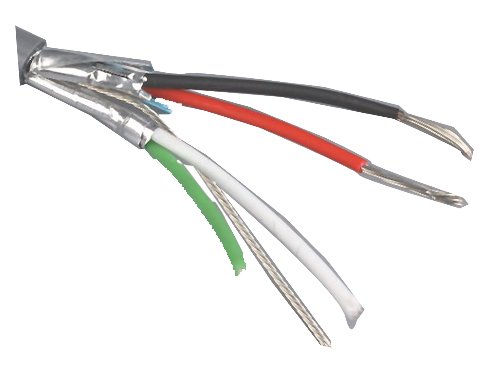
2. Data cable. Belden 8723 is the only one with independent shielded pairs. It's not supposed to be used for audio but I guess data is more critical than audio.
The last option would be to use a star-quad cable, but pairs won't be independently shielded.
What is your opinion on the subject?
Thanks
Posted by Randy Stankey (Member # 64) on 03-25-2012, 08:47 AM:
I didn't think that individual shielding was critical for balanced audio cable. Is it?
Shouldn't common mode rejection and the fact that the two cables are twisted at different rates take care of 99% of any crosstalk problems?
Unless you have some critical application, cables for general audio use shouldn't care about separate shields. No?
Posted by Scott Norwood (Member # 30) on 03-25-2012, 10:09 AM:
How about something like this Gepco product:
http://www.gepco.com/products/proav_cable/analog_audio/multi_gf22_M.htm
It sounds like Gepco GA61802GFC (two pairs, individually shielded) should work for your application.
OD is .36", which may be larger than what you want, however.
Posted by Manny Knowles (Member # 1171) on 03-25-2012, 01:48 PM:
Or, this:
Gepco D61801EZGF
Click here to see another image of it.
Posted by Marco Giustini (Member # 4544) on 03-25-2012, 02:45 PM:
Randy,
I don't really know, but if you have two different microphones lines under the same shielding, thightly twisted together, wouldn't be the crosstalk a possible issue?
Thanks Scott, but that is bigger than my 4-cores snake!
Manny, that what I was looking for, thanks. Unless someone could confirm that crosstalk wouldn't be an issue if I used a star-quad cable, connected to two different microphones.
I'm going to use the cable on an RTA for sound analisys.
Thanks
Marco
Posted by David Buckley (Member # 2600) on 03-25-2012, 05:33 PM:
quote: Randy Stankey
I didn't think that individual shielding was critical for balanced audio cable. Is it?
I've never seen anyone propose the use of individually screened cables for balanced audio.
You provide the reason why: you want any interfering signal to hit both cores identically so the common mode rejection works. With individual screening of the cores there would be bound to be differences in how well the screening works for each core all along the cable, so the CMRR would be compromised.
The screening on balanced audio is often a case of guilding the lilly anyway; balanced audio is sent (albeit at line level) all over the place on unscreened twisted pairs. Just look at that telephone set on the table over there; its audio got from the exchange to the demarc over unscreened twisted pair.
Now that Cat5 is ubiquitous in buildings, audio is often sent over Cat5 with nothing more than a RJ45 to XLR adapter cable.
Posted by Randy Stankey (Member # 64) on 03-25-2012, 06:50 PM:
quote: Marco Giustini
I don't really know, but if you have two different microphones lines under the same shielding, thightly twisted together, wouldn't be the crosstalk a possible issue?
I'm not 100% authoritative but, like David says, common mode rejection cancels out most interference.
The two wires in a balanced audio line do not have a positive/negative reference to ground. They are only positive or negative in respect to each other. Always two equal but opposite signals.
If interference is introduced into the system, it will impress itself equally but oppositely on each wire, thus the interference cancels out.
The twist of the wires enhances this effect, keeping the signal within the pair and attempting to keep interference out.
In a multi-pair system, I would expect each pair to be twisted, separately at different twist rates. The differing twist rates help reduce crosstalk.
Properly made and properly terminated with good quality connectors, I don't see any reason why two pairs carrying differing audio signals from microphones or line level should have a problem with crosstalk.
However, if I am wrong, I will stand corrected.
Posted by Marco Giustini (Member # 4544) on 03-26-2012, 12:45 PM:
I am afraid I was not clear, my apologies.
I meant "individually screened PAIRS". Think of a cable with 2 twisted pairs, each connected to a microphone. I guess each pair needs to be shielded individually and not wrap everything together.
Sorry for not being clear in the first place.
Thanks
Powered by Infopop Corporation
UBB.classicTM
6.3.1.2