This is topic what is wrong with the radio industry? in forum Film-Yak at Film-Tech Forum ARCHIVE.


To visit this topic, use this URL:
https://ft-forum.com/ft/cgi-bin/ubb/ultimatebb.cgi?ubb=get_topic;f=8;t=006705

Posted by Scott Norwood (Member # 30) on 06-28-2012, 06:10 PM:
 
Weird topic, I know, but some people here have worked in the radio and TV business and maybe they can explain what is happening now.

In the Boston market, the following changes have been made in the last few years:

- successful classical station (WCRB-FM) and country station (????-FM) swap frequencies...naturally, the country station now has the better signal (I have no idea who listens to country in this market)

- NPR music station (WGBH-FM) turns into NPR news station, despite the fact that we already have an NPR news station (WBUR-FM) with a better signal

- modern rock station (WBCN-FM) signs off to make space for FM sports talk station (WBZ-FM)

- the other sports talk station (WEEI-AM) buys an adult hits station (WMKK-FM) in order to broadcast the same programming on both AM and FM

- independent alt-rock station with crappy signal (WFNX-FM) sold to Clear Channel to be changed to a Format To Be Named Later (tm) (Spanish-language talk is one rumor)

- just today, a successful oldies station (WODS-FM) switched to an automated-sounding top-40 format, despite the fact that we already have a successful CC-owned top-40 station (WXKS-FM) (and despite the fact that pretty much all top-40 music now sucks...and despite the fact that kids don't really listen to the radio anymore, as far as I can tell)

These are all major stations with at least decent signals that cover the metro area, not dinky-doo AM daytime-only stations or anything like that.

What are these people thinking when they make what appear to be boneheaded format changes to successful stations (the FM sports talk thing has actually been a success...I believe that the jury is still out on the other moves). Does any market really need two stations with substantially the same programming (as is the case with the AM/FM sports talk and the two NPR news stations)? Is anyone else seeing major changes in his local radio market, or is this just an isolated thing?
 
Posted by Melanie Loggins (Member # 6454) on 06-28-2012, 07:23 PM:
 
My guess? Consolidation. Those stations are all programmed by one central mother ship, and all the voices you hear for station id's and song announcements were voicetracked, i.e., recorded in a half-hour session two days ago. This saves stations considerably. One company can own several and have just a few people working part-time to be on the air, and nobody has to program anything.
 
Posted by Robert E. Allen (Member # 1351) on 06-28-2012, 08:39 PM:
 
I spent many years in radio as an announcer/DJ/salesman. I agree with Melanie. The FCC has relaxed it rules about how many stations a company can own in any given market. Stations I used to work for are now nothing more than repeaters for some "mother ship" who knows where. IMO except for classic and country all the music played today is for the 14 to 34 year old crowd. That's why, except for certain Christian stations, I almost never have my radio on.
 
Posted by Dave Macaulay (Member # 813) on 06-28-2012, 08:50 PM:
 
I think it's just the death of radio. I do wonder what a successful classical station really looks like on the balance sheet.
I have friends in media, and the market has really collapsed in this depression --- I mean recession. Advertisers have thin wallets, and stations have had to drop rates a lot just to get any revenue.
So any station with live on-air staff is in trouble. Satellite radio is taking over the car business, people will tune in their local terrestrial station to get local news and weather but otherwise stick to the satellite stuff: I do, and anyone I know with it does the same - and just about every new car sold has Sirius/XM built in.
The media conglomerate stations run on an automated system with nobody home. There's no staff to pay, the only cost is the transmitter and license and a bit of overhead. Ad sales may still have local agents but production is all centralized. I travel, and I hear the same CC announcer for the car dealer in every town when I roam the terrestrial dial. But I don't do that much any more - the musical pap, sports idiocy, country whining, and religious nonsense is the same everywhere. Grateful Dead 24/7 is good for me. And book radio. Plus, the 24/7 Pink Floyd channel started up yesterday.
 
Posted by Frank Cox (Member # 6258) on 06-28-2012, 09:29 PM:
 
For long trips in the car and the like, I suggest Old Time Radio plays. Comedy, detective stories, drama, soap operas, westerns, you-name-it.

Lots of mp3's here
 
Posted by Mike Blakesley (Member # 26) on 06-28-2012, 09:48 PM:
 
Our local station used to be all-local with five DJs who were also part-owners of the station. It was cool. Lately it's been through four or five owners and is now part of a five-station chain. Nowadays they are only "live" in the morning when they have a call-in-and-sell-your-crap show. Other than that (and school sports) it's all canned content beamed in from somewhere. Everybody I know turns it on for local sports and etc., or if they have no other alternative but for serious listening, it's XM or Sirius or some kind of mp3 or CD player.

Myself, I don't like much top-40 stuff (tired of the same old stuff repeated ad nauseum and have limited interest in the new stuff), so I play my iPod or CDs in the vehicle. I don't know how the station survives; I guess they can't afford to pay on-air "personalities."
 
Posted by Monte L Fullmer (Member # 2797) on 06-29-2012, 05:36 AM:
 
Blame APPLE and iTunes, along with internet radio.
 
Posted by Jeff Stricker (Member # 224) on 06-29-2012, 06:50 AM:
 
Yup, too much competition for too few listeners. Ipods, MP-3s over the internet, etc. take listeners away from commercial radio. I once worked for a station that would have gone belly up were it not for the local high school football and basketball games. Local advertisers felt a sense of 'hometown spirit' and bought commercials on the game broadcasts.

Nowadays it is very likely that no one is alive sitting behind a microphone to tell you of impending bad weather, the end of the world, or whatever. Computers spit out the music, commercials, and connect to a network in time for the news at the top of the hour (and of course run the station ID).
 
Posted by Martin McCaffery (Member # 37) on 06-29-2012, 07:34 AM:
 
I may have reccomended the book before, but Something In The Air is a great history of the very short life of local radio. When the FCC allowed single entities to own an unlimited number of radio and tv stations (and newspapers) that was the death knell. What you have now are McDonald's radio, and it is never coming back. Theoretically the FCC could put all kinds of local requirements on radio, but the howls of interferring with The Free Market would drown out broadcasts from coast to coast.

Somewhere along the line we lost the public airways. May as well just be honest about it and sell them off, quit regulating them and let the "free market" sort it out.
 
Posted by Jeff Taylor (Member # 443) on 06-29-2012, 09:36 AM:
 
I was an on air personality at one time--long, long ago. Today I have 6 Sirius accounts. Nuf said?
 
Posted by Sam Graham (Member # 2889) on 06-29-2012, 10:49 AM:
 
quote: Melanie Loggins
Those stations are all programmed by one central mother ship, and all the voices you hear for station id's and song announcements were voicetracked, i.e., recorded in a half-hour session two days ago.
My last gig was such a situation. 30-45 minutes and I had a seven hour show done, five nights a week. I was the first such show in our market to do this, and our sales people were astounded to find out I wasn't really there.

There's very little OTA radio I listen to anymore, and even that is limited to outside market streaming of certain talk shows. I'm with SiriusXM all the way, and even there I can't stand to listen to music channels that have DJ's.
 
Posted by Manny Knowles (Member # 1171) on 06-29-2012, 11:58 AM:
 
Radio stations have to apply to renew their licenses to broadcast. They have to announce on-air their intention to renew, and make the application available for review by the public. There is an avenue -- and a window of opportunity -- to tell the FCC whether the station has or hasn't served the needs of the public.

Check it out.

Edit -- It doesn't say on that page that the broadcaster is required to announce that the application to renew the license has been filed. But I have heard such announcements in the past, both here (Indiana) and in Southern California.
 
Posted by Scott Norwood (Member # 30) on 06-29-2012, 09:15 PM:
 
So everyone here who has satellite radio is happy with it? I have considered the concept before and have had rental cars with the radios installed. I thought that the basic idea was good, but I have a hard time convincing myself to pay for radio. There also seem to be many stations that I would have no interest in ever listening to (not really a problem...just an observation).

Remind me: does one need separate subscriptions for home listening and car listening, or does one subscription cover multiple receivers? What is the current monthly fee?

In the car, about 2/3 of my listening is news. About 1/3 is music. In most markets (including mine) there are several good news stations on both AM and FM, so that is not really a problem. It's the music situation that is becoming depressing. At home, I would listen to more music, but the programming would have to be better than what is presently available on the FM dial (for example, I would love a classical station with good reception and a library of more than a few dozen recordings). I have little or no interest in talk. (Actually, talk can be interesting when travelling, and the sell-your-stuff programs are often unintentionally hilarious, but I would not want to listen to this stuff on a regular basis.) For the most part, my only interest in sports is baseball, and the existing broadcast stations (WEEI-AM, primarily) fill that need.
 
Posted by Manny Knowles (Member # 1171) on 06-29-2012, 10:31 PM:
 
In the car I listen to local radio or MP3's or Pandora
 
Posted by Frank Cox (Member # 6258) on 06-29-2012, 11:30 PM:
 
I don't know how it works in other places, but I have digital cable television and it comes with 40 or so "Galaxy music channels". I have a couple of computer speakers plugged into the digital cable box (I don't watch television so I don't really have an actual TV -- I have a Commodore 1701 computer monitor that I use when I need a display on the digital cable box) and leave it tuned to either Super 70's or Smooth Jazz, which I play all day at a low volume in my living room. I like it, and it keeps my bird entertained.

If you have cable television, perhaps you also get music channels. The Galaxy channels are nothing but music, no talking or anything else. They are apparently sold to stores for background music, similar to Muzak.

If you're looking for "live dj" stuff, perhaps this would be a good place to flog CreekFM, the radio station that's operated by the Okanese First Nation about 40 miles from here. You can stream their station on the Internet; the streaming server lives in my basement here.

CreekFM is a unique station, with programming ranging from great to ghawd-awful.
 
Posted by Mike Blakesley (Member # 26) on 06-30-2012, 12:19 AM:
 
quote: Scott Norwood
Remind me: does one need separate subscriptions for home listening and car listening, or does one subscription cover multiple receivers? What is the current monthly fee?
You have to have one subscription per device, but the second device costs less than the first. The monthly basic rate for Sirius/XM is currently $12.99 and I think the additional-device charge is $6.99. There are discounts available for paying in advance up to five years and they are pretty substantial.

You can get around the need for more than one device by buying a single radio with various "kits," like a car kit and a home kit. Then you just take the tuner with you. Of course, you wind up disagreeing with your spouse over who gets the radio, so you eventually buy another one. (Sold many a radio to a husband, who would then come back two weeks later to get one for his wife.)
 
Posted by Monte L Fullmer (Member # 2797) on 06-30-2012, 03:54 AM:
 
(Side topic: Commodore 1701's had a wonderful dot pitch of .39 for a 14" RGB monitor ...excellent VCR monitors for sharp playback...)
 
Posted by Frank Cox (Member # 6258) on 06-30-2012, 12:30 PM:
 
C-1701's had S-video inputs before S-video existed. You can easily make a cable to connect a S-video output to a 1701 monitor. The picture is a nicer than just connecting it via the composite video hookup.
 
Posted by Leo Enticknap (Member # 534) on 06-30-2012, 03:42 PM:
 
Adding a foreign perspective, from a technological point of view, radio ain't good here, either.

Digital radio (using the DAB system) was launched in the late '90s in Britain, and ever since the government and the BBC (without wanting to get into politics, they're basically one and the same thing as far as this issue is concerned) have been pushing hard for DAB to replace analogue FM/MW/LW broadcasting. What's interesting is that while digital terrestrial TV has now almost completely superseded analogue (using the DVB-T system), the consumer market has proven very resistant in the case of radio.

The reason why is that basically, DAB is shite.

People who just listen to radio for background noise aren't willing to buy DAB because it isn't worth the extra money, and people who listen to classical music etc. on FM aren't going to either, because the sound quality isn't good enough. So it's never achieved a critical mass that is big enough to make winding down analogue radio viable. Crucially, IMO, no car manufacturers (as far as I'm aware) are selling cars with DAB radios in them as standard - if you want DAB in your car, you have to pay several hundred pounds extra, either as a factory option or aftermarket.

Stupidly, I was an early DAB adopter. The branch of Richer Sounds close to my workplace in 2004 had an option on a Cambridge Audio DAB tuner for £130. So I was seduced and bought it, and for the first few weeks it was lovely, especially for the classical music station Radio 3, and Jazz FM. Then the BBC throttled the bitrate for 'minority interest' stations - R3 went down from 192kbps to 64 - with the result that the subjective sound quality went down from better than FM to worse than AM. A colleague of mine bought a used car in around 2007 that the previous owner had fitted an aftermarket DAB tuner to, and reported that the signal was so weak that the thing was virtually useless.

So DAB is clearly a fundamentally flawed technology, and/or the powers that be are not willing to subsidise it to the same extent that they are digital TV. I went back to FM about a year after getting that tuner, and I don't think I've even used it for the last 3-4 years now.
 
Posted by Ron Funderburg (Member # 4561) on 07-02-2012, 09:51 AM:
 
Radio has gone through a very hard 20 years. Expansion of the satellite stations and other competition reduced income streams. The late-night early-morning DJ’s are gone in all but the largest markets. DJ’s make less in smaller markets than every before many have to sell advertising as well as DJ to have enough to live on. Play list (the music they let you play) for most stations are a 1/4 of what they use to be.

News and Sports talk has exploded AM is all but dead many new cars don’t even have AM on the radio.

I looked at going back into working in Radio and decided no not for me now.

PS hope I didn't just rehash everyone else probable did.

PSS Mike you don't know how much old DJ's hate the satellite radio's. It has hurt local radio beyond belief far worse than other influences on the market. Can Howard Stern look out the window and tell you hey the rain started? NO. Local radio is all about the community Satellite is about getting your money into someone's pocket.
 
Posted by Mike Blakesley (Member # 26) on 07-02-2012, 02:31 PM:
 
quote: Ron Funderburg
Mike you don't know how much old DJ's hate the satellite radio's.
Oh, yes I do. We used to sell XM Radio here at my day job. I wanted to advertise this on our local station. The owner came over and told me they would not run ads for satellite radio. I understood and changed the ad to not mention satellite radio. I figured it was the same as me not wanting to run screen ads for TV shows in the theatre.

Then a few weeks later I heard a "Best Buy" ad during one of their satellite feed times. Best Buy was advertising...you guessed it, XM Satellite Radio. So I called up the station, and asked them "WTF?" I figured I ought to be able to advertise XM if our competition in Billings was going to be allowed to advertise it.

Their answer was that they couldn't do anything about the satellite-fed ads because they had no control over that programming, and "no," they still would not allow us to advertise the XM on our ads. I even asked if we could just use the generic line "we are also your local headquarters for satellite radio." (Not mentioning the brand name) -- their answer was still no.

So I did what any red-blooded ticked-off American would do. I pulled all our ads off the station (including the Roxy's) and lived happily ever after. The joke is on them, because their satellite feed still includes state-wide Carquest ads so we get advertised anyway.
 
Posted by Ron Funderburg (Member # 4561) on 07-02-2012, 02:53 PM:
 
Your right to do so but you have to understand (don't care about the owner care about the DJ), DJ's make less now when adjusted for inflation than in the 80's and sometimes less with out the adjustment. Especially in small markets their is no local service unlike satellite there is no option for local stations.

It is a free market and one must expect this sort of thing but one does not have to agree with it or like it. I still maintain no XM or serious is going to tell you about that tornado that took out your alarm tower 5 minutes before it destroyed your theater. Which is exactly what happened this year in Woodward OK they weren't open you might be.

Dropped right out of the cloud on top of the storm warning systems main site and took every thing out. However, local free radio did warn about the storm. Still I think 6 people died and over a Billion in damages in the town.
 
Posted by Martin McCaffery (Member # 37) on 07-02-2012, 03:34 PM:
 
quote: Ron Funderburg
It is a free market and one must expect this sort of thing but one does not have to agree with it or like it.
Actually, no it is not. They are the public airwaves and are licensed and regulated by the Government. In theory, the Congress could mandate all radio be local. Ain't going to happen any more than they will make local operators pay for their use of the airwaves to make money.
 
Posted by Mike Blakesley (Member # 26) on 07-02-2012, 03:34 PM:
 
quote: Ron Funderburg
no XM or serious is going to tell you about that tornado that took out your alarm tower 5 minutes before it destroyed your theater.
I totally agree. That's why I understood when they wouldn't let us advertise XM. But then when they turned around and allowed our out-of-town "national chain" competition's ads to run but wouldn't allow us, a locally owned business, to advertise the exact same product -- at that point they were helping Best Buy take money out of my pocket, so what else could I do? You have to stand for something.
 
Posted by Ron Funderburg (Member # 4561) on 07-02-2012, 03:40 PM:
 
Martin local stations do pay for the use of the air waves have checked out what license for radio station is? Well let me tell you can't afford it if you work in theaters. You pay the government for the use the customer doesn't pay to listen and we have a free market economy as in freedom to market, sell, provide not that what you provide is free to you.

Mike not upset with you about being unhappy they didn't let you advertise. I can see both sides there. I just don't like XM and Serious for what they did to the local industry. Bad companies and not regulated they can use any language they want anytime they want.

With recent supreme court rulings maybe you can local before long.
 
Posted by Mike Blakesley (Member # 26) on 07-02-2012, 07:05 PM:
 
I suspect besides the commercials, another cause is the fragmentation of the music audience. 35 years ago, if a new Bachman-Turner Overdrive album came out I would order 25 or 30 copies of it (in the various formats) and they would be gone within days. In this town of 2000, we might have sold 70 or 80 copies before all was said and done. 10 years ago, before downloading became the norm, if a new 2-Pac album came out we might have sold a couple or three CDs of it, even with about the same number of music fans in town. Now, we're lucky if we sell one copy of almost anything. It's to the point where we hardly stock any new stuff anymore. We have yet to sell one copy of the latest Lady Gaga album, which was a huge #1 hit.

So I guess to answer the question, what's wrong with the radio industry? The main answers are:

1. Fragmentation of the audience
2. Local talent costs too much for stations to afford
3. Downloading + portable players has reduced people's need to listen to radio for their entertainment
4. People get sick of hearing 20 minutes of commercials in an hour's time

Radio guys are putting all the blame on satellite radio, but it's really not satellite's fault. It's a variety of factors. Satellite is only one, and not that big a one. Not everyone has satellite and you'll never have the portability with satellite that you do with terrestrial. It's just that people don't need radio like they used to.
 
Posted by Martin McCaffery (Member # 37) on 07-02-2012, 09:59 PM:
 
quote: Ron Funderburg
Martin local stations do pay for the use of the air waves have checked out what license for radio station is? Well let me tell you can't afford it if you work in theaters. You pay the government for the use the customer doesn't pay to listen and we have a free market economy as in freedom to market, sell, provide not that what you provide is free to you.
I have no idea how many mom and pop radio stations still exist, but I imagine the bulk of the stations are owned by the giant corporations that were allowed to consolidate ownership in the last 30 years. Unless they are paying substantial royalties based on their revenues, they are getting a subsidised service from the taxpayers. The greatest is the mini-monopoly they get with exclusive use of the airwaves. They gov't grants them the use of the frequency. They get to use it and I don't, and the gov't is going to enforce it. That's not a "free market." It may be the best way to do it, depending on your definition of best, but it's not a free market. There is no market competition for the use of the airwaves.

They are free, as you say, to market, but they are still marketing within the confines of a heavily requlated quasi-monopoly.

My larger point is because this system is not a free market,but a gov't controlled system, the congress and/or FCC, can pass a law to make all radio local and or locally owned, which would clearly not be a free market for anyone involved, but is still, theoretically, currently within the power of the government.
 
Posted by Louis Bornwasser (Member # 3063) on 07-03-2012, 12:47 AM:
 
mx/sirius did not cause the problem; radio was dead before. Satellite radio is a syptom not a cause.

Back to format changes: Let us pretend you own a #2 rock station. Your #1 competitor is country. You MIGHT buy a cheap second station, run it as NON COMMERCIAL country with the idea of "splitting numbers" that the #1 has. Presto you are now #1.

I know of towns that have several "fragmentors" in suburban markets clustered around a big town. With automated/satellite fed stations, this is cheap. LLouis
 
Posted by Bobby Henderson (Member # 840) on 07-03-2012, 09:08 AM:
 
The reasons are numerous on why terrestrial radio is failing. Some of those reasons are self-inflicted.

The music industry isn't in great shape. Ultimately radio survives on music content, right? Too much of newly released pop, rock and dance genre content is basically the same flavor of stuff we've been hearing for 20 years. The crap isn't selling nearly as well as it did in the past. But the mere handful of giant media corporations who strictly control what kind of music gets distributed to radio, iTunes, etc. are so terrified of change that they're willing to keep selling the same old crap until they fail. The music industry was always at its best when radical change could and would happen every few years. That happened on the back of many smaller record labels who could live or die based on that change.

One has to consider the "edited" versions of songs OTA radio must play. SiriusXM has an advantage in that it can play music that doesn't have all the foul language bleeped out of it. People have vast collections of music stored on smart phones and portable music players. Apps like Pandora provide all sorts of variety via user-generated "stations."

Big corporations bought up radio stations all over the place. The first thing they did was cut costs. Eliminate as many live DJ positions as possible at any given radio station to save labor costs. They did that either by using automation or subscribing to a national syndicated DJ show. If the radio station still had any live disc jockeys left those employees have often been limited on what kind of material can be played. Here in Lawton Z94 is our local rock station. Its parent company has changed hands three or four times in the last decade. One of the owners deleted a huge amount of the rock station's music library, confining them to a limited number of tunes they selected. They dictated the playlist (some of it based on music industry payola), but in doing so made the station indistinguishable from any other AOR station.

In order for a terrestrial radio station to succeed, it needs local personality. That means disc jockeys that are worth a damn and music that's worth a damn. The audience is very fickle. If the big company only wants to save money and pack in those commercials the listeners will be only too happy to defect to satellite radio, smart phone apps and their own music libraries.
 
Posted by Ron Funderburg (Member # 4561) on 07-03-2012, 09:22 AM:
 
quote: Bobby Henderson
Big corporations bought up radio stations all over the place. The first thing they did was cut costs. Eliminate as many live DJ positions as possible at any given radio station to save labor costs. They did that either by using automation or subscribing to a national syndicated DJ show. If the radio station still had any live disc jockeys left those employees have often been limited on what kind of material can be played. Here in Lawton Z94 is our local rock station. Its parent company has changed hands three or four times in the last decade. One of the owners deleted a huge amount of the rock station's music library, confining them to a limited number of tunes they selected. They dictated the playlist (some of it based on music industry payola), but in doing so made the station indistinguishable from any other AOR station.
Bobby has hit the problems pretty good from my point of view (old DJ). They limited the DJ as well other than say the morning drive. "Shut your mouth and just introduce the song cut down on the jokes." Good DJ's never talked a lot but had a personality that a listener got. The jokes the trivia and inside information and the way he presented it helped him establish an audience in his time slot.

The company in the old days (80's for me) treated the DJ with some respect knowing if went to a rival station he would take listeners, listeners they might not get back. The damn labels have been afraid of change since 1992 or so and the music has suffered. Reduced play list (even at oldie stations) have made you listen to the same songs day after day. No matter how much I like CCR's Bad Moon Rising I don't want to hear it everyday and do want to hear Chicago's 25 or 6 to 4 once in a while.

On some OKC stations the songs are like clock work with live DJ's same song same time new day.
 
Posted by Martin McCaffery (Member # 37) on 07-03-2012, 11:10 AM:
 
Shorter version: They got rid of DJ's and replaced them with "Radio Personalities."

A great DJ knows how to put songs together and has people listening for what's next. A Radio Personality knows how to laugh on cue at even the most unfunny statement and play the next commercial, oblivious to what's on the air.
 
Posted by Jack Ondracek (Member # 1466) on 07-03-2012, 12:08 PM:
 
Some good answers here... and a lot of opinions from the listener-side of the equation. It's interesting, that many of the expert opinions come from people who spend most of their time on satellite-based subscription services.

In his short post, I think Louis probably hit the nail best.

For many of the rest, a romantic view of radio's past is about as likely as bringing back 35mm arc-based changeover booths.

Yes, consolidation has had an effect, and the result is centralized, cost-efficient but bland programming. Bring back local, personality-based programming, you say? Great idea. Problem is, there are a LOT more entertainment options out there... many of them with much lower overheads than terrestrial radio. The audience is much more fragmented, so your likelihood of pulling in great numbers is much more limited than in the past. Like the gross over-screening of our communities, there are many more signals on most dials than the available listening audience will support.

When I was young, the area's dominant rock station (AM) regularly pulled in 30+ shares of the available market. There were maybe 15 stations in the whole market, more or less... 5 commercial TV stations and two Non-Comms... no internet, no satellite anything, no cable, DIAL telephones, party lines (yuck), and all theatres were big and single-screened. If you were able to get into any of those businesses, you were likely to make enough to pay the bills. Now, a 5 or 6 share pretty much makes you "number one".

Today, "live" means expensive. It's just that simple. If the listeners and advertisers won't support it, the owners won't program it. Admittedly, it's a chicken-and-egg scenario, depending on which side of the microphone you're on, but that's largely the problem. You're not likely to listen to a high-school kid, making minimum wage, cut his teeth on the local teapot station. Livable wages for the really good personalities are like major-league sports positions... there aren't many of them, and you have to have huge numbers on the consumer-side to pay for them. In addition to the live personality, program directors, research, payroll and local sales efforts all add to the cost of a live format. It's comparable to the difference between a single projectionist - single screen scenario and one guy who can run a multiplex.

Yes, companies like CC have had a huge effect on broadcasting (being nice here). However, independent owners struggle to compete, and local programming doesn't always translate into bankable dollars. It takes a lot more to impress an audience.

AM is a band that has undeniably fallen on hard times, when viewed from a traditional standpoint. However, in areas with few FMs, they can still be relevant. In my area, close to Seattle, news, talk, sports and ethnic programming formats have largely replaced music on AM. Except for one well-produced "adult standards" station (read: 'Frank Sinatra'), there's no music on the AM dial that's not ethnic-oriented, and at that, there's a short list of them... Spanish, Korean, Black Gospel and Hindi is about it. A very recent effort by a major company to bring back oldies on AM fell flat. The format went back to talk within 4 months.

It's easy to zero in on this industry and ask, what happened. But step back and look at local broadcast television, local movie theatres, the music industry and 'record' stores (of course it's your right to download those songs), video, porn (!), the foodservice business, gas, oil, fishing, airlines, Greyhound buses (are those still around?), KODAK(!), Polaroid, LOCAL THEATRE SERVICE COMPANIES, a certain company that sells film cleaning supplies, etc, etc, etc. The march of "progress" has affected us all.

One thing's for sure... your chances for survival go up by figuring out how to adapt to reality. Romantic memories of the past are fun to replay, but that's about it.

I own a drive-in, for cryin' out loud. It can easily be compared to owning a local radio station. If I ran my place based on the memories of my past, I'd have a changeover booth, one screen, window speakers, in-car heaters (maybe), cartoons, bingo, sub-run bookings, carload pricing, a 7-item concession menu, a little RCA turntable with half-a-dozen 45s for pre-show music and one phone line with an old "Code-A-Phone" machine hooked up to it for showtimes. Some combinations of the above might work in a very few isolated cases, but it would spell instant death for my place. Would it be fun? For a couple of weeks, maybe, but that business model sure wouldn't work today.
 
Posted by Pravin Ratnam (Member # 1417) on 07-03-2012, 02:26 PM:
 
Nothing wrong with nationalized streams mixed in with local stuff. It saves costs and you can spread the expertise of a great DJ to more people. Problem is the great DJ doesn't seem part of this formula for many of the mega corporation run stations (like the Clear Channel ones).

Problem is the programming is very cautious when the state of radio dictates that the prudent course would be to take more chances because you are really not losing much with declining revenues. Sure, as much as we want to say we are bored by radio, there are many sheep out there who will switch the station if they dont hear something very familiar. Take the state of rock stations programmed for 35-45 year old white women . The usual name of such stations starts with RIVER something. Playlist is the same ole fucking Eagles(and add to that solo Henley), Elton John, Fleetwood Mac, Goo Goo Dolls, Shania Twain BS. I used to like those songs, but got sick of it by mere channel surfing past these stations. The mere snippets of these songs drive me crazy now.

There is a way to keep your listeners tuned in. Mix familiar with some of the less familiar. But take it in steps. I would have a DJ helmed program introduce the more adventurous but less catchier cuts to give the listener some context. And don't just play all obscure stuff at one time. In the radio, you can play obscure stuff that is catchy. Maybe even introduce some of the less catchy ones in snippet montages.

Then you got the old classic rock stations that have morphed into some weird hybrid of 70s and 80s rock with a sprinkle of some of the safer cuts of 90s so called alt rock. I love Springsteen, but you would think that these idiots would only hear about Hungry Heart or Born To Run from Springsteen's immense 70s collection. or that the Kinks actually played something other than You Really Got Me. It took me that Wes Anderson Darjeeling movie to get me to realize how great some of the lesser played Kinks songs were.
And then you got the rock for tough young men category which plays the same freaking Metallica type stuff.

I think Quentin Tarantino and Wes Anderson make for better DJs than our actual radio DJs with their mix of old, familiar and obscure cuts played in their movies. Compare the Kinks songs played in Darjeeling Ltd to the same old Kinks songs (lola and You Really Got Me) played on oldies radio(which is no more in most cities). No wonder oldies radio is dead.

I have Sirius radio by the way. Came with my car 4 years ago. Took a lifetime membership for 399 or so. I would strongly advise anyone with Sirius or XM paying full price. Bargain down to 6.99-8.99 a month. Anything more is a waste. Sound quality is not very good and music choice is not as diverse as advertised, but still preferable variety to what you get on radio. I love the fact that you can still hear 50s and 60s music on radio as that kind of music has disappeared on free radio. I get to hear old school rap and new rap. The playlists need to expand, but I will take what i can get and look for the rest online.
 
Posted by Martin McCaffery (Member # 37) on 07-03-2012, 03:28 PM:
 
Pravin, what you are describing is the core of freeform radio now long gone, which I was thankfully poisoned with in my youth. DJ's who know music inside and out and are not confined by playlist of genre. When they are hot, you can listen for hours. Of course, not profitable for the station.

You do have that weird station in Atlanta on the AM dial (1640?) that plays incredibly weird combinations of music in 3 song bundles. I always try to tune it in when driving through just for the unexpected pleasures.
 
Posted by Ron Funderburg (Member # 4561) on 07-05-2012, 03:00 PM:
 
I began to miss the old days. When I had the theater in Guymon I was always at the local Rock station. Did voice over for them and guested on the morning show a lot. But that isn't the same as DJing.

I explored getting back in it on some part time basis until I saw how little it was paying and how the stations in the area (everywhere) ran the over air now. If you ran one like the 50's through the early 90's and played classic stuff maybe you could make it good again.

There is just so much of the music that is garbage now. So many DJ's that are um BAD now. But lord I still miss doing it.
 
Posted by Scott Jentsch (Member # 1681) on 07-06-2012, 01:50 PM:
 
I have fond memories of listening to DJ's in the 80's. I can still remember some of the routines, jokes, and pranks that they pulled to this day. Now? I'm not even sure the radio tuner works in my home or car audio devices.

The end of radio for me was about 8 years ago when I was working on a remodeling project and I had the radio tuned to a local station that played mostly 80's and early 90's music, with some late 70's thrown in for good measure. After a couple of days, it became painfully obvious that this radio station had a very limited playlist, as I was hearing the same music played over and over again, and that was just in the course of a couple of hours!

When MP3 players became popular, listening to the radio diminished greatly. Why be limited to what a radio station chooses to play, especially when there was no local talent, or at least none worth listening to?

Then Pandora radio came along. It was a like a dream come true! A service that played music that you liked, but then introduced some variety that it estimates you might also like, and then adjusts accordingly.

I have 71 stations programmed, so I can choose whatever I'm in the mood for, and I'm not limited to a handful of basic genre stations that can be found on broadcast FM. In a further "up yours" to the generic radio conglomerates, I pay Pandora $36 a year to eliminate the commercials and get a higher bit rate on the desktop app. I can access Pandora on my PC, smartphone, iPod, iPad, Squeezebox, and even the new Denon receiver I just picked up. It's almost more available to me than AM and FM are!

Now, I utilize three options for music. My own music collection (I still buy CD's whenever possible, not MP3's), Pandora, and silence. Broadcast radio is a last resort.
 
Posted by Ron Funderburg (Member # 4561) on 07-06-2012, 04:37 PM:
 
I remember one morning getting out of the station at 6:15 after my show was done. I walked across the street to a restaurant to get breakfast and sat in booth awaiting my waitress. They were playing my station on their radio. The waitress comes up and takes my order then says, "Hey I know you don't I?"

"Don't think so." I respond. Every time she fills my coffee we talk a minute and she is convinced she knows me. At last a promo comes on wile we are talking and my voice says "All you early morning risers and late night party people join me 2:00 am to 6:00"

Well she realizes who I am and says "Your that DJ feller aren't you?"

I say "You got me." I used my middle name as my last name and was usually able to stay pretty anonymous but not in that restaurant that time.
 
Posted by Scott Norwood (Member # 30) on 07-24-2012, 08:52 PM:
 
In case anyone cares, as of today, Clear Channel has now turned WFNX (alt-rock station with a somewhat marginal singal, where the DJs actually knew something about music and where 100% of the programming (except for the music, of course) was produced locally) into WHBA-FM "The Harbor," a "variety hits" station that sounds automated. Way to go, Clear Channel.

I guess that this is better than Spanish-language talk, but not by much. We already had this format (WMKK, "Mike-FM") and it got replaced with sports talk (a simulcast of an MA sports talk station, no less) two years ago.

As far as I know, this move means that the Boston market (#10 in the US) is now without a single radio station that produces all of its own program material. WBZ-AM (news) comes fairly close, but even they have some syndicated programs.
 
Posted by Ron Funderburg (Member # 4561) on 07-25-2012, 10:31 AM:
 
Clear Channel is good about destroying a station.
 
Posted by Scott Norwood (Member # 30) on 07-25-2012, 12:08 PM:
 
Well, they can add this one to the list.

The funniest part is the Facebook page of the new station (no FB account required to view). It has hundreds of comments, pretty much all of which say something to the effect of "your station sucks."

I did see an article that suggested that CC might have just bought this station in order to sit on it (filling the space with the cheapest possible format) and re-sell it at a later date (and at a higher price). Is that something that they commonly do?

I am actually curious about how the programming works for these automated formats. I am sure that they don't just take 500-1000 songs and have the automation system play them back randomly. There must be some sort of scoring system to ensure that certain songs are played more often than other songs. Presumably, there is also a mechanism for saying "never play these songs back to back" and "never play two or more songs by the same band in a row or within X minutes of each other" and "play at least one of these songs every hour." How does this actually work?
 
Posted by Jesse Skeen (Member # 586) on 07-25-2012, 05:47 PM:
 
I don't know, but the way some stations repeat songs is borderline torture. I worked for a while at one place that played the same station every day, and some songs would play THREE times within an 8-hour period. I wouldn't allow the same song to play more than once per WEEK if I were in charge of a station- there's plenty of other songs by most artists that don't get played at all while their "hit" songs get repeated ad nauseum.

And I've noticed that Madonna's recent album seems to have gotten no airplay, while many of her older songs are repeated daily as they have been for decades.
 
Posted by Robert E. Allen (Member # 1351) on 07-25-2012, 07:24 PM:
 
When I was last in radio (2001) formats were set to play the top ten once every four hours. Many stations (especially in metro areas) have lost that "local" feeling.
 
Posted by Ron Funderburg (Member # 4561) on 07-25-2012, 07:50 PM:
 
Play list (for no good reason) have been reduced and automated. DJ's can't program for the most part it is per-programed or on a random selection. It and the reduced play list means you are gonna hear the same music way to often. The station have programed or reduced play list their selves out of business!

And Scott yes they they do I tell you they do just that let the computer select and play on a random setting. SUCK big green donkey um ears.

I have several pro radio station set ups on my computer in recording studio and you can set them to a play list or a random play. While you have the ability with some of the software to restrict play you have no means to never play short of deleting the song. As to not play by same artist the system only looks a the name of the song on the 4 pro version I have.

And yes it suck!
 
Posted by Mike Blakesley (Member # 26) on 07-25-2012, 08:46 PM:
 
On all these stations that are computerized, I never have understood why they severely limit the number of songs played by certain artists. On 70s stations, just to pick one group I like, Fleetwood Mac....they'll play Go Your Own Way, Don't Stop, Dreams and Rhiannon over and over and over, while completely ignoring the half-dozen other top-forty hits they had, not to mention great album tracks that even though they weren't chartbusters, people still love them.

I also hate they way they pigeonhole things by decade. I grew up in the 70s but I like a lot of the 80s and 90s music by the SAME ARTISTS that were popular in the '70s. To use the Fleetwood Mac example, they had at least another dozen chart records in the '80s, but no '70s station would ever play those songs because they didn't come out in the '70s.

I'd like to see a station devoted to an era's artists rather than just the era's records. That way if the Mac comes out with a great new record TODAY, it could get played.

God help an artist that had one top-ten hit and seven or eight mid-chart hits. They'll beat the top tenner into the ground and ignore all the others, even if they're familiar and well-liked by many people.
 
Posted by Randy Stankey (Member # 64) on 07-25-2012, 09:31 PM:
 
If they are going to have computerized radio stations, why don't they program by request via their website?

A website could log all the requests and calculate endless statistics about the songs requested and played.

What song? What artist? What year was the song released?
What time of day was the request? What song was playing on-air when the request came in?

Make the user log in and give you all his demographic data. Use that data to figure out what kinds of people are listening to your station.

Then data mine the database and use it for marketing.

I know many stations have request pages on their websites but I don't know if they keep track to this extent. In this day and age, I think they should be.
 
Posted by Scott Norwood (Member # 30) on 07-25-2012, 10:36 PM:
 
So, the automated stations are really just the equivalent of an Ipod in "random" mode with some added logic for commercial and station-ID insertion? And you could have, say, the Beatles' "Yesterday" play immediately before or after one of the cover versions? Or a Madonna song could play immediately before or after a Clash song? Or three Nirvana songs could play in a row? Wow. Is there at least something that prevents the same song from playing twice in a row or more than once in the same hour?
 
Posted by Randy Stankey (Member # 64) on 07-25-2012, 11:25 PM:
 
quote: Scott Norwood
So, the automated stations are really just the equivalent of an Ipod in "random" mode with some added logic for commercial and station-ID insertion?
Yeah, I'd say that's about right... [Roll Eyes]
 
Posted by Jesse Skeen (Member # 586) on 07-26-2012, 02:53 AM:
 
I haven't heard anything on the radio so far out of whack that it would be the random work of a computer, everything seems to be done intentionally.

"Request lines" have always cracked me up- back in the 80s when I had nothing better to do, I'd call stations and request songs that I KNEW they wouldn't play. One time I complained about certain songs being repeated, and they said it was because they got a lot of requests for those songs. Yeah right- maybe those were the only songs people requested that were on their playlist already!
 
Posted by Martin McCaffery (Member # 37) on 07-26-2012, 07:49 AM:
 
I'm always tempted to call up an "oldies" station and request The Velvet Underground or Tom Waits under the pretense "Dude, they're in the Rock n Roll Hall of Fame."

And no, it's not like an iPod on random. First of all, fewer songs(I think 600 is the usual). Second, very strict limitations and, at least 30 years ago when I was interning at an oldies station, pattern as to the dates. I'm sure now they can control for dates, times, tempo, chart position, and target audience. And then there is heavy vs light rotation. I've caught the same song at about the same time (lunch drive time) three days in a row before. That's planned, not random
 
Posted by Ron Funderburg (Member # 4561) on 07-26-2012, 09:28 AM:
 
Stations with DJ's usually use per-selected play list totally automated station may use per-selected or random play. The commercials and station id's and other non music are hard timed in the systems and the selections from a random play list will pic song lengths that bring them to the point of that cut in.

Nature of the beast DJ no DJ today's radio for the most part sucks!
 
Posted by Louis Bornwasser (Member # 3063) on 07-27-2012, 02:26 PM:
 
I think the random limitations of cheap computers will limit the total number of songs contained. That said, there ARE other limitations.

It would appear that XM/Sirius have almost everything available. There seems to be only a few "sets" of programming. In other words, there will be a lot of repetition then those songs disappear. Months later the same sets are back for 60 days or so, then they disappear. If you had 10 or 11 (optomistic aren't I) different sets, you could keep it relatively fresh over time. Louis
 
Posted by Ron Funderburg (Member # 4561) on 07-27-2012, 02:34 PM:
 
Louis I have 30 Gig of music and feed the music though the house sound system often. I put it on random (it does have a habit of repeating an individual song once in a while way to close). For the most part though it handles that large selection pretty good.

That said it is just one of my four Radio Station packs that works that well. I don't remember what I paid for it but it wasn't cheep. Then again I don't have advertising to pay for stuff so it can't be that much.
 
Posted by Robert E. Allen (Member # 1351) on 07-27-2012, 03:24 PM:
 
What about ASCAP and BMI fees?
 
Posted by Ron Funderburg (Member # 4561) on 07-27-2012, 03:28 PM:
 
In my house? I don't think so! If you are a radio station you have to pay them. If you are theater you have to. I think it is 150.00 year for a theater but not sure. The owners of the theater's I run have ad's not music YUCK!

For radio stations it is determined by the estimated number of listeners. Same on the internet! So be careful if you set up some internet radio station the fines will be 10 X's what the fees would be.
 
Posted by Bruce McGee (Member # 131) on 07-27-2012, 06:59 PM:
 
We recently lost a local AM station. Rather than change, they left the air.

They played rock and roll, mostly, and had a HUGE record library that dated back to the late 1940's. All of their on-air talent was LIVE, and many of the records they played, little tape here, had some surface noise.

The studio was out below their 3 towers away from town.

Now, the record library is gone. I bought several of their albums, and some 78's just to have. Most went to one record collector that I've heard of, but never met.

I was listening when they announced that they were shutting down after a good 59 year run, and I was listening when they pulled the plug.

The engineers and on-air talent there got a nice severance package from the owner.

The final tune? "Last Dance" by Donna Summer... extended version.

And then Robert Goulet singing the National Anthem.
 
Posted by Jesse Skeen (Member # 586) on 07-28-2012, 02:56 AM:
 
As much as I love old technology, AM simply sounds terrible. It should have died before analog TV did.
 
Posted by Scott Norwood (Member # 30) on 07-28-2012, 06:46 AM:
 
AM is fine for news and talk. FM talk strikes me as a huge waste, especially if it is a simulcast of an AM station that already exists in the same coverage area. If a station's format does not involve playing any music, it really shouldn't be on FM in my opinion.

Call me crazy, but I actually think that sports sound better on AM. The extra noise seems to add some excitement to the broadcast. FM sounds sterile and dead by comparison.

Does anyone still broadcast in AM stereo? Are any radios still available that can receive it?
 
Posted by Louis Bornwasser (Member # 3063) on 07-28-2012, 08:46 AM:
 
I keep thinking that I need to invent the M.O.O.T. award: Master of Obsolete Technology award.

Overblown, too colorful, long ribbon and overly large wax seal.

This is for anyone who remembers, works on, or is wistful for old things that are: stem powered, has tubes, airplanes with extra wings, carbon arc projectors, etc.

It may help non English speakers to know that "moot" means obsolete or "it doesn't matter anymore." A bit like "tilting at windmills." Louis
 
Posted by Randy Stankey (Member # 64) on 07-28-2012, 09:17 AM:
 
I went to the Pioneer Steam and Gas Engine Show in Saegertown, PA just last week:

http://pioneersteamandgas.com/

They have a sawmill powered by a steam traction engine.
The first thing you notice is how quiet the place is. They are sawing two-foot diameter logs into lumber but you can still hold a conversation. The steam engine barely slows down, even under full load. It only "chugs" a little louder.

There is a machine shop powered by line shaft, driven by a single cylinder gas engine. Very neat to watch!

Every day at 8:00 a.m., noon, 1:00 p.m. and 4:30 p.m. they blow the big steam whistle.

If you get a chance to visit a show like this you should go! [Smile]
 
Posted by Ron Funderburg (Member # 4561) on 07-28-2012, 10:38 AM:
 
Louis I love technology but I would have loved being born 100 years earlier than I was. I love all technology even the outdated, antiquated, and down right past its time. The cylinder phonographs for example many still working, pristine beautiful technology. Lets see a computer function at 110 years of age!
 
Posted by Louis Bornwasser (Member # 3063) on 07-28-2012, 02:37 PM:
 
Cool! If I ever meet a suitable artist, I will include you on the "list to receive." Louis
 
Posted by Jesse Skeen (Member # 586) on 07-28-2012, 03:56 PM:
 
Last time I tried listening to talk radio on AM I couldn't stand the sound quality or lack thereof. KFBK, the main talk station here in Sacramento added an FM station a few months ago and it sounds much better. Still don't listen to it that much as they play WAY too many commercials, and hearing the same commercial multiple times in a day makes me even more insane than hearing the same song several times. (Now YOU have a friend in the diamond business- The Shane Company.)

I have a Carver receiver that gets AM stereo, though I haven't seen any stations use it in a long time. One local station used it for a while but the signal seems to have gone off since they switched to a sports talk format. Separation was pretty good on what I heard, but it still sounded like AM.
 
Posted by Doug Thompson (Member # 6546) on 07-30-2012, 06:39 PM:
 
Louis and Ron,

I find that nothing beats playing my player pianos, and wind up gramophones; Granada (Victor Orthophonic), Edison diamond disk, Edison Amberola 30 cylinder.

Doug
 
Posted by Ron Funderburg (Member # 4561) on 07-30-2012, 07:21 PM:
 
Music boxes are a new thing as well. :-)
 
Posted by Scott Norwood (Member # 30) on 12-26-2012, 11:02 PM:
 
Well, here's an interesting format change: the aforementioned WHBA dumped its crappy doomed-from-the-start variety hits format last week and is now calling itself "Evolution 101.7" and is playing electronic dance music 24/7.

This isn't my personal favorite music genre, but I will actually give Clear Channel some credit here for trying something different, even if it's still automated and not the sort of programming that I would listen to regularly.

It will be interesting to see how long this one lasts. There are rumors of more FM format changes in this market, mostly related to WTKK (FM Talk) possibly switching to a music format.

I'm still amazed that so many stations have changed formats in the last decade in this market.
 
Posted by Louis Bornwasser (Member # 3063) on 12-27-2012, 08:25 AM:
 
This will continue to be the case since they pander to the lowest common denominator.

For example: assume I invent a new, widely popular format. I become #1. My ads are selling at very high prices, I am sold out. Clear channel (for example) is now #2. They will take two of their "spare" stations and program my music just like me and with almost no commercials. My #1 slot is now fractionalized by 3 (or more) stations, so I am not #1 anymore. I have been neutered. They are #1 again!

In the 60s and 70s each of us worked as hard as we could to do a great job with the hope of attracting listeners. In a competitive market the rising tide lifted all boats. Radio boomed. With the lack of competition, now that we a are deregulated we are faced with a lack of water (audience). Radio homogenized.

That is when I left! Louis
 
Posted by Mitchell Dvoskin (Member # 751) on 12-27-2012, 09:49 AM:
 
Here in the NYC metro area, a lot of stations are pushing their OTA "digital HD" radio, which sounds worse than plain old analog FM. It's everything you don't like about OTA radio with less sound quality.

As to the impending (maybe) demise of Compact Discs, you can blame the record/radio industry at least as much as downloading. When radio ceased playing a diverse selection, people ceased being able to hear a wide range of new music, so people stopped buying.

I like 60's rock, folk rock, dark new age, and the standards. Yes, I know that is a strange combination, but I can count on zero fingers how many OTA stations play any of it here in the NYC area. Years ago, I would use the original Napster to download songs, and if I liked them I would eventually buy the CD. At the time, I was buying a couple of CD's every week. These days, I buy a couple a year. I just don't have an opportunity to hear music I like on the radio.
 
Posted by Jack Ondracek (Member # 1466) on 12-27-2012, 11:38 AM:
 
quote: Mitchell Dvoskin
Here in the NYC metro area, a lot of stations are pushing their OTA "digital HD" radio, which sounds worse than plain old analog FM. It's everything you don't like about OTA radio with less sound quality.
That's happening a lot around here, too. Just about all of the Seattle stations have added HD. Beyond that though, not so much. We have a big of HD in 2 or 3 other Washington cities, but nothing remotely close to saturation.

The stations have a reason to promote. They spent an obscene amount of money on the chance they'd hook new listeners to their programming... not to mention the opportunity to push additional shows on the extra channels HD allows. They only have so much bandwidth however, so the more extra channels they fit in, the worse all of them sound.

HD has been a massive "chicken and egg" scenario. Car manufacturers wouldn't put it in until there were stations to listen to. Station owners didn't see any reason to invest if nobody could hear it. Neither side had a scenario to cover listener indifference. The radios are available now, but few people actually seek them out.

I wonder if New York might be a tough city to broadcast HD in the first place. With all those buldings & most stations transmitting from only a couple of decent locations, HD could be a tough nut.

... and then there's HD for AM.... another sad story.

Program offerings are a completely different matter. Louis covers it pretty well. Listeners want more diversity and fewer commercials. They also want it for nothing. Broadcasters face enormous recurring overhead to run a station. Get as folksy and community-oriented as you want... that doesn't change. You can't maintain a few hundred feet of tower and other station infrastructure for nothing.

Clear Channel is the most often mentioned poster boy for bastardizing the business, and there may be some blame there. They've sucked up a huge number of stations and centralized much of their programming. Still doesn't matter. If you're a mom-n-pop station, you have to find a format that enough people will support in order to keep the advertising money coming in, yet balance that so you don't lose the listeners. By ratio, it's probably more expensive for Mom & Pop to attract you as a listener, with no assurance you'll be a supportive one.

With all the other entertainment options available today, radio has lost its mystique, and I think listener loyalty is all but a far-distant memory. In the '70s you could send your mid-day announcer to an auto parts store to hawk windshield wipers, and the place would fill up. Only way you'll do that today is if you convince some gas station to give their inventory away for free... and the customers won't notice the radio staff at all.
 
Posted by Scott Jentsch (Member # 1681) on 12-27-2012, 01:23 PM:
 
I think that the place for originality and "let's build a radio station that means something" is not over the airwaves. The costs associated with doing so must be so great that no one is willing/able to do it.

Streaming online is probably the best way to go with such a pursuit. The Radio Paradise guy seems to be making it go, but I'm not sure if it's the radio version of a small theater, where it exists solely due to the owner's willingness to bankroll the entire operation without a glimmer of profit in the future.
 
Posted by Gordon McLeod (Member # 33) on 12-27-2012, 04:47 PM:
 
The American Theatre Organ Society (ATOS) has a streaming radio station on line
http://www.atos.org/radio/
 
Posted by Scott Norwood (Member # 30) on 12-28-2012, 07:50 AM:
 
Online radio is great for home listening, but it is really pretty useless in cars, which is where most people listen to the radio. Similarly, people can listen to records/CDs/MP3s/etc. for music, but doing so can be inconvenient and is not helpful to people who want to learn about music, as opposed to just listening to material that they already know.

What I find interesting about the comments in this thread is that the sort of programming that people want to listen to is not necessarily the sort of programming that would make a successful radio station. Most listeners (well, me, at least) want a high percentage of locally produced programming, either intelligent news/talk or any of various music formats with a large playlist that is programmed by people who actually know about music and can share that knowledge with the listeners. Yet, automated and/or satellite programming seems to be common. Could it be that many businesses (dentists' offices, barbershops, etc.) play the radio as background music and that those businesses prefer the more generic formats (my dentist does)?
 
Posted by Edward Havens (Member # 4715) on 12-28-2012, 01:57 PM:
 
Several years ago, when I was living in Los Angeles, there was a radio station called Indie 103 that I listened to every day. This station was awesome. Their DJs included Steve Jones (guitarist for The Sex Pistols), Dicky Barrett (Mighty Mighty Bosstones), Henry Rollins, Rob Zombie, original MTV VJ Nina Blackwood and Dave Navarro (Jane's Addiction and Red Hot Chili Peppers). Rolling Stone named Indie 103 the Best Radio Station in America. They were the first in the US to play Lily Allen, Arctic Monkeys, Wolfmother, Kasabian, Kate Nash, Adele and Duffy, amongst others. Their logo was designed by Shepard Fairey. It was the best damn radio station I'd ever listened to, and that included KROQ in the early 1980s.

It was also the only non-Spanish language station in the Entravision Communications family. Which changed in 2009, when Entravision decided it was more important to have yet another Spanish language radio station in a market that already had at least a dozen others. So Indie 103, which was truly a unique station in the #2 market, became El Gato 103.

Indie 103 is still available online and on (at least) an iPhone app, but it's not the same, since most of the big name DJs no longer participate.
 
Posted by System Notices (Member # 2357) on 06-21-2014, 07:14 PM:
 

It has been 540 days since the last post.


Posted by Scott Norwood (Member # 30) on 06-21-2014, 07:14 PM:
 
Some updates here:

WEDX (former WHBA 101.7 listed above) just switched last week from electronic dance to, of all things, country music (and is still owned by CC). That seems like a really weird format change considering that the Boston market already had one country station (WKLB 102.5) which, annoyingly, swapped frequencies with a classical station (WCRB) a few years ago, giving the country station a much better signal and the classical station a much weaker one. Also, the 101.7 signal mostly covers the city and not the suburbs, which is probably not the best way to reach the relatively few country listeners in this market.

Also, the FM talk station that I mentioned in 2012 (WTKK) switched to WBQT "Rhythmic AC" soon after I posted that.

There have been other minor format changes, too. In any case, we now have two FM sports stations, two FM NPR news/talk stations, two FM country stations, a weak FM classical station, no FM oldies station, and no FM rock station (unless the rather weak WAAF counts).
 
Posted by Frank Cox (Member # 6258) on 06-21-2014, 07:34 PM:
 
quote:
Online radio is great for home listening, but it is really pretty useless in cars,
Not any more. My phone connects automatically to my Ford Escape as soon as I start the vehicle, and I listen to skyfm now all the time when I'm going somewhere. It's really no more difficult to press play on my phone before I drive off than it would be to press play on anything else.
 
Posted by Mike Blakesley (Member # 26) on 06-21-2014, 11:12 PM:
 
Radio is fine if you're just looking for background music, but I'm too picky about what I listen to when I drive alone. So, when the trial period of XM in my pickup ran out I didn't renew it. In fact even when I had it, I never used it.

So screw it, I do my listening via connected iPod or CD when I'm driving by myself. Outside of music for background noise at work, I haven't listened to music on a radio station of any kind in years.

What I would like to see somebody do is come up with a radio station that would concentrate on the ARTISTS from a particular era, and not worry about when the actual music was recorded. For example, I happen to like Fleetwood Mac, but if you listen to a '70s channel you'd never hear a song like "Big Love" or "Say You Will" because those songs were recorded in the 80s and the 2000s, respectively. On my fantasy station, ANY song from ANY era of Fleetwood Mac would be eligible to be played. Hits, album tracks, live tunes...anything would go. And if they come out with a new album I'd feature tracks from that too.

There was actually a station like this on XM before it was swallowed up and ruined by Sirius. I forget what the station was called but their slogan was, "It doesn't have to be old for us to play it; it just has to be AWESOME." So you never knew what you'd hear next on that station. I loved it.
 
Posted by Terry Lynn-Stevens (Member # 7349) on 06-22-2014, 01:27 AM:
 
quote: Frank Cox
It's really no more difficult to press play on my phone before I drive off than it would be to press play on anything else.
I have a bluetooth speaker in my house, I use my phone and have it connected in my house and when I leave it will disconnect and then moment I start my car, the bluetooth will kick in and start playing. I don't even need to touch a button on the phone or the digital display. It just start automatically.

I still listen to local stations, but I also listen to a lot of TuneIn Radio on data or wifi. I am going to try out the Skyfm you mentioned.
 
Posted by Louis Bornwasser (Member # 3063) on 06-22-2014, 06:13 AM:
 
What is wrong is Clear Channel; that is what they do.
 
Posted by Scott Norwood (Member # 30) on 06-22-2014, 08:31 AM:
 
Looking at the May ratings for Boston-area radio stations is interesting.

WXKS-FM 7.6 CHR Clear Channel
WKLB-FM 6.8 Country Greater Media
WMJX-FM 6.5 AC Greater Media
WBZ-AM 5.5 News/Talk CBS Radio
WROR-FM 5.4 Classic Hits Greater Media
WBZ-FM 5.1 Sports CBS Radio
WZLX-FM 5.1 Classic Rock CBS Radio
WBMX-FM 4.0 Hot AC CBS Radio
WJMN-FM 3.7 Hip Hop Clear Channel
WBUR-FM 3.6 Public Radio Boston University

Country is (much to my surprise) #2 in this market. I wonder who is listening to it and where (and how old) those people are. I would have expected news/talk and sports formats to be higher on this list, too. I guess that shows how much I (don't) know about the radio business.

It almost seems as if the best way to consistently make money in that business is to have a strong signal with a generic, boring, inoffensive music format that is suitable for being played in dentists' offices (which is what WMJX does).
 
Posted by Louis Bornwasser (Member # 3063) on 06-22-2014, 09:39 AM:
 
When I was in radio,I was the ratings guru.

Nothing has changed since then.

1. Women control 81% of the channel choices. (there are few female program directors.)

2. On FM if you don't have 10Kw, you are not going to see #1

3. You must be consistent. (no block programming.)

4. Losses in a demographic take 3 years to see, but gains are immediate. (Think Rush Limbaugh.)

That is all. Louis
 
Posted by Brad Miller (Member # 2) on 08-10-2014, 02:57 PM:
 
This Calgary radio station has started cutting songs in half so listeners don’t get bored
quote:
Time is short and so is our attention span, which explains Quickhitz, a new radio format promising twice as many songs per hour as conventional radio stations.

Unveiled in Canada for the first time at Calgary radio station 90.3 AMP on Friday, Quickhitz provides shortened versions of popular songs, edited from three to four minutes down to about half that length, so listeners don’t get bored. Even the commercial breaks are brief, averaging around nine minutes per hour instead of the regular 12 minutes on most top 40 stations.

90.3 AMP says it now plays 24 songs per hour compared to the 12 it used to play.

“A lot of people can’t detect the music has been edited,” said Hillary Hommy, vice-president of brands and networks at Sparknet Communications, a Vancouver-based consultancy that developed Quickhitz.

The format was first launched in the U.S. in September and stations in the U.K. and Australia are planning to introduce Quickhitz within the next six months, Ms. Hommy said.

Sparknet typically provides radio stations with a library of Quickhitz songs and advice on how to implement the concept.

I sure wish some big exhibitor would start editing movies so they could fit more shows in a day and keep people from being bored at the cinema, forcing them to play with their cell phones.
 
Posted by Gordon McLeod (Member # 33) on 08-10-2014, 04:06 PM:
 
must be in the water in calgary
http://news.nationalpost.com/2014/03/24/calgarys-amp-radio-going-ahead-with-bank-it-or-burn-it-contest-after-it-came-under-fire-for-incinerating-5000-cash/
 
Posted by David Buckley (Member # 2600) on 08-17-2014, 04:48 PM:
 
I dabble with radio in a similar sort of way that I dabble with movies, in that I do tech work at our local community radio station. It's only a little station, with a coverage area about the size of the big island of Hawaii.

When it's not got a DJ at the helm, its a random player, from a bank of about 30K tracks. As there's been comments about tracks getting played repeatedly, I had a quick look at the stats, my data goes back over about 40K tracks played since the start of June, the repeat winner is... Psy - Gangnam Style" with 12 plays. Fuck!!! Need to have a word with someone about that. There's plenty of tracks with 7 plays, lots of which are tracks worth playing.

Unofficial listen link (ie my private feed!)
 
Posted by Jim Cassedy (Member # 4115) on 08-17-2014, 05:42 PM:
 
quote: Brad Miller
Calgary radio station has started cutting songs in half so listeners don’t get bored
I sorta heard something about this on the news over a local radio station here
earlier this week . . . . . . but they only read half the story.
 
Posted by Steve Matz (Member # 1890) on 08-17-2014, 06:32 PM:
 
 -

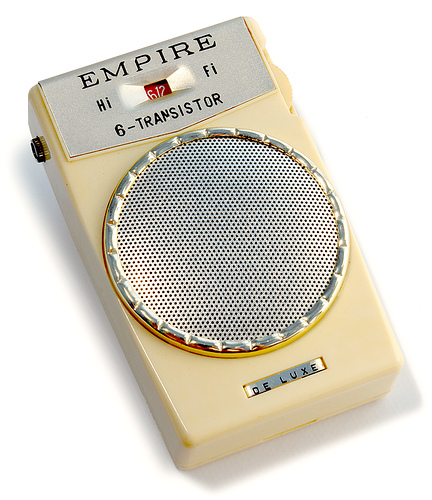
Thought back in the early 60's I might have a career in
Transistor Radio Sales... That all changed when I was
Reassigned new territory......JAPAN [Eek!]
 
Posted by Scott Norwood (Member # 30) on 08-18-2014, 07:44 AM:
 
That station that edits songs for brevity needs to die a quick death. It will probably become a huge hit, however....

As for this noncommercial station--

quote: David Buckley
When it's not got a DJ at the helm, its a random player
I actually have no issue with automation like this in the context of volunteer-run stations whose only alternative would be to sign off when no humans are available to run the station.

But for commercial stations with music formats, I think that there is something to be said for having live people in the studio who know about whatever music genre is being played to tell the listeners a bit about what they are hearing, to take requests, and to provide occasional news and weather updates.
 
Posted by Mike Blakesley (Member # 26) on 08-18-2014, 11:31 AM:
 
Random players are bad too....you get too many ridiculous song pairings.
 
Posted by Steve Kraus (Member # 476) on 08-18-2014, 01:28 PM:
 
Is it really random or weighted in some way such as by quality or popularity? I've forgotten most of what I learned in Stats but over 40K plays plucked from 30K tracks, 12 or 7 plays of anything does not seem random.
 
Posted by Sam Graham (Member # 2889) on 08-18-2014, 01:39 PM:
 
There's no real randomness on commercial music radio. There's a computer that spits out a playlist based on a clock breaking up certain types of songs (current hit, recent hit, old hit, etc) that's still manually manipulated by the program director and possibly adjusted a bit on the fly by the live DJ (if there is one).

And there's never really been such a thing as requests in mainstream formats. There's just been phone bits or a request announcement for a song that just happened to be coming up anyway.

On my live shows in my last days of radio, we were using BE's digital broadcast software. You could toggle it between "live" (where you manually started the elements) or "auto" (where it did it for you). The "auto" still had a stop button, so even when I was live I'd leave it in auto and just hit stop if I needed to talk, or I'd just turn on the mic when I wanted to talk up a ramp and I let the software do everything else for me.

Laziest job I ever had.
 
Posted by Mike Blakesley (Member # 26) on 08-18-2014, 02:37 PM:
 
When one of the stations in Billings first went "automated" it was hilarious to listen to, because sometimes the voice would be out of sync with the songs. One time I heard "Now here's a great song by Kiss" and a tune by Foreigner began to play.

Before the same station was automated, you would hear live DJs do gems such is "Now, here's a couple of REALLY BIG ones for ya....Dolly Parton!"

On our local station a DJ once announced "Here's Barbara Mandrell with 'You Can Eat Crackers In My Bed'....but you have to leave the zucchini in the fridge!"

After all these years, why I remember these two things is a mystery to me.
 
Posted by David Buckley (Member # 2600) on 08-18-2014, 06:49 PM:
 
quote: Steve Kraus
Is it really random or weighted in some way such as by quality or popularity?
I didn't know, so I asked.

When a DJ is in command, they get to play what they like, so they tend to play some tracks preferentially. When the Robot is playing, it is given free run of the collection, which is organised a series of directories, each of which contains tracks, and the robot works it's way through the collection of directories, so it plays the "first" track from every directory, then the second from every directory etc.

There are a significant number of duplicate tracks amongst the collection, because a good chunk of it is made up of compilation CDs. So there are a number of copies of the track "Hot Chocolate - You Sexy Thing" so it gets played relatively a lot.
 
Posted by Mike Blakesley (Member # 26) on 08-18-2014, 07:11 PM:
 
I would love to know how Sirius/XM Radio playlists work.

When XM first came on the air I would listen to the 70s channel for months at a time at work, because you truly never knew what you would hear. They'd play big hits, obscure tracks, album cuts, you name it.

Then when Sirius bought XM out, they tightened the screws on all the playlists. Now, if I listen to any one channel for more than a few days at a time, it gets irritating since they play the same 3 or 4 songs by an artist and totally ignore the "deep" cuts. And on the "Deep Tracks" channels, it's the same, except they play the same "deep" tracks over and over (and also mix in a few hits, which you're already tired of from listening to the hits channels).

Then they'll take a channel like Classic Vinyl and dedicate it to some specific artist for a period of time (currently, Tom Petty) which I'm sure is basically a gambit to make you switch channels and try out some other bits of the service. I mean, Tom Petty is great, but after about an hour it's more than even a fan may want to hear, you know?

They appear to have deleted about half or more of their music when the buyout happened.
 
Posted by Steve Matz (Member # 1890) on 08-18-2014, 10:35 PM:
 
quote: Mike Blakesley
On our local station a DJ once announced "Here's Barbara Mandrell with 'You Can Eat Crackers In My Bed'....but you have to leave the zucchini in the fridge!"

After all these years, why I remember these two things is a mystery to me.

Mike;You didn't happen to be one of the Guys from back in the 70's who use to come to the BABCOCK with the Long Trenchcoats with the Pockets cut out of them [Eek!] [thumbsup]


Powered by Infopop Corporation
UBB.classicTM 6.3.1.2