This is topic Another digital disaster in forum Film-Yak at Film-Tech Forum ARCHIVE.
To visit this topic, use this URL:
https://ft-forum.com/ft/cgi-bin/ubb/ultimatebb.cgi?ubb=get_topic;f=8;t=006746
Posted by Martin McCaffery (Member # 37) on 09-30-2012, 07:55 PM:
http://popdose.com/no-concessions-digital-disaster-at-the-new-york-film-festival
quote:
No Concessions: Digital Disaster at the New York Film Festival
BOB CASHILL SEPTEMBER 30, 2012
The New York Film Festival, which got underway last Friday, celebrates its 50th anniversary this year. I’ve attended every year since 1994. I’ve seen dozens of movies there–some extraordinary, many good, some run-of-the-mill, a few terrible. I wondered where Brian De Palma’s Passion, screened on Saturday, would fit in.
I’m still wondering. In what was for me an unprecedented event in my decades of festivalgoing, the screening was cancelled. Why? Three words: Digital Cinema Package, or DCP.
What is DCP? It’s heralded as the future of cinema projection, but really it’s the present; chances are your local multiplex has gone DCP, as your local independently owned theater or repertory house struggles to find a way to pay for it as celluloid goes up in smoke. The brave new world of digital projection comes with pitfalls, however. Like, if the system malfunctions, and no one can get a grip on what went wrong, you’re fucked like the fucking Diaz brothers, as the Film Society of Lincoln Center learned the hard way last night.
If you follow the festival at all you’ve been reading a lot about how Richard Pena, its programming director, is bowing out after 25 years of distinguished service. “I bet he wishes he retired last year,” grumbled a fellow patron as we all exited Alice Tully Hall after more than an hour of waiting. It had been a trying day: apparently a DCP of a Mexican film shown in the afternoon, Here and There, was plagued by intermittent subtitles that were here and there for half an hour until the problem was fixed. That was nothing compared to this utter fiasco, however. Has a festival presentation ever been cancelled due to a mechanical glitch? Not in the film cans days that I can recall.
Poor Pena–he’s a good guy (I interviewed him for Newsweek.com in 2001) and there he was, having to face not only a disappointed crowd but Brian De Palma, who’s not exactly Mary Sunshine. (I interviewed him for Cineaste about his last film, Redacted, which played without incident at the festival in 2007.) From my balcony seat I could see the filmmaker growing progressively more baleful, and when he was escorted from his box I knew we would not be seeing his movie. It can’t have been pretty backstage: “See this? I left my trademark safari jacket at home and put on a suit and tie for this thing! I was goddamned cheerful in my opening remarks, too!”
Whatever the case, it was a humiliation. Pena, who had to keep coming onstage to deliver the worsening news, said that the DCP has been tested without incident minutes before showtime, but minus a code had somehow locked down. Minus someone who could fix the code that was it for the evening. That’s not the movies we knew and loved; that’s a plot contrivance on an episode of 24. Maybe they should rename Digital Cinema Package HAL, in honor of 2001‘s errant computer.
After a half hour or so of waiting Pena announced that audience members who couldn’t stay could get refunds at the boxoffice. Only 10-15% seemed to. Which was touching; we wanted to see the movie and were willing to put up with the inconvenience. (I watched the French-made Love Crime, the basis of Passion, the other night and wanted to know, like, what was up with the masks? And the chokehold?) But it was out of Pena’s hands, or De Palma’s hands, or any human hands. It was a glitch in the machine, a hiccup in the software. And with that the 50th anniversary of the New York Film Festival was tainted.
Watch this space for actual festival reviews, if technology doesn’t bungle further screenings. Too bad they can’t project film at a film festival anymore.
Print PDF
Share this:
Posted by Mike Blakesley (Member # 26) on 09-30-2012, 08:16 PM:
With almost 40,000 screens in the U.S., and over 30,000 of them digital, there's NO WAY every single one of them is going to project a perfect performance every single showing. It doesn't matter if they're in a film festival or not, or projecting film or not.
I guess there's going to be a major news article every time
there's a digital breakdown. Oh well, it beats more political "news."
Posted by Randy Stankey (Member # 64) on 09-30-2012, 09:29 PM:
Aren't film festivals and film societies supposed to have professionals on staff for just this reason?
Isn't the Film Society of Lincoln Center supposed to be one of the biggies?
One of those big guys took such a hit for lack of getting a working key for the movie?
While it certainly is fun to laugh at digital video when it doesn't work, I think the main lesson to be learned here is that, after all the hype about "perfect digital movies" that we've heard about so long, the shine is starting to wear off and people are starting to see it for what it is: Technology that is vulnerable to malfunction just as anything is.
People have been lulled into a sense of complacency and think that digital movies happen as if by magic.
The lesson to be learned is that, if Lincoln Center can get caught flat footed, anybody can.
Posted by Manny Knowles (Member # 1171) on 09-30-2012, 09:35 PM:
I think the writer blows this out of proportion.
By way of comparison, film's early days were far more disastrous. (Nitrate)
And film still has occasional failures.
With it being such a high-profile event, with the filmmaker being present, I'm surprised there weren't backup measures in place. Why was a KDM required for this? Did nobody check the expiration date of the KDM?
Posted by Scott Norwood (Member # 30) on 10-01-2012, 07:50 AM:
We actually got a defective key for something that played in the Boston "Film" Festival this year (the second festival where I have worked where there was no actual film in the entire festival). For some reason, we got two different keys, one of which looked good, but did not work, and the other of which worked fine.
Part of the problem is that the keys for this type of screening are produced to be good for a very short time window--not much more than the screening itself. That makes it difficult to verify if the key is good. The fact that I was unfamiliar with key management in general and the Doremi server UI specifically did not help matters, either.
I am not overly concerned about this sort of issue, and expect that it will work itself out over time, as everyone becomes more familiar with the system and as distributors realize the importance of providing valid keys with reasonable time limits.
(What's with the swapping of the order of the film forum and the TV forum in the forum list?)
Posted by Carsten Kurz (Member # 5396) on 10-01-2012, 09:38 AM:
Maybe it's my lack of native language, but DO we actually know what exactly was the problem there? Was it actually an expired key between the test and the presentation?
If it was, then the question would be - did they check the expiration date beforehand? Or was some show schedule shifted and this was overseen?
Depending on time of day and issuer, in many cases it is possible to receive a key by email in very little time.
- Carsten
Posted by Edward Havens (Member # 4715) on 10-01-2012, 09:48 AM:
Overblown hyperbole from someone with an axe to grind.
A disaster is when a tsunami kills 230,000 people.
A movie that can't be projected because of a technical glitch is a minor inconvenience.
Posted by Mike Blakesley (Member # 26) on 10-01-2012, 11:40 AM:
Well you do have to consider the source. Any piece of news that contains this type of writing:
quote:
you’re fucked like the fucking Diaz brothers
can't exactly be taken seriously.
Posted by Martin McCaffery (Member # 37) on 10-01-2012, 01:34 PM:
Hey, it's show-biz. Hyperbole is the native language ![[Wink]](wink.gif)
Posted by Graham Ritchie (Member # 5226) on 10-01-2012, 01:46 PM:
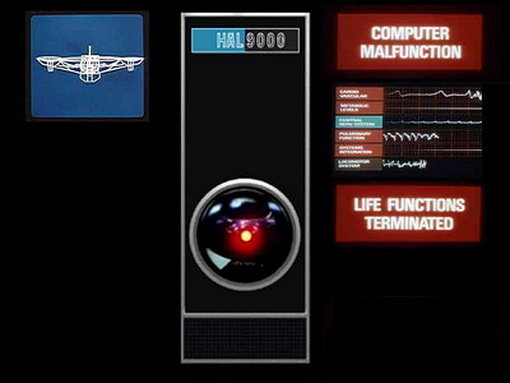
Good morning gentleman...I am a "HAL 9000" computer..........
If you'd like to hear it, I can sing for you.
Daisy Daisy, give me your answer do. I'm half crazy all for the love of you. I can't afford a carriage. But you'll look sweet upon the seat of a bicycle built for two.
Wait..Someone is coming....I'm afraid I'm afraid my mind is going I can feel it zzzzzzzzzzzzzzzzzz ![[Big Grin]](biggrin.gif)
Posted by Bobby Henderson (Member # 840) on 10-01-2012, 02:11 PM:
This article would be fairly judged as so-called overblown hyperbole if not for the fact "digital cinema" has been hyped for years as being perfect. If the proponents of this stuff are going to sell it as being perfect the average movie goer is going to expect it to be perfect. They're going to feel that way since that is how the technology has been sold to them.
The other problem is there should be no such thing as a PREVENTABLE technical gaffe of this magnitude taking place at such a high profile event as the New York Film Festival. Even I wouldn't care much at all if a digital video show failed to play at either one of the first run theaters here in little old Lawton-Fort Sill, Oklahoma. There's no excuse for that kind of thing to be happening at the friggin' New York Film Festival, especially when the movie's director is sitting in the audience. This is just as bad as a restaurant serving a major company executive or head of state a steak dinner with a cockroach sitting in the middle of it.
Maybe the writer is incorrect in blaming it all on the technology itself. Nevertheless it exposes problems many of us have known about it for years. The biggest problem is various decision makers placing far too much trust in the technology to work 100% perfect all of the time. These security keys with ridiculously short validity times is a clear symptom of that misplaced trust. They need to be going the other direction and "Murphy proof" the situation so something like a high profile show at the New York Film Festival won't be 100% hosed by a very simple problem.
Posted by Tony Bandiera Jr (Member # 2365) on 10-01-2012, 07:00 PM:
I'm gonna disappoint my "fans" who were hoping I'd go on another D-Crapma rant here and say that it was not, in this case, the format's (DCP) fault....Bobby said it best here:
quote: Mr. Trajan
The biggest problem is various decision makers placing far too much trust in the technology to work 100% perfect all of the time. These security keys with ridiculously short validity times is a clear symptom of that misplaced trust.
Which is what it sounds like from here. Remember in the not-so-distant past when film cans came with padlocks on them? And many folks had to resort to cutting locks off or cancelling shows because the dumbasses at the studios didn't release the combination on time..or to the right person?
And even if you got the combos in time, I have heard of, and personally had, situations where the print was fucked up (wrong title, duplicate reels, etc.) which you didn't find until the powers that be decided it was ok for you to look at the film.
The other key point Bobby made, and the crux of my (former) D-Cinema hate, was the simple fact that everyone involved was forcing this down our throats as the "PERFECT SHOW EVERY TIME" medium. This, while the technology was (is) not perfected yet.
This and many other incidents has shown we have a long way to go on this...and I doubt it will ever be financially possible to get a perfect system with enough redundancy to totally eliminate lost shows.
It might be possible to get things to the reliability of a properly maintained film system with a competent projectionist..but we are a long way from that now.
Posted by Mike Blakesley (Member # 26) on 10-01-2012, 07:26 PM:
quote: Tony Bandiera Jr
not perfected yet
Whadaya mean "yet?" It'll NEVER be perfected. Techno-companies don't EVER perfect anything before they race on to the next thing. Even my oh-so-wonderful iPhone 4S has had to be rebooted several times since I've had it because it just....stopped working.
That's the problem with techno-stuff. It just doesn't work too much of the time. I liked the days when you could see, hear, or smell the problem and then fix it. With digital gear, you can't see anything and if you hear or smell something, you're probably just going to be buying a new whatever-it-is.
Posted by Martin McCaffery (Member # 37) on 10-01-2012, 07:56 PM:
quote: Tony Bandiera Jr
It might be possible to get things to the reliability of a properly maintained film system with a competent projectionist..but we are a long way from that now.
As Chapin Cutler at Boston Light & Sound likes to say "Digital is where film was in 1903."
Posted by Randy Stankey (Member # 64) on 10-01-2012, 11:17 PM:
Why can't they use dual factor encryption/passwords like is used on banking websites or secure VPNs?
You have to put in your username and password then through one means or another, such as a secure dongle or your cell phone, you receive a second password which is (supposedly) known only to you and the system. You must have both passwords to access. After the dual factor encryption expires (an hour, a day, a week, etc.) you have to get a new one.
As an example, for a digital movie system, you might get the regular KDM which authorizes you, as a theater, to play that movie. Then, you call, e-mail or use a dongle to receive the second part of the password which will authorize you to play that movie for a certain period of time.
Receive the KDM via the usual channels and upload it with your USB stick, just like you do now. Then, you have to type in an 8 character code using the keypad on the machine or server to activate the movie for a playdate or series of playdates.
In the above case, let's suppose the movie director or the technical director of the film festival had a dongle.
The theater already uploaded their KDM which authorizes them to play the movie. The director or TD pushes a button on his dongle and enters "p455w0rd" on the keypad. The movie is good to go.
For daily operation in theaters, there could be a 24/7 hotline (like Technicolor) where you can call to get your second key.
I don't know if this would really work in real life but, in theory, the "malfunction" at that festival would have been prevented by such a system.
Posted by Edward Havens (Member # 4715) on 10-02-2012, 04:46 AM:
It's a matter of trust.
Disney always sends out titles and KDMs of their new movies days before opening, and rewards the dedicated projectionist who QCs those titles in advance. Sony regularly issues KDMs for sixteen weeks, when 90% of films are out of theatres after just six weeks.
Other studios have their KDMs unlock only a few hours before the start of the first show, or have their KDMs lock up at 11:59pm on the final day of the playdate. (Thankfully, KDMs that lock in the middle of a show do not interrupt that show.)
It does sound like the KDM for the DePalma movie locked up before the screening began. Maybe the show started half an hour late, and the KDM issued locked up 10-15mins after the show was supposed to start. I don't know. I doubt the writer of this article understood what they were writing about. Or at least that was I can tell from his insipid response to my comment. If it was the KDM locking up before the show started, and the show was delayed for any number of reasons, there will be some good that comes out of this. If this was the case, KDM issuers will make sure in the future to issue keys that don't lock up so dang quickly.
Posted by Mike Blakesley (Member # 26) on 10-02-2012, 10:27 AM:
I don't think "trust" has much to do with it. It's probably just the bean counting suits who have nothing better to do and are paranoid about "piracy" but have never been inside of a projection booth who make these decisions about the KDM's.
Posted by Bobby Henderson (Member # 840) on 10-02-2012, 12:17 PM:
Some of this comes down to old fashioned customer service.
An average film fan in the audience doesn't really have any obligation to know the various specific technical reasons of why a high profile film festival screening got canceled. He has a right to be pissed off about it. You can refund the customer's ticket, but you can't refund his time and planning spent to watch the movie that evening. In the end the customer is still liable to be pretty annoyed.
Likewise, an irritated customer will have many ways to sound off about a bad experience (forums, blogs, social media, etc.). Inaccurate statements posted online or spread via word of mouth about the experience are one of the very real consequences any business, not just movie theaters, can expect from delivering bad customer service. Others will embellish the story further if they feel like spreading it around to even more people.
This fact of life is all the more reason for various movie studios to do more to make "digital" more reliable.
If anything, the explanation of a prematurely expired KDM as the cause of a show failure would likely make me even more angry than getting no explanation at all. The KDM thing is a very simple problem, one that was caused by some particular person who either doesn't know or doesn't care about the "what if" possibilities that could ruin a show. The KDM thing is a pretty simple problem to solve, if certain decision makers will allow it to be solved.
I think I could be slightly more understanding with a film-based show failure. Things like brain wraps and other malfunctions can happen (although they're less likely to happen in a well maintained and operated booth). It may be something that's out of the projectionist's control. Even still, a film-based show can recover from a failure like that even though it can cause some considerable delay. A badly scheduled KDM? That's just simple human ignorance coming from up on high. There's no excuse for that. It's just too bad the person at the projectionist level is the one getting his ass chewed by audience members and the movie's director. The executive deciding how the KDMs are getting written is the one who really needs the ass chewing.
Posted by Mike Blakesley (Member # 26) on 10-02-2012, 02:13 PM:
Yeah, that's what I just said.
Posted by Brad Miller (Member # 2) on 10-02-2012, 02:19 PM:
Bobby, let me chime in here for a minute. Not all server interfaces are created equal. Some of them aren't quite as easy to look through to check KDMs as they should be.
Dolby is the one server that really got this right. You can look at the build page, content page or license page to get the info you need and it is a no-bs display.
For example from the content page "properties":
Sep 20, 2012 12:01AM - Oct 19, 2012 3:59AM
From the build page:
MOVIE-TITLE-HERE "ok"
From the licenses page:
MOVIE-TITLE-HERE / valid from 9/20/12 12:01AM / valid until 10/19/12 3:59AM / status "ok"
As if that wasn't enough, assuming you are using a schedule just look at the schedule page. If it is grey and has an unlocked padlock, you're set. If it is gold with a locked padlock, it won't run.
Even the playlist itself will show in red with a padlock if the key isn't valid.
They also have the little blinking yellow warning icon in the upper corner of their GUI when you are on the last 24 hours of a key. My only beef with this is to this day they still have not fixed the tremendously retarded fact that it blinks even if there is already a key loaded to pick up the kdm one minute after the current one expires.
Anyway, some of the server GUIs are not very "friendly" for things like checking KDMs, although all do offer a means to find out if you are willing to click the mouse enough times and navigate cramped screen resolutions.
Posted by Edward Havens (Member # 4715) on 10-03-2012, 12:07 PM:
One can also look at the key, which is an XML file, in a browser and see for oneself when said key opens and closes.
Posted by Bobby Henderson (Member # 840) on 10-03-2012, 01:50 PM:
Here's something that's even easier:
The folks making the KDM for the high profile show could double check the calendar and then author a KDM that's actually going to work during the scheduled show time, and for safety sake maybe put at least a few hours on the front and back end of the thing so it's guaranteed to work in case the screening is delayed or something.
![[Razz]](tongue.gif)
Obviously various people at different parts of the distribution and exhibition level took it for granted the show was just going to work and were then caught by surprise when it didn't. Pretty bad chance to take when the risk was getting burned with none other than the movie's director present in the audience. With film, projectionists needed to check for things like frame splices made in the wrong place. With digital, thing like the KDM are going to have to be checked in advance if possible.
Posted by Martin McCaffery (Member # 37) on 10-03-2012, 02:12 PM:
Just curious. Is everywhere along the DCP production chain as heavily secured as the theatre? Is there some security operation that prevents the lab from running off unkeyed versions of the DCP for their own profit and amusement? Or is Hollywood still convinced that all of their bootlegging troubles start at the theatre?
Posted by Michael Goucher (Member # 199) on 02-06-2013, 11:03 AM:
As I understand it the key had a 10 to 15 minute window to start the show, insufficient in the film festival environment. An introducer stepped into the spotlight, made his comments and introduced Brian DePalma who nodded and accepted applause and then the lights dimmed, the floor microphone was removed and the stage manager gave the cue to start and nothing happened. The time for the key to activate had passed.
Typically, to accommodate most if not all festival eventualities, a 1/2-hour window to start the program would be necessarily normal. However the folks who make and deliver the keys are so thoroughly brainwashed about their role in protecting the content they minimize the start time window, especially at film festivals, although there is little reason to believe that festivals provide greater opportunity for content theft.
In truth, screenings presented as part of a film's marketing run-up DO provide such opportunities, but who is going to stop the marketing departments? No One!
Posted by Manny Knowles (Member # 1171) on 02-06-2013, 03:27 PM:
Maybe I misread/misunderstood this last post but...
I've never heard of a "start time window" in connection with KDM's. Starting 15 minutes after the key unlocked would not be an issue. You don't have to start as soon as the key unlocks. I've received KDM's that unlocked days ahead of the scheduled run.
As I understand the rules:
You cannot start before the key unlocks.
You cannot start after the key expires.
But -- or, "Butt!!!" as Phil Hill would say -- I do have a question:
Does anyone know what happens if you start while the key is active, but then it expires DURING playback? Do any of the players take the running time into consideration? Would they allow you to start a show if there is insufficient time to play it all the way through? (Hmm. Must remember to try this...)
Posted by David Zylstra (Member # 4230) on 02-06-2013, 03:44 PM:
A KDM is only required to start the content, once started the show is supposed to continue through to the end regardless of KDM expiry time.
DCI says that "To avoid end of engagement issues, a show time's playout may extend beyond the end of the KDM's playout time window, if started within the KDM playout time window, by a maximum of six(6) hours."
Posted by Scott Norwood (Member # 30) on 02-06-2013, 03:48 PM:
It's still kind of risky, though, to have a key that is only valid for the show's scheduled start time and not through the expected running time of the show. What if there is a power outage? What if the show is delayed due to seating issues and/or an overly long introduction (as apparently happened here)?
Posted by Manny Knowles (Member # 1171) on 02-06-2013, 03:57 PM:
David beat me to it -- The text he quotes can be found in DCI Spec (1.2) under Section 9.4.3.5 "Functions of the Security Manager" Paragraph 2.c.
And, to that I will add, Paragraph 2.b. states:
"For any given composition, playout shall be enabled for any start time that is within the KDM's time window."
Emphasis is mine.
WAIT A SEC -- are y'all saying that the entire window was only 15 minutes?? ![[Eek!]](eek.gif)
I have to question whether this is actually the case because the sneak previews I have done (with or without filmmaker present) typically unlock the morning of the show or, at the latest, about an hour before show time and they've all lock up some time after the scheduled end time. The most paranoid KDM's lock up about 30 minutes after the scheduled end, other expire later that night at 11:59pm.
Posted by Louis Bornwasser (Member # 3063) on 02-06-2013, 04:02 PM:
A former customer of mine, who has converted to digital said today. "With film we had problems that we could deal with ourselves. With digital we still have problems. Only difference is that most of the digital problems we are powerless to solve ourselves."
Posted by Manny Knowles (Member # 1171) on 02-06-2013, 04:03 PM:
There's some truth in that.
And it reminds me of an old joke: "To err is human, but to REALLY fuck it up, you need a computer!"
Posted by Leo Enticknap (Member # 534) on 02-06-2013, 04:50 PM:
Exactly. I remember several fuckups from my days in the booth, but most of the time they degraded the show rather than stopped it from happening totally and utterly. One of the Jurassic Park movies (this would have been 1995 or 6, so I think it was the second) sticks in my mind - on the second day a drive in the DTS player died, and we discovered the hard way that the analogue track on reel 4 of the print was of the German dub. Inflicting 20 minutes of badly dubbed dinosaur growls in German wasn't ideal, but the bottom line was having to give out a few comps and free ice creams, not several hundred refunds.
All of these DCP no-show horror stories such as the one reported in this thread seem to be caused by KDM issues, and you'd have thought by now that distributors would have relaxed the time windows on them and generally started trusting exhibitors more in an attempt to deal with the problem.
Posted by Jock Blakley (Member # 6552) on 02-06-2013, 06:08 PM:
quote: Martin McCaffery
Just curious. Is everywhere along the DCP production chain as heavily secured as the theatre? Is there some security operation that prevents the lab from running off unkeyed versions of the DCP for their own profit and amusement? Or is Hollywood still convinced that all of their bootlegging troubles start at the theatre?
It would depend upon the data and staff security arrangements at each individual mastering facility, but there's nothing inherent to the D-Cinema mastering process that prevents the post house or lab from taking liberties with the content.
I'm not sure whether unencrypted versions of the DCP would be the likely outcome, though. To make the DCP the lab has obviously got to have some form of Digital Source Master, which usually takes the form of a DPX or TIFF sequence at full resolution and full colour depth, along with the LPCM Wave soundtrack.
The sheer size of the DSM is an inherent defence, granted, but again that comes down to whether the facility's security procedures allow staff to freely carry 4 TB drives in and out all day.
Posted by Dennis Benjamin (Member # 1137) on 02-07-2013, 08:17 AM:
quote: Louis Bornwasser
A former customer of mine, who has converted to digital said today. "With film we had problems that we could deal with ourselves. With digital we still have problems. Only difference is that most of the digital problems we are powerless to solve ourselves."
I think the above quote is the number one thing that most theatre owners are not prepared for. It's quite the learning curve for most people out there.
Manny: I dealt with a key issue recently that had the key expiring at the start time of the feature. We called Deluxe, they recommended the theatre start the movie one minute early. I told the theatre owner to ask for a newly generated key. During the process of dealing with this I realized that Technicolor and Deluxe are handling their key generation completely different. Some keys are generated off of GMT, some aren't. In the case of the key I was just talking about, the key was expiring 5 hours off what it stated it was good until. But when I went into the .XML code of other keys, they didn't have the +/- 5 hours. Zero consistency.
Posted by Manny Knowles (Member # 1171) on 02-07-2013, 08:46 PM:
That's unfortunate. ![[Frown]](frown.gif)
Was that a one-time snag, or is that sort of thing an everyday occurrence for you?
Was it a sneak preview, or did you only have one screening?
And are you saying that both Technicolor AND Deluxe are inconsistently using Z-Time? Or is one company using it and the other not using it?
(Sorry for all the questions -- I just want to understand the situation more clearly.)
Personally, I have only encountered a few instances where KDM's arrived with errors and needed some form of correction or revision -- maybe two cases. Maybe I'm lucky, but that doesn't stop me from having what I like to call "a healthy level of paranoia." So, as a precautionary measure, to aid in "catching" this kind of problem ahead of time, part of the info that I fill-in on my inspection report is:
Date KDM rec'd
KDM Start
KDM Expire
That's a "dummy check" for myself -- it reminds me to cross check the KDM with the play dates.
Another good reason to record that info is...it could help explain why a film couldn't be thoroughly QC'ed before show time.
^^ Is that "healthy" paranoia? You be the judge...
Posted by Mike Blakesley (Member # 26) on 02-08-2013, 12:20 AM:
For what it's worth we've never had a problem with a KDM since going digital in June 2010. I'm quite surprised to hear that so many others seem to have troubles.
Posted by Rick Raskin (Member # 1561) on 02-08-2013, 06:40 AM:
I've been watching this thread with great interest and I feel that things like Manny's "healthy paranoia" are a direct result of the excessive paranoia exhibited by the distributors.
There are plenty of opportunities for someone willing to expend the effort to pirate a copy of a film.
The content providers need to re-examine their position on security and consider issuing KDMs that are good for a theater's entire run of a film and not locked so close to the first show. Of course, coding the KDM for a day or two prior to the run should be standard practice to allow for the necessary QC checks.
Better yet, don't even bother to encrypt the content.
Posted by Louis Bornwasser (Member # 3063) on 02-08-2013, 06:50 AM:
In the time since digital started more world premieres have been lost (for various reasons) than in the entire film era. Most notably, Disney had problems with no-shows technically in Hollywood at their premiere house.
This is not to say that we didn't have problems with film premieres too, but they were resolved or made acceptable enough; in other words, they did run.
Again, analog lends itself to repair more easily than encoded digital, where an outside agency is required. Louis
Powered by Infopop Corporation
UBB.classicTM
6.3.1.2