This is topic The First Commercial Digital Presentations in forum Film-Yak at Film-Tech Forum ARCHIVE.
To visit this topic, use this URL:
https://ft-forum.com/ft/cgi-bin/ubb/ultimatebb.cgi?ubb=get_topic;f=8;t=006857
Posted by Martin McCaffery (Member # 37) on 06-04-2013, 08:45 PM:
Learning from the murky origins of film exhibition, I thought I'd start a string on the history of digital and see if we can codify what is fairly recent history:
First "digital" film to get a commercial release (defining digital is key here).
First digitally captured film
First all digital presentation
First DCP
Obviously lots of formats starting with video and overlapping. Want to target commercial first run application.
Have at it.
Posted by Aaron Garman (Member # 1653) on 06-04-2013, 09:55 PM:
Toy Story was the first feature entirely digitally animated, if that counts for anything.
Wasn't Episode II the first feature produced entirely digitally, albeit only HD and not true 2K?
O Brother Where Art Thou was the first to use a Digital Intermediate for a feature.
AJG
Posted by Scott Norwood (Member # 30) on 06-04-2013, 10:11 PM:
The first public DLP exhibition of a first-run motion picture is likely Star Wars Episode I in several locations. Some of these exhibitions also used the Hughes/JVC system, which I believe was the basis for today's LCoS chips (like the Sony D-cinema projectors). The same week, An Ideal Husband played with some sort of electronic (not necessarily digital...I don't remember the details) projection system in NYC and possibly LA. This was in 1999.
There were experiments with videotape to film in the 1970s that got theatrical releases, but those were obviously using analog video formats, not digital.
DCP is a moving target, so I'm not sure that "first DCP" really means anything.
Posted by Leo Enticknap (Member # 534) on 06-05-2013, 05:36 AM:
quote: Aaron Garman
O Brother Where Art Thou was the first to use a Digital Intermediate for a feature.
I seem to remember reading somewhere that Pleasantville was the first feature to have an entirely DI post-production workflow, but that this was experimental and necessitated by the subject mattter (frequent dissolves from b/w to colour and so on); but that O Brother... was the first entirely DI p/p feature that did not involve the extensive use of special effects; i.e. by that point it was more cost-effective to grade the footage digitally than photochemically.
Terminator 2 and Jurassic Park (both 1992) are often cited as the first Hollywood features to make significant use of CGI.
The 1993 restoration of Snow White and the Seven Dwarfs, using the Kodak Cineon system, is claimed by a number of sources to be the first digital film restoration project (e.g. Bob Fisher, 'The Digital Restoration of Snow White', American Cinematographer, 74/9 (September 1993), pp. 48-54.
Posted by Mark Ogden (Member # 43) on 06-05-2013, 07:17 AM:
The first 100% digitally shot film to get any kind of a legitimate wide distribution that I am aware of is Mike White's Chuck and Buck, released in July of 2000. It was shot, as I recall, on the Sony MiniDV format, which was their digital follow up to Hi-8. The film was standard definition.
The first film to be photographed in 24p high defination on a purpose-built camera for digital HD cinematography was Brad Anderson's horror film Session Nine, released in July of 2001.
If you remove "digital" from the qualifications, you can find examples going back as far as 1964, when both Richard Burton's Hamlet and The T.A.M.I. Show were shot on the "Electron-o-vision" system. This involved RCA image-orthicon cameras that had their power supplies and deflection boards modified to produce what has been variously said to be between 850 to 1200 TVL of resolution. The T.A.M.I. Show is available on a beautifully mastered DVD and is a hoot to watch, especially if you are in to early rock 'n roll.
Posted by Martin McCaffery (Member # 37) on 06-05-2013, 09:32 AM:
I'd totally forgotten about the T.A.M.I Show, even though it was big in rep houses when I was in HS.
Steppenwolf in 1974 (based on the book, not the band) was touted at the time to be the first feature to make extensive use of video. IMDB says it was a mix of video and 35mm.
I remember commenting here about Chuck and Buck after we showed it. I defended it's use of a different color palette than film. It sure didn't look like film.
1998's The Celebration from the fun folks at Dogme 95 was shot with a Sony PC-7E Camera but apparently has a PAL video negative.
Posted by Scott Norwood (Member # 30) on 06-05-2013, 09:56 AM:
Another popular title that was shot on video in the '90s was the Hoop Dreams documentary. I believe that it was shot on analog Beta SP video and transferred to film at Image Transform using a CRT-based film recorder, likely with nothing digital (except for a TBC) in the chian.
Posted by Richard Fowler (Member # 893) on 06-05-2013, 10:04 AM:
"Norman is that You" with Red Foxx and Pearl Bailey produced by MGM in 1976 used a multi-cam setup with a custom semi-HD system matted to 1:85. The 35mm print I saw held up well on a 80 foot drive-in screen. The frame line had running time code so framing had to be accurate...looked like film (no scan lines) with only a rare "give away" of highlight smearing.
Posted by Richard Fowler (Member # 893) on 06-05-2013, 10:05 AM:
"Norman is that You" with Red Foxx and Pearl Bailey produced by MGM in 1976 used a multi-cam setup with a custom semi-HD system matted to 1:85. The 35mm print I saw held up well on a 80 foot drive-in screen. The frame line had running time code so framing had to be accurate...looked like film (no scan lines) with only a rare"give away" of highlight smearing.
Posted by Steve Guttag (Member # 268) on 06-05-2013, 10:49 AM:
Way back in the 2002/2003 era (I know, a whole 10-years)...one of our clients (Ritz at the Bourse in Philadelphia) used one of the early digital formats that was a competitor to the whole DCP thing...it worked off of Windows Media Player (no I'm not kidding) and featured an A/V grade DLP projector. I distinctly remember them showing "Standing in the Shadows of Motown" with the set up (a really good documentary, by the way). It actually looks surprisingly good...it was a 1280x1024 machine but zoomed out for the 1.85 ratio...so it was essentially a 720p picture. Since the movie was shot on 16mm (and some 35mm)...it didn't look too bad.
We did MANY studio screenings where an SXGA projector was brought in and D5 VTRs were set up in lieu of 35mm...those I never got...renting this stuff, flying it all over the country was not cheap...there was normally multiple technicans to splice all of this gear in, possibly move/return the film projector...etc...all for one show. Christ, strike a print! I distinctly remember doing the first Bourne Identity this way.
Posted by Mitchell Dvoskin (Member # 751) on 06-05-2013, 11:41 AM:
quote: Richard Fowler
"Norman is that You" with Red Foxx and Pearl Bailey produced by MGM in 1976 used a multi-cam setup with a custom semi-HD system matted to 1:85.
Wow, I remember that. I was the manager/projectionist for the long gone Town & Country Drive-in in Coalton Ohio in 1976/77, and I still remember those counter numbers in the frame lines. Did not care for the film, but it did not look any worse than a lot of the other crap we ran at the time.
Posted by Shawn M. Martin (Member # 6762) on 06-05-2013, 03:01 PM:
quote: Mark Ogden
The first film to be photographed in 24p high defination on a purpose-built camera for digital HD cinematography was Brad Anderson's horror film Session Nine, released in July of 2001.
I'm pretty sure that Jackpot, by the Polish brothers, was shot about a month before Session 9, on the same camera (Sony F900). It was also released about a week before Session 9, and was in fact the first 24p film to be released on 35mm.
Posted by Mark Ogden (Member # 43) on 06-05-2013, 08:21 PM:
Never even heard of Jackpot before just now, but when you're right, you're right. According to IMDB, it beat Session Nine into theaters by two weeks. Huh!
Posted by Bobby Henderson (Member # 840) on 06-05-2013, 10:08 PM:
quote: Leo Enticknap
Terminator 2 and Jurassic Park (both 1992) are often cited as the first Hollywood features to make significant use of CGI.
Several movies pre-date that work.
Tron was the first to use computer graphics in a feature film (although the rendered graphics were incorporated into the movie in a very "analog" way). The Last Starfighter, Return of the Jedi and Star Trek II: The Wrath of Khan featured some ground-breaking computer graphics-based sequences -like the "Genesis Probe" animation in the 30+ year old Star Trek movie.
Young Sherlock Holmes was the first movie to have a CG-based character worked into live action (a sword wielding knight pops out of a stained glass window).
Willow had a couple ground-breaking CG effects sequences, including the first "morphing" effect.
The Abyss broke more ground with its "pseudo-pod" made of of CG-animated water.
Obviously T2 and Jurassic Park broke more ground -with JP really doing wonders with motion capture technology.
Star Wars: The Phantom Menace is the first movie I can recall to market a digital presentation and have virtual prints as an alternative to 35mm.
I'm pretty sure O' Brother Where Art Thou is the first movie to be post produced entirely from beginning to end using a digital intermediate. Other movies using CG effects prior to that used a mix of traditional analog film processing as well as CG/film scanning techniques.
Some earlier movies with significant CG use could show obvious shifts in color, contrast, grain structure, etc. when the live action traditional color timed plate changed to the CG plate. Look at the scene in Jurassic Park where the T-Rex chases Jeff Goldblum. Goldblum's "Malcolm" character is waving a flare. Right when the T-Rex roars at Malcolm you'll see a big color shift as the live action plate changes to the CG plate. The now-animated T-Rex chases after Malcolm. Had they made JP today the shot would have looked far more seamless.
I have no idea what would be the first 2K JPEG 2000 DCP.
Posted by Mike Heenan (Member # 392) on 06-06-2013, 12:20 PM:
Last Crusade had Walters melting face digitally mixed from film I believe.
Posted by Geoff Newitt (Member # 6663) on 06-06-2013, 01:22 PM:
Bob Hoskins directed, Freddie Francis DoP'd (I hesitate to say photographed), 'Rainbow' for release in 1995.
This is claimed to be the first live action feature originated in HD Video for 35mm distribution and exhibition. They used the Sony HDC-500 camera system, later developed with Panavision into the HDW-F900 used for Star Wars: Ep II, apparently.
It was a rather minor family film - not well received - but I remember showing it. It had a very distinct 'look', quite different to film.
Posted by Steve Guttag (Member # 268) on 06-06-2013, 03:47 PM:
If Video is the criteria...I really think F. F. Coppola's "One from the Heart" is the grand daddy of the modern digital release though it was just video. It had video assist and it was shot video. It was even shown in 1.33 in theatres.
Posted by Carsten Kurz (Member # 5396) on 06-06-2013, 04:36 PM:
http://www.tech-notes.tv/Dig-Cine/Digitalcinema.html
'...
1992 The first public demonstration of digital cinema. Pacific Bell and Sony Pictures Entertainment sent the movie Bugsy from the lot in Culver City to the Anaheim Convention Center where a theater had been setup...100s attended and it recieved more news coverage than any other single event in telephone history.
...
1995 Toy Story is released, the first completely computer-generated feature film.
...
1999 Digital cinema demonstrations to the public begin. On June 19th in four theatres, two on the West coast and two on the East coast. Lucas Films and 20th Century Fox debuted "Star Wars: Episode 1 -- The Phantom Menace" as the first major motion picture theatrically exhibited as digital cinema using a Pluto digital storage system in the D-5 compression format.
The Ideal Husband is shown at Infocomm in digital cinema. This was one of the last demonstartion using the Hughes/JVC ILA projector.
Tarzan, Toy Story 2 and Bicentennial Man are released by Disney in the new digital cinema format using the QuVIS wavelet based compression algorithms.
2000 February, digital cinema demonstrations go international with two theaters equipped in London, England, one Manchester, England, one in Brussels, Belgium, one in Paris, France and one in Tokyo, Japan for all digital showings of Toy Story 2.
March 6th, Christie Systems, Inc. announced today that it has been selected as the first OEM to manufacture digital cinema projectors using Texas Instruments DLP Cinema technology. The agreement will allow Christie to develop the Christie DigiPro series of digital projectors using DLP Cinema projection technology.
Mission to Mars (March), Dinosaur (May) and Fantasia 2000 (June) are released by Disney in the digital cinema format.
June 6th, 20th Century Fox, Qwest, Cisco, Texas Instruments, QuVis, Barco Projection Systems, Eastern Acoustic Works, and Sigma Design Group demonstrate the world's first digital cinema network distribution and exhibition system. The movie was "Titan AE"
...'
+ the very valuable MKPE has a nice history page with interesting details:
http://www.mkpe.com/digital_cinema/history/
- Carsten
Posted by Marcel Birgelen (Member # 6801) on 06-07-2013, 06:28 PM:
quote: Bobby Henderson
Some earlier movies with significant CG use could show obvious shifts in color, contrast, grain structure, etc. when the live action traditional color timed plate changed to the CG plate. Look at the scene in Jurassic Park where the T-Rex chases Jeff Goldblum. Goldblum's "Malcolm" character is waving a flare. Right when the T-Rex roars at Malcolm you'll see a big color shift as the live action plate changes to the CG plate. The now-animated T-Rex chases after Malcolm. Had they made JP today the shot would have looked far more seamless
I might be totally wrong here, but as far as I remember, all of the T-Rex shots in this scene were actually done with almost life-size animatronics and props. There might be a few green/blue screen effects in there. The T-Rex appears as CGI rendering when attacking the Gallimimus herd and in the last scene in the lobby of the visitor center.
Posted by Bobby Henderson (Member # 840) on 06-07-2013, 07:45 PM:
The scene in Jurassic Park where the T-Rex attacks the vehicles is a mix of CG and live action with a huge T-Rex model built on a flight simulator chassis.
The shot of T-Rex biting through the fence cables, stepping out between the vehicles and roaring was CG. The shot of T-Rex grabbing Gennaro off the toilet and eating him was CG. The shot I mentioned earlier where it chased Jeff Goldblum was a mix of live action and CG. The CG part is edited into the shot when the T-Rex roars and starts chasing Jeff Goldblum.
Posted by Michael Coate (Member # 757) on 06-08-2013, 09:57 PM:
quote: Steve Guttag
If Video is the criteria...I really think F. F. Coppola's "One from the Heart" is the grand daddy of the modern digital release though it was just video. It had video assist and it was shot video. It was even shown in 1.33 in theatres.
Video was used as a form of "pre-viz" and for video assist to speed up the post-production process. The final release version of "One From The Heart," however, was shot on 35mm film.
I think many if not most theaters projected "One From The Heart" at 1.85:1 despite the intent of the filmmakers. I think this is why they ultimately did a 70mm blow-up with a pillar-boxed Academy image so that the framing couldn't be fiddled with during presentation.
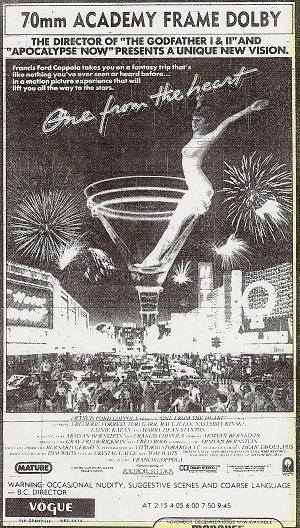
The Vancouver Sun, 11.12.1982
Posted by Bobby Henderson (Member # 840) on 06-10-2013, 10:15 AM:
They did the same thing with Fantasia in 1990. 70mm with thick pillar-box bars to preserve the 1.33:1 ratio. IIRC, the 35mm prints of Fantasia in 1990 were window-boxed to force those theaters applying a 1.85:1 crop to show it in 1.33:1 anyway. Kind of sad to have to idiot-proof a 35mm print like that when it should have been printed and shown full frame.
Incidentally (and sort of getting it back on topic), wasn't Fantasia the first movie shown in theaters with a digital audio track?
Posted by Michael Coate (Member # 757) on 06-10-2013, 12:47 PM:
Yes, I believe "Fantasia" had the first digital-sound presentation for a feature film. Its first such engagement was in early 1985 in Los Angeles at the Century Plaza. It was an interlock presentation. (I believe the first digital sound-on-print presentation was "Dick Tracy" in 1990. ) The Laurie Anderson concert film "Home of the Brave" was another early digital sound title.
I'm told there was a Japanese production shown with digital sound sometime in 1980s, but I've not been able to confirm. ("Akira," perhaps?)
By the way, Carr & Hayes' "Wide Screen Movies" book erroneously claims the Dolby Stereo SR format was digital.
Posted by Manny Knowles (Member # 1171) on 06-10-2013, 07:54 PM:
I wonder if something like "Sky Captain and the World of Tomorrow" would fit into this conversation.
IIRC it was notable for being entirely CGI except for the actors. Exactly how true that claim was, and whether it was the first to do so, I don't know.
Posted by Bobby Henderson (Member # 840) on 06-10-2013, 10:34 PM:
Sky Captain and the World of Tomorrow (2004) was the first feature length movie to be produced using what some call the "digital backlot" technique. The actors perform mostly in front of green screens. The sets were mostly computer generated. The movie was shot electronically (or shot on video as I typically say) rather than on film.
Sin City (2005) used the digital backlot technique with a greater degree of technical and artistic sophistication. It, too, was shot on video. 300 was notable for using digital backlot techniques, yet the live action elements were shot on film.
Posted by Jesse Skeen (Member # 586) on 06-19-2013, 03:42 AM:
Didn't know about "One From The Heart" being shot on video, will have to check it out- it was one of the less than 100 titles available on the hi-def D-VHS format, but hasn't been on Blu-Ray.
In the 80s I had read about the movie "Julia and Julia" (starring Kathleen Turner" being the first movie shot in hi-def video, and I rented the VHS just because of that, which looked just like ordinary video (as opposed to film.)
Have there yet been any feature movies NOT released to theaters on 35mm?
Posted by Martin McCaffery (Member # 37) on 06-19-2013, 11:10 AM:
quote: Jesse Skeen
Have there yet been any feature movies NOT released to theaters on 35mm?
In the art film part of the biz the answer is a resounding YES. I've missed out on several features this year because we haven't added digital yet. I thought the small, art distribs would be the last holdouts, but the exact opposite happened. Since they have to service the big chains that show the occasional art film, these distribs had to go DCP. They can't afford a dual inventory, so more and more of there product is digital only.
Posted by Mark Ogden (Member # 43) on 06-19-2013, 11:41 AM:
quote: Jesse Skeen
In the 80s I had read about the movie "Julia and Julia" (starring Kathleen Turner" being the first movie shot in hi-def video, and I rented the VHS just because of that, which looked just like ordinary video (as opposed to film.)
Julia and Julia was shot on the very short lived Ikegami EC-35, a conventional SD Plumbicon based camera that supposedly had its gamma response and detail contours tweaked to more closely resemble film. The output was recorded on a Sony open-reel 1" HD videotape machine. As far as I know, that was the only feature to actually use the system.
Posted by Michael Coate (Member # 757) on 06-19-2013, 01:50 PM:
quote: Jesse Skeen
Didn't know about "One From The Heart" being shot on video
Apparently you didn't see my comment from June 8th.
quote: Michael Coate
Video was used as a form of "pre-viz" and for video assist to speed up the post-production process. The final release version of "One From The Heart," however, was shot on 35mm film.
Posted by Bobby Henderson (Member # 840) on 06-19-2013, 02:00 PM:
quote: Martin McCaffery
I've missed out on several features this year because we haven't added digital yet. I thought the small, art distribs would be the last holdouts, but the exact opposite happened. Since they have to service the big chains that show the occasional art film, these distribs had to go DCP. They can't afford a dual inventory, so more and more of there product is digital only.
In one respect that might be for the best considering so much art house/indie fare is shot with video cameras. The movies might end up looking better if they're staying within the digital realm from camera to post to video projector even if the movie itself looks like video. Obviously the move to DCP-only sucks for theaters only showing 35mm film.
Posted by Brent Francis (Member # 5008) on 06-20-2013, 02:44 PM:
Worked on release prints for Julia and Julia. Looked like it was shot through a j-cloth, even using the master neg.
Posted by Pravin Ratnam (Member # 1417) on 06-22-2013, 03:19 AM:
Q1: So what percentage of mainstream movies would you guess are digitally shot?
DV is thankfully dead and everything is HD and HD cameras do a much better job than the stuff we saw in movies like Once Upon a Time in Mexico. The Dark Knight RIses was film. But most of the new movies seem digitally shot.
ALso, the transition to digital projectors seemed to have gone faster than I expected. It looks like almost every major multiplex is all digital now.
Q2: What percentage of prints of a typical mainstream release is film?
Q3: If you were to guess, what percentage of a typical multiscreen complex will have film projection capabilities? And if they are all digital, will they have a couple of film projectors handy for selected releases?
Posted by Michael Coate (Member # 757) on 06-22-2013, 01:00 PM:
Ignored...again. <sigh>
Posted by Bobby Henderson (Member # 840) on 06-24-2013, 02:36 PM:
quote: Pravin Ratnam
DV is thankfully dead and everything is HD and HD cameras do a much better job than the stuff we saw in movies like Once Upon a Time in Mexico.
To be fair the video-sourced footage in Once Upon A Time in Mexico was technically "HD" -shot with a Sony HDW-F900 camera outfitted with Panavision lenses and recorded onto HDCAM. It's similar to the video setup used on Star Wars: Episode II Attack of the Clones. IIRC the footage was not full 1920x1080 resolution, but a step between 720p and 1080p resolution.
Obviously the newest digital camera systems are doing a far better job. Unfortunately there is no shortage of instances where the video camera systems still reveal their video sourced warts and all within the finished movie product. This will become less of a problem as the cameras, disc storage systems and the cable processes that link them allow greater color bit depths in the captured footage. I don't think we're there yet.
Posted by Pravin Ratnam (Member # 1417) on 06-24-2013, 06:56 PM:
yep, I was actually referring to HD being better than not only DV but also the early HD movies. THat's why I felt filmmakers should have used HD only in indies and disposable type movies early on and transition to HD on the big budget movies only when the technology was ready.
By the way, TDK Rises looks FANTASTIC even in home video. A really glowing endorsement of film that can look better than HD sourced material on BluRay for movies. But I do think HD has really improved big time and HD has really been helpful in cable series productions.
Powered by Infopop Corporation
UBB.classicTM
6.3.1.2