This is topic 76 injured in London theatre ceiling collapse in forum Film-Yak at Film-Tech Forum ARCHIVE.
To visit this topic, use this URL:
https://ft-forum.com/ft/cgi-bin/ubb/ultimatebb.cgi?ubb=get_topic;f=8;t=006929
Posted by Leo Enticknap (Member # 534) on 12-21-2013, 04:18 AM:
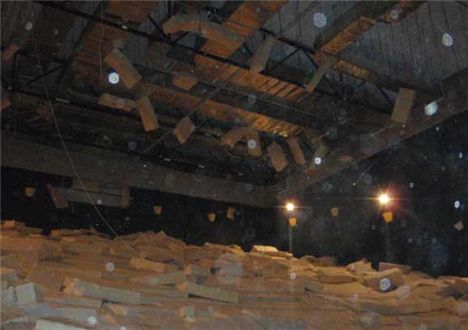
It doesn't seem to have been reported much in the US media, but on Thursday evening, the ceiling of a theatre in the West End of London collapsed, injuring 76. From what I can gather, it was essentially bits of plaster that came down, and the actual weight-bearing structure of the roof itself remained intact. A very lucky escape, I reckon, given that there were 96 deaths and hundreds of injuries in a similar incident in Washington DC in 1922, but when the actual roof did cave in.
From my days in the theatre/cinema business, I do not remember there being any laws or regulations (in Britain, at any rate) requiring the roof or ceiling of auditoria to be checked for structural integrity on a regular basis. Fire extinguishers, lifts, emergency exits, PAT testing for appliances - these did have to be checked regularly, and the results recorded, but I can't recall anything about the structural integrity of actual buildings. Presumably such a requirement will be introduced now in response to this, and I'd guess that a lot of theatre owners and managers in the UK are now on the phone to any architects they can find to get their roofs checked out.
Out of interest, are regular checks on roof integrity mandated by state laws and/or county or city-based regulation in the US?
Posted by Alan Plester (Member # 852) on 12-21-2013, 04:50 AM:
Taken from BBC news site regarding the ceiling in a building that has stood since 1901
A spokesman for Westminster City Council, which covers the West End, said it requires venues to have their ceilings checked every three years rather than every 12 months.
Posted by Steve Moore (Member # 4753) on 12-21-2013, 05:59 AM:
Our city council requires an inspection of ceiling and roof every other year to renew our licence.
Posted by Alan Plester (Member # 852) on 12-21-2013, 07:24 AM:
Steve, That's a most interesting point, all the years I was at the Banbury cinema not once, can I remember taking anyone into the roof void, and that building has been in operation since 1940.
All other tests, fire ect were rigid.
Posted by Stephen Furley (Member # 1277) on 12-21-2013, 08:49 AM:
We've had some very wet weather in London; I wonder if the plaster was damaged by water ingress. A few of the injuries are serious, but not life-threatening.
Birmingham Town Hall, which is a music venue, not a town hall in the conventional sense was closed for several years after part of the ceiling plaster fell down. I think the auditorium was empty at the time, but I'm not certain about that.
It didn't take years to repair the ceiling, but various other refurbishment/improvement works were carried out at the same time.
Posted by Kenneth Wuepper (Member # 1174) on 12-21-2013, 09:33 AM:
Are we overlooking another major cause for failure of surfaces in a theatre? Loud to deafening BASS from super powerful sub speaker systems that can be felt in the marble walls beyond the lobby.
Modern live and recorded bands and action films seem to require more and more bass energy than even standing on the tarmac while 747s are taking off. For every action there is an opposite and equal reaction. When placing that much energy into a confined space it will have to be ABSORBED by the structure and contents. How much will decorative plaster absorb before it fails to be a structure?
When the film "Earthquake" with the enormous bass sound system was being booked, every theatre was inspected BEFORE the film could be booked into that space. The large 2,200 seat theatre was UNACCEPTABLE due to the molded decorative plaster ceiling construction. The neighborhood 400 seat theatre with suspended acoustical tiled ceiling was acceptable and they played the film.
A similar study was required for screening the film "Tora Tora Tora" as it had very large added speaker systems and amplification as part of the exhibition for that film.
I worked at these theatres at the time these studies were being conducted and audience and structural safety were prime considerations.
Posted by Sam D. Chavez (Member # 1841) on 12-21-2013, 10:52 AM:
I did installations of Sensurround and I don't remember any rigorous tests being required. Maybe the suburban cinema requirements were lighter or ignored. There were no SPL spec's, only voltage at the amp output terminals that were supposed to correspond to loudness.
I found modern multiplexes worked well except for the sound leakage and exciting the rodents that scattered everywhere, esp. the projection room every time the track kicked in.
I did one in a very old building and had dirt and what seemed to be plaster dust raining down. I kept turning down the amps until the dust stopped.
Posted by Gordon McLeod (Member # 33) on 12-21-2013, 11:57 AM:
I know of several movie palaces that the 32' diaphone pipes brought ornetmental plaster down
Posted by Edgar Prass (Member # 7558) on 12-22-2013, 10:48 AM:
In Tallinn, Estonia just a week after opening of a new multiplex in 2008 a ceiling light-weight construction fell down in big auditorium, no one was luckily in the auditorium when it happened. Collapse was blamed on a poor construction quality and materials used.
Posted by Sam D. Chavez (Member # 1841) on 12-22-2013, 11:46 AM:
I am somewhat familiar with this collapse. It was first blamed on the Meyer sound system which of course was very capable of loud clear sound.
I heard later the issue was partly due to air pressure from a poorly balanced HVAC system.
Posted by Jack Ondracek (Member # 1466) on 12-22-2013, 08:32 PM:
I read that there was a very heavy rain (in London) that night.
Any chance this is a simple drainage problem & the weight of the water might have caused the collapse?
Posted by David Buckley (Member # 2600) on 12-22-2013, 09:43 PM:
The weather making an inadequately maintained theatre worse is the current leading speculation.
Posted by Steve Matz (Member # 1890) on 12-22-2013, 10:37 PM:
Back in the old Nitrate Days, Building inspectors/Fire Marshalls were more concerned about the Projection Booths being Safe than other parts of a Theater. Construction must have been pretty top notch in the Day. I don't remember hearing stories of too many Balconies/Lodges or Ceilings falling down.
I think most of your Old Buildings built before the Depression had real quality workmanship in them. Heck we still have a Couple School Houses going here that were constructed in 1909. Today because Time is Money they have a building up in a eye blink.I've seen some building construction signed off by inspectors that I wouldn't trust no how. Makes me believe some extra money is changing Hands despite Public Safety ![[puke]](graemlins/puke.gif)
Posted by Jack Ondracek (Member # 1466) on 12-23-2013, 09:41 AM:
One thing I find interesting about early accounts of this incident, is that some of the major networks reported the balcony had collapsed. It took awhile for a simple weather event to come out as the likely cause.
http://www.telegraph.co.uk/culture/theatre/theatre-news/10531656/Apollo-Theatre-ceiling-collapse-caused-by-heavy-downp our.html
Apollo Theatre ceiling collapse 'caused by heavy downpour'
Almost 15 per cent of December's average rainfall came down on London in just one hour before 100 sq ft of plaster suddenly dropped onto the audience on Thursday
The dramatic collapse of a historic West End theatre’s ceiling onto a packed auditorium was probably caused by an abnormally heavy downpour swamping the roof, the emergency services believe.
Nearly one-seventh of the average monthly rainfall for the whole of December came down on London in the hour before the disaster at the Apollo Theatre, which left 79 people injured, nine of them seriously.
The 112-year-old venue has been closed until at least January 4 while investigators piece together how the accident happened and clear away the timber beams and large chunks of ornate plaster that rained down on audience members.
Posted by Martin McCaffery (Member # 37) on 12-23-2013, 10:05 AM:
Sometimes things just let go. In 1991 we could have had a major tragedy here in our 1941 building. Sometime during the night an approx 10ft x20ft chunk of the ceiling (thick plaster, lathe, insulation,etc), just let go and crashed down on the first few rows. Had anyone been sitting there, they probably would have been killed.
Our landlord's insurance covered the repair and the complete reinforcing of the ceiling. There was no water damage or any signs of decay. The best the inspectors could figure was the nails holding things up just worked loose after 50 years of the timbers heating and contracting.
Posted by Leo Enticknap (Member # 534) on 12-23-2013, 01:23 PM:
quote: Steve Matz
I think most of your Old Buildings built before the Depression had real quality workmanship in them.
Interesting. The cinema building boom in Britain really happened between the late '20s (the 1927 Films Act caused a sort of dotcom bubble in the movie business) and the outbreak of WWII, i.e. actually during the Great Depression. The movie business must have been one the very few that actually grew during this period. My first job was in a 1930-built picture palace of the sort that went up in almost every major town and city in Britain during the following decade. I remember the chief telling me that although these buildings look grand and impressive, appearances deceive and the truth is that most of them were thrown up as cheaply as possible, and the bare minimum was spent on maintenance thereafter.
That, combined with bomb damage during the war, a lot of which was bodge-repaired at best, was part of the reason why the chains were keen to close, pull down and replace with hangar-like ring road buildings so many of them once the multiplex era began in the '80s: the amount they were costing in maintenance, just to keep them open, was staggering.
I get the impression that a lot more theatre building went on during the '20s in the US than in Britain: Hollywood's aggressive international expansion (especially into other English-speaking markets, which caused the cinema-building boom there) really went into top gear with the arrival of sound, partly because of the need to recoup the huge investment that needed.
As for the West End incident being triggered by a simple weather event, that doesn't surprise me: what does is that whatever inspection regime existed was unable to establish that the building would not be able to withstand that event. I've been visiting relatives in London for the last week (got home yesterday), and the weather in the few days leading up to the event was unusually rainy, but, writing as someone who was born and brought up in Wimbledon, not exceptionally so.
The good news is no deaths and very few serious injuries, and hopefully the publicity resulting from this will result in preventative action taking place. Unlike the Knickerbocker Theatre disaster, this appears to be a failure of maintenance rather than of design, which in a way is also a positive.
Posted by Marcel Birgelen (Member # 6801) on 12-23-2013, 02:41 PM:
The Daily Mail has a photo compilation available here.
As you can see, there doesn't seem to be any real damage to the roof from the outside.
There was also some construction work going on, mainly on the facade, but also going up to the roof. It's just some wild speculation, but maybe that could be a factor too.
Posted by Mark Ogden (Member # 43) on 12-23-2013, 03:46 PM:
I remember when the ceiling of the Murray Hill Cinema on the east side of Manhattan colapsed in 1986 during a showing of Psycho 3 . Only a few people were hurt because there were very few people in the theatre at the time. The headline in the NY Post the next day was: "MOVIE CREDITED WITH SAVING LIVES".
Posted by Mark Hajducki (Member # 1732) on 12-23-2013, 10:21 PM:
quote: Leo Enticknap
although these buildings look grand and impressive, appearances deceive and the truth is that most of them were thrown up as cheaply as possible
That applies to all the sites I have worked whether they are 100 or 10 years old. None of them were well built and most of them had leaking roofs. All of the sites show signs of being built/rebuilt on the cheap.
I would expect the insurance companies to have more interest in the routine inspection of the building as they have liability.
Posted by Steve Guttag (Member # 268) on 12-24-2013, 06:45 AM:
quote: Steve Matz
Construction must have been pretty top notch in the Day. I don't remember hearing stories of too many Balconies/Lodges or Ceilings falling down.
Oh really? Look up the Knickerbocker Theatre (Washington, DC). Weather too played in the demise of the ceiling and balcony. Complete collapse. 98 people died in that one and over 100 were injured back in 1922.
Posted by Frank Angel (Member # 248) on 12-24-2013, 05:03 PM:
I learned the hard way that plaster is not very stable over the long hall. One night while sound asleep, a roar as loud as a Mack trunk crashing into a brick wall woke me. The four tier bookshelf that was attached to the wall opposite our bed had let loose and piles of books and four heavy shelves crashed within inches of the bed. Mind you, this shelving had been up there attached firmly to the wall with three inch screws into the plaster and the lathing beneath. It had been up there for 30 years plus. Nothing at all had been placed on any of the shelves for probably over 6 months, so it was not like it had been overloaded and then one extra book placed on it brought it down -- no, it just let loose...pulled all four screws and their plastic anchors on each of three bracket strip holders right out. A maintenance fellow at the theatre said plaster just changes over time -- contracts/expands with heat and moisture and even natural vibration in a building, especially one on a street facing heavy traffic, it is not uncommon for it to give way, especially if it has been applied as an ornimental facia to other material as is often the case in the old movie palaces.
Talk about things falling -- our house audio engineer tells a story of an old theatre near Hofstra U on Long Island which closed and was sold and the construction crew was dismantling it to make it fit for another commercial business. As part of the reconstruction they needed to remove the marquee. The crew worked to cut the steel beams right at the front wall. They cut it cleanly and swung it away from the building; about 15 minutes later while the crew was intently focused on maneuvering the marquee as it hung from a crane, a huge crashing sound shook the ground that felt like an earthquake. Then a cloud of dust bellowed out the front doors of the theatre.
Seems the theatre was designed so that marquee was a counterbalance for the balcony which of course came crashing down into the orchestra once the other end of the fulcrum was removed. Luckily no one was in the theatre at the time.
Posted by Steve Guttag (Member # 268) on 12-25-2013, 07:37 AM:
Don't heat/cool an old theatre during the off season (or if it closes)...see how fast the plaster comes down! No plaster isn't that stable.
Powered by Infopop Corporation
UBB.classicTM
6.3.1.2