This is topic Citizen Kane: Is it wrecked if you know the ending? in forum Film-Yak at Film-Tech Forum ARCHIVE.
To visit this topic, use this URL:
https://ft-forum.com/ft/cgi-bin/ubb/ultimatebb.cgi?ubb=get_topic;f=8;t=006970
Posted by Mike Blakesley (Member # 26) on 03-10-2014, 02:13 PM:
So I've never seen "Citizen Kane" and I keep reading about how it's the best movie in the history of movies, so I would like to see it, but I've heard thousands of times over the years about how the word "Rosebud" is whispered at the end, and it refers to a sled, and so on.
My question: Is the movie ruined by me knowing this info? Am I going to watch it and say "That's IT? WTF?" Or will it still be a worthwhile investment of time to watch it?
I know if you watched "The Sixth Sense" knowing the ending, it would spoil that movie, so...
Posted by Rick Raskin (Member # 1561) on 03-10-2014, 02:31 PM:
I don't think knowing Rosebud will ruin it for you. The movie is far more involved than that.
Posted by Steve Kraus (Member # 476) on 03-10-2014, 02:45 PM:
You know how Hitch spoke of his movies having a "MacGuffin," the thing that was the center of everyone's attention? Well, Rosebud is sort of a MacGuffin for this film. The search for what it meant ends up telling the story but it, itself is sort of meaningless.
BTW, as Kane is to some extent about William Randolph Hearst, it is said that "Rosebud" was his nickname for a certain part of the anatomy of his mistress, actress Marion Davies.
Posted by Bobby Henderson (Member # 840) on 03-10-2014, 02:55 PM:
I don't think knowing the significance of what "Rosebud" meant would ruin the entire movie. It does give away an important reveal in Kane's character. There is more to how that part of the story is resolved.
Citizen Kane is indeed one of the greatest movies ever made. However, I do not expect someone watching the movie for the first time in this current time to come away thinking it was a really kick ass movie.
People who really know film history will have a far greater appreciation of Citizen Kane than any average viewer who rarely if ever watches classic movies. Citizen Kane is one of the most innovative and extremely influential movies ever made. The movie did a lot to re-write the "language" of film making. Citizen Kane was Orsen Welles first feature film and he was only 25 when he co-wrote and directed it.
Posted by Edward Havens (Member # 4715) on 03-10-2014, 02:59 PM:
Rosebud is, as Hitchcock coined, a MacGuffin. The movie uses Rosebud as a device to propel the story forward, but it's not really integral.
Knowing what Rosebud going in should not hurt your viewing expereince, but it being THE MOST IMPORTANT MOVIE EVER MADE might hurt your viewing experience if you put too much expectation on it. Just try to watch it with an open mind, and if you don't like it, that's cool too.
Posted by Justin Hamaker (Member # 2165) on 03-10-2014, 03:32 PM:
quote: Edward Havens
but it being THE MOST IMPORTANT MOVIE EVER MADE might hurt your viewing experience
I can't tell you how many movies have left me disappointed after watching them with the knowledge of their greatness. This is especially the case when watching movies years, or decades, after they came out. Seeing a movie out of context, changes the whole experience of the movie.
In the case of movies that were revolutionary for some technical reason, the whole experience can change after seeing the technical "trick" employed in many other movies that followed. For example, how much different would it be watching The Matrix for the first time today - 15 years after it was released. Fortunately it's a good movie regardless of the technical wizardry, but the various camera tricks would seem kind of tired today.
Posted by Mark Ogden (Member # 43) on 03-10-2014, 03:42 PM:
If for no other reason, see it for the cinematography. Gregg Toland was a master of lighting, composition and use of focus. Wells considered him so important to the picture that he gave him equal credit.
Truth be told, though, the film isn't holding up well. It was seen as pretty significant when in the latest "Sight and Sound" critics poll, it was knocked off the top by Vertigo. It's awfully theatrical and a little over the top at times, but still important to the history of cinema. The most important movie ever made? Well, except for Birth of a Nation, Sunset, The Last Laugh, The Passion of Joan of Arc, Battleship Potemkin, Breathless and a few more, all of which were more influential than Kane ever was.
Posted by Justin Hamaker (Member # 2165) on 03-10-2014, 03:46 PM:
As for the most important movie ever made, what about more modern movies for their impact on animation and technical achievements.
Star Wars, Who Framed Roger Rabbit, Toy Story, The Polar Express, The Lord of the Rings, Avatar, etc.
Posted by Bobby Henderson (Member # 840) on 03-10-2014, 03:55 PM:
I think Citizen Kane is a great movie just in terms of the conventional story. The movie does have some great lines, none of which I'll repeat here until Mike watches it.
Film buffs who like watching lots of movies from the 1930's and 1940's could go into a lot of detail in how Citizen Kane threw out a lot of film making conventions. Lots of movies from the 1920's and 1930's were shot as if they were viewing a stage play. Lots of static, eye-level conventional camera angles. You almost never saw the ceilings in a set. The cinematography, lighting and production design of Citizen Kane was very expressive. High depth of field "deep focus" cinematography was becoming possible. The story had a layered, non-linear narrative -not a simple beginning, middle and end.
One obvious bit of style: Citizen Kane is the first movie I know of that simply flashed the title only at the beginning and got into the movie, leaving all the credits for the end. Movies like Star Wars, Robocop and many other contemporary movies revived that style.
Citizen Kane is available on DVD and Blu-ray in numerous editions. The physical disc versions have some great extras (documentaries, informative commentary tracks, etc.).
If you have Amazon Prime you can stream Citizen Kane (and a LOT of other classic movies) for free. The video quality probably won't be on par with the physical discs though.
Posted by Frank Cox (Member # 6258) on 03-10-2014, 04:45 PM:
I personally prefer the older style of movie credits where they give you the title, a few screens of credits and then the action starts. At the end, it's THE END, and we're all done here folks.
That style provides some discipline in terms of how many credits they could put on-screen, unlike today's 20-minute credit roll at the end of the movie.
And people actually saw those credits. 100% of the audience is long gone down the street and probably working on their second beer by the time the credits finish scrolling on most of the movies that I play here.
I really don't see the point of having a million credits on the end of a movie when almost nobody will see them anyway. And even if you're one of the extremely rare people who sits through them, who could actually read and understand that wall-of-text when they put 20 names at a time on-screen for five seconds per card anyway?
Posted by Rick Raskin (Member # 1561) on 03-10-2014, 05:10 PM:
There is a famous tracking shot near the beginning of the film where the camera moves along a rooftop then drops down a skylight into the cavernous interior of the mansion. It really was a departure from the standards of the day (as Bobby mentioned above).
Is it the best film ever made? Probably not, but it was one of those discussed and screened in a college course I took called "The Art of the film".
Posted by Gordon McLeod (Member # 33) on 03-10-2014, 05:41 PM:
One of the shots of Xanadu was actually a process shot from King Kong ![[Smile]](smile.gif) the famous shot of the long pan and then down through the skylight was also interesting as it was a minature shot as well
the famous shot of the long pan and then down through the skylight was also interesting as it was a minature shot as well
Posted by Martin McCaffery (Member # 37) on 03-10-2014, 06:19 PM:
The problem with watching Citizen Kane now is that everything in it is a cliche. It wasn't at the time, but that's what happens after 70 years of being the most influential movie in history. Nonetheless, watch it.
Posted by Pravin Ratnam (Member # 1417) on 03-10-2014, 06:56 PM:
Rosebud was a bigger deal decades ago. But so many movies have borrowed that concept of a powerful guy yearning for something trivial but sentimental from his old simple life that it really won't be a big part of your enjoyment of the movie.
So go ahead and watch it. And don't even worry about Rosebud. Enjoy the great filmmaking and acting.
Posted by Mark Gulbrandsen (Member # 72) on 03-10-2014, 07:47 PM:
And don't watch it at home. Run it at the Roxy!
Posted by Scott Norwood (Member # 30) on 03-10-2014, 09:00 PM:
My favorite story about this film relates to the supposed editing out of the scene of the young Kane playing in the snow with Rosebud by a television station in order to fit the film into a two-hour time slot. I have no idea if this actually happened, but I would not be surprised if it did.
Posted by Martin McCaffery (Member # 37) on 03-10-2014, 09:21 PM:
I like the story of the French New Wavers who could only watch the movie in un-subtitled English after the war who thought Rosebud was the snowglobe because that's what is shown when he first says Rosebud.
Posted by Steve Guttag (Member # 268) on 03-10-2014, 09:53 PM:
There is no such thing as the definitive "greatest movie ever made" or any other subject. I think Mike was probably using those words because he has heard about this one movie (probably in another thread that Leo and I have been duking it out).
What Kane does represent was one of the single biggest departures from how movies were made before it and after it. Though not as significant, historically, but certainly fascinating was that a 25-year old Orson Wells pioneered the Director, Writer Star person...he wore a lot of hats! Orson played a man of his age and one that was MUCH older and did so very well.
The best way to appreciate Kane and where it stands in film history is to look at the movies that came before it and then those that came after it. It is undeniable, it was the turning point in how movies were to be made. It is much more on the revolutionary side of things than evolutionary. It is really up there with the advent of the talkies because it changed movie making that much. And just like with talkies...the techniques in lighting, story telling, cinematography that were pioneering in Kane have been developed and refined. It wasn't the last word in movie making, the was the first statement in modern movie making.
And Justin...while the movies you mention deserve their accolades, they don't measure up, except for Avatar (but not for the same reasons), in terms of the impact it had on the industry. With Avatar, I have to say the real turning point in Digital Cinema was made. It was THE one movie, even more than Star Wars before it, that got the exhibitors thinking..."I need to get me a Digital system so I can cash in on that new 3D thing." We were getting orders much faster than the manufacturers could fill them even though it normally only mean one system per complex. And with that, the momentum was created for where we are now. But it really wasn't the evolutionary 3D and animation techniques that were in Avatar that did it. My prediction is that Avatar 2 isn't going to have the same sort of impact...but that is my prediction.
In any event, knowing about "Rosebud" will not hurt your movie watching enjoyment (or perhaps boredom). I do suggest that you keep your mind open and if you don't get it on the technological side, watch most any movie made before it. My prediction is that you will enjoy it anyway because the story is quite good and the aforementioned film making techniques were also done very well.
Posted by Mike Blakesley (Member # 26) on 03-10-2014, 10:17 PM:
Steve - I just used those words because Citizen Kane has probably topped more "best movies ever" lists than any other I can think of. If it's not on top, it's usually at least in the top 3.
quote:
And don't watch it at home. Run it at the Roxy!
Well that's a foregone conclusion!
Posted by Bobby Henderson (Member # 840) on 03-10-2014, 11:22 PM:
Just to paint the picture in broad strokes, Citizen Kane is the Jimi Hendrix of contemporary movie making. Kane wrote the language for it.
Jimi Hendrix definitely was not the most technically precise rock guitarist ever. There's dozens of guys who could play circles around him (Eddie Van Halen, Zakk Wylde, Dimebag Darrell Abbott, Joe Satriani, Steve Vai, etc., etc., etc.). Hendrix didn't have the best "feel" in phrasing of his licks. Guys like Eric Clapton, Jimmy Page, Jeff Beck, Stevie Ray Vaughn and many others could pull tears out of peoples' faces with their playing.
The difference with Hendrix: he did it FIRST. Hendrix invented the language of modern rock guitar. So many other axe men could play better, but they ALL were copying Hendrix in some way or other. There's just no way around it.
And that's how it is with Citizen Kane. Some snotty movie-maker today (who never soiled his hands with a magazine of film) could act like Kane is beneath him, but he would have to try very damned hard and probably fail in futility to deliberately avoid any influence Kane has left on the movie making craft.
Posted by Terry Lynn-Stevens (Member # 7349) on 03-10-2014, 11:49 PM:
quote: Mike Blakesley
So I've never seen "Citizen Kane" and I keep reading about how it's the best movie in the history of movies, so I would like to see it, but I've heard thousands of times over the years about how the word "Rosebud" is whispered at the end, and it refers to a sled, and so on.
My question: Is the movie ruined by me knowing this info? Am I going to watch it and say "That's IT? WTF?" Or will it still be a worthwhile investment of time to watch it?
I know if you watched "The Sixth Sense" knowing the ending, it would spoil that movie, so...
I don't think knowing what "Rosebud" means will ruin the movie.
It depends on how you view the movie, if you go in with your bucket of popcorn and watch it for its pure entertainment or storytelling value, then knowing the ending might ruin it for you. Just like knowing the ending of Pulp Fiction would ruin it for me.
The movie was a very influential film and if you go in and watch it for those reasons, then who cares if you know what "Rosebud" means.
Not sure if anyone has mentioned it yet, but Orson Welles was just 25 when he starred, co-wrote, and directed the movie. The technical achievements were very influential. Its a good movie to read and learn about after you see it.
quote: Mark Ogden
If for no other reason, see it for the cinematography. Gregg Toland was a master of lighting, composition and use of focus. Wells considered him so important to the picture that he gave him equal credit.
True.
quote: Mark Ogden
Truth be told, though, the film isn't holding up well. It was seen as pretty significant when in the latest "Sight and Sound" critics poll, it was knocked off the top by Vertigo. It's awfully theatrical and a little over the top at times, but still important to the history of cinema. The most important movie ever made? Well, except for Birth of a Nation, Sunset, The Last Laugh, The Passion of Joan of Arc, Battleship Potemkin, Breathless and a few more, all of which were more influential than Kane ever was.
I think AFI knocked it off from #1. I wouldn't call it the greatest movie of all time, but I would say it is one of the greatest or a better term is one of the most important. I liked Casablanca more.
quote:
And don't watch it at home. Run it at the Roxy!
Good call Mark!
Posted by Steve Matz (Member # 1890) on 03-11-2014, 03:02 AM:
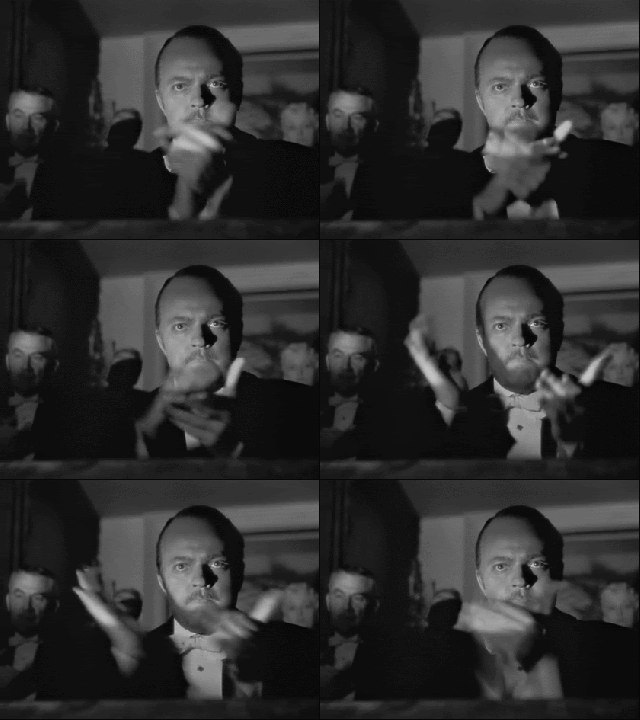
And what was your Opinion of the Film Mr. Wells?
Posted by Martin McCaffery (Member # 37) on 03-11-2014, 09:31 AM:
^^^ Welles ![[Wink]](wink.gif)
Posted by Jock Blakley (Member # 6552) on 03-14-2014, 09:38 AM:
quote: Gordon McLeod
One of the shots of Xanadu was actually a process shot from King Kong
You might also note some pterodactyls casually flapping about as Kane and company camp out for the night. Why bother shooting new background plates when you can just nip out to the RKO archives? ![[Razz]](tongue.gif)
Posted by Stephen Furley (Member # 1277) on 03-14-2014, 10:39 AM:
quote: Bobby Henderson
Jimi Hendrix definitely was not the most technically precise rock guitarist ever. There's dozens of guys who could play circles around him (Eddie Van Halen, Zakk Wylde, Dimebag Darrell Abbott, Joe Satriani, Steve Vai, etc., etc., etc.). Hendrix didn't have the best "feel" in phrasing of his licks. Guys like Eric Clapton, Jimmy Page, Jeff Beck, Stevie Ray Vaughn and many others could pull tears out of peoples' faces with their playing.
Totally off-topic, but two musicians lived next door to each other in London. Well, not literally, they lived there a couple of hundred years apart. Hendrix lived at No. 23 Brook Street, and next door, at No. 25 lived G.F. Handel. No. 25 is now the Handel House Museum, and they have held exhibitions about Hendrix.
Posted by Leo Enticknap (Member # 534) on 03-18-2014, 12:29 AM:
quote: Edward Havens
Knowing what Rosebud going in should not hurt your viewing expereince, but it being THE MOST IMPORTANT MOVIE EVER MADE might hurt your viewing experience if you put too much expectation on it. Just try to watch it with an open mind, and if you don't like it, that's cool too.
+ about 500, Amen, Brother, etc. etc.
As others have noted, there are a huge number of innovations, trying stuff out, both visually and also in terms of sound, acting style (e.g. the first scene with Susan in the bar - long monologue to camera) and story structure. Add on top of that the fact that Welles was grinding a political axe, too (if there were to be a remake now, I guess it would probably be about Murdoch), and to me the movie is dense and disorganized. It's got flashes of brilliance to it - so many and so quickly, in fact, that the movie doesn't really gel as a whole. And no, knowing the ending (both literally and the alleged metaphor) doesn't spoil it.
For me, The Magnificent Ambersons is a far more successful movie, even with the studio-imposed happy ending. I think the discipline of adapting someone else's story and not playing the lead himself helped to focus Welles. Maybe it's partly because I find the story itself absolutely fascinating (America's rapid industrialization at the turn of the 19th-20th centuries), or that Tim Holt and Anne Baxter pulled out performances which IMO, they never even got close to again (thereby proving that Welles really had something). He also inspired amazing achievements from his technical crew, too - a tracking shot in the ball near the start would make the Steadicam stuff in The Shining look like a wobbly home movie, and the audio reverb in one of the later scenes of Agnes Moorehead in the kitchen of the (now run-down) house must have been near impossible to achieve with 1940s ribbon mikes and tube preamps.
Powered by Infopop Corporation
UBB.classicTM
6.3.1.2