This is topic 35mm in TV Stations in forum Film-Yak at Film-Tech Forum ARCHIVE.
To visit this topic, use this URL:
https://ft-forum.com/ft/cgi-bin/ubb/ultimatebb.cgi?ubb=get_topic;f=8;t=006983
Posted by Steve Matz (Member # 1890) on 04-04-2014, 01:31 PM:
I was always curious what percentage of Television Stations in the 50's and 60's had 35mm Telecine Projectors. All the Stations I ever visited over the years used 16mm, mostly RCA TP6/66 or Eastman 250,275,285. The only Station that I ever was in that I saw a 35MM Projector was KTLA Los Angeles back around 1968. It was a SIMPLEX Based XL and apparently they are pretty rare. I remember seeing one up for sale on EBAY years ago and they wanted something like 35 grand; emphasizing that it was an extremely rare model Simplex Telecine model.
I can't find any relevant info on what Model it was,how many were ever made etc. I'm thinking that probably only a Few Major Large Metropolitan TV Stations; probably in California,New York,Chicago,etc would of even considered using 35mm equipment back then.
Anybody up here ever work in a Station that used 35mm Equipment.
would like some feed back....Thanks ![[beer]](graemlins/beer.gif)
Posted by Leo Enticknap (Member # 534) on 04-04-2014, 07:52 PM:
British broadcasters used 35mm pretty much exclusively for all non-studio shooting and recording (kinescoping) studio productions, well into the 1960s. The technicians' union, the Association of Cine-Technicians, fought the introduction of 16mm and later ENG tooth and nail, because of the threat they represented to its members' jobs. This article explores how, even as late as the mid-70s, the use of 16mm (more flexible than 35mm or studio-based VT technologies) was still a labor relations flashpoint.
Posted by John Eickhof (Member # 323) on 04-04-2014, 09:03 PM:
I used to service several in the Stockton / Sacramento area in the mid 70s. KCRA, KOVR, and a couple others had them. They were 2000ft capacity and had 16mm and slide projectors feeding the multiplexer. There were both RCA and GPL/Simplex machines. I also serviced an early video tape distributor who had three Simplex units with 6000 ft capacity and his camera system fed a bank of 100+ VCRs to make his tape copies. I picked up a nice Simplex and RCA telecine from Charlie Wolk when he sold his company years ago. They are in my museum. The RCA used a shutterless BX-80 and the Simplex had a shutterless XL, all were 3phase for synch use with flat 5 blade shutters driven by synch motors. The RCAs featured an automatic lamp changer if the projection lamp failed during use! The GPL / Simplex had a flip-over lamp holder like the exciter lamp in the RCA MI9030.
Posted by Gordon McLeod (Member # 33) on 04-05-2014, 10:58 AM:
CBC here had some supers that had been converted to a custom high speed movement and 5 blade shutters
There also used to be several of the RCA electronic machines in use
Posted by Stephen Furley (Member # 1277) on 04-05-2014, 06:35 PM:
I think the BBC started making significant use of 16 mm at about the time of the change to colour, which other than experimental started in 1967. Some major productions were still shot on 35mm however.
Film chains were much less common here in broadcast use than flying spot machines since for 625/50 we had no need for 3:2 pull down. Even 405 line equipment was often flying spot. I think the only studios where I ever saw film chains were the ones of the private system of the I.L.E.A. (Inner London Education Authority) who used ex broadcast monochrome equipment. They had two 16/35/slide multiplexor chains in the 70s. 35 mm was almost never used there.
By about that time film recording by the broadcast studios was also 16 mm, mainly for export and mainly monochrome. I don't think the BBC ever did colour film recording on 35 mm.
In the early '70s London Weekend were still transmitting directly from both 16 mm and 35 mm at their new studio complex on the South Bank. I saw an old black and white made for TV movie going out live from there on a pair of 35mm machines in about 1974.
I think there was another significant difference between UK and US practice at this time. We didn't generally have little local low budget stations. There was only BBC 1, BBC 2, and ITV when colour started, and BBC 2 had only been going for three years then. Channel 4 didn't arrive until the late '80s.
Posted by Jim Cassedy (Member # 4115) on 04-05-2014, 08:55 PM:
Up until the late 80's or early 90's, independent TV station KBHK here in San Francisco
used to advertise on air that they were running all their Star Trek episodes & some
of their weekend movies from directly from 35mm. I think that up until around
the same time the major networks were running 35mm prints for some of their shows.
I used to have a wholebuncha 35mm "network prints" of MISSION IMPOSSIBLE, and I
also had a number of 35mm 30min "fall preview" reels from CBS, where they advertised
the new shows for the upcoming season. It's my understanding that some of these
were meant for air use, and others were run at a CBS network affilliates convention.
I also used to have half of a Perry Mason episode in 35mm. The coolest thing
about the stuff from CBS, was that they had their own custom made film cans,
with the CBS "eye" embossed in the top cover.
Posted by Mark Gulbrandsen (Member # 72) on 04-05-2014, 10:25 PM:
There were none left in Chicago stations in the late 70's when I worked there in broadcasting, it was all 16mm and mainly because of the quantity of newsreel work that was done there. The stations even had their own film labs then. There were some 35mm telecine at WGN up to about the early 1970's though. All the 35mm telecines were in post houses or film labs and those were junked by the mid 80's in favor of Rank flying spot scanners. I ended up with a nice RCA FR-35B that came out of Editel in Chicago.
Mark
Posted by Steve Matz (Member # 1890) on 04-05-2014, 11:36 PM:
Thanks Guys, Interesting Info; Something that also had me curious was many TV Shows in the 70's when you saw behind the Scenes Footage showed them being Filmed with PANAVISION Cameras.
If your Film Episodes were expressly for a 4 to 3 ratio TV Screen Format;Why would you be filming them in Panavision/widescreen or were those Cameras capable of different aperature sizes to film Television size Format back then.
I thought Panavision Cameras shot Widescreen 35mm and Super Panavision 70mm. I know a lot of old TV Shows were shot with Mitchell 300 BNC Models and those were pretty much 1.33 or 1.37
I think...
Posted by Scott Norwood (Member # 30) on 04-05-2014, 11:41 PM:
Panavision is a rental company. "Filmed IN Panavision" implies something shot on 35mm with Panavision anamorphic lenses. "Filmed WITH Panavision cameras and lenses" means just that--any format (could be 16mm, 35mm, or 70mm) that used Panavision equipment. For TV, this would normally be 35mm Academy or, more recently 35mm 3-perf. The Panavision 35mm camera is a descendent of the Mitchell 35mm camera design and uses essentially the same movement.
(Confusingly, the Panavision company will also rent you Arriflex or Aaton cameras that have been modified to accept Panavision lenses.)
As for TV, my understanding is that NYC and LA and the US networks all had 35mm film chains, but that almost all local stations only had 16mm. What I would actually be curious about now is if any stations still have film chains set up that could be switched to air in 2014 (as opposed to sitting disassembled in a pile in a basement or warehouse somewhere).
Posted by Louis Bornwasser (Member # 3063) on 04-06-2014, 06:47 AM:
Network 35mm origination came from New Jersey due to taxation in NYC. I believe that all film originated from one place for all 3 major networks. I toured NBC as film was microwaved in to feed 2 VTR.
Posted by Mark Gulbrandsen (Member # 72) on 04-06-2014, 09:00 AM:
BNC's were in use up into the 1980's for television as well as Panavision PSR's. Seinfeld was initially shot with multiple PSR's and later changed to Panaflex's with 2000' magazines. I Love Lucy, Dick Van Dyke, Star Trek, Andy Griffith, Batman were all shows that were shot with BNC's or BNCR's.
Mark
Posted by Leo Enticknap (Member # 534) on 04-06-2014, 11:56 AM:
quote: Stephen Furley
I think the BBC started making significant use of 16 mm at about the time of the change to colour, which other than experimental started in 1967.
So the new generation of fine grain, fast 16mm stocks (e.g. FP4 and the revamped Tri-X) came on the market a decade earlier, as did the first generation of truly professional 16mm camera equipment (the Arriflex 16, Angeneiux zooms, etc.). Educational filmmakers, the New Wave, etc. etc. were using this stuff all over the place by the early '60s, but yet British broadcasters effectively refused to touch it for another decade!
About a decade ago, the BBC published a DVD compilation called something like 50 Years of TV News, which included a "making of" documentary. It included footage of a 35mm camera crystal-synced to a Nagra shooting footage of The Beatles at Heathrow in the mid-60s!
quote: Scott Norwood
What I would actually be curious about now is if any stations still have film chains set up that could be switched to air in 2014 (as opposed to sitting disassembled in a pile in a basement or warehouse somewhere).
Not strictly a film chain, but a used equipment dealer I know had a Cintel mk. III in lovingly maintained, ready-to-go condition, formerly in the possession of a private owner (retired broadcast engineer) who died. This guy didn't really have much hope of selliing it on (no-one wants standard def stuff these days, and the few that do want easy to operate and maintain telecines, e.g. Elmos and older Flashscans). Within a month, the North Korean embassy phoned up out of the blue and offered him his asking price (£10k, which he didn't expect to get). He half thought it was a prank, but the money appeared in his bank account a couple of days later, and shortly after that a removals lorry appeared, and it was crated and palleted up and driven away.
It's probably broadcasting the dear leader's propaganda (or the supreme leader's, depending on which immortal despot you choose) straight from film as we speak! Maybe they should have thrown in a print of the South Park movie as a freebie... Apparently North Korea uses PAL as its broadcasting system, hence the reason they were looking around in Britain for used equipment.
Posted by Mark Ogden (Member # 43) on 04-06-2014, 02:32 PM:
quote: Louis Bornwasser
Network 35mm origination came from New Jersey due to taxation in NYC. I believe that all film originated from one place for all 3 major networks. I toured NBC as film was microwaved in to feed 2 VTR.
That was the case for ABC and NBC, who maintained film chains in separate New Jersey facilities (Union City and Ft. Lee, respectively). CBS ran their film from their studio building on 57th St. and coughed up the tax. This was the case thru the "golden age" of television to about the late 70s, when the Type "C" one-inch tape format took hold and made it more economical to do transfers in LA and ship the tapes to NYC to beat the tax. All of the networks continued with film playback for the Saturday morning cartoon shows thru to about the early nineties, partially to appease the IATSE/MPMO, who handled projection.
I'm no longer aware of any live film-to-air facilities anywhere at any network, although some maintain transfer facilities in NYC for archival footage and the like. In fact, CBS just bought some refurbished Thomson Shadows from Technicolor that will be used for just such purpose.
I was working at CBS when the first-floor film area was ripped out. I saw a slide machine on its way to the loading dock and grabbed an old trouble slide out of it, which I recently cleaned up digitally and made my in-office screen saver.
Posted by Bill Duelly (Member # 3612) on 04-06-2014, 10:24 PM:
Mark, did you know Fred who worked in the film transfer department ? He used to tell us about running the first Lucy show, off 35mm, and the takeup broke, but he had to keep it going on air....
Posted by Steve Matz (Member # 1890) on 04-06-2014, 11:41 PM:
quote: Leo Enticknap
Not strictly a film chain, but a used equipment dealer I know had a Cintel mk. III in lovingly maintained, ready-to-go condition, formerly in the possession of a private owner (retired broadcast engineer) who died. This guy didn't really have much hope of selliing it on (no-one wants standard def stuff these days, and the few that do want easy to operate and maintain telecines, e.g. Elmos and older Flashscans). Within a month, the North Korean embassy phoned up out of the blue and offered him his asking price (£10k, which he didn't expect to get). He half thought it was a prank, but the money appeared in his bank account a couple of days later, and shortly after that a removals lorry appeared, and it was crated and palleted up and driven away.
It's probably broadcasting the dear leader's propaganda (or the supreme leader's, depending on which immortal despot you choose) straight from film as we speak! Maybe they should have thrown in a print of the South Park movie as a freebie... Apparently North Korea uses PAL as its broadcasting system, hence the reason they were looking around in Britain for used equipment.
Kim Jung Whatever is probably using it to tell everyone which relative he plans to kill next ![[Eek!]](eek.gif)

Posted by Gordon McLeod (Member # 33) on 04-07-2014, 10:05 AM:
The BBC used the Mechau projectors for transfer machines and Emil Mechau was responsible for the flying spot scanner
http://www.bbctv-ap.co.uk/mechau2.htm
http://www.bbctv-ap.co.uk/mechau.htm
Posted by Mitchell Dvoskin (Member # 751) on 04-11-2014, 12:19 PM:
I believe all the New York City stations ran 35mm at some point. I know for a fact that in addition to the 3 networks, WPIX channel 11 and WNEW channel 5 did. I believe WOR channel 9 also ran 35mm when they were still owned by RKO General.
Posted by Steve Matz (Member # 1890) on 04-13-2014, 11:24 PM:
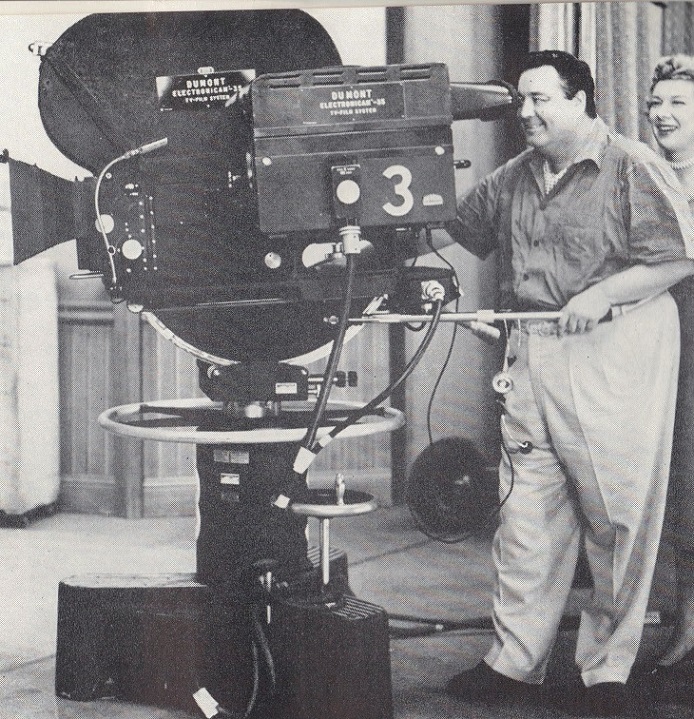
Found this Jackie Gleason "Honeymooners" Pic.Wasn't The Dumont Film System essentially a 35mm Camera directed into a Vidacon TV Camera producing a KINESCOPE or Vice-Versa! Either way the image quality from what I remember as a kid watching it was pretty poor.
Posted by Mitchell Dvoskin (Member # 751) on 04-14-2014, 08:15 AM:
I have a 20 minute 35mm promo film made by the DuMont Network to promote the Electrocam System for use by other producers. The promo shows how the system worked, and contains 35mm clips of various DuMont Newtwork shows, some in color.
The camera contained a beam splitter that sent the image simultaneously to the 35mm film section of the camera and the vidicon pickup. The video from each camera was sent to the control room where the engineers would switch between cameras just as they would a "live" broadcast. In the control room, there was a 16mm kinoscope (16mm camera aimed at a tv) running to record the resulting "live multi-camera" show. Using the 16mm Kinoscope print, they would later go back and edit the raw 35mm camera footage from the various cameras into a 35mm print that was identical to what was aired live.
Not to much different from the way films were edited in the 1990's, except the 16mm kinoscope was replaced with video tape.
Unrelated but interesting trivia, the major investor in the DuMont Network was Paramount Pictures. When they pulled their support, the network went broke, and the network owned stations were sold to a company called Metromedia, which ran them as independent stations up until the late 1980's, when Fox bought Metromedia to form the core of their new Fox Network.
Posted by Richard Fowler (Member # 893) on 04-14-2014, 01:31 PM:
They also made a 16mm model using an Arri S camera in the blimp.
Powered by Infopop Corporation
UBB.classicTM
6.3.1.2