This is topic Digital is Boring. in forum Film-Yak at Film-Tech Forum ARCHIVE.
To visit this topic, use this URL:
https://ft-forum.com/ft/cgi-bin/ubb/ultimatebb.cgi?ubb=get_topic;f=8;t=006990
Posted by Randy Stankey (Member # 64) on 04-17-2014, 09:16 PM:
I like photography and I like movies.
I like computers and digital imagery is kind of cool but, I'm sorry to say, digital is just... boring.
Digital cool in its own way but I like my film better.
A lot of people in my camera club seem to think that, because I don't use digital cameras that I CAN'T use them. When I start talking Photoshop and digital printing, some people look at me as if I'm not "supposed" to know how. The fact is that I can do digital as well as any and better than many.
If there wasn't any film and digital is all there was, I probably wouldn't be interested in movies or photography.
I don't mean like digital replaced film. I mean that film never existed and all that existed was digital. As a kid, when I first learned about photography, I probably would never had more than a passing interest and I probably wouldn't be a photographer or a movie technician today.
I like working with my hands, using machines and film to make images. We can debate about whether film or digital involves more or less work. Honestly, I think it's a trade-off. Even if it is more work to operate a film projector, it is more fulfilling to me.
Digital image quality is great but, as good as it is, it often looks "synthetic" to me. I like the visual qualities of film. It looks natural.
If movie theaters never had film projectors and DCP is all there ever was, I don't think I would have ever worked in a movie theater.
Digital is boring. It just doesn't make my "light bulb" turn on.
I think I'll go downstairs to my darkroom and print some photos, now...
Posted by Joe Redifer (Member # 3) on 04-17-2014, 10:06 PM:
Digitize them and post them when you're done.
Posted by Victor Liorentas (Member # 5272) on 04-17-2014, 10:13 PM:
Digital bores me to tears unless I'm at home in my home theater. ![[Smile]](smile.gif)
Posted by Bobby Henderson (Member # 840) on 04-17-2014, 10:28 PM:
I first learned photography using film, using a variety of different 35mm still cameras. I used a Canon F-1 when I was in art school. I do appreciate knowing how to develop rolls of black & white or color film. There is an art to knowing how to use an enlarger in a dark room and develop prints. Those "burning" and "dodging" tools in Photoshop are terms ripped off from dark room work.
A lot of terminology and interface design in digital cameras and photo editing tools is rooted in film-based photography. There is no getting away from that. It is kind of fun to hold that over the heads of digital-only fanboys. Some of those guys act like they dodged a bullet never having had to mess around with film. The truth is they lost out on some valuable experience. I believe my work with digital cameras is more disciplined, more efficient and overall just plain better because I first learned using film.
With all that being said. The deeper I get into photography the more I appreciate lighting. That's something that isn't going to change. Nikon or Canon could develop a new DLSR or mirror-less camera body boasting 2048000 ISO. It still won't produce images worth a damn without proper lighting.
EDIT.
I tell you what I can't stand in terms of digital photography:
Turds wielding smart phones or tablets acting like the advertising campaigns behind their little toys makes those gadgets equal to a real camera. I just saw an Intel ad for tablets during the Jimmy Kimmel Live show that made me want to punch my TV screen.
Here's a link to a good article about photography using tablets:
Don't be a Padhole.
Posted by Randy Stankey (Member # 64) on 04-18-2014, 12:38 AM:
quote: Joe Redifer
Digitize them and post them when you're done.
https://www.flickr.com/photos/randystankey/
Oops! I forgot! Joe hates Flickr because of the little spinning, blue and pink testicles. Too bad. ![[Razz]](tongue.gif)
I tell people who shoot digital that they should take just one summer and shoot nothing but film. Even if they don't shoot film, ever again, I guarantee that their photography skills will grow by orders of magnitude.
If they did, I would loan them a camera, give them the film and let them use my darkroom if they promise to keep my fridge stocked with beer.
Even without the beer part... I can drink a lot of beer!... I have never had anybody take me up on it. Not even for a day.
Neither have I seen any of those people ever amount to a hill of beans in photography.
Posted by Leo Enticknap (Member # 534) on 04-18-2014, 01:23 AM:
quote: Randy Stankey
I tell people who shoot digital that they should take just one summer and shoot nothing but film. Even if they don't shoot film, ever again, I guarantee that their photography skills will grow by orders of magnitude.
It's the way consumer technologies tend to go, isn't it? As it becomes more refined, the level of theoretical skill and applied knowledge needed to use it diminishes; or at least, it certainly changes. Those who learnt "the hard way" then tend to think that the later generations are missing something because an aspect of the process that previously had to be done by a human is now automated.
Another example: I learnt to drive in a car that not only had a manual transmission, but didn't even have synchromesh (you had to double-declutch when changing gears). I never drove an automatic regularly until I moved to the US, and still don't like the loss of control with it deciding when to change gears, not me. My wife, who has always owned and driven automatic cars, thinks that I'm just showing off and that automatics are a good thing because they enable you to concentrate more on the traffic and less on mechanical control processes. If we have children, Google's self-driving vehicles will probably be commonplace by the time they're learning to drive, and by the time they're my age, maintaining manual control of the speed and direction of the vehicle on a routine journey will possibly be a thing of the past.
Likewise, for those of us who learnt to take photos on film, without automatic focus, shutter speed and aperture, the level of automation in a D-SLR is disconcerting. I still don't like having to go through a menu system to set them manually. But for those who started to learn "serious" photography post-film, the cameras I started with must seem something like I'd have felt if, aged in my mid-teens, I'd been confronted with the challenge of making a Daguerrotype.
Posted by Claude S. Ayakawa (Member # 1401) on 04-18-2014, 04:30 AM:
I started my photographic career back in 1965 working with 8X10, 5X7 and 4X5 B&W sheet film and when I started to shoot my portrait and commercial work in color, I worked with medium format camera using a Rollieflex and later upgraded to the Hassleblad. In later years, the three Hassleblads I had was used for outdoor work such as weddings and environmental portraits and all my indoor portrait work was with a Mamiya RZ67. When Kodak introduced 35mm emulsions of the portrait film I was using with my larger cameras, I started to shoot a lot of my high school senior portraits with a professional Nikon camera. By the time I started to shoot portraits in 35mm, digital still photography was in it's early stage. My pro lab scanned all my 35mm negatives after processing and all the finishing was done using digital technology including retouching with Photoshop.
I cannot say, digital is boring but I miss film very much. Much of my portrait work today is created with a Nikon D7000 and D 90 digital cameras.
-Claude
Posted by Steve Moore (Member # 4753) on 04-18-2014, 06:04 AM:
Are digital cameras any less annoying than they were 10 years ago? I'm no great photo expert but used to take a lot of photos on the several different film cameras I owned and we had a small dark room for processing B&W
When i bought my canon 350D, no matter what settings I set it to (trying to replicate what I did on 35mm film for years before hand) my issue always was the fact the camera still appeared to try adjust some setting to compensate for either a dark or light area of the image. Irrespective of any adjustment If there was a light area in the photo (say some sunny sky) the foreground was dark and lost any detail or if the bulk of the shot was dark it would try make it brighter and then over expose any brighter parts.
For me that was the best advantage of film - it seemed to react to contrast and light levels far better than digital - every "pixel" (for want of a better word) of real film reacted in it's own way to the light hitting it.
After fighting with my, then new, digital camera I sort of lost interest in taking photos, and though I still use it, have never been happy. I suppose I should buy a newer model, perhaps!
I'm with Randy, though - if it was not for the spinning reels and mechanical aspect of projectors, 26 years ago when I started as a projectionist in cinemas (and 8 years earlier still with super 8 and 16mm at home) I probably would have never gotten into it at all.
Posted by Ken Lackner (Member # 1002) on 04-18-2014, 08:44 AM:
I both agree and disagree with Randy. I probably wouldn't have started in this industry if film never existed. It is fascinating. Operating and repairing moving machinery is fascinating. I'm glad I still have 8 screens of 35mm to take care of. If digital was all there ever was, I probably would have still popped popcorn all those summers ago in high school, but I don't know that I would have taken an interest in the booth and be where I'm at today.
Photography, on the other hand, is different for me. Now, don't get me wrong. Film still is fascinating, and superior in quality. But that's if you're making prints. Who makes prints any more? I'm a concert photographer. It's not uncommon for me to snap upwards of 200 shots of the first three songs of a show, and only 25 images make the cut. How much waste would there be if I were shooting on film? I would have to be a lot more selective in what I shoot, which could possibly mean missing the opportunity to get that one perfect shot. I truly believe that if there were no digital and film was all there was, I wouldn't be doing what I do.
That being said, I do wish I had the opportunity to learn on film. In a way, I feel like I "cheated" in getting to where I'm at today. But I am glad digital exists, as it suits my purpose perfectly. YMMV.
Posted by Randy Stankey (Member # 64) on 04-18-2014, 10:13 AM:
*humor* Maybe Ken would pay attention to his subject and stop machine gunning. ![[Wink]](wink.gif)
The immediacy of shooting digital is important. People don't want to wait for pictures to be developed, anymore. They want to see pictures right away.
If I have important shots, I can have them developed and printed in a few hours if I hustle but, today, event photographers are under even more time pressure than that. People just want to see their wedding photos or their concert shots 0.68 seconds after the shutter clicks. I find it weird.
When I take a photo, even a "grab shot," I usually have a pretty good idea of what I want the image to look like before I even put the camera up to my eye. I'm not thinking "depth of field" and "rule of thirds" or "exposure/shutter/aperture" or anything like that but I do have an overall idea of what I want the picture to be.
I see too many people who will snap-off ten pictures without thinking then look at the display and take ten more because they didn't get any good shots. (It's called "chimping.")
No! Stop machine gunning! Stop chimping! Think before you shoot!
I think most people would do well to learn to use film in order to force them to slow down and think. Even when I started using a Rolleiflex instead of a Pentax 35mm, I had to learn to slow down and think. I think that really changed the way I think about photographs for the better.
I also think that the same principle applies to the movie industry. Now that the immediacy of digital has become a pervasive idea, I wonder whether movie makers are doing the equivalent of machine gunning and chimping when they make movies.
Do you think that could be a factor in why we see so many crap movies being put out? There are still good movies but has the immediacy and the perception of ease in digital movie making allowed a flood of crap movies to hit the market which might not have even gotten off the ground if we were still using film? (Like we "should?" )
Maybe that's part of the reason why I find digital movies to be boring?
Posted by Bobby Henderson (Member # 840) on 04-18-2014, 10:16 AM:
quote: Leo Enticknap
It's the way consumer technologies tend to go, isn't it? As it becomes more refined, the level of theoretical skill and applied knowledge needed to use it diminishes; or at least, it certainly changes. Those who learnt "the hard way" then tend to think that the later generations are missing something because an aspect of the process that previously had to be done by a human is now automated.
Film forces any photographer to shoot with some level of discipline. He has to think a little about what he's going to shoot before he takes the shot. With digital, most people shoot the picture, look at the results on the LCD screen and then say, "that didn't look right, let me take another one." This especially goes for all those people using an iPhone or something like it as their camera. They don't learn what they need to learn in order to get the shot right in the first place. So they end up taking a lot of shit photos and missing the best shots because they're approaching the photography craft in a random manner.
Here's one exercise digital camera users can try: don't look at any of the photos on the LCD display until after the photography work is done. Anyone who knows how to set his camera up properly for the scene being photographed won't need to peep at photos on the LCD screen. With film, you didn't get to see your results until after the roll of film was developed.
quote: Leo Enticknap
Likewise, for those of us who learnt to take photos on film, without automatic focus, shutter speed and aperture, the level of automation in a D-SLR is disconcerting. I still don't like having to go through a menu system to set them manually.
The "auto" functions in even the best cameras often get things wrong. I rarely ever have the dial on my camera set to anything other than "M" (manual). If I do use an auto function it would either be aperture priority or shutter priority. I never use the full auto function. My lenses have good auto focus capabilities, but they also have manual override.
quote: Steve Moore
For me that was the best advantage of film - it seemed to react to contrast and light levels far better than digital - every "pixel" (for want of a better word) of real film reacted in it's own way to the light hitting it.
The quality (and size) of the image sensor plays a tremendous part in determining overall image quality. This is true for all digital cameras, even video cameras. Bigger sensors typically sport higher resolution, but they can also have much bigger pixel sizes. Bigger pixels on the sensor see color and contrast better. My 5D Mark II blows away the cameras I previously used, but it's easily outclassed by medium and large format digital cameras mainly over having even bigger image sensors. Smart phone cameras have some of the smallest image sensors (and smallest lenses too). So it's no accident their image quality often sucks.
quote: Ken Lackner
It's not uncommon for me to snap upwards of 200 shots of the first three songs of a show, and only 25 images make the cut. How much waste would there be if I were shooting on film?
For me that's the biggest advantage of digital. Not only do you have much greater capacity for images, you're not having to swap out rolls of film constantly. You can just keep shooting. It takes me awhile to fill up an 8GB compact flash card, even shooting in RAW.
Posted by Terry Lynn-Stevens (Member # 7349) on 04-18-2014, 10:24 AM:
quote: Randy Stankey
Digital cool in its own way but I like my film better
As much as I like film, I have moved on from it.
quote: Randy Stankey
Digital is boring. It just doesn't make my "light bulb" turn on.
I find digital interesting. The ceiling for digital capture and presentation has yet to be hit.
Posted by Bobby Henderson (Member # 840) on 04-18-2014, 10:25 AM:
quote: Randy Stankey
If I have important shots, I can have them developed and printed in a few hours if I hustle but, today, event photographers are under even more time pressure than that. People just want to see their wedding photos or their concert shots 0.68 seconds after the shutter clicks. I find it weird.
If I was shooting a wedding I wouldn't let people bother me wanting to see photos on the LCD display until after the most important stuff was finished.
Anyone photographing a news-worthy event is under great pressure to get the shots uploaded to news agencies ASAP. Some sports photographers will be feeding shots to a computer via WiFi transfer as they're being taken. An assistant does some minor tweaking and gets it uploaded maybe not even a minute or two after the big play. That approach and the pressure involved gives it some of the same feel as working on a live TV broadcast.
quote: Randy Stankey
Do you think that could be a factor in why we see so many crap movies being put out? There are still good movies but has the immediacy and the perception of ease in digital movie making allowed a flood of crap movies to hit the market which might not have even gotten off the ground if we were still using film?
Perhaps to a certain degree. Digital cameras certainly make some things easier, faster and cheaper. But other things have not changed, like lighting, production design, etc. It still takes the same amount of time to set up all that stuff.
It's possible to run and gun a bunch of a movie with DSLR cameras, but without all the other elements that add production value the end results are going to look very cheap and bad.
The thing I dislike the most about video-based movie cameras is the image quality. They have improved, but they're just not there yet in fully replicating the film look. Too often the film look filtering applied to the video footage degrades the image quality rather than improving it.
Digital's best advantage is the image capacity. For certain genres, comedy in particular, digital is pretty good. Actors can improv and experiment without anyone worrying about burning up too much film (or running out of film) during a take.
Posted by Ken Lackner (Member # 1002) on 04-18-2014, 10:39 AM:
Bobby's example doesn't apply to my situation. But at a concert, the photographer has zero control over the lighting and subject. Sometimes, especially in cases where the lighting is rapidly changing, it is necessary to "machine gun" it. You could fire the shutter a dozen times in a three second period and get one usable shot. This is entirely different from shooting weddings, portraits, models, landscapes, etc. And while my photos don't have to be turned in immediately, most publications want them published by the following day or the day after at the latest. (Ideally, they want to be the first to publish photos of that event.)
Back to movies. I don't really care how the movie is shot. The film-vs-digital argument for me comes down to exhibition. Operating and servicing film projectors is what originally captured my interest, and I'm not sure digital projectors would have in the same way. That being said, I still thoroughly enjoy the craft.
Posted by Leo Enticknap (Member # 534) on 04-18-2014, 11:17 AM:
A lot of professional film photographers "machine gunned" as well, hence the reason rapid succession shutters and motor drives were common features on higher end film SLRs. Some even had bulk film roll holders that enabled 200-300 shots to be taken without the need to reload. My mother was a journalist on a local paper, and a friend of the family who was its chief photographer would often shoot several rolls, even at a fourth division football match, of which only one would end up being published if any.
If anything I'd speculate that there could have been more machine gunning, because not being able to see the result until after processing and making contact prints probably encouraged photographers to fire off more frames than they thought they really needed, just to be sure of getting one good image - especially at a one-time, unrepeatable event such as a sports fixture. The extra cost of film and processing was just seen as a necessary expense to be built into the business planning.
Posted by Bobby Henderson (Member # 840) on 04-18-2014, 11:40 AM:
quote: Ken Lackner
Sometimes, especially in cases where the lighting is rapidly changing, it is necessary to "machine gun" it. You could fire the shutter a dozen times in a three second period and get one usable shot.
It's pretty tricky to get good photos of someone singing or even talking. There's a lot that can go wrong just with the person's mouth. If someone is singing and you know the music you can anticipate what they might do and be able to capture the right beats. I'll take photos sometimes at my civic club meetings. I can't get away with machine gunning shots while the guest speaker is talking. That would be pretty distracting. I just have to take a few shots when I feel like a moment is right and then check them later.
Posted by Scott Norwood (Member # 30) on 04-18-2014, 11:56 AM:
For still photography, I can see a big advantage for digital for most news and sports work for the reasons mentioned above: speed of getting photos to press (and, now, web) and no need to constantly re-load film. As much as I don't really like the "machine gun" approach, it really is necessary for sports work in many cases. (Interesting side question: how long will it be until video cameras get good enough that photographers just shoot continuously (think of it as a really fast motor drive) and pick out the best still frames?)
I love film, prefer the look, and do not own a digital camera, but if I were a news or sports photographer, I would be using digital cameras, too.
Digital is also a win for distribution. A photograph posted online can be seen by millions in a matter of hours, which would never have been possible before. On the other hand, film wins for long-term storage. I deal with computers and networks every day in my full-time job, but do not trust digital storage for the long term.
As for the larger discussion, I mostly agree with Randy: the mechanical and photochemical elements of photography and motion pictures are what got me interested in both. I am sure that I would still appreciate good photographs and movies if they had been digital from the start, but I doubt that I would have had any interest in the actual details of the process.
Leo also makes a good point, though, that people tend to like to do things in the way that they learned how to do them. People who grew up with manual cameras (myself among them) tend to not like automatic cameras. People who grew up with automation generally don't care (I have always driven cars with automatic transmissions and, though I know how to operate a manual car, have no desire to own anything but an automatic). Still, I would argue that, once one has learned how to operate a manual camera, the skills transfer to any camera quite easily. Button-pushing skills for automatic cameras (both film and digital) tend to be camera-specific, so a new camera model would require re-learning those skills.
In any case, the good thing is that (for now, at least), we have both, and the two can work together as needed. I can scan film photographs and have digital files output to slides or film or photographic prints. We have never had more options for producing and distributing photographs and motion pictures, and choice is not generally a bad thing.
Posted by Mark Gulbrandsen (Member # 72) on 04-18-2014, 04:19 PM:
Sorry, I don't find any of it boring. Neither film or digital. I still use both in work and for myself. Digital has it's own sets of issues that can be challenging at times.
Mark
Posted by Joe Redifer (Member # 3) on 04-18-2014, 05:40 PM:
quote: Randy Stankey
https://www.flickr.com/photos/randystankey/
You're right, those are pretty boring. They might be entertaining to look at in a non-digital format but god damn dude looking at them in digital format is less entertaining than watching paint dry. Fuck digital.
Posted by Frank Angel (Member # 248) on 04-20-2014, 12:39 PM:
And let's not take the obvious, key component out of this equation -- the human. Fact is, what we learn on we tend to feel most comfortable and can long for that just out of nostalgia, not necessarily any intellectual argument that can be made for or against.
Then there is the whole human tactile thing -- there is something about handling film that makes a very real human connection between the "thing" and us. There is much less of that with digital, at least with digital projection.
A friend of mine, after a few decades has gotten back into LPs...he spends hours in The Vinyl Experience stores looking to replace lots of the albums he got rid of when he moved to CDs. He didn't want to discuss anything about the comparisons of LP sound and CD sound, he said the thing is all about the fact that you hand hold the LP in both hands, it has a texture, you have to handle it gently, you have to place it on a turntable and place the needle in the start groove. You WATCH it go round as it plays. There's an immediacy about it that you just don't have with digital (CDs).
Not everyone would feel that connection, but I don't think you can't take that out of the equation of why some people gravitate toward film or LPs or other more technologies where you are more connected to it, like manual transmission.
Posted by Kenneth Wuepper (Member # 1174) on 04-20-2014, 03:44 PM:
Yes, Frank,
And my new Ford Escape has a manual shift on the lever that allows me to tell it when to shift. Just like my original Mustang.
Posted by Randy Stankey (Member # 64) on 04-20-2014, 08:06 PM:
It's like the difference between a Steinway piano and a Casio synthesizer.
Sure. Synthesizers can create a lot of unique sounds and can even make realistic piano sounds but there is a certain depth of sound and a tactile sensation that you get when hammers strike strings and the music resonates from the soundboard that you just can't duplicate with electronics.
You can also place piezoelectric sensors inside a grand piano and connect them up to a synthesizer to get many of the same sounds that a Casio makes, too. Just the same, I can scan my film into my computer and Photoshop the result. (I often do that.)
Which would you rather do? Take a frozen dinner from the freezer and heat it in the microwave oven or cook a meal on the stove in your kitchen? When you cook your own, you can add or subtract ingredients. You can use fewer spices or more if you prefer. You can cook as much food as you want, the way you want and when you want. You can "doctor" a frozen dinner but you, mostly, have to take what you are given.
(BTW: I don't own a microwave oven, either. I prefer to cook my food on the stove.)
There is nothing wrong with using digital but that's how I feel about it.
For me, it is as much about tactile feel as it is about mastery of the medium and the ability of being able to create something, the way you want it, without having a computer as a go-between.
I "like" digital (with quotes) but this is why I like film better.
Posted by Marcel Birgelen (Member # 6801) on 04-22-2014, 03:05 AM:
I don't think either of them is boring, no matter what the application. Also, digital isn't always a suitable replacement for analog and let's not forget that our senses still operate on an "analog level".
The analog v.s. digital discussion has seen many iterations. In many cases it comes down to nostalgia. Not that nostalgia is without it's own merits, we all have our "weaknesses" .
In terms of image capturing, digital has just recently started to catch up with analog regarding resolution. In still photography we might even be already exceeding it for most common applications, but for moving images, it has most definitely some challenges to overcome.
While the many automagic gizmos of digital image capturing have made photography and filming much more accessible to the novice, good and even great photography still requires knowledge and skill.
This increased automation isn't just bad news for professionals, as it can decrease their workload on trivia, allowing them to focus on other things. Also, don't let us forget the many merits of digital capturing. One of them is due to increasing sensor sensitivity, we can now shoot great material at light levels that were previously unachievable. Stuff that previously needed studios or sound stages can now be captured right where it happens.
Obviously, there are many points to be made for both analog and digital and that's exactly my argument. For the time being, we're living in a world were both coexist. Unfortunately, it's quite clear that analog photography (both still and moving pictures) will eventually become a niche-only business (maybe it already is). But on the bright side, by then, most remaining "digital deficiencies" will probably have been worked out.
For me, one of the most compelling aspects of digital, is that it has the potential to last forever, without any form of degradation. This is something that no analog medium will ever be capable of achieving. Up until recently, the past was an ever fading string of analog records, all with a slowly fading fidelity, eventually into oblivion...
Unfortunately, this most compelling aspect is hampered by some real world problems: digital files are probably even easier forgotten and discarded than old analog media (photos, LPs, film, you name it). Additionally, just like their analog counterparts, no digital medium will last forever, so a constant transfer to current digital storage environments is still necessary. In addition to that, digital file formats have the tendency to become obsolete rather quickly... A photo doesn't need a piece compatible viewer software, analog audio records are quite easy to decipher and the inner workings of film don't need very much explaining. A modern, digital file format can be quite compelling to understand, especially if nobody provides any kind of documentation... (or forgets the encryption key...)
Posted by Barry Floyd (Member # 385) on 04-22-2014, 08:58 AM:
quote: Randy Stankey
I'm sorry to say, digital is just... boring.
Booth tours are really boring now! When we played 35mm, opening the door to the projection booth and seeing peoples faces when the platters were turning, gears spinning on the back side of the projector, and film moving all over the room was kind of magical. Now they kind of go "huh... big black box with blinky lights".
Posted by Mike Blakesley (Member # 26) on 04-22-2014, 11:55 AM:
Yeah, that's for sure. I had a bunch of high school kids in the booth recently to help us move our old film stuff out of there and they were totally disinterested in the big computery looking thing. But they were intrigued by the heavy greasy film stuff. I heard lots of "what was THIS for?" questions.
Posted by Bobby Henderson (Member # 840) on 04-22-2014, 01:39 PM:
Digital storage is actually turning out to be a bigger, more costly, time consuming problem than analog. To quote a joke from Robert Harris about it: archival data has a shelf life of eternity or seven years -whichever comes first.
Movie productions routinely do a film-out on any finished digital intermediate. After a decade that 35mm archival print may be the only thing that can be recovered. The DI data and various digital assets that went into creating it might be toast. The big question is what are the movie studios going to do after film manufacturers close for good?
Anyone who has important digital data (be it work files, personal photos, music collection, etc.) is now leap-frogging all that data from one big external hard disc to another. Sales of blank CDs & DVDs have plummeted over the years. That could be for multiple reasons, but it's definitely a lot easier to copy data from one big hard drive to an even bigger capacity hard disc rather than fart around with stacks of optical discs.
When we think of a 20 year old 35mm film print or film projector we think of something that still seems not all that old and it's something that probably still works (and probably even works well). A 20 year old computer or 20 year old hard disc is probably something buried deep under a lot of other stuff at the land fill.
quote: Marcel Birgelen
In terms of image capturing, digital has just recently started to catch up with analog regarding resolution. In still photography we might even be already exceeding it for most common applications, but for moving images, it has most definitely some challenges to overcome.
There's still plenty of things to improve.
The best 35mm DSLR image sensors have reached pixel densities/resolution levels that exceed the optical capabilties of some low cost and mid range lenses. If you get a high end camera you need high end glass to go with it. As sensors continue to improve and pack in more pixels lens designs will have to improve too.
Color depth is another matter. I think this is an area where film is still maintaining an advantage. Film photographers could apply a certain mood or style to an image based on the film stock used. Digital camera sensors typically see the image in only one electronic manner. There's only so many bits of color depth per pixel. That places limits on how far you can go using Photoshop or Lightroom to change or improve an image without damaging it.
Let's not forget all those rolling shutter limitations. DSLRs, smart phones and just about any other still camera trying to serve double duty as a video camera is affected by this. Global shutter designs (where all the pixels on the sensor record the image at the same time) would solve those problems. Better re-sampling methods are needed for sensors that have to reduce the imagery down to 1080p, 4K, etc. to combat moire.
quote: Marcel Birgelen
This increased automation isn't just bad news for professionals, as it can decrease their workload on trivia, allowing them to focus on other things. Also, don't let us forget the many merits of digital capturing. One of them is due to increasing sensor sensitivity, we can now shoot great material at light levels that were previously unachievable. Stuff that previously needed studios or sound stages can now be captured right where it happens.
If we're talking about professional quality work there is no substitute for good lighting. A faster image sensor won't replace speedlights, strobes or even studio space for that matter. Portrait photography & event photography, the two main things that make photographers money, both require lights of some kind. You're not going to shoot much of that stuff in available light.
Camera manufacturers are releasing new sensors that boast over 200,000 ISO. But any image at that setting is as noisy as off-air snow on an analog TV picture tube. Noise free yet still tack sharp imagery at ISO 3200-4800 would be very useful though.
Posted by Terry Lynn-Stevens (Member # 7349) on 04-22-2014, 03:28 PM:
quote: Frank Angel
Then there is the whole human tactile thing -- there is something about handling film that makes a very real human connection between the "thing" and us.
I agree, there was a human tactile thing about film. The whole idea that a film print was made, shipped out to a theatre, put together by a projectionist and then shown to a paying audience was really cool to me. Then the print was broken down and sent to another theatre keeps in going. I found it all interesting.
I was lucky to watch a private screening of a 35mm print of Miracle Mile two weeks ago, what an awesome time. Trying to determine what soundtrack was on the print was also interesting as well.
But, like I have said before, I have moved on from the nostalgia of 35mm, I don't concern myself too much of the whole film preservation argument and things like that. All that is left is the memories and the odd 35mm film that we someones find on ebay.
quote: Frank Angel
There is much less of that with digital, at least with digital projection.
I find digital interesting, where and how digital evolves is interesting to me.
Posted by Randy Stankey (Member # 64) on 04-23-2014, 12:26 AM:
It's not just about nostalgia or about whether digital is better for a particular purpose as compared to film. Neither is is about film being the medium I prefer because it was what I learned first.
I can make digital photos as well as or better than anybody else. I have Photoshop and use it daily. I can create and edit digital video using Final Cut, etc. I have produced digital videos for television broadcast, for distribution via the Internet and for presentation in the theater. I do these things on a regular basis. This is not because I, somehow, can't use digital or that I don't know some part of the process. This is about the fundamental way I work and the process I use to do work.
I like developing film. It is interesting to me. I like to think about my exposure and developing process and how that effects the picture. I like experimenting with different developers like D-76, XTOL or Diafine. I like experimenting with developing times to achieve a certain result. I am not always successful but that is part of the process. If something is easy and predicable, it is no longer a challenge. Is it?
I like making prints on the enlarger and developing them. What if I use a different contrast filter? What if I add or subtract 1/3 or 1/4 stop from the exposure time? What if I develop the paper for an extra 15 or 30 seconds? What if I use hotter developer temperature? What can I achieve if I treat the print with selenium toner? If I use sepia toner, what will I get when I bleach the print for a little bit longer or a little bit sorter time?
I *LIKE* doing these things and, when I work digitally, I often find it boring for the lack of ability to do them. I don't mean things like digitally simulating a sepia toned effect. I mean using real potassium ferricyanide solution to bleach a real silver-gelatin photo print.
Would you rather carve a figure out of wood, using a knife, or would you rather generate a figure on your computer and a 3-D printer? 3-D printers are cool. I would like to have one. Wouldn't you get a certain sense of accomplishment and feel a sense of pride when you carve a real wood sculpture with your own two hands? I'm not a very good wood carver but I would feel pride and accomplishment if I carved something out of wood.
I like the smell of film chemistry. I can tell the difference between a metol/hydroquinone developer and an ascorbic acid developer by smelling them. I can tell whether a movie print is in good or bad condition, and hence how to handle the film, from the moment I open the can and smell the scent.
Hoppe's No. 9... If you know what I am talking about, I don't even have to explain it to you. If you don't know what I am talking about, there is no point in explaining.
I like working with my hands to make something. I like making things that you can hold in your hand. Digital is dandy but, unless you have a computer, digital pictures and videos are useless but, even with a computer, the results are still largely intangible.
I like digital multimedia but, compared to film, I find it to be intangible, transitory and sterile.
Posted by Marcel Birgelen (Member # 6801) on 04-23-2014, 04:15 AM:
quote: Barry Floyd
Booth tours are really boring now! When we played 35mm, opening the door to the projection booth and seeing peoples faces when the platters were turning, gears spinning on the back side of the projector, and film moving all over the room was kind of magical. Now they kind of go "huh... big black box with blinky lights".
So, you got a blinky lights upgrade kit for your projector? Does it have cool Knight Rider-style scanner lights too? And maybe you should consider getting the red stripe and tail-spoiler kit too, it makes your big black box look so much more faster and retro .
quote: Bobby Henderson
Digital storage is actually turning out to be a bigger, more costly, time consuming problem than analog. To quote a joke from Robert Harris about it: archival data has a shelf life of eternity or seven years -whichever comes first.
I doubt that everybody really gets a grip at the real costs of something like analog film archival, as long as dumping it into a big crate and putting it in some dark corner of a large warehouse qualifies as archival.
Digital archival is more than just dumping it onto a tape or disk and putting it into a cardboard box on some shelf. Digital archival also requires you to keep your storage 'alive' and moving it to new media as time progresses. The cost per byte should go down over time, since storage capabilities of modern media are ever increasing as are transfer speeds. On the downside, we're producing ever more digital information, but it's not like the information we produced in the past is suddenly going to increase, so that should be a factor that can be easily accounted for.
Regarding digital media archival of important works, I think it is paramount to store this data uncompressed, unencrypted and in an easy to interpret, well documented, open format. If all our great achievements are filed in those formats, it is quite unlikely we will ever lose the capability of reading those files, as long as we keep the bits alive.
quote: Bobby Henderson
Let's not forget all those rolling shutter limitations. DSLRs, smart phones and just about any other still camera trying to serve double duty as a video camera is affected by this. Global shutter designs (where all the pixels on the sensor record the image at the same time) would solve those problems. Better re-sampling methods are needed for sensors that have to reduce the imagery down to 1080p, 4K, etc. to combat moire.
The rolling shutter is a limitation of CMOS based designs and although we probably can improve the speed, we need a radical new design to get a "global shutter". Many professional "digital film" cameras use mechanical shutters to combat this problem. Most noteworthy, the RED cameras DON'T use a mechanical shutter. The best alternative would be using CCD instead of CMOS, but CCD seems to be too expensive at the current pixel densities.
As long as you do not kill the raw sensor data, there is no reason the data couldn't be re-sampled later on, using (down)sampling techniques that are better at "debayering", eliminating moire and other sensor and lens related "defects".
quote: Bobby Henderson
If we're talking about professional quality work there is no substitute for good lighting. A faster image sensor won't replace speedlights, strobes or even studio space for that matter. Portrait photography & event photography, the two main things that make photographers money, both require lights of some kind. You're not going to shoot much of that stuff in available light.
No automation will substitute professional lightning and no automation will entirely substitute a total lack of talent. Electronic calculators didn't replace mathematicians and neither did computers, yet many of them embrace the tools they offer and they would be foolish not to do so.
quote: Randy Stankey
It's not just about nostalgia or about whether digital is better for a particular purpose as compared to film.
But aren't most of the points you're referring too actually mere nostalgia? Don't get me wrong, it's not that it doesn't matter, because I fully agree with you that the pleasure in doing this stuff is one of the most important aspects.
Yet, if you're working for a customer and time and money counts, there isn't a lot of stuff in what you mentioned that couldn't equally be achieved using digital technology, yeah, you know, using Photoshop and the likes. Sure, there are differences, you know, I know, but for many applications they are not important.
Regarding your wood carving example: For a wood carver, digital might take the fun out of the job. Yet, there are plenty of people that love using Maya, 3D Studio, LightWave, Blender, AutoCad, etc. all day long. For them, 3D printing offers a whole new world of getting some of their designs into reality.
Also, this same wood carver could benefit from this new technology. He could, for example, scan his sculpture using 3D scanning technology and print or cut it in 3D as many times as needed. So, instead of doing the often menial task of recreating this same sculpture over and over, he can now focus on making a new sculpture.
Posted by Leo Enticknap (Member # 534) on 04-23-2014, 09:56 AM:
quote: Marcel Birgelen
Digital archival is more than just dumping it onto a tape or disk and putting it into a cardboard box on some shelf. Digital archival also requires you to keep your storage 'alive' and moving it to new media as time progresses. The cost per byte should go down over time, since storage capabilities of modern media are ever increasing as are transfer speeds.
That thought occurred to me, too: if Moore's Law continues to apply to offline storage, then sooner or later we should reach the point at which the entire surviving inventory of surviving, archived world cinema originated on film, from Dickson's Kinetograph shots in the early 1890s to whatever is on the last foot of the stuff that Kodak made, should fit on a single physical carrier, encoded at 150k and 64-bit, and clonable in a matter of seconds. When whatever is the equivalent of today's DVD-Rs can hold 50 yottabytes, taking care of the first 1.25 centuries of cinema won't be much of a problem!
If it weren't for copyright issues (of course, by the time technology reaches that stage, the default copyright term will probably have been increased to 1,000 years) you'd probably be able to buy a copy of the disc on Amazon.
quote: Marcel Birgelen
On the downside, we're producing ever more digital information...
Yup - at that point the second law of computing (data expands to fill the space available) will kick in, because if people are now shooting on 150k at 64-bit (uncompressed)... ![[Eek!]](eek.gif)
Posted by Randy Stankey (Member # 64) on 04-23-2014, 11:40 AM:
quote: Marcel Birgelen
...instead of doing the often menial task...
The "menial" is the point.
One person used his hands and his mind to create a real, tangible product that he can hold in his hands for the benefit of another.
Digital stuff is great. I use it every day. I have Blender. I have even created 3-D virtual objects and Photoshopped them into pictures of real people.
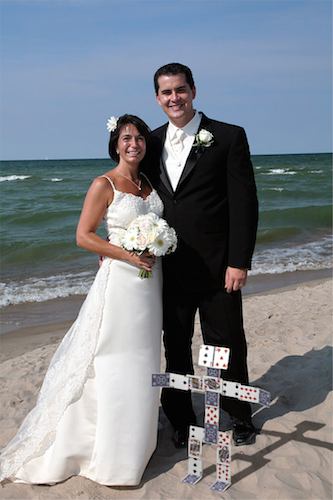
Okay, not the best picture in the world but the point is that I know how to do it. (BTW: that picture was an inside-joke.)
Honestly, I would rather use a camera like this:
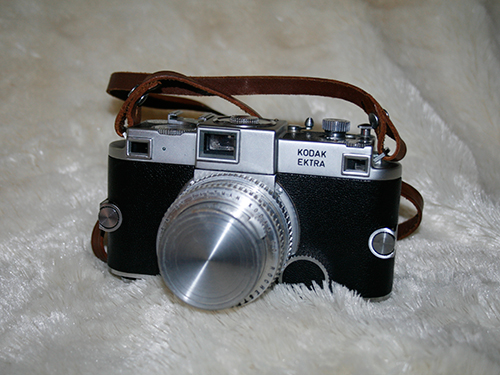
(Kodak Ektra 35mm. Circa 1942.)
I have many cameras like this. I like using them. I use them regularly.
I like putting my hands on them and turning the controls, not just because I like touching things but because I like the cause and effect relationship of operating the controls and getting a result.
We can simulate things digitally but there is a difference between using a Photoshop filter or feature and actually putting a photograph into a chemical bath in order to achieve a desired result.
Here, watch a video about Ansel Adams and how he worked in his darkroom. (Scenes of him actually working start at about 10:00.)
http://www.anseladams.com/ansel-adams-on-video-2-2/
Ansel Adams' work in the darkroom was anything but menial.
Would you rather have somebody cook you dinner in the kitchen or would you rather eat a frozen dinner from the microwave?
Would you rather actually cook dinner for somebody else, give it to them to eat and have them appreciate it?
Or, maybe, you would rather just swallow a "nutrition pill?"
Posted by Bobby Henderson (Member # 840) on 04-23-2014, 01:18 PM:
quote: Randy Stankey
I *LIKE* doing these things and, when I work digitally, I often find it boring for the lack of ability to do them. I don't mean things like digitally simulating a sepia toned effect. I mean using real potassium ferricyanide solution to bleach a real silver-gelatin photo print.
This reminds me of all the serious limitations involved in digital printing and even the display of colors in computer monitors or projectors. Scenario: a customer gives me a project. One of the colors in his logo is Pantone 3272C Green and the other is Pantone 2593C Purple. He demands these colors be matched exactly. You can't do that with any large format printer. Both of those spot colors are way outside the CMYK gamut range. Those two colors are damned near fluorescent in terms of color intensity. Even the best computer monitors will struggle simulating those colors accurately, and even then the representations provided by computer software are nothing more than an educated guess.
Hand made photographic prints often have a unique look to them you can't generate easily in the computer. The materials used make a lot of the difference. It's kind of like putting metal flake or pearlescent materials into enamel paints. You can't make digital prints of that type of stuff.
quote: Randy Stankey
Hoppe's No. 9... If you know what I am talking about, I don't even have to explain it to you. If you don't know what I am talking about, there is no point in explaining.
I cleaned my SigSauer P226 the other day. I tried not to smell the Hoppe's No. 9 too much.
quote: Marcel Birgelen
Digital archival is more than just dumping it onto a tape or disk and putting it into a cardboard box on some shelf. Digital archival also requires you to keep your storage 'alive' and moving it to new media as time progresses. The cost per byte should go down over time, since storage capabilities of modern media are ever increasing as are transfer speeds. On the downside, we're producing ever more digital information, but it's not like the information we produced in the past is suddenly going to increase, so that should be a factor that can be easily accounted for.
You're leaving out one factor in digital archival costs: the labor costs of continually checking the data and moving it from an old volume to a new one. An archival film print, if stored properly, won't have to be touched for decades. Digital data has to be moved and even manipulated (saved to current, compatible versions, etc.) far more often.
quote: Marcel Birgelen
The rolling shutter is a limitation of CMOS based designs and although we probably can improve the speed, we need a radical new design to get a "global shutter".
Some new cameras actually do have a global shutter based sensor. The new 4K camera from Blackmagic has a global shutter sensor. I don't know if there are any trade-offs with that sensor for it to have global shutter capability, such as a greatly reduced usable ISO range.
quote: Marcel Birgelen
Regarding your wood carving example: For a wood carver, digital might take the fun out of the job. Yet, there are plenty of people that love using Maya, 3D Studio, LightWave, Blender, AutoCad, etc. all day long. For them, 3D printing offers a whole new world of getting some of their designs into reality.
There is a decent amount of custom carving work done in the sign industry. It's done using wood, HDU, hard foam board and other materials. Computer driven routing tables can be used to cut out a lot of flat shapes. Computers honestly suck at other things, like making a properly beveled "prismatic" letter.
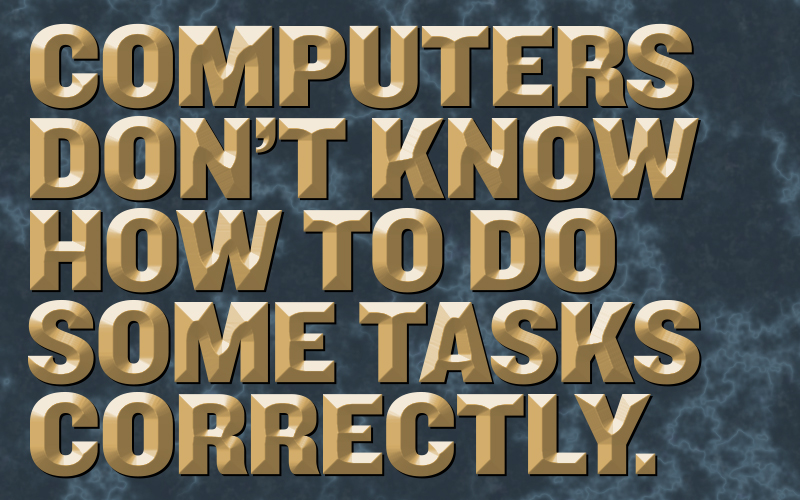
This is an example of Photoshop's inner bevel effect with the size setting maximized to create a would-be chiseled, prismatic effect. The results look like shit. The computer/software has no clue how to get the corners or joins beveled correctly. There is no computer software in existence that can generate this type of effect properly in any kind of automatic, simple click of a button way. No routing table software does it correctly. Even the most expensive 3D modeling programs can't do it right automatically.
Sign people carve primsamatic letters by hand. They might use a computer driven routing table to cut out the letter shapes to match a letter style and size exactly. But the remaining work must be done using "analog" carving tools. They'll either carve the letters directly (wood, HDU, etc.) or do the same thing to a mold for cast metal letters.
It is possible to model these kinds of letters using 3D modeling software like Maya or Cinema 4D. But it will probably take you more time to precisely model that stuff in the computer than it would for an experienced carver to generate it by hand.
Posted by Marcel Birgelen (Member # 6801) on 04-23-2014, 06:04 PM:
quote: Leo Enticknap
If it weren't for copyright issues (of course, by the time technology reaches that stage, the default copyright term will probably have been increased to 1,000 years) you'd probably be able to buy a copy of the disc on Amazon.
Yeah if somebody would ever be able to figure out all the rights, it will probably sell for $5 Million+ dollars, give or take a million... Or you could download your bootlegged version, free from DRM and non-skippable copyright warnings on the current iteration of The Pirate Bay...
But I guess you struck an important issue there, because copyright might be a bigger threat to archival in general than the progress of technology.
quote: Randy Stankey
Okay, not the best picture in the world but the point is that I know how to do it. (BTW: that picture was an inside-joke.)
Maybe the JPEG artifacts did their part in hiding it, but when I first saw the picture I didn't recognize the thing in front (let's call it Card-Bot) as an inserted 3D rendering, so I guess you did a good job here .
quote: Randy Stankey
Would you rather have somebody cook you dinner in the kitchen or would you rather eat a frozen dinner from the microwave?
Maybe you should upgrade your analog microwave to a new digital one.
But, if you treat a microwave oven solely as a device to prepare low quality, prefabricated frozen food or reheat yesterday's leftovers, then yeah, sure, it's a device the devil brought in to make us all unhappy. Although a microwave is a bad example (maybe it really is a device from hell?), I've actually used as part of some proper meals.
quote: Randy Stankey
Would you rather actually cook dinner for somebody else, give it to them to eat and have them appreciate it?
I happen to like cooking, especially the experimental part of it. But if I need to e.g. shred a bunch of onions, I sometimes happen to use a food processor. The same job could've been accomplished by hand, but it would be a menial task (at least for me) and the end result would not have been any better. Sure, somebody else might go bonkers on the cutting part, but for me that's not where the fun is, so if I can use a machine to do this, then I will gladly use it. I also don't think it takes creativity away, just the opposite actually.
quote: Bobby Henderson
You're leaving out one factor in digital archival costs: the labor costs of continually checking the data and moving it from an old volume to a new one. An archival film print, if stored properly, won't have to be touched for decades. Digital data has to be moved and even manipulated (saved to current, compatible versions, etc.) far more often.
Those things can be automated and if done right, it doesn't matter if you're moving a few gigabytes or some exabytes, the labor is the same. Modern file systems (e.g. ZFS) have built-in features to keep data consistent, there is really no need to manually check everything every so often. File systems of the future will surely improve on those features.
Fortunately, the awareness of the need of digital data archival is growing and data compatibility is one of the key issues. Still, this is a problem that can be quite easily overcome by standardizing on open, transparent formats. As long as those formats are well documented and lots of key data is stored in those formats, I'm sure we can ensure long-time compatibility and avoid the need to "transcode" those files every few years.
quote: Bobby Henderson
Some new cameras actually do have a global shutter based sensor. The new 4K camera from Blackmagic has a global shutter sensor. I don't know if there are any trade-offs with that sensor for it to have global shutter capability, such as a greatly reduced usable ISO range.
The Blackmagic 4K camera uses a CCD and not a CMOS sensor. Global (electronic) shutter and CMOS are as of yet, mutually exclusive. I would prefer CCD for film acquisition any time above CMOS based designs, because of the global shutter and more film-like look. The biggest downsides are cost (but Blackmagic has seemingly found a way to work it out) and a still relatively low frame rate.
quote: Bobby Henderson
It is possible to model these kinds of letters using 3D modeling software like Maya or Cinema 4D. But it will probably take you more time to precisely model that stuff in the computer than it would for an experienced carver to generate it by hand.
But depending on the amount of signs you sell, you could model every possible letter in any font you want to support just once and given the right tools/software, you could reuse those 3D models every time you need to make a sign with text and beveled edges.
Posted by Bobby Henderson (Member # 840) on 04-23-2014, 07:16 PM:
quote: Marcel Birgelen
Fortunately, the awareness of the need of digital data archival is growing and data compatibility is one of the key issues. Still, this is a problem that can be quite easily overcome by standardizing on open, transparent formats.
The nature of business gets in the way of standarding digital assets on open, transparent formats. It costs a lot of money to develop professional level, industry leading software. The companies that develop that software have to keep improving their applications and adding new features in order to stay in business. The improvements and changes sometimes come at a cost of negatively affecting or removing backward compatibility of files saved in old versions of the software.
Very little of the graphics software I use is open source. I have a few open source fonts installed, such as Source Code Pro, which came in automatically via Adobe Creative Cloud updates to Adobe Illustrator or InDesign. The file formats containing my projects, (.AI, .CDR, .FS, .PSD/.PSB, .AEP, .INDD, etc.) are all proprietary. People working in the video/broadcast industry, print publishing industry, movie industry, game design industry and just about any other creative industry deal with the same thing. Common file formats used by many applications, like JPEG, TIFF, etc. are still controlled by an owner rather than existing as an open source format.
Open Source alternatives for some types of creative applications do exist. Inkscape is an open source vector drawing application. The Gimp is an open source image editor. Blender is an open source 3D modeling/animation program. They're decent applications, particularly for being free to download. But they're not a practical substitute for a professional level application, like Adobe Photoshop, Adobe Illustrator or Autodesk Maya.
quote: Marcel Birgelen
I would prefer CCD for film acquisition any time above CMOS based designs, because of the global shutter and more film-like look.
CCDs have their own trade-offs. They require more power than CMOS chips. CCDs cost more to manufacture. CCDs are prone to their own strange types of artifacts, like vertical smearing. But that's not nearly as bad as all the rolling shutter effects you get from CMOS chips. I'm not so sure global shutter designs will help video look more like film -much that film look is generated via color grading in post production. Newer d-cinema cameras have different color profile modes that change how the video is captured to aid in the color grading process.
quote: Marcel Birgelen
But depending on the amount of signs you sell, you could model every possible letter in any font you want to support just once and given the right tools/software, you could reuse those 3D models every time you need to make a sign with text and beveled edges.
That's not practical to do unless you're producing a lot of copies of the same sign -like the beveled, prismatic letters and golden arches on McDonald's signs. When doing projects for small businesses and regional companies you often have to start from scratch with each job.
Posted by Mark Gulbrandsen (Member # 72) on 04-23-2014, 07:38 PM:
quote: Bobby Henderson
I tried not to smell the Hoppe's No. 9 too much.
I buy that stuff by the gallon... lots of guns to clean though. It also smells a lot better then Film Guard! However, I am considering trying Film-Guard on my barrels to eliminate streaks on my bullets.
Quick Draw McGraw
Posted by Randy Stankey (Member # 64) on 04-23-2014, 07:41 PM:
It's the shadows that give the secret away when I look at the picture of the Card-Bot. They don't map to the surface of the sand they way they should. It would have taken me a lot of time to model the ground surface then bump-map the shadows. The color and contrast of the shadow is a bit off, too. I wasn't about to spend an entire day doing that just to tell a visual joke.
I don't have a microwave oven but it's not because I don't like them. I don't want to spend the money and I can do just as well without one. It doesn't take me any longer to reheat food on the stove. I can make coffee or popcorn, actually, in less time on the stove top. If I had a microwave oven, I would use it as part of an overall cooking strategy. I have done so before but my wife took the microwave when she divorced me and I haven't seen fit to buy another one.
Same thing goes with a food processor. I have one but I don't use it very often. Mainly because of the amount of overhead involved. It is easier and faster to use a knife and cutting board than to assemble the food processor, use it then clean it and put it away than it is to just chop the onions. If I had a lot of onions to chop (e.g. onion soup) I would use the food processor. Most of the time, I'd rather just chop the onions.
Regardless of what device one uses to do a job, he needs to know how to do that job in the first place before he can decide which tool to use. Something that bugs me about digital cameras is the autofocus. It doesn't always work the way I want it to. I often end up disabling it and focusing manually, anyway. Otherwise, I'd have to press buttons to select "focus zones" or macro/landscape mode. When photographing a landscape with a lot of open sky, such as a sunset, autofocus does not work at all. I would rather just use a rangefinder focus system and dispense with all the automatic stuff.
BTW, using an autofocus lens manually usually stinks. The range of motion on the focus control is usually too short to be useful when working by hand. The Ektra in the picture has a rough focus and a fine focus. That's what the little, black dial to the right of the lens is. If you learn how to use those controls and you can get razor sharp focus, quickly and easily. Again, the point is that you have to know how to do a job before you start.
There lies another point. Too many people think that "digital" means "easy." Maybe it does, some times, but, too often, "digital" means "just as crappy but faster."
Posted by Mike Blakesley (Member # 26) on 04-23-2014, 08:30 PM:
quote: Randy Stankey
I don't have a microwave oven but it's not because I don't like them. I don't want to spend the money and I can do just as well without one. It doesn't take me any longer to reheat food on the stove.
How long has it been since you priced microwave ovens? You can get a pretty nice basic job for around $49 these days.
I agree with a lot of whats' been said here. It's a lot of fun sometimes to do stuff rather than click buttons. And, even on the computer it's more gratifying to do something manually than it is to automate or take a shortcut sometimes....I have done a lot of "newsletter" type publications for various organizations and I've never found a "template" that I liked -- I prefer to just set it up the way I want myself.
Posted by Randy Stankey (Member # 64) on 04-23-2014, 10:04 PM:
LOL! No, I haven't even had the interest to look at microwave ovens.
I don't eat microwave popcorn. I work in a movie theater. My popcorn standards are high. God! Microwave popcorn tastes terrible! Don't you think? Whirly Pop! Now THAT's popcorn!
I make coffee on the stove top with a Moka Pot. Nearly as fast as a drip coffee maker. (Which I have but never use.) I'd use a teapot on the stove to make tea. Again, nearly as fast as a microwave.
I'd rather cook most veggies on the charcoal grill, outside.
Grilled asparagus with prosciutto! Root veggies, carrots, potatoes, sweet potatoes would cook well in the microwave.
What's the cost on a microwave with enough wattage to cook a whole potato in a reasonable time? A couple hundred clams?
Posted by Bobby Henderson (Member # 840) on 04-23-2014, 11:46 PM:
quote: Randy Stankey
BTW, using an autofocus lens manually usually stinks. The range of motion on the focus control is usually too short to be useful when working by hand.
It really depends on the lens.
The 70-200mm f/2.8L IS II lens I bought a year ago works pretty well manually. The focus dial is big and doesn't have to turn far to cover specific ranges, such as medium close portraits or landscapes. It does take about half a revolution to go from minimum focus distance to infinity, but who needs to go to that extreme? The focus dial is easy for finger tips to reach even if I'm palming an attached tripod collar and quick release plate. The dial overrides the autofocus instantly. If the auto function just gets focus in the ballpark you can fine tune the results quickly. The lens has an autofocus limiting switch selecting between 1.2m-∞ or 2.5-∞. I can focus that lens manually pretty well. It's a very sharp lens and provides a bright image in the viewfinder.
If I had to do manual focus only, I'd change the focus screen in my 5D Mk II if only I could. Most modern DSLR cameras have very basic focus screens only meant to display the camera's auto focus points. The Canon F-1 I used in art school had a micro prism focus screen, showing a split image in a couple rings in the center of the frame. It was very easy to get very accurate focus using that.
Canon appears to only offer split image focusing screens for certain series 1 bodies. I'm very hesitant to try third party products that may not be properly designed to work with a 5D MkII body. I worry about how 3rd party focusing screens would affect metering, auto focus points and anything else I haven't already considered. For now, if I have to fine tune manual focus I'll use "live view" and select the 10x zoom to do so.
Posted by Randy Stankey (Member # 64) on 04-24-2014, 12:20 AM:
You should try a rangefinder camera to see how you like it.
You've got to understand how they work to use them properly but, once you do, I bet you'll like it.
More precise focusing. No mirrors or prisms to get in the way. No shutter lag. No "blackout" when releasing the shutter. No vibration. Quiet, nearly silent.
Yes, you can get digital rangefinder cameras.
Leica makes them: http://us.leica-camera.com/photography/m_system/m_new/
I'm not saying that you have to get one of these but I hope you'll check them out. I think you'll like it, if only for scientific curiosity.
Posted by Leo Enticknap (Member # 534) on 04-24-2014, 12:44 AM:
quote: Marcel Birgelen
But I guess you struck an important issue there, because copyright might be a bigger threat to archival in general than the progress of technology.
At the risk of veering off topic, it won't be so much of a threat to preservation, because both EU (2001 directive) and US copyright (DMCA) law incorporates specific exemptions and permissions for bona fide archives (defined slightly differently between the two) copying content in order to safeguard its preservation. It will be for access, though: multinational media giants are constantly spending millions on political lobbying to get the copyright subsistence term extended. In Europe, the 2001 directive standardised it at 70 years (after the death of the main creative personnel), whereas most member countries had much shorter terms than that for most media forms, and in US it was increased to 90 for some types of movie in the late '90s, basically in response to lobbying from Hollywood. As we're rapidly reaching the point at which some classic movies with significant IP value for DVDs, Netflix etc. are about to drop out into the public domain, the lobbying is going to move up a gear pretty soon, I'd guess.
Powered by Infopop Corporation
UBB.classicTM
6.3.1.2