This is topic Why didn't Mitchell continue building Projectors? in forum Film-Yak at Film-Tech Forum ARCHIVE.
To visit this topic, use this URL:
https://ft-forum.com/ft/cgi-bin/ubb/ultimatebb.cgi?ubb=get_topic;f=8;t=007014
Posted by Steve Matz (Member # 1890) on 06-01-2014, 11:13 PM:
I was doing some research on the Mitchell Camera Corporation which was a staple name in Motion Pictures going back to the early part of the 20th Century and has probably filmed more MP and Television Films in it's history than anything even close to second place.
I was surprised to see that they did build some Carbon Arc Projectors at one time;more specialized to work with their camera's for "Gone with the Wind" and also background projectors for VistaVision Effects...
So I kind of wondered why they didn't continue building 35mm Projectors since their Name was probably the best known in the Industry and their Reputation for building Professional Quality Built Camera'a was intact. I would have thought their name would have been a selling point if they would have decided to Mfger Production Theater Projectors. Maybe because they were making enough different Cameras for the Industry they didn't need to concentrate on producing a Theater Projector. It would have been interesting if they did to see what it's sales would have been like competing with the likes of Simplex,Motiograph,etc.
Mitchell made a pin-registered background plate projector with a carbon arc lamphouse which was synchronized with the film camera. One of the first MPRPPs (Mitchell Pin Registered Process Projector) was used in Gone with the Wind. Two and three-headed background projectors evolved for VistaVision effects.
Camera Models made by MITCHELL
Mitchell Standard - The original Mitchell camera, introduced in 1920
Mitchell GC - High-speed camera system able to run at variable speeds up to 128 frames per second
Mitchell NC/BNC ("Newsreel Camera"/"Blimped Newsreel Camera") - Improved model designed for production sound-shooting, introduced in 1932. This camera became the de facto standard for Hollywood Production for the greater part of the century. Mitchell NC and BNC camera heads became "donors" for Cinema Products Corporation XR35 cameras, which incorporated many of CP's improvements to the basic Mitchell production sound camera, and which were formerly available as separate features from CP.
Mitchell SS - Single-system camera - Used mainly by the U.S. Army Signal Corps units during WW-II; was a highly modified NC
Mitchell VistaVision - Production camera for sound shooting using Paramount's VistaVision process (The Ten Commandments (1956 film), 1956 and later; earlier VistaVision productions used converted Stein and/or converted Technicolor Three-Strip cameras). VistaVision was used by George Lucas in Star Wars for its larger negative while avoiding costly 65mm special-effects shots.
Mitchell FC/BFC ("Fox Camera"/"Blimped Fox Camera") - 65mm version of NC and BNC, introduced with Fox's improved Todd-AO system (South Pacific, 1957, and later)
Mitchell R35 - a pin-registered, hand-holdable and tripod-mountable reflex 35mm camera with multiple magazine mounting positions and an available sound blimp. Proprietary R35 lens mount. Succeeded by the R35R (industry-standard BNCR mount) and the R35RC (BNCR mount and crystal-controlled motor).
Mitchell NCR/BNCR - Reflex version of NC/BNC
Mitchell 16 - a pin-registered 16mm camera with the versatility of the Standard, and the high speed of the GC
Mitchell R16 - a pin-registered reflex 16mm camera which was relatively silent and was available in double-system (Model R16DS) and single-system (Model R16SS) models for newsgathering and newsfilm production. This relatively expensive model found use mainly with CBS's 60 Minutes. The single-system model incorporated a Davis (tight) Loop drive system, unique in all single-system cameras. The double-system model simply eliminated the Davis (tight) Loop drive system, and the lower sprocket, thereby reducing the complexity of the internal gearing and lowering the camera's acoustic noise signature.
Posted by Leo Enticknap (Member # 534) on 06-03-2014, 04:21 PM:
BMW is a household name in the motor industry, but they don't build trucks. Novo Nordisk is a household name in pharmaceuticals, but they don't make anti-cancer drugs. Etc. etc.
My guess would be that by the time Mitchell became established as a leading camera maker, the market in theatre projectors was a crowded and saturated one, and they didn't have any killer technology that would have enabled them to grab market share away from the established players. Look what happened to Kodak and inkjet printing.
quote: Steve Matz
and has probably filmed more MP and Television Films in it's history than anything even close to second place.
I would have thought that the Bell and Howell 2709 would be at least in a not-too-distant second place. OK, it proved too noisy to be easily usable for sync sound shooting, but for MOS photography and as an animation rostrum camera, this model remained in mainstream use well into the '80s. I seem to remember reading somewhere that the same physical camera that shot the cels for Snow White (through filters, to achieve the YCM successive frame seps) also did so for The Lion King (on chromogenic color negative stock). I believe that the SMPTE test films (e.g. RP-40) were also shot on a 2709, too.
Posted by Frank Cox (Member # 6258) on 06-03-2014, 04:37 PM:
BMW apparently makes trucks.
/pedantic
Posted by John Eickhof (Member # 323) on 06-03-2014, 04:55 PM:
The answer is fairly simple, as stated above the market was full of high quality proven equipment designs. Simplex quit making cameras in the late teens because of companies like Mitchell and Wall. A commercial projector from Mitchell would not only be too costly for the open market plus even with their high standard of quality would be overkill in comparison to the other makes of the day. The machines that you refer to were known as 'process projectors' and along with Mitchell, hundreds of variations were built to custom specs by the studio shops as well as other vendors like Straight Industries (Howard Straight, Also known as one of the co-designers of the Simplex XL, and a consultant to the industry for decades) Studios had the propensity to build one-offs or custom special purpose machines in house. Studios like Disney even designed and built their own projection systems for many of their amusement rides and special venues. Granted some of the machine work was farmed out to companies like LaVezzi, and CFS/Rentec as they had better set up facilities for the stringent demands of the studios. Of course all this is pretty much a moot point nowadays unless someone figures out a better way for pixels to line up!
Posted by Frank Angel (Member # 248) on 06-03-2014, 07:43 PM:
Actually, they need to figure out how NOT to have them lined up, but have them randomly placed....and then have them move around! ![[Big Grin]](biggrin.gif)
Posted by Steve Matz (Member # 1890) on 06-03-2014, 09:33 PM:
Actually Leo;BMW makes a nice looking PU Truck like this X5.They also make a line of Fleet Style Trucks...
BELL & HOWELL made a MP Printer usually Just referred to as a Model C that was pretty much the staple of the industry for years also. ![[Smile]](smile.gif)

Posted by John Eickhof (Member # 323) on 06-03-2014, 10:22 PM:
to add, Bowell & Growell made the Model D which was in more printing rooms during the 20s 30s and 40s than any other make. I made many positive release prints on the model D that I have. It came from a little studio called United Independent Productions that was in Oakland, CA. In my high school years I shot 35mm on an old B&H 71Q Eyemo that was the model used on front line combat in WW2 by the Signal Corps and Navy. Later I bought a JM Wall 35mm sound camera (Military version of the Mitchell NC) I still have both and lots of film shot by them. The D was a continuous contact printer long before modern step printers, and wet gate printers. Lots of memories! Sam C ought to remember UIP! and it's owner Robert M. Dominic. (LOL Sam!)
Posted by Monte L Fullmer (Member # 2797) on 06-04-2014, 01:11 AM:
We can ask the same question on why didn't Motiograph keep making projectors..
They built them too well to where they wouldn't break down. Thus, building a perfect machine was what shut them down since they couldn't sell parts.
Posted by Gordon McLeod (Member # 33) on 06-04-2014, 10:05 AM:
The Mitchell projector was far to expensive for comercialtheatre use and was designed around pin registration of B&H perf stock not regular KS perfs
Also it coulkdnt handle damaged film and rear projection prints had to be replaced every couple of takes as the wore badly
On Motiograph they were too expensive in a declining market and Wolk bought it mainly for their tooling to make parts
Posted by Steve Matz (Member # 1890) on 06-04-2014, 11:20 AM:
Speaking of MOTIOGRAPH; Our 3 outdoor theaters in the 50's all used BRENKERT BX Projectors with Strong Mighty 90 Lamps. Its interesting to note that when Cinemascope Came out in 53;two of the theaters rebuilt their Screens while one left it's old 1.33-1 size even until it closed in the late 70's(originally called the City-Vu,it was always considered the low end Drive-in) The Motor-Vu rebuilt a huge Scope size Screen compared to the Sage which was still Large compared to it's old one.When the Motor-Vu built the larger Screen they also switched to a Motiograph Projector(AAA I believe.I'm thinking maybe why they did this was something John Eickhof said to me when I was conferring with him on the differences between the AA and AAA Projectors.
John said: quote:
The Motio AAA was their answer for 4" diameter lenses, the AA had the conventional 2 25/32 lens holder, and with the larger screens and longer throws, the faster speed 4" lenses made a big difference in brilliance and sharpness plus the ultra high intensity arcs were at a faster focal speed too, so the combination made Motio the preferred drive-in machine. Plus the barrel shutter due to tight gearing was able to pass 20% more light than a Brenkert or Simplex E-7. (even though it's size and location required lamp manufacturers to make longer working distance reflectors so they could pass light past this highly efficient Shutter.
This made sense since this Drive-in's Projection Booth was much farther back than the other Drive-in's and with the much larger Screen. I guess Motiograph had an issue with it's Shutter being made of aluminum and the extreme heat from the powerful Lamp/Reflector caused the bearings to prematurely fail. All in all most of the old-timer projectionists I talked with through the decades praised Motiograph as being one of the Finest Projectors they ever used.
I also believe when Television was taking away audiences in the early 50's that Companies like Motiograph and Devry were victims of making a Product that was MAYBE too Good and Reliable. If no new theaters were being built in this time frame;your not selling any new projection equipment and selling a minimal amount of repair parts then what are your options.Filing Bankruptcy comes to mind.I don't know what it relates to but between 1953-55 there were more CHICAGO Based business's (not just MP based Equipment) that closed their doors for what ever reason.I don't remember hearing or reading that the economy in the early 50's was that bad to cause so many long time Business Mfger's to have to close their doors. ![[Eek!]](eek.gif)
Posted by Jim Cassedy (Member # 4115) on 06-04-2014, 03:08 PM:
An early (1939) Mitchell Process Projector (Minus lamphouse & base)
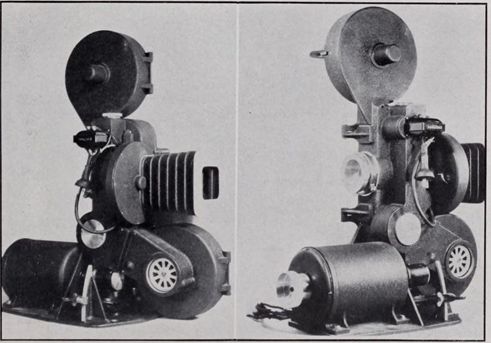
-jc-
Posted by Mark Gulbrandsen (Member # 72) on 06-04-2014, 03:12 PM:
As optical effects came into being and were perfected background projection fell out of use. There were still limited us of it but not as widespread as in the beginning. At least two of the films I worked on used background projection one of them being Uncle Buck. They hired Bill Hansard to bring one of his Mitchell projectors in to Chicago. He was there a total of two days and all it involved was a night background out the rear of a car's window.
As to why Mitchell didn't build theater type equipment... Their movements would have never held up to day in day out use in a movie theater. They are ultra precision pin registered movements that have to be oiled by hand every couple thousand feet of film.
Mark
Posted by Robert Koch (Member # 3728) on 06-10-2014, 01:54 PM:
I`m 92 and never thought I`d live long enought to hear Devry described as good and reliable.
Posted by Steve Matz (Member # 1890) on 06-11-2014, 01:03 AM:
Well Robert their is never 100% reliability or agreement in almost anything made.Of all the old school projectionists that I talked with over the decades(most of which are gone now)I never heard one of them complain about the 12,000 series or Portable XD's used in Military situations; being unreliable or troublesome projectors. I can't speak for your expierences with Devry but during my research of the Company they always had a good reputation...
Posted by Robert Koch (Member # 3728) on 06-30-2014, 08:34 PM:
Steve:
Ive tried to respond to your admonition of me for being critical of Uevry for quite a while; but, with my limited experience with computers ,some how they dont come thru. Obviously you have no experience , hands on with Devry~s. Well I have and believe me it wAS all bad.I diont know what corruption existed in the navy{Bu ships] at the time but ghe purchase of Devry projectors had to be at the top of the list. I worked for RCA Photophone for many yearsand while the higher ups were delighted when we received the navy contract, myself and my associAtes who had to work withis miserable crap were crestfallen. You had to know the existence of professional equipment available at the time. With the Devry your very existance depended upon a New Departure bycicle chain. Devry was a miserable piece of equipment and from your admonition of me,I can tell you have never worked in the business. Pay attention to my mention of corruption because I1m sure it happened and the Navy was saddled with inferior equipmentfor however many years
Posted by Steve Matz (Member # 1890) on 06-30-2014, 09:40 PM:
Bob; If your Projection Skills were as good as your Spelling and Punctuation in your above post,I would venture to bet that anything you ran was probably Junk.I wasn't admonishing you personally on your comment about Devry Projectors(maybe you were running a Uevry Projector)I simply said almost all the old school projectionists I interviewed in the 60's didn't seem to have the same opinion that you have. As far as not knowing anything about Devry Projectors I have owned a 2810 XD for a number of years and it has always ran flawlessly; and no chain issues either. I also ran a Film Library for over 20 years. so never being in the Business Dope you apparently believe me to be doesn't Fly.If you want to start slinging Mud about someone you have never met or known expect some return Mud...S.M.
Posted by Gordon McLeod (Member # 33) on 06-30-2014, 11:25 PM:
Devry was what it was it was a low cost machine in many ways clever.In away it predated the use of the timing belt in the victoria 5, the christie , and the ernamann12
It was not stellar but it also wasn't junk I worked and serviced many of them that were used for dailies projection
Is it my favorite far from it but also not the worst
Posted by Steve Matz (Member # 1890) on 07-01-2014, 10:46 PM:
What I liked about Devry! While every other Projector Mfger was essentially revising their Silent Projector head(i.e. Simplex Standard) to adapt to sound after 1928 with a big bulky Soundhead. Devry designed an
integrated unit where Picture/Sound was all in one Housing much
like most of your 16mm AV Projectors. This made the Unit not only
lighter overall but more Compact.
Myself, I would like to use a Gilmer style Cogged Belt System on my XD as I believe it would run much quieter and no lubrication needed.However I have never had Chain issues that some talk about.I use a REYNOLDS MFG Chain and it works Flawlessly. Maybe
back in the day Chain Quality wasn't what it came to be. When the Spanish Motorcycle Company MONTESA made a model called the Diablo in the mid 60's it had the worst chain that could possibly be put on a motorcycle. It kinked up and destroyed sprocket teeth among other things. Montesa sent a Sheet to dealers telling them to soak the chain in a pan of 30wSAE ND oil and literally set the pan on fire to cook the chain.(The Fire Marshal Loved This,NOT!)Believe it or not it worked but most of us just went to a Domestic made chain from Diamond Industries...
Posted by Richard Fowler (Member # 893) on 07-02-2014, 07:10 AM:
The Devry 12000 with all driven film sprockets was a passable machine……the XD I removed from many screening rooms and dailies packages usually went to the dump….except for the intermittent assembly.
Posted by Mark Gulbrandsen (Member # 72) on 07-02-2014, 01:30 PM:
There are a lot of issues with the DeVry's. Many of the rollers are not machined for any clearance in the image and sound area. There is also a dead heading roller in the sound head section that can seize up... I would never run any valuable film on one. The last one I had went in the dumpster about 5 years ago!
Mark
Posted by Sam D. Chavez (Member # 1841) on 07-02-2014, 07:36 PM:
Agree with Bob Koch and Mark. The only precision item was the Simplex Int.
Powered by Infopop Corporation
UBB.classicTM
6.3.1.2