This is topic Interesting Read on Film vs Digital in forum Film-Yak at Film-Tech Forum ARCHIVE.
To visit this topic, use this URL:
https://ft-forum.com/ft/cgi-bin/ubb/ultimatebb.cgi?ubb=get_topic;f=8;t=007017
Posted by Steve Matz (Member # 1890) on 06-08-2014, 09:02 PM:
The whole Page is interesting but scroll down to the Newspaper Article that ALEX GORDON/ MOTION PICTURE HERALD wrote back in November 1953 on why in his opinion Theaters were losing Audiences and it wasn't because of TELEVISION. Probably a big reason why 3D Fizzled out as quick as it did. Check it out!
http://greenbriarpictureshows.blogspot.com/2012/09/the-film-vs.html
Posted by Mike Blakesley (Member # 26) on 06-08-2014, 09:56 PM:
Yep bad presentation could be a problem even then. It didn't get invented in the 1990s.
When I started projecting, there were often 2 of us in the booth (one working, one hanging out and helping due to having nothing else to do). The boss was downstairs -- he watched every movie, every night -- and if ANYthing went wrong, we could hear him coming up the stairs. Sometimes you'd swear everything was fine and he'd bust in the door saying check the focus, dammit! and we'd find that it was just a hair out of whack.
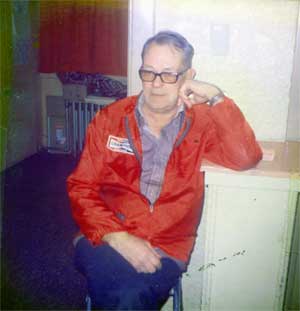
I credit this guy, Don Herndon (seen here at his show-watching post in 1975), for me being the presentation nerd I am today.
Posted by Robert E. Allen (Member # 1351) on 06-08-2014, 10:52 PM:
I never worked a two-man booth but the IA had a number of them around. And you bet the presentation in those (usually first run) had better be perfect or the union would be in for a big fight for two man booths the next time contract talks came up. I took a great deal of pride in doing the very best I could to put on a good show.
Posted by Steve Matz (Member # 1890) on 06-09-2014, 01:45 AM:
I can't remember even as a little kid going to the downtown theaters every Saturday 52 weeks out of the year;ever remember things like Film Breakage,sound flutter,etc. Maybe every blue moon the Focus might change but it was corrected in just a few seconds so you knew the Projectionist was on the ball.
A competent projectionist would inspect all the reels when they came from the exchange before exhibiting them. That was just standard procedure.If for some reason the Print you got didn't get a thorough inspection from the last return; it might have anything from torn sprocket holes,bad splices,etc. All of this would have been caught ahead of time before that Reel ever even made it to the Projector.
It wasn't until the first Multiplex came here and it was just 3
theaters(CINE 3) that I started seeing things like extended out of Focus times, Bad Sound,Film Flutter,etc. Of course this is when the same guy running the projectors was down selling Popcorn once the Movie started because they were using Platters by then. I remember one time having to go out to the Lobby to get someone back up in the Booth to correct the Focus. This was like after 4 or 5 minutes;thats unexcusable but it happened all the time.
It seemed all the Good Competent Projectionists went with the Sunsets.I guess it's that way with almost every profession;your going to have employees that actually care about their job and give 100% and then your going to have the one's just there to do the minimum and collect their PayCheck. ![[thumbsdown]](graemlins/thumbsdown.gif)
Posted by Rick Raskin (Member # 1561) on 06-09-2014, 06:09 AM:
I don't recall ever missing a changeover when I was a projectionist nor did I allow a picture to remain out of focus. If I had, the Union would have been on my case because the chain I mostly worked for (KB) would not have put up with it.
What I did encounter however, were some other theaters who in the interest of having the largest possible picture and the shortest possible throw, exceeded the capabilities of the lens technology of the time. That resulted in scope pictures that had to be focused at the center because it was impossible to get proper azimuth alignment across the whole screen. Anybody remember Kollmorgen lenses? Fault of the projectionist -- Nope!
One theater chain wanted everything projected 1.85:1 resulting in severe cropping. They did not even have the proper lenses or plates to project 1.33:1. Fault of the projectionist? -- Nope. In fact when I suggest using the scope plates with the scope prime lens and adjusting the masking, I was told it was none of my business. They once showed a special engagement of "An Evening with the Royal Ballet" and the operator had to ride the frame knob in order to keep the dancer's feet in view.
Granted, there were some lazy ass operators who could have cared less but a management call to the Union usually got those guys either removed or corrected.
I don't advocate film over digital or visa versa. What I'm interested in is the best possible viewing experience, independent of media. I can remember receiving 35mm prints in normal distribution that were damaged and no replacements were available. I can also remember receiving prints within minutes of show time and inspecting reel 2 while reel 1 was on the screen.
It seems to me that here were a lot of don't care attitudes out there at the time right from the distributor on down to the in house theater personnel.
Posted by Steve Matz (Member # 1890) on 06-09-2014, 11:29 AM:
I'm all for the Practice which you see in a lot of Mfgering/Assembly of having to sign off on what you assembled,built, inspected,etc. When you bought a Z06,LS7 engine optioned CORVETTE; those engines were hand assembled by a Journrymen GM Employee in Wixom,Michigan. He even had his name on your Engine Block;so you know his Competence and Work Ethics was more than likely going to be 100% as his Job could be on the Line.
If Film Exchanges had done this ,where who ever inspected/repaired the Print before your theater got it,then your chances that the print was in acceptable shape would probably be pretty good. Even people that are earning minimum wage that still give their all in what ever their Job may be; shows you that they are the type employee you want working for you or at a place you do business with.
If a person has to sign off on everything he builds,assembles,inspects,repairs,etc.,then your going to be able to weed out the Lazy Incompetent Bums fairly fast from Business's and the product you buy/receive should generally be in the higher quality category...
Posted by Martin McCaffery (Member # 37) on 06-09-2014, 12:14 PM:
Of course, the whole point of modern, corporate capitalism is to remove any individual responsibility, from top to bottom. Scapegoats, yeah, they're good with that. I don't know about the car engines you mention, but most things are so atomized they can't claim to be assembled by any one person.
Besides, most of the names would be in a language we can't read ![[Wink]](wink.gif)
Posted by Gordon McLeod (Member # 33) on 06-09-2014, 03:01 PM:
MCA Universal when they had their own exchange and depot had a sticker placed on each reel saying revised by....... and date
Posted by Scott Norwood (Member # 30) on 06-09-2014, 04:35 PM:
TES did this in the late '90s and early 2000s. The problem is that the employees there just put their name stickers on the reel bands (usually covering the thing that the string needs to loop around to secure the band) without actually inspecting the prints.
Posted by Frank Angel (Member # 248) on 06-29-2014, 06:32 AM:
Gee, I guess for over a century no one ever got a chance to enjoy any movies at all, let alone any of the great classics, what with them being out of focus and missed or bad change-overs every 18 minutes! I mean, how could anyone know if CITIZEN KANE or CASABLANCA were good movies if they were "consistently" out of focus and the sound to loud or too soft? This guy claimed that New York City and Hollywood LA were the two WORST centers for film projection? Come on; it's one thing to take some license in making a point, but really? At the premiere of GONE WITH THE WIND at Grauman's Chinese, it was out of focus and they missed change-overs? Same with MY FAIR LADY at the Rivoli in NYC...bad changeovers and some guy forgot to thread correctly around the sound drum?
Like everyone has already pointed out and we probably have decades of film viewing under our collective belt, a good portion of it as spectators in our youth and lots of it before the advent of the multiplex and platters, and while I can't speak for everywhere else, I watched almost every film title that I now consider beloved classics, all in NYC, in the great theatres on Broadway and I simply did not experience these anomalies this Alex Gordon guy talks about in his gripe-fest letter to the MPH, most of which just seems ludicrous and which the author of the article then uses to seemingly bolster some vague connection he's trying to make between film collection and poor projection practices (evidently in every theatre on the planet), DVDs and his personal inability to properly operate and maintain a 16mm projector at home. Seems he's been soured on film by all those paper cuts he's endured.
So his point is....?
And btw, this notion that quality projection only existed in the big cities and in the big union houses is also another unfair bias that you hear occasionally...I worked in probably one of the smallest towns in the USA -- College Station, so small they didn't bother naming it -- they just called it the name of the train stop; then they finally combined it with the town next to it to be Bryan-College Station. Anyway, in our theatre (800 seater with a cry room), a first run for that town, the owner would watch many a show from the floor and woe to you if he saw something he didn't like. Every projectionist that worked for him was conscientious and dedicated. I learned a lot from those guys (and one woman, believe it or not) and none of them or any other projectionist in his chain would be nonchalant about any aspect of the craft, changeovers, focus, arc alignment or curtain protocol (yah, we had that).
Could you find operators who were slackers, of course, just as in any line of work; but I am sorry, suck-ass shows were not something you saw routinely, Mr. Gordon notwithstanding; he's just off base.
Posted by Bill Gabel (Member # 1105) on 06-29-2014, 10:26 AM:
quote: Frank Angel
At the premiere of GONE WITH THE WIND at Grauman's Chinese, it was out of focus and they missed change-overs? Same with MY FAIR LADY at the Rivoli in NYC...bad changeovers and some guy forgot to thread correctly around the sound drum?
That guy must of had the worst seats in the house for the premiere of Gone with the Wind at the Grauman's Chinese Theatre. Because the film premiered across town at the Fox's Carthay Circle Theatre. It's really hard to make a good change-over of My Fair Lady at the Rivoli Theatre when the film premiered at the Criterion Theatre 4 blocks away.
Posted by Frank Angel (Member # 248) on 06-29-2014, 10:53 AM:
Oh Bill, you're so picky. Only 4 blocks away? That's exactly what I mean...those guys were REALLY skilled.
Hey, we were so skilled in fact that we were able to run BLOW UP among others, in TWO theatres, one at my theatre in College Station and the other in Bryan and we only had a SINGLE print! That and an old beat up pickup truck. The kid usher would take three reels and truck truck them back and forth between the two theatres. The big worry always was that the truck would break down between on one of the runs and there you were as reel 3 was running out and 4, 5, and 6 were just a dust cloud in the distance. Skill...and nerves of steel, I tell ya!
Posted by Bill Gabel (Member # 1105) on 06-29-2014, 11:04 AM:
A few years back we were doing a press screening of Apocalyse Now Redux in Times Square at the Broadway Screening Room and we had to bicycle the print with another full screening with the Park Ave Screening Room which was 10 blocks away. We did that a few times with the Magno Screening Room which was 1/2 block away.
Posted by Leo Enticknap (Member # 534) on 06-29-2014, 11:42 AM:
quote: Frank Angel
Could you find operators who were slackers, of course, just as in any line of work; but I am sorry, suck-ass shows were not something you saw routinely...
The problem now is that suck-ass shows are becoming more common in the remaining theaters that still show film, not so much because of negligent projection, but because most of the 35mm and 70mm prints remaining in circulation are pretty bad - from negligent handling in the past, simple wear and tear, and/or dye fading.
Apart from the ones from archives that are anally retentive about where they let their prints go, pretty much all the film prints I've shown since I started at the American Cinematheque about two months ago have had at least one serious defect. I was chatting to one of our volunteers the other day, who told me that her and her husband used to see movies regularly at the New Beverly (the rep theater owned by Quentin Tarantino that has a "35mm only" policy and refuses to screen digital features), but that they eventually stopped because things got to point at which virtually every movie they played was either scratched to hell, dirty, pink or all three. It doesn't matter if the projectionists at that house are all master craftsmen/women: if the prints entering the building are all garbage, then garbage in = garbage on the screen.
Posted by Bill Gabel (Member # 1105) on 06-29-2014, 11:54 AM:
quote: Leo Enticknap
(the rep theater owned by Quentin Tarantino that has a "35mm only" policy and refuses to screen digital features)
Quentin has a collection of films that he has bought over the years that have a lot of miles on them.
Posted by Martin McCaffery (Member # 37) on 06-29-2014, 12:31 PM:
quote: Leo Enticknap
Quentin Tarantino that has a "35mm only" policy and refuses to screen digital features
HAD. Past tense. They have digital now.
http://www.newbevcinema.com
Posted by Leo Enticknap (Member # 534) on 06-29-2014, 11:25 PM:
Wow - another domino has toppled over!
Posted by Steve Matz (Member # 1890) on 06-30-2014, 10:22 PM:
Changing the Subject here to CHANGE OVERS;Obviously you want a scene change when going to the next reel.I guess if a projectionist had checked every reel on a footage counter I would be answering my own question.Someone working in a Processing Lab would probably know this. Are their slight footage differences between reels. If the printer operator needed to go another few feet or more so the reel would end at a scene change does he do it or do they print exactly 1800FT and if it ends in the middle of a scene;Too Bad.
All the years that I watched reel changes as a kid when I knew what the Que Marks were in the upper right corner. I can only remember just a couple times where the scene was still in continunity. If the changeover wasn't perfect than you could spot that little glitch after the second set of Ques. I would think the Quality Labs like Deluxe and Technicolor would have printed enough footage to have a scene change at the end of each reel so you would have a smoother transistioning Movie and not give the projectionist Fits...
Posted by Bill Gabel (Member # 1105) on 07-01-2014, 01:37 PM:
quote: Steve Matz
All the years that I watched reel changes as a kid when I knew what the Que Marks were in the upper right corner. I can only remember just a couple times where the scene was still in continunity. If the changeover wasn't perfect than you could spot that little glitch after the second set of Ques. I would think the Quality Labs like Deluxe and Technicolor would have printed enough footage to have a scene change at the end of each reel so you would have a smoother transistioning Movie and not give the projectionist Fits...
Steve the editor of the film conforms the film as to how each reel should end and start, not the lab. The lab prints the reel only after the editor has signed off on the print and the picture is locked.
Posted by Martin McCaffery (Member # 37) on 07-01-2014, 04:27 PM:
quote:
Wow - another domino has toppled over!
And interestingly enough, they are showing DCPs of new films that are available in 35mm. Only Lovers Left Alive we just ran in 35mm, but they'll be showing it DCP.
Posted by Victor Liorentas (Member # 5272) on 07-01-2014, 04:31 PM:
It should be added that Only Lovers Left Alive was shot digital.
They are still playing plenty of 35mm.
Anyone know any projectionists from The New Bev?
Posted by Leo Enticknap (Member # 534) on 07-04-2014, 01:01 AM:
quote: Bill Gabel
...the editor of the film conforms the film as to how each reel should end and start, not the lab. The lab prints the reel only after the editor has signed off on the print and the picture is locked.
I get the impression that in the pre-long play nitrate days (i.e. when all movies were projected with changeovers), editors tried to configure their reels to make the changeovers easy. Show a '30s or '40s studio classic and the chances are that most if not all the changeovers will happen on a fade to black, so much so that you barely need the visual cues. From the mid-50s (roughly) onwards, however, they started putting them anywhere, reducing the margin of error in changeovers from fractions of a second to virtually zero. One that sticks in my mind is in Chinatown, right in the middle of a quickfire exchange of dialog. If you thread the incoming reel too far down the leader or are a millisecond out punching the buttons, you'll clip some words out.
I'm guessing that this is something that studio editors were trained to do in the nitrate/reel-to-reel days (make the reel ends projectionist-friendly), but then as safety film and platters/towers/double-MUTs became the norm, the old timers still did it but it just wasn't on the radar of the the new generation of editors, for whom this didn't factor into their decision-making as to where the reel breaks went.
Posted by Martin Brooks (Member # 1269) on 07-04-2014, 08:25 PM:
quote: Frank Angel
Like everyone has already pointed out and we probably have decades of film viewing under our collective belt, a good portion of it as spectators in our youth and lots of it before the advent of the multiplex and platters, and while I can't speak for everywhere else, I watched almost every film title that I now consider beloved classics, all in NYC, in the great theatres on Broadway and I simply did not experience these anomalies this Alex Gordon guy talks about in his gripe-fest letter to the MPH, most of which just seems ludicrous and which the author of the article then uses to seemingly bolster some vague connection he's trying to make.
Totally agree. I also grew up in NYC and while some second- or third-run neighborhood theaters may have not had the best practices, I don't think I ever saw a bad show on Broadway during the roadshow era. Seeing such presentations as "How The West Was Won" at the Loews Cinerama and "West Side Story" in 70mm at the Rivoli was so amazing to me, it's one of the primary reasons I became a recording engineer.
And while it never projected in 70mm or 35mm stereo, the Loew's Paradise in the Bronx, one of the original "wonder theaters", was an experience all unto itself. That movie palace was magic and the presentation was pristine.
During the Dolby 70mm era, I did have to be a bit more selective by seeking out the best theaters, but the old Loews Orpheum Twin, the Ziegfeld and the Loews Astor Plaza all put on spectacular presentations.
And during the mid-80s to mid-90s, I found myself on business in Los Angeles and San Francisco and found many of the theaters there to have even better presentation than theaters in NYC at the time.
I'm sure there were plenty of bad presentations in plenty of theaters - worn prints, sloppy projectionists, dirty theaters, etc., but that's true for any type of business. If you sought out the best, you got the best.
Admittedly, that's a bit harder to do today.
Posted by Martin McCaffery (Member # 37) on 07-22-2014, 08:35 PM:
quote: Leo Enticknap
I'm guessing that this is something that studio editors were trained to do in the nitrate/reel-to-reel days (make the reel ends projectionist-friendly), but then as safety film and platters/towers/double-MUTs became the norm, the old timers still did it but it just wasn't on the radar of the the new generation of editors, for whom this didn't factor into their decision-making as to where the reel breaks went.
A Hollywood editor friend of mine sends along the following:
quote:
As an editor I was taught to be aware of where to "break" the reels, so the changeover wouldn't accidentally clip dialogue or action. Ideally I would end the reel at the end of a scene where there'd be a "beat" before the next scene, which would ideally start on an establishing shot, or a character entering a room. But as the film editing pace got "faster" this became more of a challenge - yet I tried -- still do. As changeovers are almost a thing of the past (with digital projection) it is not much of an issue anymore, but movies are mostly still mixed in "reels," so I try to end a reel at the conclusion of a scene, so the scene sounds uniform. Some movies are now mixed as 1 long reel, but not many - yet.
Another reason editors tried not to break scenes over 2 reels was for color consistency. Back in the film days different reels would come out looking slightly different, which would be jarring to the viewer's eye.
He's been an editor since the early 80's, so post nitrate and into the platter era, but still dealing with changeovers for most of that time.
Powered by Infopop Corporation
UBB.classicTM
6.3.1.2