This is topic First In Flight Movie in forum Film-Yak at Film-Tech Forum ARCHIVE.
To visit this topic, use this URL:
https://ft-forum.com/ft/cgi-bin/ubb/ultimatebb.cgi?ubb=get_topic;f=8;t=007021
Posted by Michael Putlack (Member # 6523) on 06-21-2014, 10:34 AM:
http://paleofuture.gizmodo.com/was-this-the-first-in-flight-movie-1591487207/+ericlimer
quote:
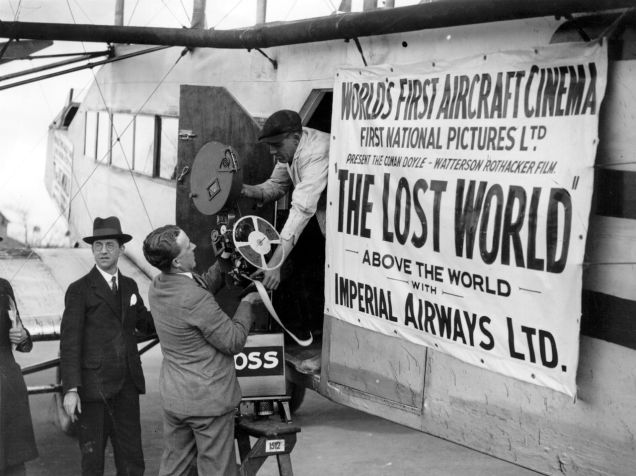
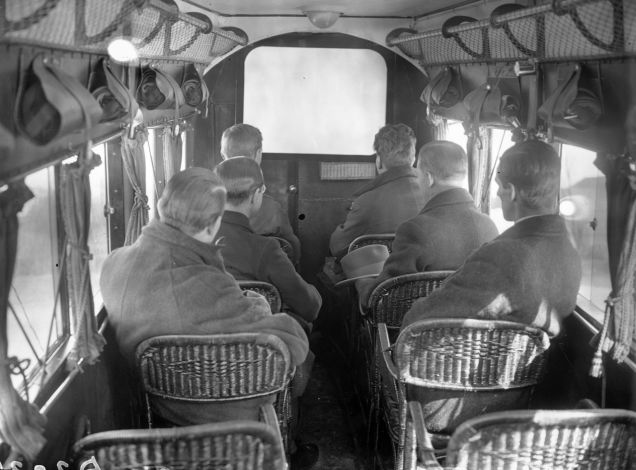
The photo above, taken on April 6, 1925, shows a movie projector being loaded into an Imperial Airways airplane for the first in-flight movie ever. And the photo below shows the screen and interior set-up for this historical feat. But was it really the first in-flight film ever shown? Technically, no.
Indeed is was one of the first, and amazingly those Imperial Airways flights even experimented with sound delivered via radio and a live orchestra. But if they weren't the first to play a movie in the sky, as they proudly claimed with that banner on the side of the plane, then who was? The answer is probably a flight in 1921 showing a short film called "Howdy Chicago!"
The "Howdy Chicago!" flights were happening during a trade show called Chicago's Pageant of Progress, and the film itself was more or less just an ad for how great Chicago was. We can compare and contrast that with the Imperial Airways flights four years later in any number of ways.
Imperial was screening The Lost World, a major Hollywood movie adapted from Arthur Conan Doyle's 1912 novel. The Chicago flights were showing a short film made by Chicago business boosters. So, yes, the Imperial flights were closer to what we think of today as in-flight entertainment. But the Chicago flights were the first known demonstrations of movies in an airplane.
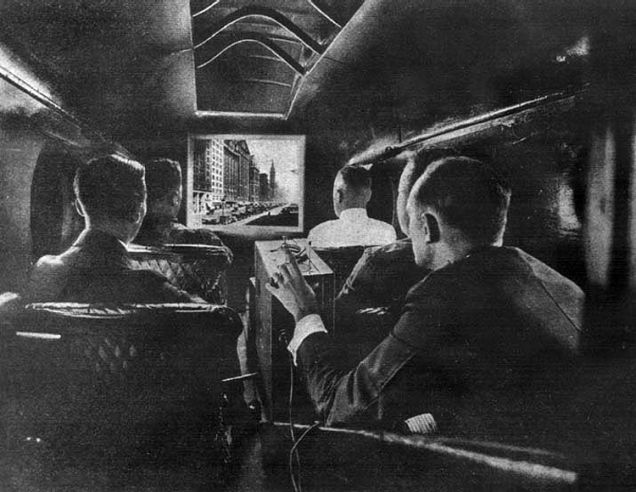
The image below (clearly a photo-illustration, since the screen itself wouldn't have photographed that well) appeared in the August 22, 1921 issue of Aerial Age magazine and showed what the "Howdy Chicago!" screening might have looked like.
From the August 22, 1921 issue of Aerial Age magazine:
Motion pictures on the screen while flying through the clouds at 90 miles an hour! History's first aerial movie show was on board the eleven-passenger hydroplane, Santa Maria, at the Chicago Pageant of Progress—and the first picture ever to be projected 2,000 feet above the earths surface was 'Howdy Chicago!" produced by the Rothacker Film Co. for the Chicago Boosters Club, for use in telling the world about the Windy City's selling points. A screen was hung in the forecabin of the machine; a DeVry suit-case projection machine fastened firmly in position and connected with an electric light socket. The projectionist pressed the button and the audience beheld cinema views of Chicago while flying over Chicago,
Before the flight it was feared that the vibration of the giant hydroplane as it shot through at 90 miles an hour would seriously interfere with the screening. But it did not. This historic flight demonstrated the practicability of movie entertainment for transatlantic aerial commuters in the days to come.
Anytime you're dealing with claims of technological "firsts" you're stepping into a steaming river of shit. Technically, the Imperial Airways flights were the first Hollywood feature movies shown on commercial flights. But the pedantic weirdos out there (read: me) can always say, "yes, but what about..." any time there's some technology or demonstration that was close and happened earlier.
You see this all the time with claims of "first" to technology — like how today's brutal patent battles between companies like Apple and Samsung try to lay claim over the invention of glowing rectangles. And things only get more complicated as years pass and new high-tech becomes ancient history.
There may even be some example of a short movie being shown in an airplane prior to the 1921 Chicago experiments. If you know of any, please provide photos and links below, you pedantic jerks.
Posted by Brad Miller (Member # 2) on 06-21-2014, 01:14 PM:
Pasting the images here since that link will probably die in time and these pictures are very relevant.
Posted by Leo Enticknap (Member # 534) on 06-21-2014, 02:13 PM:
quote: article
Indeed is was one of the first, and amazingly those Imperial Airways flights even experimented with sound delivered via radio and a live orchestra.
And furthermore, delivered from the plane as well as to it! The jazz bandleader Jack Hylton and several of his musicians had a weekly show in the mid-1930s, which was broadcast from an Imperial HP42 flying over London (footage). In Edward Pawley's book BBC Engineering, he explains that putting the band in the air wasn't just a publicity stunt: being aloft allowed them to transmit the signals to multiple relay stations at once, meaning that the outside broadcast was more reliable. I have a vague memory of there also being some airborne Hylton footage in the documentary The BBC: The Voice of Britain (published by the BFI on a DVD box set a few years ago), but it's a long time since I've seen it and I could be misremembering.
Posted by Scott Norwood (Member # 30) on 06-21-2014, 02:18 PM:
Nitrate film and airplanes sound like a great combination! I wouldn't want to be on that flight....
Posted by Rick Raskin (Member # 1561) on 06-21-2014, 02:23 PM:
They probably allowed smoking too.
Posted by Joe Redifer (Member # 3) on 06-22-2014, 02:51 AM:
I am very jealous of their legroom and comfort compared to the stuff we have today and it still looks like a horrible claustrophobic mess.
Also notice that there are 6 passengers but only 4 of them showed up to the movie. Did the other two see what movie it was and just decide to jump? That's what I'd do if they showed something with maybe John Leguizzamo in it. Also why did the interior of the plane change shape once the movie started? I assume it had some sort of auto-acoustic thing which optimizes the interior for the best sound.
Posted by Leo Enticknap (Member # 534) on 06-22-2014, 11:55 AM:
quote: Scott Norwood
Nitrate film and airplanes sound like a great combination!
It could have been safety. Safety film did exist before the invention of what was then called "high acetyl" (i.e. triacetate) in 1948, but it was a lot more expensive, fragile and brittle than nitrate. So 16mm, film for still photography and film for virtually every application in which fire precautions were impractical was made on diacetate, butyrate and/or propionate base. A limited amount of theatrical 35mm was, usually for ads, trailers and shorts so that they could be sent through the regular mail.
All that having been said, if you were willing to take a ride on an inter-war airliner, the hazard posed by nitrate film on board was probably insignificant! That having been said, the Handley-Page HP42 (Imperial Airways's flagship land plane during the 1930s) was probably one of very few 1930s airliners that had no accidents and did not injure anyone who flew in it throughout its service life. Their flagship flying boat, the Short Empire, however, was a different story: of about 40 built, half were destroyed in accidents! Alexander Frater's book Beyond the Horizon: On the Track of Imperial Airways is an entertaining read about early British passenger flying.
Anecdote alert: working in an archive about a decade ago, a friend was coming to visit from the south-west of England. For a long time, I'd known about two reels of nitrate sitting in an archive down there that needed to come up to me. She offered to collect and bring them for me, and for some reason I just assumed that she'd be driving. So when the day of the visit arrived, she showed up at my front door and immediately handed over a carrier bag containing the two, 1,000 reels, in ordinary cans. "Thank goodness," she said, handing them over, "...I didn't know how heavy these things were. They were awful to get into the overhead rack!". She'd come by plane, with the nitrate as carry-on luggage! ![[Eek!]](eek.gif)
Posted by Randy Stankey (Member # 64) on 06-22-2014, 01:02 PM:
I thought 16mm was never supposed to be nitrate.
The width was designed so that 35mm couldn't easily be split.
Posted by Scott Norwood (Member # 30) on 06-22-2014, 01:21 PM:
quote:
All that having been said, if you were willing to take a ride on an inter-war airliner, the hazard posed by nitrate film on board was probably insignificant!
Probably true in many cases, although I would happily travel on a DC-3 any day. The flying boat thing is just scary....
Posted by Stephen Furley (Member # 1277) on 06-22-2014, 03:39 PM:
quote: Joe Redifer
Also notice that there are 6 passengers but only 4 of them showed up to the movie. Did the other two see what movie it was and just decide to jump?
That third picture ls odd; is it a photograph, maybe heavily retouched, or a drawing? It's certainly a different aircraft, and if that square box that the man has his hand on it the projector then where are the spools?
Maybe the 35 mm machine seen being loaded in the first picture was experimental, and they then switched to 16 mm. What were they screening I wonder? Newsreels and shorts would have been ok, but for features they would have needed two 35 mm machines, and there seems to be very little room in that aircraft.
Pathe used safety stock for their 28 mm prints in 1912, so it was certainly available by then.
I'm guessing that these aircraft were covered in either aluminium or plywood, but at one time scrap nitrate film was used for making dope for fabric covered aircraft.
Posted by Frank Cox (Member # 6258) on 06-22-2014, 04:11 PM:
The article says that the third image is a "photo illustration" and is from a different event.
It was printed in the quote:
August 22, 1921 issue of Aerial Age magazine and showed what the "Howdy Chicago!" screening might have looked like.
Posted by Leo Enticknap (Member # 534) on 06-23-2014, 02:07 AM:
quote: Randy Stankey
I thought 16mm was never supposed to be nitrate.
Yes - the Kodak stuff was propionate throughout the '20s and '30s, hence the camphor/mothball smell of small gauge stock from that period. It tends either to be totally immune from any sort of base decomposition (i.e. the stuff feels like the day it was made) or has shrunk and hardened up so much that it's a write-off. You hardly see anything in between, for some reason.
16mm nitrate was made in Russia and China, though probably only in very limited quantities, as late as the early '60s. In the late '90s I had a 16mm print of a 1949 Chinese feature, The Green River Flows East, delivered for a screening at the arthouse place I was working at the time. It had a nitrate-y smell to me, and burn testing a few frames confirmed it. Needless to say, that screening was cancelled. I've also heard stories of 16mm nitrate prints of '50s and early '60s vintage from the USSR surfacing, too.
quote: Rick Raskin
They probably allowed smoking too.
Until relatively recently. I remember that Northwest's DC-10s had ashtrays built into the seat armrests. By the time I started flying on them (early '00s), the flights were all no smoking, but when those planes entered service there must have been a smoking section, I guess, or else those ashtrays wouldn't have been put in. And even brand new airliners still have illuminated "no smoking" notices. Whether this is because there are some airlines somewhere that still do allow smoking (i.e. they actually turn those signs off) or for the benefit of the occasional moron who would think it's OK to light up if the signs weren't there, I don't know.
Posted by Frank Cox (Member # 6258) on 06-23-2014, 02:26 AM:
I wish they still put ashtrays into cars. I don't smoke and never have, but I kept a bunch of change in the ashtray in my old truck for things like parking meters and shopping cart dispensers.
In my new Ford Escape I have to keep that change in a jar in the glove box. It's substantially less convenient there. I actually considered getting the "smokers package" for my Escape just to get an ashtray, but discovered that the ashtray they give you is just a fitted cup-shaped thing that goes into one of the cup holders. Oh well.
Posted by Rick Raskin (Member # 1561) on 06-23-2014, 05:53 AM:
Airlines used to allow smoking. Sometime after the US Surgeon General's (1960's) report that smoking causes cancer, airlines created a smoking section at the rear of the aircraft. No matter where you sat, you were exposed to second hand smoke. I can remember smoke drifting throughout the coach cabin as late as the 1980s.
I find it interesting that even today they have to warn passengers that the lavatories are equipped with smoke detectors. I guess there are still enough occasions of some idiot lighting up in the restroom.
Posted by Mike Blakesley (Member # 26) on 06-23-2014, 10:38 AM:
And probably a lot more nowadays, thanks to the movie "Nonstop."
Posted by Martin McCaffery (Member # 37) on 06-23-2014, 11:12 AM:
Airlines used to GIVE you cigarettes with the meal. I remember getting them in the 60's. It would be a 3 cig pack of some national brand. Probably tried my first cigarette out of one of those packs I put in my pocket and hid for a few months. Thankfully, never took up smoking.
Posted by Mike Blakesley (Member # 26) on 06-23-2014, 03:18 PM:
It's pretty amazing how attitudes have changed toward smoking.
I had a buddy who was in the military a long time ago, who told me that he had started smoking because the guys who smoked got "smoke breaks" and the non-smokers didn't.
I am amazed that any young people start smoking today, but a lot do, especially women. I don't get their rationale for it.
Posted by Leo Enticknap (Member # 534) on 06-23-2014, 08:59 PM:
Veering OT, but WTH...
I get the impression that it's both a generational and a locational thing. Growing up in 1970s and '80s London, most of my parents' generation (including both my parents) smoked, but most of mine didn't - we were subjected to constant anti-smoking propaganda and it worked. I still vividly remember being shown this 16mm educational movie in high school, and making gross jokes about it afterwards. When I was a teenager, smoking was perceived to be something that was done by morons attempting to look cool. When I was a university student, smokers were in a tiny minority. I can think of only one close friend I ever had in England who smoked, and she stopped in her late 20s. My aunt and uncle gave up after probably over 50 years of smoking.
Yet the generation that came after mine appears to be smoking in greater numbers. I haven't seen any cigarette sales figures or anything to back it up, but my unscientific observation seems to be that smoking is on the increase in Britain, especially among people in their 20s.
However, since moving to Southern California last summer, I haven't met a single smoker, or even seen anyone smoking. Nor have I ever seen anyone buy cigarettes at the very few places that sell them (e.g. my local Staters). I suppose that part of it could be that I live in a town where around 80% of the population are Seventh-day Adventists (i.e. health nuts - the religion encourages vegetarianism and lots of exercise, and even discourages caffeine, let alone tobacco and alcohol!) - but I now work in LA and can't remember ever seeing anyone smoke there, either. I'm guessing that it boils down to the US just being ahead of Europe in the process of tobacco smoking becoming a thing of the past, but for some reason the UK at least seems to be going backwards.
Posted by Joe Redifer (Member # 3) on 06-23-2014, 10:15 PM:
Doesn't everyone in Britain and Japan smoke? As far as I know, it's mandatory in those places.
I think one generation smokes and then the younger generation comes in and wants to be different and cool, so they DON'T smoke. Then that generation's offspring wants to be different and cool so they start smoking. It's basically all about differentiating yourselves from the old people because you are much too cool for whatever nonsense they did and by god you know better! I mean you're a teenager! There is nothing at all that you don't know.
Posted by Paul Mayer (Member # 355) on 06-23-2014, 10:35 PM:
Even in Japan, smoking is generally going out with the old folks. Nowadays there are no-smoking sections on the train platforms to go along with the non-smoking cars. Japanese major air carriers like JAL and ANA were the last to ban smoking on overseas flights, citing the long flight times as justifying the need for some smoking allowances. But even those long trans-Pacific flights are all non-smoking now.
Smoking is still allowed in Japanese offices, but as the old generation dies off, or retires, or gets "restructured" out of their jobs, "no smoking" office policies are becoming more commonplace.
Some places in the US are still smoker's paradises - Nevada, with its casinos will always allow smoking in the casino pits, even as some of them are experimenting with non-smoking gaming areas. And anyone of legal age can buy smokes at any supermarket, convenience store, or drug store. Smoking does seem to fit right in with drinking and gambling, so it will probably never completely die out in gaming establishments.
Back on topic, there is Jerry Lewis' "Eddie's Airways" 1929 Ford Tri-Motor with 16mm in-flight movie entertainment...
http://www.youtube.com/watch?feature=player_embedded&v=1IW758UciaA
Posted by Stephen Furley (Member # 1277) on 06-25-2014, 04:51 PM:
These days, at least in the UK, smokers seem to be either older people, probably retired, who have probably smoked for most of their lives, or teenagers. As far as the teenagers are concerned, it seems to be significantly more common among girls than boys.
Both of my parents smoked very heavily. Father was born in 1912 and mother in 1915. Father had to stop in his '50s after illness not directly related, and mother gradually reduced, but I don't think ever completely stopped.
Father gave me my first cigarette when I was, I think, eight. I thought it tasted absolutely disgusting. The following day I thought that it couldn't be as bad as I thought it was; after all, a large majority of people smoked, as they did then. I tried another one and it was just as bad, and I never smoked again other than a single clay pipefull for theatrical purposes about twenty five years ago.
These days I find it difficult to breathe if anybody is smoking near me, but strangely, I don't remember being affected by it when both parents were smoking at home.
Over the next couple of decades the older smokers will have pretty much all died, and the teenagers mostly don't seem to continue into adulthood so I suspect that the habit will die out fairly soon.
In my childhood days there were two types of toy cigarettes, 'sweet' ones which were basically a rod of sugar with a bit of red food dye on one end, and one which was a paper tube with some sort of powder in it so that you could make 'smoke' by blowing through it. I remember having both when probably aged about five or six, but it would be unthinkable to give children these today. It was thought perfectly normal then.
Posted by Frank Cox (Member # 6258) on 06-25-2014, 05:11 PM:
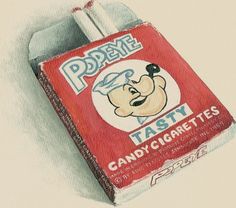
I sell these at my candy counter:
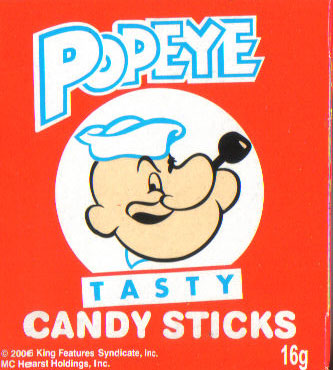
They're reasonably popular with little kids and some adults buy them too, always saying "I haven't seen those in years" when they do.
Note, however, that they are now Candy Sticks and no longer Candy Cigarettes. They no longer have the red colouring on the end of the stick, but the box hasn't changed much:
Posted by Joe Redifer (Member # 3) on 06-25-2014, 05:42 PM:
quote: Stephen Furley
These days I find it difficult to breathe if anybody is smoking near me, but strangely, I don't remember being affected by it when both parents were smoking at home.
When you're around it all the time you're used to it so it becomes less noticeable. Once you're away from it for a significant amount of time your reaction to other people's smoke becomes much more unpleasant.
I've never even tried smoking since I've never had any interest or curiosity about it at all even though my mom smoked (my dad had stopped when I was too young to remember). But then again I'm not really a follow-the-herd type of guy and don't take excessive pride in getting drunk, etc.
Posted by Steve Matz (Member # 1890) on 06-26-2014, 09:36 PM:
I got a quick lesson on not taking up smoking back when I was 13.My dad was in the coin operated Machine Business and we had JukeBoxes,Pinballs and even Cigarette Machines in Bars and eating establishments. I could have smoked for Free back then.A pack of Cigarettes in the mid 60's was 30 cents for non-filters like Camels and Pall Malls and Filtered Smokes were 35cents a pack. A Carton cost us 2 Dollars and you had to give the owner 15% of the payout. You never made any Money on Cigarette Machines, it was just a convienence you put in an establishment besides your Jukes and Pinballs.
I use to have to go to these Bars each week and count the Money and also Clean these Machines. The First Time I sprayed some Windex on a Juke Box Front Glass and saw this Pure Black Substance(Nicotine) streaming down the Glass I knew that taking up smoking wasn't going to be for me.If this was secondhand smoke doing this to these Machines than what was it doing to someone's Lungs that was actually inhaling. My Dad smoked Camels and my Aunt smoked Pall Malls;probably the 2 worst Cigerettes you could smoke back then. My Aunt Died from Lung Cancer in 1976.
I'm glad I was strong willed enough to not take up the Habit. A pack of Cigarettes in New York the last time I looked was almost 14 dollars a pack. If the Government keeps hiking the Tax on Cigarettes your going to see people who are addicted to smoking Robbing Convienence Stores and maybe Store Clerks getting Hurt or killed because of this.
I also see People at the Nursing Home my Mother resides at carrying oxygen bottles around with them or on their Walkers/Wheelchairs. Of all the people needing oxygen I asked how many of you smoked growing up and over 90% said they were at the least a pack a day smoker.
Your Lungs are very important to Life don't be a Fool and regret down the Line when you can't take a Full Deep Breath that you ever even considered Smoking ![[thumbsdown]](graemlins/thumbsdown.gif)
Posted by Leo Enticknap (Member # 534) on 06-27-2014, 01:45 AM:
quote: Steve Matz
A pack of Cigarettes in New York the last time I looked was almost 14 dollars a pack.
Interesting: here it's around $5-7, significantly less than in England at around the time I left last summer (about the same in pounds, so $10ish). The problem with trying to tax smoking out of existence (or any other activity you want to stop, for that matter), of course, is that you can only tax it so far before criminals can make enough of a margin on producing and/or smuggling the things for them to be able to undercut the legit prices, at which point (a) the government loses revenue to organized criminals, and (b) the "sin tax" is no longer dissuading sin, because it can easily be circumvented. And now we're in danger of getting political, so I'll stop there.
Posted by Steve Matz (Member # 1890) on 06-27-2014, 10:36 AM:
This is a List from 2013 so I'm sure New York's Prices are even higher this year. All this is doing is inviting Crime and Violence down the Line. I certainly wouldn't want to be the lone employee at midnight in a Convience Store when Cigarettes are over 14 dollars a Pack. Good Ole Government punishes the same people they help get addicted back in the 50's and 60's when smoking was popular on TV... Considerable Price Jump in every State when you could buy a Carton of Cigarettes in the early 70's for just over 3 dollars a Carton(10packs)
Smokers, flee New York City and head to Kentucky, where a pack of Marlboro Reds will cost you practically a third of what you’re paying now. And while you’re on the road, steer clear of New Hampshire and Vermont, too: the price for a pack has jumped 35% and 25%, respectively, over the past year.
We called a gas station—and oftentimes, when we were turned away or simply misunderstood, we called several—in the most populous city of every state in the nation and Washington D.C. and asked the clerk for the price of a pack of Marlboro Red cigarettes including tax. (Obviously, local prices will vary some.)
Here’s the current 2013 price, in bold, and also how the prices of cigarettes have changed since last summer.
48. Kentucky (last year $6.56): $4.96 = -24%
47. North Dakota ($5.03): $5.04 = +.2%
46. West Virginia ($4.84): $5.07 = +5%
45. Oklahoma ($5.24): $5.19 = -.1%
44. Idaho ($5.11): $5.25 = +3%
43. Missouri ($5.87): $5.25 = -10%
42. Louisiana ($6.50): $5.33 = -18%
41. Oregon ($5.74): $5.35 = -7%
40. Wyoming ($5.21): $5.37 = +3%
39. Mississippi ($5.55): $5.45 = -2%
38. Nevada ($6.04): $5.50 = -9%
37. South Carolina ($6.25): $5.55 = -11%
36. Colorado ($5.19): $5.59 = +8%
35. Indiana ($5.56): $5.77 = +4%
34. Alabama ($5.18): $5.80 = +12%
33. Virginia ($5.43): $5.81 = +7%
32. Ohio ($5.67): $5.88 = 4%
31. Tennessee ($4.91): $5.89 = +20%
30. Georgia ($5.93): $5.93 = 0%
29. Minnesota ($5.96): $5.95 = -.2%
28. Florida ($6.29), Delaware ($6.10): $6.00 = -5%, -2%
27. North Carolina ($5.14): $6.03 = +17%
26. Nebraska ($5.99): $6.09 = +2%
25. Kansas ($6.47): $6.21 = -4%
24. Montana ($6.12): $6.25 = +2%
23. Arkansas ($7.10): $6.50 = -8%
22. New Hampshire ($4.86): $6.59 = +35%
21. Utah ($6.88): $6.64 = -3%
20. California ($6.45), South Dakota ($6.82): $6.77 = +5%, -.7%
19. New Mexico ($6.69): $6.91 = +3%
18. Michigan ($6.50), Pennsylvania ($6.93): $6.95 = +7%, +.3%
17. Maine ($6.97): $7.12 = +2%
16. Texas ($6.89): $7.24 = +5%
15. Iowa ($7.52): $7.25 = -4%
14. D.C. ($8.27): $7.89 = -5%
13. Maryland ($6.53): $7.93 = +21%
12. Wisconsin ($7.98): $8.11= +2%
11. Washington ($8.98): $8.31 = -7%
10. New Jersey ($8.00): $8.55 = +7%
9. Massachusetts ($8.49): $8.77 = +3%
8. Connecticut ($8.85): $9.30 = +5%
7. Vermont ($7.60): $9.52 = +25%
6. Rhode Island ($8.16): $9.56 = +17%
5. Alaska ($9.39): $9.59 = +2%
4. Arizona ($7.46): $9.65 = +29%
3. Hawaii ($10.22): $9.68 = -5%
2. Illinois ($10.25): $11.59 = +13%
1. New York ($12.50): $14.50 = +16%
Powered by Infopop Corporation
UBB.classicTM
6.3.1.2