This is topic Century's Vistavision and Cinerama in forum Film-Yak at Film-Tech Forum ARCHIVE.
To visit this topic, use this URL:
https://ft-forum.com/ft/cgi-bin/ubb/ultimatebb.cgi?ubb=get_topic;f=8;t=007026
Posted by Steve Matz (Member # 1890) on 07-03-2014, 01:28 AM:
While researching Century Projectors Production Records for the portable C I was going to buy; I came across some interesting numbers for Vistavision and Cinerama Production. According to their records they only built a total of 24VV Projectors between 1955-1958 compared to the DD 35mm Model used in 3 projection Cinerama format where approximately 600 projectors were Mfgered.
It makes me wonder what Paramount was thinking when they decided not to go with an anamorphic type process where only a Lense would be needed verses a completely new type projector. Apparently most theater owners weren't too interested in having to add a new projector system just for showing Vistavision only Movies.The only other Projector Mfger that I know of that produced a VV type projector was KAYLEE which I have no idea how many projectors they produced for the VV Format.Apparently even Foreign distribution of VV Pictures to the United Kingdom weren't going great guns either and VV died pretty quick all over.
When I was a kid going to the Movies in the late 50's and 60's and saw that opening "Filmed in Vistavision" on a Paramount Picture I always thought whats the big deal it looks the same as any other widescreen Film. What I was actually watching was a normal vertically projected print on an E7 w/a B&L Scope Lens...
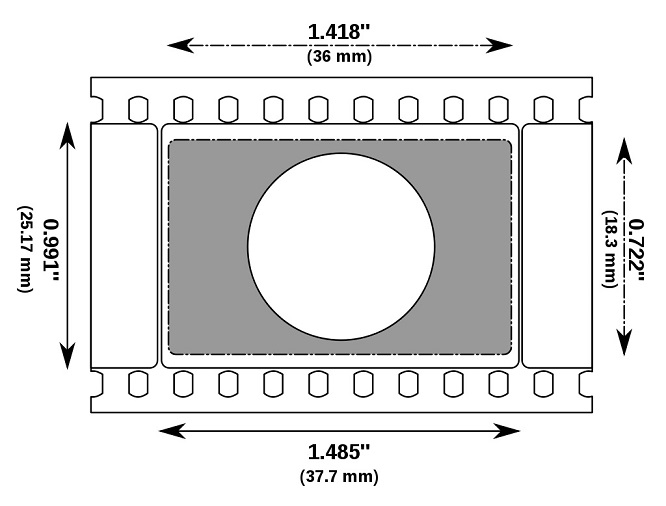
VISTAVISION FRAME FORMAT
Posted by Monte L Fullmer (Member # 2797) on 07-03-2014, 02:45 AM:
Ever seen a frame of VV film printed 90 degrees using the IB transfer for standard 35mm viewing?
I ran "Ten Commandments" in 1972 with 12 full reels being struck on IB Technicolor, and the image on the print was more than stunning - never seen such a sharp image on a piece of film.
..and you saw the classic "F" marks right after every changeover in the upper right hand of the image.
-Monte
Posted by Stephen Furley (Member # 1277) on 07-03-2014, 02:48 AM:
I think six Kalee Vistavision machines were built, with four, two pairs, actually installed in cinemas. I don't know how many Century machines were built.
Battle of the River Plate was shown at the Odeon Leicester Square in London, and I think about two other films, but I can't remember which titles, in the two cinemas in London which were equipped. As a release format it existed to a slightly greater extant than the proposed 55.625 mm six-perf format for Cinemascope 55, but not by much.
Posted by Frank Angel (Member # 248) on 07-03-2014, 03:02 AM:
What I never could figure out was, once a film was shot in VV, why didn't Paramount just extract the widest image from the 2:35:1 area or even just 2:1ar of the negative and optically convert it to standard 2.335:1 ar anamorphic release prints so it could be shown as a full scope image. THE TEN COMMANDMENTS could have looked even more impressive in Technicolor Scope.
They would have been getting more negative geography that shooting in 35mm anamorphic giving them a very sharp scope image rivaling anything that Scope shot in 35mm anamorphic could produce, what with all the "cirles of confusion" anamorphic lenses produced. Fox knew it -- filming CAROUSEL and THE KING AND I in CinemaScope 55mm only to discover that the larger negative produced such a superior image when optically reduction printed to anamophic 35mm, that they just dumped the whole idea of converting theatre projectors to run 55mm prints and just ran the optically converted 35mm anamporphic prints instead and everyone was thrilled -- Fox, because it did away with that whole nightmare of some theatres converted while other not and double inventory prints, etc., and the exhibitors because they didn't have to do ANYthing, did have to spend a dime, which always makes them salivate like Pavlov's dogs.
Then again, I guess there WAS that "my wide screen system is better then your wide screen system" pissing contest thing going on between Paramount and Fox. Paramount simply was not going to give in to Fox and admit that CinemaScope was way ahead of the curve when it came to the number of screens already equipped to show anamorphic prints, regardless of the quality as compaired to spherical VV. But Paramount remained adamant about the fact that their VV process for wide screen was a superior system to CinemaScope, and while that may be true from a purely technical standpoint, Fox had already won the battle by the most significant and prize winning fact that the CinemaScope system was backward compatible and could play both the existing formats and the Scope format. This was music to exhibitors ears, and rightfully so; can you imagine what it must have sounded like to exhibitors when they heard that to run a VV film, the projectors had to be turned on their sides?
That said, I think the Paramount techs could have come up with a solution to that problem which might have saved VistaVision from going under so fast. Surely there could have been a way VV projectors to be outfitted with an adaptor/prism & mirror system that could flip a standard picture on its side, i.e., it could run BOTH VV prints and standard, vertical prints, both flat and scope -- a truly triformat projector, and everyone's happy, except for the film which had to make those two bloody painful twists to get the image to turn sideways into the head...ouch.
I mean you can understand how Paramount just couldn't swallow its pride and give up on its system like Warner and the other studios did. I remember running MR. ROBERTS (WB) and though how it must have galled Jack Warner. Evidently in order to use the word CinemaScope in the film TITLE credits -- it had to take up its own frame with the CinemaScope logo big a point size as the film Title, but it also had to have under the CinemaScope graphic in smaller font but very visible nonetheless, the credit "CinemaScope is a registered Trademark of 20th Century Fox" I bet he had to get drunk before he signed that agreement. But that's how big CinemaScope was in those heady first days -- every scope title had the CinemaScope logo as big or nearly as big as the film title -- in ads, on all 1-Sheets and on the screen. In Fox titles the CinemaScope graphic is part of the Fox logo fanfare and so it is ABOVE the title and the stars. Imagine!
Posted by Thomas Hauerslev (Member # 566) on 07-03-2014, 04:38 AM:
Read this: http://in70mm.com/news/2012/vistavision/index.htm
Posted by Christian Appelt (Member # 1067) on 07-03-2014, 08:59 AM:
quote: Steve Matz
The only other Projector Mfger that I know of that produced a VV type projector was KAYLEE which I have no idea how many projectors they produced for the VV Format.
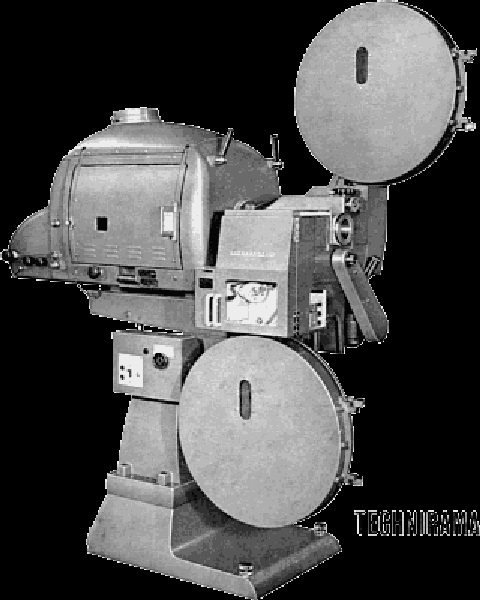
There was another 8-perf machine built by Microtecnica Company of Turin, Italy. This "Microlambda" projector was used for 8-perf showings of MONTE CARLO STORY in 1957. Martin Hart has a press note and an image on his Widescreenmuseum website:
American Widescreen Museum / Technirama projector (scroll down)
Posted by Jim Cassedy (Member # 4115) on 07-03-2014, 09:37 AM:
One thing I've always been curious about his how Century technicians solved the
intermittent movement horizontal 'oil bath' problem.
In a standard intermittant, gravity plays a big part in the flow of oil through the
mechanism, not only for lubrication, but to carry heat away from the star-pin assembly.
I've never read anything about how they re-designed the movement so that not only was
it able to run in a horizontal orientation, but also at twice the normal speed.
It seems to me that solving that took some good mechanical engineering design work!
Posted by Sam D. Chavez (Member # 1841) on 07-03-2014, 09:53 AM:
I believe Cinemeccanica also made a few VV projectors. There were also a few custom VV projectors made for ILM. There were based on Century.
Some of the earlier VV Century's had Brenkert Int. movements with some sort of enclosure that presumably held oil.
Posted by Gordon McLeod (Member # 33) on 07-03-2014, 11:14 AM:
The latest PPT magazine Rewind has a interesting VV Kalee projector that was vertical and had a massive prism to rotate the image It was in use at Deluxe UK untill recently when the trust aquired it
Posted by Mark Gulbrandsen (Member # 72) on 07-03-2014, 11:55 AM:
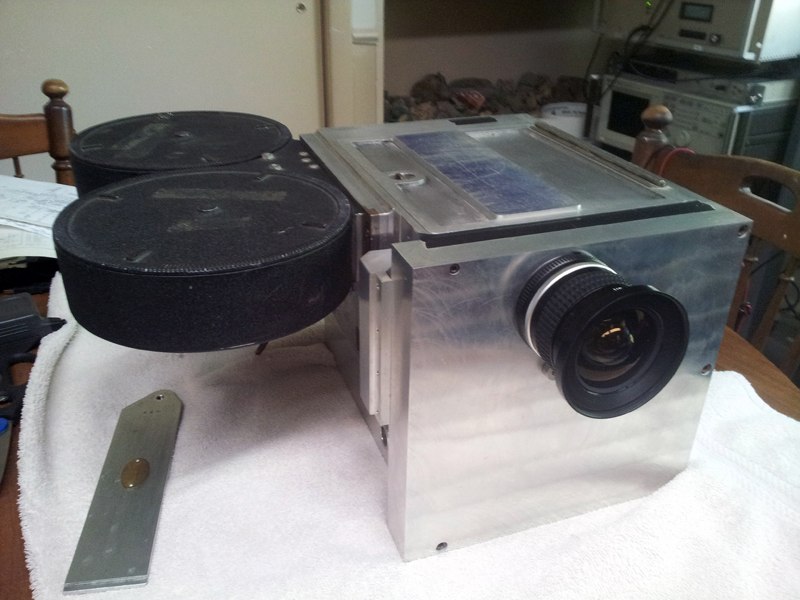
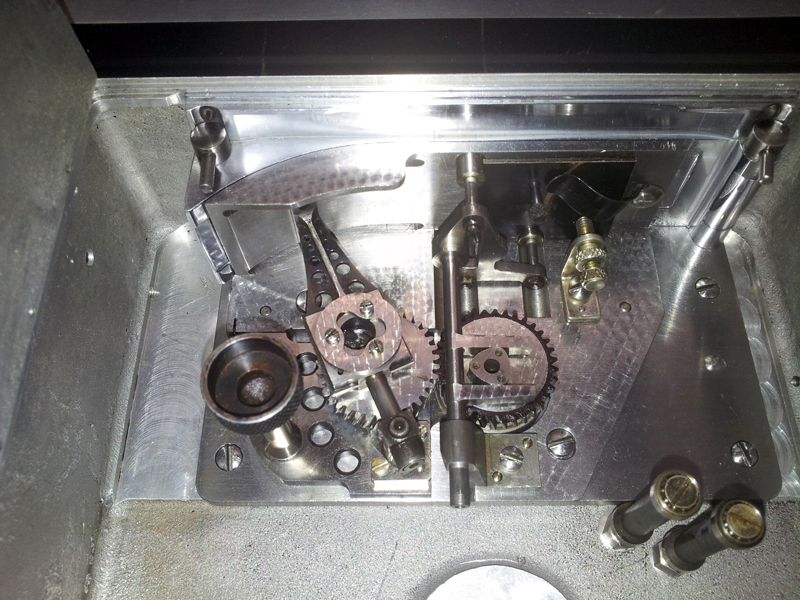
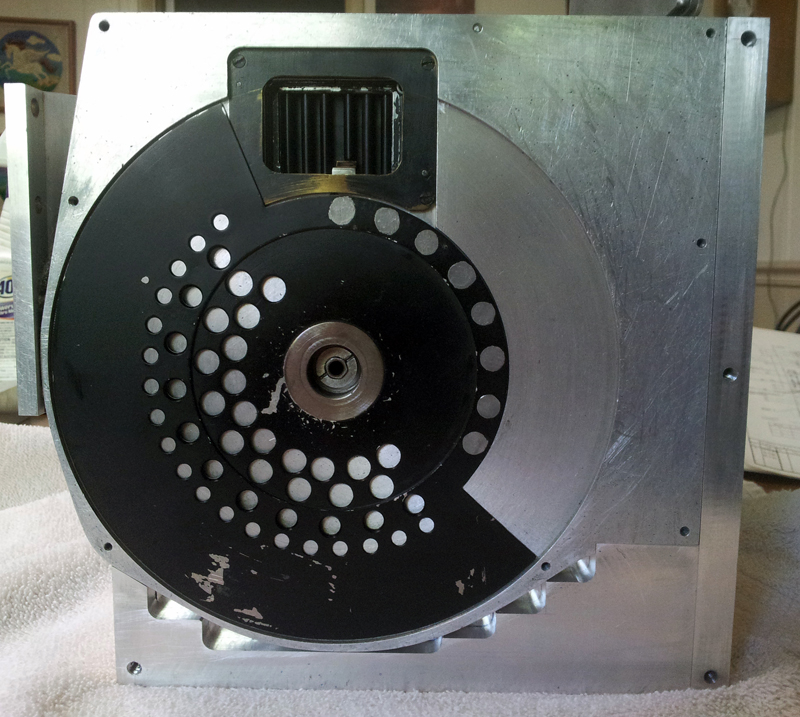
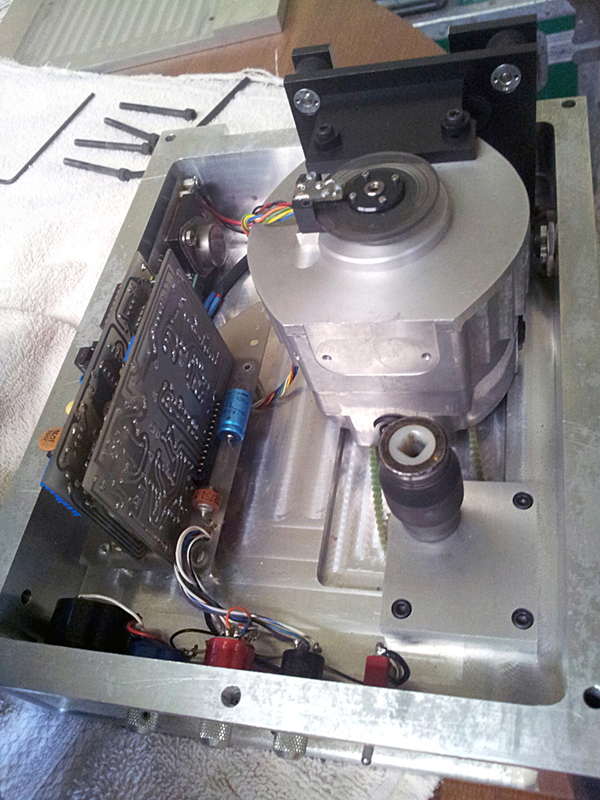
I'll share a few pictures of my VistaVision camera which I am now in the process of finishing. I have shot film with it but it still needs to be reflexed and a new shutter made. I found a camera guy on the West coast that is going to do the work for me. I have also acquired the original hand drawn plans done by ILM designer Mike Bolles... so having those will make finishing the job much easier. ILM used similar cameras on Robocop, Robocop 2 and a number of other movies before they built the Vistaflex. The same Fox two color cameras were also the ones Paramount first shot VistaVision with. I did all the machining on this myself... The motor is a BNCR crystal drive motor adapted to this camera. Hopefully it'll all be done in about 6 months time...
Posted by Mark Gulbrandsen (Member # 72) on 07-03-2014, 01:25 PM:
quote: Jim Cassedy
One thing I've always been curious about his how Century technicians solved the
intermittent movement horizontal 'oil bath' problem.
I used shaft seals on mine, plugged the sight glass and breather(overflow) hole and put a breather hole at the end of the outboard arm which is now at the top of the intermittent. movement. Hasn't leaked a drop of oil in 20 years. I filled it with LaVezzi synthetic oil and it's also had the same oil in it all these years. The stuff never goes bad. Pictures are in the warehouse.
Mark
Posted by Claude S. Ayakawa (Member # 1401) on 07-03-2014, 05:49 PM:
Is there a list of world wide theatres that played horizontal VistaVision prints, the titles and dates? I bet THE TEN COMMANDMENTS looked awesome in the full VV format in the theatres that played them.
-Claude
Posted by Steve Matz (Member # 1890) on 07-04-2014, 12:01 PM:
quote: Stephen Furley
I think six Kalee Vistavision machines were built, with four, two pairs, actually installed in cinemas. I don't know how many Century machines were built.
Battle of the River Plate was shown at the Odeon Leicester Square in London, and I think about two other films, but I can't remember which titles, in the two cinemas in London which were equipped. As a release format it existed to a slightly greater extant than the proposed 55.625 mm six-perf format for Cinemascope 55, but not by much.
Here is the Projection Booth of London's ODEON in the late 50's
with the 2 Vista Vision Projectors(one on each end) plus 3 other projectors. That has to be a rarity in Single Screen Theaters back in the day to have 5 Projectors in a Booth. Most theaters had two,sometimes 3, I have never been in a Booth that ever had more than 3(excluding Multplexes) ![[Eek!]](eek.gif)

Posted by Jim Cassedy (Member # 4115) on 07-04-2014, 04:54 PM:
Bigger Apertures & Bigger Screens Needed Bigger Lamphouses!
1955 Ad For Peerless Hy-Candescent Cinerac
( "Not A Reflector Arc" ! ! ) Int'l Projectionist, Oct '55
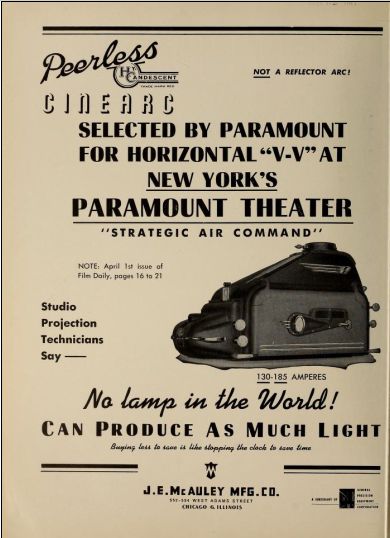
Never ran V-V, but I do recall running a couple of these
lamps at a Long Island, NY drive-in back in the mid 1970's.
Posted by Mark Gulbrandsen (Member # 72) on 07-04-2014, 05:45 PM:
quote: Steve Matz
I have never been in a Booth that ever had more than 3(excluding Multplexes)
At one time Radio City had as many as six.
Can anyone (not British please) name the three projectors in the center of the VV projectors in the above picture. They were fairly common in GB at one time.
Mark
Posted by Steve Matz (Member # 1890) on 07-04-2014, 07:21 PM:
CINEMECCANIA VICTORIA 10 ![[beer]](graemlins/beer.gif)
Posted by Dick Prather (Member # 1136) on 07-04-2014, 07:24 PM:
Mark, They look like BTH Supa machines. Common in the UK.
Dick
Posted by Steve Guttag (Member # 268) on 07-04-2014, 08:42 PM:
I've only ever seen 5 in RCMH (Simplex 35/70s on the middle three and Simplex XLs on the outside 2). I've personally put in two 4-projector booths (two 35/70s and two 35/16s in each booth).
In the big cities, 3-projector booths in the 70mm houses were not uncommon.
Posted by John Eickhof (Member # 323) on 07-04-2014, 09:04 PM:
the Dorothy Chandler Pavillion in Los Angeles (long time home to the AMPAS and academy awards) Had 3 Norelco AA2 s flanked by 2 XLs, (one on each end)2 Eastman 25 16mm next to them. (one at each end)The entire back wall of the booth was sound racks!
That's seven projectors!I will try to find the pictures took (1980s) and scan and post them. I once submitted a bid to move all the equipment across the street to the new Kodak Theatre, I lost the job by a small margin! A crane would have been used to lower the equipment to the street then the street would have to be detoured a couple hours while everything was moved across the road and lifted up again by crane. Not your normal booth install!
Posted by Will Kutler (Member # 770) on 07-04-2014, 10:35 PM:
Hi John
Glad to see your back. Please P.M. or e-mail me regarding some projects you were helping me with.
Posted by Steve Matz (Member # 1890) on 07-05-2014, 01:17 AM:
Dick Prather is Correct,The BTH Supa MkI's were changed out in 1962 for the 3 Cinemeccania Victoria 10'S ... ![[thumbsup]](graemlins/thumbsup.gif)
Posted by Stephen Furley (Member # 1277) on 07-05-2014, 08:12 AM:
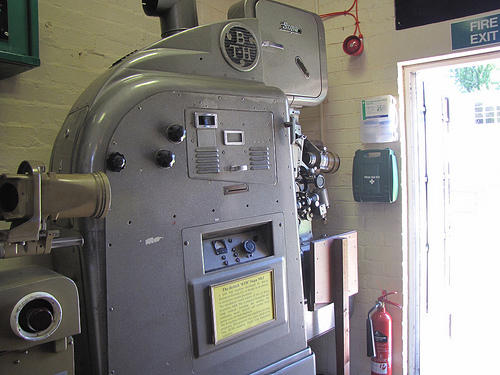
Ok, I won't name them, but I will say a few things about them. While they were quite widely used, they weren't considered to be a very successful design, and were generally quite short-lived comparted to other models. The Telekinema at The Festival of Britain had a pair on which the 3-D shorts were shown. The Projected Picture Trust has one, and there used to be one in the Science museum in London.
They were strange machines, and the manufacturer reverted to a more conventional machine for their following model. The optical axis slopes downn within the machine, as can be seen by the fact that they are tilted down much less than the VistaVision machines in the picture. They took strange spools with a large centre hole to fit a splined shaft, and couldn't easily be converted to take larger spools when these were introduced.
Posted by Jim Cassedy (Member # 4115) on 07-05-2014, 08:19 AM:
Somebody probabaly beat me to this by now, but from the
little bit of the ass-end you can see in the picture,
they look like BTH Supra's
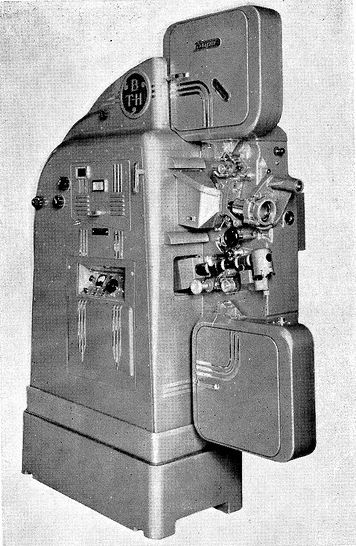
(from a 1950's equipment catalog)
Posted by Steve Moore (Member # 4753) on 07-05-2014, 08:45 AM:
And i know someone with one in storage; we keep talking about getting it restored and re-assembled - but I can't quote it's name
Posted by Gordon McLeod (Member # 33) on 07-05-2014, 10:10 AM:
There were also lots of issues with focus due to the design of the curved gate as well
Posted by Frank Angel (Member # 248) on 07-05-2014, 11:54 AM:
The optical path had a built-in down tilt? I guess you didn't see these used much at drive-ins!
Posted by Mark Gulbrandsen (Member # 72) on 07-05-2014, 12:03 PM:
Dick gets the steak dinner! I have a book here on British projectors that also says the Supa had a plastic star wheel.
Steve Guttag... I have pictures of RCMH booth in International Projectionist Magazines from the 30's and again in the 40's and it shows six projectors.
Mark
Posted by Stephen Furley (Member # 1277) on 07-05-2014, 03:09 PM:
quote: Will Kutler
Glad to see your back.
Will,
I think you mean Glad to see you're back. the way you wrote it sounds like a very different meaning, i.e. Glad to see the back of you. I don't think that's what you meant.
I've never heard a projectionist that worked with them speak well of the SUPAs. I've never actually seen one running, most were scrapped before my time, but I have seen a couple of disused pairs in ex cinema buildings, plus the two museum ones. Steve's picture looks like the Projected Picture Trust one, with a Kelee behind it.
The publicity for them when they were introduced saw them as being an ultra-modern projector. In some ways they were the predecessor of the modern 'console' type projectors, with everything built in. One configuration had the amplifier housed within one projector, and the rectifiers for both housed within the other. 'Ultra-modern' they may have been when introduced, but they soon became outdated, and were not the easiest of machines to modernise. I'm told that the light output wasn't great, just as screens were getting bigger and more light was needed. The built-in lamphouse couldn't be replaced by a Xenon one, and the existing one wasn't well-suited to conversion to typical early vertical Xenon lamps. They weren't the easiest of things to mount anamorphic lens brackets on; I think BTH did eventually produce one, but several pictures which I've seen had makeshift arrangements. You couldn't easily fit them up for 4-track mag; you certainly couldn't just mount a standard mag penthouse on top of them.
The Telekinema did survive the closure of the Festival of Britain, and became the first home of the National Film Theatre for a few years, tith the television projector in the centre position between the SUPAs replaced by a Bell & Howell 609 16 mm machine, but the SUPAs themselves were soon replaced by Kalee machines with large spoolboxes for showing 3-D. Interestingly, the Kalees had mechanical inteerlock, whereas the SUPAs had used selsyn motors.
The SUPAs at Leicester Square would have been there for about 10-12 years I think; a surprisingly long time given that the cinema has replaced its projectors quite frequently during it's life, and the rapid rate of change in cinema technology at the time.
Posted by Steve Guttag (Member # 268) on 07-05-2014, 05:09 PM:
Oh, I can believe it has had more machines...just that I'VE never seen it with more. It has done so many special shows I have no doubt it has had more projection based equipment come and go that most booths.
The problem I've run into with the greater than 2 projection booths are keystone issues. Naturally, the bigger/longer the theatre, the less of an issue. I have one screening room where film #1 and DCP are essential at the left/right edges of the screen and have to lens shift/toe to get the image on screen. And forget about tracking systems...the "booth" is on a riser, the DCP is suspended in mid-air already and you can't open the #1 machine without unbolting it and pivoting it!
One thing we discovered when we were putting dual 35/70 systems into IMAX venues was the importance of putting like pairs on the SAME side of the center line rather than equally splitting them on either side. While you can cut a plate so that the rectangle is the same from both machines, the perspective is so great that the changeovers are annoyingly apparent. When you move the like pairs to the same side of the centerline, that problem goes away. This is why at the AFI/Silver and Library of Congress you'll see the 35/70s grouped together (in both cases they happened to be machines 1 and 2) and the 35/16s grouped together (in both cases as 3 and 4). The AFI/Silver wasn't so bad since its throw is over 100 feet...LOC Culpeper...that is about half that.
Posted by John Eickhof (Member # 323) on 07-05-2014, 07:07 PM:
In extreme center offsets it was common to shim the film trap rails or machine an angle into the trap mounting surface to compensate for lateral keystone. Howard Straight had shown me several sets of modified XL traps with left and right offsets. The pad on the trap door would easily self locate to the angled rails and straight gates were always used.At the film plane the offset was quite minimal to achieve a good result.
Posted by Steve Guttag (Member # 268) on 07-05-2014, 07:10 PM:
For many projectors...it would be easier/better to shim the lens mounts rather than the gate/traps...then you are not stressing the film by putting it through a twist. Note, shimming the gates or lenses do not compensate for keystone...they do allow you better lateral focus...if you are off center...you have keystone or non-linearity if you shift the lens.
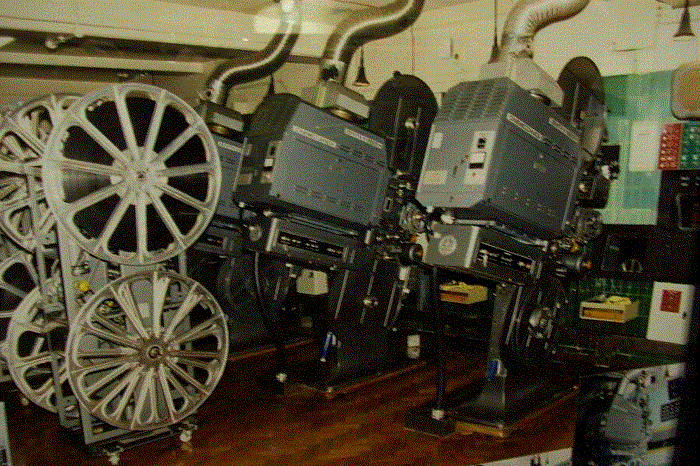
Posted by Steve Matz (Member # 1890) on 07-05-2014, 08:18 PM:
The ODEON Booth in the 1980's with the 3 Cinemeccania Vic 10's in Place. The VV Projectors removed close to 2 decades earlier with the BTH's. Quite a departure from the 5 projector Booth Photo...
Posted by Stephen Furley (Member # 1277) on 07-06-2014, 05:22 AM:
Steve,
Those are Vic 8s, not 10s (Xs).
The Odeon started out with normal 1930s BTH machines, as were normally installed by Odeon. These were replaced by the Mk. 1 SUPAs, then the Vic Xs, one of which is preserved by the PPT, then by the Vic 8s shown in your picture, then at the last major refurbishment by new Cinemeccanica machines which can take the large spools on the base of the machine, rather than using the tower. In all cases three machines were installed, except for the brief period when the VistaVision machines were also installed. At least one of these seems to be using a follow spot port. I've seen, or seen pictures of spots in three different positions, but I don't know if all three were ever installed at the same time.
A photograph exists of a fourth temporary machine installed for Napoleon, and at one time a monochrome Eidophor was also installed. A Ross Scenoscope, similar to Brenograph, survived long enough to be converted to Xenon, but had gone when I last visited the box some years ago.
As far as I know at least one film machine remains, and at least two digitals.
Three projectors was quite common, either to provide a spare, or to show 35 mm material with a 70 mm feature. A few cinemas, I know of two, installed a fourth machine in the 50s for showing 3-D with changeovers. I've never seen more than four 'normal' projectors. Mark, were all of the RCMH machines 'normal' projectors, and if so, do you know why the additional ones were installed?
The Pictuteville has seven projectors installed, three Cinerama, one Vic 8 for normal 35 and 70 mm films, one DP-70 mainly used with a special lens for showing 70 mm film on the Cinerama screen, one Christie digital, originally 2k, but now replaced by 4k model, and a small subtitling projector. The vast majority of normal shows are digital now, but six of the projectors are normally used during the Wide screen Weekend. It used to have a 16 mm machine, but this was removed to make room for the DP-70.
The last time I was in the box at the Loews Jersey there were three 35 mm machines, one 16 mm, two spots, but only one of them set up at a port, and two non-functioning Brenographs, but this was in 2002, and I believe things have changed there now. Mitchell, what is there now?
Even the tiny place where I still project from time to time has four projection positions, two 35 mm and one digital permanently installed, and slides, 16 mm, video etc. can be installed in the fourth position, but this is seldom done now.
Posted by Mark Gulbrandsen (Member # 72) on 07-06-2014, 10:11 AM:
Stephen... RCMH was for a number of decades the test bed for Simplex when they were in N.J. So it's hard to say what was what in that booth. Likely Simplex had them running tests on differing gear trains in the very same machines. Remember with the E-7 there is an oblique and a later vertical shaft model. I will have to try to dig out the old magazines that show the Simplex ads and the pictures of the booth there...
Posted by Geoff Newitt (Member # 6663) on 07-07-2014, 06:31 PM:
Twenty odd years ago, one of the two film societies at Southampton University was still running BTH SUPA Mk II projectors with Peerless lanterns converted to xenon. I don't remember seeing a film on them, but they still ran a show every week. IIRC the cause of the focus problems was that the aperture plate was in front of the film path rather than behind, so the film tended to overheat and flutter in the gate - much worse for B&W, as the silver dye absorbed heat so readily.
I've not visited the projection room at OLS for a couple of years; last time, the middle Vic 8 was still there, but had an NEC installed so close to it that it was unusable. IIRC, there were two NC3240s and I think there was a Sony something or other that had been brought in temporarily. It's certainly the case that in the 'digital era', projectors move in and out of there at an astonishing rate.
Interestingly, the Vic 8s that replaced the Vic Xs were not new machines - I believe the left hand one was from the old training centre in Camden, for instance. Certainly by 1998 they seemed very tired. At the refit in 1998, three brand new Vic 8s were installed (craned in through the roof light) - but with the X6500H lamphouses from the early 80s reused. The mag penthouses were retained as well, I think (never used for a public screening post-98, anyway). And although the bases would take 4000m spools, a Christie platter was retained as well.
Anyhow - back on topic - my late friend Hugh McCullough once told me that when he worked there in the 70s and 80s (during the Eidophor and Napoleon period) that the only trace of the VV equipment was a couple of mysterious bolts left in the floor.
Posted by Leo Enticknap (Member # 534) on 07-08-2014, 01:40 AM:
quote: Stephen Furley
16 mm, video etc. can be installed in the fourth position, but this is seldom done now.
We've just had four 16mm shows in as many weeks at the Egyptian after, I am told, many months of none at all. Funny how these things seem to go in waves...
Posted by Frank Angel (Member # 248) on 07-08-2014, 05:40 AM:
Leo, what 16mm projector?
About two years passed since the last time we ran 16mm on an Eastman 25B, and when we started it up, found that an all-important rubber isolation coupling between the intermittent motor and the intermittent mechanism had deteriorated into some non-solid crumbly stuff. James Bond (yes, that is his real name) of Full Aperture out of Chicago machined a replacement part and personally did the repair; he got us up on the screen in time for the playdate -- ripped that projector apart and back together again practically with his eyes closed.
Letting a projector sit idle a few years without turning it on can wind up really takine a big bite out of one's posterior.
Posted by Manny Knowles (Member # 1171) on 07-08-2014, 09:50 AM:
The main room at the DGA in Hollywood had 4 film projectors the few times I worked there. I'm not super-sure about the make/models, but one pair was 35mm only (Simplexes, I think?) and the other pair had a larger projector body. Kinda looked like a Ballantyne Pro or maybe a Norelco. IIRC the larger pair were 35/70.
Does anyone remember for sure? I wish I still had the photos.
At the time (2008-2010) they did not have digital permanently installed -- their projection booth was unionized, so they wouldn't touch video -- which explains why I was there. I'm told they eventually installed a pair of Barco's. I don't know if they removed any film projectors to make space, but I recall the rental projector was a tight fit in the center position.
OBTW, the IU Cinema has 4 projectors, but 2 are digital. Does that count?
USC's Norris Cinema Theatre used to have 3 projectors. A pair of Century JJ's and one Eastman 16mm projector. (Norris also had a carousel slide projector with a small Strong lamp house.) I believe the current setup uses a pair of Kinoton FP-38-E-S and one Christie digital cinema projector.
Posted by Bill Gabel (Member # 1105) on 07-09-2014, 07:46 PM:
quote: Manny Knowles
their projection booth was unionized
The DGA was under Local-150's jurisdiction.
They had Norelco's in the old DGA theatre and moved them over to the new building's theatre.
Posted by Leo Enticknap (Member # 534) on 07-09-2014, 10:09 PM:
quote: Frank Angel
Leo, what 16mm projector?
Kinoton FP38-E-S. Shutter and intermittent motion are electronic, hence less to dry out and seize up than there would be in a traditional, Maltese cross-based mechanism. It gives a lovely 16mm picture, and the use of 35mm lenses gives it great uniformity of focus.
Posted by Gordon McLeod (Member # 33) on 07-10-2014, 11:14 AM:
BTH als had a issue with the radius of the curve of the gate Bill Bell wrote an article on it years ago Often wondered how much worse it would be with ester stock
I believe those vv are the ones that bradford now has and were restoring
Maybe someone local to the PPT could get permission to scan and copy the article and pictures on there vv machine
Posted by Scott Norwood (Member # 30) on 07-10-2014, 11:56 AM:
Mark--is that a Mitchell VV movement? Or a 4-perf Mitchell movement converted to 8-perf? Or something else entirely?
Posted by Mark Gulbrandsen (Member # 72) on 07-10-2014, 01:58 PM:
Hi Scott...
It was originally a Fox 2-Color camera. Same cameras that Paramount converted to Lazy-8 format. So it had a septum in the middle of the frame and recorded two 4 perf high images through 2 different lenses with red and green Kodachrome filters placed in front. In converting all these cameras the septum is removed and the gate opened up to the full 8 perf dimensions. The one thing that was not done in the original conversions was to move the registration pins to the normal frame line location. They end up on perf off the frame line. My movement was modified so the reg pins are at the frame line and a third pin was added. The original Mitchell and Fox movements always had a tiny image steadiness problem at the far end of the frame where the film was unsupported going into the gate. Attached is an image of an unmodified movement in a reflexed camera converted by ILM.
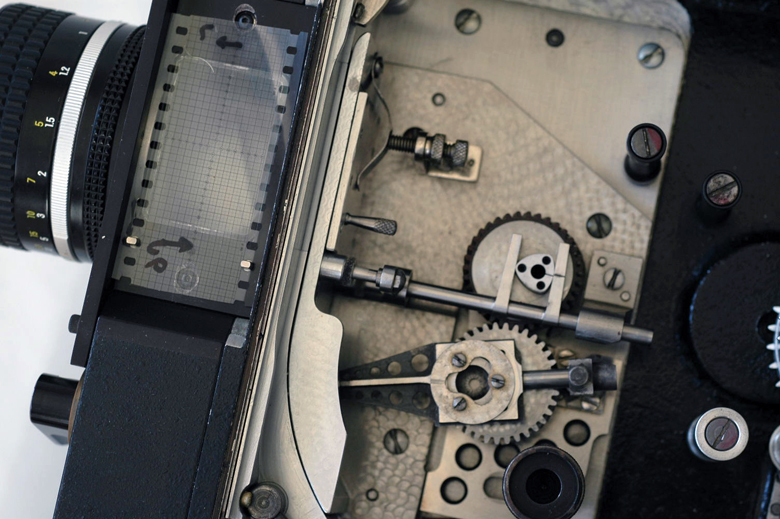
Posted by Louis Bornwasser (Member # 3063) on 07-10-2014, 02:28 PM:
DGA had AA2's. Bob Perlmutter was there for years and was a good friend and customer.
Posted by Mark Gulbrandsen (Member # 72) on 07-10-2014, 02:31 PM:
The DP-70 are still there Louis. I made them a new pair of change overs a number of years back for them...
Mark
Powered by Infopop Corporation
UBB.classicTM
6.3.1.2