This is topic Interesting info on 3 strip Technicolor Processing! in forum Film-Yak at Film-Tech Forum ARCHIVE.
To visit this topic, use this URL:
https://ft-forum.com/ft/cgi-bin/ubb/ultimatebb.cgi?ubb=get_topic;f=8;t=007042
Posted by Steve Matz (Member # 1890) on 08-09-2014, 09:10 PM:
I have been meaning to post this for some time but never got around to it. This is a Reply from an Old School MP Processing Lab Technician and long time SMPTE Member that I was conferring with on 3 strip Technicolor and also asking about how much better a direct Print from the Camera Negative would be compared to a general theater release print...He really went into detail
but the info is both very interesting and informative...
FOR "WIZARD OF OZ" & "GONE WITH THE WIND"
STEVE:
Both those pictures were in Technicolor and aside
from the sepia opening to Wizard, Technicolor prints
were never from the camera negative. If there were
any fades or dissolves, the full scene was duped cut
to cut and put into the original negative. That meant
black and white master positive then shot to dupe
negative and that was spliced into the camera
negative. Technicolor would make a protection
master positive of the entire cut camera negative for
each color, yellow, magenta, cyan.
Then the camera negative would be used to make
the matrix for each color, a positive image in gelatin
relief. That was then dipped in the proper dye and
pressed on the "blank" stock which had the
previously printed black and white sound track. Each
color was pressed individually on a stainless steel
belt with registration pins. After the color had been
imbibed, the print was washed and sent back for the
next pass for the next color. The belt ran at 300 fpm
but making three passes reduced the output to 100
fpm just slightly more than projection speed.
The biggest problem Technicolor had was
registration and the toughest scene would be white
letters on a black background which would require
the highest degree of precision.
When Cinemascope broke out in 1953-54 Technicolor
was in big trouble since the prints weren't sharp
enough for the new screen size and were grainy.
Kalmus went to Messe at Kodak and threatened to
go to DuPont stock if Kodak couldn't work out the
problems (They had used some DuPont stock
manufactured to their specs with success earlier)
Kodak did and later Technicolor could make Scope
prints with Fox Hole Perfs and magstripe the prints
as well.
But prints shown to audiences on 1939 screens
weren't near the quality of the recent Warner Bros
new transfer from the original elements for both
Wizard and GWTW. I have seen clips from the original
1939 nitrate GWTW release at a SMPTE meeting back
in the 80s at MGM Cary Grant Theatre showing
variation in color, saturation of various releases and
difference between Tech and Eastman prints (Tech
holds better highlight detail, Eastman better shadow
detail).
One thing to remember, color--especially three strip
color--was rare in 1939 and would have been a treat
to any audience. GWTW was originally printed with
more subdued color compared to Oz and other Tech
releases. But every Tech release was "custom" back
then.
NITRATE FILM....Two things:
Nitrate had a number of attributes that had nothing to
do with the supposed "quality" of the image. The
stock itself would last longer and was more wear
resistant than the safety film stock that was
available at the time.
Nitrate produced "better" prints in part due to it's
shrinkage. The newly processed negative would
shrink to a point that it removed printer slip in a
contact printer. Up to this point negative and positive
film carried a .1870 pitch. Going to a safety film
required a new "short pitch" on film that would be on
the inner diameter of the printing sprocket of .1866.
As for safety film, the "slow burning film" was
introduced with 16mm for home use. There were
some 35mm projectors built for institutional use that
were designed for safety film and had sprockets that
added a round pin in between the 35mm sprocket
holes so that the machine couldn't run nitrate and
only the specially perforated 35mm safety film. The
definition of "safety film" or "slow burning" was a film
that would not support a flame once the source of
ignition (match) was removed. Still film and sheet film
in Speed Graflex cameras was also on nitrate base.
DuPont nitrate had a "curl" problem with sheet film.
This is why those blackmail negatives in 1940s
movies burst into flame when they're burned.
The reason that nitrate stayed on was there was no
desire in the industry to change to the new stock
which didn't last as long as the nitrate stock in
projection.
Many of the theatre "accidents" occurred once
safety film was introduced and projectionists
removed magazine doors, started smoking in booths
and generally were not as careful as during the
nitrate age. Then a children's matinee print would
come in and the projectionist wouldn't notice it was
nitrate and ..... You can only imagine what would
happen if a theater with a platter system had a
nitrate print running and something happened.
THEATER RELEASE PRINT COMPARED TO MASTER
NEGATIVE AND POSITIVE?
A color master positive couldn't be projected. It's on
a material like color negative which has colored
couplers that correct for cross talk with the color
dyes and therefore has an overall orange tint. They
can be used (and are) for telecine where the dye
mask can be corrected electronically. They are also
a flatter curve, i.e. lower gamma in B&W terms and
thus have a lower overall contrast...again something
that you can correct for in telecine.
GWTW was a 3-strip negative, however the 70mm
blow-up was done at MGM lab and also changed the
aspect ratio of the picture on that release to "wide
screen" or 2.21:1. In general, Technicolor would
make a protection master positive from the cut
negative (without light changes) and the cut negative
(with dupes) was timed and printed to the matrices
which were used to make the prints.
I knew once (having been through an entire evening
with GWTW at MGM at an SMPTE Meeting), but have
forgotten which element was used to make the
blow-up. There would have been a couple of ways to
go, considering the aspect ratio change the most
likely would have been the 35mm master positives to
a 65mm dupe negative and contact prints to 70mm
release prints. MGM Labs was one of two labs in
Hollywood that did 65mm and 70mm release printing.
(We also did 70mm release printing at Alpha Cine
when I was there). The other Hollywood lab was
Technicolor (although never IB prints).
So the comparison is really academic since you
could never see a color print directly from the
Technicolor 3 strip negatives (they were black and
white) so it would have to go through some process
unless you had lots of money and time and had a
color positive print exposed from each of the color
negatives on an optical printer. The system that
Warner Bros uses now is the closest to that system,
they use the individual negative or positive (as close
as they can get) to create a new digital master. The
various elements are combined on an aerial image
optical three head printer and instead of a film
camera, a digital scanner is used.
WRS (when it was still alive as a film lab) had a set-up
like that as well. There may be other set-ups like
that, I just don't know what CineTech is doing as part
of their restoration work right now.
It used to be all photo-chemical but people have
stopped restoring to film now days.
FWIW:
JAWS Eastman color negative, first generation
contact print would have been used for timing and
look better than any release print.
TEN COMMANDMENTS was three strip Technicolor.
BEN HUR was 65mm Eastman color negative at MGM
Labs, the contact first trial would be like looking at
picture postcards--incredible...
Posted by Claude S. Ayakawa (Member # 1401) on 08-09-2014, 10:15 PM:
Thanks Steve for your in depth report on three strip Technicolor. To go a little further, the photography of three strip Technicolor films is shot with B&W film and a primary color filter for each strip of film. The filters are RED , GREEN and BLUE..
When it is time to print, three secondary color matrices are made. First one is Cyan made from the negative that was photographed with a Red filter. The 2nd one is Magenta, made from a Green filtered negative. The 3rd one is Yellow produced from the Blue filtered negative.
-Claude
Posted by Leo Enticknap (Member # 534) on 08-09-2014, 10:18 PM:
Probably the most comprehensive source of technical info on Technicolor and every other color photography system that was in existence or had existed at the time of writing (1951) is Adrian Cornwell-Clyne's Color Cinematography. Wanna know the precise chemical formulations of the dyes used by Technicolor London in the 1930s? The data is in there. Want to recreate your own Gasparcolor processing line? That book probably has all the information you'd need to do so. Sadly, the original print run wasn't very big and as a result, secondhand copies now go for silly money on the rare occasions that one appears on Ebay. The library of the university in England I used to work for had a copy in pretty good shape, and one of my very few regrets about emigrating is that I didn't borrow it and scan the whole lot before going. At 780 pages I just couldn't summon up the persistence to do it (or deal with the thought of destroying the spine).
Posted by Steve Matz (Member # 1890) on 08-09-2014, 11:38 PM:
I always wondered what kind of success "Gone with the Wind" would of had if filmed in B&W or Sepia. When you read about the complications of Filming 3 Strip Tech and the Amount of Extra Time and Money it took to do the Dye Tranfer Process back then;it amazes me that any Studio back in 1938 wanted to Spend that kind of Money and Time for a Color Feature Film;Yet the TECHNICOLOR CORP had a 2 year backlog of Studios wanting to shoot a Technicolor Feature.
Because the First TECH Film Stock needed such intense Lighting;They had to use the Powerful Krieg Lamps which on "The Wizard of Oz" cost the Studio over a 1/4 million Dollars in just the Electricity Bill alone.Another Back Lash from these Lights was numerous Law Suits against MGM from Actors after Post Production that suffered permanent vision problems resulting from being subjected to these Lights for long periods of time.
This was such a powerful Film to begin with,it still might have been just as successful and MGM would have saved considerable amounts of money and Time; and probably no Lawsuits either...
Posted by Monte L Fullmer (Member # 2797) on 08-10-2014, 12:39 AM:
New Line - Division of Warner Bros, in 1998, released "GWTW" for a limited run, printed on IB Technicolor with the image sqeezed 2:1 for anamorphic presentation so the image on the screen was the academy 1.37:1 playback.
Sound was Quad, but the silver soundtrack was hard for the DTS reader, the basement SRD readers to pick up, thus I had to present it in 05 Dolby SR optical.
In short, it was very impressive (and wonderful to see again), but sad in parts at the same time due to the shrinkage of the three nitrate negative strips causing sight color bleed, especially in the first reel.
-Monte
Posted by Steve Matz (Member # 1890) on 08-10-2014, 01:14 AM:
quote:
When it is time to print, three secondary color matrices are made. First one is Cyan made from the negative that was photographed with a Red filter. The 2nd one is Magenta, made from a Green filtered negative. The 3rd one is Yellow produced from the Blue filtered negative.
Claude
Yes Claude and it all came out of this complicated Technicolor DF-24 3 Strip Beam Splitter Camera that incorporated a special Prism for doing the Task. Not that many of these Projectors made back in the day and only a handful or less still in existence.They were responsible for the Beautiful Rich Color we saw in those Films from back in the Day...
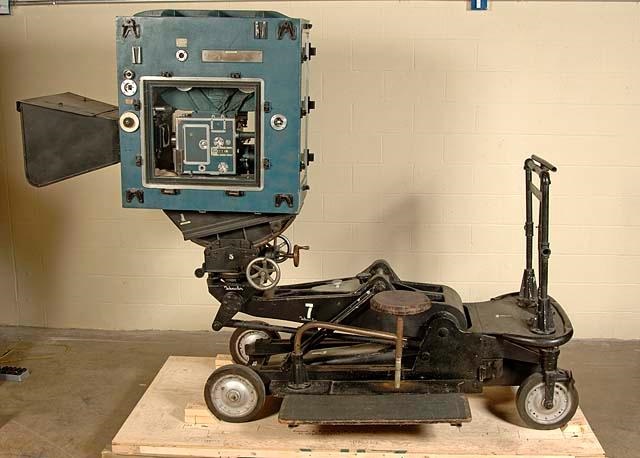
Technicolor DF-24 3 Strip Beam Splitter Camera w/ sound Blimp afixed
Posted by Randy Pryde (Member # 7488) on 08-10-2014, 02:09 AM:
Monte,
My recollection is that when we played a well used print of the 1998 "squeezed" IB Tech GWTW it was the SDDS and SRD tracks that did not hold up well. The DTS time code ran perfectly.
Posted by Rick Raskin (Member # 1561) on 08-10-2014, 07:12 AM:
quote: Steve Matz
There were
some 35mm projectors built for institutional use that
were designed for safety film and had sprockets that
added a round pin in between the 35mm sprocket
holes so that the machine couldn't run nitrate and
only the specially perforated 35mm safety film.
I recall seeing some 35mm prints that had a hole punched every 4th perf. I wonder if that was for those "protection" projectors?
I have some 70mm film that has the punch every 5th perf. What's the reason for that?
Posted by Richard P. May (Member # 3598) on 08-10-2014, 11:25 AM:
Steve, thanks for posting the description of Technicolor. It's one of the most accurate I've seen.
The question of would GWTW have been such a big hit if in B&W or Sepia is interesting. My opinion is that it would not. It was the first really BIG picture to use Technicolor, rivaled only by THE ADVENTURES OF ROBIN HOOD the previous year in production quality. It was the first color picture to win the Academy Award for Best Picture. It's negative cost was about $4.5 million, but the returns, adjusted for inflation, are over a Billion $$$. The use of color, even though expensive, had to have been a major factor in the public "want to see" factor.
Posted by Steve Matz (Member # 1890) on 08-10-2014, 12:29 PM:
You may be correct Richard on GWTW.I remember my Mother telling me the 1st time she saw GWTW in 1939(she was 13) She was awestruck at seeing this Technicolor Classic and remembered the 1939 Audience oohing and awhing when it started playing, Audiences back then were accustomed to seeing B&W Films;so this
3 Strip Technicolor Marvel was probably like going to Disneyland for her back then. She said the same thing happen when viewing "Wizard of Oz" Audience members who may not have already seen GWTW Literally Gasp when Dorothy opens the Door going from Sepia to the Rich Technicolor. She actually liked Wizard better than GWTW as far as Color Factor; saying things like Flowers,sky,etc seemed more rich in color than the real thing...
BTW: When Technicolor & Deluxe were auctioning off their Equipment awhile back. I remember looking at one of their High Speed Color Optical Printers. It said this Printer had a speed rate of 1200FPM That's like a Reel of Film every Minute and a half or so. When you consider what the Speed of a Contact Printer like the B&H C which is something like 250-300FPM; that is truly amazing but also disheartning because even with the precision optics of this printer it still wouldn't produce the quality Print that a contact print would. However when a couple thousand Prints are needed in modern cinema contact printing is too slow and cost effective even though a theater Audience would be seeing a Superior Image...
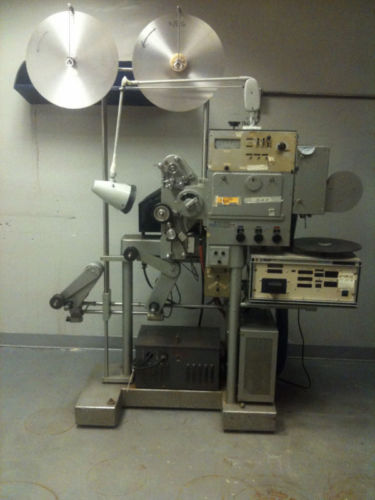
Bell & Howell Model C 35mm Contact Printer
Posted by Monte L Fullmer (Member # 2797) on 08-10-2014, 06:55 PM:
quote: Randy Pryde
The DTS time code ran perfectly.
The one small house we played it in, even with fine tuning the scanner drum to the LED pickup, I was losing timecode off and on. Thus I "forced" the CP500 to run optical with this week long engagement.
Posted by Mitchell Dvoskin (Member # 751) on 08-11-2014, 08:31 AM:
In 1997, Warner Brothers digitally restored re-released The Wizard Of Oz, striking both full 1.37 frame dye transfer (IB) Technicolor prints, and "windowboxed" 1.37 in a 1.85 frame Eastman color prints. Both looked good, but one of the complaints at the time was that the "windowboxed" prints wasted so much of the available frame.
In 1998, Warner Brothers re-release Gone With The Wind, dye-transfer (IB) Technicolor "windowboxed" 1.37 in an anamorphic frame, thus using more of the available frame space. Unfortunately, unlike Oz, the quality control was terrible on these prints, with focus and fringing issues that varied widely from print to print.
Back in 1976, MGM re-issued Gone With The Wind in anamorphic wide screen by cutting off the top and bottom of the 1.37 frame. The first home video LaserDisc of GWTW came out in Japan a few year before USA LaserDisc. This Japanese release was mastered (pan and scanned) from one of the 1976 prints, so the top/bottom/left/right sides were cut off. What were they thinking...
Posted by Martin McCaffery (Member # 37) on 08-11-2014, 10:12 AM:
They were thinking they could make a lot of money;>
We ran the "scope" 1.37 version of GWTW here. As we had to mask down for scope, it looked like a postage stamp on the screen.
Powered by Infopop Corporation
UBB.classicTM
6.3.1.2