This is topic Imax Forrest Gump ad in forum Film-Yak at Film-Tech Forum ARCHIVE.
To visit this topic, use this URL:
https://ft-forum.com/ft/cgi-bin/ubb/ultimatebb.cgi?ubb=get_topic;f=8;t=007063
Posted by Geoff Jones (Member # 3668) on 09-14-2014, 10:29 PM:
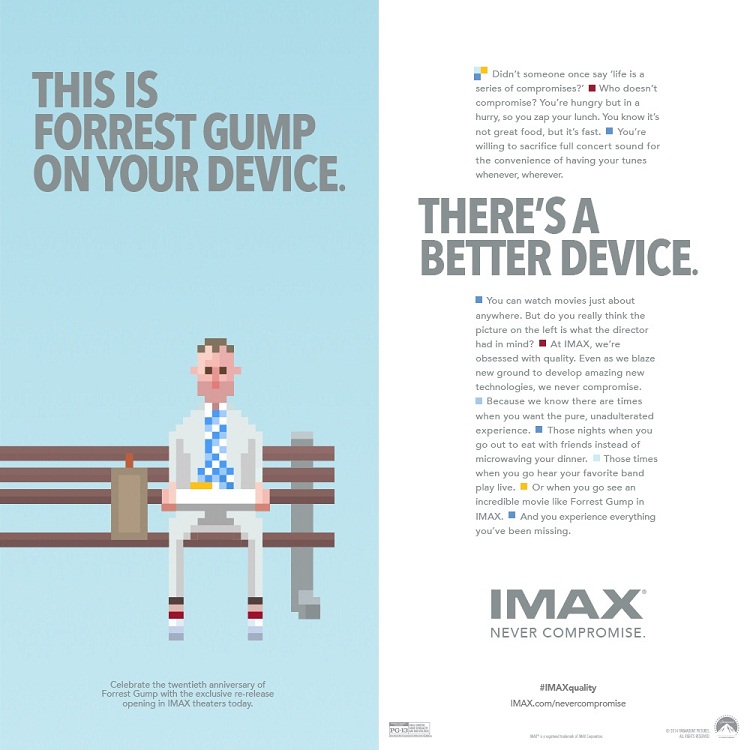
I just logged into Imax.com to see if they had Interstellar 70MM locations (nope) and I noticed this ad, which I found to be somewhat ironic, considering that almost all Imax locations now project 2k digital onto large-ish screens.
http://www.imax.com/community/blog/imax-never-compromise/
Posted by Terry Lynn-Stevens (Member # 7349) on 09-14-2014, 10:39 PM:
Don't lie Geoff, you're full of shit. You logged on to find out what's playing this week at IMAX theaters in your area.
Anyways, its a shit ad and IMAX is not doing well right now as there really is nothing playing in IMAX. They kind of look desperate and silly with this ad. Plus, IMAX is increasingly becoming content reliant for their financials. Forrest Gump IMAX tickets were $6 for the entire week long engaegment in Canada.
Posted by Bobby Henderson (Member # 840) on 09-14-2014, 10:42 PM:
Yeah, Steve Kraus had a discussion about the same ad going on in a thread on Facebook. It's quite a comical ad, particularly that "never compromise" thing.
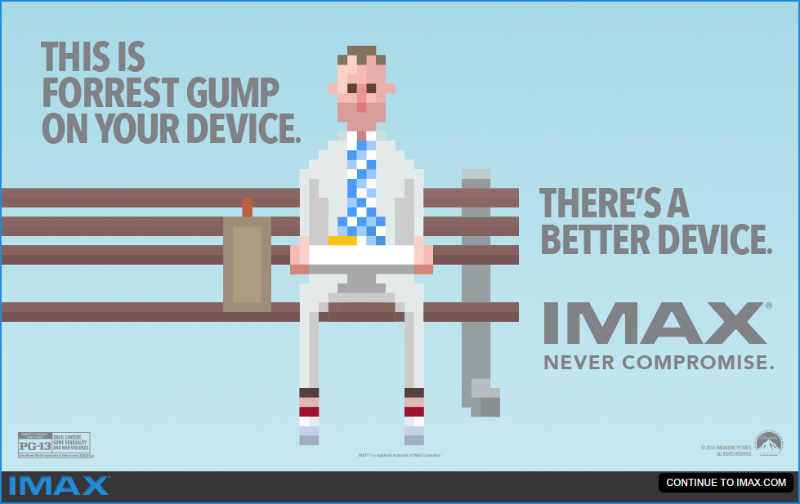
What's really funny is IMAX' implication that phone & tablet users are watching a badly rasterized, pixellated, Atari 2600 looking version of a movie when in fact most new cell phones and tablets have at least 1080p HD resolution or better. Some new phones are even boasting 4K resolution capability. Yet IMAX' digital-based theaters are stuck at 2K.
If anything IMAX could apply that Atari 2600 accusation to their own switch from extreme rez 15-perf 70mm film projection to consumer HD rez 2K digital projection. IMAX is the one pushing those blocky pixels now. So much for never compromising.
![[Roll Eyes]](rolleyes.gif)
quote: Terry Lynn-Stevens
Don't lie Geoff, you're full of shit. You logged on to find out what's playing this week at IMAX theaters in your area.
He's not lying Terry. I just visited IMAX' home page. The first thing I saw was a big pop up of the same ad with a "continue to IMAX" link at the bottom of it.
Posted by Buck Wilson (Member # 5885) on 09-14-2014, 11:24 PM:
What a joke. You could have a better presentation 20 years ago than in a current IMAX house.
Posted by Monte L Fullmer (Member # 2797) on 09-14-2014, 11:40 PM:
True. How long is IMAX gonna BS the public with this nonsense where the ones who've seen 15/70mm presentations remember how much better the image was on the screen.
Film is going to come back .. one of these days.
-Monte
Posted by Chris Slycord (Member # 4239) on 09-15-2014, 01:51 AM:
quote: Terry Lynn-Stevens
Don't lie Geoff, you're full of shit. You logged on to find out what's playing this week at IMAX theaters in your area.
1) Why would you think he was lying?
2) And why so rude about it?
Posted by Jarod Reddig (Member # 6363) on 09-15-2014, 04:30 AM:
Quote:
Film is going to come back .. one of these days.
-Monte
Film is basically dead. Whats gunna happen is eventually DCI Projectors will equal or surpass the performance of large format film in all areas. Its not if its when. Having said that I love film and miss it.
Also this add is so damn retarded.
Posted by Bobby Henderson (Member # 840) on 09-15-2014, 09:22 AM:
Film may be on its death bed, but it doesn't deserve to be in that position. Digital projection still isn't better than film done right. Video cameras still don't deliver the "film look" and detail of film better than professional motion picture film cameras. There is always some compromise going on somewhere with digital.
Sure, digital video technology may eventually surpass the capabilities of 4-perf 35mm film and perhaps even 5-perf 70mm. But we're not there yet. More video cameras are supporting 4K capture (with some going 5K and 6K), but they need to be doing a whole lot more with color depth. I think that's one of the keys to imitating the film look correctly, especially when the imagery is going to be altered in post production. Unfortunately it will take an obscene amount of data bandwidth and storage to do it right. Basic 8-bit video uncompressed, be it 2K or 4K consumes a hell of a lot of hard disc space.
Another problem is the digital camera sensor designs. Some already have "global shutter" designs, which helps. But why do so many of them need to be 35mm sized? If you have an even bigger camera sensor, like something on the order of a 5-perf 65mm sized film frame, you're going to have bigger pixels, which in turn will be able to see better quality light and color. This is one reason why large format digital cameras capture better image quality than a DSLR and also why DSLR cameras outdo the microscopic cameras in smart phones.
I'm actually concerned high end video camera technology might have hit a glass ceiling along the lines of "it's already good enough." The same may hold true for d-cinema projector technology. Some theaters may go the laser route, but what will get developed beyond that?
The stagnating consumer electronics sector is a big warning sign in all of this. New 4K resolution TV sets aren't selling all that well. One reason is because the electronics companies have yet to come up with a simple effective way of distributing 4K movies in retail. The other reason is most people are 100% satisfied with their current 1080p HDTV. They'll buy a new TV when the current one breaks and can't be repaired several years later. Movie studios are quietly sabotaging Blu-ray and physical media in general. Average Internet speeds are too slow to make 4K streaming practical, at least in terms of delivering content truly 4K in resolution.
It's already been clear that Hollywood has been making movies tailored more for the home HDTV set rather than the big movie theater screen. With that in mind, they might be able to push technology farther to beat film image quality. But why go to that trouble if the current methods are good enough?
Posted by Terry Lynn-Stevens (Member # 7349) on 09-15-2014, 10:40 AM:
quote: Bobby Henderson
Sure, digital video technology may eventually surpass the capabilities of 4-perf 35mm film and perhaps even 5-perf 70mm. But we're not there yet.
Film makers are already using large format digital cameras, the new IMAX digital camera is a using a sensor that is the same size as the image area of a 15/70 film camera.
quote: Jarod Reddig
Whats gunna happen is eventually DCI Projectors will equal or surpass the performance of large format film in all areas. Its not if its when. Having said that I love film and miss it.
Agreed, the ceiling on film has already been hit decades ago. Digital projection will continue to get better and better.
quote: Jarod Reddig
Also this add is so damn retarded.
I totally agree, it is a pretty bad ad. Releasing Forrest Gump in IMAX was a stupid idea to begin with.
Posted by Marcel Birgelen (Member # 6801) on 09-15-2014, 02:58 PM:
quote: Terry Lynn-Stevens
Don't lie Geoff, you're full of shit.
Have you been looking into the mirror lately?
This stupid ad is all over their front page. And if I wanted to know what's playing THIS WEEK in my local Fake-MAX theater, I would check the sites of those theaters, not imax.com.
quote: Chris Slycord
2) And why so rude about it?
Probably because, like Brad already mentioned in other topics, he's an IMAX astroturfer with bad manners.
quote: Monte L Fullmer
True. How long is IMAX gonna BS the public with this nonsense where the ones who've seen 15/70mm presentations remember how much better the image was on the screen.
The "populace" around here is learning. While watching the Guardians of the Galaxy as of late (not in D-IMAX I might add), I've heard people behind me talking about IMAX and how they remember it differently... And the fact that the picture was so bad because it was so blown up and that the sound was more like a rock concert than a cinema experience... It was a little bit if I heard myself talking. And no, I didn't forget to take my meds.
And what makes this ad extra sad is that my "mobile device" has about the same resolution as this frickin' IMAX device...
Posted by Bobby Henderson (Member # 840) on 09-15-2014, 04:21 PM:
quote: Terry Lynn-Stevens
Film makers are already using large format digital cameras, the new IMAX digital camera is a using a sensor that is the same size as the image area of a 15/70 film camera.
That needlessly heavy IMAX camera was first used on the latest Transformers sequel. It's hardly qualifies as something in the "filmmakers have already standardized on a bigger image sensor" thing. Seeing how it is made specifically for IMAX' branded films only there's not a whole lot of build-out potential for 3rd party companies, like lens companies such as Zeiss and Angénieux, to support it.
What I'm talking about is getting video camera companies (that aren't attached to IMAX) to move up from arguably small "Super35" sized sensors to at least something like a 5-perf 65mm sized sensor design and then maybe even go proportionately larger than that. It involves more than just coming up with a new sensor though. Entire product lines of lenses have to be developed to support it, and that's probably an even bigger challenge than just coming up with a newer, bigger sensor -even a bigger sensor that supports global shutter operation and other goodies most current sensors lack.
quote: Terry Lynn-Stevens
Agreed, the ceiling on film has already been hit decades ago. Digital projection will continue to get better and better.
I'm not nearly as optimistic about digital. If the drive was really there to make image quality better and better we would already be seeing it on the production and post production end. That isn't happening. 2K is still more common than 4K. With the way physical media has quietly come under attack on the home video front, I strongly suspect an effort to dumb down quality levels. It's as if the lesser quality standards of digital cable and Internet streaming are going to force a "low fi" step backwards.
Meanwhile, the digital fanboys out there are, at some point, going to get a little more irritated having to leap frog huge amounts of precious data from one digital storage device to another, before one storage container (be it a hard drive or data tape) degrades and loses the files it holds forever. This problem is going to be another thing that holds down digital video quality levels. 8K movies? At better than basic color depth? What studio is going to want to pay all that money extra to back up that much more data particularly if they think 2K is good enough?
At least some people are starting to realize it might be a good idea to have an "analog" backup of that high priced movie product. The digital-based archive files are far more volatile and less reliable than a 35mm archival safety print.
quote: Marcel Birgelen
And what makes this ad extra sad is that my "mobile device" has about the same resolution as this frickin' IMAX device...
Actually, if you want to get into real resolution terms, such as pixels per inch ratings, those small devices are a lot higher in resolution that the image blown up on an IMAX Digital screen.
A lot of marketing hype has gone into the high resolution displays in mobile devices like smart phones and tablets. Apple certainly turned the "Retina Display" into a household term. Google then released Nexus tablets with even higher PPI ratings. Several new smart phone models have greater than 1080p resolution displays (2560 X 1440 for instance) and can even shoot 4K video.
Posted by Mike Blakesley (Member # 26) on 09-15-2014, 04:48 PM:
You guys are being too hard on the ad. It might be ill-conceived to attach that kind of ad to something like Forrest Gump (an old movie) but the bottom line intent of the ad is to let people know that movies are better on the big screen than on a 4" diagonal hand held screen.
Too bad the WHOLE industry doesn't embrace such an ad concept. Any movie theater with a good presentation is a better way to watch a movie than on a handheld "device."
Posted by Marcel Birgelen (Member # 6801) on 09-15-2014, 05:01 PM:
While I agree with the underlying message, it's hard to just ignore the irony of especially IMAX dreaming this up.
Posted by Mike Blakesley (Member # 26) on 09-15-2014, 05:24 PM:
Agreed on that.
quote: Terry Lynn-Stevens
IMAX is not doing well right now as there really is nothing playing in IMAX. They kind of look desperate and silly with this ad. Plus, IMAX is increasingly becoming content reliant for their financials.
Every movie theater is "content reliant."
Also, nobody is exactly "doing well right now" because this is always the slowest time of the year. (Of course the news media forgets that every year and predicts that we're all going to fall into the toilet, until the big Christmas season numbers start rolling in and everything's all right again.)
Posted by Geoff Jones (Member # 3668) on 09-15-2014, 08:36 PM:
quote: Terry Lynn-Stevens
Digital projection will continue to get better and better.
In another thread, one operator said he spent more money on two digital projection systems than he did on his house. How much will it cost theatres to upgrade from 2k digital to 4k? And then 4k to 8k? How about an upgrade that has decent contrast? Are cinema owners making enough to support those upgrades? If so, I'm jealous. You guys must be raking it in.
quote: Mike Blakesley
You guys are being too hard on the ad.
Imax has gone from having the best available resolution on all of their screens to having the worst available resolution on almost all of their screens in just a few years.
Their tag line says "Never Compromise"
The very first thing I thought when I saw the Gump picture was, "Wow, that reminds me of what Raiders of the Lost Ark looked like when I saw it in Liemax." No, it didn't look that bad, but the image reminded me of it. I felt like I was watching it through a screen door.
I don't think it's possible to be too hard on that ad.
Posted by Bobby Henderson (Member # 840) on 09-15-2014, 08:40 PM:
quote: Mike Blakesley
You guys are being too hard on the ad. It might be ill-conceived to attach that kind of ad to something like Forrest Gump (an old movie) but the bottom line intent of the ad is to let people know that movies are better on the big screen than on a 4" diagonal hand held screen.
I agree that it's preferable to watch a good movie on a really big movie theater screen rather than at home on a HDTV set or on a smaller display such as a computer screen, tablet screen or smart phone screen.
However, in the past, movie theaters offered imagery that was both bigger and better in terms of quality. Today, the image is merely just bigger, not better. Yet consumers are expected to pay a price premium to see the same limited number of pixels blown up to a much larger screen. And this is really where that ad deserves to be attacked mercilessly. In the past, we didn't have to pay a premium to see the movie on the biggest screen in the theater, even when the movie was projected in a superior format like 5-perf 70mm. But now it costs extra when it really isn't any better.
Devices like smart phones and tablets are all about portability. You connect and consume content wherever you choose to be. But those devices aren't really limited to just small screen viewing. I think Google's little $40 Chromecast doohickey is a pretty nifty thing. It's a pretty simple and cheap way to wirelessly blast some content from your phone or computer onto the big TV set.
Posted by Jarod Reddig (Member # 6363) on 09-15-2014, 09:46 PM:
I agree with you Bobby that Hollywood has a "its good enough" attitude with 2K. I guess the real question is when the next big thing comes out, being laser than the next step and beyond, is can the commercial exhibitioners afford each upgrade and and will it be feasible? Also 99% of the public can't notice or doesn't care about such performance upgrades.
Quote:
What studio is going to want to pay all that money extra to back up that much more data particularly if they think 2K is good enough? Bobby
I would think eventually someone will event an algorithm that will be able to compress the data to extremely small sizes and intense speeds without any loss just like on the show Silicon Valley on HBO. Who knows though. Heres to wishing they do.
Quote:
You guys are being too hard on the ad. It might be ill-conceived to attach that kind of ad to something like Forrest Gump (an old movie) but the bottom line intent of the ad is to let people know that movies are better on the big screen than on a 4" diagonal hand held screen. Mike B
Thats a good point Mike and when looked at from that point of view makes it better. But the resolution thing irked me. This would be a better type ad for after they have the 4K laser Pjs.
Posted by Bobby Henderson (Member # 840) on 09-15-2014, 10:24 PM:
quote: Jarod Reddig
I would think eventually someone will event an algorithm that will be able to compress the data to extremely small sizes and intense speeds without any loss just like on the show Silicon Valley on HBO. Who knows though. Heres to wishing they do.
I won't say it's impossible, but that story point in Silicon Valley is pure fantasy. It's possible to use lossy data compression to shrink audio, video or image content down to sizes far smaller than the original. It's far more difficult to do the same thing in a lossless manner.
Maybe someone will develop better lossless compression methods and formats in the future. For now, you can't data compress audio material any farther than about a 2:1 ratio without lossy degradation. Image compression formats like LZW can do a lot better than 2:1 lossless compression, but that's only when the imagery is "simple" and has broad areas of flat color and not much texture. Movies aren't really like that.
It's vital for movie and TV productions to be able to work with uncompressed or lossless compressed material. They have to make changes to it. Those changes are less harmful if the original material is lossless compressed or uncompressed. If you open and edit a lossy compressed image file, video file or audio file and then save it again in the same lossy format the edited file will be further degraded.
Posted by Terry Lynn-Stevens (Member # 7349) on 09-15-2014, 10:43 PM:
quote: Bobby Henderson
Entire product lines of lenses have to be developed to support it
That is not true at all. You are incorrect. IMAX 3D film camera lenses can mount on the new 4K 3D IMAX camera. It was designed that way.
quote: Geoff Jones
Imax has gone from having the best available resolution on all of their screens to having the worst available resolution on almost all of their screens in just a few years.
You do realize that IMAX has been projecting IMAX DMR content in 15/70 at lower resolutions at their 15/70 locations for more that 10 years now?
Posted by Bobby Henderson (Member # 840) on 09-15-2014, 11:23 PM:
quote: Terry Lynn-Stevens
That is not true at all. You are incorrect. IMAX 3D film camera lenses can mount on the new 4K 3D IMAX camera. It was designed that way.
You're missing the point. How many different types of lenses (focal lengths, max aperture ranges, etc.) are available for that platform? I'm willing to bet it has nothing near the range of lenses available for PL-mount 35mm film or 35mm oriented d-cinema cameras. It probably doesn't even come close to the range of lenses available to EF-mount d-cinema cameras.
That's one of the big challenges in pushing d-cinema cameras to a larger than Super35 sized sensor. What lenses will be available for it? I wouldn't mind owning a $50,000 large format still image digital camera, but they're arguably limited in terms of creative choices due to the more limited range of lenses available. You couldn't use one of those cameras for sports or wildlife photography where super-telephoto reach is vital.
You're only going to be able pack so many pixels into an image sensor, shrinking the size of each pixel on the sensor before you start getting hit with the trade-offs of reduced contrast, reduced color fidelity, increased noise and blur increasing diffraction from the glass in the lens itself. This is why I think d-cinema cameras can get only so good as long as they stay locked into the Super35 size platform.
This is why I laugh at the idea of sticking a tiny 41 megapixel image sensor into a Nokia phone. Diffraction isn't going to allow that tiny lens to yield 41 megapixels of real image data. With pixels being so tiny the sensor itself would have a hard time even seeing that data if the tiny lens was perfect.
In order for mainstream d-cinema cameras to continually get better and better at some point the image sensor and lens system matching to it is going to have to get bigger. That's easier said that done.
In the meantime, cameras in the HDTV to 4K resolution range will get further refined, with the lower cost consumer and pro-sumer product lines continually adding more "professional" level features. Earlier today, Canon announced the EOS 7D Mark II. One of its factory features includes uncompressed video output via HDMI. That feature was previously limited to a series 1 body costing over $10,000. Maybe Canon saw all the people bypassing Canon's UI with Magic Lantern and getting some of those high priced features anyway.
Posted by Terry Lynn-Stevens (Member # 7349) on 09-15-2014, 11:49 PM:
Bobby, you really are out to lunch, you talk a lot of bullshit. There are plenty of lenses for different digital sensor sizes. In fact, many of the 35mm digital lenses can be mounted on 65/70mm digital sensor cameras. All you need is a 70mm lense mount. All new product lines do not need to be made, the current digital lenses can be made to backwards compatible with future cameras.
Posted by Bobby Henderson (Member # 840) on 09-15-2014, 11:59 PM:
I'm out to lunch and talking bullshit? How do you expect a camera lens designed for a 35mm film frame to cover a much larger 5/65mm negative? That's about like expecting someone to stick a lens from a small mirror-less digital camera on a full frame DSLR body.
One example: Panavision has a different product line of System 65 lenses. They're not designed to work with 4/35mm film or digital cameras. They would probably work with a digital camera equipped with a 5/65mm sized image sensor.
Posted by Terry Lynn-Stevens (Member # 7349) on 09-16-2014, 01:40 AM:
quote:
Every movie theater is "content reliant." quote:
'm out to lunch and talking bullshit? How do you expect a camera lens designed for a 35mm film frame to cover a much larger 5/65mm negative? That's about like expecting someone to stick a lens from a small mirror-less digital camera on a full frame DSLR body.
[Roll Eyes]
One example: Panavision has a different product line of System 65 lenses. They're not designed to work with 4/35mm film or digital cameras. They would probably work with a digital camera equipped with a 5/65mm sized image sensor.
Keep to the digital discussion. Future 65mm sensors will be able to window down to 35mm recording size, you will be able to mount a 35mm lense onto the camera and use it.
Also, nobody is exactly "doing well right now" because this is always the slowest time of the year. (Of course the news media forgets that every year and predicts that we're all going to fall into the toilet, until the big Christmas season numbers start rolling in and everything's all right again.)
Mike, what I meant was that IMAX has transitioned form a hardware/equipment/service first company to a joint revenue sharing partner as it major source of revenue. The majority of the revenue from IMAX is now dependent on film/box office performance as they are receiving less and less revenue from actual sales/equipment purchases. The IMAX digital equipment is not usually purchased by the exhibitor.
Also, IMAX is more dependent on the films than the typical multiplex chain. But you are right that everyone is content driven, but the financial performance of IMAX is very dependent on box office performance. If IMAX opens the wrong film and it flops, then they will really suffer.
I personally think the ceiling has been hit for IMAX in North America. China is doing well but North America has been tapped out as much as possible. The next wave of upgrades will be to upgrade the purpose built locations, I highly doubt the purpose built locations will be given the opportunity to joint a joint revenue share agreement.
quote: Geoff Jones
In another thread, one operator said he spent more money on two digital projection systems than he did on his house. How much will it cost theatres to upgrade from 2k digital to 4k? And then 4k to 8k? How about an upgrade that has decent contrast? Are cinema owners making enough to support those upgrades? If so, I'm jealous. You guys must be raking it in.
Well, if the 120 or more AMC locations upgrade their IMAX projectors to laser then I am sure you will see competitors like Regal or Cinemark upgrade as well. Same thing for their in house IMAX ripoff auditoriums, once one of them does it then the others will to.
Then you also have to consider the marketing. I am pretty sure IMAX will brand their laser IMAX presentations as something like IMAX Ultra or something along those lines, then there will be IMAX and IMAX Ultra which will force competing IMAX locations to consider and upgrade.
Posted by Marcel Birgelen (Member # 6801) on 09-16-2014, 03:16 AM:
quote: Bobby Henderson
I'm out to lunch and talking bullshit? How do you expect a camera lens designed for a 35mm film frame to cover a much larger 5/65mm negative? That's about like expecting someone to stick a lens from a small mirror-less digital camera on a full frame DSLR body.
Yeah, don't expect him to get back on it. In his fancy world of IMAX fantasy he can accuse anybody of anything but he will never be man enough to admit that he was wrong on any count. He's a troll, one with typical bad manners associated to it. The best way to deal with it is not to feed it. And yeah, I'm guilty myself, I keep feeding it. But maybe if we feed it enough, it might one time explode due to overfeeding.
Getting back to digital film cameras, my take on it is a bit different. If we want to see some real improvements in this aspect, we should let go of lens-interchangeability. Usually, I'm not the one to push for something new if the existing products are just fine, but they aren't.
This 35mm sensor design might have eased the transition between film and video for cameramen and cinematographers, but if we want to go further, we need to let go of that paradigm.
One thing that has been done for professional video for quite some time is an RGB beam-splitter design, effectively increasing color resolution about three to four times of the typical Bayer filter design. Such a beam-splitting device will probably never work with current focal lengths, there's not sufficient space between the lens and the sensor.
Also, CMOS cameras are, in my opinion only usable as film cameras with a physical shutter, not with an electronic rolling shutter. If we want to preserve the look of film, including the "blooming" effect a bit, then we should exclusively go for CCD sensors, with the added benefit of a truly universal, electronic shutter.
Effectively ditching all current lenses seems like making a big impact and for independent productions, this might actually be the case. But if you look at Hollywood, the cost for camera equipment and lenses is just a tiny fraction of total production costs. Plus, unlike many special effect rigs and sets, those cameras can obviously be used again. The bigger impact will probably be on the side of the cinematographers, directors and cameramen that need to learn to work with those new lenses.
Of course, I'm aware that this is a gross simplification of reality and there are many more aspects to be covered.
quote: Terry Lynn-Stevens
Well, if the 120 or more AMC locations upgrade their IMAX projectors to laser then I am sure you will see competitors like Regal or Cinemark upgrade as well. Same thing for their in house IMAX ripoff auditoriums, once one of them does it then the others will to.
The dominant chain in Belgium is already starting to roll out projectors with frickin' lazers attached to them using a bunch of Barco 6P projectors. Besides that, laser currently does nothing in the sense of resolution, it's still "just" 4K and although the system supports a much wider color gamut, DCI specs currently don't allow for it anyway.
Posted by Lyle Romer (Member # 1266) on 09-16-2014, 06:48 AM:
quote: Jarod Reddig
I would think eventually someone will event an algorithm that will be able to compress the data to extremely small sizes and intense speeds without any loss just like on the show Silicon Valley on HBO. Who knows though. Heres to wishing they do.
Some leaps in compression ratio are a matter of the processing power needed to perform the encode/decode (especially the decode). The more advanced the codec, the more powerful (i.e. expensive) the decoder needs to be. Hell, DCI went with JPEG-2000 because it was cheaper to implement the decoders than a more efficient compression scheme.
That said, quantum leaps in lossless compression are not likely. You start to have to defy the laws of physics. There is only so much information that you can remove from a data stream and still be able to recreate it without a loss of quality.
Video can be compressed more than audio simply because (even though it doesn't seem like it) our eyes are not as capable as our ears.
From a camera perspective you need actual lossless compression not visually lossless compression. If you are going to do manipulation in post production or effects work you need to be able to re-create the original data. If you are dealing with visually lossless, the image will start to get get screwed up in post production.
Posted by Marcel Birgelen (Member # 6801) on 09-16-2014, 07:10 AM:
The additional power required for a better form of compression with about an equal data footprint went to content decryption ![[Wink]](wink.gif) .
.
Still, Motion-JPEG(2000) is a whole lot better than any picture-update-based (MPEG et all) based compression.
Magic forms of lossless compression schemes resurface now and then. The simple fact is that there is no magical universal compression scheme, but you can optimize your compression based on the type of data to be compressed. Achieving anything over 1:2 for image and audio-data seems to be pretty hard though.
Another problem using lossless compression in such systems is that the amount of compression is highly unpredictable. You cannot throw extra data away when it appears, so your system needs to be able to cope with the full, uncompressed bandwidth any time, or it could run into trouble if you're recording a bunch of hard to compress images for example.
Posted by Bobby Henderson (Member # 840) on 09-16-2014, 10:21 AM:
quote: Marcel Birgelen
Getting back to digital film cameras, my take on it is a bit different. If we want to see some real improvements in this aspect, we should let go of lens-interchangeability. Usually, I'm not the one to push for something new if the existing products are just fine, but they aren't.
Interchangeable lenses are mandatory on any high end d-cinema camera, just like it is with professional level still image photography, but even more so. It's physically impossible for lens makers to create a one size fits all ciné lens for movie production. Too many specific focal lengths and aperture sizes are needed, with some aperture sizes being impossibly beyond the reach of any zoom lens.
Consumer level "point and shoot" cameras can have a fixed lens, even one that "super zooms" from a wide angle view like 20mm to super telephoto lengths like 800mm. Unfortunately those kinds of lenses have fatal trade-offs like reduced image quality, slow performance and very serious aperture ramping. I have a fairly expensive 70-200mm zoom lens that maintains an f/2.8 aperture through the zoom range. Unfortunately it, like so many DSLR lenses, are affected by other problems such as focus breathing and zoom tracking that isn't dead center straight.
CCD vs CMOS has been a long running debate. CCD sensors have some advantages, a big one being global shutter capability. CMOS sensors have taken over much of the market because they're easier and less costly to manufacture and can have additional functions built into the imager (commonly signal amplification and noise reduction). Canon has added "live view" auto focusing circuitry into the CMOS sensors of their new 70D and 7D Mark II DSLR cameras.
Rolling shutters still absolutely suck for any kind of video use. It's obvious imaging chip and camera manufacturers are trying to do something about this and try to stick with CMOS chips. Blackmagic's new 4K camera has a CMOS chip that has global shutter operation, but some complain the mode comes with trade offs of reduced dynamic range and reduced low light performance. Red has some new $4000 "motion mount" thingie that makes their newest cameras act as if equipped with global shutter sensors.
Posted by Frank Angel (Member # 248) on 09-16-2014, 11:33 AM:
quote: Geoff Jones
In another thread, one operator said he spent more money on two digital projection systems than he did on his house. How much will it cost theatres to upgrade from 2k digital to 4k? And then 4k to 8k?
It will cost plenty; will exhibition shell out more millions? They probably will not. And that's the problem with the whole digital rollout. It happened WAY too soon before the technology was where it should have been, i.e., surpassing 35mm and even matching 5/70 in quality so that for all those millions spent retrofitting cinemas across the globe, the results could have been a REAL improvement in what movies looked like when you went to a cinema (as opposed to sitting on your fat ass at home watching your TV). Digital was an opportunity to ADVANCE the art, not stagnate it to BELOW the quality that the existing film technology was capable of delivering.
The production and hardware industries were selling the Kool-Aid and the exhibition industry drank it by the gallons (and paid super big bucks for the privilege) and the filmmakers and audiences who now have to shell out $15 to see a movie got royally screwed and without so much as kiss.
Sure, digital projection technology will improve and possibly surpass the capability of film techology, but what economic motivation will exhibition have to dump more cash for upgrades or even replacements when there is no Damocles sword hanging over their heads like there was with the first digital conversion (no digital conversion you putzes? no product for your screen)? The answer is, Very Little, especially since they see that after years of watching home video quality on their screens, the public has been lulled into the idea that what they see is perfectly acceptible.
A few generations down the line and no one will have to worry about getting the "film look" because no one will remember or have ever even SEEN the film look. All they will know is that movies have always looked like. What will be the incentive for technology to look like anything but what it is....video?
We are in a glue mouse trap of "it's good enuf" medeocrity and it's of our own making; it will be VERY hard to break out of it. I mean, if we even will want to. I think the dunces at IMAX actually believe their own Kool-Aid BS. Seems human beings can convince themselves of anything if there is a strong enough incentive -- usually money or pride or both. When there is that kind or Orwellian Double-Speak, there is no hope.
Posted by Bobby Henderson (Member # 840) on 09-16-2014, 12:05 PM:
quote:
Sure, digital projection technology will improve and possibly surpass the capability of film techology, but what economic motivation will exhibtion have to dump more cash to do the upgrades when there is no Damaclese sword hanging over their heads like there was with the first digital conversion (no digital conversion, no product for your screen)?
Two things are going to force further upgrades.
1. This d-cinema stuff is not much more than glorified personal computer hardware with similarly short life spans. The computer-based components can't be expected to last more than 10 years. Spare parts for a given d-cinema projector model can't be expected to remain available for that long either. When the projector or some other part in the digital chain breaks down and can't be repaired/replaced that forced upgrade will then take place.
2. Content providers (the movie studios) can still force upgrades. The most obvious route is them developing an entirely different security/encryption system for the movies that isn't backward compatible with existing projection systems. The studio can merely say, "we're only supplying content encrypted in the new system." Again, the theater operator is forced to upgrade.
These two factors still won't necessarily translate into every d-cinema theater eventually adopting the latest and greatest in projection technology. What's the price difference between one of those new "6P" laser based projectors versus the more traditional models still on sale? As long as the cheaper models are available I'm sure plenty of theater operators will choose them over a higher end 4K laser-based model.
Posted by Marcel Birgelen (Member # 6801) on 09-16-2014, 02:29 PM:
quote: Bobby Henderson
Interchangeable lenses are mandatory on any high end d-cinema camera, just like it is with professional level still image photography, but even more so. It's physically impossible for lens makers to create a one size fits all ciné lens for movie production. Too many specific focal lengths and aperture sizes are needed, with some aperture sizes being impossibly beyond the reach of any zoom lens.
I guess I didn't make myself clear. Sure, you need to be able to change lenses, as one lens obviously doesn't fit all. I was pointing at interchangeability between current 35mm lenses and some future "digital only" design with a longer focal length and possibly even other sensor dimensions.
quote: Bobby Henderson
CCD vs CMOS has been a long running debate. CCD sensors have some advantages, a big one being global shutter capability. CMOS sensors have taken over much of the market because they're easier and less costly to manufacture and can have additional functions built into the imager (commonly signal amplification and noise reduction).
While I do understand the concerns for semi-pro gear, we're talking about pro cameras here that have traditionally had a price tags in the range of luxury cars. And while it's nice for the semi-pro market that high-definition gear is getting more affordable, there's no need to cut those corners in this high-end gear.
quote: Frank Angel
It will cost plenty; will exhibition shell out more millions? They probably will not. And that's the problem with the whole digital rollout. It happened WAY too soon before the technology was where it should have been, i.e., surpassing 35mm and even matching 5/70 in quality so that for all those millions spent retrofitting cinemas across the globe, the results could have been a REAL improvement in what movies looked like when you went to a cinema (as opposed to sitting on your fat ass at home watching your TV). Digital was an opportunity to ADVANCE the art, not stagnate it to BELOW the quality that the existing film technology was capable of delivering.
Yeah, it was pretty clear right from the start that they weren't interested in improving upon 35mm, the whole intention has always been to push it as soon as it is "good enough". Some even were convinced that this 1.3K abomination that came before 2K was "good enough"...
quote: Frank Angel
A few generations down the line and no one will have to worry about getting the "film look" because no one will remember or have ever even SEEN the film look. All they will know is that movies have always looked like. What will be the incentive for technology to look like anything but what it is....video?
Electronics manufacturers will start pushing 4K and content owners will see this as an opportunity to resell your existing content at a "remastered" quality so they will follow suit. This will push 4K further into consumer markets. Exhibitors that don't want to be stuck with "sub par" quality will need to upgrade. And after 4K, the next upgrade will surely be around the corner, maybe a focus on a broader color gamut, maybe 8K, maybe HFR...
I'm not pretending that this is the best way, but at least there will most certainly be some kind of progress for years to come. The problem surely is where this leaves the exhibition industry and their capability to bankroll all those upgrades...
Posted by Bobby Henderson (Member # 840) on 09-16-2014, 03:53 PM:
quote: Marcel Birgelen
I guess I didn't make myself clear. Sure, you need to be able to change lenses, as one lens obviously doesn't fit all. I was pointing at interchangeability between current 35mm lenses and some future "digital only" design with a longer focal length and possibly even other sensor dimensions.
Making a lens system work well with differing sensor sizes is, I think, a more difficult issue. It's going to involve some level of compromise. And if the different sized sensor is larger than a 4-perf 35mm frame or an 8-perf 35mm still camera frame it's going to need a different lens system to cover that extra negative area.
People using more affordable DSLR camera bodies deal with sensors that crop into the view of a 35mm still camera lens at factors of 1.3x or 1.6x. Those smaller sensors have smaller pixels, which can reduce image quality. Those smaller pixels and tighter pixel grid will do more to show off limitations in a given camera lens, like if the lens is a tad bit soft. Diffraction can start to take a toll. A VistaVision sized full frame DSLR sensor won't be as prone to those problems because of the larger pixels spread across a much greater view from the lens. Instead it will be more prone to vignetting and showing how good or bad a lens is near its corners.
quote: Marcel Birgelen
While I do understand the concerns for semi-pro gear, we're talking about pro cameras here that have traditionally had a price tags in the range of luxury cars. And while it's nice for the semi-pro market that high-definition gear is getting more affordable, there's no need to cut those corners in this high-end gear.
Yeah, but going the CCD route will add a LOT of cost to the equation. And if you're talking about adding prisms, beam splitters, 3 CCD arrays, etc., as well as having a much more versatile lens system, you're going to end up with one huge, bulky, very expensive video camera.
quote: Marcel Birgelen
Electronics manufacturers will start pushing 4K and content owners will see this as an opportunity to resell your existing content at a "remastered" quality so they will follow suit. This will push 4K further into consumer markets. Exhibitors that don't want to be stuck with "sub par" quality will need to upgrade. And after 4K, the next upgrade will surely be around the corner, maybe a focus on a broader color gamut, maybe 8K, maybe HFR...
I think the upgrades are going to go only so far. Aside from the problems with consumers growing ever more hesitant to adopt new things (like Blu-ray 3D, 4K UHDTV, Home Dolby Atmos, etc.) these higher resolution camera systems are going to be a tough sell to some movie production people.
Actors are very age/youth conscious. A higher resolution camera will do more to show any crows feet, wrinkles and other signs of aging that peek through all that makeup. A higher resolution camera could reveal more flaws in movie sets. Not everyone wants a much sharper image. Us movie fans do. I've been wanting a whole lot more movie productions to originate in 5-perf 65mm for the longest time, but that hasn't been happening. I think there has been more than the somewhat higher cost of shooting in 65mm preventing the use of 65mm.
Posted by Marcel Birgelen (Member # 6801) on 09-16-2014, 05:25 PM:
quote: Bobby Henderson
Making a lens system work well with differing sensor sizes is, I think, a more difficult issue. It's going to involve some level of compromise. And if the different sized sensor is larger than a 4-perf 35mm frame or an 8-perf 35mm still camera frame it's going to need a different lens system to cover that extra negative area.
No, there should be a consensus about a sensor size to avoid suboptimal use of lenses and cross-manufacturer compatibility. That shouldn't be based on legacy film formats, but on technical constrains, usability and costs.
quote: Bobby Henderson
Yeah, but going the CCD route will add a LOT of cost to the equation. And if you're talking about adding prisms, beam splitters, 3 CCD arrays, etc., as well as having a much more versatile lens system, you're going to end up with one huge, bulky, very expensive video camera.
Sony has been building 3CCD DVCAMs for years and those aren't any more bulky than the average film camera, quite to the contrary. Sure, they're probably not using 35mm sized sensors, but I doubt those cameras need to be much bulkier than current common "digital film" cameras. Many professional digital cameras still use a mechanical shutter, you can get rid of this component when using CCDs.
quote: Bobby Henderson
I think the upgrades are going to go only so far. Aside from the problems with consumers growing ever more hesitant to adopt new things (like Blu-ray 3D, 4K UHDTV, Home Dolby Atmos, etc.) these higher resolution camera systems are going to be a tough sell to some movie production people.
This reluctance is already fact of life. You already see this with computers, that have become a total commodity. Mobile phones seemingly still enjoy some kind of special status, but that won't continue forever either.
Most consumers weren't motivated to upgrade to 3D but practically all newer TVs support it one way or another. I don't see anybody getting all excited about 4K TVs either, but most people will get those upgrades "for free" when they buy their next TV.
Once Dolby cannot market their Atmos system as something special and novel anymore, many people will end up with something supporting "Dolby Atmos" and will maybe just install three speakers or use some kind of soundbar with "virtual surround".
Posted by Mike Blakesley (Member # 26) on 09-16-2014, 07:06 PM:
quote: Marcel Birgelen
Most consumers weren't motivated to upgrade to 3D but practically all newer TVs support it one way or another. I don't see anybody getting all excited about 4K TVs either, but most people will get those upgrades "for free" when they buy their next TV.
That's me right there. We have two large TVs at home...we got the first one about 4 or 5 years ago, and the other one last summer. Until one of them quits working I have no plans whatsoever to "upgrade." The only thing I wish is that the older one had wi-fi capability, but I can live without that since the attached Blu-Ray player has it.
Posted by Bobby Henderson (Member # 840) on 09-16-2014, 08:28 PM:
quote: Marcel Birgelen
Sony has been building 3CCD DVCAMs for years and those aren't any more bulky than the average film camera, quite to the contrary.
The sensors in those video cameras don't have to do what cameras meant for d-cinema use are meant to do. If those 3-CCD systems were able to perform just as well in terms of low light/low noise, image resolution, speed and color depth Sony would be putting CCDs in their best CineAlta cameras instead of CMOS chips.
As far as I know there aren't any CCD-based video cameras that go beyond 1080p resolution. Generally speaking CCD sensors in video cameras are quite a bit smaller than CMOS sensors within video cameras in the same price range. It's more difficult to manufacture CCD chips; the chips frequently much be checked for any defects. Manufacturers should probably be doing more of this with CMOS chips, but they don't have to do that so much.
Posted by Marcel Birgelen (Member # 6801) on 09-17-2014, 01:50 AM:
We're really drifting away here, but since Terry has already insulted everybody in this topic and we all know Digital IMAX is mostly snake oil and we've done this discussion many times over, we probably can do that. ![[Razz]](tongue.gif)
Well, the Sony CineAlta HDWF900R for example, uses a 3CCD design. Unfortunately, only with a 1080p resolution and yes, you're right, there doesn't really seem to be any production camera that uses a 4K or higher CCD sensor. There are a few 4K CCDs out there, most of them in the 60mm+ range, but they seemingly didn't make it into production camera designs just yet. Also, at that odd sensor size, it will be hard to get matching lenses.
If you look at the technical details, you'll see that CCDs are still outperforming CMOS in most cases. Also, what will absorb more light? A beam-splitter setup or a color filter? I guess the latter one will effectively absorb more usable light.
So, we don't see such sensors, primarily because the high-end CMOS sensors are most probably made in the same foundries as the lower end sensors. It costs an enormous amount of money in both research and initial investments in production lines, to introduce something like a production quality 4K CCD sensor.
Tweaking existing sensor designs without the need of new production lines is therefore cheaper and just like with e.g. TFT panels, the cheaper sensors, with smaller surface areas can probably produced from larger sensors with small amount of production defects.
quote: Mike Blakesley
That's me right there. We have two large TVs at home...we got the first one about 4 or 5 years ago, and the other one last summer.
My last TV also came with "3D" support, although it was being pushed as the next-big-thing a few years ago, I've only used it once ever since (I don't think that 3D on small(ish) screens really makes any sense) and now it's just an extra logo on the box.
Posted by Bobby Henderson (Member # 840) on 09-17-2014, 12:45 PM:
quote: Marcel Birgelen
If you look at the technical details, you'll see that CCDs are still outperforming CMOS in most cases. Also, what will absorb more light? A beam-splitter setup or a color filter? I guess the latter one will effectively absorb more usable light.
I don't know about that performance claim of CCDs. Red's Epic Dragon sensor, a CMOS chip, is the current performance champ at DxoMark, scoring over 100 points. Some people insist the previous champion sensor, the Nikon D800, should remain at the top because Red's proprietary Redcode RAW format doesn't allow direct access to the Bayer pattern data. At any rate, they're both CMOS-based imaging chips.
If CCDs were really a better solution I think companies like Arri, Red, Sony & Vision Research would be using them in their d-cinema cameras. Even Panavision's Genesis camera, which only does 1080p resolution, uses a CMOS chip. I think the fundamental problem is the beam splitting prism. If you want to use CCDs in a professional camera you need three of them and the image has to be filtered through that prism. At least some penalty with image quality must occur in that stage. And then you have the cost. Three CCDs, the size of a Super35 sensor, would substantially increase the cost of a d-cinema camera. One with VistaVision sized CCD sensors would cost quite a lot more.
One of Vision Research's high speed cameras, the Phantom v7.3, has a CMOS sensor with a true global shutter where every pixel has its own parallel read-out. Unfortunately the sensor has a native resolution of only 800x600.
Over the next few years I expect CMOS sensors in many product lines, from d-cinema cameras to GoPro cameras, to incorporate global shutter functions within the sensor. There's just too much demand for them to put off doing so. Meanwhile, some current d-cinema cameras are offering expensive, mechanical solutions like rotary shutters to counteract rolling shutter artifacts.
I'm watching this situation mainly from the still photography end of things, because global shutter sensors are needed just as badly for still use. It just sucks having flash sync speeds of no better than 1/200 or 1/250. The combination of the sensor's top to bottom linear read out and the old 1st curtain/2nd curtain shutter design creates that serious limitation. Flash sync speeds of 1/1000 to 1/1600 is a big selling point for those medium and large format digital still cameras (they use things like leaf shutter lenses). They'll let you use controlled studio lighting outdoors in broad day light. You can open the camera's aperture to get a more artsy looking depth of field and controlled focus and greatly reduce ambient light from the sun. It would make a huge difference on things like wedding and event photography gigs.
quote: Marcel Birgelen
My last TV also came with "3D" support, although it was being pushed as the next-big-thing a few years ago, I've only used it once ever since (I don't think that 3D on small(ish) screens really makes any sense) and now it's just an extra logo on the box.
And that's really the problem with selling new things like 4K. Stock investors want these new "the next big thing" items to generate huge sales windfalls like what DVD did for home theater. Too many people now have digital devices that work fine and are good enough. Even though most people have HDTV capable flat panel TV screens, plenty of them are still feeding those screens standard definition signals from DVD players and stretching standard definition feeds from a cable or satellite TV box. We're now in a cycle where people are only adopting new technology standards when their old device finally dies. I know people who own Blu-ray players yet are still buying DVDs because they don't understand the difference. With those factors present at the consumer level and what the movie studios are doing to gut their home video distribution departments I don't see things like 4K creating a huge boost in the consumer electronics business.
Likewise, the lethargy taking place on the consumer end will allow commercial movie theaters to drag their feet on upgrading to better projection and sound systems.
Overall, I think ground-breaking movies, ones that turn into a pop cultural phenomenon the way Star Wars did back in the late 1970's, do more to drive sales of commercial movie theater gear and consumer electronics gear than anything else. The problem is we don't have any of those kinds of chance taking movies being made anymore. Hollywood is too busy playing it safe in the content it creates.
Posted by Mike Blakesley (Member # 26) on 09-17-2014, 02:14 PM:
quote: Bobby Henderson
Even though most people have HDTV capable flat panel TV screens, plenty of them are still feeding those screens standard definition signals from DVD players and stretching standard definition feeds from a cable or satellite TV box.
That's because SD is "good enough" for a lot of people. I like HD as much as the next guy, but in our town "basic cable" is 30 bucks, and the lowest HD option is double that. It includes more channels, but nothing we're interested in. Screw that -- we don't have much time to watch TV at home anyway and while the picture is definitely noticeably better in HD, it's not worth that kind of extra money.
Posted by Bobby Henderson (Member # 840) on 09-17-2014, 03:05 PM:
That's why I've gone with digital satellite TV the past 15 years. Initially it was for the far greater number of channels and lower cost than what Lawton Cablevision could offer here locally. The price difference became more extreme with both sides starting offering HD service; Dish and DirecTV offered HD for a whole lot less (not to mention a lot more channels in HD and still for less money).
Lately prices have been shooting up quite a lot for satellite TV. My Dish bill is almost double what it was 5 years ago, and that's even with a lesser channel package. They did away with their "DishHD" tier and moved me over into a package that cut out some of the HD channels I was getting. And then the price has gone up $10 here, another $5 there, etc. I was paying barely $50 per month for the service in 2010 and now pay just over $90. I've been thinking about "cutting the cord" so to speak, but HBO and live sports are among the few things that keep me hooked on pay TV.
Funny thing is Netflix and Amazon Instant Video don't have any HD or SD pricing tiers. If your Internet connection is fast enough to stream content in HD you'll get it in HD.
Posted by Marcel Birgelen (Member # 6801) on 09-17-2014, 03:13 PM:
quote: Bobby Henderson
I don't know about that performance claim of CCDs. Red's Epic Dragon sensor, a CMOS chip, is the current performance champ at DxoMark, scoring over 100 points. Some people insist the previous champion sensor, the Nikon D800, should remain at the top because Red's proprietary Redcode RAW format doesn't allow direct access to the Bayer pattern data. At any rate, they're both CMOS-based imaging chips.
I've not seen any pictures shot with the Red Epic Dragon camera, at least not that I actively remember, so I will withhold judgement. What I do know is that I generally dislike the looks of their previous cameras, like the Red One and the Epic. It's hard to assign any non-subjective terms to it, but I would describe it as flat and lacking color depth. Also, they tended to be rather noisy at low light levels, noisier than other CMOS based cameras.
quote: Bobby Henderson
I think the fundamental problem is the beam splitting prism. If you want to use CCDs in a professional camera you need three of them and the image has to be filtered through that prism. At least some penalty with image quality must occur in that stage.
The only real problem besides focal length that I see with beam splitters is convergence. Convergence is also a problem in 3DLP and 3LCD projectors. But a beam splitter will be more light efficient than a bayer filter. A filter effectively blocks out most of the light per pixel. A prism splits the beam into three separate beams and doesn't just throw light away. (Yeah, sure, nothing is 100% efficient, but you get the point ).
Besides that, the larger size of the individual photocells in a CCD avoids the usage of a micro-lens array, like many CMOS cameras use.
quote: Bobby Henderson
If CCDs were really a better solution I think companies like Arri, Red, Sony & Vision Research would be using them in their d-cinema cameras. Even Panavision's Genesis camera, which only does 1080p resolution, uses a CMOS chip.
Canon openly admits the primary reason for CMOS imagers is power consumption and costs. Effectively, CCDs still deliver a far better image quality in almost all aspects, they are more light sensitive, less prone to noise and don't need any hacks for universal shutters. For the market Canon is in, cost and power consumption is very relevant, for a professional cinema camera, those factors are far less important.
The reason why CCDs are a dying breed in even high end video cameras? I guess it's just because main-stream has gone the CMOS route and it's cheaper and less risky to improve upon that technology than go the CCD route.
CCDs are still being commonly used for high end science imaging applications, like digital telescopes for example. The primary reasons are both light sensitivity and less noise.
And this noise really is quite a large, remaining issue for CMOS. For still photography using a real physical shutter, this is not really a problem, as the camera actually takes two pictures, one with the shutter closed and one of the actual image. The "black" picture is then being used to cancel the noise in the actual image. This isn't perfect, but "good enough" for most applications, even most professional applications. For video cameras without a physical shutter, this is absolutely impossible and those who still have a mechanical shutter, it will still be hard to squeeze an additional black frame in-between each recorded frame.
quote: Bobby Henderson
Overall, I think ground-breaking movies, ones that turn into a pop cultural phenomenon the way Star Wars did back in the late 1970's, do more to drive sales of commercial movie theater gear and consumer electronics gear than anything else. The problem is we don't have any of those kinds of chance taking movies being made anymore. Hollywood is too busy playing it safe in the content it creates.
Maybe movies have become far too expensive over time. If you look at the initial budget of Star Wars, which was about $11M, that would be about $43M today. That's still a lot of money, but a big budget blockbuster nowadays starts somewhere around $100M. All this excludes marketing costs, which can easily double the actual costs of a movie. You only need a handful of those $100M+ projects to explode in your face and it can bring the future of your entire business into peril. So no wonder everybody is playing it safe...
Posted by Bobby Henderson (Member # 840) on 09-22-2014, 09:28 AM:
It's kind of funny how we (or at least I) was suggesting the need for larger sensor sizes. This weekend Arri officially announced a new camera they were rumored to have been developing, the Arri Alexa 65.
There's several articles about it online already, like this one at the No Film School web site.
Arri Rental Group also has this page available now.
The new 6.5K resolution sensor covers slightly more area than a frame from a 5-perf 65mm film negative. The sensor's active image area measures 54.12mm X 25.58mm, with an "open gate" maximum resolution of 6560 X 3102. Obviously the image will get cropped in just a little. The sensor is CMOS based.
Some useful size comparisons: a "full frame" DSLR still camera sensor, like that out of a Canon 5D body, has a 36mm X 24mm image area, similar in size to a VistaVision frame. "Super35" sized sensors are smaller, only 24.9mm X 14mm.
The photosites on this new 6.5K Arri sensor aren't significantly any bigger than those from the Arri Alexa XT camera, due to the much higher resolution level. It's almost like Arri took the same sized pixel grid and added a lot more pixels to it to flesh out a 65mm film frame sensor. I wouldn't expect a huge improvement in terms of color & contrast quality, but the picture will be a whole lot sharper.
Just as I expected, the development of a new camera like this also required development of a new series of "XPL" mount lenses. Arri has a wide variety of them with optics made by Hasselblad & IB/E. One obvious question I have: will this camera be able to work with existing 65mm film camera lenses, like those from Panavision's System 65 line? It would be a shame if Arri didn't already have some kind of adapter ready to fit such lenses.
There are no commercial grade 6K resolution d-cinema projectors. We probably won't see such projectors for at least a few years. The movie industry is gearing up for 4K 6P Laser projection.
However, if 5-perf 70mm film projection can be revived that would provide at least some way for 6K cameras from Arri and Red to get that extra detail onto the screen.
Posted by Marcel Birgelen (Member # 6801) on 09-22-2014, 03:21 PM:
I wasn't only arguing for larger sensors, but also for custom lenses .
Such an adapter would only work if the focal length still matches with the adapter in place. So why develop a new mount? Just to sell a new bunch of lenses? Or because it's inherently incompatible?
It's always nice to have more resolution in the images you captured than your end result will be, so this 6.5K absolutely isn't wasted, even if there are no 6.5K projection solutions available yet.
Powered by Infopop Corporation
UBB.classicTM
6.3.1.2