This is topic Film v Digital - Differences in Presentation Standards in forum Film-Yak at Film-Tech Forum ARCHIVE.
To visit this topic, use this URL:
https://ft-forum.com/ft/cgi-bin/ubb/ultimatebb.cgi?ubb=get_topic;f=8;t=007069
Posted by Michael Brown (Member # 890) on 10-03-2014, 04:53 PM:
So now that the majority of multiplex cinemas have gone digital how are people who go regulary feeling about presentation standards? I want to talk mainly about peoples experiences at standard multiplex cinemas. Are standards better, worse or about the same.
When I mean 'standards' I'm talking about faults - like image being out of focus, wrong format - problems with sound. For what I'm experiencing i'm experiencing faults at shows about the same rate I was with 35mm. Digital has brough it's new problems.
So i'm having a little rant about sound faults: With 35mm my issue was always weather the digital sound was working or not. Becuae I hated Dolby SR. I know some people likes the sound of SR but It gave me a headache. I avoided places that only had SR at all costs and tried to only goes to places that had SRD, DTS or SDDS. (with SRD far being the most popular around where I was.) Anyway it would annoy the heck out of me if the digital was out and they had a print running in SR. I would leave at the adverts/trailers get my money back and go on home. Anyway I thought digital projection would cure this - no more Dolby SR for me.
What i've found though is a new problem - missing channels, and it's happening more and more often. I don't know just in this age of managers in the booth if they are unable to switch on all the amps in a morning but something is going on. If had this happen at least 10 times now that I'v been to a show with missing channels. The last one of witch happened today - was atempting to see Lucy at my local multiplex. No right stage channel and no surrounds. I've had other combinations of channels missing as well. A couple times just the surrounds were dead and other times I've had missing stage channels with and without surrounds. I've even had an IMAX show with no right stage channel.
I've also been subjected to some presentations with shitty focus on the image and some with the wrong projector macro being used.
So digital didn't make much difference presentation wise to me.
I sould point out that this isn't one place. It is like 6 different multiplexes that I visit regulary.
Posted by Terry Lynn-Stevens (Member # 7349) on 10-03-2014, 05:15 PM:
Overall, I have no issues with digital.
While I understand that film done correctly can be superior, I have gotten to point where I really don't care. I have moved on from it.
DCP audio vs compressed 35mm audio, I don't really give a shit. Truthfully, I always liked Dolby Stereo/Dolby Surround from the pre-digital days the best.
All I ask for is proper masking and volume playback levels that are appropriate.
Posted by Justin Hamaker (Member # 2165) on 10-03-2014, 06:56 PM:
I haven't been to many theatres besides my own since digital took over, but what I've seen has been a huge improvement.
Because I rarely see a movie the opening weekend (unless it's a QC screening in my own theatre), I would normally see prints which were dirty and/or scratched. And it was normal to see aperture plates that were poorly filed.
The digital presentations I have seen so far have been 100% problem free. I realize this isn't always the case based on what I experience in my theatre, but overall I think it's lead to more consistent quality.
Posted by Geoff Jones (Member # 3668) on 10-03-2014, 07:48 PM:
At digital showings, I have noticed these new problems:
- Jagged stair-steps on diagonal lines (easy to see in text/ credits).
- Low resolution fuzziness.
- Shimmery blotchiness in dark areas of the picture.
- Convergence (?) issues where high-contrast edges show green or purple bleed.
At digital showings, I continue to experience these problems:
- Scratches or marks on the screen.
- Audio problems, such as an entire channel not turned on.
- Disruptive talking.
- Auditorium light bleeding onto the screen.
I will admit that since the roll-out of digital, I have not noticed any problems with unsteady images.
Posted by Buck Wilson (Member # 5885) on 10-03-2014, 08:27 PM:
I've noticed more late starts which is obviously a little backwards, but happening nonetheless.
I've also noticed more bizarre artifacts like the entire screen going to snow with only a hint of the actual image behind it upon start, lasting for a few minutes, and even once right during the climax of a feature. The show had to be passed out, it lasted for 5+ minutes.
Convergence issues, lack of focus and resolution are all almost constant issues.
Bulb flicker is still an issue I see frequently.
Posted by Sam Graham (Member # 2889) on 10-03-2014, 08:55 PM:
ANALOG:
Shaky presentations and scratched up prints are non-existent (except Cinemarkury 20 at Jordan Creek, where I swear the booth must double as a bouncy castle).
No more digital sound fail/analog backup.
Picture less likely to be out of focus.
Which, to summarize, is to say that human error/uncaring booth people has been all but eliminated.
DIGITAL:
When something does go wrong, almost nobody on site has a clue how to fix it.
Posted by Joe Elliott (Member # 4006) on 10-03-2014, 11:54 PM:
The biggest problem I have seen is missing channels. In many locations, no one checks the sound. The digital contracts rarely include sound, and if they do, (ours has started doing basic checks), you tell the management that they have channels out, and need to order amps, and they never do. Not until their center goes out, then I get weird notes like, auditorium 2 has a crackling sound like the speakers are blown. Well lets see, that is because they only have the left channel working, so they turn it way up to hear the slight mumblings that are carry overs from the center channel, and they likely have blown that left speaker when the music comes on. Many sites no longer have staff that have a clue about the equipment. Especially in the morning. They know how to turn it on, and a couple of things to do if it doesn't work. That's it.
Posted by Brad Miller (Member # 2) on 10-04-2014, 01:03 AM:
quote: Terry Lynn-Stevens
All I ask for is proper masking and volume playback levels that are appropriate.
Gosh Terry, you would hate IMAX if you ever experienced one. ![[Razz]](tongue.gif)
Posted by Joe Redifer (Member # 3) on 10-04-2014, 02:26 AM:
Unfortunately digital has not even touched the problems of poorly EQ'd sound, low light levels and crappy equipment. It has brought the new problems of aliasing and no masking. I know I know, there were some theaters here and there before digital that had no masking, but it really didn't start to become popular until digital took off.
Posted by Michael Brown (Member # 890) on 10-04-2014, 06:36 AM:
quote: Joe Redifer
know I know, there were some theaters here and there before digital that had no masking, but it really didn't start to become popular until digital took off.
Two of the major chains in the UK have adoped a company wide policy of "open your masking to it's largest size and switch it off" since digital roll out. Luckily the others still use their masking.
Posted by Terry Lynn-Stevens (Member # 7349) on 10-04-2014, 12:20 PM:
Its standard around here to watch movies on an open flat screen in scope at Cineplex theaters. All new screens that Cineplex installs do not have masking, they are wall to wall floating. In some of the theaters that have a renovated auditorium, the masking is fixed and set to flat.
I don't have a problem with no masking if the screen in wall to wall (Premium large format/VIP), what becomes totally unwatchable is scope projected on a flat screen with black masking set to flat.
Ideally, masking would be nice, Landmark Cinemas stills does the masking right.
Posted by Brad Miller (Member # 2) on 10-04-2014, 12:39 PM:
quote: Terry Lynn-Stevens
Its standard around here to watch movies on an open flat screen in scope at Cineplex theaters. All new screens that Cineplex installs do not have masking, they are wall to wall floating. In some of the theaters that have a renovated auditorium, the masking is fixed and set to flat.
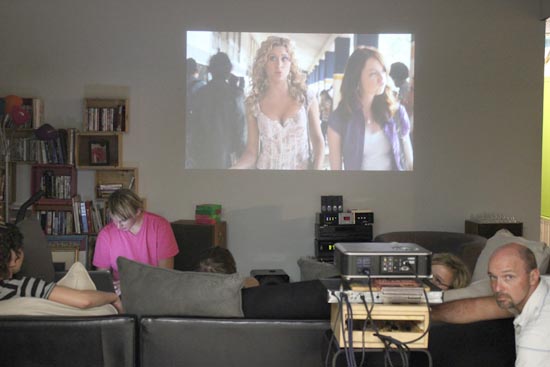
So stop patronizing them. Personally I find the below Cineplex masking-less presentation simply unacceptable. Sure it's digital and the edges are sharp, but the picture doesn't fill the screen and it looks like some half-assed presentation you would see in some guy's home.
Posted by Terry Lynn-Stevens (Member # 7349) on 10-04-2014, 12:43 PM:
quote: Brad Miller
Cineplex masking-less presentation simply unacceptable
Even worse is flat masking around a scope letter box image. The common height cinemas are now set to flat and scope is projected on them.
VIP/AVX which have no masking does not bother me as much
Posted by Sam Graham (Member # 2889) on 10-04-2014, 07:51 PM:
quote: Brad Miller
Personally I find the below Cineplex masking-less presentation simply unacceptable. Sure it's digital and the edges are sharp, but the picture doesn't fill the screen and it looks like some half-assed presentation you would see in some guy's home.
Danged Cinetopia living room auditoriums...
Posted by Steve Matz (Member # 1890) on 10-04-2014, 11:40 PM:
Weii;I'm pro film but I watched "A Walk through the Tombstones" at a Carmike Theater(Winnsong 10)this evening and was actually impressed with the Picture Quality/sound and Screen Size. Usually on these Multiplexes when you have 10 or more screens they get pretty small. This Screen was as large as the old single screens we had decades back. I'm sure not all the theaters have equal size screens;this theater must be where the Big Blockbusters are shown.Resolution,sharp focus,etc was very good.The Blacks still don't seem to have the contrast of film but if I had to rate my experience at this Movie from 1 to 10 I would easily give it a 9+..... ![[beer]](graemlins/beer.gif)
Do all the Carmike Chain theaters use the same brand Projectors? I would probably think they would if you had that many theaters across the Country. Buying in Bulk they would probably be getting a pretty good price per Unit....I didn't get a chance to ask one of their People what Mfger they were using,but whoseever it was I was impressed...
Posted by Monte L Fullmer (Member # 2797) on 10-05-2014, 01:31 PM:
35MM = autostrike assemblies might fail to where a manual bulb strike is needed. Put a new one in and all is good.
Machine is happily doing its thing.
Digital = network issues with projectors losing communication with servers, security issues and resets, RAID issues, and the VPI NAZI Police.
..and those boothless auditorium setups!
-Monte
Posted by Steve Matz (Member # 1890) on 10-05-2014, 03:09 PM:
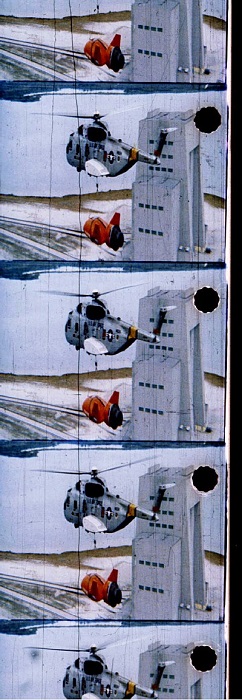
I think just for Nostalgia sake on these Digital Films;they should still put the Que Marks up in the Right Corner every 20 minutes; so it at least gives you the illusion that you were watching Film ![[Roll Eyes]](rolleyes.gif)
Posted by Monte L Fullmer (Member # 2797) on 10-05-2014, 09:33 PM:
Corrected screen image ..
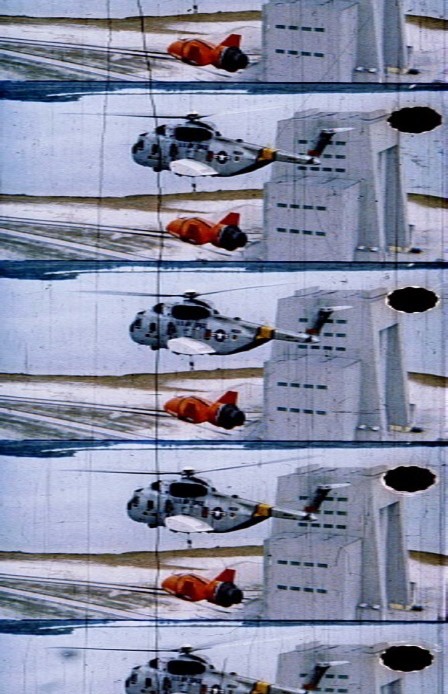
The classic elliptical dots !
And suddenly, the image definitely shows quite a bit of acreage on the screen.
Posted by Steve Matz (Member # 1890) on 10-05-2014, 10:13 PM:
Yeah Monte;the sample I posted was 16mm ![[Eek!]](eek.gif)
Posted by Frank Angel (Member # 248) on 10-07-2014, 02:03 PM:
OK, totally off subject, but what made those wavy, white curliques around the edge of the black cue mark? I understand that the negative is punched and hence the black dot, but then how does that small little band of white with the ruffles on it get there?
Posted by Jim Cassedy (Member # 4115) on 10-07-2014, 04:42 PM:
quote: Frank Angel
how does that small little band of white with the ruffles on it get there?
I don't know, Frank, but I had always noticed that on "real" IB-Tech
prints, the change-over 'lab dots' were always more like little 'stars'
and had an 'edge color' border around them.
It probably made them more obtrusive to the patrons, but almost
impossible to miss as a projectionist, unless you just happened to
sneeze or blink at that moment. Oh, how I miss them. . . . .
I do recall reading once, somewhere, how Technicolor did this, but,
unfortunately, I don't remember any of the details.
LOOK:
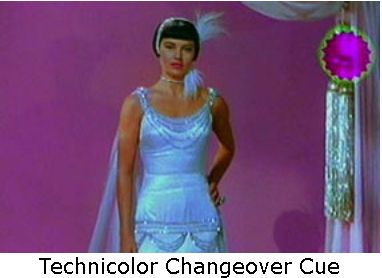
(an image I found online)
Posted by Jarod Reddig (Member # 6363) on 10-07-2014, 09:31 PM:
Overall Ive noticed that the theaters that couldn't get film right still have crappy presentations with digital. Then the theaters that did good with film are having more consistently good presentations with digital.
I notice an overall improvement in brightness compared to film as well as a steady image. I have also noticed that digital black levels for the most part pale compared to film, although in most cases ambient light is still an issue film or digital with an EXIT sign shining on the screen. Audio wise I hear imporovments with digital locations but as said shitty EQ's are still and will keep on being an issue.
Posted by Steve Matz (Member # 1890) on 10-07-2014, 10:23 PM:
quote: Jim Cassedy
I don't know, Frank, but I had always noticed that on "real" IB-Tech
prints, the change-over 'lab dots' were always more like little 'stars'
and had an 'edge color' border around them.
Jim;This is from a 16mm IB-Tech Print...Look Familiar to your Sample ![[Confused]](confused.gif)
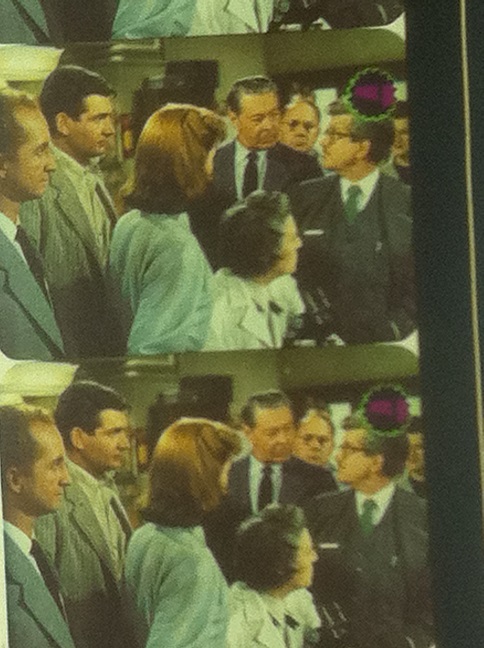
"War of the Worlds"
Posted by Steve Matz (Member # 1890) on 10-08-2014, 01:51 AM:
Now I remember where I saw a Cue Punch that made that IB-TECH Pattern. If any of you have an Old SOS PHOTO-CINE-OPTICS -INC. Catalog from the 70's you will find one in there.They had an East and West Outlet. One on Burbank Blvd in North Hollywood and one in New York. They had Everything related to TV and MP. Bought a Ton of Stuff from them through out the 70's. I know I have some of their Old Catalogs;but Where!
Posted by Michael Brown (Member # 890) on 01-27-2015, 06:24 PM:
I just seen 4 films in the last 2 days. Only one of them had good presentation. 2 out of focus and 2 with sound issues (So to keep up with the math one had both out of focus picture AND a problem with the sound - lucky it was only Taken 3.)
So that's how I'm doing at the moment. ![[Frown]](frown.gif)
Just had something strange happen to me a couple of times in 2 different auditorium. Surround sound only coming from the back wall - nothing from the sides (these were both meant to be 7.1 theatres) Happened a while ago with the last Die Hard film and just in the last few days with the new Hobbit film. Any idea? Did they just forget to turn on all the amps?
Posted by Marcel Birgelen (Member # 6801) on 01-27-2015, 07:46 PM:
quote: Michael Brown
Just had something strange happen to me a couple of times in 2 different auditorium. Surround sound only coming from the back wall - nothing from the sides (these were both meant to be 7.1 theatres) Happened a while ago with the last Die Hard film and just in the last few days with the new Hobbit film. Any idea? Did they just forget to turn on all the amps?
This could be a thousand things obviously, but if none of the speakers on the side was working during the entire show it's probably due to failed or switched off amps.
Missing channels isn't something new, most people will only start complaining if the center channel drops dead... Also, ever tried to convince some lowly cinema staff some channel isn't working?
Posted by Martin McCaffery (Member # 37) on 01-27-2015, 08:12 PM:
quote: Michael Brown
Only one of them had good presentation. 2 out of focus
And thanks to digital it will stay out of focus until someone has a technician come in and refocus, which probably means forever (in DCP lifetimes). No chance of accidentally getting it in focus.
Posted by Bobby Henderson (Member # 840) on 01-28-2015, 02:05 PM:
In my experience d-cinema has brought up the bottom level of movie theaters to much improved standards, but it has been an obvious step backwards in theaters that were already doing a good job with film projection.
Locally, d-cinema gear has made it tolerable for me to see a movie at the 12-plex in our mall here. However, presentation quality still isn't top notch.
Others have rightly pointed out that d-cinema is not idiot proof. Theaters that were making silly mistakes in film presentations can be counted on for goofs with digital.
My biggest complaint about digital -where it has been a step backwards: image quality.
The image may be totally steady and debris free. But it isn't sharp. With things dialed out of focus, perhaps on purpose, what difference does it make if the projector is 2K or 4K? I have to watch something on freaking Blu-ray at home if I want to see a crisp, sharp looking image.
For example, I've visited Harkins' Cine Carpi theater in Oklahoma City several times, including a few visits before the switch to digital. The booth used to have a very good Kinoton 35mm projector that threw pretty sharp looking images on a 70' wide screen (my only complaint was the images were a tad bit dim; something that would be solved with 5/70mm projection). With digital this same theater is showing imagery that isn't nearly as sharp. I strongly doubt they've cut corners. The house is equipped with Dolby Atmos. It's one of Harkins' showcase auditoriums.
quote: Marcel Birgelen
Missing channels isn't something new, most people will only start complaining if the center channel drops dead... Also, ever tried to convince some lowly cinema staff some channel isn't working?
I've been through this before, at a freaking brand new movie theater no less. The 7.1 surround sound was loud and dynamic, just no center channel.
quote: Martin McCaffery
And thanks to digital it will stay out of focus until someone has a technician come in and refocus, which probably means forever (in DCP lifetimes). No chance of accidentally getting it in focus.
I think a lot of digital-based movie theaters have the picture shifted out of focus deliberately. I'm sure some of it has to do with trying to hide that crude, electronic looking pixel grid. It also probably has to do with battling moiré created by the dot pattern of the perforated screen and pixel grid pattern from the projector (film obviously never had this problem). And then it also comes down to the quality of optics on the projector.
I haven't priced any d-cinema projector lenses, but just looking at the glass of some of these zoom lenses I imagine some of them must be very expensive. So I also image there are opportunities where the theater can cheap out and get a lesser quality, softer looking projection lens. If they're deliberately trying to hide the pixel grid or just eliminate moiré then what's wrong with saving some bucks on glass? By the way, lower quality lenses can introduce chromatic aberration, such as green and purple fringing on high contrast edges. This might be what some are seeing in regard to "convergence issues".
Posted by Rick Raskin (Member # 1561) on 01-28-2015, 03:53 PM:
How the hell can you sit and watch an out of focus picture? Missing sound channels might be borderline tolerable but in either case I'd be out of there in a heartbeat.
Posted by Buck Wilson (Member # 5885) on 01-28-2015, 04:03 PM:
quote: Marcel Birgelen
Also, ever tried to convince some lowly cinema staff some channel isn't working?
Well heck, have you tried convincing MANAGEMENT there's something wrong??
Posted by Martin McCaffery (Member # 37) on 01-28-2015, 05:58 PM:
quote: Rick Raskin
How the hell can you sit and watch an out of focus picture?
I'm not sure anyone on this list can, but the general public has been trained for over a generation to watch things out of focus.
And I'm pretty sure lowly theater worker includes management;>
Posted by Buck Wilson (Member # 5885) on 01-28-2015, 07:20 PM:
Fair enough! ![[Big Grin]](biggrin.gif)
Posted by Mike Blakesley (Member # 26) on 01-28-2015, 08:13 PM:
I suppose people who can train themselves to watch TV with the picture stretched out of shape can stand anything.
Posted by Marco Giustini (Member # 4544) on 01-29-2015, 04:18 PM:
Michael,
Cinemas are now like McDonalds. Some random guy turn the equipment on; if some does not turn on or shows a red light or beeps or does not show anything at all... they don't know/don't care/haven't been trained for.
I worship cinema. But I had to give up, I couldn't spend money for what Michael is experiencing on a regular basis.
I know of a cinema with the 7.1 badly configured. For several years all their screens ran Centre and Subwoofer channels from Back surrounds when in 7.1 mode.
TWO complaints overall. And I was told they came from the same guy.
Posted by Marcel Birgelen (Member # 6801) on 01-29-2015, 06:15 PM:
Running Center and Sub from the back surround speakers and practically no one ever complained? Wow and I thought the multiplex around the corner mixing up surround channels in some of their rooms and using a Bose Acoustic Wave Cannon as sub is already a pretty FUBAR situation ![[Wink]](wink.gif) .
.
The situation is actually worse than McDonald's, because over there, they usually know the patties, cheese and condiments should go between the buns.
Posted by Monte L Fullmer (Member # 2797) on 01-29-2015, 07:51 PM:
Means that the "Booth Monkeys" we knew of yore now have been graduated to Digital Cinema Managers, yet still hold on to the two attributes they were trained with: don't know anything and won't listen to reason.
One thing that they know how to do well is, "Pass the Buck", and play, "The Blame Game!"
Posted by Marco Giustini (Member # 4544) on 01-31-2015, 06:28 PM:
Marcel, I have more stories if you want. I can think of a cinema that ran 3D with swapped eyes for 12 months (no complaints) and another one who ran a whole performance with the wrong colour space (all pink or green) in a sold out room and received 1 complaint. It was a 3D show BTW and if not mistaken it was ALSO run with swapped eyes.
I am indeed fussy but I would be able to accept a little compromise when going to the cinema. I said compromise, not a complete random mess.
Michael, focus on D-Cinema is pretty stable. What you are seeing is more likely to be the 3d device left in place all the time. It's pretty common these days.
That said: was 35mm any better? Yes, there were projectionists. Were they skilled enough to realise things? Were projectionists running regular sound and picture tests unless the company they worked for asked them to do so?
My personal experience says that 10y ago there were cinemas, including big groups, which cared about Cinema - or at least they tried.
Those company eventually disappeared and what is left is run by the number department. No quality, no customer satisfaction. Just a big black box with cheap speakers with some light and sound in there.
Is it just my impression?
Posted by Jarod Reddig (Member # 6363) on 02-01-2015, 04:34 PM:
Marco thats about my same impression as well.
Posted by Martin McCaffery (Member # 37) on 02-01-2015, 06:29 PM:
I don't know about the UK, It's my impression the big boxes gave up caring a lot more than 10 years ago. Certainly where I am it has been more than 30 years.
Posted by Mike Blakesley (Member # 26) on 02-01-2015, 10:01 PM:
We hear constantly about lavish new theaters being built and opened....is the experience at these wonderful places lousy? Or is it just at the chain theaters that have been there forever that things decline?
We've been to the AMC 24 in Disney World many times and always had a nice (if not exactly unique or memorable) experience there. My only real complaint about that place is that it's sometimes impossible to get across to some of the multiple-pierce-having, barely-English-speaking, many-tattoo-having concessionaires what I mean by "put a lot of ice in it.)
Posted by Marcel Birgelen (Member # 6801) on 02-02-2015, 09:14 AM:
quote: Marco Giustini
I can think of a cinema that ran 3D with swapped eyes for 12 months (no complaints) and another one who ran a whole performance with the wrong colour space (all pink or green) in a sold out room and received 1 complaint. It was a 3D show BTW and if not mistaken it was ALSO run with swapped eyes.
Well, I also had a hard time convincing the manager his gear was off when I was watching a show where left and right eye were reversed. It's not something you spot immediately, although I might be a bit more trained to see it... My girlfriend who was with me, also noticed it, but she couldn't explain exactly what was wrong. Your brain is trying to compensate, but it doesn't really work. I would never be able to watch an entire show this way.
So, the manager tried to push a few buttons but it didn't work. Eventually I put my glasses on upside down. Not really comfortable, but better than watching a show in "reverse 3D".
Interestingly, no-one else in the room complained about it... I even asked a few patrons if they did notice anything odd... Nobody did notice anything. I just couldn't believe it...
On the other hand, I had a show with a screwed up color space once and the whole room was up in arms. It's also not really that difficult to spot I would say... The feature arrived way to late on a disk that had either a defective DCP or the KDM was incorrect. There was no more time to fix this.
So, I needed to do an instant Blu-Ray hack job with the first Blu-Ray player I could lay my hands on. We fetched the actual Blu-Ray and HDMI cable at the local record shop... With no time to spare we crossed fingers and launched the Blu-Ray on a monitor. Once I plugged the HDMI over into the projector, it was obvious: wrong color space. Screwed. It took about 5 minutes to fix, but at least here people didn't put up with funky pictures .
Posted by Terry Lynn-Stevens (Member # 7349) on 02-02-2015, 11:39 AM:
quote: Mike Blakesley
We hear constantly about lavish new theaters being built and opened....is the experience at these wonderful places lousy? Or is it just at the chain theaters that have been there forever that things decline?
IMO, the way many people on here see a movie theater/presentation vs. a regular average person is the difference. Most people on here will argue that a movie with masking, 4k and object based sound etc etc is the best way to see a movie. I have often seen comments from members on the board that features such as reclining seats, reserve seating and Coke Freestyle machines are not needed or do not add any benefit.
While I do not disagree with most of the above, the average consumer sees things differently. Since Cineplex has gone to their scope presentations on an open masked screens I have yet to see anyone care to even discuss it. I have often asked people at social function if they have seen a movie and if I even mention the idea of masking they would just look at me with a strange face.
I have yet to meet anyone who knows what Dolby Atmos is and we have numerous Atmos installations in my area. (word is that Cineplex will not be installing Atmos going forward)
Most people like VIP and the AVX Experience. Most really like the idea of reserve seating and strange enough D-BOX is more popular than I thought.
Rocker seats are popular in my area, I think they suck because they start squeaking and they make noise over time. But people seem to like them.
I don't think the average person cares about things we do, they certainly don't know or notice either.
Posted by Mike Blakesley (Member # 26) on 02-02-2015, 11:57 AM:
It is definitely a fact that we on this board are much pickier than the average person. I have to keep telling myself that when some circumstance happens that drives me crazy, but most people don't even notice.
In the film days when we played "Driving Miss Daisy," it took forever to get a print -- and when we got one, it was scratched beyond belief. It had scratches throughout the whole print and all the way across the picture -- platter scratches, vertical scratches, various gouges here and there, you name it, this print had it. And there were no replacement prints available. So every night of that movie I warned people as they went in that the movie was very scratched, and then I stood by the door as people exited and said "Sorry about the scratches!" Almost every person said they "barely noticed" the scratches or "I didn't think it was that bad!" And nobody decided not to buy a ticket after my warning.
I guess me getting out in front of the problem by warning people is what helped, but still....I couldn't even watch the movie it was so bad. To this day I've never seen that movie.
Posted by Martin McCaffery (Member # 37) on 02-02-2015, 02:35 PM:
Mike: first off, you didn't miss anything.
Second, good for you. I do the same thing when there is a problem and most people are good with it. I really think the audience respects you more for being up front about a problem - and being the face of the person to complain to. Can you imagine the manager of a multiplex even trying to pull this off.
Customer service sooooo sucks in this country, and people are so pissed at having to put up with it, that they are damn near grateful when a real person is there AND takes responsibility.
Posted by Bobby Henderson (Member # 840) on 02-02-2015, 03:47 PM:
quote: Mike Blakesley
We hear constantly about lavish new theaters being built and opened....is the experience at these wonderful places lousy? Or is it just at the chain theaters that have been there forever that things decline?
It's a combination of things.
Inconsiderate people disrupt shows for other customers at both new and old theaters. Few theater chains have things like no cellphone use policies, much less the nerve to enforce those rules. Hardly anyone wants to get in a confrontation so they put up with jerks kicking the back of their seats or some other nonsense and then think twice about going back to that theater.
Big theater chains look for any way to pinch pennies and with old theaters including deferring maintenance on lots of things. They'll let things go to hell as much as possible if customers don't complain. They appear to make more of an effort spending on maintenance with new theaters. Also, the newer and bigger theaters will tend to be staffed with more people and (maybe) better managers.
The switch to digital projection has solved some problems but created others. The projected image may be rock steady, but it's likely going to be a tad bit soft and slightly out of focus. Not nearly as much attention is paid to sound systems like in the 1990's when digital surround sound still had some novelty to it. Lately things like 3D and Fake IMAX have overshadowed the sound component of the show. D-cinema systems are arguably more complicated than their film-based predecessors. They're certainly a lot more costly and have a far shorter life span. There's lots of details to handle. If they're not handled properly then shows get goofed up.
quote: Mike Blakesley
It is definitely a fact that we on this board are much pickier than the average person. I have to keep telling myself that when some circumstance happens that drives me crazy, but most people don't even notice.
While it's true most audience members don't consciously notice the difference between mediocre and great presentation quality, movie theaters should never be operated down to the standards of people who can't tell the difference. Any theater doing that is going to be one shitty movie theater. A good movie theater at least tries to get as many things right as it can. This is at the root of being professional.
Also, it's really only a theory most customers can't tell any difference.
I think the real truth is most customers don't give enough of a shit to bother going out of their way to tell a theater manager about some nits they would like to pick about the show quality. Even fewer are going to bother going out of their way to tell the staff about what they really liked. Maybe they'll get on Yelp or Facebook later to talk about it, or not. Laziness is a factor. When some technical problem messes up a movie a packed audience will have an endurance contest among themselves. They'll wait it out seeing who is nerdy enough of or intolerant enough to bother getting up and leaving the room to hunt for a manager. The rest stay comfy in their seats while the loser of the contest gets inconvenienced.
quote: Terry Lynn-Stevens
I have yet to meet anyone who knows what Dolby Atmos is and we have numerous Atmos installations in my area. (word is that Cineplex will not be installing Atmos going forward)
Terry, do you have any actual sources for that "word" or is this just wishful thinking on your part?
Even if Cineplex wasn't planning any new Atmos installations they've already installed it in a couple dozen of their locations in Canada and might simply be reaching a saturation point with their premium priced big screen theaters.
Posted by Terry Lynn-Stevens (Member # 7349) on 02-02-2015, 04:39 PM:
quote: Mike Blakesley
It is definitely a fact that we on this board are much pickier than the average person. I have to keep telling myself that when some circumstance happens that drives me crazy, but most people don't even notice.
And that usually what I have noticed, those who work in certain industries usually notice or "know" things that regular folks would never know.
As for what people want to spend their money on and why has always been an interesting thing. Right now it seems that anything that allows a movie to be associated with "event" status such AVX, VIP, or D-Box seems to be the trend. Alcohol at the movies also seems to be quite popular around here. Discount theaters seem to be struggling.
quote: Martin McCaffery
Can you imagine the manager of a multiplex even trying to pull this off.
I once tried to complain to a theater manager about the masking and how they were showing scope on an open flat screen, the guy just looked at me with a blank stare and thought I was crazy.
I think if the chains did things the best way possible, they would see a 10% improvement on ticket sales and revenues. But the majority of people just don't care, they seem happy with what they are paying for.
Posted by Mike Blakesley (Member # 26) on 02-02-2015, 05:47 PM:
quote: Bobby Henderson
I think the real truth is most customers don't give enough of a shit to bother going out of their way to tell a theater manager about some nits they would like to pick about the show quality. Even fewer are going to bother going out of their way to tell the staff about what they really liked.
I think it's more about the combined experience over time. We're supposed to be "wowing" them every time. If they are continually underwhelmed, they might be satisfied with their show but increasingly not "wowed." People leaving with just a "that was OK" feeling, as opposed to a "WOW!" feeling, are more likely to decide to forego the experience the next time.
Posted by Frank Cox (Member # 6258) on 02-02-2015, 05:56 PM:
I just now got an email from someone I've never heard of before stating that American Sniper is a great movie and the sound in my theatre does it justice.
So I'm pretty happy about that. ![[Smile]](smile.gif)
I guess the glitch in the one scene didn't bother him.
Posted by Buck Wilson (Member # 5885) on 02-02-2015, 06:58 PM:
quote: Terry Lynn-Stevens
I once tried to complain to a theater manager about the masking and how they were showing scope on an open flat screen, the guy just looked at me with a blank stare and thought I was crazy.
This is the garbage that drives me crazy. It's a vicious circle really, a general dumbing down of the industry.
#1- New, under-paid, freshly promoted usher-to-manager fails to notice that the masking is in the wrong position.(How COULD he? Never properly trained, no one ever told him- he doesn't even know what masking is!)
#2- Customer immediately complains(during or right after show, same day) and 'manager' looks at him with a dumb look on his face, never looks into issue further(can't be bothered, doesn't know, doesn't care)
#3- Customer's expectations drop, why would he complain again if the "theater" doesn't seem to care and the problem continues? After all, It's not even his place to have to complain. Customer may or may not return...
#4- Theater suffers because that customer doesn't return(or at least not as often as he would have) and takes shortcuts like promoting underpaid staff, cheaper equipment, no masking to cover margins....... and there's the full circle.
You can apply this to nearly any problem. Especially if it saves the theater money. "Well, customers don't seem to care about of a lack of masking(Or curtains, tuned sound, fill-in-the-blank), so why install it?!" They never stop to consider the fact that they might in fact care, even if the customer doesn't know it. Again, it truly IS NOT the customers' job to know or care about masking or whatever else, it's part of the MAGIC that they EXPECT.
You'll hear constantly "They don't SEEM to care... "No one SEEMS to notice..." That's extremely dangerous. It's one thing in a one off instance like the skipping the fellow is trying to fix(promptly) but an entirely other thing when it affects business operations/plans/expectations etc...
The magic is leaving and the industry wonders why attendance is dropping.
Honestly, I don't get it. They're blind. They keep cutting corners thinking it's saving them money and increasing profits, BUT IT'S NOT. IT IS NOT WORKING.
quote: Terry Lynn-Stevens
I think if the chains did things the best way possible, they would see a 10% improvement on ticket sales and revenues. But the majority of people just don't care, they seem happy with what they are paying for.
Agreed about the revenue boost, but I wouldn't say a majority don't care, but rather, they simply don't know what they're missing. And to me, that's truly heartbreaking.
I work at a standard cheap multiplex, and I am truly embarrassed to even sell tickets because I know the experience is sub par. But what can I do but sell with a smile on my face....
Posted by Mike Blakesley (Member # 26) on 02-02-2015, 07:12 PM:
quote: Buck Wilson
'manager' looks at him with a dumb look on his face, never looks into issue further(can't be bothered, doesn't know, doesn't care)
Here's a big part of the problem right here. I wonder how many customer complaints never reach the ears or desk of someone who could actually do something about them? I wonder how many comments about the lack of masking have never gotten any further than the popcorn pusher in the lobby?
We tell all our employees, if anyone ever makes any kind of a negative comment OF ANY KIND they should tell us what the comment was, so we can work on a solution if possible.
Posted by Buck Wilson (Member # 5885) on 02-02-2015, 07:44 PM:
I don't even KNOW of a desk of someone who could actually do something about it... let alone if they WOULD.
Granted things like masking will get fixed with my managers persistence, but even he has only so much say. Wouldn't at all be surprised if they were to say "Just get it into flat and leave it there"
We've had duct tape on our stair carpet for years, the seats are deplorable... The building was built in 2004.
You are in the minority and I give you huge kudos.
Posted by Mike Blakesley (Member # 26) on 02-02-2015, 08:23 PM:
See that's the problem... I'm just running what SHOULD be a normal theater here but I deserve "huge kudos?" That makes no sense. What's wrong with the owners in this industry?
Posted by Buck Wilson (Member # 5885) on 02-02-2015, 10:10 PM:
There's a radio commercial for a local law firm here. It asks business owners "What is your goal running your business? If it's money, you'll eventually fail. If it's your customers, you'll eventually make money. Funny how that works [...]"
And that's what's wrong with the industry. It's all about the money and the shareholders, not the customers or the presentation.
Posted by Mitchell Dvoskin (Member # 751) on 02-03-2015, 10:47 AM:
quote: Bobby Henderson
I think the real truth is most customers don't give enough of a shit to bother going out of their way to tell a theater manager about some nits they would like to pick about the show quality.
The public does notice. Most do not bother to complain, they just do not come back.
Posted by David Buckley (Member # 2600) on 02-03-2015, 03:28 PM:
quote: Mike Blakesley
See that's the problem... I'm just running what SHOULD be a normal theater here but I deserve "huge kudos?"
And there's your problem right there, Mike: You give a fuck. That differentiates you from the operators of most cinemas across the world.
Film-tech remains no way representative of cinemas worldwide.
Posted by Mark Hajducki (Member # 1732) on 02-03-2015, 05:35 PM:
One of the UK's large multiplex chains disconnected the masking when they converted to digital. This was a deliberate decision to reduce maintenance costs.
------------
Part of the problem with the management of most chains is that they are owned by venture capitalists who want short term profits, not a sustainable long term business.
By making "enhancements" (reducing staff hours and training, building maintenance, presentation quality, food quality etc.) whilst at the same time "revising" (increasing) prices they will make more money in the short term.
With the ever increasing challenge from home entertainment and other leisure activities there will become a point when customers are not prepared to pay a high amount for a substandard experience.
With a lot of films being TV quality and with the quality of a lot of TV/streaming content being cinema quality the days of the ever enlarging multiplex are probably coming to an end.
Posted by Allan Young (Member # 6332) on 02-05-2015, 04:01 AM:
quote: Mark Hajducki
One of the UK's large multiplex chains disconnected the masking when they converted to digital. This was a deliberate decision to reduce maintenance costs.
I'm guessing this was Vue?
I complained to a Vue manager about the masking no longer being used and I got a puzzled look and the response "I've worked here for a year and a half and I've never heard of masking".
Posted by Michael Brown (Member # 890) on 02-08-2015, 03:13 PM:
Both Vue and Odeon quit using masking.
Posted by Brad Miller (Member # 2) on 02-08-2015, 03:15 PM:
I really wish some tv manufacturer would step up to the plate and make a nice big square television to where no format fit it properly and there was always extra white screen. That way consumers can experience that "large format eXperience" at home!
Posted by Manny Montes (Member # 5639) on 02-08-2015, 03:32 PM:
I might be spoiled or something, but I've found that most cinemas in south florida (even multiplexes) actually have pretty decent service. What was sad was towards the end of film (and since AMC put "booth ushers") in place, film sucked. It flat out was an awful experience, so now that managers are on the floor and can focus on that, I think my overall experience at most theaters has actually gone up. With a few exceptions of course (sadly the mom&pop ones around here are the worst)
Posted by Frank Angel (Member # 248) on 02-16-2015, 12:53 PM:
Yesterday I saw JUPITER ASCENDING 3D and not only was the masking not used, but the image was letterboxed in the center of the screen for what reason I don't know other than Digital Done Dumb. This resulted in a WHITE surround rather than a black one all around the image. Perhaps when they do Scope 3D titles, this is the way they do it rather than full screen so they can get a brighter image. If that is the case, then it doesn't work; the light level was downright awful (except in the HOT SPOT). In fact, we walked in on the previews and at first I thought I was watching some preshow crap on one of those consumer projectors. Fall off on one side was dramatic and the overall image was dull as a butter knife; imagine my surprise when the feature started and nothing changed. Which is why I will ALWAYS opt to see any 3D film in IMAX when I can -- never had a brightness problem with their dual projection system. RealDull 3D doesn't cut it for me.
And why didn't the DCI bunch mandate proper masking in the DCI spec if they were so concerned with quality presentation like their PR bs claimed, rather than just protecting content?
Maybe if directors want to force theatres to properly mask their films, they should digitally create a soft shadow edge around the entire image perimeter like existed around the edge of the film image so the theatres would be forced to properly mask. The sharp edge that digital creates just gives idiot exhibitors an excuse to not use masking.
We need to have a Digital Done Dumb thread.
Posted by Mark Hajducki (Member # 1732) on 02-16-2015, 06:58 PM:
quote: Frank Angel
why didn't the DCI bunch mandate proper masking in the DCI spec
Version 1 (2005) of the spec did require masking.
quote:
8.3.3.3. Screen Characteristics
The screen is required to be non-specular and equally reflective over the entire visible
spectrum. The screen is required to have variable black masking, adjustable to tightly
frame the projected image. This is required to minimally include 1.85:1 or 2.39:1 image
formats. Masking for other formats is optional.
By Version 1.2 (2008) the above section had been removed and replaced by:
quote:
8.3.3. Environment, Image Parameters and Projected Image Tolerances
The SMPTE published recommended practice "SMPTE RP 431-2: D-Cinema Quality - Reference
Projector and Environment" shall be utilized and shall be normative in its entirety for this specification.
Unfortunately this is not publicly available so I am unable to tell if the requirement for masking is still in place.
Posted by Terry Lynn-Stevens (Member # 7349) on 02-16-2015, 07:18 PM:
quote: Frank Angel
Which is why I will ALWAYS opt to see any 3D film in IMAX when I can -- never had a brightness problem with their dual projection system. RealDull 3D doesn't cut it for me.
Does the lack of masking in an IMAX Theatre bother you?
Posted by Frank Angel (Member # 248) on 02-16-2015, 07:35 PM:
EVERYTHING about DCinema bothers me....IMAX or otherwise.
Posted by Terry Lynn-Stevens (Member # 7349) on 02-16-2015, 07:53 PM:
Wow, you sound like a really unhappy person.
I've given up and stopped worry about these things, I sometimes get masking, most times I don't.
Posted by Mark Ogden (Member # 43) on 02-16-2015, 08:38 PM:
Traditional fabric masking is a thing that seems to be going the way of the traveller and title curtains that were discussed in a recent thread. In an era of films like Life of Pi and The Grand Budapest Hotel, pictures that change aspect ratio during the course of the film, masking is impractical. There's a film playing at arthouses right now that goes by the title Mommy. The aspect ratio for most of the picture is 1:1, literally a perfect square, but at some points it changes to widescreen. There's one scene where the protagonist walks into a close-up and with his hands pushes the sides of the frame open to 1:85. It may sound pretentious, but in the context of the story it's an effective moment. How do you mask for that?
While I would've been horrified at an unmasked screen during the film era, I don't mind it so much in the digital era, as the image generally has a very tight edge sharply transitioning to a very dark gray to near-black area of unused screen space. Since varying the aspect ratio during a film to suit the story is a trend that I believe will probably continue, I guess I'm lucky that it doesn't bother me.
Posted by Bobby Henderson (Member # 840) on 02-17-2015, 12:36 AM:
Unmasked screens in standard movie theaters look cheap. They just look like the construction crew got to a certain point in the installation process and then said, "fuck it," pulled off the job and went home. Screens with no masking (much less curtains) just look unfinished.
Equally as bad, unmasked screens make the rest of the auditorium look kind of cheap as well. You're already in a cubic shaped room surrounded by cinder block walls. The combination of a bare screen with no treatment can easily make the room seem more like a big storage space at Sam's Club or Home Depot. They might as well have some shelves in there stocked with giant bags of cat food, quick-crete and lumber.
The only kind of indoor theaters where screens featuring no masking or curtains has been acceptable was true, film-based IMAX theaters. The screens were big enough both in terms of height and width to fill the peripheral vision of most viewers.
Rectangular shaped screens in traditional movie theaters do not fill peripheral vision. Even if you sit close to the screen you're still going to see the top and bottom of it pretty easily.
These stupid wall to wall screens lacking masking and curtains are taking on the function of a big TV screen. Letter-boxed 'scope images? HDTV sets do that. Movie theater screens shouldn't be making 'scope the smallest, lowest resolution format. But that's exactly what's happening in d-cinema now. Changing aspect ratios? That's another TV set behavior. Lately some movie theater chains are installing "floating" movie theater screens, some of which have glowing light behind them. That's another TV set design! Some of it looks straight out of the 1970's. Shit, Regal's "RPX" logo looks lifted from Letraset's "Stop" typeface designed back in the 1970's!
If these movie theater chain operators think they're offering something contemporary with these cheap looking non-treated screens and obnoxious wall graphics they need to think again.
Posted by Marcel Birgelen (Member # 6801) on 02-17-2015, 01:56 AM:
In the film days, without masking, you would have ugly looking soft edges, in the digital days, edges are sharp as a knife (at least if you get the focus right). This is the primary reason why masking is being seen as redundant nowadays.
The extinction of the properly masked screens is just another result of the "cost optimizing" aspect of almost anything nowadays: If "the public" at large, doesn't mind it, you don't need it.
Combine this with the rise of the multi-aspect-ratio movie and yeah, it's not looking good for movable masking in general.
Posted by Mike Blakesley (Member # 26) on 02-17-2015, 12:01 PM:
quote: Marcel Birgelen
In the film days, without masking, you would have ugly looking soft edges, in the digital days, edges are sharp as a knife (at least if you get the focus right). This is the primary reason why masking is being seen as redundant nowadays.
I'm sure you're right on this but it still looks bad to have a lot of white screen showing around a picture.
Our screen is 30x15 (Don't blame me, the size was determined before I was born) and we have fixed masking. Our flat picture has been pillarboxed since Day 1, but in the film days we always ran scope pictures cropped to 2:1. We changed that when digital came in, and went with a letterboxed image for scope. No complaints about it from anyone, but it drove me crazy to see that white space. So recently we changed the macro to where the picture fills the screen again and is cropped to 2:1. I can't even explain the "why" of it, but it looks way better to me. (Maybe it's just me!)
I don't like cutting off the edges of the picture, but we still have the previous letterboxed format to fall back on if there is ever a movie with essential image information out on those edges.
Posted by Bobby Henderson (Member # 840) on 02-17-2015, 03:12 PM:
The frame edge in d-cinema can be sharply defined, but almost never is due to so many theaters showing the projected image slightly out of focus. Even if the focus was dialed in very sharp the black levels are not nearly as deep as they were with film. A letter-boxed 'scope image on a taller white screen may give off the appearance the image is just being projected cheaply on a bare wall.
Posted by Jim Cassedy (Member # 4115) on 02-18-2015, 12:29 AM:
quote:
There's a film playing at arthouses right now that goes by the title Mommy. The aspect ratio for most of the picture is 1:1,
OMG! I ran this movie at a major film festival late last summer.
First of all- - let me say it's a very good movie, and I briefly met its'
(very young) director, who seemed to be a nice guy.
But the aspect ratio drove me up the wall. I understand why he did it,
but I was projecting in an auditorium with a screen appx 35ft wide,
so I had a 10ft square image, with 12.5ft of "nothing" on each side.
Closing the masking was not an option, since: 1) no masking comes in that far;
2) There are one or two (short!) scenes where the picture expands to 1:85
Almost as soon as the movie began I started getting calls over the radio
from the floor staff asking if "that was the way it was supposed to be".
Customers were complaining. I heard one or two actually walked out.
I had one of the festival 'big wigs' come upstairs and tell me:
"EVERYBODY says you're using the wrong lens"
I explained that the director himself had looked at the picture earlier
in the day and approved the way it looked on screen and that if anybody
was 'using the wrong lens' it was the director. NOT ME!
And yes, it was a 'perfect' 1x1 image. I know this because along with the
DCP we were running an HDCAM tape a few seconds behind it as a back-up.
I punched up the tape output on one of those fancy ikegami control
room reference monitors where you could superimpose a grid over the
image, and it was definitely 1:1.
(And by the way, if digital is so freakin' good, would you please
explain to me why at every big film festival I work at, there's always
SOME sort of back-up as well as a couple of Dolby & Barco techs standing
by whenever we run a DCP? When we ran film, I NEVER had a Simplex or
Century tech in the booth, and only one print. Go figure. . . )
Posted by Monte L Fullmer (Member # 2797) on 02-18-2015, 12:53 AM:
quote: Frank Angel
and not only was the masking not used, but the image was letterboxed in the center of the screen for what reason I don't know other than Digital Done Dumb
I was told by a big circuit tech why this is so:
1-Cut back expenses on masking motor maintenance.
2-Since the invention of the HD widescreen TV, and with the majority of the TV shows are presented in a letterboxed format along with older VHS 'scope movies being shown in Letterbox on the older 4:3 TV screens, it just seem fitting that movie theatres adopts this same presentation format since the video public has accepted this form of presentation and can't tell the difference between what was and what is now.
AND, when you think of it: I've NEVER had any complaints on the letterboxed presentations at our cinema from any of the general, movie going public.
Only one or two that knows the difference between open screen and masked screen presentations.
-Monte
Posted by Steve Guttag (Member # 268) on 02-18-2015, 06:30 AM:
For the record, SMPTE 431-2 in Section 6.2 still has the masking requirement for 1.85 and 2.39.
SMPTE documents do not and never have had the rule of law...just the standards that engineers have determined to present movies in the best possible manner. It is up to the industry to follow them or not.
However, here is an interesting angle. For the VPF deals, strict adherence to DCI specs (which, by extension, seems to include SMPTE standards and recommended practices). So, in theory, any theatre not using masking could lose their VPF payments. Furthermore, a theatre/chain on the VPF plan that is using their maskings and otherwise adheres to DCI...could probably sue to require the big-boys either comply or lose their VPF payments. Fair is fair...if you have a contract, you have to apply it uniformly. The net result would probably be the expunging of that requirement from the DCI spec though.
Posted by Monte L Fullmer (Member # 2797) on 02-18-2015, 12:59 PM:
quote: Steve Guttag
could probably sue to require the big-boys either comply or lose their VPF payments
If so, then, who would want to take the first step and, would it be worth the fight?
Posted by Martin McCaffery (Member # 37) on 02-18-2015, 02:17 PM:
Their lawyers are bigger than our lawyers
Posted by Terry Lynn-Stevens (Member # 7349) on 02-18-2015, 09:29 PM:
quote: Monte L Fullmer
AND, when you think of it: I've NEVER had any complaints on the letterboxed presentations at our cinema from any of the general, movie going public
That pretty much sums it up. Most customers have no issue with it, although I prefer masking, it does not really bug me all the much.
Posted by Brad Miller (Member # 2) on 02-18-2015, 10:28 PM:
Customers are stupid.
Posted by Mike Blakesley (Member # 26) on 02-18-2015, 11:07 PM:
Well, it isn't the customer's job to know about masking (or miss it when it's not there). It's the theater's job to deliver an impressive experience.
To me, walking in and seeing the lacings of the screen exposed would be a huge turnoff. I expect a non-theater-owner might just look at it and go "hmm, that's kind of weird looking" and forget about it, but it would definitely look less luxurious and thus, not seem as "worth the money" to the customer. Same as if the walls were unpainted, or if there were bare bulbs hanging from wires instead of nice sconces.
Posted by Terry Lynn-Stevens (Member # 7349) on 02-18-2015, 11:27 PM:
What is the lacing thing? The new screens are mounted on metal frames, it wraps around the frame. Nothing is exposed.
Posted by Bobby Henderson (Member # 840) on 02-19-2015, 12:16 AM:
quote: Terry Lynn-Stevens
What is the lacing thing? The new screens are mounted on metal frames, it wraps around the frame. Nothing is exposed.
You're probably not looking at the setup closely enough. No one will ever stretch a movie screen properly by screwing it directly into a metal frame.
The same principal is true for large flex face signs. A proper flex face sign uses one of a variety of adjustable tensioning systems. The cheap, fly by night sign companies just cut the flex faces to size and drill them into an angle iron frame. The approach is fast, but it isn't for shit. The faces never stretch evenly and then when a decent storm blows through the faces can be ripped to shreds.
quote: Mike Blakesley
To me, walking in and seeing the lacings of the screen exposed would be a huge turnoff.
Yep. Some theaters do a better job of hiding it than others. But the whole thing takes on the appearance of a trampoline leaned up against the cinder block wall.
"Uh, yeah! Hey, uh, bring that big trampoline back here in this big tall storage room! It has a bunch of seats in it, but we can lean it against the wall over here on this end!"
Posted by Brad Miller (Member # 2) on 02-19-2015, 12:28 AM:
Terry is talking about wrap-around screens. (The crappy kind like IMAX uses.) The gromits and lacing string/springs are on the back side because the screen wraps a few inches around the round frame edges.
Posted by Monte L Fullmer (Member # 2797) on 02-19-2015, 12:39 AM:
Good ol' "Floating Screens."
Cheapest things to install.
They were a Big rave in the early 70's so dimming lights could be mounted behind and on each side of the screen.
Screen frame was mounted solely on the black core coated back wall and mounted far enough from the back wall to allow speaker install.
No masking was present, thus flat presentations had fuzzy edges and scope presentations would spill over the sides since the black core material soaked up the excess light.
This concept was to represent a drive-in screen with glow on each side as if the sun was at dusk making the screen more darker than it was.
Yet, in short, very distracting with those lights at just a dim glow.
Fad only lasted a few years, but the install of floating screens really took off due to the economical way of install especially using screen springs.
Our location has screens installed on conventional frames and actual black lacing twine was used instead of screen springs...
And we have no movable masking, but just the black dubotene cloth strip masking to hide the lace and screen lace grommets.
-Monte
Powered by Infopop Corporation
UBB.classicTM
6.3.1.2