This is topic Upgraded my Internet and lost the whole works in forum Film-Yak at Film-Tech Forum ARCHIVE.
To visit this topic, use this URL:
https://ft-forum.com/ft/cgi-bin/ubb/ultimatebb.cgi?ubb=get_topic;f=8;t=007078
Posted by Frank Cox (Member # 6258) on 10-31-2014, 10:01 PM:
Here's something that I never knew was even possible.
The phone company here now offers 25Mbps dsl service. Since my current service is 10Mbps and the 25Mbps service works out be $10/month more than what I'm paying now, I called them this morning to get my service upgraded.
Ten minutes after I got off of the phone, I lost the whole thing.
I called them back to complain and the service department guy checked and said that my current phone line can't handle the 25mbps service so they will have to send someone out on Monday to change it. In the meantime, he would switch my service back onto the 10Mbps connection that I've had up to this point.
No dice. Apparently switching me to the higher speed has smoked something between me and their dslam, which is located about two blocks away from here. So now I have no dsl service at all until they get out here on Monday and start taking things apart somewhere down the street.
I never would have thought that merely uploading a new modem profile could cause a hardware failure in something upstream from the modem.
Posted by Marcel Birgelen (Member # 6801) on 10-31-2014, 10:13 PM:
If it's plain old ADSL2(+) then it's most likely just bullshit. They probably don't know what went wrong, so they have the tech figuring it out. The port on the DSLAM might have died, but the stuff between your modem and their DSLAM is 100% passive copper wire.
What I don't get though is this 25 MBit/s, as ADSL2+ maxes out at 24 Mbit/s and you need to be living IN the DSLAM to get close to it. So, maybe you were already on VDSL? Or...
Maybe they tried to switch you from ADSL2+ to VDSL. For that to work, your modem needs to support it and also needs a total reconfiguration. There are many differences in the protocol, but even the basics are different: ADSL is still ATM based and VDSL uses Ethernet.
Posted by Leo Enticknap (Member # 534) on 10-31-2014, 11:27 PM:
Presumably they knew that your modem was compatible with the faster DSL before they offered the service to you?
A while back we were forcibly upgraded to the AT & T "U-Verse" thing: apart from the cable monsters (we don't have cable), Assholes Through & Through, as we refer to them, is the only telecoms provider that services our development, so we had no choice but to go with them.
Their changes to the exchange infrastructure meant that we had to have a new modem/router. For weeks we were given the hard sell for their U-verse TV through IP package, and for weeks we told them that we didn't want it, and just wanted to continue with no frills landline phone plus DSL Internet monthly package, and nothing else. Eventually they gave up and sent us the new modem/router without managing to bully us into signing up for 873 channels of bullshit, warning us that our existing modem/router would stop working on a given date and that we needed to install the replacement by then. What actually happened was that our Internet access and landline phone went out for several hours on that day. We'd already installed the new box and had been using it for about a week beforehand, and so the problem was definitely at their end.
Posted by Frank Cox (Member # 6258) on 11-01-2014, 01:52 AM:
The modem is owned by and provided by the phone company. It just comes as part of the service.
When they first started offering dsl service here you could get 5Mbps service, so that's what I got. A few years later they started offering the 10Mbps service, and when I upgraded to that they brought me a different modem. I wonder if they will end up replacing it again for the 25Mbps service. The modem actually looks like it's working; all of the usual lights are on. There is just no communication.
I actually have cable Internet service here as well. By having both dsl and cable Internet I am reasonably assured that if one of them is down the other is probably working.
Posted by Rick Raskin (Member # 1561) on 11-01-2014, 05:24 AM:
My guess is they reconfigured the DSLAM port to ADSL but neglected to re-establish the ATM PVC that maps the port to the uplink. I also suspect you'll need a modem change for the higher speed service. The tech should have been able to access the circuit and run PINGs in both directions to determine the problem.
Posted by Marcel Birgelen (Member # 6801) on 11-01-2014, 06:10 AM:
5MBps can be achieved using plain ADSL, 10 MBps can be achieved with ADSL2 and 25MBps only with VDSL over twisted copper pairs.
Most modern High Speed services over twisted copper pairs use VDSL2, which is quite recent and most older modems do simply not support it. Many Fiber to the Curb installations also use VDSL2. They essentially put a DSLAM in a cabinet in your steet or neighborhood and terminate your copper lines right there. They run fiber up into the cabinet, directly to the DSLAM. This way, the local loop on old copper lines is reduced to a minimum.
Whereas ADSL and ADSL2(+) can run over the same ATM backbone, VDSL usually employs an Ethernet based backbone. So, no more PVCs, but VLANs.
Posted by Jeff Kane (Member # 6372) on 11-02-2014, 12:07 PM:
If it's still ADSL2+ instead of VDSL they may be doing pair-bonding (using 2 pairs and bonding those connections) to get around the 24/1.4 limitations. Or they may just be rounding and being lazy about the marketing. Concur that it's highly unlikely something 'fried' unless it was coincidental.
Posted by Rick Raskin (Member # 1561) on 11-02-2014, 03:23 PM:
Either way, I still suspect a Layer 2 problem.
The techs have more than PING at their disposal. They can monitor port stats as well as run diagnostics. They should have been able to determine the problem PDQ.
Posted by Bobby Henderson (Member # 840) on 11-02-2014, 09:25 PM:
I've had AT&T Uverse for a little over a year, after being forced to upgrade to it from my older "DSL Pro" service.
I have not been satisfied at all with Uverse. For one thing, it's never delivered the higher bit rates AT&T promised. Instead I've had connection speeds hardly any better than my old DSL service, but noticeably less reliable. AT&T's phone lines in my neighborhood are ancient and AT&T is obviously doing as little as they can to upgrade them or even maintain them since so many people have dumped their land line phones. I'm sure some of the Uverse connection issues have to do with the shitty Motorola DSL Modem/Router they make Uverse customers use. I can't use better quality, after market equipment like I was using with my previous DSL connection.
I'm slowly migrating all my online accounts over to different e-mail addresses, getting ready to switch to cable Internet. Fidelity now owns the cable company here in town. Their TV service is an overpriced joke (and they make you pay considerably more for HD service while DirecTV and Dish provide HD for nothing extra). But Fidelity is offering much faster Internet speeds. I can get a 20Mb/s connection for $30 per month. I'm paying $40 for Uverse's stuff now. But I'm now out of their 1 year contract. So it's time to switch.
Posted by Frank Cox (Member # 6258) on 11-02-2014, 11:03 PM:
You should consider registering your own domain name. Then you can have an email address (or as many as you want) that is independent of any ISP. You can rent server space for very little these days, or run your own if you prefer. And if you decide to change the way that you're hosting your server, moving your email is as simple as updating your dns record with the IP address of your new email server.
Posted by Frank Cox (Member # 6258) on 11-03-2014, 03:55 PM:
The phone repair guy just left. He re-wired the phone jack that the modem plugs into. He said that he just changed it to use Pair One instead of Pair Two. I don't know enough about it to know what that actually means, but he said that their old modems that they used when they first offered the dsl service used Pair Two and that's why that jack was wired in the way that it was.
After he rewired the jack and plugged the modem back in I have 24.77Mbps download speed and 2.13Mbps upload speed on my dsl connection (that's now working again). So I'm pretty happy with that.
I asked him what protocol this service uses and he said that this new higher speed service is VDSL.
I still have the same modem that they gave me when I got the 10Mbps service.
Posted by Marcel Birgelen (Member # 6801) on 11-03-2014, 04:17 PM:
Well, it all depends on how wicked your local phone company has implemented their network. Usually, a phone line is just two (twisted) copper lines. In house cabling often uses 4 wires, but as soon as it leaves the building, it's usually just two.
But it's not common to just draw a single pair to any subscriber terminal. Because someone might want two separate phone lines or a copper wire might inadvertently break. Usually you get at least two pairs, around here you usually get 4 to 8 pairs per termination point and businesses often a lot more. It usually depends on local regulation and how mingy and foreseeing they were when they installed it.
Usually when you order DSL but keep the analog telephone service, they install a splitter on either end of the line. The splitter is essentially just a frequency filter. At the PBX, they hook one side of the splitter into the DSLAM (essentially just a large bunch of modems concentrated into a single device) and the other one back into the good old phone switch. At your side you hook up the "phone" side of the splitter to your telephony equipment and the DSL side goes into your modem. If you have a dedicated DSL service, without analog voice, they should omit the splitter on either side and it's just your modem and their DSLAM talking with each other.
Now, maybe they already pre-wired the second pair of copper wires going into your building to one of their VDSL capable DSLAMs, or maybe just on the same DSLAM, but just another port. When they switched your service, they disconnected your profile from the existing ADSL port and took it live on the VDSL port. Since they didn't effectively disconnect your "old" line from the DSLAM port, your modem was still capable to sync, but there was no more service behind it.
Still, this all sounds like a problem that would be common for almost everybody with the same setup as you have and who upgrades their service.
Posted by Rick Raskin (Member # 1561) on 11-08-2014, 05:03 PM:
Typical DSL (HSI) wiring was as such down here:
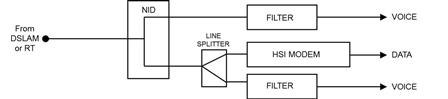
The splitter is passive and the filter kept telephony from interfering with the data. Both data and voice shared the same cable pair back to the CO.
Posted by Joe Redifer (Member # 3) on 11-08-2014, 08:06 PM:
Ug. Screw DSL. I'd get faster data if the internet was mailed to me as binary code printed out on many sheets of paper and I had to type it in manually. Grasshoppers can piss with more strength than a DSL stream

I did this while the WiFi in the house was being used by Jen for Yotube. Comcast.
Posted by Rick Raskin (Member # 1561) on 11-09-2014, 05:24 PM:
DSL is a stop gap measure at best. Better than ISDN but inferior to FTTP or Cable. They've squeezed about as many bits as possible with The DMT protocol running at the Link Layer. Cable has the limitation of being user sensitive in that bandwidth is shared with multiple users. It is after all, a broadcast bus and the more congested the link to slower the response time. My son has Comcast internet and it is lightning fast during the day and painfully slow at night. FTTP on the other hand is dedicated bandwidth. The beauty of FTTP is that it can be multispectral. The configuration of FTTP (FiOS) in my location uses three spectra: one for voice, one for video and another for data. Presently I have 50 Mbps bi-directional.
PS: The diagram in the earlier post was taken from training I developed some years back.
Posted by James Westbrook (Member # 3690) on 11-10-2014, 02:25 AM:
An AM radio station in Lubbock has it's signal delivered from the studio downtown to the transmitter southeast of town via ISDN. I keep wondering if there is a better way for them to deliver the signal, thinking ISDN is supposed to be a back up to the other methods of signal transmission...
The station owner divulged this after said signal was affected with a buzzing noise. "The phone company said it would be fiber optic all the way there! HA HA HA!"
Posted by Rick Raskin (Member # 1561) on 11-10-2014, 05:37 AM:
Actually ISDN on is good for voice transmission and can even work for video if inverse multiplexing schemes are employed. The physical connection could be very well be fiber end to end as ISDN, like any other communications protocol, can run over fiber.
Back in the day we used to say that ISDN was "too little too late" and ATM was "too much too soon".
Posted by Marcel Birgelen (Member # 6801) on 11-10-2014, 09:36 AM:
One of the first commercial uses of MP3 compression was to deliver "high quality" audio over ISDN lines. You could now do live transmissions that didn't sound like telephone using ordinary phone lines. The underlying PSTN infrastructure has always been rock solid. The great thing with all those TDM based protocols, no matter if it's ISDN, ATM or SDH is that you exactly know what you get, end-to-end.
Those packet networks are great for "computer data" transmission, especially if the data isn't sensitive to latency or rather more importantly: jitter. But for live audio and video, nothing still really beats it. The only reason why people are switching to packet/IP based solutions is because they ended up being cheaper. Ethernet has become a commodity protocol, found everywhere, it's cheap and abundant. The modern solution is to simply throw a huge amount of extra bandwidth at it or compress the hell out of it if it doesn't fit...
Posted by Rick Raskin (Member # 1561) on 11-10-2014, 04:01 PM:
I completely agree. Try VOIP on a congested network and see what you get. ![[evil]](graemlins/evil.gif)
Posted by Jeff Kane (Member # 6372) on 11-12-2014, 09:06 PM:
A ve ry cho pp y exp e r nc if n e th ing all.
Posted by David Buckley (Member # 2600) on 11-12-2014, 09:30 PM:
quote: James Westbrook
I keep wondering if there is a better way for them to deliver the signal...
Have they got line-of-sight from studio to transmitter? Either a conventional STL or AoIP using wireless networking are popular choices if so.
If not, then it has to be wired.
Perhaps a question for the broadcast forum?
Posted by James Westbrook (Member # 3690) on 11-15-2014, 12:34 PM:
There may be some compromise with line of sight between the station's studio and transmitter. The studio is located in downtown Lubbock in a single story building that was retail 60 or so years ago. I need to look more closely, but from the front of the building I am not seeing a satellite dish on the roof nor nearby, which makes me wonder how they receive their talk shows or the Sunday car racing program they air.
But definitely, there is no terresterial dish on the roof directed toward the transmitter like I see at other radio stations.
There are rather tall buildings between the studio and transmitter, but these are storage facilities for cotton at the processing plant. The same facility a misguided you-tube user claims is a FEMA Prison Camp. ![[Razz]](tongue.gif)
Posted by Rick Raskin (Member # 1561) on 11-15-2014, 01:49 PM:
quote: James Westbrook
said signal was affected with a buzzing noise
Its been some 20+ years since I last dealt with ISDN but the above statement intrigues me. ISDN is a dial-up service. Is that the case here or are we talking about a dedicated circuit?
Any buzzing is likely being introduced before the voice data is digitized. I would suspect a bad NT1 at either end or something interfering at the U interface. If the connection is a dedicated circuit why deal with ISDN at all when a simple 56K modem at each end would suffice.
In my experience I found grounding, or lack thereof, to be a big issue. I once shot a trouble where the customer had plugged the equipment 3-wire power cord into a 2-wire extension cord. Lightning had fun with that one.
Posted by James Westbrook (Member # 3690) on 11-16-2014, 02:03 AM:
It's a dedicated circuit, from what the owner said. The buzzing occurred after an electrical storm knocked out the power to the city. This occurred before dawn Saturday morning, but their issue was resolved that Monday. It may have been on their end. Or somewhere down the line. The owner sounded resolute that the problem was on AT&T's end before the buzzing was resolved.
It's an oldies station and for AM they have a quality sound. I would listen to them a lot more but they carry a talk show which I am not fond of, and will speak of no further to abide by the policies of the forum.
They may not be the only ones using ISDN locally for this purpose. The stations owned by Townsquare use the line of site devices. Another one has their transmitter in the same building as the studio. This leaves at least two others...one should have good line of site having their studios in the tallest office building in town. I am not sure where the transmitter to the last station is. (Radio Locator website, here I come...)
Powered by Infopop Corporation
UBB.classicTM
6.3.1.2