This is topic Question about DSLR Available/Affordable Lenses in forum Film-Yak at Film-Tech Forum ARCHIVE.
To visit this topic, use this URL:
https://ft-forum.com/ft/cgi-bin/ubb/ultimatebb.cgi?ubb=get_topic;f=8;t=007086
Posted by Lyle Romer (Member # 1266) on 11-23-2014, 06:08 AM:
I am a very amateur photographer. Most of the photos I take are landscape and wildlife when I visit national parks.
I currently use a Panasonic DMC-FZ18 which has a built in 28mm-504mm equivalent zoom lens. Having that range comes in handy when trying to photograph wildlife at a distance. I zoom out to locate the animal and then slowly zoom in so that I don't lose track of it. If I start zoomed in, sometimes it is extremely difficult to locate the animal.
With Black Friday sales, I am considering upgrading to a DSLR. Specifically, a Nikon D3200 that comes with 18-55mm and 55-200mm Lenses. I need a 500mm range lens for the type of shots I take.
I have seen 500mm mirror lenses for under $100. Do lenses exist for DSLRs with the type of zoom range that my current camera has? If so, do affordable options exist and are there any that are somewhat compact in size and light in weight?
Posted by Scott Norwood (Member # 30) on 11-23-2014, 08:14 AM:
You could come close with a 2x teleconverter for the 200mm lens. You will lose a couple of stops' worth of light, however.
No one makes a 28-500mm zoom for the 35mm format--it would be enormous and the quality would be rather poor (and it would also be rather slow). Better to get a 35-70 or 28-70 and an 80-200. Prime lenses would give better quality, but zooms are more convenient, especially for travel. Anything longer than 200mm-ish will be expensive and physically large, unless you are willing to go with a rather slow lens.
Posted by Marco Giustini (Member # 4544) on 11-23-2014, 09:01 AM:
not familiar with the Panasonic. You may want to have a look at www.dpreview.com for some test results.
In general, DSLR are more demanding, but will give you much better quality.
A 500mm on a DSLR is going to be a massive and expensive lens. I believe you could stay on a 300mm (is the 3200 an APC-S sensor? I am on Canon, sorry!) and then crop the picture to suit your needs. I feel the final results will be better then the Panasonic anyway.
Could you post some of your best shots? I am curios to know what you can do with a 500mm mounted on a small camera like yours.
Posted by Lyle Romer (Member # 1266) on 11-23-2014, 09:26 AM:
quote: Marco Giustini
I believe you could stay on a 300mm (is the 3200 an APC-S sensor?
Yes it is.
For an APC sensor camera, when they spec a 55mm-200mm lens, are they talking "full frame 35mm equivalent?" If not, how do you calculate the conversion?
quote: Marco Giustini
Could you post some of your best shots? I am curios to know what you can do with a 500mm mounted on a small camera like yours.
I will definitely post some a little later when I can get to my other laptop.
Posted by Marco Giustini (Member # 4544) on 11-23-2014, 10:37 AM:
I believe the numbers on Canon lens are referenced to the full frame. To calculate the actual focal on an APC-S, you multiply for 1.6. Hence my 300mm is in fact a 500mm on a full frame! ![[Smile]](smile.gif)
Before you move to a D-SLR I would maybe give it a go. I am concerned that you may find it much less practical than your current camera. The kit you have seen means you will have to go around with two lenses, and swap them sometimes.
Also, I am not familiar at all with Nikon, but you may want to check the quality of those lenses. The "Nikon" (or "Canon") logo on it does not mean it's going to be a great lens unfortunately!
Posted by Randy Stankey (Member # 64) on 11-23-2014, 11:57 AM:
quote: Lyle Romer
I have seen 500mm mirror lenses for under $100.
Catadioptric (mirror) lenses have drawbacks. If you understand them and are willing to work with those drawbacks, okay. But I have seen lots of people who buy them and end up being disappointed.
"Cat" lenses do not have ƒ-stops. Because of the way the optical system is arranged (a system of lenses and mirrors that obstructs the center part of the lens) they can't have a diaphragm. The lens's ƒ-number is set by the ratio of its focal length divided by the diameter of its primary mirror. You're probably going to be stuck with something in the range of ƒ-8 or ƒ-11.
That means that you're going to need a lot of light or else your going to need to use slower shutter speeds. (Or use a faster ISO.)
That leads to another problem. The higher the magnification, the more the lens magnifies camera shake. Unless the camera has image stabilization or you use a big, heavy tripod, you will get a blurry image due to slow shutter speed. When taking pictures of birds and butterflies, sharp focus is likely going to be important for you.
You're also going to end up with razor thin depth of field and huge hyperfocal distances. You might end up with a DOF of less than a half inch at 10 ft. distance or 3.5 ft. at 100 ft. distance. Your hyperfocal distance is probably going to be on the order of 2-3000 feet or more.
Catadioptrics can produce crappy contrast if the light isn't bright. Like a bright, sunny day. They can also produce ring shaped halos around specular highlights.
None of these things are meant to tell you that you shouldn't get a mirror lens but you need to know their properties before you jump into buying one. If you can work with these limitations, okay. Since you are doing a lot of landscape and nature photography, you might, very well, find a catadioptric to be useful.
There are a lot of nature photographers where I work and I have seen a few people who bought these lenses but ended up being disappointed by them because they didn't understand their properties.
That's probably the reason why you're seeing that mirror lens for sale at such a cheap price. It was probably bought by somebody who ended up disappointed and who is trying to dump it for cheap.
If you know what you're buying, his loss could be your gain! ![[Big Grin]](biggrin.gif)
Posted by Justin Hamaker (Member # 2165) on 11-23-2014, 06:15 PM:
I have a Sony A200, which is about 8 years old. It still functions very well, but I'm interested in the newer cameras with the Translucent Mirror Technology. The good thing about the Sony Alpha cameras is you can use older Minolta A mount lenses - and there are quite a few of these available on Ebay.
My understanding is the Nikon cameras also allow you to use a wide range of older lenses.
I'm still pretty much a novice myself, so I can't really provide much feedback about the performance of one camera vs the other. I just know that my Sony has done the job well.
Posted by Randy Stankey (Member # 64) on 11-23-2014, 07:03 PM:
I have more than 100 cameras but it's not the camera that makes the photograph. It's the idiot behind the camera that makes the photograph. Any good photographer can make a good photograph with a beer can.
There are two important things:
First, the photographer needs to know what he wants in a photograph. Call it "conceptualization." Call it "previsualization." Call it whatever you want but, no matter what you call it, you need to have something in mind before you even put your finger on the shutter release.
Second, the photographer needs to know how to achieve the desired result. You don't need to know every detail about how digital sensors work. You don't need to have a PhD in chemistry or optics. You just need a basic idea of how the photographic process works and how your equipment works to that end.
Out of the many cameras in my collection, I use, maybe six of them with any frequency and only two or three of them, regularly. The rest are only used in special situations or, maybe, just because I like tinkering with old cameras. I look at my collection like a golfer looks at his bag full of golf clubs. I have a driver and a putter and a fairway club. The rest are just extras.
The upshot is that I don't worry about the minute details of each camera's specs unless I need to do so for a certain picture. I do most of my shooting with a Rolleiflex and a Pentax K-1000. The important thing is that I know how a TLR works versus an SLR or how center-weighted TTL metering works versus a Gossen hand meter.
I use this knowledge, coupled with the concept of what my picture is going to be and I use it to decide what camera and film to use.
So, the bottom line is... Pick a camera and stick with it.
Sure, you should pick a good camera but don't slave over details. Just pick the equipment that meets your needs and don't worry about all the other junk unless and until you come to the place where you need to worry about that stuff.
If you are an amateur/vacation photographer, a point-and-shoot or your iPhone will do. If you are a serious amateur, a good quality SLR is probably what you need but you likely don't need every bell and whistle. Unless you are a serious professional, you can worry abut that stuff later.
Nikon and Canon are probably the two top brands but, with either brand, there are people who swear by them and there are people who swear AT them. Some people like Sony, Others like Fuji. The list goes on.
It's good to see that you are doing your homework but, by the same token, don't let it paralyze you and keep you from getting a camera.
The whole point of the exercise is to get your ass outdoors and take pictures!
Right?
Posted by Lyle Romer (Member # 1266) on 11-24-2014, 07:58 PM:
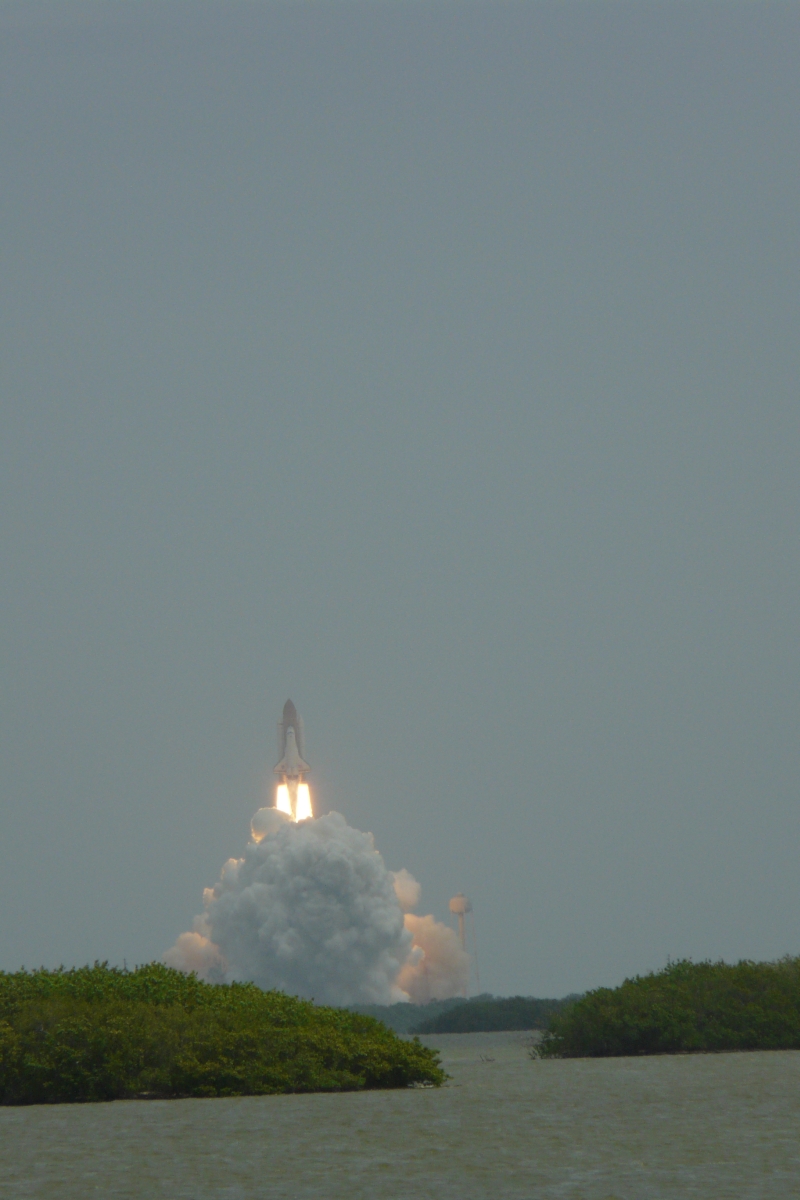
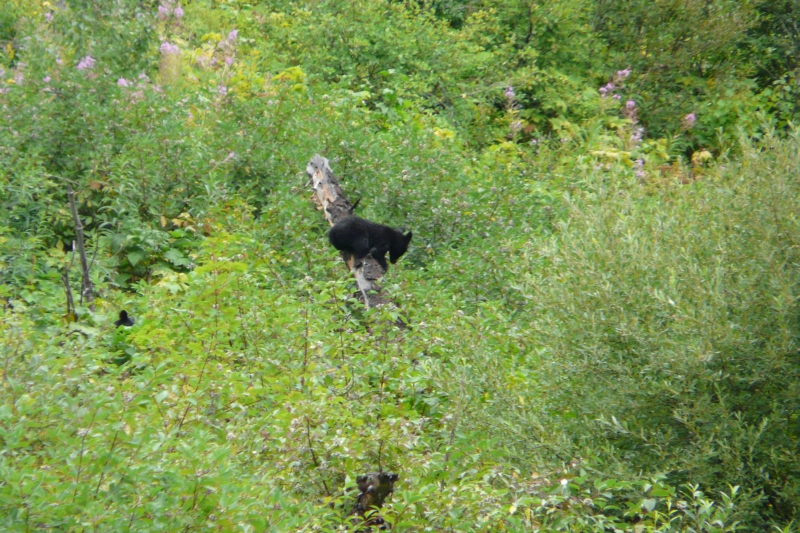
Here are 2 pictures taken at 524mm equivalent (83mm in actuality with 1/2.3" sensor).
The space shuttle launch (last one, STS-135) was on a tripod from about 6.5 miles away. It is a little underexposed because otherwise the SRB plume clips.
The bear cub was probably 200 feet or so away and was hand held.
Posted by Bobby Henderson (Member # 840) on 11-24-2014, 09:56 PM:
Lyle, if you're wanting some serious reach for wildlife and landscape shots your best bet will probably be upgrading from your current fixed lens point and shoot camera to a newer model.
Over the last couple years various "super zoom" point and shoot cameras have been improving a great deal. Some new models have telephoto reach at or beyond the 35mm equivalent of 1200mm.
Point and shoot super zoom cameras are a long long way off from replacing professional level super-tele lens/camera combinations, but if you can work within their limitations (slower apertures, shutter speeds and auto-focus) they'll at least let you get some very compelling shots.
Another thing to consider is the limitations in the "kit" lenses that are bundled with lower priced DSLR cameras. They're not so great optically speaking and don't have very fast apertures either, typically f/3.5 to f/5.6 or f/6.3 which is pretty similar to what you see in the one piece point and shoot cameras. They're giving you a variable aperture and maxing out in terms of zoom at 200mm or 300mm. 1.4x and 2x teleconverters may not work with those lenses either, and even if they do the camera body might possibly not be able to auto-focus.
I'm kind of surprised no one is making super-telephoto lenses for the new mirror-less breed of interchangeable lens cameras. It's easy to understand why Canon and Nikon aren't doing it: they don't want to risk cannibalizing their DSLR market in super-tele lens, especially after cranking up some lens model prices well past the $10,000 mark. The equivalent of a 400mm f/2.8 lens on a mirrorless camera might cost a fraction of its 35mm DSLR counterpart.
Posted by Evans A Criswell (Member # 381) on 12-01-2014, 10:38 AM:
Although I've taken pictures with digital cameras since 1997, I really got serious in spring 2012. My advice is start with a DSLR. Pick something along the lines of a Canon Rebel or the Nikon equivalent that will take the full range of Canon or Nikon lenses. The camera will come with a kit lens. You will be able to take pictures and figure out if you want to get more serious. If the kit lens limits you and you become frustrated by its limitations, getting better lenses will make much more of a difference in many cases than upgrading the camera. I bought a Canon Rebel T2i at Costco in March 2012 and started shooting concerts at a few venues in my area. I quickly found that I needed lenses that would work much better in low light. I bought a Sigma zoom lens that was f/2.8 at all zooms rather than the 3.5 to 5.6 or whatever that the kit one was. Over the months, I got the Sigma 85mm f/1.4 and Canon 135 f/2L because facial close-ups of the performers got a lot of response in my postings. Later, when I upgraded the camera to a Canon 5D Mark III, since focal lengths were "true", I had to "go up a lens" for many shots and the 70-200mm f/2.8L became my most-used lens at the wide-open venue where I shot so many shows. The 24-70mm f/2.8L is probably the most generally useful indoor lens such as in houses or offices.
Posted by Bobby Henderson (Member # 840) on 12-01-2014, 06:36 PM:
The DSLR platform is pretty much the entry level platform in professional photography. You can go from there into medium and large format digital photography if you're independently wealthy or have a client base willing the pay the bucks for that kind of work.
There are a couple large sensor one-piece cameras and mirrorless models out there that take great quality photos, but have some serious limitations (with lens choices being one of them if the design allows interchangeable lenses).
When you get into DSLR territory higher cost comes along with it. Newer lenses from Nikon and Canon are carrying some severely high price tags. Canon's "II" replacement for their 24-70 f/2.8L lens costs nearly $1000 more than the previous model, and it doesn't even have optical image stabilization. They're wanting over $2000 for the soon to be released "II" version of their 100-400 L series zoom. That's over $2000 for a lens with a f/4 to f/5.6 variable aperture. At least that one is image stabilized.
To do sports and wildlife photography really well in the DSLR platform there's little way around spending a lot of money on gear. My 5D Mark II is 5 years old now; I paid $2500 for it. I'll be looking at the 5D Mark IV when it is released. I'm just hoping it doesn't cost much more (if any or hopefully less) than the $3500 5D Mark III. I see guys on the sidelines at NFL games with about $30,000 tied up in 3 lens-body combinations.
One interesting note on the one piece point and shoot camera front: Panasonic's Lumix FZ200 camera, normally $600, is priced at half that. It has a 25mm-600mm equivalent zoom lens with a constant f/2.8 aperture through the entire zoom range.
Powered by Infopop Corporation
UBB.classicTM
6.3.1.2