This is topic ELP Laser Turntable in forum Film-Yak at Film-Tech Forum ARCHIVE.
To visit this topic, use this URL:
https://ft-forum.com/ft/cgi-bin/ubb/ultimatebb.cgi?ubb=get_topic;f=8;t=007305
Posted by Frank Angel (Member # 248) on 05-05-2015, 11:41 AM:
Quite a number of years ago we had a discussion about a turntable a Japanese company was selling and I commented that it sounded like a perfect world -- a laser that could read the surface grooves of an LP as analog without touching it at all -- zero wear on the record, but full frequency response. And evidently from groove to output this is all kept in the analog realm -- nothing is digitized. They also claim that it has the ability to focus the laser scanning beams down at the lower portion of the groove walls so with records which have been played and are worn, the beams will read below upper groove area where the needle has cause wear, thus get a cleaner, virtually pristine record sound. In theory, sounds fantastic....in theory.
I recall at lease one of our F-T members was well aware of this invention and was not at all impressed, saying it had big-time flaws. Can anyone recall that thread? I searched for it but couldn't find it.
Seems these guys are back at it with a new model ($15K price tag). Just wondering who it was who was familiar with it and nonplussed about this technology and if those comments can be revisited.
Clicky here: ELP Laser Turntable
Posted by Mitchell Dvoskin (Member # 751) on 05-05-2015, 01:55 PM:
Final Technology Turntable Thread
That tread does not specifically address the issues, the big one was that dust and groove damage was much more pronounced than with a needle pickup. Of course, this goes back to before and during the early days of digital recording. There is now digital dehissing/depopping software that will work on the fly eliminating the major drawback.
Audiophile Magazine ELP Turntable Review From 2008
quote: Audiophile Magazine ELP Turntable Review Excerpt
However, what the ELP giveth in convenience with one hand, it more than taketh away with the other. Unlike a relatively massive diamond stylus, which plows through a record’s grooves like the prow of a ship, the ELP’s tiny laser-beam styli have next to no mass and cannot move dust particles out of their way. Any speck of dirt, however minute, is read by the lasers along with the music. In his review of the ELP in Stereophile, Michael Fremer compared the playback of an uncleaned record to the sound of someone munching potato chips. That’s a pretty accurate description.
Posted by Jim Cassedy (Member # 4115) on 05-05-2015, 02:53 PM:
I seem to recall reading somewhere that many of the recent restorations of
WB Vitaphone shorts & features were done using a 'laser turntable' to read
the old Vitaphone disks.
This isn't exactly a new idea, as you can see from this 1940 Philco Ad:
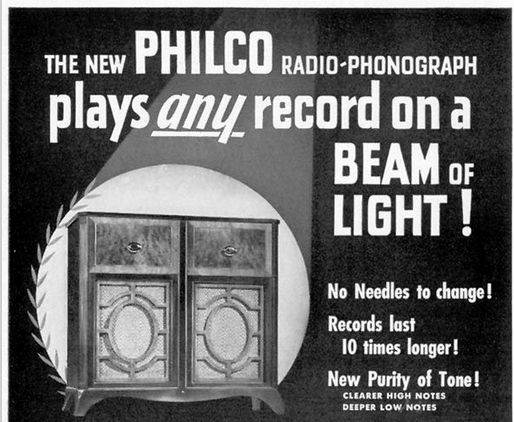
OK, so it's not exactly the same thing. The Philco "beam of light"
phonograph still had a 'jeweled sylus' that tracked the record grooves.
The restulting vibrations were transmitted to a mirror that modlulated
a light beam bounced from a small bulb. (same as good old optical sound)
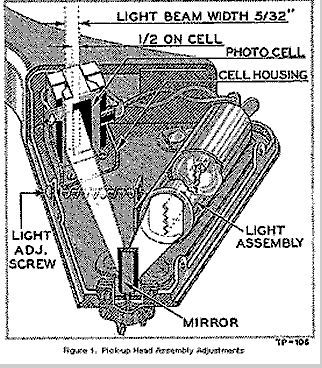
Philco claimed less record wear and surface noise because their 'jeweled stylus'
could track the grooves at much less pressure than other pick-ups of the day.
Posted by Mark Gulbrandsen (Member # 72) on 05-05-2015, 02:53 PM:
The ELP used to be distributed by Smart Devices sister company. It had a lot of issues and although it works it takes reading back dust and scratches to whole new levels of annoyance. Works great on virgin vinyl is about it. You can buy a uber high end TT, arm and cartridge for way less!
Mark
Posted by Martin McCaffery (Member # 37) on 05-05-2015, 04:11 PM:
In related news:
Edison Talking Dolls Can Be Heard Again
quote:
In 2014, the technology was made available for the first time outside the laboratory.
“The fear all along is that we don’t want to damage these records. We don’t want to put a stylus on them,” said Jerry Fabris, the curator of the Thomas Edison Historical Park in West Orange, N.J. “Now we have the technology to play them safely.”
Last month, the Historical Park posted online three never-before-heard Edison doll recordings, including the two from the Rolfses’ collection. “There are probably more out there, and we’re hoping people will now get them digitized,” Mr. Fabris said.
The technology, which is known as Irene (Image, Reconstruct, Erase Noise, Etc.), was developed by the particle physicist Carl Haber and the engineer Earl Cornell at Lawrence Berkeley. Irene extracts sound from cylinder and disk records. It can also reconstruct audio from recordings so badly damaged they were deemed unplayable.
Posted by Mike Blakesley (Member # 26) on 05-05-2015, 07:13 PM:
I always wanted to try this experiment: Take a CD recording and add just a slight touch of "surface noise" and the occasional tiny click and pop type sounds to it. Then blindfold one of those golden-eared "audiophiles" and tell him he's going to hear an CD followed by a LP, and to state which sounds better. Then play the altered recording followed by the unaltered one and watch him gush about how much "warmer" the "LP's" sound is.
I'll bet it would work.
Posted by Leo Enticknap (Member # 534) on 05-05-2015, 07:37 PM:
So the Philco pickup was basically an optical sound camera that modulated in response to a stylus going through a groove rather than an electrical input signal, and which exposed a photocell directly rather than unexposed film stock
It's a similar principle to the Philips-Miller system: signal inscribed mechanically and then read optically. The surviving Philips-Miller recordings I've heard sound about 20 years ahead of their time in terms of clarity and s/n, but I guess that it was short-lived because it was so expensive. Still, it enabled both editing and instant playback over a decade before magnetic tape was widely available, which I guess is why the BBC bought it and used it.
Posted by Louis Bornwasser (Member # 3063) on 05-07-2015, 08:41 AM:
Just get yourself an EMT turntable off of ebay and let it ride. Totally self contained with 600 ohm +8 balanced outputs. Essentially no options, the reference standard in overseas radio broadcasting, made in Switzerland. Running $4K to 5K by now.
Posted by Ken Lackner (Member # 1002) on 05-07-2015, 08:56 AM:
quote: Mike Blakesley
I always wanted to try this experiment: Take a CD recording and add just a slight touch of "surface noise" and the occasional tiny click and pop type sounds to it. Then blindfold one of those golden-eared "audiophiles" and tell him he's going to hear an CD followed by a LP, and to state which sounds better. Then play the altered recording followed by the unaltered one and watch him gush about how much "warmer" the "LP's" sound is.
A more accurate test would be to NOT tell the person which is which, and let them tell you which one they think sounds better.
Posted by Leo Enticknap (Member # 534) on 05-07-2015, 11:09 AM:
I don't think that's the object of Mike's experiment, which is to see if someone who believes vinyl to be superior can be tricked into believing that digital audio is actually analog. Someone who is genuinely agnostic being asked to compare two sources blindly is simply going to respond to what (s)he hears, without preconceptions. I think Mike's point is that the existence of a preconception can cloud your judgment, and this is what he's trying to test.
Last fall I projected a DVD (not even a BD - just a plain vanilla, 480i NTSC DVD) of Dante's Inferno, and afterwards a customer knocked on the booth to congratulate me on how good 16mm looked in our house. He was reluctant to believe me when I told him that he'd just seen a DVD. Apparently a large number of 16mm prints of this title were made in the '60s and '70s and many of them have ended up with collectors, hence this guy's belief that he'd just seen a 16mm print. He only really believed me when I showed him the disc! The bottom line is that his eyes couldn't tell the difference; though that having been said, the transfer did have a slightly soft, 16mm-ish look to it.
Posted by Gordon McLeod (Member # 33) on 05-07-2015, 07:44 PM:
smarts page regarding abandoning the laser
http://www.smartdevicesinc.com/laserturntable.html
Posted by Jeff Kane (Member # 6372) on 05-10-2015, 07:46 AM:
I have one although it's currently in storage; bought it through Smart Devices back when. Primary utility is playing old 78s and damaged LPs you wouldn't want to or couldn't track with a stylus. The comments about noise are spot on. Even virgin, fresh out the sleeve vinyl will have snap crackle and pop. The only record cleaner that could do any justice was a Loricraft but I never once heard playback that was without a tick or pop. Neat idea but not for hi-fi playback.
Posted by Leo Enticknap (Member # 534) on 05-11-2015, 11:34 AM:
So if you have a record that's so badly damaged it appears to have been played with a thorn from a rose bush and with a tracking weight measured in pounds rather than grams, and are then willing to spend a lot of quality time with Adobe Audition cleaning the resulting transfer up, this thing is actually useful for something, but not otherwise?
Sounds like a very good basic idea, that came unstuck because the company that made it was undercapitalized. So it was poorly marketed and supported, and the extra development work needed to bring it to the point of being a good, high end consumer product never happened because initial sales failed to raise the money for it.
Posted by Mitchell Dvoskin (Member # 751) on 05-11-2015, 12:11 PM:
Wikipedia Article
quote: From Wikipedia
History
William K. Heine presented a paper entitled A Laser Scanning Phonograph Record Player to the 57th Audio Engineering Society (AES) convention in May 1977. The paper details a method developed by Heine that employs a single 2.2 mW Helium–neon laser for both tracking a record groove and reproducing the stereo audio of a phonograph in real time. In development since 1972, the working prototype was named the "LASERPHONE" and the methods it used for playback was awarded U.S. Patent 3,992,593 on 16 November 1976. Heine concluded in his paper that he hoped his work would increase interest in using lasers for phonographic playback.
Finial Technology
Four years later Robert S. Reis, a graduate student in engineering at Stanford University, wrote his master's thesis on "An Optical Turntable". In 1983 he and fellow Stanford electrical engineer Robert E. Stoddard founded Finial Technology to develop and market a laser turntable, raising $7 million in venture capital. In 1984 servo-control expert Robert N. Stark joined the effort.
A non-functioning mock-up of the proposed Finial turntable was shown at the 1984 Consumer Electronics Show (CES), generating much interest and a fair amount of mystery, since the patents had not yet been granted and the details had to be kept secret. The first working model, the Finial LT-1 (Laser Turntable-1), was completed in time for the 1986 CES. The prototype revealed an interesting flaw of laser turntables: they are so accurate that they play every particle of dirt and dust on the record, rather than pushing them aside as a conventional stylus would. The non-contact laser pickup does have the advantages of eliminating record wear, tracking noise, turntable rumble and feedback from the speakers. The projected $2500 street price (later raised to $3786 in 1988) limited the potential market to professionals (libraries, radio stations and archivists) and a few well-heeled audiophiles.
Unfortunately for Finial, the laser turntable development exactly coincided with both a major economic recession and the perfection and introduction of the Digital Compact Disc, which soon began flooding the market at prices comparable to LPs (with CD players in the $300 range). Vinyl record sales plummeted, and many existing turntable manufacturers went out of business as a result.
The Finial turntable never went into production. After a few hand-built (and finicky) prototypes were completed and shown, tooling delays, component unavailability (in the days before cheap lasers), marketing blunders, and high development costs kept pushing back the release date. With over US$20 million in venture capital invested, Finial was faced with a dilemma: to forge ahead with a selling price that was too high for most consumers, or to gamble on going into mass production at a much lower price and hoping the market would lower costs.
ELP
In late 1989 Finial's investors finally cut their losses and liquidated the firm, selling the patents to Japanese turntable maker BSR, which became CTI Japan which in turn created ELP Japan for continued development of the "super-audiophile" turntable. After eight more years of development the laser turntable was finally put on sale in 1997 as the ELP LT-1XA Laser Turntable, with a list price of US$20,500 (in 2003 the price was lowered to US$10,500). The turntable, which uses two lasers to read the groove and three more to position the head, does allow one to vary the depth at which the groove is read, possibly bypassing existing record wear. It will not, however, read clear or colored vinyl records.
This is accurate as far as I remember it. I first heard about this concept back in the late 1970's, and patiently waited for it to actually be produced. When it finally did, not only was I disappointed that it was not priced as a consumer product, but CD's were already out making it somewhat pointless. If CD's had not killed off record sales, I assume that it would have eventually been perfected and a consumer priced version would have been introduced.
Posted by Gordon McLeod (Member # 33) on 05-11-2015, 12:26 PM:
Somewhere I still have a pair of broadcast studio McCurdy turn tables that weight in the stone category on tone arm weight ![[Smile]](smile.gif)
Posted by Bill Brandenstein (Member # 7758) on 05-13-2015, 12:29 PM:
Leo, glad to know I'm not the only one spending "quality time" with Adobe Audition when dealing with records.
Posted by Scott Jentsch (Member # 1681) on 05-14-2015, 04:07 PM:
If they had a problem with the laser picking up the dust in the grooves, then it sounds as though they needed to crank up the power on that laser a little. Maybe if they put it up to 11, dust wouldn't survive!
Posted by Doug Thompson (Member # 6546) on 05-15-2015, 09:40 PM:
Leo and Bill,
I use Creamware by TripleDAT for editing and noise reduction. An older piece of software, it was designed to be CD mastering software. Although it began in the Windows 3.1 era, I'm used to it and don't want to have to learn new software. I run it on Windows 98SE. More on my introduction to this software in a moment.
Mike,
I recall many years ago someone conducting an A/B test where one choice was a digital recording and the other was the same recording with a little hiss added. The "analogue forever" types thought the one with added hiss sounded warmer and had to be analogue.
That said, the guy who demoed the Creamware program to me was one of the engineers for Frank Zappa, and man, the stories he had.
An acetate for an album came back from mastering, and after auditioning it, Mr. Zappa wanted an equalization change. I don't remember the particulars, but it was plus a half or maybe as much as one db at a very specific frequency I don't remember. The engineer went back to the mastering engineer , and after a lot of eye rolling, a new acetate was cut. When it was delivered to the studio, the engineer purposely played the first acetate. Frank told him he had the wrong one on, and to put on the new one.
Powered by Infopop Corporation
UBB.classicTM
6.3.1.2