This is topic weird airline question (how does this happen?) in forum Film-Yak at Film-Tech Forum ARCHIVE.
To visit this topic, use this URL:
https://ft-forum.com/ft/cgi-bin/ubb/ultimatebb.cgi?ubb=get_topic;f=8;t=007319
Posted by Scott Norwood (Member # 30) on 07-16-2015, 07:33 PM:
See here, specifically Delta flight 5039 from Seattle to Atlanta (listed here as an Alaska Airlines code-share), which I was on earlier this month:
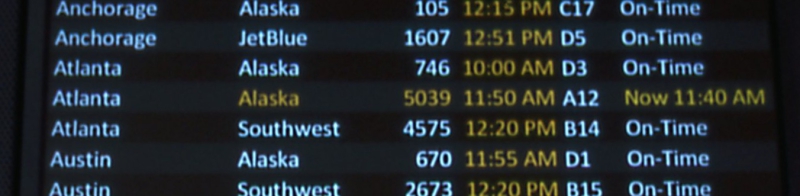
How and why did this get re-scheduled to depart ten minutes before the originally scheduled time? I have never seen that before. Not that it matters...it left a bit late, anyway (boarding a full 777 takes a while). Still, I am curious.
Posted by Randy Stankey (Member # 64) on 07-16-2015, 07:48 PM:
I don't know for sure but I have been on flights, in the past few months, where earlier times were posted on digital signs and printed on tickets.
Apparently, there is a trend toward posting a boarding time that's earlier than takeoff time.
I guess it's a move to encourage passengers to get to the gate sooner so as to avoid delays in getting all those people onto crowded planes.
Posted by Louis Bornwasser (Member # 3063) on 07-17-2015, 08:01 AM:
If all is ready, they now take off early, too. My wife's flight Munich to Atlanta pushed back 10 minutes before scheduled departure.
Posted by Rick Raskin (Member # 1561) on 07-17-2015, 08:43 AM:
Could be a million reasons: Weather en route, to avoid congestion at the destination, crew hour limits, all passengers have checked in, impending need for the departure gate, and the list goes on...
Posted by Chris Slycord (Member # 4239) on 07-23-2015, 01:19 AM:
quote: Randy Stankey
Apparently, there is a trend toward posting a boarding time that's earlier than takeoff time.
These days, takeoff time is when the plane is closed and taxiing away to take off.
Posted by Lyle Romer (Member # 1266) on 07-23-2015, 05:31 AM:
quote: Randy Stankey
Apparently, there is a trend toward posting a boarding time that's earlier than takeoff time.
The flight time that you book is the "departure" time, not the "takeoff" time. The departure time is the time that you are supposed to leave the gate.
Boarding passes have been listing a "boarding time" for quite a while (at least on Delta, American and Southwest). I fly those airlines somewhat frequently and those have been listed for several years.
As for the original question, it may have just been a case of somebody making a mistake. Either that or for some reason they thought they would be ready early. Those same times are probably tied into their other systems to let baggage handlers and other ground service personnel know what time the plane needs to be ready. If they thought boarding would be done early, they would want the ground services finished early as well.
Posted by Scott Norwood (Member # 30) on 07-23-2015, 06:42 AM:
I always assumed that the time listed on the schedule board was the time when one could no longer board the plane. In this case, the flight was listed as "11:50" (originally), which implies to me that a passenger who showed up at the gate at 11:49 with a valid boarding pass would be allowed to board. Is this not the case? (obviously, in the case of the "rescheduled" flight time, a passenger who showed up at 11:49 would be screwed). Similarly, I assumed that the arrival times listed in schedules would be the time when passengers would be allowed to exit the plane, and that the actually takeoff/landing times were of concern only to the pilots and ATC personnel. Yes? No?
Related question: why do/did airlines separate the "ticket" part of a ticket from a "boarding pass"? At least historically, passengers would buy a ticket for their flight and then use it at check-in to obtain a boarding pass with a seat assignment. Now, the "ticket" part is usually just a database record, but the same concept applies. Anywhere else (movie theatre, train, sporting event, etc.), the "ticket" is all that is necessary to gain admission to the venue and contains the seating assignment (if applicable). Why do airlines feel the need to make this simple process more complicated?
Posted by Leo Enticknap (Member # 534) on 07-23-2015, 10:49 AM:
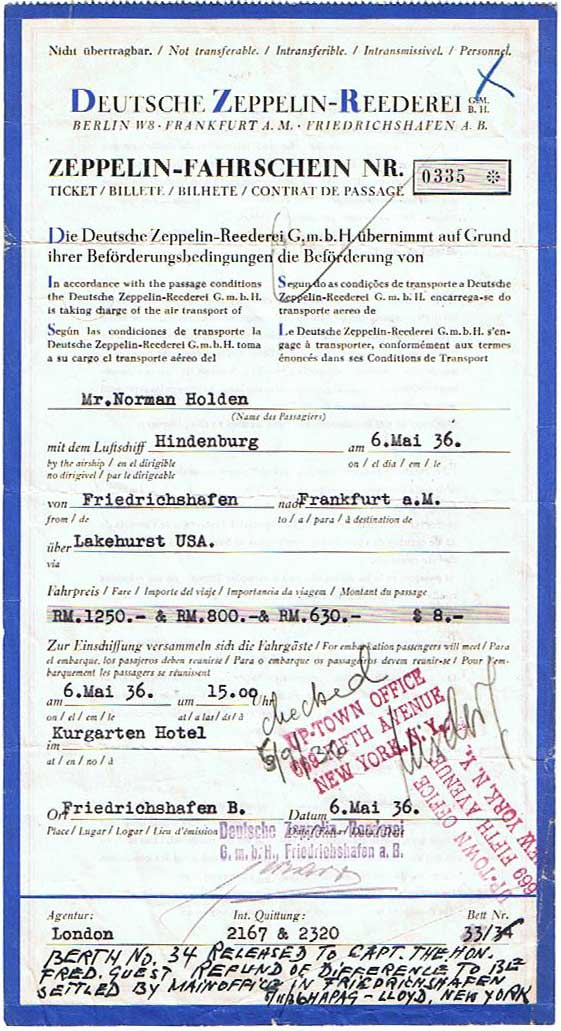
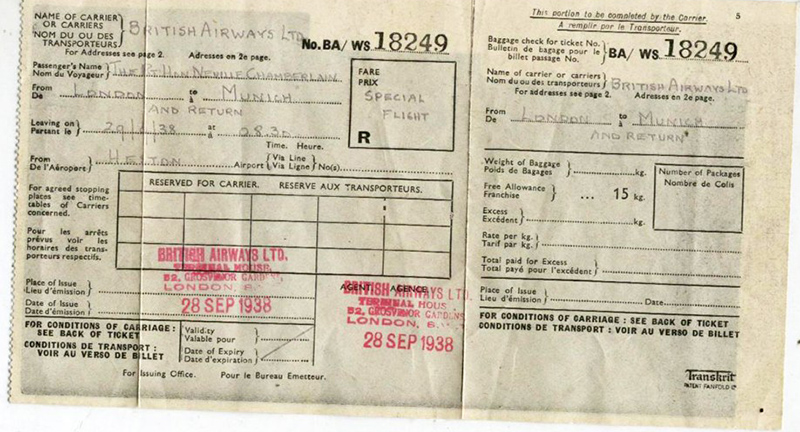
If these examples are in any way typical (which, clearly, the latter is not, though it appears to be on their standard stationery form), it would seem that different airlines did different things in the 1930s. The Zeppelin ticket has the berth number on it, so presumably that's all you needed to go through the terminal and onto the airship. But the BA ticket has no seating information, and so unless seats were completely unassigned in those days, presumably you were given another document with your seat number on it.
We know that Chamberlain didn't need any excess baggage allowance, unless his briefcase and that infamous piece of paper exceeded 15kg (though if Ryanair had been around in those days, he'd have probably had to pay a supplement for them)!
Given the weight restrictions on planes in those days, I'm surprised that you were allowed an inclusive 15 kilos in your ticket in 1938 (that's about what you get with an economy class plane ticket now, on the airlines that still give economy passengers an inclusive checked bag), and that a British company was measuring things in kilos.
Posted by Sam Graham (Member # 2889) on 07-23-2015, 11:33 PM:
I once was scheduled on an Allegiant flight at McCarran that showed an on-time scheduled arrival, then showing as "Arrived", then "Boarding", then "Departed", before the delayed aircraft had even landed.
I call it "fudging the on-time records".
Posted by Paul Mayer (Member # 355) on 07-24-2015, 08:22 AM:
At Allegiant, the MD-80s that make up most of their fleet are older aircraft that do not have things like ACARS, which automate things like logging operations times. So the "out", "off", "on", and "in" event times are whatever the aircraft captain decides.
With ACARS, the "out" time is transmitted to operations when the aircraft brakes are released; the "off" time is sent and logged when the aircraft landing gear squat switches no longer detect weight on the wheels. The "on" time is when the aircraft weight is on the wheels, and the "in" time is when the park brakes are set.
One can still log an "on-time" or early departure by having the pushback tractor hooked up to the aircraft and releasing the aircraft brakes. Other airlines use the cabin doors (all doors closed and their "door open" lights are out) as the signal to ACARS to send the "out" time. IATA rules allow any "out" time within 10 minutes of scheduled departure to be counted as "on-time."
For Scott, some airlines also have early boarding or check-in requirements for their domestic flights (all airlines have those requirements for international flights). The boarding pass and ticket will have such a notice printed on them, words to the effect stating a customer must be at the gate podium at least 10 minutes (20 minutes on US Airways) prior to departure time or risk getting bumped off the flight. I was denied boarding that way once at LAS on a US Airways non-stop flight to Philly even though I was in the departure gate area. Ended up getting on a later pair of flights that connected through Charlotte to Philly with long weather delays - finally got into the hotel around 2am instead of 6pm. Another fun day of traveling for digital cinema installs! ![[Smile]](smile.gif)
Posted by Lyle Romer (Member # 1266) on 07-24-2015, 09:44 AM:
quote: Scott Norwood
I always assumed that the time listed on the schedule board was the time when one could no longer board the plane. In this case, the flight was listed as "11:50" (originally), which implies to me that a passenger who showed up at the gate at 11:49 with a valid boarding pass would be allowed to board. Is this not the case?
This is not the case. The departure time listed on the ticket is the time that the aircraft is supposed to "depart" from the gate. As Paul mentioned, most airlines state that you have to board 10 minutes (or more in some cases) prior to departure.
quote: Scott Norwood
Related question: why do/did airlines separate the "ticket" part of a ticket from a "boarding pass"? At least historically, passengers would buy a ticket for their flight and then use it at check-in to obtain a boarding pass with a seat assignment. Now, the "ticket" part is usually just a database record, but the same concept applies. Anywhere else (movie theatre, train, sporting event, etc.), the "ticket" is all that is necessary to gain admission to the venue and contains the seating assignment (if applicable). Why do airlines feel the need to make this simple process more complicated?
The reason it is separated is so that they know who actually showed up (or at least checked in) for the flight. This allows them to clear standby passengers and also know if they have to do voluntary/involuntary bumps.
Other ticketed events (sports, concerts, movies, etc.) don't sell more tickets than capacity. If you don't show up, your seat stays empty.
I've seen numbers posted where, depending on the flight, over 10% of the sold tickets are "no shows."
People like me that buy the cheapest tickets possible don't understand this phenomenon but a decent number of refundable/changeable tickets are sold to business travelers.
The "ticket" also doesn't have a seat assignment in some cases. The "boarding pass" gives everybody a seat assignment (except on southwest where it gives you a spot in the boarding line).
I don't know the history of how boarding passes started since I doubt the same phenomenon existed at the beginning of air travel.
Way back "in the day" I think that when you checked in, they gave you a boarding pass that was a seating card taken from a physical "seat map." Today, the boarding pass is essentially a ticket with a "check mark" that you have checked in for the flight.
Posted by Leo Enticknap (Member # 534) on 07-24-2015, 12:39 PM:
quote: Paul Mayer
For Scott, some airlines also have early boarding or check-in requirements for their domestic flights (all airlines have those requirements for international flights).
For O & D international, it's ridiculous. If you're simply showing up at the airport to take a long-haul international (i.e. not boarding it via a feeder flight), Delta's small print says three hours. In practice you'll almost always get on if you arrive later than that, but it's not guaranteed and they can bump you with no rebooking if you arrive at the check-in desk later.
This is one of the many reasons I'd always prefer to fly, say, ONT-SLC-LHR when I go to visit my relatives in England, rather than LAX-LHR. Not only is the regional airport only 20 minutes' drive away, but as the first flight in the itinerary is a domestic, the airline only requires you to get to the airport an hour before the scheduled departure time (i.e. as long as you present yourself at the desk by that time, their responsibility to get you to your destination kicks in). Compared to fighting my way along the 60 and the 405 for two hours and then having to be at LAX three hours before the scheduled departure time, this saves several hours on the total journey (unless there's a long layover at the connection hub, which you can usually avoid when booking the ticket).
Powered by Infopop Corporation
UBB.classicTM
6.3.1.2