This is topic light switch orientation in forum Film-Yak at Film-Tech Forum ARCHIVE.
To visit this topic, use this URL:
https://ft-forum.com/ft/cgi-bin/ubb/ultimatebb.cgi?ubb=get_topic;f=8;t=007326
Posted by Scott Norwood (Member # 30) on 08-28-2015, 06:54 AM:
This is probably a dumb question, but I have never seen a good explanation of it.
In the US, light switches are normally installed like this
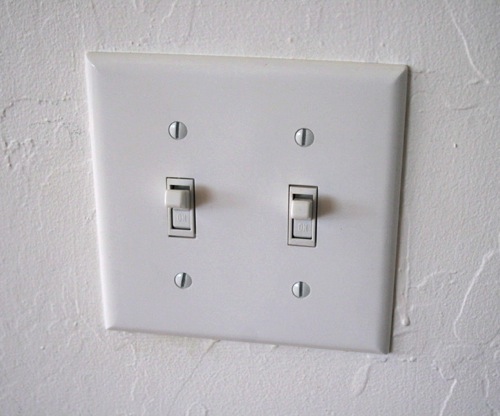
such that the "up" position of the switch turns the light on. In the picture above, both switches are in the "on" position.
In the UK and possibly elsewhere, switches are normally installed so that the "down" position turns the light on:
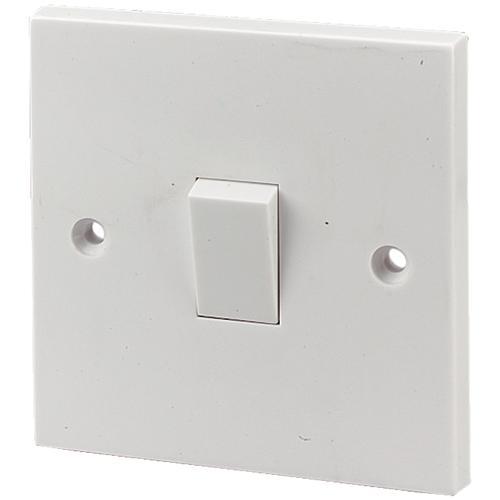
In the picture above, the switch is also in the "on" position.
Why is this? It doesn't matter so much that "up" or "down" should indicate "on" or "off," but why are there differing standards for this?
Are there any electricians here who can explain this? And is "up"="on" a code issue in the US, or is it just common practice? Most (non-3-way) US switches have "OFF" and "ON" printed above and below the lever, respectively, so these labels would be upside-down if the switch were installed the other way, so maybe that explains the US orientation. None of this is really a big deal for light switches, but I could imagine that a switch in a non-standard orientation could be dangerous if it controlled a power tool or some other motorized device.
Posted by Steve Moore (Member # 4753) on 08-28-2015, 09:17 AM:
Another way of looking at it is that they are "stuck out" at the top in both the US and UK for on?
Though having said that, I do have to say that when I go to the US that they feel to me that they are upside down compared to ours!
Posted by Steve Kraus (Member # 476) on 08-28-2015, 09:28 AM:
Well, isn't there an association with something being "up" meaning on? Is your server UP?
Posted by Steve Guttag (Member # 268) on 08-28-2015, 09:38 AM:
Sorry to burst you bubble Steve (interesting that 3/4 of the posters on this subject, thus far, are named Steve too)...
In the US, "Decora" switches, a rocker switch, pressing in on the top is "on." So the bottom stuck out would be on.
With conventional round-hole toggle switches, the slot goes on the bottom. If you get a plate for that switch that has the labels on/off...it will presume the slot is on the bottom for it to read properly. On will be up.
It wouldn't surprise me if the rational for the difference in the light switch is along the lines of why the UK drives on the wrong side of the road too.
Posted by Lyle Romer (Member # 1266) on 08-28-2015, 10:21 AM:
I read somewhere that the US practice of up for on and down for off came from safety with big industrial switches. Supposedly, if you leaned against the switch and accidentally switched it, you'd accidentally turn something off instead of on. I guess to pull those up takes force and intent where if it is up and you take a rest against the wall you could push it down. Who knows if true but there is some logic there.
Of course with a 3-way (or greater) circuit, there is no standard on (or off) position.
Posted by Brad Miller (Member # 2) on 08-28-2015, 11:22 AM:
Whoever provides a reasonable answer to this should also tackle this one. 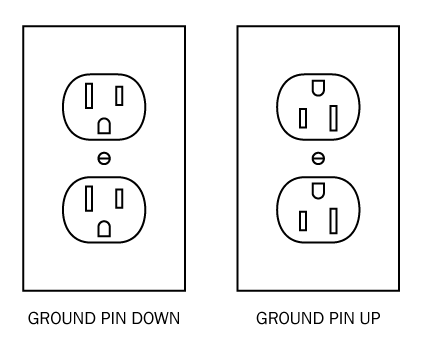
Posted by Gordon Bachlund (Member # 124) on 08-28-2015, 11:48 AM:
With the ground pin up, if a plug is loosened there is a possibility of the ground pin disconnecting first, thereby leaving the load ungrounded, if only momentarily, until the other pins disconnect.
With the ground pin down, if a plug is loosened, the ground pin will be the last to disconnect, a safe practice.
Posted by Leo Enticknap (Member # 534) on 08-28-2015, 12:09 PM:
quote: Steve Guttag
It wouldn't surprise me if the rational for the difference in the light switch is along the lines of why the UK drives on the wrong side of the road too.
The latter was an Empire/Commonwealth thing, which is why India and Australia also drive on the left (steering wheel on the right side of the car). I believe that Canada once did, but switched, to make cross-border traffic easier. AFAIK, the only major country that drives on the left but never had any significant political or economic ties to the UK is Japan.
The light switch thing confused me for months after emigrating from the UK to the US; driving much less so, because you're doing it along with everyone else and so driving on the right just comes naturally. But if you're operating a toggle switch in a room on your own, there isn't any "peer pressure" to help you do it right!
I can't for the life me remember what other European countries do for light switches. When I was UK-based I visited France, The Netherlands, Germany and Denmark several times, but simply don't remember anything about their light switches. I'm guessing that they're the same as Britain's (up = off / down = on), because if they were the opposite, I think that would have stuck in my mind.
Posted by Jeremy Weigel (Member # 4208) on 08-28-2015, 12:55 PM:
How about 3-way switched circuits? If the switches are all installed to expose "on" in the up position, then one of those switches will have to be installed upside down.
Posted by Ron Lacheur (Member # 1126) on 08-28-2015, 01:08 PM:
They all should have a " top " indication on one side showing the direction it should be installed in.
In a three-way switch situation, one side is always going to be " wrong side on ".
Posted by Rick Raskin (Member # 1561) on 08-28-2015, 01:50 PM:
Up = On. How many of you guys pulled dimmer handles down to raise the lights? Zero I suppose.
There really isn't any specific code relating to outlet orientation.
Posted by Paul Mayer (Member # 355) on 08-28-2015, 02:06 PM:
For what it's worth, we have the same issue in airline flying. If you fly Boeing big iron, you are used to "up = on", If you fly McDonnell Douglas big iron, you are used to "down = on". Don't remember how Lockheed, Convair, Fairchild/Fokker, Martin, or any of the Canadians, Brits, EU, Brazilians, Russians, Kiwi/Oz, and Asians configured theirs... ![[Smile]](smile.gif)
Posted by Mitchell Dvoskin (Member # 751) on 08-28-2015, 02:37 PM:
Just curious, does this UP/DOWN issue extend to electronic equipment with toggle switches?
Posted by Lyle Romer (Member # 1266) on 08-28-2015, 03:44 PM:
quote: Jeremy Weigel
How about 3-way switched circuits? If the switches are all installed to expose "on" in the up position, then one of those switches will have to be installed upside down.
With a 3 way (or more) circuit "on" and "off" positions don't exist for any switch. A change in position of any switch will change the state of the circuit.
The upside down outlet I will never understand.
Posted by Justin Hamaker (Member # 2165) on 08-28-2015, 03:50 PM:
Turn the lights UP, turn the lights DOWN.
If you think of it this way than up/down becomes intuitive. I don't know if this is the reasoning, but it seems logical to me.
Posted by Stephen Furley (Member # 1277) on 08-28-2015, 04:05 PM:
But Scott, you're looking at two different types of switches. In the UK the two toggle switches would be off, and the single rocker switch would be on. I'm not sure about light switches, but in mainland Europe toggle switches on appliances seem to be up for on, but down for on in the UK.
Larger switches,anything from the lighting 'main' switch in a house to industrial switches rated at hundreds of Amperes, always seem to be up for on wherever in the world they are. really big knife switches are generally up for on, and large circuit breakers are down whether set or tripped. To set them you lift the handle, which does nothing, and then pull it down, which closes the contacts. To trip them manually you lift the handle sharply, which trips the breaker, and then allow it to drop back down which does nothing. I've stood next to a 20,000 A d.c. one, made in the first decade of the 20th century, and definitely not conforming to modern health and safety standards; a really frightening thing, and it was in service until about twenty years ago.
As to NEMA receptacles, I'm told that the standards do not specify a preferred orientation, and I've seen plenty both ways, and a few duplex receptacles which have one outlet each way. Ground down seems to be generally standard on older installations, while both are common in newer ones. Larger 30 and 50 A ones generally seem to be ground up. The argument I've heard for ground up is that if something is dropped, and falls onto a partly inserted plug in is more likely to land on the ground pin than a live blade. this sounds like a pretty unlikely scenario, and wouldn't happen in most other countries, where receptacles and/or plugs are designed so that a partially inserted live pin is never exposed.
There's an interesting situation in Europe where most countries have plugs where live and neutral pins are round, and spaced 19 mm apart. There are several different eathing arrangements; German and Italian plugs are non-polarised, but Swiss and French are polarised, in the sense that the plug will only fit one way, but the French standard does not specify which pin is live, and which neutral, so the 'polarised' design is meaningless. You can even buy double adapters in France where one socket it earth down and the other earth up, but both are wired with live on the same side, left or right, so that the two sockets have opposite polarity, unlike Duplex NEMA one I've seen, where the grounds are towards the centre, so the two outlets are opposite ways round, but the internal connections cross over, so that both outlets are connected correctly.
With toggle switches up for on, as in the US and most of Europe, seems more logical, though I don't really know why. With rocker switches, top sticking out for on, as in the UK, seems more logical because these switches are normally mounted below eye level, so you look down on them, and can see the top of them when they're in this position. Here, the top is often coloured red to indicate that they're on when in this position. when turned off this red is not visible.
Posted by Carsten Kurz (Member # 5396) on 08-28-2015, 05:34 PM:
It could go very far back where switches should never activate on their own by gravity as a safety measure. That way, the switch mechanics should only travel into the 'ON' position against gravity. When the whole electricity thing started, they only had few (if not only one) type of switch, and these may have had that tendency to 'fall' into the downward position.
As far as I know, there is no regulation in germany about this, and boy, we DO have a lot of regulations and standards on electrical installation. But we have so many choices of switches around here.
That said, a lot of simple domestic switches used to have red lines on the protruding part that would serve as an On/Off indicator. I guess most people do not really care, since these switches are mostly used to switch on lights, and in these cases, the indicator is the result of the switch action in itself ;-)
When machines, etc. are operated, there are usually other switch types.
We do have regulations for sockets and switches in bath-rooms as well, and very often switches are positioned outside of these rooms. As then very often you can't see the light when the door is closed, we typically install indicator switches with a small light on them.
Our automatic circuit-breakers here are ALL on in the UP position, with no exception. My personal preference which I implemented on all switches in my home is to push on the upper part for On. That said, we do have a lot of very large flat switches here where the difference in visible profile between On and Off is very small.
- Carsten
Posted by Scott Norwood (Member # 30) on 08-28-2015, 06:41 PM:
I am curious about electrical panels where the breakers move in a vertical orientation.
In the US, the usual orientation is horizontal, like this:
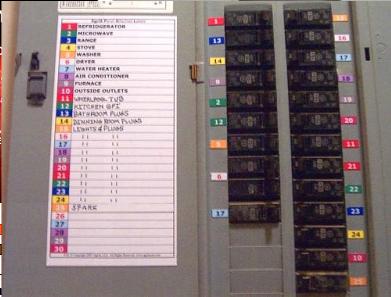
(with exceptions for high-current systems).
Having the switch towards the center of the panel is usually "on," but I have seen older panels that reverse that. Either way, "ON" and "OFF" are indicated on the breaker. Older homes and businesses have fuse boxes.
The goofiest thing about US panels is that, at least in new-ish residental installations, the main service disconnect is usually in the same panel as the regular breakers. It would seem to be that one would want to be able to completely de-energize the entire panel and that the main disconnect should be in a separate box, but that seems to be uncommon.
Posted by Monte L Fullmer (Member # 2797) on 08-28-2015, 07:12 PM:
From what an electrician's instruction ..
that the proper code for outlet installs, is that the ground being up (the frown look), so that if a metal object drops between plug and outlet, that the object hits the ground pin first than if installed with the ground being down (the smile), which would be prone to electrical fires up do direct shorts, if the object hits the hot blade first.
I'd just mount the rocker switch to where it makes more sense. Here at our location, we have a barista coffee unit with the power rocker switches that use the European (rocker down for "on") position.
Posted by Louis Bornwasser (Member # 3063) on 08-28-2015, 08:58 PM:
Italy has 3 inline round pins. Much like the two pin for Germany except the center of the three pins is ground.
The down-is-on switch could also be viewed as: Raise switch to turn the darkness on.
Posted by Michael Putlack (Member # 6523) on 08-29-2015, 04:42 AM:
So, I've been probably putting too much thought into this over the last day, but I think we're looking at this the wrong way.
Each of the example switches are on when the switch itself is angled down towards the wall. So, in that regard, they are the same. Another way of seeing it is if the top of the switch is furthest from the wall, the switch is on in both cases.
I have to say, this was tough to get used to when I moved to NZ.
Also, I don't understand why every wall outlet has a pair of switches of it's own. Is this common elsewhere around the world?
Posted by Carsten Kurz (Member # 5396) on 08-29-2015, 05:04 AM:
No, but I noticed this as well when I started traveling to Ireland. Basically they seem to have the same product in all the houses there. Two sockets, two switches, the same design everywhere. And these switches show red indicator color for 'On'.
When you go to a D.I.Y. store in germany, there are dozends of different designs of switches, plugs, sockets, frames,covers,1,2,3,4,5 in a row, different colors, shapes etc. Also most of our stuff here is flush-mounted.
Also, in Ireland and the UK they have equipment fuses in the wall-plugs. In germany, fuses are in the device itself. But our standard mains-plugs are too small for fuses anyway, especially the two-pin euro plugs.
- Carsten
Posted by Stephen Furley (Member # 1277) on 08-29-2015, 09:06 AM:
Louis, there are two diameters of pins in Europe, Italian and Swiss ones are 4 mm, and French, German, Danish, ones are larger, 4.7 mm I think.
The live and neutral pins are all spaced at 19 mm, and the dreadful two pin 'Euro' plug is designed to be able to ( badly) fit all of them. It has two 4mm pins which are angled inwards slightly towards the tips, so they will still make contact in 4.7 mm sockets.
Even worse are the so called 'universal' travel adapters, which are designed to take almost all plugs worldwide, except for the 15 A South African one, but which fit most of them badly, often do not provide an Earth connection, and have large, odd-shaped holes into which children could easily insert various objects.
Scott, that panel looks very much like the one in the projection room where I am now. breakers are horizontal, and 'out' for on. Labels are red, yellow and blue, the old phase colours before these were changed to brown, black and grey.
Vertical breakers seem to be more common in small, domestic, panels.
Posted by Louis Bornwasser (Member # 3063) on 08-29-2015, 03:09 PM:
Stephen: I gave up on travel adapters a long time ago. I carry 24 inch cords left over from amplifiers for UK and German plugs. US female connector on other end with a 3 way splitter. Everything I own will run on 90-240 volt. 50 or 60 Hz. If not, then I won't buy it.
Wife bought a multi voltage hair dryer in Germany.
Posted by Mike Blakesley (Member # 26) on 08-29-2015, 04:38 PM:
At work we have a couple of spots where there are two switches (opposite sides of the room) to control the lights. So either up or down could be on.
This reminds me of a cool Gallagher quote: "Why do they label light switches 'off and on?' If the light's on, you can see it's on; if it's off, you can't see to read!"
Posted by Frank Cox (Member # 6258) on 08-29-2015, 05:19 PM:
Outside of a dog, a book is a man's best friend. Inside of a dog it's too dark to read.
Groucho Marx
Posted by Steve Guttag (Member # 268) on 08-29-2015, 05:50 PM:
With respect to the receptacle, every NEMA diagram for the 5-15 (or 5-20) will show the ground pin down (likewise on the other straight blade NEMA drawings).
The reason I heard that the practice on installation was changed was due to the potential for a metal wall plate to come off and land on hot and neutral. With the ground pin up, you have a 50/50 shot that the short will go between ground and neutral or ground and hot.
Anyone remember the Christie CK-20 console (and I think the CH had the same "design"...if you merely removed on of the ZEUS screws for the rectifier adjustment cover plate, the plate could swing around and land right across anything plugged into the convenience outlet. Never happened to me but I did know of it happening.
Posted by Kenneth Wuepper (Member # 1174) on 08-29-2015, 08:25 PM:
I the old comic strip, Major Hoople had this switch thing nailed.
The hallway switch has these positions
OFF
ON
NOT ON
End of definition.
Posted by Leo Enticknap (Member # 534) on 08-29-2015, 10:21 PM:
Reminds me of the "Far Side" cartoon captioned "Night school for electric chair executioners." It shows a class full of students, earnestly writing in their notebooks, while the instructor speaks in front of a slide on the screen of a toggle switch labeled "off" and "on". Can't remember which way round it was, though...
Posted by Mark Hajducki (Member # 1732) on 08-30-2015, 01:06 PM:
quote: Stephen Furley
With rocker switches, top sticking out for on, as in the UK, seems more logical because these switches are normally mounted below eye level, so you look down on them, and can see the top of them when they're in this position. Here, the top is often coloured red to indicate that they're on when in this position. when turned off this red is not visible.
Although light switches don't have the red marking it makes sense for them to switch the same way when a single switch controls the light.
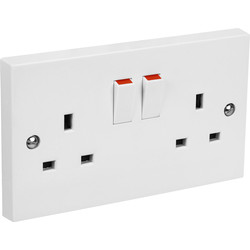
Posted by David Buckley (Member # 2600) on 08-30-2015, 04:08 PM:
Also amusingly, in the context of light switches, what an American calls a "three way" the rest of the world calls a "two way".
Posted by Scott Norwood (Member # 30) on 08-30-2015, 05:08 PM:
Why do the UK outlets have switches in them? Are they not mounted near the baseboards on the walls where switches would be inconvenient to use?
In the US, it is common to have a wall switch near a door that controls an outlet on the wall. The idea is that a lamp would be plugged into that outlet and one could simply flip the wall switch when entering the room in order to turn on the light. This works fine unless someone decides to plug, say, a clock (or anything else that requires constant power) into that same outlet.
Having said all of this, the standard US "Edison" style outlet (NEMA 5-15P/5-15R) is pretty awful, as it allows one to touch both the hot and neutral pins when plugging something into the outlet and it also has no locking mechanism. Also, older outlets are not polarized and have no ground pin, which means that it is possible to plug in a lamp in such a way that the socket will be live even when the switch is "off." The UK connector design is far superior.
Posted by Louis Bornwasser (Member # 3063) on 08-30-2015, 05:41 PM:
Steve: Only had to happen once to me on the Christie rectifier cover. I mounted a long screw with a spacer to block that happening: 3/4". Tried to get Christie to move the outlet location.
Posted by Leo Enticknap (Member # 534) on 08-30-2015, 05:48 PM:
quote: Scott Norwood
Why do the UK outlets have switches in them?
You can buy ones that don't, but in practice you don't see many of them in a typical home. In my last UK home before emigrating, the only one was for the hot water boiler's power supply. I guess a switchless outlet was installed there because it was intended to supply just the one appliance, that would be always on.
But I agree that the switches were largely pointless. Whenever I was away from home for a significant length of time, I always pulled the plugs right out for everything that didn't need power while I was away, anyway.
Another difference I've noticed is that outlets with built-in GFCIs (known as a residual current device, or RCD, in Britain) are widespread in the US - indeed the National Electrical Code requires them in rooms that have a running water supply. In Britain, although plug-in RCDs are common and easily available (i.e. you plug the RCD into the outlet and the load into the RCD), outlets that have them built-in are almost unheard of. I never saw one in B & Q (the British version of Home Depot).
Posted by Mark Hajducki (Member # 1732) on 08-30-2015, 06:34 PM:
quote: Leo Enticknap
Another difference I've noticed is that outlets with built-in GFCIs (known as a residual current device, or RCD, in Britain) are widespread in the US - indeed the National Electrical Code requires them in rooms that have a running water supply.
Before 2008 no mains electrical sockets were allowed in bath/shower rooms in the UK with the exception of shaving sockets with an isolating transformer.
The regulations have become more flexible over the years allowing RCD protected sockets in some areas of bathrooms.
The UK regs tend to be more protective than most countries insisting on plugs/sockets which are more substantial than most countries have fused plugs and earthed (an earth pin is required to allow the insertion of a plug, some dual insulated appliances have a plastic earth pin).
Posted by Leo Enticknap (Member # 534) on 08-30-2015, 09:58 PM:
quote: Mark Hadjucki
Before 2008 no mains electrical sockets were allowed in bath/shower rooms in the UK with the exception of shaving sockets with an isolating transformer.
Plus the light switch has to be a pull-cord, not a switch you actually put your finger on. The principle was that your potentially wet hands should not go anywhere near the mains current.
Maybe a reason for the more safety-conscious design of British electrical fitments is the higher voltage (240 when most of them were designed, 230 now) than in the US? My understanding from the medical experts on this is that a 120v shock is highly unpleasant but is unlikely to cause serious injury or death, but 230 stands a very good chance of killing you.
If I remember correctly, 2007 was when the US National Electrical Code was revised to require GFCIs/RCDs in all rooms that have a water supply. Before then it was just the bathroom and outdoors. In a typical American suburban home that can mean the entire living room/kitchen area if it's open plan, plus the bathroom(s) and possibly the garage as well, if the washing machine is in there. Normal light switches are allowed in bathrooms, though, plus outlets as long as they have a built-in GFCI.
When we moved into our current house, built in 1984, none of the outlets were GFCI-protected whatsoever apart from the one in the back yard! The surveyor's report flagged up that some of the wiring was aluminum and that aluminum wire joined to copper is very dangerous and needs fixing immediately. We hired an electrician do this, who tipped us off about the new GFCI regulation, which wasn't there when the house was built, but is now. I replaced the outlets myself. Rather than mess around trying to figure out where they were required and where not, I just got a contractor's pack of 20 from Home Depot and replaced all the outlets in the house.
Posted by Lyle Romer (Member # 1266) on 08-30-2015, 10:27 PM:
quote: David Buckley
Also amusingly, in the context of light switches, what an American calls a "three way" the rest of the world calls a "two way".
More amusingly is that they are really four way.
UP-UP
UP-DOWN
DOWN-UP
DOWN-DOWN
You could argue that UP-DOWN and DOWN-UP are the same and therefore the name of "three way" is correct. I don't know how you can get "two way" out of that configuration. A regular switch is "two way" since it is open and closed.
Just to throw in some more semantics, you "close" a switch to "turn the lights on" yet some people say "close the lights" to mean turn off the lights. I guess if the action is done with covers (as some metal halide arena lights do for instant on/off during pre-game) then you are literally closing the lights.
Posted by Stephen Furley (Member # 1277) on 08-31-2015, 03:12 AM:
quote:
- posted 08-29-2015 05:50 PM Central (GMT -6:00) (11:50 PM Local) Profile for Steve Guttag Email Steve Guttag Send New Private Message Edit/Delete Post
With respect to the receptacle, every NEMA diagram for the 5-15 (or 5-20) will show the ground pin down (likewise on the other straight blade NEMA drawings).
The reason I heard that the practice on installation was changed was due to the potential for a metal wall plate to come off and land on hot and neutral. With the ground pin up, you have a 50/50 shot that the short will go between ground and neutral or ground and hot.
Steve, it always seemed unlikely to me that something would fall between a plug and the receptacle; I hadn't thought of a metal wall plate. Over here we don't normally have wall plates like you do. Something similar is sometimes used for switches, mainly for large boxes with a large number of switches are installed, or switches of different types in the same box, e.g. Where some are key switches are required.
With normal 13a sockets we don't mount the socket in the box, and then attach the wall plate, the plate is a permanent part of the socket and the whole thing is secured in the box by two screws.
Also, in the UK it has been a requirement for many years for both current-carrying pins to be shielded over part of their length, so that bare metal cannot be exposed when live if the plug is not fully inserted. I have never seen anything similar on any type of Nema plug, though it is required in Austrailia, where the blades are the same size as those on a 15 or 20 A Nema plug, so it is possible on such thin blades to remove enough metal for part of their length to enable the shielding to fit. It does however make the blades very thin, and liable to bend.
Similar shielding is also required in Italy, while in France and Germany the socket is by design recessed, so the plug body prevents access to the pins when they become live. More recent Swiss sockets also have to be recessed, though older ones were not.
Posted by Steve Guttag (Member # 268) on 08-31-2015, 06:48 AM:
Yeah, in the US, one has always had the ability to shock themselves. There is plenty of exposed metal once the prongs have been electrified to touch them. Note, the ground pin is longer so there is never a time when the ground pin isn't inserted when the hot pins are.
Aside from the GCFI changes...about all I see different now on SOME outlets is that that there is a cover to the hot pins that doesn't open until the ground pin goes in.
quote:
When we moved into our current house, built in 1984... The surveyor's report flagged up that some of the wiring was aluminum and that aluminum wire joined to copper is very dangerous and needs fixing immediately.
Now those statements shouldn't be true together. In 1984, aluminum wiring shouldn't have even been available in typical branch circuit sizes of 20A or less (12awg and smaller). By the late 1970s, aluminum wiring should have been all but gone in new work.
Aluminum remains the wire of choice for high voltage/long distance lines...it is MUCH lighter than copper. It isn't that aluminum isn't a good conductor it is that it can have issues with what it is connected to if the connection is not designed for aluminum.
Posted by Sam D. Chavez (Member # 1841) on 08-31-2015, 10:14 AM:
I had a new house in the late '60's with aluminum romex. What a horror. When used with outlets that moved around a little, the aluminum would crack instead of flex as copper would. Also, all the plugs were wired daisy chain style using the push in connectors on the back. The only thing that prevented a fire was I had plastic child proof caps in the outlets and one melted alerting me to an issue.
Posted by Gordon McLeod (Member # 33) on 08-31-2015, 04:48 PM:
Properly installed aluminum romex was perfectly safe the trouble was many people didn't use al rated devices or made connections improperly
Posted by Sam D. Chavez (Member # 1841) on 08-31-2015, 05:48 PM:
I'm not sure the correct type of aluminum was used for Romex. Seemed mighty brittle to me. After all, the main reason contractors used it was to save a few $$ on the cost of house wiring. Lets say it was $50.00 on the total cost of a new house. Hardly worth it.
House wiring is very low tech and cheap with plastic junction boxes that won't hold up to any significant heat.
Even in industrial use, you don't see it used in small gauges, 10 to 14 for instance.
Posted by Steve Guttag (Member # 268) on 08-31-2015, 09:33 PM:
Sam is correct on all counts on this one. Aluminum was used for cost reasons in internal wiring (unlike for power distribution where aluminum has benefits due to not only cost but weight). Aluminum is definitely more brittle to work with too. And yes, with the proper terminations, Aluminum can be safe (it is used as the feeder from city power to many/most dwellings. However, in its "heyday" for domestic wiring, what was being connected was NOT designed for it so many outlets overheated.
Now it is a tainted product that nobody would want and it is still more dangerous to use than copper since it requires more care/attention than copper and in most home applications, the cost benefits are not there. I'd think most residential codes no longer allow it on branch circuits. That said, I see the AL/CU on most receptacles signifying that it is designed for Aluminum/Copper.
Posted by Gerard S. Cohen (Member # 994) on 09-02-2015, 03:03 PM:
New York City code does not permit Romex cable for houses nor for commercial use. I think BX cable was required since before any of us were born. Although its metal shield provides grounding, as it is connected with all metal outlet and switch boxes and also to a water pipe closest to the entry water main, code now requires three copper wires to run through the armored shielding (iron or steel galvanized with zinc). The green wire serves as an additional ground.
I think it was in the 1920's that George Herriman's Krazy Kat first used the expression "Turn on the Dark", a phrase that served as sub-title of a popular super-hero Broadway play.
Posted by David Buckley (Member # 2600) on 09-02-2015, 04:02 PM:
I believe Chicago also has this attitude; all wiring in metal.
Powered by Infopop Corporation
UBB.classicTM
6.3.1.2