This is topic Kodak to launch new Super 8 camera in forum Film-Yak at Film-Tech Forum ARCHIVE.
To visit this topic, use this URL:
https://ft-forum.com/ft/cgi-bin/ubb/ultimatebb.cgi?ubb=get_topic;f=8;t=007364
Posted by Leo Enticknap (Member # 534) on 01-06-2016, 11:26 PM:
quote: Daily Mail
Tech companies are battling it out to see who can come up with the most high-tech, compact camera on the market.
But Kodak is taking filmmakers back to a simpler time and re-releasing the Super 8.
Although the design is similar to the original 1965 model, the company promises the modern day Super 8 camera will be loaded with digital functionalities.
Although most of us become nostalgic just by looking at it, Kodak is hopeful the new generation of filmmakers and top directors will want to use it for their next blockbuster hit.
The company is rolling out its Super 8 Revival Initiative this week at the Consumer Electronics Show (CES) in Las Vegas top promote the modern day camera.
Kodak plans to demonstrate an early prototype of the new Super 8 camera, which combines the classic design from the original, with digital functionality.
The Super 8 is just a small piece of a larger plan Kodak has put together to keep film making alive.
The company will also launch range of cameras, film development services, post production tools and more.
'It is an ecosystem for film' said Jeff Clarke, Eastman Kodak Chief Executive Officer.
'Following the 50th anniversary of Super 8, Kodak is providing new opportunities to enjoy and appreciate film as a medium.'
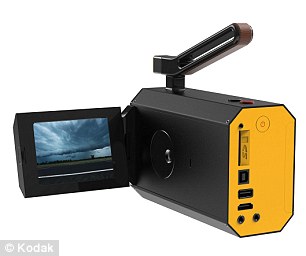
The modern Super 8 camera combines classic features with digital functionality.
It has a 3.5-inch swiveling digital viewfinder for framing shots and it still uses film cartridges, and each one contains 50 feet of film.
The front of the camera is designed with a 6mm Ricoh lens and there is also a job wheel user interface, a built-in light meter, cartridge detection, exposure control, manual speed/iris setting, and charging the battery via a USB wall adapter, according to PetaPixel.
Once you're done with the film, send it to Kodak.
They then process it, scan it and deliver right back to you as a digital copy and 8mm film for a projector.
Film has generated huge buzz in Hollywood recently as the chosen medium for award-winning movie directors and blockbuster movies.
Now the Kodak Super 8 Revival Initiative is being applauded by the industry's top directors, many of whom got their start on Super 8 film.
Kodak published comments from well-known and successful directors about the company and the Super 8 camera.
'While any technology that allows for visual storytelling must be embraced, nothing beats film,' said JJ Abrams, writer and director of Star Wars: The Force Awakens.
'The fact that Kodak is building a brand new Super 8 camera is a dream come true.'
'With a gorgeous new design, interchangeable lenses and a brilliant scheme for development and delivery of footage, this camera appears to be the perfect bridge between the efficiency of the digital world and the warmth and quality of analog.'
Steven Spielberg, Quentin Tarantino and Shannon McIntosh and others who also discussed how the Super 8 played a major role in their careers.
When it will be available and for how much is still a mystery.
But Kodak's Clarke told The Wall Street Journal the release could happen sometime in the fall for around $400 to $750 and processing of the film cartridge will be about $50 to $75.
The original Super 8 made its debut in 1965 at the New York World's Fair.
Plastic cartridges containing coaxial supply and take-up spools loaded with 50 feet of film, with 72 frames for every foot, for a total of about 3,600 frames for each cartridge were included in the camera's design.
Up until 1973, all Super 8 cameras were silent, but Kodak started using magnetic strips on the side of the fil that made it possible for it to capture the sounds along with the image, according to DeWitt Davis, Kodak's film school liaison.
But, sales slowly started to decline around the '80s when VHS camcorders hit the market.
Kodak scaled down production and eventually stopped making the cameras altogether, according to an article in Live Science.
An interesting idea, but at $50 to $75 to process each 50-foot roll, I can't see it ever selling as a home movie camera. I'm guessing that the market will be serious students and low-budget professional productions, of the sort that Pro8mm currently service.
Posted by Buck Wilson (Member # 5885) on 01-07-2016, 12:32 AM:
NEAT!!! FILM THINGS!
Posted by Emiel De Jong (Member # 4225) on 01-07-2016, 02:55 AM:
Thanks for sharing this Leo. This makes me insanely happy... I don't know if I will start filming on super8 again, but definitely these slogans as "Analog Renaissance" are good. We are all so embedded in a digital world that now you can present film as the new cool thing. Now for the glorious return of Kodachrome... ![[Big Grin]](biggrin.gif)
Posted by Scott Norwood (Member # 30) on 01-07-2016, 06:58 AM:
I am not sure that I really see the point of this. For a few hundred dollars, one can buy a used Bolex or similar 16mm camera, which is far more useful (can do in-camera effects, does not require batteries) and will produce far nicer pictures.
Super 8 film is slightly cheaper than 16mm, but not by much, once processing and video transfer is taken into account. And 16mm offers the option of making prints from negatives as well as cutting the negative and making sound-on-film prints (I believe that super-8 mag striping is NLA) that can actually be projected on a reasonably large screen. There are also far more labs that are equipped to process 16mm and transfer it to videotape (vs. super-8).
I know that super-8 has its fans and does have a certain amount of charm, but its real benefits over 16mm at the time of its introduction were the snap-in cartridge and the lower cost of the film and processing (when people were shooting home movies on Kodachrome). Neither of these is much of a benefit now. The snap-in cartridge was nice when Aunt Millie was shooting home movies on film, but anyone using film now should be able to thread a Bolex or Arri or whatever without much difficulty, and the precisely machined pressure plate in those cameras will give a far steadier picture than the plastic cartridge ever could. As noted above, the cost difference between super-8 and 16mm is now minimal, and anyone who is shooting film in 2016 is probably not doing so on a super-tight budget.
I'm not saying that the existence of this product is a bad thing, but rather that I don't really see the point of it.
I truly want Kodak's motion-picture division (and the lab infrastructure necessary for processsing, printing, and scanning film) to succeed, but, if their goal is to sell enough film to keep production economical, they would probably do better by trying to encourage 65mm origination for movies and TV shows than by trying to sell super-8 cartridges to owners of this camera.
Posted by Paul Gordon (Member # 3320) on 01-07-2016, 07:25 AM:
Scott its does have some advantages over a wind up Bolex. The camera has crystal sync and can record audio onto a SD card while shooting. The real problem is Kodak got rid of the two best film stocks for super 8 PX B&W and the Reversal EKTAKROME. Though Ferrania is saying will be producing colour reversal in the enar future. Kodak proessing the stock and digitally transferring teh film is also an odd one. Are they doing this in house or contracting it out to teh last labs that still do Super 8 processing?
Posted by Martin McCaffery (Member # 37) on 01-07-2016, 07:56 AM:
Lenny Lipton Lives!
(ok, he's not dead yet).
Posted by Leo Enticknap (Member # 534) on 01-07-2016, 10:27 AM:
quote: Emiel de Jong
Now for the glorious return of Kodachrome...
I really can't see that happening. For the last 2-3 years of its existence, Dwayne's Photo processed all the Kodachrome being shot in the world. They were a relatively small business with relatively low overheads, and even they couldn't sustain that operation. It just needs too many highly skilled chemists, too complicated and bespoke machinery and too much time for it to be do-able on a boutique scale at a price that the customer base is willing and able to pay. I understand that the guys in, I think, Belgium, who restarted Polaroid film production out of a garage looked at Kodachrome too, and concluded that it would be just too expensive.
As for Super 8, I agree with Scott, and it all hinges on one factor: the likely cost of the stock and processing. As he points out, it's not significantly less than that of 16. While modern Vision 200T stocks on Super 8, even shot through the optics of refurbished 1970s cameras of the sort Pro8mm supply, can be pretty amazing compared to the home movie footage the format is best known for, the D-SLR revolution effectively blew that out of the water except for people who actually want the "film look".
If the relaunch of Super 8 involved true home movie level pricing (say, $25 for a process paid roll, which is about what super 8 Kodachrome cost, adjusted for inflation, in the 1980s), then that might open up a larger market of retro home movie makers and people who just wanted to dabble in film, just as you can buy a cheap 'n nasty $99 turntable now. Anyone who cares about analog audio quality wouldn't go near one, but someone who think's it's cool to have a retro looking device playing at a party might. But if the figures in this article are right, the stock and processing are going to be priced such that any "prosumer" or professional filmmaker is likely to prefer 16.
Posted by Claude S. Ayakawa (Member # 1401) on 01-07-2016, 12:40 PM:
Beside my professional photography profession, I photographed movies with Super 8 cameras as a hobby. Most of the footage I shot were of family events and my numerous travels. I started out with a Nikon camera and eventually moved up to using a state of the art French Beaulieu camera. I do not remember the model number but I remember it was a very expensive camera. I was able to do a lot of great stuff with it and I still have all the footage I shot with it as well as all the other stuff I shot with my Nikon. I also had an excellent Elmo Super 8 projector that handled very large reels holding about 1200 feet of film but I sold it many years ago with my cameras and my collection of feature length Super 8 sound prints of GREASE, MURDER ON THE ORIENT EXPRESS and a few others.
-Claude
Posted by Monte L Fullmer (Member # 2797) on 01-07-2016, 02:49 PM:
Interesting to read.
You think that Kodak now will resurrect the Brownie Super 8mm Projector if they're going to release film again?
Bet the thrift stores are now going to hike up the price of 8mm projectors that people drop off for donations, when they were had for pennies.
Still have my Kodak MovieDeck 265 sound unit.
-Monte
Posted by Scott Norwood (Member # 30) on 01-07-2016, 03:29 PM:
There is little point in producing a super-8 projector because, at this point, the only way to shoot super-8 film for projection is to shoot B&W Tri-X reversal.
All of the other currently available camera stocks produce color negatives, which are really only useful for video transfers (which is what most people do with s8 footage now) or printing (not really an option for s8, as there is no print stock available at the moment, though there is supposedly some lab in Germany that cuts down 35mm 2383 and can make s8 prints, though not with sound and probably at great expense). Additionally, it isn't really possible to make s8 prints of edited material, since s8 film does not have (and never has had) the edge numbers that make it possible to conform the camera negative to an edited workprint. And, as far as I know, there exist no film recorders to provide digital output to s8.
I hope that my posts about this don't come across as being overly negative. I love film and, if this camera helps it to survive, then I am happy that it exists (or might soon exist). I just don't, personally, see the appeal of buying a new s8 camera when, for the same price or less, one can buy a good, used 16mm camera and produce much better images with it for about the same price per minute of film, while having the option of making composite sound prints that can be projected in cinemas. If a s8 look is needed, one can crop the center of the 16mm frame on an optical printer or film scanner/telecine to the same dimensions as the s8 camera frame. Furthermore, effectively every existing film lab can process 16mm and provide prints or video transfers; the number of labs that can work with s8 is rather small.
Posted by Bill Brandenstein (Member # 7758) on 01-07-2016, 03:48 PM:
quote: Leo Enticknap
For the last 2-3 years of its existence, Dwayne's Photo processed all the Kodachrome being shot in the world. They were a relatively small business with relatively low overheads, and even they couldn't sustain that operation.
As one who had a substantial Kodachrome project going right up to the final days of processing, let please me clarify a couple of things (and it's hard to believe Kodachrome processing ended 5 years ago already!). First, Dwayne's Photo is still alive and well. Second, the story as I heard it was that Kodak, having discontinued manufacture of Kodachrome years before, sold to Dwayne's all of their last remaining processing chemicals and no longer wanted the expense of having to create more of that complicated chemistry. The only reason I have to question that story is the fact that they didn't seem to run out of that chemistry with the unbelievable onslaught of work received before the final deadline - which took weeks into the following month for them to catch up with, even with extra shifts.
Now back on topic. I wish Kodak well and hope that this wonderful camera will be sensibly priced, and with the wonderful feature set it has, price is a great concern.
Doing a little math from Dwayne's price lists, excluding shipping, a finished minute (24fps) of Super 8 using Wittnerchrome 200D is $20. A finished minute of the same in 16mm (100' loads) is $30.24. You're right - that's not a big enough difference unless Kodak comes up with a new reversal stock that undercuts this price.
Back in 2005 I was shooting Kodachrome Super 8 for about $10/minute, purchasing film directly from Kodak, and processing at Dwayne's. That was only .50 foot finished!
Posted by Scott Norwood (Member # 30) on 01-07-2016, 07:24 PM:
I found the German lab that can make prints from s8 negatives:
http://www.andecfilm.de/en/e_s8_neg_pos.htm
The charge .66/foot for this service, if I did the metric and currency conversions correctly.
So, using the prices on their web site and a conversion factor of $1.09 per 1 Euro, to shoot and print one 50' roll of s8 7219 would cost about $48 for film and processing and $33 for the print, for a total of $81, not including shipping to and from the lab, which would be nontrivial from the US.
Compare that with 16mm, which would be about $45 per 100' roll of 7219 plus $45 to process and print at Cinelab. The total would be $90. (Note that Cinelab, like most labs, has a 200' minimum for processing.)
The extra $9 per 2.5 minutes buys a heck of a lot of improvement in image quality, not to mention the additional flexibility that the 16mm format provides.
The economics are a bit different if one is doing a scan or telecine of the negative. In that case, the expensive part is the colorist, so the price per hour of telecine suite time is effectively the same for s8 as it is for 16mm or 35mm.
For those who are curious about the sort of quality that is possible with 16mm today, here are two shorts about movie theatres that I have made. Both were shot on 16mm, edited on film, printed to 16mm interpositives, and blown up to 35mm internegatives in order to make 35mm prints for screenings (I also had 16mm prints and DCPs made). The video transfers were made from 16mm interpositives to HDCAM tapes. Naturally, the 35mm prints look way better than the Vimeo versions. Negative processing was done at Magno Lab-Link and Alpha Cine, respectively (both, sadly, gone now). Post printing, blowups, and video transfers were done at Foto-Kem.
The Exhibitor - shot in 2005, completed in 2014
Cinema Time Capsule - shot in 2013, completed in 2014
Posted by Leo Enticknap (Member # 534) on 01-07-2016, 08:53 PM:
quote: Bill Brandenstein
First, Dwayne's Photo is still alive and well.
Sorry - didn't mean to suggest that they were out of business, just out of the Kodachrome business.
According to Wikipedia, it was the discontinuation of the stock itself, rather than the processing chemistry, that killed Kodachrome. Presumably Kodak produced enough chemistry for Dwayne's to process the remaining stock that had been sold and was in the field, and then that was that.
What is telling to me is that even though there are now no IP, royalties or patents obstacles related to Kodachrome or K-14 at all (the patents all expired long ago), there has been no small scale, boutique resumption of production, I'm guessing because the pure cost of making the stuff and doing the processing is high enough to be beyond viability, given the likely number of customers out there and what they'd be willing and able to pay.
Posted by Randy Stankey (Member # 64) on 01-07-2016, 09:14 PM:
I'm really digging this!
One of the main things I like about using film is that it is a tactile medium that teaches us to manipulate images in real life. Manipulating images in a purely digital space teaches us that images are transient things that can be easily thrown away. The end result, I believe, is that purely digital media does not teach us to think about the end result and how it will affect the viewer. I think this is one reason why there are so many crappy movies, these days. Too many people see movies and imagery as transient things to be watched once and thrown away. Nobody cares. While I am not advocating a "film revolution," I do believe that a person who truly cares about making movies and images will have, at least, some experience with film.
I noticed that this new camera has a built-in microphone. It says on the web page that it has, "An integrated microphone is a true innovation for a Super 8 Camera."
http://www.kodak.com/ek/US/en/Consumer/Products/Super8/Super8_Design/default.htm
Does this mean that it uses digital technology to make sound on film? I hope so! That would be REALLY cool! ![[Cool]](cool.gif)
I already own several vintage 8mm cameras, a 16mm Bolex and a couple of 8mm and 16mm projectors but, if I had the money I might be interested in getting one of these new cameras, if not to use, to add to my collection. ![[Smile]](smile.gif)
Posted by Emiel De Jong (Member # 4225) on 01-08-2016, 02:18 AM:
The built-in microphone being a true innovation for a S8 camera isn't true at all of course, quality of the audio is probably questionable,but I like the design ! Crystal controlled camera speed makes that you can record sync audio on any device anyway.
I understood Kodak sends you a file of the scanned film, I guess they will provide some software that can add the audio from the SD card to that file.
But (no, I am definitely not thinking from a practical viewpoint here ;-) it would be totally cool indeed if they would use digital technology to make sound on film! It is possible to print in camera a tiny optical analog track on the side, or, mini dolby digital... Then imagine this super8 projector with little reverse scan soundhead...
Posted by Richard Fowler (Member # 893) on 01-08-2016, 07:39 AM:
They are proposing Max 8 image to take up the area occupied by the former sound track to create a 16.9 widescreen image.
Posted by Leo Enticknap (Member # 534) on 01-08-2016, 01:45 PM:
quote: Emeil de Jong
I understood Kodak sends you a file of the scanned film, I guess they will provide some software that can add the audio from the SD card to that file.
The camera appears to have a flip-open video viewfinder, like 1990s camcorders. Therefore, there must be a video imaging device in this thing as well as the film gate. I wonder if it records both video and audio onto the SD card, so that the owner can use it as a video camera when (s)he is too skint to afford film rolls, or for rehearsal shots before a take, and/or as a video assist to review a shot after the take but before processing?
Posted by Randy Stankey (Member # 64) on 01-08-2016, 03:53 PM:
quote: Emiel De Jong
I understood Kodak sends you a file of the scanned film, I guess they will provide some software that can add the audio from the SD card to that file.
But (no, I am definitely not thinking from a practical viewpoint here ;-) it would be totally cool indeed if they would use digital technology to make sound on film! It is possible to print in camera a tiny optical analog track on the side, or, mini dolby digital... Then imagine this super8 projector with little reverse scan soundhead...
quote: Richard Fowler
They are proposing Max 8 image to take up the area occupied by the former sound track to create a 16.9 widescreen image.
Most people I know do not understand that picture and sound are two separate entities that are married together at the time of presentation/viewing to create the illusion of seamless image and sound.
If this new camera does not, somehow, tackle this problem it will be a resounding flop!
Even your lowly "iThingy" automatically records sound and picture. Who, in their right mind, would buy something as expensive as this new camera if it doesn't record sound and play it back seamlessly?
Using some form of LED to digitally create a soundtrack on the film at the time of the recording would be the way to go.
Posted by Bill Brandenstein (Member # 7758) on 01-08-2016, 04:30 PM:
Randy, I'm really sympathetic to your point of view, but on-film sound recording can't be done in a camera that small with a standard-shaped Super 8 cartridge. The geometry is difficult because the sound needs to be about 4 inches advanced from the image.
The use of the Max 8 gate precludes on-film sound recording, as already noted.
The reason this might not be a resounding failure is because, since mag sound on camera film went away, nobody has had the ability you describe. It's ALWAYS double-system or silent. What this camera can do is create a sound file that perfectly locks with the film image, including shot lengths, right out of the camera. I have dozens of rolls of Super 8 footage shot 5 - 10 years ago, all with digitally recorded sound, that still are unedited and unprojectable to this day: all of the sound is wild and 3/4s of it is still uncut. It's very do-able, just takes time. The portions I've finished work perfectly. So if the camera eliminates all that lining up and trimming, it's definitely a leg up.
So with what Kodak has here, you potentially could even project a roll right from the lab with locked sound, using the pulse-sync capabilities of an Elmo GS-1200 projector, or that of certain Bauer models. That would require no more prep than identifying where the starting frame is.
Posted by Randy Stankey (Member # 64) on 01-08-2016, 05:01 PM:
quote: Bill Brandenstein
The use of the Max 8 gate precludes on-film sound recording, as already noted.
I get it.
That still doesn't negate the need for some kind of synched sound. How can it be done? Time code on the film?
A single synch point at the beginning probably won't do.
What happens when the camera is stopped between shots/takes?
There would have to be a synch blip at the beginning of every shot.
What will happen if the film is cut and spliced?
Or? Is this whole system meant only for filming then scaning, the rest of the work to be done entirely in digital space?
That would be a waste. Wouldn't it?
Posted by Carsten Kurz (Member # 5396) on 01-08-2016, 05:14 PM:
I think that is basically what Kodak is after.
They propose the 'film look' + the advanced digital editing capabilities. Then if you still want to project, you can.
If they wouldn't take this approach, they would also have to make and sell film + sound editing and projection gear.
No, they propose what some Hollywood big boys like J.J. Abrams do.
- Carsten
Posted by Mark Gulbrandsen (Member # 72) on 01-08-2016, 07:42 PM:
oOdak received a BEst Of Show Award at CES for the introduction of the camera which is apparently going to be made by Logmar in Denmark.
Mark
Posted by Scott Norwood (Member # 30) on 01-08-2016, 08:34 PM:
Unless this is aimed at Aunt Millie, internal sound recording seems like it would largely be a waste. Anyone using it professionally or semi-professionally would record sound separately using a Sound Devices/Zaxcom/Nagra/etc. recorder, which will be easier to use, provide better sound quality, and allow the soundman to move about without being connected to the cameraman with cables.
Also, the 50' roll of film would be kind of limiting for sync sound shooting, anyway. I can't really imagine doing a doc-style interview where I had to stop every two and a half minutes to reload the camera.
Does this camera even run silently?
Again, I don't mean to dump on this too much, since I am in favor of anything that keeps film alive for production and/or exhibition, but I still don't see the point of this. For the occasional music video or commercial that needs the super-8 look, millions of cameras already exist. For "serious" film-making, 16mm is a far more practical format that can be used for about the same price as s8.
Edit: if an internal syncing mechanism is needed, they could borrow some technology of the 1970s, using a small light bulb (probably an LED now) inside the camera that would flash briefly at the start of each take to fog a frame or two of film at the same time when a beep is recorded on the separate soundtrack. This would be just as easy to sync in post as a regular slate. Aaton and Arri both have timecode-on-film systems, but they seem overly complicated for this purpose and require special equipment to be read in telecine. For those reasons, they are not commonly used.
Posted by Randy Stankey (Member # 64) on 01-08-2016, 11:16 PM:
quote: Scott Norwood
Again, I don't mean to dump on this too much, since I am in favor of anything that keeps film alive for production and/or exhibition, but I still don't see the point of this. For the occasional music video or commercial that needs the super-8 look, millions of cameras already exist. For "serious" film-making, 16mm is a far more practical format that can be used for about the same price as s8.
Like Scott, I don't want to dump on it, either but if it doesn't have any kind of sound sync or sound-on-film features, I figure it would be a waste to spend the estimated $400 to $750 to buy one of these cameras when I can just use the Bolex that I already own. I can just use my digital audio recorder and sync it with a clap stick made from a couple of rulers and a stove bolt.
But... Then, again, if this camera takes off, that means that there will be more places that process film. Right?
Posted by Emiel De Jong (Member # 4225) on 01-09-2016, 04:34 AM:
To sync the sound from the SD card with the scanned images afterwards the only thing is needed that for every new shot some marker is recorded with the sound. Start and end of the roll can be tricky when, like in the old days, some frames from start and end are cut in the lab. But, unless the roll is used for one continuous take, the length of the different shots on it should provide all the information that is needed for some simple software to sync this sound automatically.
I agree with Scott that for a professional filmmaker 16mm is in every aspect more practical. This "new" super8 system will be just a lot of fun to play with. I like very much the sheer improbability of this whole project in this day and age.
I think back of the days I started filmmaking in the '80's when all normal people were putting their super8 gear down in favor of video8 and VHS videocameras which offered shitty images but also sound to go with them. Sound was the big problem for super8, the sound-on-film cartridges were expensive and editing possibilities limited. I was tinkering with this modified Uher recorder from hell that should synchronize its perforated tape to the camera. For years I had to explain to everyone why I still preferred to shoot on film.
And now in 2016, when seemingly every effort has been taken worldwide to kill film in general, super 8 is back! With sound sync problems! Oh yeah...
Posted by Leo Enticknap (Member # 534) on 01-09-2016, 11:49 AM:
quote: Emiel de Jong
To sync the sound from the SD card with the scanned images afterwards the only thing is needed that for every new shot some marker is recorded with the sound.
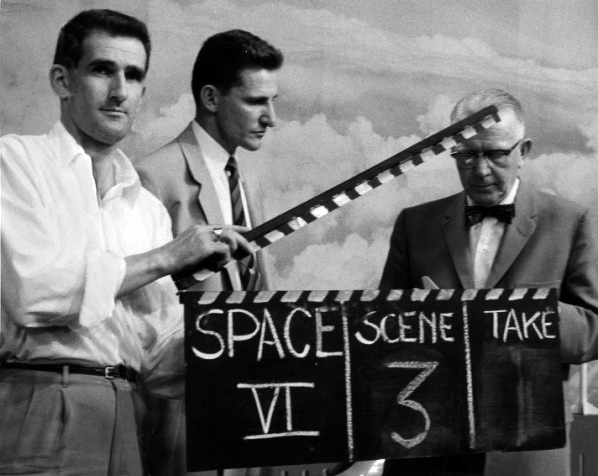
Maybe Kodak is trying to encourage the return of another "retro" technology ... ?
Posted by Mark Gulbrandsen (Member # 72) on 01-09-2016, 12:49 PM:
That's not at all far fetched because you will need a slate of some sort to use with this camera because it records audio on a micro SD card for later syncing in post editing.
Mark
Posted by Bill Brandenstein (Member # 7758) on 01-09-2016, 07:16 PM:
I really don't understand what the big deal is. We already know from the specs that the camera has crystal sync, so sample rate and shutter rate are locked together. Next, if it puts a wave file on the SD card with start and stop timed by your trigger, there is no post-production sync work to be done other than to slide the wave file into place in your video NLE. Why wouldn't Kodak make this so the cut is done by your index finger? What isn't clear is if there's a file for each shot, or if it's a file per roll. If the latter, it would be just as simple for there to be a marker placed in the file at the start of each shot - wave file markers have been around for decades.
I think the bigger problem is camera noise. Sync, no issue.
Posted by Scott Norwood (Member # 30) on 01-09-2016, 07:32 PM:
quote: Bill Brandenstein
What isn't clear is if there's a file for each shot, or if it's a file per roll. If the latter, it would be just as simple for there to be a marker placed in the file at the start of each shot - wave file markers have been around for decades.
That would only work if the camera motor could go from 0 fps to 24 fps (and back) instantaneously. Cameras don't do that, and the run-up and run-down time would cause sync to drift slightly from shot to shot. I suppose that it would be possible to design the camera to have a carefully calibrated run-up and run-down time and to design the sound recording system to take this into account and add or drop a specific number of samples for each take to account for this, but I really doubt that they are doing this on a sub-$1k device.
I still say that internal sound recording is a pointless feature, especially on a camera that can only shoot 50' of film before needing to be reloaded.
Posted by Bill Brandenstein (Member # 7758) on 01-09-2016, 09:04 PM:
Scott, that is truly a good point. When I do pulse-sync stuff I always have to add 2 frames' worth of audio in spite of the fact that the motor doesn't sound like it takes all that long to spring to life. A camera motor would be better, but even a quarter-frame delay added up over many shots would make a mess.
Well then.
I suppose this is intended for the pro-sumer crowd, or the trendy Millennials who like retro stuff like vinyl, as much as people who like film. And I agree, Scott, I'm probably not going to want to use the built-in mic if I can at all possibly opt for something better.
Powered by Infopop Corporation
UBB.classicTM
6.3.1.2