This is topic Looking for annotated version of picture in forum Film-Yak at Film-Tech Forum ARCHIVE.
To visit this topic, use this URL:
https://ft-forum.com/ft/cgi-bin/ubb/ultimatebb.cgi?ubb=get_topic;f=8;t=007396
Posted by Mark Lensenmayer (Member # 134) on 04-14-2016, 07:11 PM:
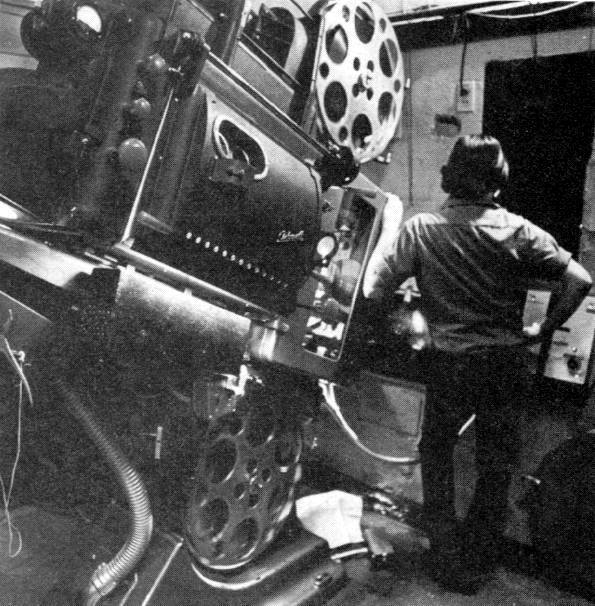
Somewhere, out on the web, I've seen this picture with annotations, I believe trying to figure out where it came from. Can anyone point me to that image?
Posted by Carsten Kurz (Member # 5396) on 04-14-2016, 08:35 PM:
'Alien'?
- Carsten
Posted by Mark Ogden (Member # 43) on 04-14-2016, 09:28 PM:
Since it's a DP70 (or AAll) it would probably be a good idea to check with Thomas Hauerslev, who comes around here once in awhile and has many of these pictures on his site. I'm guessing he could help you, especially if you changed your subject line to "annotated picture of DP70" or some such thing.
Posted by Mark Fontana (Member # 153) on 04-14-2016, 10:05 PM:
This was on a web page I used to have for the New Neon Movies' Cinerama revival in Dayton back in the late 1990s. There's a snapshot of it at archive.org, but for posterity on Film-Tech, here's the same info:
Now here's some heavy-duty projection gear...
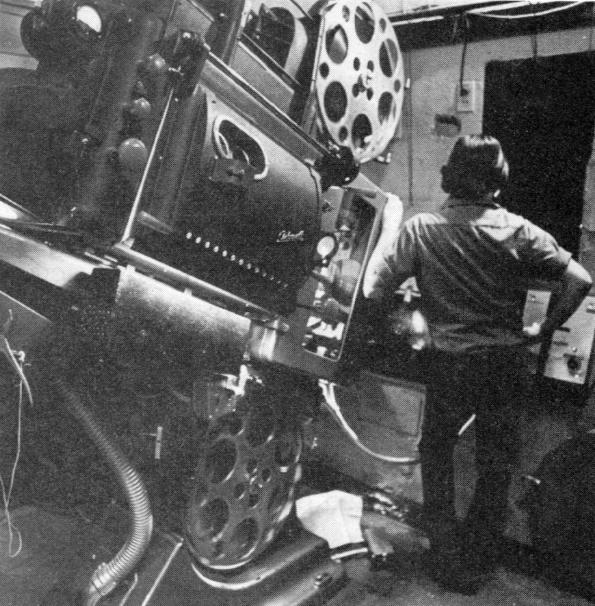
I recently asked if anyone could identify the equipment in this photo (or perhaps the theater where it was taken) and quickly got responses from Steve Kraus, Henry Taylor, Scott Bosch, Lothar Baehr and Randy Pryde confirming that the picture shows a Norelco AA-II (Philips DP70) projector and pedestal, and an Ashcraft "Super Cinex" carbon-arc lamphouse.
Steve Kraus has some pictures of an AA-II in use at the Cinema Borealis event.
Randy Pryde provided some additional information about the lamphouse:
quote:
Just found an article on the lamphouse in the 1955-1956 Theatre Catalog. This appears to be the first year that it was introduced. It was made by the C.S. Ashcraft Manufacturing Co. and is the "Cinex" series, made especially for scope and 70mm prints. Designed for use with hi-intensity carbons from 9mm to 13.6mm, it is claimed to put out 41,500 lumens through a scope aperture. The reflector is 18 inches with a speed of f/1.64. Cooling is by a special blower system and a water circulator. (BTW, the Norelco also uses a water circulator on the film trap). Ashcraft claims that this lamphouse will put 10 foot-candles on an 80 foot scope screen!
I would also like to share the impressive and detailed observations made by Lothar Baehr of Germany. He included the following picture to help clarify his findings:
quote:
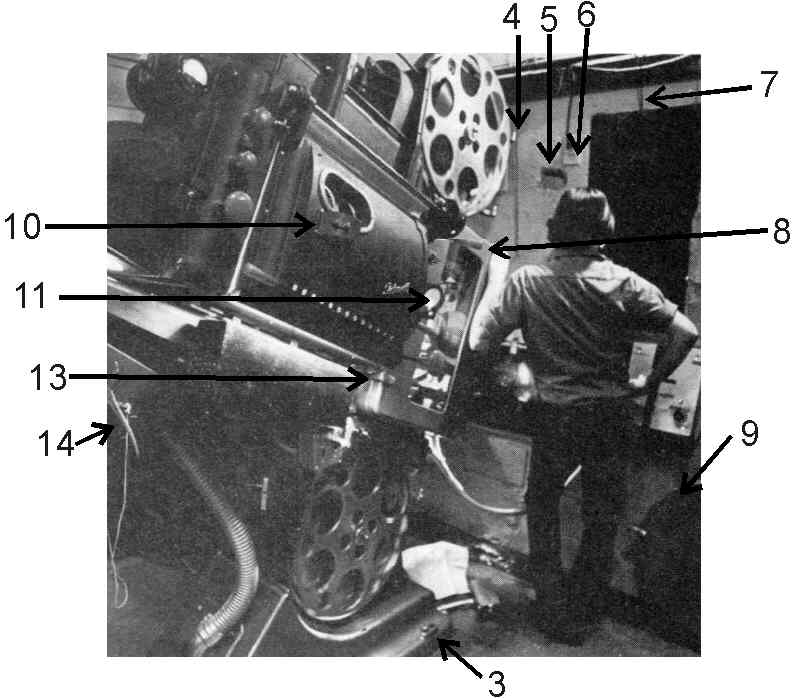
It's possible that I know which kind of projector the picture shows. I'm not absolutely sure, but it looks very equal the "DP70" from Philips. I send you with this message two pictures. One is your picture with some numbers, which I use in the following description. The second picture shows the "DP 70". This picture I found in a "Cinema pocket handbook" from Philips which was printed in Germany 1955.
I analyzed your picture for a while and I found a lot of small details. Sometimes I felt like Sherlock Holmes.
In my opinion the projector head and pedestal is the "DP70" from Philips. You find the same screw holes at the bottom of the pillar (1,3). The Philips label (2) is, if it exists, unfortunately hidden by an lever of the lamphouse. The magazine doors are dismounted, you can see the empty hinge (4). One of the cover you can see on the right bottom (9). The cover must be used for a while, because you can see a hole in the isolation (maybe for fire protection or for noise) of the front wall of the projection room (5). This hole was made by the opened cover I think. The only thing I can't find on the Philips picture is the clamp of the gear cover (13), but it could be that it was not closed on that photo. That's it for the projector head.
Now the lamp house. Unfortunately I can't tell you which company has made it. I can't identify the label. I think it is not from Philips. Maybe it was made by an American company, and I have no information about American companies. But I found something out from the picture. First of all it must be a carbon arc lamp, because the cover of the lamp house is opened a little bit. If it were an xenon lamp, that would not be allowed because of the danger of explosion of the xenon tube. But there are two additional details. First you can see a pair of pliers which is connected with a string (14). This must be an absolutely necessary tool for the operator, otherwise he wouldn't have put it on a string. I think it is used to change the old, burned out, very hot carbons against new one. The second clue is the thing on the cover of the lamp house (10,11). It could be a crater projector. It is use to adjust the crater of the arc lamp in the focal point of the parabolic mirror of the lamp. It is an simple pinhole camera, in that case with a passive reflector (10), which projects the arc on a ground glass (11). That's it for the projector.
Let's have a look at the projection room. I've explained the hole in the wall (5). You can see a mechanical fire protection shutter at the projection portholes, which will fall down when a fire sensitive string or anything else is burned (7). I suppose that the projection room was built in the 40's or early 50's, because after that safety film made that unnecessary. The socket on the wall (6) tells me that the theater stands in the USA. The last thing I found out is that it must be a theater with a very high auditorium and the projection room must be under the top of that. This you can see by the very steep tilt angle of the projector. They must have had big problems with the parallax distortion!
Isn't it exciting how much information can be hidden in a small picture? So that were a lot of things. Most of them are suppositions of mine. Maybe everything is wrong, but I had a lot of fun to find it out and write it down.
Best regards,
Lothar Baehr (Germany)
Lothar also included this picture of a Philips DP70 from the Phillips pocket reference book he mentioned in his letter:
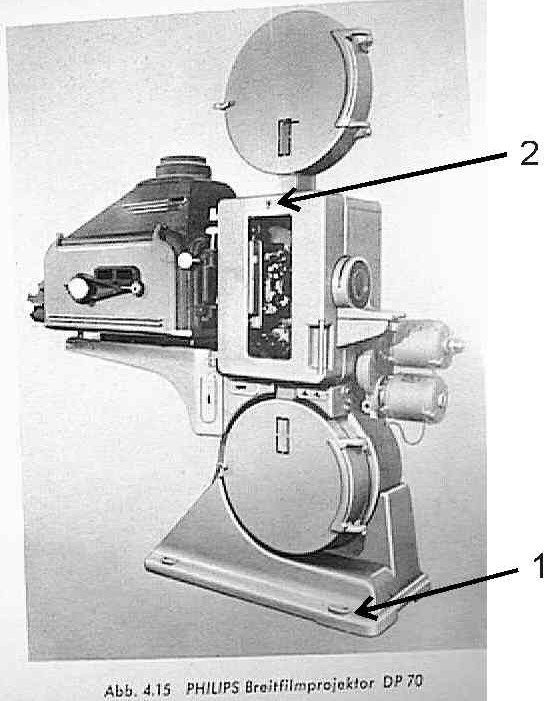
(Several readers have pointed out that the picture actually shows an AA-II.) The accompanying text (translated from German) was as follows:
quote:
The PHILIPS DP70 projector is a special projector for the widegauge film format newly adopted by Michael Todd and the American Optical Co. The higher quality demanded by doubling the film width, enlarging the frame height to 5 perforations and increasing the frame rate to 30 fps requires a new, very stable construction. A few minutes of changing parts enables one to configure the projector for 70mm/30fps or 35mm/24fps. The film guides are slightly curved to prevent the 70mm film from fluttering in the gate. Sound pickup is provided for magnetic sound (above) and for optical sound (below). The magnetic sound device is constructed such that the sound pickup heads may be easily interchanged for various systems. The DP70 is a machine for special purposes, but is an ideal replacement for projectors in ordinary situations as well.
Posted by Mark Lensenmayer (Member # 134) on 04-15-2016, 09:00 AM:
That is it! Thanks muchly, Mark.
Posted by Steve Kraus (Member # 476) on 04-15-2016, 11:13 AM:
The basic facts are readily apparent: A big Norelco 35/70 with an Ashcraft carbon arc lamp. What spotting features exist to tell a DP70 from a AAII when you can't see the drive motor(s) I do not recall nor do I know "Ashcans" well enough to know a, say, Super Core-Lite from a Super Cinex without relying on the emblem but one or the other version of the big Norleco 35/70 with an "Ashcan" is gist of it.
Posted by Mitchell Dvoskin (Member # 751) on 04-15-2016, 11:50 AM:
The lamphouse is not a Super Core-Lite, which have the amp meter facing the rear, not the side.
Powered by Infopop Corporation
UBB.classicTM
6.3.1.2