This is topic Alternating Black and White lines on evidence - WHY? in forum Film-Yak at Film-Tech Forum ARCHIVE.
To visit this topic, use this URL:
https://ft-forum.com/ft/cgi-bin/ubb/ultimatebb.cgi?ubb=get_topic;f=8;t=007461
Posted by Frank Angel (Member # 248) on 12-07-2016, 02:39 PM:
Sorry for the ambiguous subject, but there is just no easy way to explain the puzzle.
Which is...any time you see any activity relating to police recovering evidence, on any of the indicators such as marker cards or barrier tape and especially on the rulers they place next to evidence with the ruler there to show the object's size, you will always see the tell-tale rows of alternating black and white bars, as in... 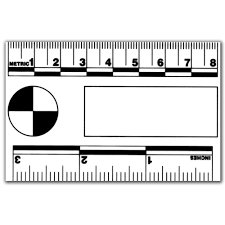
and
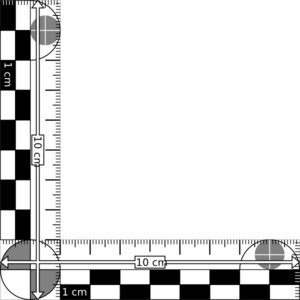
So the question is, what exactly is the function of the alternating strips of black and white? What information or reference data can that impart for later evaluation? Thing is, they are not always the same size or positioned the same way. I have a cop friend who has no idea their meaning, but then, he is not a detective. Seems like you always see them where evidence is being collected.
Just wondering.
Posted by Jim Cassedy (Member # 4115) on 12-07-2016, 04:07 PM:
I'm not an expert, but this was explained to me once.
The black & white squares are known as Optirectiliner graphics.
(this may be a trademarked name, but like "xerox" it is often
used as a generic term.)
The sizes do vary, depending on the scale of the "ruler" part of the evidence
card, but basically they are there for 3, and possibly more, reasons.
1) Police departments and crime labs are familiar with the type of evidence
card their jurisdiction uses, and therefor know the size of the squares.
The contrasting squares (or rectangles) make it easier to read the
ruler scales when photographed at a distance.
2) They are always either squares or rectangles. Knowing this makes it
possible to correct angular distortions when printing a photo,
3) The white is also often used as a 'white balance' reference when
printing or viewing a photo. That way you can better tell the difference
between blood spatter and a coffee stain. (for example)
I'm sure they have other purposes too. A little "googling' might
provide
more information for you, but this is basically what someone once
told
me when I asked the same question.
Posted by Steve Guttag (Member # 268) on 12-07-2016, 05:12 PM:
That is standard drafting information to denote scale. One block is sized so the rest may be used as a measure. I could see it being used in an evidence marker since a photo does not convey size unless something you know the size of is in the picture and even then you have to worry about "forced perspective). However with the marker next to the evidence, it will convey just how big the object is since even in 2D and magnified, one could use the scale provided by the marker to "measure" the object in the picture.
Powered by Infopop Corporation
UBB.classicTM
6.3.1.2