This is topic People really hate Philly's new soda tax in forum Film-Yak at Film-Tech Forum ARCHIVE.
To visit this topic, use this URL:
https://ft-forum.com/ft/cgi-bin/ubb/ultimatebb.cgi?ubb=get_topic;f=8;t=007469
Posted by Mike Blakesley (Member # 26) on 01-12-2017, 05:52 PM:
I don't think this is a violation of the forum's no-politics rule... if so please take it down, mods. But since it will impact all of our business when it inevitably goes nationwide, it deserves discussion.
People Really, REALLY Hate Philadelphia's New Soda Tax
by Brad Tuttle
Updated: Jan 09, 2017 1:13 PM Mountain
Philadelphia passed a soda tax last June, becoming the first big U.S. city to approve such a measure. So it should have come as no surprise when the resulting tax of 1.5¢ per ounce of sugary beverage went into effect at the start of 2017.
But based on the reaction of many Philadelphia shoppers, plenty of people were either unaware of the new tax or didn't understand exactly how it would work. What appears to have caught many off guard is that the tax applies to far more than just sugar-laden sodas: The tax also hits sugar-free soda, sports drinks, energy drinks, iced tea, lemonade, and even some milks and fancy bottled waters.
Even more alarming to shoppers is how much the tax can add to the bottom line—in some cases hiking the cost of a beverage by more than 50%.
A Philadelphia Inquirer infographic showed exactly how the tax is impacting the price of a wide range of beverages. A 16-ounce Monster Energy drink listed at $2 goes up to $2.24 due to the sugared-beverage tax. A 64-ounce jug of V8 Splash Carrot Orange Juice listed at $2.39 goes up to $3.35. A 20-ounce bottle of Coke Zero—which contains no sugar, but gets affected anyway because diet sodas are also hit with the tax—that used to cost $1.99 is now $2.29.
Because the tax is applied on a per-ounce basis, the price increase on larger items is particularly steep. A 32-ounce Gatorade formerly priced at $1 rises to $1.48 after the new tax is applied. A 128-ounce iced tea listed at $2.50 shoots up to $4.42. And all of that doesn't include normal sales tax of 8%, which also pumps up the final bill.
The list of what is and isn't taxed can be confusing. Basically, all sodas and energy drinks (including diet and sugar-free) are hit with the new tax, as are fruit juices that are less than 50% juice, plus any sports drink, tea, or coffee drink that contains sugar or artificial sweeteners. Plain old bottled water and fruit juices that are more than 50% pure juice are exempt—but products such as Vitamin Water and almond milk, which have sweeteners, are taxed just like Mountain Dew or Dr. Pepper.
The Tax Foundation noted that as a result of the new tax, beer can now be cheaper than soda or energy drinks in Philadelphia. The sugared-beverage tax is 24 times higher than the tax applied to beer sales—and after all taxes are added in, a 12-pack of Propel energy drink costs more than a 12-pack of Icehouse beer. "Before sales taxes, 12 Propels is $5.99 plus $3.04 in soda taxes for a total of $9.03 (and that's when it's on sale for $1 less than the $6.99 standard). The 12 Icehouses are $7.99, beer tax included," the Tax Foundation explained.
Understandably, shoppers haven't been happy to see that their normal beverage purchases suddenly cost an extra 25%, 50%, or more. One 7-Eleven employee in Philadelphia said she was "yelled at all day" by angry customers on the first day the tax went into effect. People have taken to social media to gripe as well.
Some have noted that the sugared-beverage tax could hurt Philadelphia businesses, because circumventing the tax is as simple as hitting a supermarket or convenience store just outside the city limits.
Many others have said that they'd cut back on soda purchases altogether—which, after all, is partly what motivated the law in the first place. The new tax was sold as an easy way to raise $91 million annually for city schools and public spaces. But Philadelphia also became the first major city to pass such a tax because proponents hoped to improve the health of citizens. Studies show that nearly 70% of kids are overweight or obese in North Philly, and the city as a whole has the second-highest rate of obesity among the country's biggest metropolitan areas. Article
Posted by Rick Raskin (Member # 1561) on 01-12-2017, 05:59 PM:
I suppose theaters goers will have to fork over even more to fill up. That'll go over well. ![[evil]](graemlins/evil.gif)
Welcome to the 'city of brotherly love'.
Posted by Leo Enticknap (Member # 534) on 01-12-2017, 07:13 PM:
quote: article
But based on the reaction of many Philadelphia shoppers, plenty of people were either unaware of the new tax or didn't understand exactly how it would work.
Exactly, precisely, the same thing has happened here with CA's plastic bag tax. A ballot proposition passed in November, to the effect that supermarkets can now no longer give away carrier bags with your shopping: the only ones they can provide are "reusable" ones (a bad joke: try reusing a TJ's brown paper bag after it's had any significant weight in it, and you'll wish you hadn't), and they have to charge a minimum of ten cents per bag.
Two days after this came in, a checkout girl at my local Trader Joe's told me that she'd been reduced to tears by the amount of abuse she'd received as a result of being on the sharp end of that.
It's funny how tax measures that relieve you of a serious amount of money, but in a hidden or less obvious way (e.g. a sales tax hike) annoy and polarize people a lot more than a trivial amount, but levied in a very clear and open way (e.g. you pay 30 cents for some carrier bags, or have no way of getting your shopping to the car).
Gordon Brown understood this in Britain in the late '90s, hence his political opponents invented the phrase "stealth tax" to describe the very clever methods he used to separate his compatriots from an impressive amount of their money in a boiling-the-frog sort of way. The soda and carrier bag taxes are about as unstealthy as you can get, and will probably end up biting the politicians who championed them in the rear; even though the amount of money we're talking about is tiny compared to other taxes that receive almost no complaints or attention.
Posted by Bobby Henderson (Member # 840) on 01-12-2017, 08:22 PM:
That soda tax is just plain stupid. It's an overly simplistic "solution" for a very complicated problem. I don't see it having any positive effect on obesity and other health problems in the Philadelphia area. The people who drafted the legislation obviously didn't have much legitimate input from medical and nutritional experts.
Regular soft drinks like Coca-Cola are bad for you. The big offender is high fructose corn syrup. But that goop is widely used in many different kinds of food products, not just soft drinks. It's even in a bunch of breads.
The artificial sweetners in diet sodas aren't good either, but at least those kinds of drinks aren't going to spike the insulin levels in your blood stream and add to your waistline. By the way, there's nothing natural about High Fructose Corn Syrup either. Just as many strange chemicals are used to create that crap.
I really don't get this law lumping in drinks that are sweetened with natural sugars, such as sports drinks like Gatorade. Naturally sweetened sports drinks are actually a good thing to drink during or after a work out. They're probably not so good to drink for someone that never gets off his ass all day. Chair potato at work and couch potato at home. Consumers do have to read labels carefully. There are plenty of fruit juices, teas, energy drinks and sports drinks that are loaded with high fructose corn syrup.
I have no problem with "sin" taxes on cigarettes or alcohol. Abuse of either one leads to serious health problems and the latter can be a risk to public safety (drunk driving, violence toward others, etc.). Obesity, heart disease, adult onset diabetes, etc. are problems mostly related to overall diet and lack of physical activity. The consequences of those diseases are creating a huge burden to taxpayers, medical service providers, insurance companies and it's making the cost of health care continue to spiral upward like it has for over 20 years. Making any meaningful progress on the nation's obesity epidemic is going to take a lot more than just making people drink a little less Coca-Cola.
Posted by Leo Enticknap (Member # 534) on 01-12-2017, 09:07 PM:
quote: Bobby Henderson
egular soft drinks like Coca-Cola are bad for you. The big offender is high fructose corn syrup.
Hence the reason I only drink Mexican Coke. It's still pretty bad for you, but at least it doesn't have that in it.
Posted by Martin McCaffery (Member # 37) on 01-12-2017, 10:10 PM:
Of course, if they saw how much of the price of hard liquor, or "spirits" in most States (on top of the Federal tax) they'd consider themselves lucky. Admittedly, one doesn't (or shouldn't) drink liquor in the same quantities as soda, but a "sin tax" is a "sin tax" no matter the "sin"
Posted by Jim Cassedy (Member # 4115) on 01-12-2017, 10:14 PM:
It wasn't clear to me from the story (unless I missed it) - -
Was the soda tax something that was voted into existence by
the public, like the plastic bag tax Leo mentioned here in CA?
Or was it just something "forced" onto taxpayers by the city government?
- - and whats to stop me from going into a Starbucks and buying a cup
of black coffee or plain tea, and then putting 15 spoonfuls of sugar in it?
Posted by Jonathan M. Crist (Member # 413) on 01-13-2017, 01:29 AM:
The Philadelphia soda tax was something that mayor Jim Kenney got his city council to pass by ordinance. It was not voted on by the public in any referendum.
The soda tax monies are supposed to be earmarked for early childhood education programs but I don't know of any rational person that seriously believes that. The City of Philadelphia has been desperate for tax dollars and has already enacted a recent series of additional revenue measures on top of Philly's local income tax. For example a couple of years ago Philadelphia lobbied the PA legislature and was given special permission to add an additional 2% sales tax on top of the regular Pennsylvania statewide 6% percent sales tax .... so that sales tax in Philly is now 8% of any purchase price. And just to be clear ..... the Philadelphia Soda Tax of 1.5 cents per ounce is in addition to the already existing 8% sales tax on that same soda purchase. [By was of example: If a two liter bottle of soda is $1.00 then there is an additional .08 of sales tax PLUS another $1.02 of soda tax for a total price of $2.10. 2 liters =67.628 ounces x 1.5 cents per ounce equals $1.02.]
[And last year Philly again lobbied the state and was given permission by the state legislature to add an additional $2.00 per pack on cigarettes on top of the Pennsylvania's statewide cigarette tax of $2.60 per pack. A total of $4.60 per pack in cigarette taxes in Philly.]
Perhaps the most onerous provision of the Philly Soda Tax is how it is calculated in the case of fountain drinks. If you serve a 64 ounce cup which is half ice and half soda, the tax is based on 64 ounces regardless of how much soda is actually in the cup.
Personally I want to know how they are going to collect the tax from children's front yard lemmonade stands since that lemonade is a 'sugary beverage' as defined by the Philly ordinance. ![[Big Grin]](biggrin.gif)
And for those of you who may think that could not possibly be coming to your area .... in addition to Berkley California, Philly and Chicago the tax was on the ballot in 4 other places this past November 2016 (in San Francisco, Oakland and Albany California along with an excise tax on soda distributors in Boulder Colorado) See: 4 Cities Pass Soda Tax Effective Jan 1, 2017
And it will continue. Politicians of both parties are desperate to raise revenues without raising income or sales taxes.
Posted by Lyle Romer (Member # 1266) on 01-13-2017, 05:53 AM:
Perhaps they should create a video game tax also. Kids playing video games instead of running around outside like they used to contributes to childhood obesity.
Even if you believe that obesity is as bad as smoking and needs to be solved, taxes like this will do almost nothing. Anybody that regularly travels outside Philly will just buy their "sugary drinks" outside of the city and avoid the tax.
98% of the rest of people will just buy it anyway, bitch about the tax and then re-elect the same council members that passed it.
These taxes are just like red light cameras. They are revenue sources disguised as something to benefit the public at large. Heck, a large part of why Marijuana keeps getting pseudo legal is that the states are losing revenue from less people smoking cigarettes and they can tax it.
To protect the public from these schemes, States need to pass laws at the State level that defines what can and can not be taxed by any municipality. That way, things like soda taxes would take a 2 step process of the state legislature and governor approving the ability to tax in the first place and then the municipality having to pass the tax.
Will they remove this tax when it is shown that the obesity rates in Philadelphia don't change after 2 or 3 years. I think not!
Posted by Scott Norwood (Member # 30) on 01-13-2017, 07:43 AM:
quote: Jonathan M. Crist
The soda tax monies are supposed to be earmarked for early childhood education programs but I don't know of any rational person that seriously believes that.
This sounds a bit like what happened in Virginia with lottery funds. Virginia law requires that 100% of revenues from the state lottery be used for the benefit of public schools. On the surface, this sounds like a good idea, since few citizens are likely to oppose a program that provides money to schools. What has happened is that all lottery revenues do indeed go to public schools, but the amount of money in the state's general fund that is designated for public schools has been reduced by a commensurate amount. The result is, of course, that schools have no additional money, but that the general fund has increased significantly.
Posted by Leo Enticknap (Member # 534) on 01-13-2017, 09:53 AM:
quote: Lyle Romer
Anybody that regularly travels outside Philly will just buy their "sugary drinks" outside of the city and avoid the tax.
Given just how high the tax is (I didn't realize that it doubled the price of a beverage until reading Jonathan's post), absolutely. Sin taxes only work long term if they are high enough either to raise a decent amount of money or deter the "sinful" behavior in question (if you really believe that the latter is the reason for having them), but not high enough to promote evasion.
In England in the mid '80s there was a big hike in the booze tax (which had not much to do with alcohol abuse and a lot to do with red ink on Her Majesty's bottom line), as a result of which there was a home wine and beer making craze that lasted for around 5-7 years or so. The tax was only on actual alcoholic beverages, not the stuff you need to make them yourself. During that time supermarkets sold kits containing everything you needed, plus the paraphernalia and consumables individually. People quickly discovered that to produce a drink that didn't take a long time to make and tasted gross and disgusting actually took quite a quite a lot of skill and commitment, and so when the tax started creeping down again through several years of raising it below CPI, the home booze making fad petered out. But it was a demonstration of what happens if you push people too far with sin taxes.
Maybe we'll see a reboot of The Dukes of Hazzard in which Uncle Jesse makes bootleg Sprite?
Posted by Bobby Henderson (Member # 840) on 01-13-2017, 10:19 AM:
quote: Scott Norwood
This sounds a bit like what happened in Virginia with lottery funds. Virginia law requires that 100% of revenues from the state lottery be used for the benefit of public schools. On the surface, this sounds like a good idea, since few citizens are likely to oppose a program that provides money to schools. What has happened is that all lottery revenues do indeed go to public schools, but the amount of money in the state's general fund that is designated for public schools has been reduced by a commensurate amount. The result is, of course, that schools have no additional money, but that the general fund has increased significantly.
The same kind of nonsense happened with lottery funds here in Oklahoma. The public schools system in this state is reeling, thanks to policy makers handing out tax cuts as candy to pander to voters. Then oil prices tanked, causing a huge amount of state funding to suddenly disappear.
Meanwhile brick and mortar retail across the United States is struggling badly. A big part of that problem is sales tax. Retailers with a local presence and physical store front have to collect it on every purchase. But many online merchants do not. For a bigger ticket item like an HDTV set, computer system, DSLR, etc. the difference on sales tax can add up to hundreds of dollars. That big price difference on tax alone has increased in many cities and towns. Many have passed measures to help fund infrastructure projects or pay police or teachers more competitively. If you're paying upwards of 10¢ worth of sales tax on each $1 spent it's very tempting to just order the item from Amazon and save all that money from sales tax.
Here in Lawton the Kmart store that had been here since before I was born closed down in December. The Sears location in Central Mall is closing at the end of March. It's looking like the entire Sears-Kmart business could fold before the end of 2017. Hastings Books, Music and Video went out of business, so we're down to just one video rental store left (Family Video) in a city of 100,000 people. In the 1990's we had at least a dozen or so video rental stores. Our mall no longer has any music stores or book stores; we're stuck with whatever is on the shelves at Walmart or Target. I expect even more retailers to go bust as long as this issue with sales tax continues to go un-addressed.
Amazon claims they want to add 100,000 jobs. What kind of jobs and where? For a company that is so huge on automation and has nothing in terms of retail store fronts I can't help but be suspicious that 100,000 jobs headline is bullshit. One thing is certain: I don't make my living designing signs for online companies. My business depends on companies that have a store front.
Philadelphia's soda tax is priced high enough that I can easily imagine people driving their SUVs out of town to load up on soft drinks, bottled water, etc. at some suburban grocery store not subject to the tax. The gasoline money would be more than offset by savings from dodging the high soda tax.
It appears to be ever more difficult to implement a clear, fair yet uncompromising tax system. Nothing in our way of life is free. Our streets, highways, water systems, sewage systems, garbage removal systems, police, fire departments, public schools, etc. all cost a lot of money to staff and maintain. We all have to pay for it with money. Waving a flag on the front porch doesn't pay any bills.
Posted by Leo Enticknap (Member # 534) on 01-13-2017, 10:35 AM:
My $0.02 on this is that the founding fathers simply didn't see online retailing coming, or anything like it, and therefore the interstate commerce provisions of the Constitution simply don't enable anything like a fair taxation system to be applied to business that is done by a combination of the Internet (which fundamentally doesn't even recognize national borders, let alone state, county or city ones) and freight shipping.
This is especially true if you have two adjoining states, one of which has a very high sales tax and the other none. Half of northern California makes short drives across the border into Oregon (zero sales tax) to buy small, portable, high value items, and that's completely legal.
IMHO this is a slightly different issue from sin taxation, which, theoretically at least, is not done just to raise revenue for the public purse. Sin taxation doesn't work on its own and never will: the public need convincing that an activity is actually sinful before any public acceptance of curtailing it is going to happen. With tobacco that took half a century: the first research that showed a clear link between tobacco and cancer was done by the Nazis in the late 1930s, but you didn't start to see smoking banned in many public places until the 1980s.
Posted by Rick Raskin (Member # 1561) on 01-13-2017, 10:51 AM:
I wonder how long it will be before a national value added tax (VAT) is implemented in the US. It seems that with states inability to tax online transactions and the decline in brick and mortar stores, there has to be a way to make up for lost taxation revenue. It would not be difficult to determine each state's portion of VAT funds. Another option is to call the VAT a national sales tax and eliminate local sales taxes altogether.
To all of the comments before, I totally agree that sin tax is ridiculous. Scott's comments about the Virginia Lottery are on point. It is illegal to earmark a tax in Virginia so all funds had to go into the general fund the results being as Scott mentioned. The voters were never told how the funds would be allocated, only that they were funding education.
I my area, the city of Manassas has a 4% meals tax on top of 6% sales tax. Its no wonder that most restaurants are located outside the city limits.
Posted by Mike Blakesley (Member # 26) on 01-13-2017, 12:52 PM:
quote: Jonathan M. Crist
The Philadelphia soda tax was something that mayor Jim Kenney got his city council to pass by ordinance. It was not voted on by the public in any referendum.
That's probably the only way it would have ever passed. If it was put to a vote it'd get voted down. Maybe some future council member will revoke it, if it stays unpopular enough.
Posted by Bobby Henderson (Member # 840) on 01-13-2017, 01:49 PM:
quote: Leo Enticknap
My $0.02 on this is that the founding fathers simply didn't see online retailing coming, or anything like it, and therefore the interstate commerce provisions of the Constitution simply don't enable anything like a fair taxation system to be applied to business that is done by a combination of the Internet (which fundamentally doesn't even recognize national borders, let alone state, county or city ones) and freight shipping.
As of 2014 figures, manufacturing makes up about 8% of the 150 million jobs currently in the US. Yet that's the jobs sector policy makers keep talking about when it comes to improving the nation's economy. Construction is about 4%.
Currently over 80% of America's labor force is made up of "services providing" jobs. That's 120 million jobs. 15 million jobs are in retail and that figure hasn't moved much over the past decade. 14 million jobs are in leisure and hospitality. Such jobs are cousins to the retail sector since store fronts for both are mixed together and depend on each other. A bunch of those jobs can be negatively affected by online merchants.
People like to get out of the house, supposedly. When you visit a city or town that seems to be thriving you see lots of store fronts offering various products and services. Movie theaters certainly fit into this category. Yet there are people promoting the idea of buying anything and everything via the Internet, packaging it into some kind of utopian ideal. I see the concept of not having to leave the house as an ultimately very negative dystopian thing.
Can you imagine just how sad, boring and socially isolated our cities and towns would be if there was no more in-person commerce? If cities just had houses, factories and some offices they wouldn't look "American" anymore. They would look like something out of a cold war, totalitarian state.
quote: Leo Enticknap
IMHO this is a slightly different issue from sin taxation, which, theoretically at least, is not done just to raise revenue for the public purse. Sin taxation doesn't work on its own and never will: the public need convincing that an activity is actually sinful before any public acceptance of curtailing it is going to happen.
Sin taxes don't work well as a revenue generator. If the tax does what it's supposed to do, convince people to buy/use less of a product deemed harmful to a person's health and harmful to society in general, then the tax will bring in less and less money as it becomes more effective in curbing the appetite of that product. In the case of cigarettes, there is still a bigger overall benefit to the taxes. As more smokers quit that lowers the rate of lung cancer, heart disease and other smoking related illnesses, the treatment of which costs taxpayers many billions of dollars every year.
Posted by Timothy Eiler (Member # 383) on 01-13-2017, 02:43 PM:
quote: Leo Enticknap
Half of northern California makes short drives across the border into Oregon (zero sales tax) to buy small, portable, high value items, and that's completely legal.
In Minnesota if you do that you have to file a form with the state and pay the required sales tax. Which I'm sure gets a 100% compliance ![[Wink]](wink.gif)
Posted by Justin Hamaker (Member # 2165) on 01-13-2017, 04:04 PM:
quote: Leo Enticknap
Two days after this came in, a checkout girl at my local Trader Joe's told me that she'd been reduced to tears by the amount of abuse she'd received as a result of being on the sharp end of that.
The funny thing about this is the law was initially passed a few years ago and put on hold because of lobbying by plastic back makers. Where I live it wasn't a huge shock because many of the North Coast counties have had this law in place for a few years. I live in Lake County where we did not have a local ban, but many locals shop in Mendocino and Sonoma counties where this has been the law for 4-5 years.
Posted by Lyle Romer (Member # 1266) on 01-13-2017, 09:40 PM:
quote: Timothy Eiler
In Minnesota if you do that you have to file a form with the state and pay the required sales tax. Which I'm sure gets a 100% compliance
I think that same law applies in a lot of places. I know here in Florida, you are supposed to report purchases made over the internet (from sites that don't have to collect it) and send in the sales tax.
The interstate commerce clause doesn't prevent a state from taxing a purchase made across state lines. It prevents the state from compelling an entity that doesn't have a presence in the state from collecting the tax on the state's behalf.
Since the interstate commerce clause doesn't allow a state to do anything to prevent commerce across state lines, they can't prevent goods from being shipped across state lines. However, if the company that does the shipping doesn't do business in the state, they lack the jurisdiction to compel them to collect the tax.
Unfortunately for consumers and fortunately for brick and mortar businesses, Amazon opened distribution centers in Florida a few years ago and therefore they have to collect sales tax on purchases shipped to Florida.
Posted by Bobby Henderson (Member # 840) on 01-14-2017, 04:20 PM:
Yeah, here in Oklahoma everyone is supposed to enter in what they purchased online during the year on their tax returns. Next to no one actually does this. The law is pretty much a joke. The only way the state is going to get that sales tax revenue is by making merchants collect it at the time of purchase.
Worse yet, even if a taxpayer does do the honest thing and report his online purchases, the state will probably just keep any taxes it collects for itself and not redistribute any of it back to the taxpayer's home town.
Posted by Leo Enticknap (Member # 534) on 01-16-2017, 03:15 PM:
quote: Rick Raskin
I wonder how long it will be before a national value added tax (VAT) is implemented in the US. It seems that with states inability to tax online transactions and the decline in brick and mortar stores, there has to be a way to make up for lost taxation revenue. It would not be difficult to determine each state's portion of VAT funds. Another option is to call the VAT a national sales tax and eliminate local sales taxes altogether.
I couldn't resist Googling "national sales tax constitutional" just now, and discovered a lot of amateur Constitutional scholars (and one or two professional ones) arguing both ways on that one. It seems to hinge on whether the interstate commerce clause only allows federal taxation at the point at which a product is first manufactured or enters the country, or if it can be applied to the final retail sale if the product crosses state lines between those two things happening. About the only takeaway I got from all the online noise is that if any federal administration were to try it, there would be an avalanche of challenges (not least because it stirs up the states' rights hornets' nest) and it would be fought inch by paper-strewn inch all the way to the SCOTUS.
Posted by Bobby Henderson (Member # 840) on 01-16-2017, 04:35 PM:
With the tremendous imbalances present between online and retail merchants, I can imagine the entire sales tax system being dismantled nationwide.
Lost sales tax revenues would be replaced by big tax hikes elsewhere, mainly property tax and income tax but possibly taxes on other things as well. If enough brick and mortar retailers are forced out of business and job losses really start piling up across all store front sectors the whole sales tax system will have to be re-examined. Legal challenges over the Interstate Commerce Clause as a means of protecting the tax free status of online purchases will only help dismantle the entire sales tax system.
Posted by Leo Enticknap (Member # 534) on 02-27-2017, 09:10 AM:
quote: Fox News (my emphasis)
Distributors say layoffs coming because of Philly soda tax
Two months into Philadelphia’s 1.5 cents per ounce soda tax, distributors are reporting 30-50 percent declines in sales and saying that hundreds of layoffs are coming.
ShopRite told Philly.com that it will have to lay off 300 workers, while one of the largest distributors said it will have to slash 20 percent of its workforce.
The soda tax comes on top of the existing 8 percent sales tax, adding $2.16 to the cost of 12-pack of soda.
Mayor Jim Kenney said the companies are being greedy for passing the cost of the tax onto consumers instead of reducing their bottom lines.
Mayor Kenney really let the cat out of the bag, didn't he? If the object of his sin tax was to reduce "sinning," then surely he'd be holding a press conference, crowing about what a huge success his tax had been in cutting consumption of unhealthy garbage between a third and a half? Instead he brazenly admitted that the object of the exercise was to transfer money from the soda industry to the city, and that he did not expect consumers to have to pay more.
Posted by Jim Cassedy (Member # 4115) on 02-27-2017, 10:08 AM:
quote: Leo Enticknap
Mayor Kenney really let the cat out of the bag, didn't he?
. . . . Was that a paper, or plastic bag, Leo?
Posted by Leo Enticknap (Member # 534) on 02-27-2017, 10:14 AM:
Doesn't matter - you still have to give the eco hippies their 10c for it!
Plastic would give the kitty more claw-sharpening exercise, though.
Posted by Frank Cox (Member # 6258) on 02-27-2017, 10:49 AM:
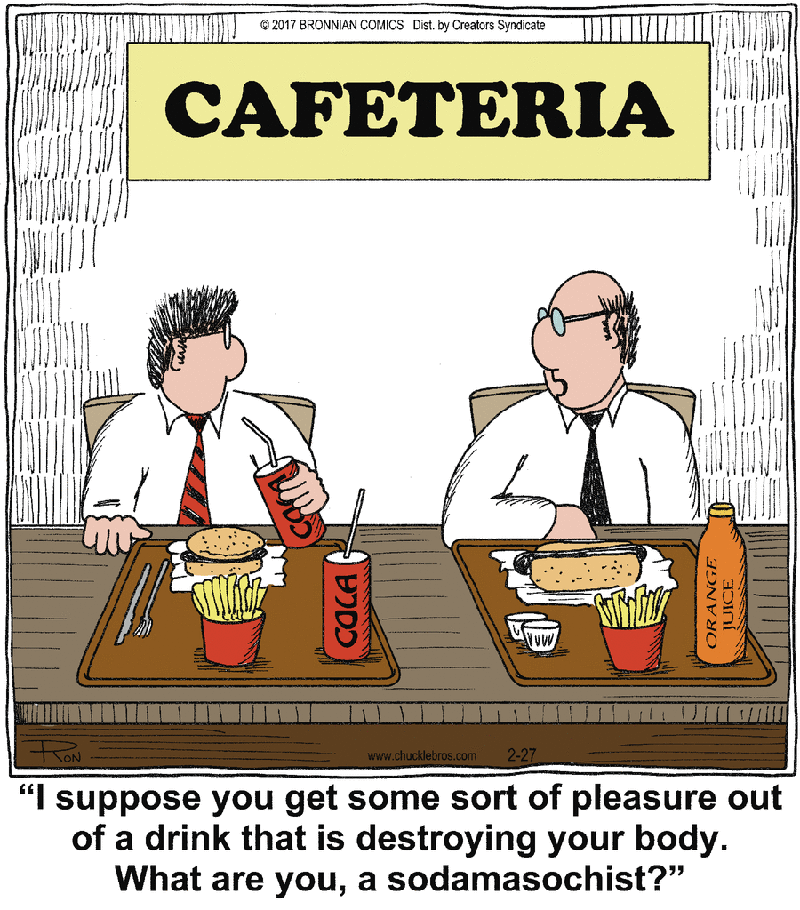
Posted by Jim Cassedy (Member # 4115) on 02-27-2017, 10:56 AM:
quote: Leo Enticknap
Mayor Kenney really let the cat out of the bag, didn't he?
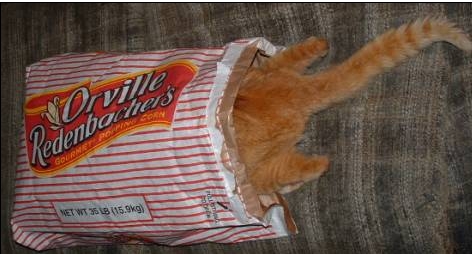
Apparently, not this cat, and not this bag.
("Albert The Cat" having a great time with an old O.R sack)
Posted by Jim Cassedy (Member # 4115) on 03-02-2017, 09:23 AM:
The next thing we can expect to get banned is plastic soda straws.
I saw a story on the news last night about a big push to do this
down in Southern California ( oddly enough, I haven't heard or read
anything about it happening here in San Francisco, where such
silliness usually starts) and a bit of quick 'google-ing' revealed that
such bans are already in effect in several American cities.
One article even suggests that if people want to use a straw, they
should carry their own reusable one around in their pockets.
Of course, if drinking straws ever got banned here in San Francisco,
I'm sure you'd be able to file for some sort of health-related exemption
claiming that you are afflicted with some rare condition that requires
you to drink through a straw.
The Dept Of Health would then issue you an exemption certificate to
carry in your wallet, right next to your phony "medical marijuana" ![[Roll Eyes]](rolleyes.gif) card.
card.
Posted by Bobby Henderson (Member # 840) on 03-02-2017, 10:02 AM:
As far as trash goes, how about those Walmart bags? Those things are blowing all over the landscape. Give it a few years and there will be a big push for people to buy reusable grocery bags.
Posted by Leo Enticknap (Member # 534) on 03-02-2017, 10:04 AM:
Last fall my wife made an impulse buy of a counter top hydroponic herb garden. The first reaction of almost every visitor to the house since then who has laid eyes on the thing has been to ask if we're growing pot in it.
Come to think of it, the invention of high power LED lighting has probably reduced the production cost of the stuff dramatically. In the past, illegal pot growing operations were often busted because they were hacking in to the power grid illegally and stealing a vast amount of electricity to floodlight the stuff. The power company would wonder where the sudden spike in demand was coming from, send guys to investigate, and that's how the pot grow would be discovered.
Posted by Frank Cox (Member # 6258) on 03-02-2017, 10:32 AM:
I've never understood why there are all of those plastic grocery bags blowing around. I use them for kitchen trash and it usually works out about even so I have enough for trash bags and not a giant pile of left-over bags.
I wouldn't be too happy if they banned those bags since I would then have to buy bags to put the kitchen trash into.
Posted by Mike Blakesley (Member # 26) on 03-05-2017, 12:28 AM:
quote: Jim Cassedy
Of course, if drinking straws ever got banned here in San Francisco, I'm sure you'd be able to file for some sort of health-related exemption claiming that you are afflicted with some rare condition that requires you to drink through a straw.
Actually, drinking through a straw is way better for your teeth than sipping from a bottle, can or cup/glass because the liquid tends to go straight down your throat rather than swishing around your teeth. My dentist told me that...he said, if you must drink sweet stuff, use a straw.
I'd be fine with paper straws, I guess...they already have brought them back at lots of places. Sea World in Florida uses them, or they did the last time we were there.
Posted by Daniel Schulz (Member # 1881) on 03-05-2017, 12:33 AM:
quote: Bobby Henderson
As far as trash goes, how about those Walmart bags? Those things are blowing all over the landscape. Give it a few years and there will be a big push for people to buy reusable grocery bags.
Already happened here in Southern California. I thought I'd be super annoyed, but it's really fine. Reusable bags encouraged, if you forgot yours or need more bags than will fit in your 1 or 2 reusables you can buy a bag for ten cents. Seems to have cut down on the empty-bags-blowing-around problem.
Posted by Leo Enticknap (Member # 534) on 03-05-2017, 10:25 AM:
My father-in-law is a dentist, and issues exactly the same advice. That was a little bit of an American culture adjustment for me, because where I grew up, abandoning drinking straws and drinking from a cup or glass directly was part of growing up, in the same way that learning to use a knife and fork is. On my first visit to the United States (in 2003), I was surprised to see adults using them. Maybe this is why Americans tend to have teeth in better shape than Brits!
As for supermarket carrier bags, I used them to empty the contents of the cat litter box into, and so the move to reusable ones is forcing us to buy trash bags for that purpose. So for my family at least, it hasn't reduced the use of plastic bags, just imposed a tax on them.
I suppose I could poop scoop the litter box straight into the outside garbage bin, but I don't like the hygiene implications of that, especially in the summer.
Posted by Lyle Romer (Member # 1266) on 03-05-2017, 11:39 AM:
quote: Leo Enticknap
As for supermarket carrier bags, I used them to empty the contents of the cat litter box into, and so the move to reusable ones is forcing us to buy trash bags for that purpose. So for my family at least, it hasn't reduced the use of plastic bags, just imposed a tax on them.
Similarly in my household, if they start this nanny state ban/charge in my area, I will end up using MORE plastic. Now, we use the bags from the grocery store for 90% of our garbage. If they start forcing me to use reusable bags at the grocery store, I'll have to start buying and using trash bags which are made from thicker plastic and tend to be larger than needed most of the time.
Posted by Bobby Henderson (Member # 840) on 03-05-2017, 03:55 PM:
A couple of the grocery stores in my area recycle the grocery bags. About every other trip or so to the store I'll drop off a bag filled with those things.
We have an ALDI store here in Lawton across the street from one of the Walmart locations. They charge for bags to encourage people to bring their own grocery bags or buy the more durable, reusable ALDI bags. It takes a little getting used to that as well as the shopping cart deposit.
quote: Mike Blakesley
Actually, drinking through a straw is way better for your teeth than sipping from a bottle, can or cup/glass because the liquid tends to go straight down your throat rather than swishing around your teeth. My dentist told me that...he said, if you must drink sweet stuff, use a straw.
I've heard conflicting evidence on this. Whether a person is sipping liquid from a glass or drawing it into the mouth from a straw the liquid is still going to make contact with the teeth to some degree as the liquid is positioned in the mouth to swallow. The important thing is to brush and floss regularly and limit the amount of sugary drinks and sweets in the diet.
Another point regarding drinking from a straw: don't drink from a straw following any kind of dental surgery, such as getting wisdom teeth extracted or work done on the gums. The suction that comes with using a straw can dislodge tissue that is trying to heal. That's really bad for wisdom teeth since it can lead to dry socket. Even following the dentist's advice I ended up with dry socket when my wisdom teeth were extracted; had it on both bottom left and right positions. Dry socket is excruciating.
Posted by Clint Koch (Member # 1179) on 03-05-2017, 04:22 PM:
Leo & Lyle,
We have a litter box and use the plastic bags we buy our vegetables in for that. No problem at all. Just need to buy (and eat) enough veggies.
Clint
Posted by Rex Oliver (Member # 7593) on 03-06-2017, 12:46 AM:
Bag and package problems-think the packaging isn't the problem-but the folks USING it or MISUSING it are the problems.I can't blame the bag or package-but the people that throw it into the landscape rather than their trash can or litter bag.Maybe its time to bring back the idea of litter bags for cars.Remember this from years ago.You would hang the bag on a radio knob or other knob on the dash and put your trash in it rather than throw it out the car window while driving.You simply emptied the litter bag when you got home or at your destination into a trash can.
Posted by Frank Cox (Member # 6258) on 03-06-2017, 12:55 AM:
My vehicle has pockets in the doors. I buy small paper lunch bags and put one of those in the pocket to fill up with any garbage generated during a trip.
Posted by Bobby Henderson (Member # 840) on 03-06-2017, 09:10 AM:
quote: Rex Oliver
Bag and package problems-think the packaging isn't the problem-but the folks USING it or MISUSING it are the problems.I can't blame the bag or package-but the people that throw it into the landscape rather than their trash can or litter bag.Maybe its time to bring back the idea of litter bags for cars.
I don't think very many people are simply tossing these small grocery bags out of a car window. What I've observed in my own town is people toss them in the garbage. But the wind can blow like crazy here in Oklahoma. If someone has their garbage can overflowing with trash it's nothing for the wind to catch any of those bags if they're loose at the top of the pile. Then there is the situation at the local land fill. The garbage trucks dump all that trash onto the garbage mountain South of town. They use bulldozers to smash and bury the trash. But a lot of those Walmart bags take flight in the wind before they can be buried. They just go blowing all over the damned place.
Posted by Kenneth Wuepper (Member # 1174) on 03-06-2017, 09:30 PM:
There is a group of ladies here that take those bags, slit them into strips and knit the strips into mats. These mats are distributed to the homeless where they use them for sleeping and covering themselves. Since the mats are plastic, they are waterproof and can be shaken clean after use on the ground.
Some bags are different colors so the ladies have found ways to incorporate those strips into patterns making the mats distinguishable from each other.
This is a really useful purpose for the used bags.
Posted by Rex Oliver (Member # 7593) on 03-07-2017, 02:30 AM:
Another problem about the bags and other trash is trash falling off or out of vehicles besides garbage trucks.Out here in my area the roadside trash gets shredded by the roadside mowers-making even more of a mess.Besides WalMart bags-see bags blowing around from Food Lion,Ice bags from ice vending machines and so on.The mower drivers don't have litter containers on their tractors-so--- they just run over the trash and grind it up-pieces of it blow around.My house is on a through street-I have had to pick up other folks trash and haul it to the dump.One time spotted a stalled roadside flail mower-several T-shirt bags stuck in its blades.The unit blew a hydraulic hose and the operator waiting for a tech to replace it.
Posted by Tim Androes (Member # 9010) on 03-07-2017, 02:04 PM:
Both Seattle and the state of Washington are considering a 2-cent an ounce tax on sugar sodas. Mayor Murray, Governor Inslee: ![[fu]](graemlins/fu.gif)
![[bs]](graemlins/bs.gif)
![[puke]](graemlins/puke.gif)
![[thumbsdown]](graemlins/thumbsdown.gif)
Posted by Jack Ondracek (Member # 1466) on 03-07-2017, 03:20 PM:
quote: Tim Androes
Both Seattle and the state of Washington are considering a 2-cent an ounce tax on sugar sodas.
I found articles about Murray, but nothing about the Gov...
Actually, Washington State has had a beverage tax for years. They charge $1 per gallon of syrup, which works out to about .65 cent per delivered ounce. Curiously, merchants can deduct this amount from their sales tax returns, meaning the State only makes money if the merchants charge more for the finished drink. That creates additional gross revenue, which generates additional sales tax, which the State does get.
You're right about Seattle though. If Murray does get a tax put in, merchants there will be paying two taxes on sodas, sugary or not.
Posted by Tim Androes (Member # 9010) on 03-07-2017, 11:24 PM:
Jack...I don't think it's Inslee specifically but a news item on the radio said that Olympia was considering the tax and maybe Seattle would cancel theirs if there was a statewide tax. I'm usually listening to KOMO am so that's probably where i heard it.
Posted by Jonathan M. Crist (Member # 413) on 03-21-2017, 06:24 PM:
The spread of the Soda Tax continues:
It is going into effect in Cook County Illinois (including Chicago) in July. They are not even pretending to fund early childhood education but admit it will be used to plug a budget deficit.
It is also on the ballot (at 2 cents per ounce) on May 2, 2017 for Santa Fe, New Mexico.
Posted by Mike Blakesley (Member # 26) on 03-21-2017, 08:17 PM:
There ought to be some kind of an adjustment for places that sell sodas in cups with ice - you're paying tax on half a cup of ice.
Powered by Infopop Corporation
UBB.classicTM
6.3.1.2