This is topic 1910 American Fotoplayer in forum Film-Yak at Film-Tech Forum ARCHIVE.
To visit this topic, use this URL:
https://ft-forum.com/ft/cgi-bin/ubb/ultimatebb.cgi?ubb=get_topic;f=8;t=007522
Posted by Frank Cox (Member # 6258) on 07-26-2017, 12:42 PM:
Joe Rinaudo Discusses the American Fotoplayer
Playing a Disney cartoon soundtrack
What a cool gadget. It was designed to provide music for silent movies.
As the narrator says, the operator was kept pretty busy while the shows were on.
Posted by James Biggins (Member # 8574) on 07-26-2017, 01:44 PM:
Fascinating stuff. Old tech rules!
Thanks for that Frank.
Posted by Bill Brandenstein (Member # 7758) on 07-26-2017, 03:34 PM:
Fantastic stuff. Never met him, but Joe Rinaudo projects silent shows with organ accompaniment at the fantastic Nethercutt Collection near us in Sylmar. Apparently has enough 35mm safety prints of vintage silents to do this on a hand-crank projector. Maybe someday I'll score some very competitive free tickets!
Thanks for posting, Frank!
Posted by Martin McCaffery (Member # 37) on 08-07-2017, 10:09 PM:
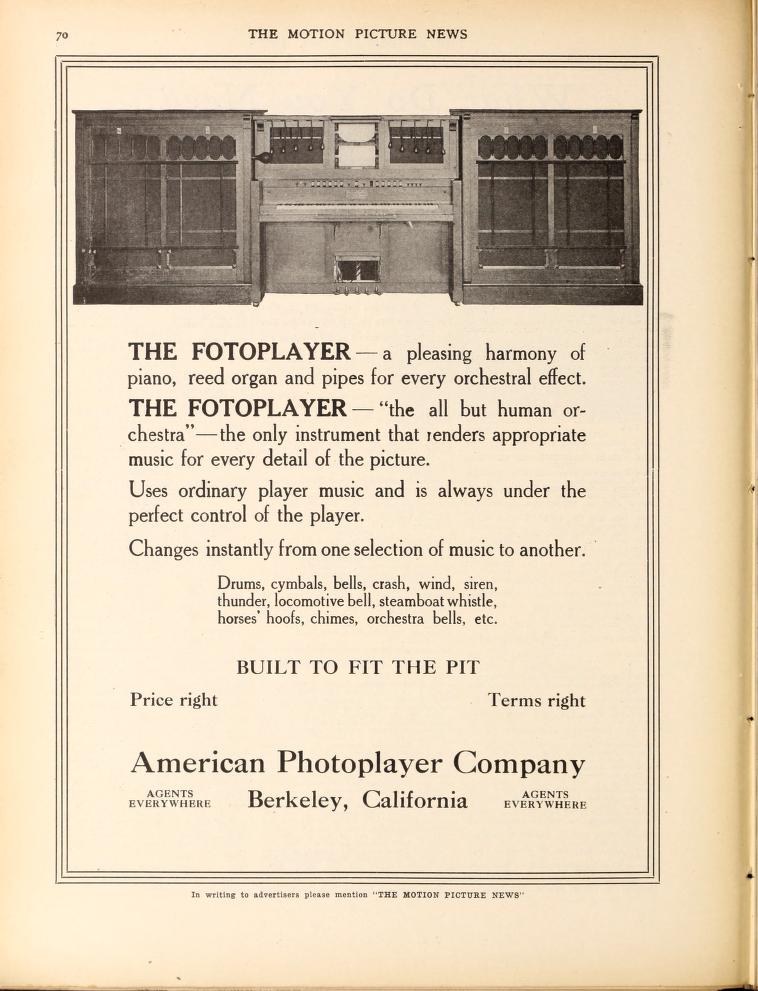
1914 Ad
Motion Picture News
May 16, 1914
Posted by Rex Oliver (Member # 7593) on 08-07-2017, 11:56 PM:
YES!!!!Bring the FotoPlayer BACK!!!Would make watching movies more fun!-instead of the Droll music that is on now.The FotoPlayer just could be the forerunner of the music Synthesizer!And this device used REAL musical instruments for the effects-and do watch Joe Renauldos videos on this-a wonderful musical instrument!
Posted by Martin McCaffery (Member # 37) on 08-13-2017, 09:20 PM:
Renaldo says the person playing the Fotoplayer had to know the film and create his own cue sheets. I wonder if that was true in practice. If these started being used in 1910, theaters ran mostly 1 reel (10min) movies and changed, at minimum, 3 times a week; daily was not unusual. The theatre would be running all day, I can't imagine any time to watch the films and create cue sheets. I bet cheat sheets were passed around with the films, and the performers got really good at improvising.
I'll have to keep an eye out for more info. Must have been a high stress job with fascinating results.
Posted by Leo Enticknap (Member # 534) on 08-13-2017, 11:04 PM:
By the late teens, full scale scores were being distributed with prints; for prestige movies, both piano solo versions and orchestral parts were available. They were annotated with precise tempo markings. Some of them also included references to intertitles in the movie, to help the performer or conductor "sync" the performance to the projection of the movie. The controversy in the 1980s over whether The Birth of a Nation was really intended to be projected as slowly as 12fps in some scenes was basically settled by reference to the tempo markings in Carl Joseph Breil's score. If the music were played obeying the tempo indications and the contentious scenes projected as slowly as some were advocating, the film would have run for about 20 minutes longer than the music that was written to go with it.
But going back to the topic, the Fotoplayer is clearly a much more complex instrument to operate than a regular pianola, even though it's based on that core technology.
Posted by Kenneth Wuepper (Member # 1174) on 08-14-2017, 12:50 PM:
I believe that watching the player in the pit might have been more entertaining than the film.
It is obvious that there needed to be more holes in the player roll to activate the various additional things besides the musical notes.
The "fair grounds organ" would have been a better starting technology than the player piano.
Even a four manual theatre pipe organ required less dexterity than this Fotoplayer device.
Posted by Frank Cox (Member # 6258) on 08-14-2017, 02:20 PM:
The ad says that it uses "ordinary player music", and what I can see in the video shows the operator doing the work of playing everything himself except the piano.
There's certainly a lot of cord pulling and pedal stomping and button pushing going on there.
Posted by Dave Bird (Member # 490) on 08-14-2017, 04:16 PM:
Watched a couple other videos with this guy.....boy, the way he "mixes" those reels while doing all those "effects", if those weren't the first true "DJ's" (in the current use of the word), then who was?
Posted by Leo Enticknap (Member # 534) on 08-15-2017, 10:24 PM:
quote: Kenneth Wuepper
It is obvious that there needed to be more holes in the player roll to activate the various additional things besides the musical notes.
As Dave points out, it appears from the videos that the audio effects devices were operated manually, while pumping the rolls by foot. One of the adverts for it states that it can use the industry standard format pianola rolls. The reproducing piano roll data format included the ability to encode dynamics (changes of tempo, how hard each note was struck, use of the pedals, etc.) as well as the raw note data, and so theoretically, if there was a proprietary Fotoplayer roll format, it could have included "automation cues" to activate the effects devices. But I couldn't see that happening in the videos.
Posted by Frank Angel (Member # 248) on 08-15-2017, 11:47 PM:
I wonder if projectionists who had worked with silent film and were used to a pianist playing a piano or the more elaborate Fotoplayer or orchestral accompaniment in the big houses, whether when sound was added, if they were pretty negative about it. I am sure they immediately heard the sound from those first va soundtracks with their awful 10% harmonic distortion and thought the music from the Fotoplayer and certainly from a live orchestra, and though it was decidedly a big step backward, not forward. I wonder if they lamented the move to the new technology and the loss of the much more exciting sound of live instruments, like many of us took one look at the first 1.3k digital projection and grabbed for the barf bags.
Posted by Leo Enticknap (Member # 534) on 08-16-2017, 08:18 AM:
When recorded sound with movies first began to look like a serious possibility in the early 1920s, the immediate potential that was seen for it was in reducing the cost of playing music in the theater, not in adding synchronized dialogue. The De Forest Phonofilms and Vitaphone shorts were nearly all heavily musical, and the few that did have dialogue (independent of song lyrics) were made mainly towards the end of the decade. When sound features came along, Don Juan and Sunrise had no dialogue at all, and The Jazz Singer only one line.
I do wonder, therefore, if you're right and that the emergence of "talkies" wasn't so much because Hollywood visionaries stumbled across this wonderful application for their new invention, but rather because the recorded music sounded so bad (compared to live, or mechanized performance using live instruments, such as with the Fotoplayer), that Warners and Fox were faced with having to figure out what the hell else they could do with the new toy they'd sunk millions into, or writing down a humongous loss. The audio quality isn't as important for the spoken word (as long as you can understand what the speaker is saying, it works), and so gradually the spoken word overtook music as the main application for synchronized recorded sound with movies.
As recorded sound got better, music became a more important part of movies again. With the possible exception of King Kong (and even that music was mainly copied and pasted from c19 classical staples) and a few Soviet propaganda movies with music by Shostakovitch and Prokofiev, I can't think of any really memorable film scores written for recorded sound movies from before the late 1930s. But I can't help wondering if the quality of sound recording and reproduction in movies was a much bigger influence in the development of film music than most if not all historians working in that area have been willing to explore.
Posted by Martin McCaffery (Member # 37) on 08-16-2017, 09:22 AM:
When sound started coming in and the "orchestras" were getting moved out there was serious conflicts with the unions. Yes, even here in Alabama, the musicians were unionized and they didn't mess around. There were a couple of bombings in Birmingham (of course) - what Variety referred to as "pineapple parties." Mostly stink bombs, but still direct action.
Not sure how big these "orchestras" were (I've got several sources at about 8 men), but taken nationwide, there were a lot of musicians who lost what were good paying steady jobs with the advent of sound.
Posted by Richard P. May (Member # 3598) on 08-16-2017, 09:37 AM:
It is interesting that this comes up at the moment. Just three weeks ago, on July 25th, the Hollywood Section of SMPTE held their evening meeting at the Academy's Linwood Dunn Theater, and featured a performance by Joe Rinaudo on the FotoPlayer installed in the lobby.
The main subject of the program was stereo sound in the 1950s, but before the film portion, Joe gave a 35 minute live performance on the FotoPlayer. Since this device is far from portable, it was necessary to set up a video and audio feed from the lobby to the projection booth so he could be seen and heard on screen.
We had an audience of about 150 people, who thoroughly enjoyed the evening. Several of his performances can be viewed on YouTube by putting in either his name, or American FotoPlayer. There is also a 30 minute program he did with the late Huell Howser for local television, with an explanation of the machine.
Watching it in action is pretty amazing. It's not only a player piano, but needs the operator to play sound effects, change player rolls, operate foot pedals, etc. Whew!!
Posted by Frank Angel (Member # 248) on 08-16-2017, 11:13 AM:
An coincidentally, a wonderful man, Stuart Oderman, silent movie pianist just passed away. I worked with Stuart at the Brooklyn Museum when we were still running 35 and a silent series curated by silent film maven Ken Gordon who moved the series to the NY Public Library where he with Stuart have been running it for over a decade.
Stuart started when he was 14 yrs and perfected his craft to the point where he was sought after by venues running silent films, including Lilian Gish who had taken him under her wing as a young man. "Silent Films" was a term he once told me he thought was absurd because while films had no soundtracks, they were rarely if ever shown "silently." They always had accompaniment.
The first time I met Stuart, he had already been seated at the piano and I was having the lights adjusted so as to get as little light bounce as possible on the screen, but still have the audience be able to see him. With that small amount of illumination on him, I thought to ask if he wanted a clip light on the piano so he could read his music. He kind of chuckled and said, no, he didn't need a music light. Ken told me he never used sheet music -- he had a library of music melodies and riffs in his brain that he could call up at will to match the action as well as the mood of the scene. He also knew every existing silent film pretty much backwards and forwards; his playing was so precise that you would think the piano music was a soundtrack on the film itself. As I ran those films, listening to his performance over the booth monitor, I was always in awe.
These guys were extraordinary talents.
Posted by Leo Enticknap (Member # 534) on 08-16-2017, 01:46 PM:
I know of only one film that was actually intended by its maker to be viewed in complete silence - The Passion of Joan of Arc. A few years ago, someone sent me a link to the handiwork of someone who decided to defy Carl Theodor Dreyer's artistic vision in a pretty spectacular way, and put Light My Fire by The Doors over the final scene. I've never been able to take the movie seriously since.
Powered by Infopop Corporation
UBB.classicTM
6.3.1.2