This is topic Keeping Film Alive in forum Film-Yak at Film-Tech Forum ARCHIVE.
To visit this topic, use this URL:
https://ft-forum.com/ft/cgi-bin/ubb/ultimatebb.cgi?ubb=get_topic;f=8;t=007539
Posted by Victor Liorentas (Member # 5272) on 09-01-2017, 03:21 PM:
http://www.newstatesman.com/culture/film/2017/08/can-celluloid-lovers-christopher-nolan-stop-digital-only-future-film
Can celluloid lovers like Christopher Nolan stop a digital-only future for film?
Despite proponents like the Dunkirk director, physical film is finding it tough in the modern age.
By Daniel Curtis
Sign up for our weekly email *
“Chris Nolan is one of the few producing and directing films right now who could open that film. He is one of the all-time great filmmakers.”
No prizes for guessing which new release Vue CEO Tim Richards is talking about. Aside from its box office success, aside from its filmmaking craft, aside even from its early reception as an Oscar favourite, Dunkirk sees Nolan doing what Nolan does best: he has used his latest film to reopen the debate about celluloid.
Until relatively recently all film was projected from that old, classic medium of the film reel - a spool of celluloid run in front of a projector bulb throwing images on to a screen. It comes mainly in two forms: 35mm (standard theatrical presentations) or 70mm (larger, more detailed presentations most popular in the 60s and 70s). Fans say it provides a “warmer” colour palette, with more depth and saturation than modern digital formats.
But now it’s hard to even see movies on film to make the comparison. After George Lucas, godfather of the Star Wars franchise, shot Star Wars Episode II: Attack of the Clones entirely in digital rather than on physical film, the rollout of digital progressed with clinical efficacy. Within ten years, film was almost wiped out, deemed to be impractical and irrelevant. Modern cinema, it was argued, could be stored in a hard drive.
Christopher Nolan set out to change all that. He championed film as a medium against the industry trend, producing (The Dark Knight, The Dark Knight Rises, Interstellar) in super-detailed, super-sized IMAX 70mm. With Dunkirk, Nolan has taken that further by screening the film in 35mm, 70mm and IMAX 70mm.
Nolan is not the medium's only poster boy – it is symbolic that the new Star Wars trilogy, 15 years on from Attack’s groundbreaking digital filming, is now being shot on film once more. This summer, Dunkirk may well be seeing the biggest rollout of a 70mm presentation in cinemas for 25 years, but in 2015 Quentin Tarantino’s The Hateful Eight saw chains and independent cinemas having to retrofit 21st Century cinemas for a 20th Century presentation style. It was a difficult process, with only a handful of screens able to show the film as Tarantino intended – but it was a start.
Today, celluloid is, ostensibly, looking healthier. A recent deal struck between Hollywood big wigs and Kodak has helped. Kodak will now supply celluloid to Twentieth Century Fox, Disney, Warner Bros., Universal, Paramount and Sony. It’s a deal which is not only helping keep Kodak afloat, but also film alive.
Kodak has also gone a step further, launching an app to help audiences find 35mm screenings in local cinemas. Called ‘Reel Film’, it endeavours to back Nolan and co in ensuring that celluloid is still a viable method of film projection in the 21st century.
Even so, whether Nolan’s film fightback has actually had any impact is unclear. Independent cinemas still screen in film, and certainly Vue and Odeon both have film projectors in some of their flagship screens, but digital dominates. Meanwhile, key creatives are pushing hard for a digital future: Peter Jackson, James Cameron and the creative teams at Marvel are all pioneering in digital fields. Whether or not film can survive after over a decade of effacement is a difficult – and surpisingly emotionally charged – question.
****
Paul Vickery, Head of Programming at the Prince Charles Cinema in London, is the kind of person you might expect to talk all about how physical film is a beautiful medium, key for preserving the history of cinema. History, he tells me, is important to the Prince Charles, but it's a surprise when he says film is actually more practical for their operation. Because not every film they screen has been digitised, access to old reels is essential for their business.
“If you completely remove film as an option for presentation as a cinema that shows older films,” he says, “you effectively cut 75 per cent of the films that you could possibly show out of your options, and you can only focus on those that have been digitised.”
Vickery says the debate around film and digital often neglects the practicality of film. “It's always focusing on the idea of the romance of seeing films on film, but as much as it is that, it's also to have more options, to present more films. You need to be able to show them from all formats.”
That’s a key part of what makes the Prince Charles Cinema special. Sitting in London's movie-premier hub Leicester Square, the Prince Charles is renowned for its celluloid presentations of older films and has made a successful business out of its 35mm and 70mm screenings of both classics and niche films. They're currently running the Check the Gate festival, which is, in their words "a celebration of films presented from film".
“If there is the option to show film and digital, we tend to take film as the option because it's also something you can't replicate at home,” he explains. “It's also just the nature of how film is seen on screen: its image clarity, its colour palette, the sound is just something that's very different to digital, and I think that's something that's very worth saving.
“Not many people have 35mm projectors at home. If you have it on Blu-Ray or DVD, to see it on film is a way of dragging someone out from their house to come and see it at the cinema.”
Currently screening is Stanley Kubrick’s 1968 epic 2001: A Space Odyssey in 70mm. It’s an incredible presentation of what Vickery says is a seven or eight year-old print struck from the film’s original negatives: the colour of the picture is far richer, while the fine detail in some close-up shots is on par with modern movies. Even more impressive, though, is that the screening is packed. “Fifteen years ago, there would be cinemas where that would be almost on a circuit,” laments Vickery. “We've just stayed the course, and that's something that's just fallen away and we're one of the last, along with the BFI, to show films from film.
“There’s still a bit kicking around, but as we do more and more of it, we seem to be pulling out those people who are looking for that and they seem to be coming back again and again. The repertory side of our programme is more popular than ever.”
That popularity is seemingly reflected in its audiences’ passion for celluloid. Vickery tells me that the PCC’s suggestions board and social media are always filled with requests for film screenings, with specific questions about the way it’s being projected.
For Vickery, it’s a mark of pride. “It sounds like inflated ego almost,” he begins, as if providing a disclaimer, “but it's why I think the work we do and the BFI do and any cinema that shows films from film is about history. By us continuing to show film on film, studios will continue to make their film print available and keep them going out. If people stop showing films on film, they'd just get rid of them.
“Once they're all gone, the only way we're ever gonna be able to see them is if they're taking these films and digitising them, which as you imagine, is always going to be the classic set of films, and then there'll be very select ones will get picked, but it's not gonna be every film.
“You have to keep showing films from film to keep the history of cinema alive in cinemas.”
****
History is something that the BFI is committed to preserving. 40 per cent of their annual programming is projected on celluloid, and they loan around 200 prints to venues each year. Their new “BFI 2022” initiative will produce 100 new film prints in the next five years.
Most recently they have focussed on safeguarding their archive, the BFI’s creative director Heather Stewart tells me when we meet her in her office in the BFI’s artsy offices just off Tottenham Court Road.
“We got money from the government to renew our storage which was a big deal because the national collection really wasn't safe,” she says “There was work at risk because it was warm and humid and we have bought a fantastic, sub-zero state of the art storage facility in Warwickshire in our big site there and our negatives are there. So our master materials are all in there safe - all the nitrate negatives and all that. In 200 years, people will be able to come back and make materials from those, whether digitising or analogue.”
Stewart tells me that it’s important to do both: “Do we at the BFI think that audiences need to see films in the way the filmmaker intended? Yes. That's not going away - that's what we're here for. Do we want as many audiences as possible to see the film? Yes. So of course we're interested in digital.”
The restoration and printing project is attracting lots of “international interest” according to Stewart: just one example is that the BFI are looking into partnering with Warner Bros in their labs in Burbank, California.
“We're becoming the only place left that actually loans film prints around the world so that you can see the films the way they were intended,” she says. “So if you don't have any kind of renewal programme, you'll eventually just have blanked out, scratchy old prints and you can't see them."
They're getting financial support too, she says: “There are people like Christopher Nolan, Quentin Tarantino, Paul Thomas Anderson [director of Oscar-winner There Will Be Blood whose 2012 film The Master was shot and screened in 70mm], a lot of people who are very committed to film, and so there's conversations going on elsewhere and with the film foundation about bringing other investments in so we can really go for it and have a fantastic collection of great great 35mm prints for audiences to look at.”
As a fan of the film reel, Stewart is passionate about this. I put to her the common suggestion that lay audiences can’t tell the difference between screening on film, and digital. “I don't agree with that", she says. "If you sit with people and look at it, they feel something that you might not be able to articulate.
“It's the realism the film gives you - that organic thing, the light going through the film is not the same as the binary of 0s and 1s. It's a different sensation. Which isn't to say that digital is 'lesser than', but it's a different effect. People know. They feel it in their bodies, the excitement becomes more real. There's that pleasure of film, of course but I don't want to be too geeky about it.”
Yet not every film print available is in good condition. “There's a live discussion,” says Stewart. “Is it better to show a scratched 35mm print of some great film, or a really excellent digital transfer?”
There’s no neat answer.
But Stewart is certainly driven by the idea of presenting films as closely as possible to the filmmakers’ true vision. “If you're interested in the artwork,” she explains, “that's what the artwork has to look like, and digital will be an approximation of that. If you spend a lot of money, and I mean really a lot of money, it can be an excellent approximation of that. But lots of digital transfers are not great - they're cheap. They're fine, but they're never going to be like the original.”
The process of restoration doesn’t end with digitisation. Keeping film copies in order to have originals is hugely important given how quickly digital media change. Film is a constant form of storage which does not alter. As Stewart defiantly puts it, “all archives worldwide are on the same page and the plan is to continue looking after analogue, so it ain't going anywhere.”
****
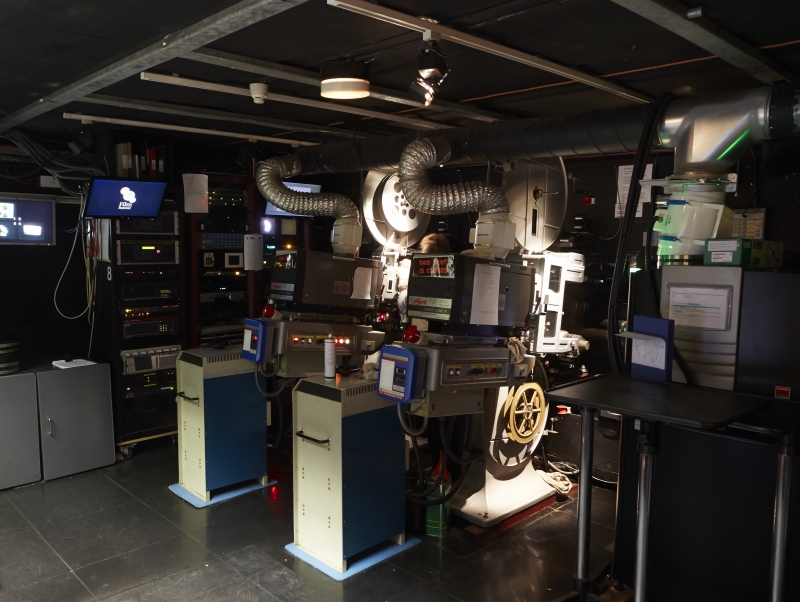
The BFI were kind enough put on a display of how film projection works in practice. Tina McFarling, Media Advisor, and Dominic Simmons, Head of Technical, provide a tour of two screens at BFI Southbank. Chatting in the projection room above the screen which hosted the 70mm première of Dunkirk, their passion for celluloid was on display.
Standing next to two mammoth 70mm projectors, Simmons talks through the real-terms use of film, and the technical expertise behind it. “It's a lot more labour intensive than sticking digital prints on, but it's something we want to do,” he says.
One of the projection booths at the BFI
During the visit, the team are prepping a rare 35mm screening of the documentary I Am Cuba to be shown that afternoon. Simmons says that operating a celluloid projector is a “more complex operation” than digital. Looking at the endless labyrinth of film and sprockets, it's easy to believe.
“If you're screening from film in a cinema,” he says, “then you need engineers, technicians who are capable of doing it, whereas a lot of multiplexes have deskilled their operation.”
Simmons says that, while larger chains have one engineer to oversee every screen with the actual process of running the films centralised with a centre loading playlists, the BFI has twenty-two technicians, each closely overseeing the projection of a film when on duty.
“There's so much about the different elements of the presentation that you need to know that all comes together with the sound, the lighting and the rest of it.
“When you're starting a film, it's more of a manual operation. Someone needs to be there to press the buttons at the right time, manage the sound, operate the curtains, and attach the trailers to the feature.”
Having skilled operators is all very well, but of course you need to have the equipment to operate in the first place. “We have to make sure that the equipment is kept and utilised as well as making sure the prints are available, and then the skills will follow”, he says.
Simmons says many are likening the film fight back to vinyl’s resurrection, but has a rueful smile when he talks about film being described as “hipsterish” and “boutiquey”.
He also points out that the quaint touches that make film attractive to this new, younger audience – blemishes, the occasional scratch – are a headache for projectionists. “For me,” he says, “that's quite difficult because a bad print of a film is never a good thing, but if it's a bad print of a film that can't be seen any other way...” He trails off sadly.
The threat of damage to film prints is constant, he says. “Every time you run a film print through a projector there is some element of damage done to it. You're running it over sprockets at loads of feet per second.”
He switches a nearby projector on – it’s loud, quick and, after leaning in to look more closely, it’s easy to see that it’s violent. “It's a really physical process,” Simmons continues. “The film is starting and stopping 24 times a second.”
The idea that shooting on film, for which the very raw material is in short and ever-decreasing supply, is endangered is a tragic one. “There's a finite amount,” Simmons says. “People aren't striking new prints, so if you damage a print, the damage is there forever.”
****
The Prince Charles and the BFI are in a privileged position to protect endangered film stock. A friendly partnership between them, which sees the BFI lending reels to the Prince Charles, as well as benefitting from the business of London’s rabidly cinephile audience, allow them to prioritise screening on film the majority of the time. Not every cinema is so lucky.
While the historic Ultimate Picture Palace in Oxford does have a 35mm projector, owner Becky Hallsmith says that it’s mainly the digital projector in use “for all sorts of logistic reasons”.
Though Dunkirk’s push for film projection was a welcome one, it still didn’t make sense for the UPP to screen it. “Certainly we thought about it, but I felt that if you're going to see it on celluloid, you probably want to see it on 70mm, so we decided not to get it on 35mm.”
Economic factors come into effect here too – the UPP, based just out of the city centre in Cowley, vies for Oxford’s filmgoers’ love with the Phoenix Picturehouse in nearby Jericho. While they do have slightly different markets, Hallsmith was aware that the Picturehouse was already set to screen Dunkirk in 35mm, leading her to decide not to.
“It's not like I'm saying we never do it” she clarifies. “But there are reasons I haven't this time.”
Hallsmith was also aware that not all of her projectionists are trained in screening film, saying that, by screening Dunkirk in digital, she was “taking that little headache out of the equation”.
For the UPP, practicality of this kind trumps sentiment, given the cinema’s small operation. “I'd love it if I had the time to work out what films had beautiful 35mm prints and programme accordingly,” she says, “but I just don't have the time to put that amount of thought into details of programming. We're tiny. I'm doing all sorts of different jobs around the cinema as well. The programming is by no means the least important - it's the most important part of the job - but there is a limit to how much one can do and how much research one can do.”
Despite the practical issues related to 35mm, Hallsmith is still glad to have the option available, saying that when the digital projector was installed in 2012, there was enough room for the installation to account for the 35mm one – and to revamp it.
Despite many 35mm projectors being sent to an unceremonious death in skips, some projectors that are replaced for digital successors are cannibalised for parts. Hallsmith was a beneficiary. “Most of the bits on our 35mm projector are quite new,” she explains, “because they had all this stuff that they were taking out of other cinemas, so they upgraded our 35mm for us because they had all the parts to do it with.”
But Hallsmith is grounded when I ask her if having both projectors in operation is important. “It's important for me,” she laughs. “One of my real pleasures in life is to sit at the back near the projection room and to hear the film going through the sprocket. It's one of the most magical sounds in the world and always will be for me.
“But I know that for a lot of our customers, it is neither here nor there, so I have mixed feelings about it. It's not like I think everything should be on 35mm. I love it, but I can see the practicalities.”
****
It is certainly practicality that’s governing cinema chains. Cineworld, Odeon and Vue have all seen huge expansions in recent years. Vue chief Tim Richards, says celluloid is a “niche product”, but the admission is tinged with sadness.
“The problem that we had,” he says about the 70mm screenings of Dunkirk, “with the conversion to digital that happened globally, there are literally no projectors left anywhere, and it's very, very hard to get one. We managed to find a projector and then we couldn't find anybody who actually knew how to run it. There are very real practical issues with the medium.
“To reinforce that we have a new look and feel to our head office, and I really wanted to have an old analogue 35mm projector in our reception and we couldn't find one. We had thousands of these things, and we had none left. We couldn't even get one for our reception!”
Even with a working projector and a trained projectionist, Richards says the format has “very obvious issues” with mass consumption. Again on the subject of Dunkirk, this time in 35mm, he says, “One of the prints that arrived was scratched. It's something that's been in the industry for a long time. If you have a big scratch, you simply can't screen it. You've got to get another print, especially when it will run through part of the film.”
It’s something that saddens Richards, who still says that projecting on film forms part of the “philosophy” of Vue. “We’re all big supporters [of film] and we love it. We've all been in the industry for between 25 and 30 years, the whole senior team. We genuinely love what we do, we genuinely love movies.”
That said, Richards, who is a governor of the BFI, is firmly committed to refining digital, more practical for Vue’s multiplexes. “If you go down and look at what we opened up in Leicester Square, our new flagship site, it's a 100 year old building where we shoehorned in new technology so it's not perfect, but it gives you an idea of what we're doing."
The new site has two Sony Finity 4K resolution projectors working in tandem – as well as the brand new Dolby Atmos sound system. The dual projection gives the screen a brighter, deeper hue. From a digital perspective, it is bleeding edge, and the set up is being rolled out across the UK and Germany, with 44 sites and counting. Richards is, as you would expect, enamoured with the results, claiming “that screen stands up to anything in the world”. What might be more surprising are the reactions he claims that it has elicited from celluloid devotees.
“There were a lot of old hardcore film fans there who were pleasantly surprised at the quality” he says. “People think of digital as being that new, TV-at-home which has got that clinical feel to it, and they don't feel it's got that warmth and colour saturation. This [Finity presentation] has that warmth of an old 35mm or 70mm, so I don't think the future is going back.”
****
For Richards and Vue, the future appears to be as bright as that 4K Sony Finity screen in Leicester Square - for celluloid, not so much. While the appetite for watching movies on film might be growing at a promising rate for indie exhibitors, the list of technical and logistical problems is still insurmountable for many smaller venues - saying nothing of the race against time to preserve easily-damaged prints.
The main concern is an ephemeral one: the preservation of the knowledge needed to run a film projection. When the BFI’s Dominic Simmons speaks about the skills of his team and the need to pass those skills on, it evokes near forgotten skills such as thatching and forging. If the BFI and the PCC have anything to say about it, those projection skills will live on, but it’s unclear how far their voices can carry in a digital multiplex age.
As for the voice of celluloid-lover-supreme Christopher Nolan, even he too is shouting down what seems to be an unstoppable march towards a convenient digital future. But in a groundswell of growing interest and passion for the film reel, it seems that a director so obsessed with playing with time in his films seems to have bought exactly that for celluloid. Time is running out on the film reel, but there might be more of it left than we thought.
Posted by Alexandre Pereira (Member # 9295) on 09-01-2017, 06:21 PM:
Here comes the old preciousness of film story combined with the complexities of running film gag.
Of course in the world of propaganda as information supplanting analysis this is the kind of article that we get. Passing off as informative and critical all the while nothing more than obfuscation and cover for the real motives.
The memory hole has quickly sucked up the fact that less than a decade back the vast majority of multiplexes all ran film - automated on platters with only threading required.
But we know this - exhibition worked fine as an industrial automated process with analog film.
However, completely undocumented here are the real reasons for digital - encryption keys as yet another form of distributor control over the medium. Specifically as a tool to extract and maintain payment from exhibitors and ultimately as a means to tighten even further the oligarchical control of mass media. That process continues.
Posted by Mike Blakesley (Member # 26) on 09-01-2017, 06:57 PM:
quote: Alexandre Pereira
a tool to extract and maintain payment from exhibitors
The keys have nothing to do with the 'payments,' they just make sure you don't run the movie when you're not supposed to. Nothing wrong with that, unless of course you're one of the people who thinks all "art" should be free, boneheaded as that concept is.
Digital offered an opportunity to reduce the number of freebie showings and the distributors took it. You really can't blame them for that one.
Posted by Alexandre Pereira (Member # 9295) on 09-01-2017, 07:10 PM:
Really keys have nothing to do with payment?...So they have everything to do with avoiding piracy? As in piracy of piratebay where you cannot find any of the recent releases?
Try not paying on a seven day pay on a new release and then hold your breath for next week's key.
Of course keys have everything to do with payment - and the caveat that art should be free is disingenuous considering that we are not on filmtechtorrent.
Speaking of fair - where was the gain for exhibitors in moving to digital?...Maybe in spending all that money on digital and subsequent upkeep and upgrade. Or perhaps the savings was for the distributors who got a whopping discount from Deluxe for distribution of drives and creation of keys minus film. Oh wait that happened a lot.
Posted by Frank Cox (Member # 6258) on 09-01-2017, 07:27 PM:
How about not doing that. If you book a movie with a 7 day payment required, pay up within seven days and you won't have any problems.
Personally I'm one of those nut-heads who hates owing people money so I try to pay for my movies on Friday after the Thursday night show, or Monday at the latest depending how long it takes someone to tell me how much they want me to send in.
The keys haven't changed anything in regard to payment -- I used to occasionally be told hold a print of some movie here when I was finished with it instead of sending it another theatre, and then a few days later I would be told to send it on after they paid what they owed for previous movies.
Posted by Mike Blakesley (Member # 26) on 09-01-2017, 08:03 PM:
quote: Alexandre Pereira
Really keys have nothing to do with payment?...So they have everything to do with avoiding piracy? As in piracy of piratebay where you cannot find any of the recent releases?
Try not paying on a seven day pay on a new release and then hold your breath for next week's key.
Same thing happened with film.... if you didn't pay, you didn't get the next movie from that studio. Or, in severe enough cases, they would send a guy to pick up the print from you. The keys are maybe 5% about payment and 95% about piracy or unauthorized shows.
quote: Alexandre Pereira
Speaking of fair - where was the gain for exhibitors in moving to digital?...Maybe in spending all that money on digital and subsequent upkeep and upgrade.
Hmm let's see...not having to deal with damaged film, access to all the trailers we ever need, shipping is less than 1/3 the cost of film, reduced projection booth wages, easy to move a movie from one auditorium to another, no backbreaking huge boxes or cans to carry up/down stairs, easy 3-D capability, improved sound, automation cues easier to set up, less maintenance, shows can be programmed in advance with no threading required, being able to tweak and adjust the trailer pack on the fly, being able to stop the movie easily if nobody shows up, being able to do really cool things for customers like show them the first 10 minutes of a movie they missed, old movies being available in "good" condition again, and so on. (I realize there are a few things on this list that only benefit a small operator like myself.)
Posted by Alexandre Pereira (Member # 9295) on 09-01-2017, 08:16 PM:
You guys are missing the point by rationalizing digital. NO - nothing is the same. Encryption is ownership - which is control and yet another extension of corporate convergence into a full feudal state. Digital - internet - cashless economy.
Whether it is a large exhibitor or a single screen - effective control has been handed over to the distributor.
The only reason studio transnationals do not run their own theatres is because the are prevented from doing so. Encryption and digital is a backdoor into the theatre business that precludes anti-trust laws.
Film to digital conversion was never out of a desire for quality of presentation or for that matter efficiency of operation - if anything things are worse now - pre-digital there was no encryption police and no exponential scale of upgrade and maintenance.
Forest for the trees - distributors are money whores nothing good will come of this.
Posted by Dave Bird (Member # 490) on 09-01-2017, 09:02 PM:
Our presentation at the drive-in has VASTLY improved with digital along with the various little conveniences that Mike mentions. Brightness is the main thing of course for us, as we can now run "to spec" just like any indoor does.
Posted by Mike Blakesley (Member # 26) on 09-01-2017, 09:05 PM:
quote: Alexandre Pereira
Forest for the trees - distributors are money whores nothing good will come of this.
Well you can be an eternal pessimist if you want, I guess. Nothing has changed with the studios....they've always been money-hungry and they've always had 'control,' because if you book a movie you're under a contract. The digital controls only make the contract easier to enforce.
I see what you're getting at, I think...it's more the principle of the thing. But so what...we ARE dealing with the studio's property, are we not?
As for the film / nostalgia angle, I ran film from 1975 until 2010, and while it was definitely cool, I can't say I miss it.
Posted by Victor Liorentas (Member # 5272) on 09-01-2017, 11:41 PM:
I understand only too well the attitudes of those who feel "good riddance"to film but I really do miss it. ![[Frown]](frown.gif) I truly loved being a reel projectionist but I also miss the beauty and magic of good film projection as a movie fan.
I truly loved being a reel projectionist but I also miss the beauty and magic of good film projection as a movie fan.
The impact of the near overnight destruction of film and even the possibility that it could coexist along side digital has truly hurt me in so many ways. After a few years of it I can only now really take it all in.
My goal these days? Just to keep it alive where I can and enjoy the magic it still produces,given the chance.
http://www.independent.co.uk/arts-entertainment/films/features/dunkirk-film-digital-christopher-nolan-quentin-tarantino-paul-thomas-anderson-lawrence-of-arabia-a7918586.html
Film vs Digital? In the same way that a new generation of music lovers are rediscovering vinyl, cinema enthusiasts are discovering, or rediscovering, celluloid
Thanks to high-profile directors like Christopher Nolan, Quentin Tarantino and Paul Thomas Anderson, some titles are still shot and projected on film – but not that many
Geoffrey Macnab
@TheIndyFilm
Thursday 31 August 2017 08:45 BST
2 comments
293
Click to follow
The Independent Culture
chris-nolan.jpg
The director Christopher Nolan shot his recent wartime epic ‘Dunkirk’ on film, not digital Paramount Pictures
In the wake of Christopher Nolan’s wartime epic Dunkirk, which was released in July, the long-simmering debate about the respective merits of film and digital is again coming to the boil.
In interviews, Nolan has wasted no opportunity to proclaim the superiority of film over digital. He lets everyone know that Dunkirk was shot on film, much of it using IMAX cameras. Cinematographer Hoyte van Hoytema, strongly tipped for awards nominations for his work on the movie, likewise champions the benefits of old-fashioned film.
In the mad scramble to convert cinemas for digital projection, van Hoytema argues that the industry has been contributing to the “fast decline of a sublime technology a hundred years in the making”.
When we go to see a movie at our local cinema, he points out, it is likely to be projected with a 2K resolution
dunkirk-1.jpg
A scene from Nolan’s ‘Dunkirk’ which has rekindled the film vs. digital debate. Much of ‘Dunkirk’ was shot using IMAX cameras (Rex)
“To put things in perspective: nowadays standard TVs are sold with twice that resolution,” van Hoytema notes. By contrast, a Dunkirk analogue IMAX film print is projected with close to 18K resolution. In other words, the gulf in quality is huge.
“You will hear people saying that the layman doesn’t know the difference. Truth of the matter is that without pinpointing exactly why, they [spectators] actually do see the difference. And if not now, they will in a few years, as the keen eye of the cinemagoer evolves rapidly. Remember when we thought DVDs looked incredible?” the cinematographer asks. He talks of recently watching David Lean’s Ryan’s Daughter in a restored 70mm film print and realising that it was “far superior than the best thing that the digital industry is offering up today”.
The implication is clear. Throwing out the cans of celluloid, closing the film labs and jettisoning the projectors has been nothing less than an act of cultural vandalism. Audiences have been hoodwinked into accepting films projected digitally that don’t have anything like the richness or resolution of old 35mm or 70mm prints.
Of course, the debate isn’t that simple at all. To those who remember films catching fire in the projector or watching scratchy old prints of supposedly new movies, digital projection has been a boon. It offers consistently, clarity, a clean image. It is cheaper and easier to shoot on digital too.
quentin-tarantino-1.jpg
Quentin Tarantino says he would give up directing if he couldn’t shoot on film (Rex)
Thanks to high-profile directors like Nolan, Quentin Tarantino and Paul Thomas Anderson, some titles are still shot and projected on film – but not that many. “If I can’t shoot on film, I’ll stop making movies,” Tarantino recently proclaimed but there is little sign yet that the public shares his enduring passion for photochemical film. Spectators aren’t picketing cinemas or demanding that film projectors be reinstalled. The film vs digital debate itself has been running for years and even inspired a movie of its own, Side By Side (2012), produced by Keanu Reeves. This feature documentary, featuring Nolan, James Cameron, Martin Scorsese, George Lucas and others, appeared to rehearse every side of the argument at exhaustive length. Nonetheless, five years later, the debate is still rumbling on.
“For me, the means by which the film is being presented to the public is less important than the story that is being told,” says Nick Varley, co-ceo of Park Circus, a company that has been highly successful in re-releasing back catalogue classics into cinemas, most of them in digitally restored versions. As Varley points out, if it’s a lousy film, the format on which it is shown becomes irrelevant anyway.
Scorsese is one of the great champions of film but when he was interviewed at the BFI earlier this summer, he spoke very movingly and evocatively about the circumstances in which he first saw many of his favourite movies… crouched down in front of the battered old family TV.
No one denies the magic of holding film or of feeding it through a projector. There’s little such romance with digital. (You can’t hold an electronic file in your hands.) Nonetheless, the digital revolution has made many more classic movies available than ever before. “What digital cinema and digital distribution has allowed us to do, certainly in our business, is to take films and restore them so they look as good as the director intended them to,” he says.
lawrence-of-arabia.jpg
‘Lawrence Of Arabia’ is being re-released on a new 70mm print and screened at the BFI in September – special screenings like this always sell out (Rex)
The advantages of digital distribution are also self-evident. The same film can be shown at the same time in a cinema in London and one in Orkney. There’s no need to pay expensive transport costs for film prints. Everyone knows, too, that celluloid deteriorates. However careful the projectionist is in handling a movie, by the time it has been projected 20 or 30 times, there will be specks of dust and scratches. The digital version, though, should remain unblemished.
Park Circus is partnering with the Prince Charles Cinema in London on Check The Gate, a season of 35mm films, from 22-24 September. The programme includes such titles as Boogie Nights, Jackie Brown and Taxi Driver. Prints for the films aren’t all in pristine condition but audiences don’t mind. In the same way that a new generation of music lovers are rediscovering vinyl, cinema enthusiasts are discovering, or rediscovering, celluloid.
How to End an Email: 9 Never-Fail Sign-Offs and 9 to…Get Grammarly. It's free!
These Crossovers Are The Cream Of The Crop!Yahoo Search
17 Brides You Can't UnseeSemesterz
by Taboola
Sponsored Links
“If you remove the ability to play 35mm prints, you instantly lose a large part of cinema history,” says Paul Vickery, head programmer of The Prince Charles Cinema.
Park Circus represents over 25,000 films from Hollywood and British studios. The company still maintains several thousand 35mm prints. This is a matter of practicality as much as it is a nod to film history; huge numbers of classic old movies still haven’t been digitised, they’re only available on film.
Special 70mm screenings of popular titles like 2001: A Space Odyssey and Lawrence Of Arabia still sell out. It costs around £25,000 to strike a single new 70mm print of such a title, as opposed to $100 for a Digital Cinema Package (DCP) of the same film. Nonetheless, the box office justifies the extra expense. One of the ironies is that these old classics will be restored digitally even if they are then projected on film. Nonetheless, film has a mystique that digital just can’t match and seeing 2001 projected in a cinema is still an event.
boogie-nights.jpg
Julianne Moore and Mark Wahlberg in ‘Boogie Nights’, which will be screened later this month as part of a season of 35mm films at London’s Prince Charles Cinema (Rex)
“There is grain on film that’s not present on digital,” Vickery explains the enduring aesthetic and organic appeal of projected film. “[With] a moving film print, every film has a different make-up of grains. It looks like every image is moving within itself because of the grain whereas the digital version is very flat. There is nothing happening beyond the hard lines of the object you’re looking at.”
The good news for “film” lovers is that the format isn’t disappearing. Seasons like Check The Gate and revivals of Lawrence Of Arabia on 70mm suggest that digital hasn’t squeezed film entirely out of existence quite yet. Hollywood is bound to notice the hugely enthusiastic response to Dunkirk. At the world’s leading archives, even movies shot originally on digital are still preserved on film. Prominent directors and cinematographers continue to proselytise on behalf of film. “I think as filmmakers we can’t allow that medium [film] to disappear from our palette,” says van Hoytema. “It’s far too good and far too beautiful, and there is no valid replacement yet, or perhaps never will be.”
Nonetheless, there is no turning back. Film still has its place for historians and cinephiles but it’s no longer in the mainstream. The success of Dunkirk won’t stem the retreat or dent the dominance of digital in the long run.
The Prince Charles Cinema and Park Circus present Check the Gate, a season dedicated to presenting films on film, from 22-24 September; ‘Lawrence Of Arabia’ will be re-released on a new 70mm print, from 22 September to 3 October, at the BFI Southbank
Posted by Dave Bird (Member # 490) on 09-02-2017, 08:40 AM:
I tell folks that I believe that film cameras/projectors (and/or the sewing machine) was probably the most reliable, best engineered system ever. Ran reliably for over a century, and still does really. I know our XL here in the booth still purrs like a kitten, but can't touch the brightness on a 72 foot screen outdoors that the Barco does.
As for the perception of "evil" or "greedy" (public) corporations, I guess I just never saw who it was exactly that referred to. As they are owned by millions of shareholders (directly or via pension or government holdings), benefitting rich, poor, workers, retired, Lib, Con, Dem, Republican, whoever....and bound by law specifically to grow or distribute shareholder value....why people expect them not to operate in this manner.
Posted by Jack Ondracek (Member # 1466) on 09-02-2017, 11:44 AM:
The studios do own the content, not you or me. Whatever they do to control access to it is their prerogative. We have nothing to say about that. Think not? Give Disney a call and try some of this rationale on them.
The studios did pay for some of our projectors, in the form of VPF payments. That was fine, for those of us who were OK with the attached strings. For those who weren't, we were welcome to buy outright, and some of us did.
I spent 50 years in the booth. Don't remind me about the "romance of film". In its time and place, I was as big a cheerleader for film as anyone else. At the time we converted, I had 5 year-old Schneider lenses, 3 - 5 year-old Big Sky lamphouses, rock-steady projectors and freshly-painted screens. I'm not sure you could get a better image on an 86-foot screen or force any more energy through 35mm without incinerating it.
For 27 years, I sat in the booth and watched the wheels spin. Being ready for anything that might shut down a show was my job.
Today, I push "play". Many indoor houses don't even have to do that. My job as projectionist has vaporized. Now, I walk around, act like I own the place and watch how well my wife and I have turned the basic operations over to my daughter and staff.
My sound is better, my picture is much better, and my customers have noticed. I've had a few glitches with the technology, so I'd have to say it's about the same as when I had film... the incidences being not better or worse, but certainly different.
As for keys, payment, piracy, & the like... I'm not sure I buy any of it. So long as China and the torrent sites have the same content as I, but 3 days earlier, the studios still have a challenge on their hands, and that has little to do with me.
Film is no longer a practical option for my business, but I'd certainly come and watch it at yours.
Posted by Leo Enticknap (Member # 534) on 09-02-2017, 01:54 PM:
The film worship feature articles that have been discussed on this site (and most of the ones that weren't) all have some characteristics in common.
1 - They are published in magazines, journals or websites written by and for upper middle class, upper middle income, above average educated cultural elitists.
2 - The interviewees are almost all academics, critics, workers in the top 5% (by income) of the nonprofit archives, museums, cinematheques, etc: people you will almost never find living in a flyover state (or outside the M25, if they're in Britain), or with personal circumstances that do not allow them to attend lavishly equipped arthouse/repertory theaters on a weekly basis.
3 - The writers and interviewees have a tendency to jump on whatever bandwagon is rolling past. Rewind 10-15 years, and the British Film Institute (also under Heather Stewart's effective leadership) was promoting and playing up its "Digital Screen Network" for all it was worth, and celebrating the DCP as something that would "free independent cinema from the tyranny of 35mm" (that's a direct quote, the ignorance of which seared into my memory at the time I read it). What it actually freed cinema from was the elitism that these people depend on to make their living, which is why Stewart and her ilk have done a 180 and are now spearheading the "bring back film" movement, their weapon of choice being cliche-laden quotes and press releases dished out to any liberal culture/arts publication that is willing to print them.
I used to work in the academic/archival world (between 2001-13), and the hypocritical opportunism on display in this article is a textbook example of why it'll be snowing in Hell before I ever do so again.
Nowhere in the article does it mention the fact that a suburban multiplex in the Midwest, or a three-screen indie in a non-university town can now play the occasional classic or arthouse title at all, whereas previously the economic and technical barriers to this happening were too high. Nowhere does this article mention that the digital remastering (and in some cases, restoration) processes that precede a rerelease DCP can also yield home viewing versions (DVD/BD/streaming) that people who can't get to a theatre at all can now see, whereas a generation ago they'd have been stuck with VHS or whatever was on offer from broadcasters.
None of this is to argue that those few venues that can still play film should not continue to do so for as long as they can. I would have loved to have seen Dunkirk and Wonder Woman in 5/70, but work and childcare commitments prevented me from doing so. Like around 98% of the theatrical audience for these movies, I saw the DCPs, and still enjoyed them. All of us here know that judged by the criterion of "bang for limited buck," (as distinct from bang for a blank check) a digital installation will outperform a 35mm one for image and audio quality in almost all real-world environments. But living in the real world is not something that the writers and interviewees in this article tend to do (hence Heather Stewart's "We got money from the government," as distinct from "from the taxpayer"), and so it has to be read through that filter.
Posted by Justin Hamaker (Member # 2165) on 09-02-2017, 07:04 PM:
We have had more than a few occasions where keys have been held back due to payment issues. In every case it's not because the hadn't been paid, but that the payment hadn't been processed. In a few cases it was the result of a film settlement months after the movie played.
Whether intended or not, the reality is keys are used as a way to force payments. Although I don't pay the bills, it does seem like the studios have generally gotten much tighter on the turn around for payments. Which in turn leads to more situations where keys are held back.
Posted by Jack Ondracek (Member # 1466) on 09-02-2017, 07:22 PM:
That's true, Justin. But this new technology allows the studios to take things much closer to the edge.
In the film days, if you had a depot near you, a print could be held up for COD at will-call. Give them the money and they gave you the print. After the depots consolidated and everything went out UPS, those on COD status had to have a payment cleared before a print went out the door. For many, that meant Tuesday or Wednesday. Today, a studio could hold keys right up until showtime, if they wanted to.
I'm sure you know all of this... I just don't see where there's much difference. It's like everything else these days. Internet, telephone, cell phone and satellite TV are all services that can be held up for payment, and turned back on just as soon as they get it.
Alexandre's objections to digitalization only seem to make sense if there's a deeper reason for it. There's nothing wrong with the studios protecting their property, to the extent they can. Now, if one might be objecting because of the notion that the consumption of intangible content over the air or internet should be free, and digital encryption gets in the way of that, well, that's something else altogether. It's also nothing new. People squawked when C-band Digicypher came out.
Posted by Frank Cox (Member # 6258) on 09-02-2017, 07:46 PM:
I don't know about what happens for you folks elsewhere, but in Canada all of the film companies (that I've ever dealt with) accept payment via Electronic Funds Transfer, aka Direct Deposit.
I just log into my bank account from my computer and transfer the payment to their bank account, print off the transaction record to a pdf file and email that pdf file to their accounts receivable people, and that's all done.
No wondering why the cheque in the mail hasn't arrived there yet, and it's actually cheaper than a cheque and a stamp anyway -- the bank charges me 85 cents per payment made this way.
Posted by Jack Ondracek (Member # 1466) on 09-02-2017, 08:09 PM:
Frank, that can be done here, but I don't know how prevalent it is. A year or so back, one or two studios tried to mandate it, but went silent on the topic for reasons unknown.
We prefer to send checks, because I can itemize the total, both charges and credits, which also print on my computer check stubs. My checks have double stubs, one of which we attach to the pay sheets we file here. If a studio ever questions whether a payment was made or how a check was applied, we have all of that in the computer. A second look to the bank tells us whether the check has cleared.
On rare occasions, we've had a studio misapply a payment. Having that detail in our system has saved our butts more than once.
In our case, single checks usually cover several films and frequently cover at least two weeks... another reason for the line-item detail.
I've never tried electronic transfer, and I'm not sure if it would cover all of our particular needs. In any case, I only hear it come up when a studio wants money yesterday. The banks I use impose a fairly stringent time deadline to arrange one, and I think the cost is substantially more than 85 cents.
Posted by Daniel Schulz (Member # 1881) on 09-02-2017, 09:49 PM:
I have a couple of random thoughts on this.
I frequently hear comparisons between film aficionados and vinyl aficionados. Usually in a somewhat dismissive tone, accusing film people of being these weird, fussy romantics who stubbornly refuse to embrace the future, and have scientifically disproven theories about the superiority of analogue vs digital.
Here's the thing - while the accusation of romanticism may be true of vinyl fans (vinyl, despite its obvious charms, is a fatally flawed medium in terms of frequency response, channel separation, bass extension and so on - digital sound, when done correctly, really is vastly superior), the analogue vs digital case with film is not so clear cut. Nolan isn't really being a romantic, he's just saying that as an imaging professional, who watches his own dailies for a living, he has yet to see a digital acquisition and projection system that is better than the results he sees with film. And you know what? I think he's right. I'm lucky in that I live in a city that had a 15/70 print of Dunkirk, and I'm sorry, but there is no digital system that looks *that* good. I think it would be helpful if the digital partisans were less dismissive of Nolan's POV that if you are after the absolute apex of motion picture quality, film is still the way to go.
All of that said - for mainstream presentation digital obviously has a whole host of advantages. Most people don't live in LA, New York or London. Most filmmakers don't shoot on film, much less IMAX film. Literally no one apart from Nolan, PT Anderson and Quentin Tarantino are doing a photochemical finish (without a lame 2K Digital Intermediate). I think it is 100% clear that to the vast majority of the viewing audience, digital presentation is a great way to experience motion pictures, whether they originated on film or with digital cameras.
My hope with the ongoing film renaissance is that filmmakers will have the option of at least *aquiring* their image on 35mm or 70mm stock, with all the lush advantages there, at least until such time as digital cameras are up to par (and they are getting close).
Posted by Marcel Birgelen (Member # 6801) on 09-04-2017, 04:21 AM:
Well, I totally agree on that.
I've often had discussions with vinyl affectionados that spend large proportions of their monthly paycheck on overpriced boutique hardware. Yet, any professional digital system will blow their setup out of the water in regards to clarity and dynamic range.
It's just science. And science is also clear on the film v.s. digital discussion.
Film, especially large formats, still can do stuff digital can't. I'd say we're pretty much in the realm where a digital camera can resolve anything 35mm film can. Yet, we're not yet in the realm of 65mm yet.
The same is true for projection. While I'm pretty sure a top-of-the-line 4K setup can outperform anything a 35mm setup can do, we're not even close to what 70mm can do in resolution.
With audio, we can now easily achieve resolutions so large, it greatly surpasses anything a normal human being can possibly distinguish. We're simply not entirely there yet with imaging technology.
We're still in the realm, where the artifacts of the underlying technology interfere in how we perceive the image that was generated. Both film and digital have perceivable artifacts.
While film can without certainty beat the 2D resolution of any currently available digital alternative, digital has its own advantages, like the availability of larger color gamuts with the latest iteration of equipment, perfect stability, flicker-free presentations and higher frame rates. (Although the HFR aspect is still a pretty controversial one and has been done with film too.)
Posted by Bobby Henderson (Member # 840) on 09-04-2017, 03:36 PM:
quote: Marcel Birgelen
The same is true for projection. While I'm pretty sure a top-of-the-line 4K setup can outperform anything a 35mm setup can do, we're not even close to what 70mm can do in resolution.
4K being better than 35mm really depends on the framing "format." If we're talking flat 4K versus flat 4/35mm then I might side with the 4K source. If we're talking 'scope, the aspect ratio chosen for what seems like 90% or more of Hollywood studio releases, then 4K ends up being inferior to 4/35mm anamorphic. D-cinema 'scope is the digital equivalent of 2-perf Techniscope. Scope in d-cinema is the lowest resolution, lowest quality format. Maybe theater operators should be thankful casual movie theater customers aren't aware of these things; they don't get past the word "digital."
I prefer movies to at least be shot on film. It's a high quality source that can be re-used for ever better quality digital dupes. If you shoot a movie digitally and post produce it in 2K then it's baked into that TV quality resolution permanently. Meanwhile 20+ year old films like Leon: The Professsional and Unforgiven are getting new 4K masters and releases on UHD Blu-ray.
Unfortunately the door is closing shut on film projection in commercial movie theaters. The few theaters that have both properly functional film projectors and booth staff well-skilled in using them are facing their own battles with keeping the gear operational and staff in place (the guys move on to bigger and better things or retire). IIRC, no one is making brand new film projectors and film projector parts anymore. And there's not exactly a lot of young people learning the craft of film projection.
I could be more enthusiastic or at least positive about digital projection if not for the obvious compromises made in the current system. With the results being marginally better than a letter-boxed presentation on the TV at home it's one of those issues that makes me worry about the prospects for the movie industry and movie theaters. The theaters are having to spend so much money on all sorts of amenities and new upgrades to keep audiences coming to the theater. Now film projection is becoming a thing in at least a few higher profile theaters. But the movie studios are undermining the theaters on various levels, be it ever shorter theatrical release windows, bland quality of movies and a product very often dumped down to TV quality 2K. It's possible for a movie production to shoot digitally in 6K or 8K resolution and do true 4:3 anamorphic in some of these digital camera systems. But those advances don't mean much when they're down-rezzed and effectively deleted in post production.
I don't know if movie studio executives are fully aware of just how many billions of dollars Netflix and Amazon are pouring into their own TV and movie productions. Theatrical releases are the bedrock for movie studio business. They can't fund big budget 2 hour movie productions without the theaters. If the studios kill off the theaters I'm certain we'll see a lot of movie studio brands disappear or just get folded into TV networks. And those networks will be fighting for survival against the big streaming service guys.
Posted by Leo Enticknap (Member # 534) on 09-04-2017, 05:18 PM:
quote: Bobby Henderson
IIRC, no one is making brand new film projectors and film projector parts anymore.
What I think could force the issue within a few years is the declining availability of xenon arc bulbs. It's now three months since I started work as a service tech. In that time, I've done (either solo or as part of a team) around a dozen new digital projector installations. Only one of those has been a xenon arc projector, and even that one was actually bought a year and a half or so ago, and sat in storage for a long time, because the booth refurb it was bought for got delayed for unrelated reasons.
Everyone now seems to be opting for mercury vapor lamp projectors (e.g. NEC NC900 or Barco DP2K-6E) for smaller screens, and RGB laser for the larger ones.
Every screen that goes over to a non-xenon illumination source reduces the market for xenon arc lamps even more. Movie theatre projectors account for around 95% of the market for these things, the other 5% being accounted for by military searchlights and a small number of very specialist medical imaging devices. If this application goes away, therefore, xenon arc bulb factories are going to shut down. As there is no laser lamphouse or other illumination source that I'm aware of available for film projectors, then unless a serious attempt is made to resurrect carbon arcs, how are film projectors going to be lit once it's no longer possible to buy xenon bulbs? The number of 35mm and 70mm projectors in use is too small for any serious R & D in an alternative light source to be commercially viable, I'd guess.
Posted by Marcel Birgelen (Member # 6801) on 09-04-2017, 06:37 PM:
Due to the monochromatic composition of the light, an RGB laser light source would not be an effective light source for film. Yet, a laser-phosphor based light source should be a viable alternative to a Xenon based one.
I don't expect Xenon to go away any time soon though. Even if the major manufacturers like Ushio, OSRAM and Philips turn their back on Xenon in the foreseeable future, I expect several Chinese manufacturers jump into that niche.
Posted by Mike Blakesley (Member # 26) on 09-04-2017, 08:36 PM:
quote: Justin Hamaker
We have had more than a few occasions where keys have been held back due to payment issues. In every case it's not because the hadn't been paid, but that the payment hadn't been processed.
Same here. This is where having a booker comes in handy for us... there's no issues of "missed phone calls" and whatnot. Normally all it takes is a check number and mailing date from me and the problem is taken care of.
Posted by Leo Enticknap (Member # 534) on 09-04-2017, 09:33 PM:
quote: Marcel Birgelen
Even if the major manufacturers like Ushio, OSRAM and Philips turn their back on Xenon in the foreseeable future, I expect several Chinese manufacturers jump into that niche.
Are you sure?
As I understand it (based on reading several "how a xenon arc bulb is made" articles and websites), the production process is very labor intensive, and very skilled labor intensive. The quartz blowing process, forming the airtight seals between the cathode and anode assemblies, and the xenon filling process (which has to be done at such a low temperature that the gas liquefies, and the fully assembled bulb warmed up to room temperature, very gradually and over days to pressurize the thing in a stable way), is something that can't be done by robots. Or at least, the R & D needed to develop robots that can do it hasn't been done, and the market for these bulbs is small enough that doing it would never be commercially viable.
As I understand it, Chinese manufacturing is strongest when it comes to the automated production of components in vast quantities; not the manual production of components in small quantities, and especially not when quality control is so critical. If an iPhone is DOA when you take it out of the box, no big deal. If a xenon arc bulb explodes while fitting it into the lamphouse, that's a slightly bigger deal.
Returning to topic somewhat, maybe something like this would work in a film projector? The challenge, I guess, would be to focus the light output on the gate.
Posted by Justin Hamaker (Member # 2165) on 09-04-2017, 10:03 PM:
quote: Leo Enticknap
Returning to topic somewhat, maybe something like this would work in a film projector? The challenge, I guess, would be to focus the light output on the gate.
What if they were mounted pointing into the focus point of a parabola. Seems like that could focus the light on the gate. Also seems like it could be adapted into a digital projector.
Posted by Marcel Birgelen (Member # 6801) on 09-05-2017, 02:01 AM:
quote: Leo Enticknap
Are you sure?
As I understand it (based on reading several "how a xenon arc bulb is made" articles and websites), the production process is very labor intensive, and very skilled labor intensive. The quartz blowing process, forming the airtight seals between the cathode and anode assemblies, and the xenon filling process (which has to be done at such a low temperature that the gas liquefies, and the fully assembled bulb warmed up to room temperature, very gradually and over days to pressurize the thing in a stable way), is something that can't be done by robots. Or at least, the R & D needed to develop robots that can do it hasn't been done, and the market for these bulbs is small enough that doing it would never be commercially viable.
Well, the Chinese are already actively selling them. Even some integrators around here offer them for sale. They even offer a warranty program similar to those of the big names (although I don't know if they're good for it).
Regarding retrofitting LEDs into a 35mm projector lamphouse, there was a pretty interesting discussion about it in this topic a while back. LED certainly has potential in this regards, but focusing the light output of all those different arrays evenly on the gate isn't all that simple. Not that it cannot be done, but it will most likely require some custom optics and/or mirrors.
Posted by Scott Norwood (Member # 30) on 09-05-2017, 07:14 AM:
Do xenon bulbs have a shelf life? If so, what is it? Is there any reason not to just put a bunch on the shelf right now? It's not as if many theatres are running film all day every day now. The xenon issue is an interesting point, though, but we still have time--the current installed base of D-cinema projectors probably has nearly a decade or so of lifespan left, even if zero or few new installations are being made.
What is the selling point of the mercury bulbs? They don't look as good on screen as xenon....
Posted by Steve Guttag (Member # 268) on 09-05-2017, 07:17 AM:
FWIW, laser and other non-xenon projectors are not nearly as popular here. We've sold but a handful of HMI projectors and but one LP projector. The rest are all xenon.
I think the big TV screen Samsung and Sony are developing is the bigger end to projectors (film or digital) than alternate light sources. I really think in less than 10-years time, they will be the norm for new installations.
Posted by Leo Enticknap (Member # 534) on 09-05-2017, 08:11 AM:
quote: Marcel Birgelen
Well, the Chinese are already actively selling them.
Interesting! I'd be very interested to know how their reliability and longevity compares to the longer established European and Japanese brands.
quote: Scott Norwood
Do xenon bulbs have a shelf life? If so, what is it? Is there any reason not to just put a bunch on the shelf right now?
I've never seen any official expiration date on one, but both personal experience and the comments of others would lead me to be cagey of one that is more than 4-5 years old. Like any other pressure vessel, its ability to achieve the designed operating pressure will degrade over time if not maintained (for example, it's illegal to have tires on your car that are over six years old in California, even with zero miles on them). As the seals at either end of the bulb weaken, xenon gas will leak out of them and they'll gradually depressurize. In the late 1990s, a company I was working for bought a consignment of 2kW Osrams for next to nothing from a chain that went out of business, with manufacture dates from 1982 stamped on the boxes. I tried three of them, and they simply wouldn't strike.
quote: Marcel Birgelen
LED certainly has potential in this regards, but focusing the light output of all those different arrays evenly on the gate isn't all that simple. Not that it cannot be done, but it will most likely require some custom optics and/or mirrors.
I'd guess that coming up with the custom optics and/or mirrors is a more viable engineering challenge (given the size of the remaining, long term market for film projection) than an entirely new illumination source from scratch. It might even be possible to come up with a kit that could be retrofitted into existing lamphouses, like the kit that Barco sells for converting a series 2 projector from xenon to laser phosphor.
quote: Scott Norwood
What is the selling point of the mercury bulbs?
User friendliness is a big one. No special safety precautions are needed when handling the things, and swapping them out is as easy (and in some cases easier than) as replacing the bulb in a consumer light fitting. You don't need a trained tech.
Posted by Carsten Kurz (Member # 5396) on 09-05-2017, 08:17 AM:
The majority of current installations is still xenon. Not even counting the hundred thousand xenon machines that are in operation now. Yes, some will receive laser retrofits, but there will be a need for replacement xenon lamps for a very long time. Because of the reduced run time/warranty issues/3D light need in digital projectors, I would assume lamp manufacturers are selling more bulbs nowadays than they did in film times.
- Carsten
Posted by Dave Bird (Member # 490) on 09-05-2017, 10:47 AM:
That's good to know Frank. I took a stab at going to all ETF here about 3 years ago (virtually everything else we do here including payroll is), however some studios said they couldn't do it, and needed the Box Office Reports mailed. So printing those off and writing a check (still makes me giggle at the thought of Disney needing and advance now and again from lil' ol' me) is one of the last things I now do "manually". But now my tills send all this stuff nightly, and ETF would be far handier for me, being away from the place at times.
I feel as Jack does, my "job" around here has kind of vaporized, though I'm finding I very much enjoy being able to support our staff and be downstairs or in the field helping out customers with the little things that staff can get a little too busy for during the rush. People really seem to like that the owner "has time" for that.
Posted by Scott Norwood (Member # 30) on 09-05-2017, 06:03 PM:
Leo--that is interesting about the non-striking old xenons. I have personally worked in places with original bulbs that were 20+ years old and worked fine (obviously, these are performing-arts houses that occasionally show films). I can absolutely believe that the seals would fail over time, though.
Based upon my experience with other Chinese-made products, I think that I would stay away from their xenon lamps, at least until they prove to be reliable and safe.
Posted by Marcel Birgelen (Member # 6801) on 09-06-2017, 03:53 AM:
quote: Leo Enticknap
Interesting! I'd be very interested to know how their reliability and longevity compares to the longer established European and Japanese brands.
I only know one small exhibitor that actually uses them and they seem to be content with them. According to them, they perform about as well as the Osram bulbs they replaced. You can't base any reliable statistics on a single venue though and they're just using 2K bulbs, it's the high power ones were it starts to get more interesting.
You have to ask yourself the question if you want to risk thousands worth of damage by saving a couple of hundreds. Although they offer warranty on both hours and projector damage resulting from premature failure, I know nobody who ever used it. Also, if you're on VPF, you really should check your contract before you start to put "non-certified" lamps into "your" equipment.
There was the occasional rumor, those PlusRite bulbs were just the repackaged bad apples from Ushio and/or Osram, but that's just rumour, they most definitly look different on the details. They also don't look shoddy, but you can't judge a book by it's cover alone obviously.
But they're there and I guess they will be around for quite some time. I guess they will have a pretty major foothold in their domestic market already. So, if the supply from the big brands would ever run dry, I'm pretty convinced there will be alternatives. Even though they might not be as good as an Ushio bulb, it still beats not having a bulb at all. ![[Wink]](wink.gif)
quote: Leo Enticknap
I'd guess that coming up with the custom optics and/or mirrors is a more viable engineering challenge (given the size of the remaining, long term market for film projection) than an entirely new illumination source from scratch. It might even be possible to come up with a kit that could be retrofitted into existing lamphouses, like the kit that Barco sells for converting a series 2 projector from xenon to laser phosphor.
Optics seem simple enough, until you actually start to dive into it. Then you quickly understand why it's a real science.
Back in about 2012/2013, when I was actively looking into it, as a kind of pet project, I had a chat with an optics specialist about it and it's pretty interesting what he had to say about it, because current RGB laser setups essentially use the same setup.
According to him, a setup with a parabola mirror wasn't feasible, because in order to cool and mount the LEDs, you need quite a lot of infrastructure behind the LEDs. If you don't actively cool them, they die almost instantaneously at the required wattage. So, bending the light around the assembly efficiently would be close to impossible.
Then, there might be the solution of stacking a lot of those arrays and use a whole bunch of lenses, mirrors and/or prisms to focus it on a single spot. Although this would be feasible, the optics system to achieve this would be huge and horrendously complex and expensive to built.
So, the other option would be to use "light pipes" or fibers. Every LED array itself would be a contained module, which focuses the light on a single fiber. Those fibers would then be bundled as closely as possible to a single spot. Then you only would need some kind of diffuser lens and some other simple lenses to focus it right onto the gate.
In such a setup, you would have the added benefits of a modular setup for your primary light source. Those LED arrays will eventually fail and you could replace them one-by-one. Also, like in some of those laser setups, you decouple the "lamp house" from the projector, which allows greater flexibility of placing the actual light source.
quote: Steve Guttag
I think the big TV screen Samsung and Sony are developing is the bigger end to projectors (film or digital) than alternate light sources. I really think in less than 10-years time, they will be the norm for new installations.
Well, at least it would definitely kill film, since you can't easily use your big TV as a projection surface.
Posted by Steve Guttag (Member # 268) on 09-06-2017, 07:43 AM:
The other venue that will be hurt by the big TV is mult-purpose venues that use roll-down screens, until such time that they have a roll down TV.
As for film, being able to project on a whitish surface will allow them to be projected but as the entire infrastructure around film projection continues to collapse, there will come a time where it becomes prohibitive.
One thing film does have going for it is its simplicity for projection. Being able to machine parts won't likely go away but it will be a matter of cost for small quantities, which may be mitigated by some form of 3D printing. Who knows what the future may bring in that area.
Posted by Leo Enticknap (Member # 534) on 09-06-2017, 08:20 AM:
quote: Scott Norwood
Leo--that is interesting about the non-striking old xenons. I have personally worked in places with original bulbs that were 20+ years old and worked fine (obviously, these are performing-arts houses that occasionally show films). I can absolutely believe that the seals would fail over time, though.
I'm sure that there are a lot of factors in play, and that generalizations will only get you so far.
When I first worked in a movie theater (1989), the chief projectionist there would opine that xenon arc bulbs were probably invented by IRA terrorists as a dastardly means of killing us, because they exploded so often and with so little provocation. He whined loudly and often that we should never have abandoned carbon arcs (good luck running a 3-plex single handed while trying to dash around trimming carbon rods!). He was already out of date: from what I've gathered from trade papers and talking to industry veterans, they did explode frequently in the 1960s and '70s, but by the 1980s, manufacturing materials and processes had improved to the point at which spontaneous explosions had become a lot rarer. By the late 1990s, they were practically unheard of unless the bulb was seriously abused (e.g. surface contaminated, lamphouse cooling failed, run way over hours). In 28 years of working on and off in this business, I have only personally experienced one spontaneous bulb explosion: that was about five minutes after I struck it up for the first time after the theater had been closed for nearly three weeks after being flooded. The interior of the lamphouse had become damp.
So it wouldn't surprise me if a bulb made in 1982 is a substantially different animal to one made in the late 1990s (which if would be if you were running a 20-year old lamp now). Perhaps the seal material isn't as resilient, or it was never as highly pressurized to start with, or something like that is going on.
As for giant screen TVs killing film, not only will the non-reflective surface do that, but if they do replace projectors as the mainstay imaging technology in theaters, then projection booths will likely go away entirely. This is already happening in some new builds that have digital projectors in pods hung from the ceiling, but with a big screen TV, you won't even need the pod. Without either a reflective screen or a booth, film projection really is dead in the water.
Posted by Brad Miller (Member # 2) on 09-06-2017, 10:06 AM:
quote: Leo Enticknap
When I first worked in a movie theater (1989), the chief projectionist there would opine that xenon arc bulbs were probably invented by IRA terrorists as a dastardly means of killing us, because they exploded so often and with so little provocation.
What did he have to say about nitrate film?
Posted by Marcel Birgelen (Member # 6801) on 09-06-2017, 05:50 PM:
One of the inventors was Hannibal Goodwin, a priest. A priest who co-invents celluloid film? There must be some evil plot here to take over the world with deadly fumes and flames.
Posted by Leo Enticknap (Member # 534) on 09-08-2017, 11:21 AM:
He never mentioned nitrate, so I'm guessing he started in the industry after it had gone. I'd guess late '50s or early '60s based on his likely age when I knew him, so that figures.
As for inventors with weird backgrounds, the first viable dye coupler film stock for mass production (Kodachrome) was invented by two professional classical musicians (Leopold Mannes and Leopold Godowsky Jr). Despite the fact that both are mainly remembered today for having invented Kodachrome, chemistry was just a hobby for them: Kodak tried and failed to hire them full-time in the mid-30s, and they resumed their musical careers. Godowsky Jr. was married to George Gershwin's sister. I have a 1950s LP of Godowsky Jr. (and others, obviously) playing Dvorak's String Quintet in G, op. 77.
Powered by Infopop Corporation
UBB.classicTM
6.3.1.2