This is topic Should I replace my car battery pre-emptively? in forum Film-Yak at Film-Tech Forum ARCHIVE.
To visit this topic, use this URL:
https://ft-forum.com/ft/cgi-bin/ubb/ultimatebb.cgi?ubb=get_topic;f=8;t=007540
Posted by Leo Enticknap (Member # 534) on 09-10-2017, 11:31 AM:
Despite having only been in the car since August 5, 2015, and having only done 9,004 miles, my wife's car battery completely died last Thursday, and with no warning whatsoever. Everything seemed perfectly normal when she drove our son to his daycare and then on to work, but when she came to leave work about eight hours later, the battery was so dead that even the electric door unlocking wouldn't function.
Thankfully, I had just got home when this happened, and her workplace is only 1.1 miles from home, so we were able to get her started, get her home, and then go straight to the Honda dealership (in my car, obviously) to replace the battery.
Her car is a 2012 Civic, which is now on its third battery. The one that came OEM in the car died under almost identical circumstances (thankfully it was at home, in the garage, at the time), after two years and 11 months. It was at that point that we bought the one that died last week. Kudos to Spreen Honda, who swapped it for a new one under warranty and without any arguing.
I could really live without the same thing happening to me, only this time just after a service call 150 miles from home and with a three-hour wait time for breakdown service. My car is a 2015 Fit, bought just a week before her last battery went. Therefore, the battery in my car is of a very similar model (151R in mine, 51R in hers, but both OEM Honda batteries), from the same place and almost exactly the same age. It currently measures a steady 12.4 volts with the engine off (I've heard it said that below 12.2 is not good), but there again, there was absolutely no warning that hers was about to go, either.
My wife's usage pattern is a lot more brutal to batteries than mine: she does around 5,000 miles a year, most of it in journeys of 1-3 miles from a cold start. I do 35,000 to 40,000 miles a year, most of it freeway trips of 50-100 miles. So the alternator has more of a chance to keep mine properly charged than it does hers, but even so, I'm thinking that $150 is probably worth it for the peace of mind.
Thoughts? Is there any way of detecting an early warning sign of imminent battery failure without buying expensive test gear like the AAA guys have? A basic multimeter won't tell you, as far as I can figure out.
Posted by David Stambaugh (Member # 1102) on 09-10-2017, 12:24 PM:
An OEM car battery should "typically" be good for about 5 years. Of course in extreme hot or cold climates the battery will be stressed more.
Features like keyless entry can malfunction and quickly drain the battery.
Have you tried a code scanner on it to see if anything unusual shows up? Also when a battery does die it can trigger many fault codes from modules all over the car. Those fault codes really should be manually cleared if possible.
Posted by Rick Raskin (Member # 1561) on 09-10-2017, 12:51 PM:
I'd have the battery tested at an auto supply store. Many will test it for free. Batteries should really be tested with a load tester because it can ID weak or shorted cells. Testing with a voltmeter is usually inaccurate because the hi-impedance meter puts very little load on the battery.
If the battery tests good I'd recommend looking for a possible short circuit or cross in the cars wiring or a faulty component. I'd also test the alternator to be sure it is putting 13.5 volts charge on the battery.
Posted by Frank Cox (Member # 6258) on 09-10-2017, 01:01 PM:
I rarely drive since most of the places I go are within walking distance; sometimes my vehicle can sit for a month or six weeks and not move at all. I used to have a Ford Ranger and this was no problem but when I got my new Escape with all of the fancy electronics the battery would go dead within about a week of sitting around. My solution was to get a permanently installed battery charger under the hood and I just keep it plugged in when I'm not using it.
Posted by Buck Wilson (Member # 5885) on 09-10-2017, 04:46 PM:
Is there any chance she left an interior light on or something?
I'd recommend getting yours load tested at any auto parts store(free) and going from there on your Fit. I personally wouldn't preemptively replace any battery under 5 years of age if it were not showing any signs of failure.
Speaking of which, if you pay attention, batteries normally provide some clues days to weeks before they outright fail... Slower cranking and slower response to increased loads(like when your radiator fan clicks on, the lights dim harder/longer than normal)
Posted by David Stambaugh (Member # 1102) on 09-10-2017, 05:33 PM:
Some newer cars have automatic shutoff for things like dome lights. Makes it almost impossible to accidentally drain the battery by leaving something on. Don't know about Hondas specifically..
Car batteries do not like being deeply discharged. They may never fully recover their original charge capacity.
Posted by Jason McMillan (Member # 5542) on 09-10-2017, 06:28 PM:
Living in Texas where in the summer it can get over 100F/38C multiple days in a row, I replace my car battery every 3 years. They're not that expensive and I'd rather have the piece of mind as I've had too many of them fail on me when I was younger.
It seems most car batteries are either made by Johnson Controls or Exide. The consensus I've run into in car enthusiast circles seems to be that batteries made by Johnson Controls are much better than Exide.
Posted by Mike Blakesley (Member # 26) on 09-10-2017, 10:19 PM:
We sell Johnson Controls batteries (under the Carquest brand). Batteries are definitely a "get what you pay for" item.
If you get a "top line" battery it should easily last 5 years, given average driving conditions. My daily commute is about 2 minutes (twice a day) so I do mostly "intown, stop and go" driving, with Montana's famous cold winters and hot summers, and I have always gotten 5 to 7 years out of batteries. I traded in my 2011 Ranger a few months ago and it still had the stock battery.
Frank, if your Escape is draining your battery after a week of sitting, you might have some other problem somewhere. A modern car should easily be able to sit for a month or more without being started with no ill effects. We have a 2013 Escape that has occasionally sat for up to 10 days and never a problem, although we DID replace the battery in it early this summer.
Posted by Leo Enticknap (Member # 534) on 09-11-2017, 08:26 AM:
quote: David Stambaugh
Have you tried a code scanner on it to see if anything unusual shows up? Also when a battery does die it can trigger many fault codes from modules all over the car. Those fault codes really should be manually cleared if possible.
The check engine light didn't come on, so it didn't occur to me to do this, but I do have a scanner (albeit a cheap, no-name Chinese one from Ebay), and so will hook it up and see what it says - thanks.
quote: Rick Raskin
I'd have the battery tested at an auto supply store. [...] I'd also test the alternator to be sure it is putting 13.5 volts charge on the battery.
I handed the dead battery over to the Honda dealership when they replaced it, so that's not an option. The alternator did occur to me, though a cigarette lighter plug-in voltmeter is saying 14.4 with the engine idling, which would suggest to me that the alternator is not overcharging. Will measure its output separately, though.
quote: Buck Wilson
Is there any chance she left an interior light on or something?
No, but she does lock the car and arm the alarm overnight, even when it's in the garage, and I've heard that an armed alarm system is a significant power drain. For this reason, I don't with mine. I figure that if a burglar breaks in (which would require physically breaking two locks on either the front or back door, or a double-pane uPVC window), makes it into the garage and is that determined to steal one of our Hondas, then that will be the least of our worries. Besides, without the radio keyfob (which I keep a significant distance from the car, not in the garage and in a non-obvious place), they can't start it anyways. We do live next door to San Bernaghetto - oops, sorry, -dino - but even so, I figure that the risk of a dead battery outweighs the risk of making it easier for someone to steal the car. I'd arm it if I had to park it out on the street, though.
quote: Jason McMillan
Living in Texas where in the summer it can get over 100F/38C multiple days in a row, I replace my car battery every 3 years. They're not that expensive and I'd rather have the piece of mind as I've had too many of them fail on me when I was younger.
I'm thinking exactly the same thing. We've had sustained daytime temperatures in three figures since the weekend of June 17-18 here, and the last two summers have been similar. And although one doesn't tend to think of Southern California as a place that can get seriously cold (at least I didn't, before I moved here), the overnight lows in January-February can hit the low 30s, and very occasionally down into the 20s.
quote: Jason McMillan
It seems most car batteries are either made by Johnson Controls or Exide. The consensus I've run into in car enthusiast circles seems to be that batteries made by Johnson Controls are much better than Exide.
I can't see any clue on the Honda-badged ones as to who actually made them.
I think I am going to go ahead and replace it, but get the existing one load tested, and if it checks out OK, keep it as a good spare. Thanks, folks.
Posted by David Stambaugh (Member # 1102) on 09-11-2017, 06:05 PM:
Fault codes are assigned levels of severity or importance. Low rankings that don't impact drivability or safety don't necessarily turn on the CEL. But the codes can still be retained indefinitely, possibly sending some future tech on a snipe hunt over some other problem.
Posted by Sean McKinnon (Member # 612) on 09-12-2017, 11:08 AM:
It sounds to me like you could have a small current drain somewhere. Your battery should not be going dead so often.
Posted by Bill Brandenstein (Member # 7758) on 09-12-2017, 01:54 PM:
Has anyone besides me used the AAA Roadside Service to buy and install a new battery? For about $100 you get a full 5-year warranty (not the 36-month garbage most auto parts stores seem to be full of now) and installation... in your driveway. (Or wherever you happen to be.)
These batteries are branded for AAA but apparently are manufactured by Interstate.
I've done this twice now and am still looking for the catch because it seems too good to be true.
Posted by Rick Raskin (Member # 1561) on 09-12-2017, 05:31 PM:
quote: Sean McKinnon
It sounds to me like you could have a small current drain somewhere. Your battery should not be going dead so often.
Exactly. You could use a clip on current meter (we called them sniffers) to help locate a fault. With everything turned off see if there is a current drain. A few milliamps would be normal to keep electronics powered up but amps of drain could indicate a problem.
Harbor Freight sells them pretty cheaply.
BTW: I've had off the shelf batteries last between 5 and 7 years.
Posted by Justin Hamaker (Member # 2165) on 09-12-2017, 06:37 PM:
For a battery to simply die with no prior indications seems like there may be a charging system problem, especially if it's happened more than once.
As for your battery, I would say heading into winter is a good time to change if yours is approaching 4-5 years old. On the other hand, if it starts right away every time then you are probably in good shape.
Posted by Mike Blakesley (Member # 26) on 09-12-2017, 08:12 PM:
quote: Bill Brandenstein
not the 36-month garbage most auto parts stores seem to be full of now
The reason for 36-month is, even if your battery dies on the last day of month 36, you get a brand new replacement battery with another 36-month warranty. Under the old system where you had "72-month" batteries or whatever, the warranty was 72 months but it was pro-rated, meaning in the last few months you only got a couple dollars credit. The "full replacement" period was only for a year on top-line batteries, and less time on cheaper ones.
If I were you I'd check and see if the AAA warranty is for a full replacement or if it's pro-rated.
If it IS a full replacement for 5 years, that's great, but keep in mind you're paying a hefty dues payment to AAA so...pay one way or pay another, I guess.
Posted by Monte L Fullmer (Member # 2797) on 09-13-2017, 12:00 AM:
I've seen batteries go bad after two years - just the nature of the beast.
Had a 7yr old battery in my Kia. Still was cranking good, had the 14.3vdc across the terminals while vehicle in idle, but decided to take it in for a checkup...and it was bad-it would have pooped out within a few months.
Took the car home, yanked out the battery, went to NAPA auto and got a replacement.
Back on the road again.
Posted by Lyle Romer (Member # 1266) on 09-13-2017, 07:40 AM:
quote: David Stambaugh
Fault codes are assigned levels of severity or importance. Low rankings that don't impact drivability or safety don't necessarily turn on the CEL. But the codes can still be retained indefinitely, possibly sending some future tech on a snipe hunt over some other problem.
Apparently the emissions control system is deemed very important. The CEL always comes on for that stuff and indicates some ridiculously expensive repair is necessary to prevent an additional part per billion of hydrocarbon being released.
Posted by Mike Blakesley (Member # 26) on 09-13-2017, 03:22 PM:
quote: Monte L Fullmer
I've seen batteries go bad after two years - just the nature of the beast.
Heck we've had batteries be "no good" right outta the box. It's rare but it does happen.
Posted by David Buckley (Member # 2600) on 09-13-2017, 03:26 PM:
quote: Monte L Fullmer
Had a 7yr old battery in my Kia
Is this a contest ![[Smile]](smile.gif) Original battery in new Mitsubishi, eight years. Never had such lifer out of a battery.
Original battery in new Mitsubishi, eight years. Never had such lifer out of a battery.
Posted by Marcel Birgelen (Member # 6801) on 09-13-2017, 05:11 PM:
I recently replaced the original lead battery of a Toyota with a newfangled Lithium-Ion battery, because the shop were I bought it had it on sale for the same price as a comparable lead battery. Usually they're more than twice as expensive.
It's a car we keep around for backup purposes, but I'm not sure if I really do like the concept yet. Those batteries are much lighter than their lead alternatives and should have a longer lifespan. They're also not suited for harsh climates and we know about the tendency of other lithium based batteries to catch fire now and then.
Posted by Scott Norwood (Member # 30) on 09-13-2017, 05:47 PM:
quote: Rick Raskin
You could use a clip on current meter (we called them sniffers) to help locate a fault. With everything turned off see if there is a current drain. A few milliamps would be normal to keep electronics powered up but amps of drain could indicate a problem.
Agreed with this--I know very little about cars, but I do know that this is the way to troubleshoot battery drain problems. You can go through and pull each fuse and see if doing so changes the current draw. Eventually, you will figure out which circuit is draining the battery. (As a bonus, you will learn how to re-set the clock and radio presets!)
I don't own a car at the moment, but, when I did, I generally took it to a mechanic in the late fall to have snow tires put on and to have him do a quick mechanical check-over to ensure that it was ready for the winter. I always asked him to check the battery and, occasionally, he would find that it was about to fail (in which case I would replace it). My logic in doing this is that I know that regular batteries tend to fail when cold, so I assume that car batteries do, too. As car parts go, batteries are fairly inexpensive, so it seemed like good insurance to me to replace one that is expected to fail soon. I did keep jumper cables in the trunk and had (and still have) an AAA membership, too. I think that I have only ever used jumper cables to help start someone else's car. I don't remember ever having a battery completely die on me.
Posted by Daniel Schulz (Member # 1881) on 09-14-2017, 02:26 AM:
I had a battery go after only one year, but it was a bit of a self-own. I drive a Mazda Miata, and the Miata follows Colin Chapman's theory, which is the best way to go faster is to add lightness. We're always looking for ways to shave a few pounds, and getting a very small battery is a good way to shave ~20lbs off the nose of the car.
After that experience I have determined it would be better to shave ~20lbs off the *driver*...
Posted by Steve Guttag (Member # 268) on 09-14-2017, 07:54 AM:
On the battery is going to fail thing...
When having tires changed (and they did a real good job on that, including polishing and getting corrosion off the rims that were allowing the old tires to leak a little), they noted that the battery should be changed. It wasn't that the machine said that failure was imminent but that its CCA had fallen below the desired range.
I opted to "let it ride" since the battery was not near its 5-year mark (Interstate battery, for those interested). FFW to this year where I had an exhaust manifold issue and had it in the shop to address that and I asked them to check the battery to see if it was time to change (I wanted to see if it had degraded and how fast it was going down). Nope, no problem with the battery at that shop (and they sell batteries).
So was the tire shop just trying to get more money since it was fall time and one of the reasons I was changing the tires is I HATED, HATED, HATED, the Goodrich tires that were on the car (Subaru with AWD with ABS and I was scared to drive it in bad weather it would slip and slide so much; seriously, my Corvette tracked better in the snow than this did, but I digress and the new tires rectified the problem), or is the threshold in which a shop will say a battery has lost enough CCA to warrant replacement?
I suspect that depending on what machine you are using to analyze the battery you are going to get different results and in combination with that, what a shop determines is good-enough sets when you are told to change the battery.
Posted by Leo Enticknap (Member # 534) on 09-14-2017, 08:52 AM:
So I bought one of these, and it measured the CCA as being well within spec on my two-year/72K mile old battery: should be 330, measured 341. I'm going to try again on Sunday, when the car will have spent 24 hours without being driven (barring an emergency callout somewhere).
Haven't had a chance to put the fault code reader on my wife's car yet. My gut feeling is that I'd be a bit surprised if there's a rogue current drain anywhere, but rather that her usage pattern (all very short drives from a cold or nearly cold start, with the a/c, radio, phone charging and sometimes the headlights all on), plus leaving the alarm armed overnight, is what's killing the batteries. At some point I'll jerry rig some long extension leads for my multimeter probes to position the meter itself out of the car with the hood closed, so that I can see what the current drain is with the alarm armed and disarmed. I'd be surprised if all those sensors aren't drinking quite a bit of juice. The long term solution is probably to disconnect and externally charge her battery up every month or so, which I'll try to remember to do.
Posted by Leo Enticknap (Member # 534) on 05-03-2018, 09:44 PM:
Cinemacon killed my battery!
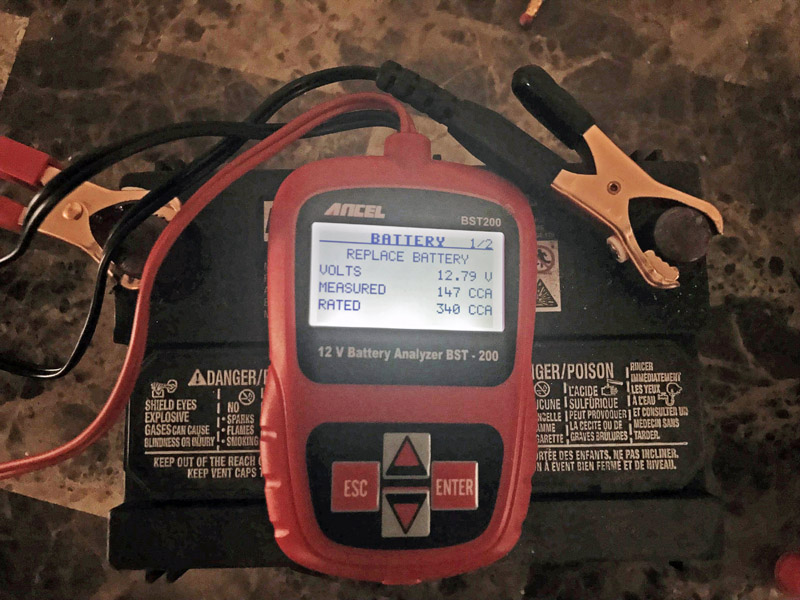
The car sat for four days in the hotel parking garage in Las Vegas, and when I came to start it for the journey home, I noticed that the starter motor sounded slow and hesitant, and needed to turn over three or four times before the engine caught. Usually, it does so on the first turn. I put this down to four days of sitting idle, with alarm sensors, etc., drawing current, and thought that the 230-mile drive home would charge it again, and all would be OK.
About five hours after getting home, I tried to start it again: it turned over once, then nothing. Then I put the meter on it and got the result above. So I jump started it, drove to Autozone, was relieved of $130, and am back on the road.
That one lasted two years and nine months. A bit surprised that it died so quickly, especially given that I do 35,000 miles a year of mainly freeway long-haul. But that is consistent with my wife's experience of Honda batteries, and the reason why I did not buy the replacement from the Honda dealership.
The alternator is putting out a steady 14.2 to 14.4 when the engine is running, so I don't think it's cooking batteries.
Posted by Steve Guttag (Member # 268) on 05-04-2018, 07:48 AM:
Note, still on the same Interstate battery in my Subaru and it just came from its 230,000 mile inspection without any mention of a need to change the battery. Still cranks decisively every time, including after sitting at the airport parking lot during CinemaCon ![[Razz]](tongue.gif)
I don't have any conclusions here other than the tire place seemed to want to sell me a battery prematurely or they had experience with Honda batteries!
Posted by Mike Blakesley (Member # 26) on 05-04-2018, 12:03 PM:
As a guy who sells a few hundred batteries a year (Carquest brand, made by Johnson Controls, same company that makes Interstate batteries), I can tell you the battery experience is all over the map. Sometimes they last 2 years...sometimes 10 years. There are just too many variables, and sometimes two batteries in the exact same conditions will last wildly different times. You just never know. It's weird.
One thing I've noticed with today's batteries in cars -- when they decide they're done, they are DONE. I remember a number of years ago I drove to work in my Ford Ranger and everything seemed fine, but that night when I went to go home, the truck wouldn't even crank at all....NOTHING. That battery was 6 years old. I guess it had a heart attack or something.
We're currently in lawn-mower-battery season, otherwise known as "well yeah, it sat outside all winter but it should still be under warranty...right?" season.
quote: Mike Blakesley
A modern car should easily be able to sit for a month or more without being started with no ill effects. We have a 2013 Escape that has occasionally sat for up to 10 days and never a problem, although we DID replace the battery in it early this summer.
My wife had knee replacement surgery last fall, and her car (the Escape mentioned above) sat in the garage for 5 weeks while she was in the hospital and recovering. I purposely didn't start it up the whole time, just as an experiment. At the end of the seige, it fired right up with no problem.
Posted by Monte L Fullmer (Member # 2797) on 05-04-2018, 03:17 PM:
If I know I'm not going to use a vehicle (we have two cars) for a while, esp while on vacation or similar, I will remove the negative cable off the battery.
Granted, on reconnect that I have to go do some driving around to get the ECU parameters back in again, but its actually good to refresh the ECU once in a while.
Posted by Carsten Kurz (Member # 5396) on 05-04-2018, 05:31 PM:
My father-in-law during his last years only took his car to drive 1mile or so into town two or three days a week. His batteries died quicker than he needed to fuel up...
- Carsten
Posted by Marcel Birgelen (Member # 6801) on 05-04-2018, 05:52 PM:
The good news is that the Lithium-Ion battery in the Toyota hasn't exploded yet and is still going strong, besides the car only being fired up about twice a week and mostly for just short trips.
We did have a few unusually cold days around here back in February (the kind of days many Teslas don't even make it to the nearest supercharger ) and even on those days the battery didn't cause troubles.
It's still hard to tell from the limited experience, but maybe those kind of batteries are the answer for cars that see very mixed use patterns and are primarily being used in temperate climates.
Posted by Scott Jentsch (Member # 1681) on 05-04-2018, 05:59 PM:
I don't drive my car much, and it will go 2-3 weeks between being used, and I used to burn through batteries every couple of years.
There would be times I would try to start it, and my radio wouldn't even have kept its memory settings. Thankfully, a manual shift car can be roll-started, even in reverse... Every time I went in for an oil change and they would check the battery, they would tell me that it was close to or needed replacing.
The shop finally convinced me to get a Battery Tender:
example: https://www.amazon.com/Battery-Tender/dp/B00068XCQU/
I haven't had to replace my battery for quite a few years now, so it's paid for itself.
I've taken to attaching it to our other vehicles in the winter every so often to top off the batteries. One car sits outside, and even though it's new, the battery drains quite a bit because of the cold and wind, and the fact that the average trip distance is less than 5 miles. It's good peace of mind to do and I figure if it saves on replacing batteries and preventing a no-start situation (usually at the worst possible situation), it's well worth it.
Posted by Mike Blakesley (Member # 26) on 05-04-2018, 07:04 PM:
We sell those battery tenders (maintainers) here but they're not too popular. I assume it's because there's no public transport here and everybody pretty much drives everywhere, so vehicles sitting for weeks are fairly rare. I probably make about a half-dozen or more 2-miles-or-less trips on a typical day.
Posted by Louis Bornwasser (Member # 3063) on 05-05-2018, 12:24 PM:
My (large) generator has a standard battery that is on a special charger that is engaged 24 hours. The service contractor (factory) changes the battery every 3 years. Here is the rationale: Battery is under $100 ($76 at Costco) and labor is more. Does this NEED to start? Simple thoughts.
On the other hand, my airplane has a very small 24 volt battery that sits all Winter and (barely) cranks over in the Spring.
Go figure
Posted by Leo Enticknap (Member # 534) on 05-07-2018, 04:28 PM:
quote: Marcel Birgelen
...maybe those kind of batteries are the answer for cars that see very mixed use patterns and are primarily being used in temperate climates.
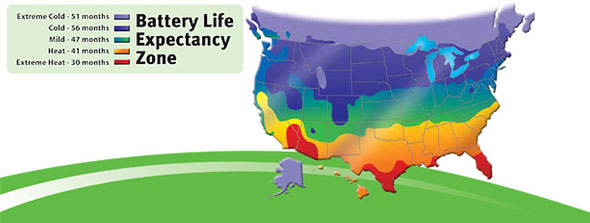
I wonder if the climate here is part of the reason why neither I nor my wife have had a battery last to warranty in recent years. Probably around 70-80% of the driving my car has done has been in ambient temperatures of 90-105 Fahrenheit (32-40 Celsius approx.), which is significantly hotter than the rest of the developed world, and so I'm guessing that the batteries are not designed for optimum performance in that sort of environment.
Posted by Mike Blakesley (Member # 26) on 05-07-2018, 06:13 PM:
Around here the temps range from -35 to +115, and I can vouch that extreme heat and extreme cold are about equally hard on batteries...the worse the weather is in either direction, the more batteries we sell.
I'd be curious how long the average battery lasts in, say, San Diego with its famously mild climate, vs. here in Montana.
Posted by Buck Wilson (Member # 5885) on 05-11-2018, 04:19 PM:
As I understand it, Hot temperatures kill batteries, cold temperatures just negatively affect the performance.
Posted by Mike Blakesley (Member # 26) on 05-11-2018, 05:45 PM:
That makes sense, although if you're heading into winter and the cold has negatively affected your battery to where it won't start your car, you pretty much need to replace it.
Does make me wonder how many "bad" batteries would have come back to life in the summer though.
Posted by Mark Gulbrandsen (Member # 72) on 05-11-2018, 07:15 PM:
quote: Mike Blakesley
We sell Johnson Controls batteries (under the Carquest brand). Batteries are definitely a "get what you pay for" item.
I have one of these batteries in my Expedition now for 5 years. I called Mike before I bought this one to find out which batteries were the best. So I went to the nearest Car Quest and bought what he reccomended and THAT battery is now going on 6 years old and doesn't have any hit of quitting on me. I will replace it with the exact same battery when this oen does fail.
Mark
Powered by Infopop Corporation
UBB.classicTM
6.3.1.2