This is topic Could 35mm ever return to mainstream cinemas? in forum Film-Yak at Film-Tech Forum ARCHIVE.
To visit this topic, use this URL:
https://ft-forum.com/ft/cgi-bin/ubb/ultimatebb.cgi?ubb=get_topic;f=8;t=007587
Posted by Cobi Fox (Member # 10476) on 05-21-2018, 08:59 AM:
This is something I've been wondering about lately. I guess one possibility could be that theaters could get tired of upgrading D-Cinema formats and having security loopholes patched, so they may choose to replace D-Cinema with 35mm due to it being a more stable format. Obviously this is unlikely, but it would be neat. What are your thoughts? Could 35mm ever return in any way?
Posted by Martin McCaffery (Member # 37) on 05-21-2018, 09:35 AM:
Not unless the studios are willing to underwrite all of the new labs that would be needed. It can continue for awhile as a boutique format, but the industry as currently configured (ie: big studios and big movie chains) are not going back, and the small theatres do not have the clout to make a dent in the current system.
Posted by James Biggins (Member # 8574) on 05-21-2018, 09:35 AM:
In a word, no.
Posted by Mitchell Dvoskin (Member # 751) on 05-21-2018, 10:25 AM:
I'll second, NO. The infrastructure no longer exists to produce large number of 35mm prints, and the movie distributors have absolutely no incentive to bring it back. D-Cinema issues are an expense for the theatre owners, not the studios.
Posted by Steve Guttag (Member # 268) on 05-21-2018, 10:58 AM:
Not a chance,
The entire infrastructure for film is gone. We are down to what, one lab in LA now and a few scattered throughout the world.
But more than that, even the means to manufacture projectors and relating support equipment is gone.
And least we forget, the vast majority of cinemas put out a pretty crappy show and mutilated film.
What is more likely is that there will be a shrinkage of the quantity of cinemas in any given marketplace to better fit the demand and to be able to be profitable supporting the current and future technologies.
Posted by Mike Blakesley (Member # 26) on 05-21-2018, 11:27 AM:
A related question is, would the exhibitors WANT to have film back. Speaking as one, I would say no. I mean, film was fun, I like film, it made a better picture (although most people wouldn't know the difference, in fact we STILL have people who don't know we've switched), the fact is digital saves so much work and is so much more versatile, I would never want to go back to film.
The one feature of film that I wish we still had is, in trailers I would often cut out the release date of movies we weren't going to play on the break....but other than that, I'm happy with digital.
From a collector standpoint, I do wish I had the means to watch all the trailers I collected over the years (about 3 1/2 6000' reels worth) but I can live without that, I guess.
Posted by Steve Guttag (Member # 268) on 05-21-2018, 11:33 AM:
Mike, one aspect that most exhibitors would like about film is its longevity (the equipment, if not the medium). That is, how often did you have to change out your film equipment? You are already on your second server, conversely.
Posted by Aaron Garman (Member # 1653) on 05-21-2018, 11:39 AM:
70mm is in a way kinda back, but not 35mm. It could still be used for smaller, boutique cinematheques but not the local Cinemark or AMC.
And even that is going to dwindle as the available prints die off due to poor handling. Does anyone know what the last 35mm print that was released by a major? Are any indie studios even printing them for exhibition? I'd imagine some may still be getting made for archival purposes.
Posted by Mike Blakesley (Member # 26) on 05-21-2018, 12:20 PM:
quote: Steve Guttag
Mike, one aspect that most exhibitors would like about film is its longevity (the equipment, if not the medium).
True, cost of ownership is much lower. I did like that aspect as well, but I knew that going in. I still wouldn't want to go back.
Posted by Scott Norwood (Member # 30) on 05-22-2018, 07:26 AM:
I love film as much as anyone, but I'm not sure that this would be a desirable outcome. For most theatres, DLP projection provided a significant upgrade in sound quality and, often, picture quality as well.
As long as the economics support negative and print film manufacturing and processing, I am perfectly fine with film being a niche format for the filmmakers who like the aesthetic and for repertory screenings. The current 70mm-mini-revival has been lots of fun and I hope that it will continue in some way for many years.
That said, film is a great acquisition and archive format and I hope that we never lose that capability.
Posted by Sean McKinnon (Member # 612) on 05-22-2018, 09:27 AM:
Unfortunately, no. The infrastructure is gone. It was a massive undertaking to provide 120 70mm machines and supplies for the hateful 8 and I couldn't imagine increasing that scale enough to re-equip commercial cinemas as a whole.
However, we do a fair amount of film projector installs in single, and twin type of multi use higher end venues, and colleges. I think film will live on in these niche locations as well as regular 70mm releases in major markets.
Posted by Monte L Fullmer (Member # 2797) on 05-22-2018, 02:47 PM:
No. Film is gone.
Cinemas have adjusted to the fact and operations of digital (even though the units are now washing machines instead of a well oiled and precision tooled machine), how it ticks and the issues that arises from these units...
And now, with laser projection and the upcoming video screen thing, it's quite apparent that this new generation of ideas and procedures have taken over.
It's their world now and not ours anymore.
Besides, in a hundred years, who is going to notice any difference?
- Monte
Posted by Cobi Fox (Member # 10476) on 05-22-2018, 03:54 PM:
quote: Mike Blakesley
True, cost of ownership is much lower. I did like that aspect as well, but I knew that going in. I still wouldn't want to go back.
Does the Roxy Theatre still have a 35mm projector? When was the last time it's been used to show a movie? Just curious.
Posted by Mike Blakesley (Member # 26) on 05-22-2018, 05:20 PM:
We kept our 35mm machine in place when we switched to digital in 2010, but it sat there for years and never showed a movie, so we took it out to make room for storage. I'm not sure what year - sometime around 2015 or '16.
Posted by Victor Liorentas (Member # 5272) on 05-22-2018, 05:36 PM:
At the Hyland Cinema in London Ontario Canada I've not only kept both 35mm machines in place but...upgraded to the best lenses and parts I can find.
When I do show film...it really rocks!
The Christie 2220 sits in the middle.
Posted by Marcel Birgelen (Member # 6801) on 05-22-2018, 05:46 PM:
Besides film labs having been dismantled, nobody is currently producing any polyester film base in the quantities required to bring it back to main stream. Maybe there is still some stock left that's still good and will bridge a gap of a few months, but it will probably take more than a few years to get back to the required output.
The industry should focus on 4K and getting the grey out of the picture in the next iteration of digital and boost the contrast in general. Then I'd say we've got everything back that we lost with 35mm, besides some grains of nostalgia.
PS: I don't really consider the lack of emulsion scratches, jitter and constant flicker a real loss, they were deficiencies mostly inherent to the format. Since many movies are still at least partially shot on film, we haven't entirely "lost" film grain yet. ![[Wink]](wink.gif)
Posted by Frank Angel (Member # 248) on 05-25-2018, 01:41 PM:
If the 35mm film format were a strong economic advantage for exhibitors, the big chains would have vigorously fought to keep it. They certainly had the power to demand that the studios keep it. As in, "We only have equipment to run film...it's bought and paid for, and if you want your picture to play on our screen, give us film prints to play in our film projectors or see how well you do having no place to show it. See how well you do selling it to TV."
Quite obviously the big chains saw an substantial economic advantage to scrapping their existing equipment and investing huge sums of money in digital; that has to tell you something; even when it was in its questionable infancy (remember the first digital projectors that quickly became fancy planters or door stops?), and some got burned with that first roll-out debacle, they still shelled out investment money. They saw the economic advantage of not paying shipping costs and eliminating projectionists, a salary was a major operational cost for them. Plus, let's face it, by the time digital was making a breakthrough, film presentation quality had hit a very low bar. Just read bad presentation thread there that goes on for miles and miles.
So if the chains who could have gone toe-to-toe with the studios if 35mm were something that was really essential to their business model, they could have insisted on it. They didn't. And they certainly won't ever again.
Posted by Marcel Birgelen (Member # 6801) on 05-25-2018, 02:59 PM:
Well, I guess most chains only started moving after the Virtual Print Fee agreements became a reality. You can pay a lot of minimum wage salaries for a multiplex worth of digital gear.
That's also how IMAX made it's way into many of those multiplexes biggest houses: By taking the big edge off the big investment needed to convert the big house into a digital "Premium" experience...
Posted by Brad Miller (Member # 2) on 05-25-2018, 06:08 PM:
quote: Marcel Birgelen
PS: I don't really consider the lack of emulsion scratches, jitter and constant flicker a real loss, they were deficiencies mostly inherent to the format.
What shitty theaters were you patronizing?
Posted by Cobi Fox (Member # 10476) on 05-25-2018, 06:19 PM:
Probably the local AMC, Brad.
Posted by Justin Hamaker (Member # 2165) on 05-25-2018, 07:26 PM:
Given all the logistical advantages for digital, I just can't see why there would ever be a demand. Every segment of the exhibition supply chain benefits in some way from digital. Especially the movie goer who receives a far more consistent quality of presentation than with film.
The only people who are advocating for the return of film are a small segment of people who believe film is a superior picture and an even smaller segment of people - almost hobbyists at this point - who enjoy the hands on work of film, including the maintaining of projectors. Aside from the longevity of machines, none of them really has a compelling economic reason why film would be a better choice.
What will be interesting to see is what happens over the next few years as the bulge of digital installations hit the 10 year mark. We'll start to get a better sense of the long run operating life of digital projectors. Knock on wood, but so far I have been relatively impressed with the reliability of digital equipment. Most issues have been the result of poorly designed parts (NEC white switches) or hard drives wearing out.
Posted by Bobby Henderson (Member # 840) on 05-25-2018, 10:45 PM:
quote: Cobi Fox
This is something I've been wondering about lately. I guess one possibility could be that theaters could get tired of upgrading D-Cinema formats and having security loopholes patched, so they may choose to replace D-Cinema with 35mm due to it being a more stable format. Obviously this is unlikely, but it would be neat. What are your thoughts? Could 35mm ever return in any way?
Just to answer the original post directly, far too much has been lost for any film-based projection to make a return to widespread use. Others have mentioned all the lost infrastructure for making film prints. The skills base for showing film prints in theaters has dwindled down to a minimal level. Lots of experienced film handlers in theaters and others throughout the print production chain have changed jobs or even passed away. I'm not sure how perishable the skills are in film handling, but it would seem that at least some practice is necessary.
If anyone thinks mainstream movie theaters were doing a terrible job with film prints 15-20 years ago they should brace themselves for the disasters that would happen now in the typical neighborhood multiplex if some movie production tried to stick hundreds of 35mm film shows into a wide release.
The situation makes me think of other things that seem to be dying. Just like film in the movie industry, neon in the sign industry is kind of trying to make a resurgence, at least in certain trendy big city night-life areas and a few other busy commercial districts. But overall, neon use in signs is dying out and I think it's a damned shame. Some of the coolest looking signs I've ever seen were seriously decked out in neon.
The number of experienced neon tube benders is dropping rapidly -a lot of these guys are getting old, retiring (or dying). The tube bender at our sign company is going to retire in a couple years. We rarely sell any new signs with neon in them anymore. The only application now for neon is signs where the neon glass is directly visible, such as open faced channel letters or border lighting that follows unusual curves or shapes. LEDs have replaced neon everywhere else. LED systems are now even replacing a lot of the high output fluorescent lamps in traditional cabinet signs. Various companies are trying to market flexible LED "rope" products to imitate exposed neon, but that stuff is cheesy as hell and it can't do tight bends and complex curves as well as neon.
These days most of our tube bender's neon work is just repair work for existing signs. People still love the look of neon. Nothing else can successfully imitate it. Unfortunately customers don't love the price of neon and its potential maintenance costs. Repair work can be frequent when you live in tornado alley where signs can be pummeled by hail. Making matters worse, some of the products for neon have dropped in quality. We've had headaches lately with neon-specific transformers and other components. They're just not made as well as they were a few years ago (even when carrying UL approved labels). Falling product quality leads to more maintenance issues and frustrated customers.
Topping it off, more and more communities are drafting very restrictive sign ordinances, some of which ban the use of neon outright. I'm seeing more and more commercial districts that look more like a residential neighborhood or school campus. The streets are lined with so many bushes and trees you can barely see the damned store you're trying to find. And if there are any street signs allowed they're about the size of a fucking tombstone, which might be apropos considering the brick and mortar retail apocalypse that has been unfolding. Can't find the store? Just go home and order what you were going to buy from Amazon!
quote: Aaron Garman
70mm is in a way kinda back, but not 35mm. It could still be used for smaller, boutique cinematheques but not the local Cinemark or AMC.
In a way 70mm is a victim of its own recent success. Some movies that want to put "70MM" on the marquee (or at least on the theater's web site or Fandango) aren't going about it the right way. For instance, shooting a movie on 5/65mm film yet post-producing it digitally at 4K resolution and then laser recording it back to a few 70mm prints is kind of insulting to people who appreciate real 70mm productions. I would have less of a problem with this crap if the posting work was done at a higher resolution level, such as 8K and at deeper color bit depths. Unfortunately the bean counters aren't going to go for rendering all those extra pixels if they're only going to show up on a few 70mm film prints and nowhere else. So, in the end, why even bother with 70mm in the first place?
quote: Marcel Birgelen
The industry should focus on 4K and getting the grey out of the picture in the next iteration of digital and boost the contrast in general. Then I'd say we've got everything back that we lost with 35mm, besides some grains of nostalgia.
D-cinema's version of 'scope still sucks ass. It's just like watching a letter-boxed movie on TV at home. Anamorphic 'scope is at least one category where a 35mm print can potentially beat a DCP. But! That's only going to happen if the movie's post production process is all film-based or has a digital intermediate specifically tailored for what a 4-perf 35mm anamorphic print can deliver. If a 35mm 'scope print is sourced from the same kind Digital TechniScope master used for the letter-boxed DCPs then any advantage the 35mm print could have had is lost.
Perhaps the 'scope format could do better IF the LED "jumbotron" style screens start taking over theaters. It's already possible to build a huge LED screen with a very wide aspect ratio. You could even configure one with a deep curve and be able to show the image with PERFECT geometry. Theaters would have to tailor their auditorium designs to these wider screens. Right now the trend just seems to be making screens taller, not wider. Movie studios would have to do their part in production and post production. Currently the studios seem fixated on making letter-boxed "scope" movies for HDTV screens at home. That latter part there worries me about the future of commercial movie theaters. Lots of younger people may still be paying to see movies in theaters. But there's no loyalty to the cinema at all. So many people have these modded Fire sticks and Kodi boxes that I wonder how the business model for cable TV in general is still hanging on, never mind the issues facing the movie industry.
Times are changing.
Posted by Justin Hamaker (Member # 2165) on 05-26-2018, 03:04 PM:
quote: Bobby Henderson
These days most of our tube bender's neon work is just repair work for existing signs. People still love the look of neon. Nothing else can successfully imitate it. Unfortunately customers don't love the price of neon and its potential maintenance costs.
My theatre still has neon, but the problem is the nearest neon shop is something like 3 hours away. Any time we need repairs or maintenance it becomes a major deal. As a result we don't usually schedule a repair until we need more than just one thing fixed.
quote: Bobby Henderson
If a 35mm 'scope print is sourced from the same kind Digital TechniScope master used for the letter-boxed DCPs then any advantage the 35mm print could have had is lost.
Wouldn't a full frame image and an anamorphic lens resolve some of the issues. At least this way the picture is receiving the full 2048x1080 worth of light.
Posted by Randy Stankey (Member # 64) on 05-27-2018, 07:17 AM:
quote: Justin Hamaker
What will be interesting to see is what happens over the next few years as the bulge of digital installations hit the 10 year mark. We'll start to get a better sense of the long run operating life of digital projectors. Knock on wood, but so far I have been relatively impressed with the reliability of digital equipment. Most issues have been the result of poorly designed parts (NEC white switches) or hard drives wearing out.
Does anybody know which workmanship level DCP equipment is built to? Which class under IPC-A-610 standards?
There are three levels or classes that are used when electronics are manufactured.
Class 1: General. Consumer goods.
Class 2: Industrial. Mission-critical.
Class 3: Military/Medical. Life-Safety. Critical.
Most equipment in theaters that I have seen and worked with appears to be Class 2. That's what I expect DCP to be, too.
However, given then expense of DCP and the cost of replacing it, I could see a justification for Class 3.
Posted by Mark Gulbrandsen (Member # 72) on 05-27-2018, 07:47 AM:
quote: Steve Guttag
But more than that, even the means to manufacture projectors and relating support equipment is gone.
Actually, that's the easy part and it does all still exist in machinery. It's just not all conveniently located in one shop except for LaVezzi.They are still able to produce sprockets and gears. As long as the plans, be they blueprints or CAD, then the CNC coordinates still exist, the projection gear could be easily brought back. Labs and film stock are the problem.
Mark
Posted by Robert Harris (Member # 1712) on 05-27-2018, 09:26 AM:
I’m not seeing it.
We ran a 2k DCP of Singin’ in the Rain last night via a 4k Christie, and the image looked like a 35 dye transfer Tech.
Only more stable, and with zero imperfections.
Screen size was 16 x 24.
Posted by Mike Blakesley (Member # 26) on 05-27-2018, 01:21 PM:
quote: Justin Hamaker
My theatre still has neon, but the problem is the nearest neon shop is something like 3 hours away.
Same here, except the sign shop is 1 1/2 hours away. I budget around $800 to $100 a year for marquee maintenance - it's just the nature of the beast. Our marquee has 54 neon tubes on it, 24 of which are inside the readerboards.
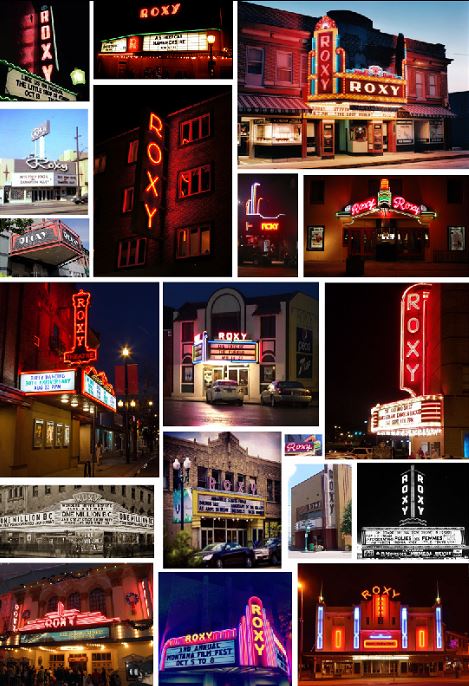
At our ticket window, we have a glass top on the counter where I like to put a different pictures from time to time -- the staff, an upcoming movie's mini-poster, etc. It occurred to me how many Roxy Theatres there are (four in Montana alone), so for fun I made up a montage of photos of many of them, with the help of my good buddy Google. Lots of wonderful neon in here. That's ours in the middle. My favorite is the one in the top right corner (which I hope to see in person someday).
Posted by Jarod Reddig (Member # 6363) on 05-27-2018, 05:42 PM:
I also like the bottom left one as well as the top right. I watched an episode the other day of How Its Made where they showed the process of making neon signage. Very cool.
Posted by Victor Liorentas (Member # 5272) on 05-27-2018, 09:47 PM:
I think the with all the 2k,4k,laser and Samsung screens in it's digital arsenal. The battle to keep film alive is completely lost long ago. Home theater is also pound for pound better than most commercial cinema IMO.
I think us film people would be happy with just a wee bit more help from the studios in keeping the art and craft of classic film projection alive at the venues trying so hard to do so.
Do we forever have to seek out collectors to lend us prints?
The war was won. Everything is digital. It's actually better quality for the common cinema goer and the studios are saving so much money. The support us little single screen film capable cinemas get is embarrassing. I say single screen because it's mostly the surviving Palaces that are trying to maintain film projection. We have a cool history,help us maintain the film part.
I wish Christopher Nolan,Paul Thomas Anderson and Quentin would push the studios to throw us a bone(prints). Not just the 70mm venues.
Posted by Bobby Henderson (Member # 840) on 05-28-2018, 03:45 PM:
As it is the film vs digital thing is pretty much a moot point now. The real trick over the next 20 years will be keeping the commercial movie theater business model viable. I'm worried about a few trends.
I previously mentioned all the mass piracy taking place (Fire sticks, kodi boxes, etc). There's a lot of people, particularly in younger age groups, that really don't care how or where they watch a movie. If there is a free option they'll take that free option even if the image and sound are crap (and they're watching it on a smart phone).
LED-based "jumbotron" screens do have a lot of potential. But I think new board designs which allow sound to pass through are a must. Cost per pixel has to drop too. One of these boards in 4K resolution would probably be even more expensive than a high end, dual projector laser setup. These LED boards have no chance of going mainstream, being installed in common neighborhood multiplex theaters, until numerous improvements and cost reductions happen.
Then there's the issue of real estate. The theatrical side of the movie industry depends on movies getting advance buzz before they open. World premiere events are really just a big marketing thing. New York City has lost most of its best premiere-class theaters. Movie theaters, night clubs and other fun places are being closed and demolished to make way for luxury condos and other boring crap like that. Los Angeles has lost a number of its better venues too. How it will play in marketing terms if a New York world premiere of a movie has to be held out at a garden variety multiplex in Paramus, New Jersey?
The sad thing is when enough pieces of which build up what we think of as the movie industry are gone many of us won't even care by that point if/when the whole movie industry goes over the brink into oblivion. So much of the movie industry is really only a TV industry anymore. Book stores, music stores and video rental stores are rapidly vanishing. Does anyone really think movie theaters are immune to the same trends?
quote: Justin Hamaker
My theatre still has neon, but the problem is the nearest neon shop is something like 3 hours away. Any time we need repairs or maintenance it becomes a major deal. As a result we don't usually schedule a repair until we need more than just one thing fixed.
As the skills base of neon workers continues to age it's going to get harder to get neon repair work done. Deferred maintenance is common unless a local shop can get the work done promptly (and not for too much money). A neon sign with bad or broken glass units (or a bad transformer) that remains un-fixed is going to be a turn-off for other business people considering buying a neon sign.
quote: Justin Hamaker
Wouldn't a full frame image and an anamorphic lens resolve some of the issues. At least this way the picture is receiving the full 2048x1080 worth of light.
I've mentioned that very thing here in other discussion threads. A d-cinema projector with a 1.25x anamorphic decompression lens could throw a significnatly higher resolution image onto the screen. For the 2K standard the usual 2048x858 letter-boxd thing that passes for 2K scope on DCPs would be ditched. The whole image sensor would be used instead. The image would be sourced from a 2560x1080 master and would be re-sampled/squeezed to fit the 2048x1080 sensor.
2560x1080 is a standard imaging format; there's lots of computer monitors available in that setting. Scaling the method to 5K/4K anamorphic could work. There are numerous d-cinema camera systems equal to or higher than a 5120 pixel width, which is what it would take to squeeze a 1.25x anamorphic image onto a 4096 pixel wide image sensor. Red's new 5K Gemini camera shoots a 5120 pixel wide image (in 2700 or 3000 pixel high image heights). Red's other DSMC2 models have 8K resolution (the Monstro has a VistaVision sized sensor).
This anamorphic approach probably won't happen any time soon, if ever. In post production it's cheaper to render, store and distribute a 2048x858 image than a larger 2560x1080 image. In movie theaters everyone seems to prefer the projector having only one single, spherical zoom lens. That translates viewers being stuck with "digital TechniScope," which is a more fancy way of saying it's TV-style letter-box 'scope.
quote: Randy Stankey
There are three levels or classes that are used when electronics are manufactured.
Class 1: General. Consumer goods.
Class 2: Industrial. Mission-critical.
Class 3: Military/Medical. Life-Safety. Critical.
How do computer chips figure in to this standard? I can understand integrated circuits, capacitors and other components like that being made to varying standards. These d-cinema projectors use quite a few different kinds of computer chips, some of which may be used in consumer level computer gear. Personal computer style components don't have dependable life spans beyond 7-10 years and those components aren't produced new for any more than 3-5 years. Any computer-based stuff that has a part fail after the 10 year life span mark can easily turn into a door stop unless a working replacement part can be found (and successfully installed).
Posted by Randy Stankey (Member # 64) on 05-28-2018, 03:56 PM:
The IPC class is important because it determines what standard of workmanship all those parts are assembled to.
If a circuit is assembled to Class 1 standard, solder joints are allowed to have 50% coverage and still pass. Chips and other components can be misaligned by up to 50% of the solder pad width. Stranded wires in connectors or solder joints may have up to 3 strands missing and still pass.
If it's Class 2 it is 25%. Solder joints may have up to 25% missing solder. Components may be 25% misaligned. Wires may have one strand missing.
Class 3 is 100% coverage/alignment.
So, yes, it's quite important to know so that we can estimate how long the equipment was designed to last.
If D-Cinema projectors are made to Class 3 standard, they'll probably last quite a long time. But, if they are Class 2, their lifetimes will be shorter.
Posted by Mitchell Dvoskin (Member # 751) on 05-28-2018, 04:21 PM:
> How it will play in marketing terms if a New York world premiere of a movie has to be held out at a garden variety multiplex in Paramus, New Jersey?
Probably would not make any difference. In fact, it might help as the AMC in Paramus has free parking, and presentation comparable or better than most of the surviving movie theatres in Manhattan, and Paramus has 70mm/5 perf capability should the distributor choose to take advantage of it.
What I am trying to say is that in this day and age, it does not matter where a "premier" is held, the "buzz" comes from the internet.
Posted by Justin Hamaker (Member # 2165) on 05-28-2018, 05:34 PM:
quote: Bobby Henderson
A neon sign with bad or broken glass units (or a bad transformer) that remains un-fixed is going to be a turn-off for other business people considering buying a neon sign.
We don't have a full neon sign. Most of what we have is just accents.
Posted by Cobi Fox (Member # 10476) on 05-28-2018, 09:45 PM:
It's funny how this thread has gone from 35mm to neon signs.
Back on topic (sort of), does anybody know if AMC still has any 35mm-equipped locations? When I went to the AMC Oakview Plaza 24 several months ago, I noticed that there was a platter installed in the booth. It couldn't have been for 70mm, because the AMC 24 was equipped only for 35mm until it finally switched to ![[dlp]](graemlins/dlp.gif) in 2014. In fact, I think they only used analog sound in film's final years (loss of SDDS support?). I don't see why platters would still be installed if there were no 35mm projectors, possibly on standby either for special events or the possible collapse of .
in 2014. In fact, I think they only used analog sound in film's final years (loss of SDDS support?). I don't see why platters would still be installed if there were no 35mm projectors, possibly on standby either for special events or the possible collapse of .
But maybe not. Perhaps AMC, being AMC, was simply too lazy to remove the platters.
Posted by Bobby Henderson (Member # 840) on 05-28-2018, 11:24 PM:
quote: Mitchell Dvoskin
Probably would not make any difference. In fact, it might help as the AMC in Paramus has free parking, and presentation comparable or better than most of the surviving movie theatres in Manhattan, and Paramus has 70mm/5 perf capability should the distributor choose to take advantage of it.
Even if a suburban multiplex theater is well equipped and has great presentation standards, how many of a movie production's stars would bother to show up for a gala out there? I think a lot of those red carpet events would just become a thing of the past if high profile theaters in major city centers disappear. As far as marketing buzz on the Internet goes it seems like there's every bit as much for TV shows as there is in movies. On the streaming services (Netflix, Hulu, Amazon Prime Video) Hollywood studio movies look like they're taking a back seat to TV shows in the user interface.
quote: Justin Hamaker
We don't have a full neon sign. Most of what we have is just accents.
LED-based lighting systems are replacing many of those, especially border lighting that runs in straight lines. We visited a Harkins Theater in the Dallas Fort Worth area this past weekend. I was kind of surprised to see this theater still had exposed neon tubes mounted on the building as border/accent lighting.
Posted by Pravin Ratnam (Member # 1417) on 05-31-2018, 08:57 AM:
It's dead as a mainstream format. Even the 70MM presentations of Django and Dunkirk weren't that awesome to watch in the local Atlanta multiplex I saw them at. With Dunkirk, I actually preferred the miniImax version of the movie to the 70MM when I walked into the nearby auditorium to compare mainly because the 70MM projection had a tad too much jitteriness. And I am one of those that used to seek out 70MM presentations in my younger days.
I like the vibrancy of good film capture, but that's not something possible anymore at a mainstream level. The only area where film can still hold some ground is archival simplicity even if it lacks the efficiency of digital storage.
Posted by Leo Enticknap (Member # 534) on 05-31-2018, 09:19 AM:
quote: Cobi Fox
When I went to the AMC Oakview Plaza 24 several months ago, I noticed that there was a platter installed in the booth.
Most of the mainstream 'plexes I serviced left a 35mm projector and platter in at least one of the screens, in case they were ever called upon to do a 35mm show in the future. None of them have ever been used since the conversion, though, and for the places we have service contracts with, those contracts don't include the 35mm equipment.
quote: Bobby Henderson
Even if a suburban multiplex theater is well equipped and has great presentation standards, how many of a movie production's stars would bother to show up for a gala out there? I think a lot of those red carpet events would just become a thing of the past if high profile theaters in major city centers disappear.
Reminds me of the opening of Cecil B. Demented, in which a gala premiere is being held in a down-at-heel main street theater in Baltimore. As the opening credits roll, the prima donna star gushes to an interviewer about how much she admires Baltimore, but as soon as the journalist has left, snarls "Get me the f*** back to LA!".
Posted by Bobby Henderson (Member # 840) on 05-31-2018, 11:44 AM:
That's about the size of it. Movie stars and other big wigs will only show up for a screening held at a lower profile venue in a lower profile town if they want to do so.
There's two notable examples involving Lawton, Oklahoma. In 1993, the movie Geronimo: An American Legend had a premiere of sorts here in Lawton at the United Artists Cache 8 theater. The screening was actually held a couple days before its official premiere in Los Angeles. The screening was organized for a few Native American groups. None of the movie's stars attended the event. There might have been a couple of crew people there. In 2013 The Lone Ranger had its premiere in Lawton (a day before its premiere in Hollywood) at the now-closed Carmike 8 theater. Unlike the Geronimo screening, some VIPs actually attended this one: Johnny Depp, Jerry Bruckheimer and director Gore Verbinski. I think what made the latter example different is the Comanche Nation made Johnny Depp an honorary member of the tribe. Depp has visited the Lawton area a few times since then either to attend events like the Comanche Nation Fair held each September or just to hang out.
Posted by Louis Bornwasser (Member # 3063) on 06-06-2018, 11:10 AM:
Bobby: D Cinema has always had a 10 year design cycle. This number comes from TI. Given the smallish (not millions) market 100% replacement is marginal for the factory to sustain itself. Remember that we (users) never see the first 2 years or so; the vapor-wear phase. The next 1-2 years is the order/delivery phase so 6-8 years on a good day. If you get more than that, then the factories will suffer and leave the market. (I'm looking at YOU, SONY.)
Posted by Monte L Fullmer (Member # 2797) on 06-06-2018, 06:59 PM:
Course, as with Carbon Arc, came Xenon, now Laser....and eventually large Video Screens to eliminate projected images totally.
Like with regular seating: out they came with wider seat gauging for the rockers slightly reducing seat count.
Now, we have recliners that are taking up space to convert big houses that had tons of seats, to big houses with 35% seat reduction.
Yet, with the reduction of seat count, yet offering more fancier seats, attendance is actually increasing per day.
Payroll can be reduced if justified with less seat count.
Thus, the old saying, "less is more" hold true.
Industry is preparing for changes due to generations, where what we know, the new generation doesn't need to know.
-Monte
Posted by Mike Blakesley (Member # 26) on 06-06-2018, 07:20 PM:
quote: Bobby Henderson
Movie stars and other big wigs will only show up for a screening held at a lower profile venue in a lower profile town if they want to do so.
When the Prince movie "Under the Cherry Moon" was coming out, there was a contest to have the premiere in your hometown, with Prince in attendance. The winner was from Sheridan, Wyoming, which has a population of about 8000. I believe it was the first time a movie ever played on the break in Sheridan, which had just one single-screen theater at the time.
I thought sure Prince would weasel out of being there, but he was there. I'm sure he had a delightful time. ![[Roll Eyes]](rolleyes.gif)
Posted by Bobby Henderson (Member # 840) on 06-06-2018, 08:55 PM:
There's not all that much in Sheridan, but it's not far away from some nice, mountainous scenery. But, yeah, if I had to guess Prince probably flew in and out of town via the county airport pretty fast.
![[Big Grin]](biggrin.gif)
A few of my relatives live farther east off I-90 in Gillette. The terrain is a lot flatter there. But they're just an hour's drive from the Close Encounters mountain.
Posted by Marcel Birgelen (Member # 6801) on 06-11-2018, 03:22 PM:
quote: Brad Miller
What shitty theaters were you patronizing?
Only the very best obviously.
But before we get all nostalgic, what was the average quality of the AMC around the corner in the height of 35mm distribution? Besides on opening day, before they ran their print through the grinder, the quality was acceptable, maybe... But beyond that, I'm sure the average digital presentation looks better now.
quote: Louis Bornwasser
Bobby: D Cinema has always had a 10 year design cycle. This number comes from TI. Given the smallish (not millions) market 100% replacement is marginal for the factory to sustain itself. Remember that we (users) never see the first 2 years or so; the vapor-wear phase. The next 1-2 years is the order/delivery phase so 6-8 years on a good day. If you get more than that, then the factories will suffer and leave the market. (I'm looking at YOU, SONY.)
I'm not too afraid of companies leaving this sector. It could actually open it up further. Besides copy protection, there really isn't much what is preventing us from using the gear everybody else does.
There will always be projectors, the development of massive LED screens will continue. With proper knowledge, there is no reason why a big venue projector could not be used for cinema presentations for example.
quote: Monte L Fullmer
Like with regular seating: out they came with wider seat gauging for the rockers slightly reducing seat count.
Now, we have recliners that are taking up space to convert big houses that had tons of seats, to big houses with 35% seat reduction.
Yet, with the reduction of seat count, yet offering more fancier seats, attendance is actually increasing per day.
Payroll can be reduced if justified with less seat count.
The movie exhibition business has always seen change. The single biggest constant has been 35mm film, but there always have been improvements. Not everything sticked around for long but many changes didn't go unnoticed.
As long as the movie industry keeps on improving and as long as it keeps delivering experiences better than you can have at home, it will continue to exist. I have my doubt about recliners, but more comfortable seating is most definitely something that has to be expected. Nobody will accept a hard, wooden seat anymore.
As for image and sound, there are still many mountains to climb there, before we reach the absolute maximum attainable, so there is still room for an almost endless number of iterations of new and improved technology there.
Posted by Jack Ondracek (Member # 1466) on 06-11-2018, 06:51 PM:
quote: Marcel Birgelen
before we get all nostalgic, what was the average quality of the AMC around the corner in the height of 35mm distribution?
Our local (GCC turned) AMC was the only union house in our county. They also had the only Cinemeccanica projectors in the area. As far as I know, projection quality was never an issue there.
The rest of us were running variants of XLs, Brenkerts and Ballentyne VIPs. The Brenkerts and XLs did a pretty decent job (mostly). There's nothing to say about the VIPs that hasn't already been expressed here with vivid color.
Posted by Pravin Ratnam (Member # 1417) on 06-14-2018, 09:58 PM:
What seems underutilized is the flexibility of digital showings in the bigger screens. I wanted to see Avengers on a big sscreen and because of Deadpool 2 , it was already showong on the secondary screen by the third week. With 35MM, I understand it would not be as easy to swap screenings, But with digital, how tough would it have been to still show Avengers a couple of Liemax showings a week during off peak times and this way, extend the time people can enjoy a blockbuster on a big screen?
Posted by Frank Angel (Member # 248) on 06-17-2018, 10:37 AM:
Many distributor contracts require an engagement to play in a specific size house for a full day's run and with the number of days/weeks specified. And aren't the KDM's tired to a specific media block/projector? It might not be as easy as its was in the film era just to move a 35mm print from one platter to another (or even reroute and thread it into another projector). But even with 35mm, there was still a requirement to play a title in a specific size house. Then when you get to splitting a screen between two titles, ESPECIALLY when they are from different studios, e.g., like playing a children's title in the day, then playing an R title for the evening shows -- that is just begging for headache-making negotiations that most exhibitors don't want to deal with unless they see a real profit advantage for then. Moving titles around just to accommodate customers' preferences probably isn't a strong incentive.
Posted by Pravin Ratnam (Member # 1417) on 06-17-2018, 06:31 PM:
I have seen RPX and IMAX showings in Regal be split among a couple of titles in the past on a couple of occasions. At least, from what I remember. I could be wrong, I guess.
It would be a shame if they didnt rotate more movies into the big screen showings at least in the off peak hours.
Posted by Leo Enticknap (Member # 534) on 06-19-2018, 10:02 PM:
quote: Frank Angel
And aren't the KDM's tired to a specific media block/projector?
Yes, but I have never encountered a situation in which an exhibitor wants to move a show between screens, and the distributor refuses to issue another KDM, or even queries the request.
I've been to probably around a dozen breakdown calls in the last year, in which the fault couldn't be fixed that day, so the manager wanted to shuffle shows around screens to enable the movie that was to have played in the screen that was down to play in one of the surviving houses. In every case, all it took was a call to Deluxe Technicolor, and the new KDMs arrived within minutes. Likewise, when I've been replacing a media block, I have never known there to be any pushback or queries in response to a "Please issue Screen 3 KDMs for H0005476, and delete 532651 from your records" type request.
Presumably the distributors trust the theater staff to make the right decisions in situations like this, and the DRM aspect of the process is simply to ensure that they know what is happening.
Posted by Marcel Birgelen (Member # 6801) on 07-06-2018, 04:18 PM:
The DRM aspect of it is to avoid extreme high quality copies leaking directly to the Internet. Up until now that's pretty much holding tight, I haven't heard from a movie leaked via a broken DCP yet.
That's also why some of those artificial time constrains, that don't even allow for proper QC screenings are so bonkers...
Posted by Justin Hamaker (Member # 2165) on 07-06-2018, 06:52 PM:
quote: Frank Angel
Many distributor contracts require an engagement to play in a specific size house for a full day's run and with the number of days/weeks specified.
So far the only studio we've encountered this restriction with is Disney for the Star Wars movies (not including Solo).
The reality is digital has greatly increased our flexibility in scheduling. We frequently alternate long movies and short movies between two (or more) auditoriums in order to get better show times. Now we can get 4 shows a day from a movie where we would have only been able to have 3 with film (or have less than desirable show times).
We easily play a kids movie in the big house during the day then swap it with the adult title at night (doing it this week with Incredibles 2 and The First Purge). Or move things around to meet demand. As long as you have the content loaded onto multiple servers, it's just a few mouse clicks to move a show from one auditorium to another. And this can be done while the show is playing, so you don't have to worry about the last minute rush to move prints.
One of the new opportunities which has opened up with digital is "download" screens. Essentially this gives us the ability to have multiple screens of a movie without the hassle of a second (or third) print. When doing these downloads it is easy to have an extra show of several movies, especially in weeks where there just aren't enough movies people want to see.
And of course all of this comes with zero risk of losing shows because a print got dropped or screwed up while moving from one house to another.
Posted by Brad Miller (Member # 2) on 07-06-2018, 08:31 PM:
Bah. We did ALL of that via platter array and delayed interlock setups.
Posted by Steve Guttag (Member # 268) on 07-06-2018, 11:42 PM:
We did all of that with reel-to-reel cinemas. Starting a show in one screen and then after the first changeover moving it to the next screen. Heck some even went between theatre locations (aka bicycling).
Posted by Sam D. Chavez (Member # 1841) on 07-07-2018, 01:45 PM:
Sharing prints one or two reels at a time was always a thrill. Anxiety was the order of the day. Traffic, car accidents, etc. I recall one instance of just five minutes to go when the reel arrived. Five minutes is adequate time but not when your nerves are shot from not knowing exactly when it will arrive.
Posted by Scott Norwood (Member # 30) on 07-07-2018, 02:40 PM:
Brad still needs to make an interlock video involving multiple theatres, perhaps with film running along telephone poles or some such.
Posted by Brad Miller (Member # 2) on 07-07-2018, 06:15 PM:
I wanted to. Apparently in California somewhere there was an AMC 30 and a Regal 24 joined by a parking lot. It would've been stupid fun.
Posted by Jim Cassedy (Member # 4115) on 07-08-2018, 02:36 PM:
quote: Sam D. Chavez
Sharing prints one or two reels at a time was always a thrill.
OMG Sam, I recall doing this a couple of times in the 1970's.
Once, when I was running the Streisand version of "A Star Is
Born" (1976) I was at a sold-out first run theater, & a couple
of reels of the print they sent us had serious lab issues.
(both picture & sound)
For opening night & part of the first weekend, I was sharing
a print with another theater. We had staggered our starting
times, & added a cartoon to give me some 'buffer time' but
one night I had them hand me the 'incoming' reel right as
my 'reel end alarm' went off, meaning I had appx 60-80sec
or less before the change-over. I'd already struck the carbon
arc when I heard the kid coming up the stairs, & got the film
threaded just as the motor cue hit the screen. It was close!
(I actually had messenger-guy watching for the cue mark
in case I missed it while threading)
Remember, kids, back then, there were no cell phones, so there
was no way to tell where the guy with the film was once he left
the other theater until he arrived at mine.
Afterwards I found out that the guy said he was hungry and
"got stuck behind somebody with a big order" at a Burger King
drive-through.
I don't know which irked me more- - the fact that he had stopped
on the way, or that he didn't at least bring me anything to eat.
>and yes, management made sure there was a "no stopping" rule
between theaters for the remaining trips!
Posted by Jack Ondracek (Member # 1466) on 07-08-2018, 04:44 PM:
quote: Justin Hamaker
We easily play a kids movie in the big house during the day then swap it with the adult title at night (doing it this week with Incredibles 2 and The First Purge). Or move things around to meet demand. As long as you have the content loaded onto multiple servers, it's just a few mouse clicks to move a show from one auditorium to another. And this can be done while the show is playing, so you don't have to worry about the last minute rush to move prints.
We have enough storage to hold around 10 features plus all the trailers we'd ever need and still keep the drives below 50%. After we ingest a feature (or trailer), we copy them over to the other servers. When keys arrive, all features have them for all 3 machines we have here. That way, should we want, or need to move things around, it's as easy as moving a playlist... 30 seconds, tops.
We doubled our storage last year, but from day one, the keys have always arrived for all the machines in our booth.
Can't everybody do this, more or less?
Posted by Frank Angel (Member # 248) on 07-11-2018, 05:03 AM:
quote:
management made sure there was a "no stopping" rule
between theaters for the remaining trips!
Our boss did better than that -- he just gave the company car, a souped up Mustang to a high school kid who fancied himself as Mario Andretti, told him he had a hug responsibility on his shoulders as our reel runner, to get the reels to us as fast as possible. He had to bring reels from our larger downtown theatre (I think was The Palace) in Bryan TX to our smaller theater in College Station TX, appropriately named The Campus Theatre, a block away from A&M campus. That kid broke every speed limit between the two towns and to his credit, was never late, until.... One night he ran past a state trouper; that night I didn't get R3 in time.
I was in a panic. It became obvious I was not going to get R3 in time. Do I stop the show and wait? Now I know I am going to get flamed for this move, but hear me out -- I decided to just make the changeover to R4. It looked PERFECT on the screen and to my surprise, it didn't even hint at bad continuity. Then 10 minutes into R4, here comes R3. Now I knew this picture inside and out -- I had already been playing it for two weeks. If you know BLOWUP, Antonioni tells the story in non-linear style, back and forth in time. I realized I could make the changeover to R3 when there was a scene in the park -- R3 starts with that same scene, different time. I wait for an appropriate moment and make the changeover from where we are in R4 to R3, it plays. Then at the end of R3, I change back to where we were in the last 10 min of R4, it finished and now changeover to R5 and we are back on track. Believe it or not, the film made just as much sense with 10 minutes out of sequence as it did when it played correctly -- the audience just had to think about it a little harder. Thing is, on the screen it looked like nothing at all was wrong; audience just chalked it up to, "Well, this is what crazy avant garde movies are like. Damn foreigners." In my defense, I was 19yrs old.
For two weeks we bicycled that print on the weekdays.
Posted by Jim Cassedy (Member # 4115) on 08-22-2018, 10:06 AM:
Oddly enough- - In the last month, I've had two SF theater owners ask me
what it would take to "put 35mm back in" to at least one auditorium at
each location.
One even asked about 70mm but I told him that in his situation it would
be totally impractical, from both a technical & financial standpoint, and
that I wouldn't discuss 70mm further, unless he was willing to put in a
2 projector change-over system, which would be even more impractical
for him, but hey- - - if you're going to do it, why not do it right? ![[Cool]](cool.gif)
Posted by Rick Raskin (Member # 1561) on 08-22-2018, 03:33 PM:
Good for you!
Posted by Timothy Eiler (Member # 383) on 08-22-2018, 03:35 PM:
quote: Steve Guttag
We did all of that with reel-to-reel cinemas.
I was working a a twin with both screens reel to reel. And Orc model 1000 lamphouse. One went down so i had to shuffle the lamp house around to keep booth screen going.
Posted by Dave Macaulay (Member # 813) on 08-23-2018, 06:40 AM:
"aren't the KDM's tired to a specific media block/projector"
I believe locking a KDM to a projector is possible but that has not been used - yet.
The info sheet from Technicolor for KDMs asks what projector model you have, the software version it's using, and capability (2K/4K, cinelink, etc). They certainly need the server model and serial number, but ask nothing about the projector serials.
So you could swap servers between screens if you really want to play around with whatever restrictions a distributor gave you.
Not so easy with integrated servers or IMB servers though.
Posted by Marcel Birgelen (Member # 6801) on 08-23-2018, 08:26 AM:
I wonder what happens when you put your Alchemy IMS into a NEC projector.
Posted by Lyle Romer (Member # 1266) on 08-23-2018, 10:50 AM:
quote: Bobby Henderson
That's about the size of it. Movie stars and other big wigs will only show up for a screening held at a lower profile venue in a lower profile town if they want to do so.
I'm just reading this thread for the first time. Just wanted to add that when I worked at the GCC Mission Bay Plaza in Boca Raton, FL back in high school, we had two "movie stars" visit. Jim Belushi showed up to secretly watch Curly Sue from the back to see the audience reaction and Judge Reinhold watched part of Baby on Board secretly as well. For the staff that interacted with them, I was told Belushi was really nice and Reinhold "not so much." I was actually working on both occasions but wasn't in the lobby when they came in and I didn't want to bother them just to say I met such hugely important people!
Posted by Cobi Fox (Member # 10476) on 08-23-2018, 08:59 PM:
quote: Jim Cassedy
Oddly enough- - In the last month, I've had two SF theater owners ask me
what it would take to "put 35mm back in" to at least one auditorium at
each location.
I'm guessing they're art houses/repertoire theaters? Those seem to have the biggest demand for 35mm equipment.
Or has hell frozen over, and they're multiplexes that want to re-install 35mm?
Posted by Leo Enticknap (Member # 534) on 08-23-2018, 09:23 PM:
quote: Dave Macaulay
I believe locking a KDM to a projector is possible but that has not been used - yet.
Sorry to drag this OT, but a few months ago we received instructions from NEC to the effect that whenever we install a projector, update its firmware, or swap out any of cards in the card cage, we should use the read cert tool to download a projector cert, and then send it to NEC. I presume this is to ensure that their records are up to date, and that they can issue correct public key certificates, in the event that KDMs do start to be locked to a specific ICP and media block combo. I'm not aware of any similar instructions having been issued by any of the other projector manufacturers, though.
Posted by Brent Francis (Member # 5008) on 08-24-2018, 02:08 PM:
"we STILL have people who don't know we've switched"
...sigh...
Saw an old Hollywood studio feature on the weekend. Looked like it was run off a DVD, but people were raving about the picture on the way out.
Posted by Martin McCaffery (Member # 37) on 08-24-2018, 02:47 PM:
When we were mostly film, many people assumed we were DVD. Now we get DCP's clearly made from a DVD/Bluray source, and people still can't tell the difference. I suspect that, even with all of their home movie theatres, the viewing public is overwhelmingly indifferent the the medium and could not tell the difference without you pointing it out.
We have a festival tomorrow in which one if the films is a DVD of a video probably made from a television print. Betting no one says a word. It will just "look like an old movie" to the public.
Posted by Justin Hamaker (Member # 2165) on 08-24-2018, 04:36 PM:
quote: Martin McCaffery
I suspect that, even with all of their home movie theatres, the viewing public is overwhelmingly indifferent the the medium and could not tell the difference without you pointing it out.
This has always been my contention. As long as you have a good quality image on the screen, the average person wouldn't know the difference between 4k and 2k digital or film. Even if they did know they likely wouln't care.
Posted by Martin McCaffery (Member # 37) on 08-24-2018, 08:54 PM:
Which leads to the conclusion they come for the experience, not the technology.
Posted by Steve Guttag (Member # 268) on 08-25-2018, 11:34 AM:
There are limits to everything. The trick is finding those limits. How small can you make the image? How far can you roll back the sound (mono?) How accurate do the colors need to be or the illumination level? How good do the acoustics have to be? How good do the chairs have to be? How about the carpet? Duct tape okay for repairs?
At what point do you NOTICE you are losing business and not just blame the product or other forms of entertainment?
Part of the "experience" IS the technology and the manner in which it is presented. Some things are more obvious than others (BIG screen). Some are less so (7.1 versus 5.1 audio, depends on the movie a bit too).
However, I think cinemas have made the experience too pedestrian to the point that the average consumer is only equating the cinema experience as the first opportunity to see the movie. They'll get the same or better experience at home.
I think we took a major step away from the presentation side when we stopped using curtains and making a movie a show. It changed the entire experience from one of a professional show to a pedestrian one. The screen became something to put things on instead of that magical piece of equipment that turned into a window. Now we don't even mask the image, leaving dead screen...just like at home. Our sound systems rarely challenge the home version. The home quality bar has risen there. If you put in 4K now, you are merely keeping up with the home technology. There is no marquee value there.
I think for cinemas to survive, they really need to look at the cinema experience from top-to-bottom from the moment someone decides that they want to go out to the moment they return home and see how they can make the cinema a good choice worth repeating.
Posted by Justin Hamaker (Member # 2165) on 08-25-2018, 01:34 PM:
quote: Steve Guttag
I think for cinemas to survive, they really need to look at the cinema experience from top-to-bottom from the moment someone decides that they want to go out to the moment they return home and see how they can make the cinema a good choice worth repeating.
I think this is what's happening in many theatres with things like large format screens, luxury seating, and more. I agree with you about losing the masking, but that seems like such a small piece of the equation compared to the rest of the experience. Of course this is subjective.
However, price is one of the main complaints about going to the movies, and all of these "upgrades" cost money and drive-up ticket prices. I'm not sure where the proper balance is.
My location is 22 years old and the primary upgrades we need is new seats. We don't really receive many comments about the experience beyond the seats. We are also talking about a large format screen. I'm not fully convinced this is a good idea. When we do have a large format title, I'm not sure customers will go for the higher prices and not having an option for a regular option.
Posted by Steve Guttag (Member # 268) on 08-25-2018, 04:31 PM:
It isn't a small price. People are staring at that screen for the longest time they are in the business...and THAT is the place people compromise on. Masking doesn't cost that much and it finishes the presentation (once the curtain parts).
People ALWAYS complain about price...always have. Even in the 80s they did (or whenever you started). The fact remains, a movie ticket costs a minimum wage worker just under 2-hours work...which has been true for as long as I've been in the business.
The digital technology, for cinemas, is a huge cost for zero increase in ticket sales and it keeps wanting to be fed. We replaced $10K projectors with $35K, by and large and replaced 50-year items with 15 year items. And now Samsung would like you to spend $500K+ on a movie screen that compromises sound.
So you put in a PLF theatre...what is premium about it? It is the SAME movie that is in the other theatres. Quite often, the SAME resolution. Is it just the bigger screen (and I'm not discounting the bigger screen). In the film days, a big theatre used to mean that it ran something like 70mm that had inherent advantages to the alternative.
Now, if the PLF theatres had 8K/16K images (and movies shot for them), then I could see what the whoopdedo is about.
Is it the sound? Atmos is scalable down to a 20'x20' room. There is nothing inherently PLF about Atmos...in fact, I'm putting it into my home theatre (and again, consumers can too though in a more reduced fashion).
I do think a big screen can bring a certain factor in, particularly if it is W I D E though DCPs are anti-wide. They made Scope the little format .
Posted by Cobi Fox (Member # 10476) on 11-04-2018, 12:45 PM:
Sort of off-topic (though more on-topic than neon signs were), but I was at the local AMC, and I believe I saw a platter in the port window. There also appeared to be two projector consoles side by side. Was it common for multiplexes to keep at least one 35mm system installed after conversion to D-Cinema? This location went digital in 2014, and no 70mm was installed at a later date for the 70mm revival. So it has to be one of the original 35mm systems. Does anybody know why they would've kept it?
Posted by Mike Spaeth (Member # 524) on 11-04-2018, 02:35 PM:
Yeah. If you have extra space in the booth it's cheaper than removal and disposal.
Posted by Steve Guttag (Member # 268) on 11-04-2018, 05:37 PM:
"Abandon in-place" was VERY common. Why pay to remove it? Nobody is going to be in the booth anyway. Many of our customers set up one system in the lobby as a display. If their platter had aluminum decks, we recommended that they remove them and head to a recycle center. All-aluminum would fetch some good money during the years of DCP conversion and a platter deck is low-hanging fruit (easy to remove and many are all aluminum). Conversely, a projector head is never cost effective to strip the bits and pieces out to get it to all aluminum (Simplex or Century)...you'll get about $5 for the head as mix-metal and maybe $10 for all aluminum but it will take you more than an hour to get it to that point.
Even the rectifiers, we tried various ways to get them down to copper, iron and steel...there was never a cost effective way (we band sawed the windings off...you name it). With consoles...almost all were just abandoned in the booth. Who wants to get hurt or pay someone to throw away "junk?"
Powered by Infopop Corporation
UBB.classicTM
6.3.1.2