This is topic Smoke In The Screening Room in forum Film-Yak at Film-Tech Forum ARCHIVE.
To visit this topic, use this URL:
https://ft-forum.com/ft/cgi-bin/ubb/ultimatebb.cgi?ubb=get_topic;f=8;t=007617
Posted by Jim Cassedy (Member # 4115) on 11-15-2018, 05:02 PM:
Smoke from the huge wildfires burning up north of San Francisco has
reached The City, even though the blaze is several hundred miles away.
- - but for the past few days, there's been the smell of burning wood in
the air, accompanied by an overall smokey haze everywhere.
Air quality has been very bad, & a lot of people are wearing face masks.
It's taken a couple of days, but the bad air has finally found its' way
into one of the screening rooms I work at.
That's not lens flare or dust under the downlights, it's smoke.

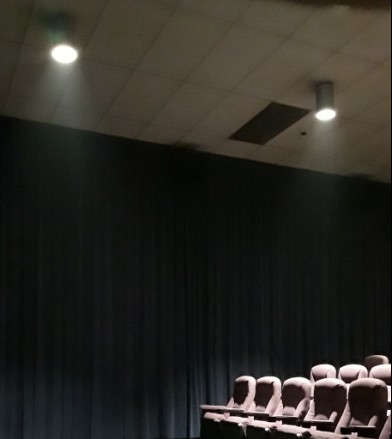
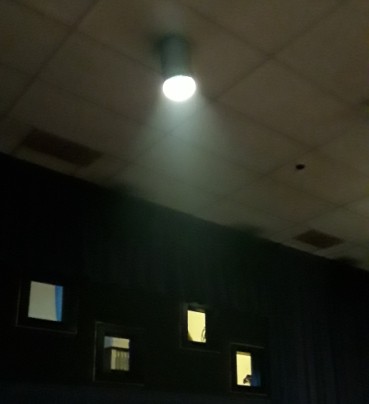
We first started noticing this last night, and it's worse today.
I've got a police/fire radio & at times the smoke has been thick
enough to set off smoke detectors in some buildings, especially
those detectors located in air ducts & elevator shafts.
Posted by Frank Cox (Member # 6258) on 11-15-2018, 05:49 PM:
Smoke can travel amazing distances. Sometimes everything around here gets covered with a smoky haze and the whole area smells like a campground. Usually it's due to forest fires in northern Saskatchewan but sometimes it's due to forest fires in British Columbia, and that's almost a thousand miles from here
Posted by James Wyrembelski (Member # 9037) on 11-15-2018, 09:15 PM:
I spend a lot of time in the upper peninsula here in Michigan. Specifically the western side in Ontonagon which is about as west as you can go. The last two years we've had terrific sunsets over lake Superior due to fires in the western states. There's a constant daily haze cast over the whole sky....all from smoke.
Posted by Marcel Birgelen (Member # 6801) on 11-16-2018, 03:45 AM:
I'm wondering how long it will take to get rid of it once the situation gets back to normal...
You don't really want your screening room to smell like a BBQ smokehouse.
Posted by Leo Enticknap (Member # 534) on 11-17-2018, 02:24 PM:
quote: James Wyrembelski
I spend a lot of time in the upper peninsula here in Michigan.
I was in Petoskey for a week in September, and the air smelled like it did in downtown LA. Even though I was in the middle of pretty countryside, the air seemed like downtown urban metro air. There was no huge freeway or factory nearby to explain it. I thought at the time that I must be in the path of air currents that are blowing fumes from an industrial area, but didn't realize that they came all the way from the west coast without dispersing.
In contrast, I did a job in Santa Monica during the worst day of the Malibu fire: the air was completely clear, and I couldn't see or smell anything amiss. The wind must have been blowing the other way.
Posted by Mark Gulbrandsen (Member # 72) on 11-17-2018, 03:15 PM:
https://www.cnn.com/2018/11/16/health/san-francisco-wildfires-air-quality-worst-in-world/index.html
Schools, colleges and public transit have closed as smoke from the Camp Fire descends on the region.
"It appears to be the worst air quality ever experienced in San Francisco," said Dan Jaffe, a professor of environmental chemistry at the University of Washington. He called the situation "an air quality emergency," and experts said the smoke could undo decades of progress on pollution.
"We have made tremendous efforts and investment to clean up our air with considerable benefits for public health," said Dr. Daniel Jacob, a professor of atmospheric chemistry and environmental engineering at Harvard University. "But now it's like we're getting stabbed in the back with those wildfires."
Some call cancellations 'too little, too late'
San Francisco's transit agency has taken its cable cars off the streets, several schools have canceled classes, and the National Park service suspended tours to Alcatraz Island.
Public schools in San Francisco and Alameda County were closed Friday, along with UC Davis and UC Merced. UC Berkeley also canceled Friday's classes, but some students criticized the university's decision to stay open Thursday as smoke descended on the campus.
The school's student association wrote a letter to their chancellor denouncing the "administration's insufficient response to these public health risks" and urging administrators to allocate emergency funds for masks and mobile air filtration units.
"Campus buildings are not equipped to filter out the pollutants making the air indoors just as harmful as it is outside," the group wrote. Some students, even those without pre-existing conditions, said they felt sick.
"I had a bloody throat, bloody nose, a cough, dry and watering eyes, and my throat is still very sore and dry," freshman Sabrina Thorn said. "I almost passed out trying to go to class yesterday. My professor told me to go home."
Students struggle to find respirators
Thorn's sorority sister gave her a mask, but freshman Samantha Greene said that other students have struggled to find them. That's because the university's health service is not distributing them to all students -- just those with medical conditions like asthma.
"There are over 40,000 students at the university," spokesman Dan Mogulof said, "and we just don't have access to masks of that number."
Some students, though, still think the school needs to be doing more.
Students at the University of California, Berkeley wait for respirators distributed by a student-led organization Thursday.
Students at the University of California, Berkeley wait for respirators distributed by a student-led organization Thursday.
"I have many friends who have been coughing up blood and [were] forced to seek emergency medical help because of the air and Berkeley's unwillingness to act," Greene said.
The student association itself decided to hand out masks Thursday, she said, leading to large crowds as people "desperately [tried] to get respirators from [the] student-run club, which ran out in the first five minutes and turned into a mob scene."
In stores near Berkeley, masks also quickly sold out, Greene said, leading to "an absurd sort of competition between students to get one." Students lucky enough to get the masks, she said, were trying to sell them at "absurd prices."
In a message to students announcing Friday's cancellation, the school's chancellor, Carol Christ, said Thursday that Berkeley had "a limited supply of appropriate 'N-95' respirators available for those students with medical conditions that may make them particularly susceptible to the impact of degraded air quality."
Greene called that "too little too late" and said masks are still difficult to come by. The university told students that "even these relatively advanced masks provide limited protection and are not a substitute for staying indoors."
Jaffe, however, said that "the masks definitely help" if worn properly and are "better than nothing," although staying in a building with filtered air offers the best protection.
The university, for its part, says it's doing the best it can. "Our students, like our staff, our faculty and our neighbors, are without a doubt being impacted by one of the greatest natural disasters in California's history," Mogulof said. "The university just does not have the ability to completely mitigate the impacts of this wildfire."
Particulate matter is the "number one environmental killer in the world," Jacob said, and "the levels that are present in those areas affected by wildfires are like you might expect on a very polluted day in China or India."
Smoke from fires releases particles small enough to make their way through our nose and into our lungs, Jaffe added, and "young children and the elderly have the greatest risks for immediate health concerns."
PM can aggravate asthma, decrease lung function and increase the risk of cardiovascular events such as stroke, according to a study published last year in the Lancet. And because children with developing airways breathe more air per pound of body weight than adults, they can experience more severe symptoms.
"We give people advice to say indoors and to reduce exercise and things like that," Jaffe said, "but those don't mitigate the problem too much." That's especially true in San Francisco, where many don't have air conditioning.
Posted by Jim Cassedy (Member # 4115) on 11-18-2018, 10:19 AM:
quote: James Wyrembelski
we've had terrific sunsets over lake Superior due to fires in the western states.
This was taken abt 4pm on Thurs
from the roof of my apartment.
Normally you'd also be able to see
the ocean at the bottom of the picture,
but not last week!
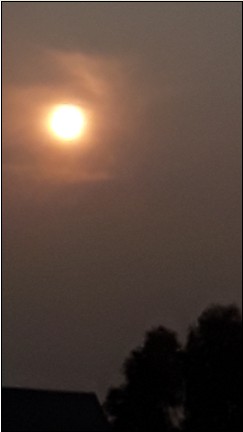
(And this is SMOKE, not fog- -
I've lived in SF long enough
to know fog when I see it! LoL)
quote: Marcel Birgelen
You don't really want your screening room to smell like a BBQ smokehouse.
What??? I don't smell anything.....

Mark's article was pretty informative and pretty much sums up the bad
air quality situation here in San Francisco. (and it give s whole new
meaning to the phrase "I'm going outside for a smoke!" )
Many businesses were closed on Friday, & a lot of schools and
universities started their Thanksgiving holiday recess early.
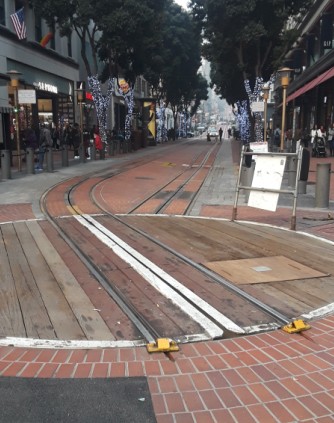
They've even shut down the cable car system! This
is the famous end-of-the line cable car turnaround
at Powell Street, and as you can see, there isn't a
cable car (or any tourists!) in sight.
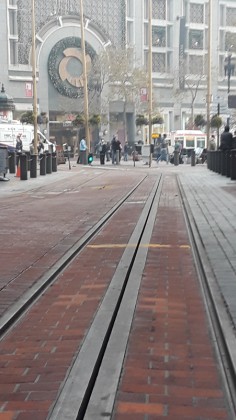
Of course, all of this is just a minor inconvenience
here, compared to the hundreds of people who lost
everything, or even their lives, in the fires. ![[Frown]](frown.gif)
Posted by Leo Enticknap (Member # 534) on 11-18-2018, 11:52 AM:
My sister in law drove down from Redding (to Loma Linda) yesterday, and reported that she was driving through a haze until around the 5/130 junction.
Posted by Bobby Henderson (Member # 840) on 11-18-2018, 04:53 PM:
quote: cnn news article
The school's student association wrote a letter to their chancellor denouncing the "administration's insufficient response to these public health risks" and urging administrators to allocate emergency funds for masks and mobile air filtration units. "Campus buildings are not equipped to filter out the pollutants making the air indoors just as harmful as it is outside," the group wrote. Some students, even those without pre-existing conditions, said they felt sick. "I had a bloody throat, bloody nose, a cough, dry and watering eyes, and my throat is still very sore and dry," freshman Sabrina Thorn said. "I almost passed out trying to go to class yesterday. My professor told me to go home."
That sounds pretty rough. But at the same time the Bay Area has millions of other people, some of whom are far less fortunate than students attending an elite (and expensive to attend) university in a community whose living costs are among the highest in the nation (if not the world). What about those people? Anyone getting breathing masks or air filtration systems for them?
What about the thousands of newly homeless people stuck much closer to the Camp Fire? They're living in tents or their cars situated in Walmart parking lots or any other place that might allow them to take temporary refuge. Those people aren't nearly as well off as students at Berkeley. They've lost just about everything they own in the fires and to top it off the rampant, price-gouging douche-baggery across California has made it just about impossible for these victims to find affordable housing elsewhere in the state.
I don't know. IIRC Berkeley is a public university at least partially funded by taxpayer dollars. The tone of the article made it sound like the student association expected the university to either already have a stockpile of breathing masks and other stuff on hand for a disaster of this scale or go out buy a bunch of it instantly like magic. Possibly with taxpayer dollars. The article made the students sound a bit entitled and overlooked other people more vulnerable to bad air quality than college students.
quote: cnn news article
In stores near Berkeley, masks also quickly sold out, Greene said, leading to "an absurd sort of competition between students to get one." Students lucky enough to get the masks, she said, were trying to sell them at "absurd prices."
Like I said, rampant douche-baggery.
Maybe the students can order some masks off Amazon and have Jeff Bezos deliver them in a swarm of drones.
Posted by Leo Enticknap (Member # 534) on 11-18-2018, 08:38 PM:
Agreed with Bobby. It reminds me of an incident when I was a teenager growing up in London. During one brutally cold winter, the commuter railroad system serving the London suburbs pretty much ground to a halt, resulting in howls of protest from the train drivers' union, passengers representatives, and anyone else who wanted to jump on the gravy train (pun irresistible), calling for the public execution of everyone involved in managing the rail system.
In a now infamous press conference, the chief exec went on the TV blaming "the wrong kind of snow" for the chaos. Sweden and Norway have this sort of weather all the time and they don't let it bugger up the trains, screamed the press, so why is London incapable of dealing with it?
The reason, of course, is that because Sweden and Norway have snow all the time, they spent bazillions on the infrastructure needed to make their railways snowproof. If British Rail had spent those bazillions, they would have got a very poor return on the investment, because the infrastructure would only have been needed for a few days every twenty years or so.
The same applies here - attacking UC Berkeley for not being prepared to protect their students from the effects of a smog that only happens once or twice a century is unrealistic.
Posted by Martin McCaffery (Member # 37) on 11-18-2018, 09:43 PM:
Visit the south during a "snowstorm".
Anything more than a dusting and we're shut down for days.
Posted by Marcel Birgelen (Member # 6801) on 11-19-2018, 03:55 AM:
It's seemingly part of human nature to complain about everything and people seemingly expect that all eventualities, how minor their chance of happening, are accounted for.
I still remember a quite a few years back, when the Icelandic volcano named Eyjafjallajökull (try to pronounce that one) erupted and essentially grounded all air traffic in large parts of Europe. Given on just how many people nowadays rely on cheap flights, this caused a major havoc. On the other hand, it helped me to convince people that you can perfectly do meetings using "modern" tools like video conferencing.
All kinds of stupid people made the news back then, including those who demanded airlines and aircraft manufacturers to invest in planes, capable of flying though volcanic ash clouds...
quote:
They've even shut down the cable car system!
What's the reasoning behind this? The lack of tourists? The health of the cable car drivers?
I'm actually always wondering, if there any locals that rely on the system or if it's really just a tourist attraction those days.
quote: Bobby Henderson
They've lost just about everything they own in the fires and to top it off the rampant, price-gouging douche-baggery across California has made it just about impossible for these victims to find affordable housing elsewhere in the state.
Since it hit American people on American soil, I guess you should be able to motivate a bit of national fundraising and get people and businesses to show a bit of euhm.... nationalism?
I still remember the last time the Netherlands was hit by a big flooding incident more than 20 years ago, where multiple rivers carried record high waters and lead to the flooding and destruction of many homes in the South-East. The national fundraising action collected almost as much money as the total insurance claims afterwards.
People that did not get compensated by their insurance, got most of their damage refunded using the national emergency fund, combined with the money raised. Although obviously people still lost a lot, including a lot of stuff that cannot just be compensated with money, nobody ended up being homeless. People that lost their homes and couldn't stay elsewhere weren't put into camps or tents, but in hotels, holiday resorts or temporary housing. Now, having somewhat of a Dutch background (I'm just living there ![[Smile]](smile.gif) ), I'm not proud of what we achieved, a lot of stuff could've even have done better. But at the least, we didn't let those people just sit in their own shit, we did what you can expect from civilized people.
), I'm not proud of what we achieved, a lot of stuff could've even have done better. But at the least, we didn't let those people just sit in their own shit, we did what you can expect from civilized people.
Without getting borderline political, I still don't understand how a rich country and a rich state like California can let this happen. Why do those people need to stay in temporary encampments so close to the fires? There are plenty of hotels or other decent places they could stay. Those hotels could help a hand by not milking the situation and you'd expect either the National government or California to have an emergency fund to pay for it?
Posted by Carl Martin (Member # 1146) on 11-19-2018, 04:22 AM:
quote:
quote:They've even shut down the cable car system!
What's the reasoning behind this? The lack of tourists? The health of the cable car drivers?
I'm actually always wondering, if there any locals that rely on the system or if it's really just a tourist attraction those days.
it's priced for tourists for sure, and locals rely on it about as much as venetians rely on gondolas.
my ladyfriend and i did take a cable car once a few years ago as it happened to take us exactly from where we were to where we were going, and it was romantic and all, but no, it's not part of the regular commute.
and as for the air quality around here, i'm over it! i remarked to a smoker friend of mine that he must love it as it's like smoking all the time. apparently it's not.
Posted by Leo Enticknap (Member # 534) on 11-19-2018, 07:55 AM:
quote: Marcel Birgelen
I still remember a quite a few years back, when the Icelandic volcano named Eyjafjallajökull (try to pronounce that one)...
I was in California when that happened (but had not actually emigrated there by that point), and due to fly back to what was then home (north-east England) two days later. I remember whiling away a morning in limbo listening to Rush Limbaugh attempting to pronounce it: "Eyf.... Eyf...... oh, darn it, I can never do these foreign names. It sounds like I f*** a golf ball!"
I eventually got back across the Atlantic on the day transatlantic flights restarted. I almost had an A330 to myself from Portland (OR) to Amsterdam. I've never been on such an empty plane: they upgraded everyone, because there were only about 10 passengers. Permission to start flying again happened so quickly that almost no-one waiting to travel was able to get to the airport and through security in time. Delta wanted the plane in Europe ASAP, in order to start getting stranded Americans home.
The fun started in Amsterdam, though - KLM's short haul network was still paralyzed, so I was given the choice of waiting at least three more days, or finding my own way back. That consisted of a 20-hour boat ride from Amsterdam to Newcastle, in the company of a very rough North Sea and about 200 drunk Geordies returning from a weekend that appeared to have been spent acquiring the mother of all hangovers.
But yes, that is a classic illustration of how, occasionally, things happen that hit the limits of what you can plan to mitigate, and when it does, you just have to make the best of it that you can. I understand that this incident resulted in a lot of knowledge being developed as to what the safe levels of volcanic ash in the atmosphere for different engine types at different altitudes are, and that if the same thing were to happen tomorrow, the disruption would be a lot less severe as a result.
quote: Marcel Birgelen
Without getting borderline political, I still don't understand how a rich country and a rich state like California can let this happen. Why do those people need to stay in temporary encampments so close to the fires?
A lot of people don't want to leave the area, because although their homes are gone, they still have their jobs, and need to keep them. The same thing happened with the other big fires in the last couple of years.
And while there is hotel capacity, it is finite. The hotel industry does not try to keep a lot of empty room capacity available year-round, for obvious reasons.
quote: Marcel Birgelen
...and you'd expect either the National government or California to have an emergency fund to pay for it?
It's difficult to explore that one without getting political, not least because a political dispute already exists as to what the relative responsibilities of the state and federal governments are in this case, and why.
One issue that really will need to be looked at, though, is that of insurance. Already, it is effectively nonexistent for earthquakes. My wife and I got a quote when we moved into our current home: $2,200 a year for earthquake coverage, with a $20k deductible for any claims. A quick look online revealed that 99.8% of insurance claims for earthquake damage are below $20k. So the overwhelming odds are that our insurance would be no insurance at all. Statistically, I am three times more likely to drop dead from a heart attack tomorrow than our home is to sustain more than $20k of damage in an earthquake.
California has lots of earthquakes, almost none of which are the sort that has Charlton Heston prowling through apocalyptic ruins, clutching his .44 Magnum in one hand and a glamorous blonde in the other afterwards. Most result in a few dozen properties sustaining damage in the high four to low five figures. A Charlton Heston-scale earthquake is about the only thing that one of these policies would be any use for.
I can see the same thing happening for wildfire insurance, too. Insurers will simply walk away from covering it, or charge so much that almost no-one can afford it, and the few who can will conclude that it is a lousy deal. I've read reports that property prices in Paradise were way below the average for that region. It was well known that the place was a fire trap and it was widely feared that eventually, what has happened would happen. I wouldn't be surprised, therefore, if we later discover that a significant proportion of the damaged and destroyed homes were not insured for wildfire damage.
Things could get to the point at which either there has to be a taxpayer-funded and (at least partially) state run program for fire insurance, or the higher risk rural areas are going to depopulate.
Posted by Bobby Henderson (Member # 840) on 11-19-2018, 02:26 PM:
quote: Marcel Birgelen
Since it hit American people on American soil, I guess you should be able to motivate a bit of national fundraising and get people and businesses to show a bit of euhm.... nationalism?
This country has a lot of what I call fake patriotism frequently put on display, often by fair weather patriots. It doesn't cost any time, work or money to wave a flag or say things like, "I support the troops!" The gestures might make people feel good, but in the end it's just lip service. When it comes to actually offering one's time, elbow grease or money a bunch of those fair weather patriots disappear.
Disaster victims also have to be the right kind of people to attract any real help. People in different regions of the United States often don't like each other. There is a lot of resentment traded back and forth between people in coastal states versus those in "flyover country." The same back and forth resentment exists between California residents and people outside the state.
quote: Marcel Birgelen
Without getting borderline political, I still don't understand how a rich country and a rich state like California can let this happen. Why do those people need to stay in temporary encampments so close to the fires?
Some of these people are hoping to re-build their homes and businesses. Some have an emotional attachment to the place and don't want to leave. If you look at the town of Paradise in Google Street View it looked like a pretty nice mountain town. A bunch of Paradise residents are just stuck and can't go elsewhere. It was not a high income location. Many of the town's residents were retired. It costs money to drive somewhere else. If a fire victim was going to hit the road he would still need to have a specific, practical destination in mind. Expecting to start over in the nearest cities is a no-go since it's too damned expensive.
That gets back to the question, "how can a rich country and a rich state like California let this happen?" I assume that is a rhetorical question. After all isn't it obvious?
Lots of people in this nation are willing to do all sorts of unethical things to make money. One of the games is artificially running up the cost of housing in major cities in very absurd ways. Some hedge fund buys a rent-controlled apartment building or housing project tower to convert it into luxury condominiums. They use means both legal and illegal to kick out the old folks and riff raff to make room for high income tenants. Gentrification can make a neighborhood look really nice, but it comes at a cost. The homeless population has exploded in cities like Los Angeles, New York and even the Bay Area. I think it's absurd that New York City now has a homeless working class, people who work full time yet live in shelters or on the street. One would think at some point this obviously unsustainable real estate bubble would burst. The bubble is being helped out by the influx of younger adults leaving behind smaller towns, which are dealing with their own structural problems: aging/declining tax base, under-funded public schools, fewer good jobs, lower wages and (putting it bluntly) fewer good opportunities to find a spouse or just to get laid.
To go along with fake patriotism, we have a very strong winners versus losers ethic in American culture. Right now the burned out residents of Paradise are getting plenty of "thoughts and prayers" while the news coverage lasts. Months or years later these residents are still going to be recovering (or trying to recover) from this disaster. The rest of the country will have long since moved on.
Anyway, quite a few of the people affected by the fire are stuck in a very difficult position. It may be years before Paradise, CA can recover substantially enough to function as a town. Can those residents wait that long? Or will they be forced to move somewhere else, possibly somewhere hundreds or thousands of miles away?
quote: Leo Enticknap
I can see the same thing happening for wildfire insurance, too. Insurers will simply walk away from covering it, or charge so much that almost no-one can afford it, and the few who can will conclude that it is a lousy deal. I've read reports that property prices in Paradise were way below the average for that region. It was well known that the place was a fire trap and it was widely feared that eventually, what has happened would happen. I wouldn't be surprised, therefore, if we later discover that a significant proportion of the damaged and destroyed homes were not insured for wildfire damage.
The same thing has played itself out over and over again with flood insurance. When a hurricane hits the coast or there's a major inland flood from a river over-flowing its banks there's always a lot of homes destroyed that are not covered by flood insurance. Such coverage is pretty expensive. Sometimes residents won't know they bought a new home in a potential flood zone until after the disaster hits. They didn't know they needed the insurance until they had to have it. There's a bunch of people in Houston who fell in that camp when Hurricane Harvey hit last year, unleashing catastrophic flooding. Too much money was changing hands in these housing developments to worry about details.
We just have to remember insurance companies are businesses. They're in it to make a profit. Providing coverage is a secondary concern. It doesn't matter what type of insurance it is either, even health insurance. There's money to be made in making premiums very expensive and denying claims.
Posted by Mike Blakesley (Member # 26) on 11-19-2018, 04:00 PM:
A lot of the "why doesn't somebody DO something?" lies in the cost of doing things. Lots of people will contribute to a cause, but when something like this comes along there's not much you can do rapidly because the cost is so astronomical.
Even if every man, woman and child in the rest of the country gave a $10 bill to the California victims right now, that still would only amount to about $3 billion, not nearly enough to rebuild what was/is being lost in just this one disaster. And there are plenty of other disasters to go around, not just this one.
Plus, those fire victims don't necessarily need money -- they need helpers, and they need a place to stay. Most people can't just drop everything and go offer to lend a hand, because most people have jobs or other obligations, or they're just too far away. That's why the responsibility for helping disaster victims falls mostly on the government. And there again... limited money, limited people, limited resources. Just because we are a "rich country" doesn't mean we have unlimited everything.
I get a little tired of the new "thing" of criticizing people who offer their thoughts and prayers in situations like this. Maybe that's all they can afford, or have the means, to offer.
Posted by Leo Enticknap (Member # 534) on 11-20-2018, 12:00 AM:
My guess as to why some people have a short fuse with "thoughts and prayers" is due to the suspicion that the phrase is being used out of political correctness rather than sincerity, or as a way to avoid answering uncomfortable questions related to the incident that gave rise to them. A recent example that sticks in my mind is when a San Bernardino Police Department spokeswoman was on TV in the aftermath of an horrific pile-up on the 215, which left three dead and a dozen seriously injured. When it was pointed out to her that the two individuals who were illegally road racing who caused it had multiple driving-related felony convictions, and she was asked why they were behind the wheel rather than behind bars, her respone was along the lines of now is not the time, thoughts and prayers for the victims, etc. etc.
Posted by Marcel Birgelen (Member # 6801) on 11-20-2018, 07:49 AM:
quote: Leo Enticknap
Things could get to the point at which either there has to be a taxpayer-funded and (at least partially) state run program for fire insurance, or the higher risk rural areas are going to depopulate.
Like Bobby already put it. Insurance companies are almost always for profit organizations. Although they often cover each other in bigger funds that cross the industry, in the end, they need to make a profit. So, if the amount of fire related disasters increases and they still want to be able to cover those cases, their rates have to go up.
There is no simple solution though. I think what happened in the Netherlands, after the flooding events I’ve mentioned, is probably a more reasonable solution, but it’s never an one-fits-all solution.
First off all, they started to encourage people moving away from some very flood-prone regions or simply start to live with the potential consequences. They also stopped new developments in those regions.
Then they started to improve the infrastructure, like implementing huge overflow areas and increasing the strength of protection in vulnerable high-density areas like potentially affected cities. It was a plan that already took multiple decades, is still not entirely finished and billions to implement, but in the meantime it employs a lot of people and you get a lot of new technology and insights in return. And since we very much see that the climate is changing all around us, which has a big impact on not just sea levels but also the water flow of rivers, the nice thing is, it’s a never ending process, so there’s always lot of work to be done. It’s like restoring that big medieval cathedral. Once you finished restoring the back, you can start all over again at the front.
I guess the approach in California could be potentially the same. In case of Paradise, CA, it’s probably not smart to just rebuild the town like it was. You need to learn from what went wrong here, how you can avoid it in the future and if it is unavoidable, then maybe it simply isn’t a good idea to reconstruct it on the same spot.
Lessons learned here can also be used to avoid it happening elsewhere and thus also reducing potential insurance exposure. In the end, that’s the only way to keep the system healthy, without having government foot the bill.
Potential technical solutions could be developed and implemented, at least it should be an avenue worth exploring. This is where government could have its role as a “high risk, but potential high returns” investor. For the Netherlands, it worked pretty well during the years. They’re exporting their water control knowledge and affiliated industries like giant-scale dredging solutions all over the world. California, with all of its big tech, could maybe become the prime exporter of wild- and forest fire control technology in the world...
quote: Bobby Henderson
That gets back to the question, "how can a rich country and a rich state like California let this happen?" I assume that is a rhetorical question. After all isn't it obvious?
Well, it is obviously a somewhat rhetorical question. Let me say that I know a bunch of people over in the U.S., I work closely with many of them, I’ve been there countless of times, have worked there for a couple of years in several intervals. I think I know a bit about U.S. culture, which in general is more competitive than European culture.
But, from the outside, it looks pretty bad to be honest. Not the fact that those fires happened, but the simple fact that such a disaster is now also being used as a political football, instead of focusing on the people that are most in need.
Real patriotism shows itself when it’s needed the most and it traverses political and racial differences. I suspect it’s still in there, somewhere, but the last decade and a half, it almost seems like it was replaced by a foul mixture of greed, egoism, “I-Don't-Care-ism” and despair, as the middle class was almost slowly entirely eradicated. It’s not something that’s exclusive to the U.S., it’s merely fulfilling its function as a forerunner, it’s almost like a pandemic steadily taking over the world.
quote:
A lot of the "w]3hy doesn't somebody DO something?" lies in the cost of doing things. Lots of people will contribute to a cause, but when something like this comes along there's not much you can do rapidly because the cost is so astronomical.
I think no matter what political opinion you do have (unless it’s to the utter extreme of whatever side…), but I think this is where Government should start to step in big. In case of disasters, it should be the party with the backbone to help those who are hit hard and can’t help themselves back up. Yes, it will cost us all some money, but everybody could find him/herself in a similar situation someday. It has nothing to do with socialism or communism, it’s just what makes us human.
quote: Mike Blakesley
Even if every man, woman and child in the rest of the country gave a $10 bill to the California victims right now, that still would only amount to about $3 billion, not nearly enough to rebuild what was/is being lost in just this one disaster. And there are plenty of other disasters to go around, not just this one.
There’s a lot that can be done, with $3 billion, especially if it would be immediately available, the spending would be properly supervised and people would largely refrain from abusing the situation. It will not be sufficient to rebuild everything that’s lost, but it should be sufficient to bring some immediate relief.
quote: Mike Blakesley
Plus, those fire victims don't necessarily need money -- they need helpers, and they need a place to stay. Most people can't just drop everything and go offer to lend a hand, because most people have jobs or other obligations, or they're just too far away. That's why the responsibility for helping disaster victims falls mostly on the government. And there again... limited money, limited people, limited resources. Just because we are a "rich country" doesn't mean we have unlimited everything.
In the end, it all boils down to money, don’t you think? Money is the thing that can most easily be converted into helping hands, much more than “thoughts and prayers”. Depending on how you look at it, it may be unfortunate, but that’s how it works in a capitalist system. You cannot simply leave your business behind and help to rebuild some essential infrastructure in some hard hit region out of pure generosity, but if somebody would pay you a fair price for this, and you happen to be in construction, why not?
I’ve worked for a big global network operator for a time. I remember that every time a disaster like a big storm hit a region, we were working overtime trying to get communications back up in the region. It’s not like we really had the time to do it, but heck, those people often didn’t have any means of communications, often even no emergency services. So you simply worked day and night to make sure those people could at least contact emergency services, or tell their relatives they were fine. If you got paid for the massive amount of hours you logged, was an issue for later...
Posted by Bobby Henderson (Member # 840) on 11-20-2018, 01:28 PM:
quote: Leo Enticknap
My guess as to why some people have a short fuse with "thoughts and prayers" is due to the suspicion that the phrase is being used out of political correctness rather than sincerity, or as a way to avoid answering uncomfortable questions related to the incident that gave rise to them.
The best example I've seen was personified by Susan Orfanos, the mother of Telemachus Orfanos. He survived the Oct 2017 mass shooting in Las Vegas yet was one of 12 people murdered earlier this month at the Borderline night club in Thousand Oaks. On camera she was furious and had every right to be considering the circumstances. To her the thoughts and prayers thing translated to, "we feel bad for you but are not going to do anything about the problem."
quote: Marcel Birgelen
Like Bobby already put it. Insurance companies are almost always for profit organizations. Although they often cover each other in bigger funds that cross the industry, in the end, they need to make a profit. So, if the amount of fire related disasters increases and they still want to be able to cover those cases, their rates have to go up.
Unfortunately the rates of premiums for things like flood insurance rise well above the what most people can afford. So you end up with a lot of people with insufficient coverage or no coverage at all.
The aftermath of Hurricane Harvey is still playing out in the Greater Houston area. The homes of tens of thousands of people were completely destroyed in the floods and many thousands of other homes suffered serious damage. Some spots near Houston got upwards of 60" of torrential rain. Between 300,000 and 500,000 vehicles were destroyed by Harvey's floods in the Houston area. Around 20% of those vehicles were uninsured. Some of the homes destroyed in the Houston area were in housing developments that were allowed to be built despite flooding risks. Developers make their money. Municipalities get their boost of property tax revenue (and property tax runs high in Texas since there is no state income tax). At least some of the home buyers were unaware of flooding risks. In the end a major Hurricane has left tens of thousands of people in one part of the country with a struggle that may take many years to overcome. Meanwhile for the rest of America that disaster has long since disappeared from the rear view mirror.
Meteorologists and other scientists warn a great deal of prime coastal real estate in Florida is prone to flooding from major hurricanes or long term climate change. Yet the mantra is build baby build. They're only living for the moment down there, future risks be damned.
quote: Marcel Birgelen
Real patriotism shows itself when it’s needed the most and it traverses political and racial differences. I suspect it’s still in there, somewhere, but the last decade and a half, it almost seems like it was replaced by a foul mixture of greed, egoism, “I-Don't-Care-ism” and despair, as the middle class was almost slowly entirely eradicated. It’s not something that’s exclusive to the U.S., it’s merely fulfilling its function as a forerunner, it’s almost like a pandemic steadily taking over the world.
There are still some people who are willing to show up and do physical work to help people in need. But it seems like those numbers are dropping. I've participated in a local AMBUCS charitable civic club chapter for over 20 years. Our club had nearly 100 members in the 1990's; now we have about 30. Membership in civic clubs is in decline nation wide. The median age of these clubs is skewing older and older. We're not attracting younger adults very much. One of the things our club does is build wheel chair access ramps at homes of people with disabilities. Many of these people can't get out of their own houses or apartments and down the steps without someone helping them, literally carrying them in some cases. Some have been stuck indoors for years. It's likely some of the retired people living in Paradise, CA were in that predicament when the fire came raging to town. It's rewarding to see the kind of difference something as simple as a ramp can make in a person's life.
quote: Marcel Birgelen
I think no matter what political opinion you do have (unless it’s to the utter extreme of whatever side…), but I think this is where Government should start to step in big. In case of disasters, it should be the party with the backbone to help those who are hit hard and can’t help themselves back up. Yes, it will cost us all some money, but everybody could find him/herself in a similar situation someday. It has nothing to do with socialism or communism, it’s just what makes us human.
The problem is there is a number of systemic issues that have been allowed to go un-checked, all in the vain of making lots of money. Housing and real estate is one of those things. Much of California and many other high population zones around the United States were already in the midst of an affordable housing crisis before these forest fires hit.
Far too much of new housing supply is geared to high income customers. I live in what's considered a pretty low cost of living small city and the problem is the same even here. Nobody is building new houses for people in middle and lower income classes. It's all 4000+ square foot McMansions. I don't know how they intend to sell that property. There's not that many rich people living around here. Even apartments cost a lot to rent unless you want to live in "the 'hood." So now the local market is really slow and the city is shedding residents. The negative effect was amplified when Fort Sill recently chose to build hundreds of new housing units on Post. But that was direct reaction to price gouging and other unethical treatment of military families for housing off-post. Local developers cried foul about all the new housing units on Post, but the Army pretty said "tough shit" in response. And rightfully so.
Hell, the cost of day care for one child here in my town is at least several hundred dollars a month. It's scary to think what day care costs out in California. Let's not forget about our nation's insane health care costs. A bunch of the survivors of the fires in California were put in the hospital. So not only are a bunch of these people homeless, they're also going to be buried under a mountain of medical bills.
Posted by Mike Blakesley (Member # 26) on 11-20-2018, 07:02 PM:
quote: Bobby Henderson
"we feel bad for you but are not going to do anything about the problem."
I think it's more like, "we feel bad for you but we have no idea how to fix the problem."
Powered by Infopop Corporation
UBB.classicTM
6.3.1.2